Archive for the ‘Uncategorized’ Category

Power of One: End of an Error

Friday, August 3rd, 2012

At least, I Hope so. Adam M. Smith has been sacked from both his jobs, from the look of things, for his poor judgment in harassing a Chick-Fil-A server at the drive-thru, and then videotaping his own harassment and posting it on YouTube.

That embed, again:

In defense of this wart in the colon of humanity, what I think he was trying to do, was this:

This mash-up was uploaded back in ’07, but I know the experiment was going on since before that, as is evidenced by this 2005 comment on the Straight Dope message board:

In principle I agree perfectly that even the less overt forms of racism and xenophobia should be discouraged, but these ads are just so damned smug, righteous and annoying! It’s got so I always change the channel when one comes on. Does anybody else have the same reaction?

I have that reaction, and more:

This whole thing was a dumb, stupid, just plain bad idea.

Put on these “public service announcements” encouraging us — total strangers — to monitor the behavior of our friends, relatives, and other total strangers who simply consume oxygen from the same air space…looking for signs of perceived bigotry, then to act as judge, jury and snotty-lecturer.

The trouble begins with the whole “silence is consent” thing, which is plainly the point of all these ads. Silence is consent, since the whole point is to get the scolding out there…the power of one voice, and all that. If silence is consent, then awarding the benefit of the doubt, must also be consent. So presume the worst. If you look for that prejudiced behavior and you haven’t managed to find it, you must not be looking hard enough.

Again, with my litmus test: Can society continue to operate indefinitely this way? And we’ve found out, first-hand, the answer is no. Adam M. Smith practiced what the videos said people should be practicing. He did everything right. Sure, you can pick a quibble with the fact that it’s the CEO of Chick Fil A who made the comments he doesn’t like, and he took it out on a drive-thru server…which is something of a disconnect…but hey, how can you let that get in the way of the Power of One Voice??

When your cause is glorious, you’re obliged to win. All of the time.

Nifty, cool experiment. I’m sure it was inspiring when it was first thought up. And its ultimate effects are certainly a surprise…at least, maybe, to some of us, not to others of us.

But it isn’t an experiment anymore, we see where it leads. Time to declare the experiment over, m’kay? Go back to being non-judgmental and liberty-minded, as opposed to simply talking about it while scolding strangers.

And the “Freedom Center” owes the country an apology.

Four Things

Thursday, August 2nd, 2012

From my previous

To make liberal ideas look sensible…it becomes necessary to make meaningfully similar things look like they’re different, and meaningfully different things look like they’re identical.

I had no idea, at the time, that blogger friend Rick would be linking to this…nor do I have a good idea of how to excerpt from it…

In light of the Chick-Fil-A controversy, I now realize modern man is almost incapable of distinguishing between these four things:

1. Approval and Implicit Condemnation. Just because you support one thing doesn’t mean you’re viciously antagonistic toward another (i.e. “anti-” the opposite.) If Dan Cathy supports traditional marriage between one man and one woman, that doesn’t mean he ipso facto “hates gay people” or is “anti-gay.”

2. Disagreeing and Hating. I disagree with ideas all the time. This does not necessitate hating the person who proposed them. Your beliefs are not your identity.

3. Beliefs and People. This is somewhat similar to #2. Rejecting a belief does not equal rejecting a person. You can reject the validity of same-sex marriage on philosophical and social grounds while still profoundly loving people with same-sex attraction. I reject at least some opinions or actions from each of my friends (such as “double-rainbows are boring” or “playing the lottery is wise.”) They in turn reject plenty of my own. But we don’t hate each other. In fact, just the opposite is true. Our relationship is grounded on a communion of persons, not a symmetry of beliefs.

4. Bigotry and Disagreement. The definition of bigot is “one unwilling to tolerate opinions different than his own”—not “someone who disagrees with me.” Toleration doesn’t require agreement, merely recognition and respect. (Ironically, those quickest to accuse people of bigotry are often bigoted about their flawed definition of “bigot.”)

The solution to these failures is not more dialogue. It’s better philosophy, logic, and reason. Unfortunately, until two people are capable of making these distinctions, healthy, productive dialogue about same-sex marriage is almost impossible.

Now that is good. Very, very good.

Memo For File CLXV

Thursday, August 2nd, 2012

Somewhere, I made the comment “Looks like we have our campaign year issue” or something like that. The “We” was the country, not the conservatives or the Republicans or libertarians; and the “issue” is the idiotic remark made by our current President, “If you’ve got a business, you didn’t build that, somebody else made that happen.” In the wake of the Chick-Fil-A hoop-dee-doo, I’ve thought back to this thing I said with the understanding that it is going to require some updating. We have two issues. They have it in common, as consequences, that they arouse great passion in people because they speak directly to the inner psyche — how each individual has developed his comprehension of the world around him, and his methodology of figuring out what to do about whatever it is he’s noticed lately.

I say “as consequences” because, on one side of each issue, the passion is a cause as well as a consequence; on the other side, the passion is a consequence only, it is logic and reason that have detonated it. Liberals came up with a goofy idea and said “We’re just sure this is going to work out super-awesomely,” conservatives took a look at it, saw what would happen, and said “Can’t believe they’re really serious about this.” That seems to be a consistent configuration.

Before these two, there was the Buffett Rule imbroglio. That, too, aroused great passion for the same reason.

So we have three things:

One: I think, if you’ve built a business, the credit for building it needs to go to the government and “roads and bridges,” versus, that’s horse squeeze it’s the guy who built the business who gets credit for building his business.

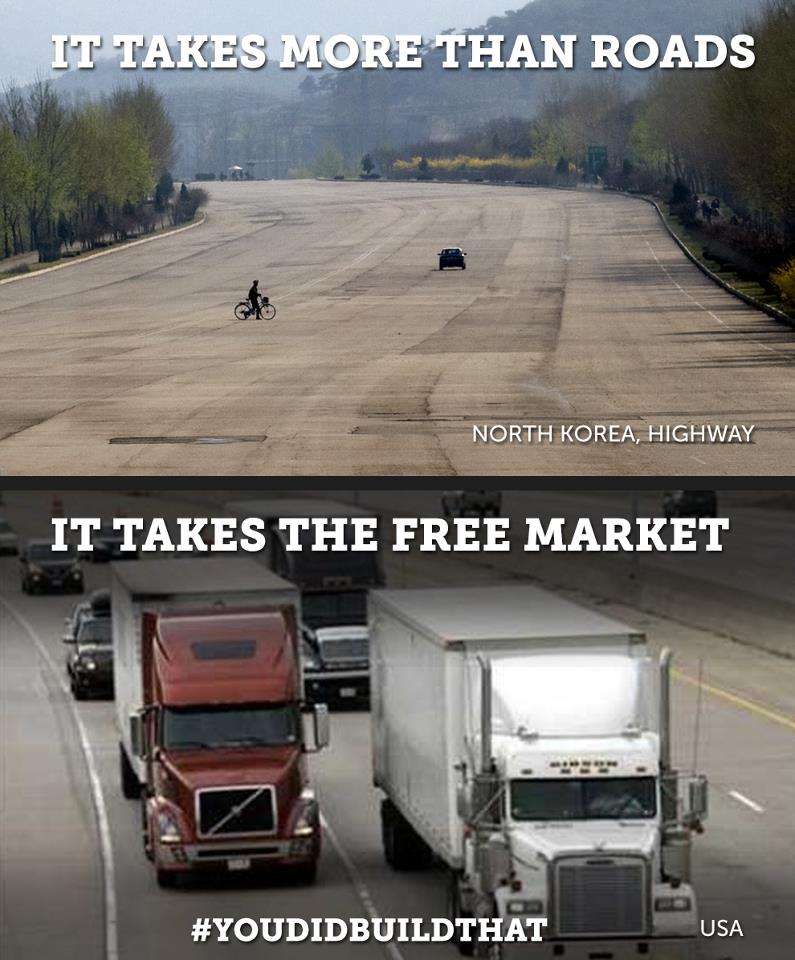
It Takes More Than RoadsTwo: I think, once the business is built, it might be incompatible with the sensible values of a community so we need to elect some really smart and enlightened mayors and councilmen to tell the business to go stuff itself…versus…uh, if the community doesn’t like the business, it can not shop there, and boy will that business ever end up sorry. Mayors and councilmen should stick to staying within budget and making sure the traffic lights work.
Three: I think, if someone is really rich then he needs to give back to the community and pay his fair share through higher taxes…versus…taxes exist to fund vital services, not to make sure everyone ends up with roughly the same amount of money at the end of it, if these guys want to pay more they can just write a friggin’ check.

It is hard to read my summations and come away with much sympathy for the progressive viewpoint. The progressives, I’m sure, will point out all sorts of reasons for this. The most meritorious will be: I can’t provide sympathy for the progressive viewpoint that I do not have, and I have little to none. They will also say, with far less merit, that I am somehow misstating the left-wing position, missing some subtle but very important nugget of nuance. Well, fine, let’s agree to disagree about that. Liberal positions like these are based on emotion, and there is no nuance in emotion; quibbling about such things is like insisting that only a surgeon’s scalpel can be used to slice jello. It isn’t so. Arguments based on feeling are just feelings. You can divide jello with a scalpel, butcher knife, bread knife, or heck, a chainsaw. Once you spot a valid problem involved with enshrining a primitive feeling into public policy, the criticism stands. To criticize the criticism on the basis that is grounded on some trifling misunderstanding just pulled out of thin air, is, well…just more arguing based on emotion, when you get down to it.

You can apply tests to the three, to show the left-wing position on each of the three is based on emotion and not on reason. If people do not build things, they merely channel the beneficial energies of society as society does the building — does that pertain to Barack Obama’s many accomplishments then? Society won the Nobel Peace Prize? How about when people destroy things instead of build things…did they not really do that? Pop goes the argument, just like a balloon…if it’s based on reason and not emotion. But of course it isn’t. If we need to elect Mayors to tell businesses, with bad values, they aren’t welcome here…does that rule hold for a conservative Mayor in Utah, telling Disney they can’t build an enchanted castle in his area? Pop! And as to the third, what the heck is “fair share,” exactly? Pop! So you see, not only are the progressive positions based on emotion, but measurably so. The conservative positions are also emotional, but they’re not grounded in emotion, the emotion is consequential. Reason has been applied. If a guy built a business, he built the business; if you don’t like the business, you can shop elsewhere; if your taxes aren’t high enough, write a check.

The three have it in common that, in addition to the intensity of emotion, there is a durability as well, a quality of “remember ’til November.” Nobody’s going to go through a drastic epiphany in one direction or the other, about any of the three. In all three, our friends the modern liberals are opposed to freedom.

The unifying principle among the three, from what I can tell about it, is: Roles of hosts and roles of parasites. That is not, I hasten to add, a way of expressing this unifying principle in a way that all sides would agree to it. But here we get into the cognitive dissonance of the liberal mind: Their quibbling with the word “parasite” would be purely semantic.

Parasite (n.):

1. An organism that lives on or in an organism of another species, known as the host, from the body of which it obtains nutriment.

2. A person who receives support, advantage, or the like, from another or others without giving any useful or proper return, as one who lives on the hospitality of others.

I’m presuming that the weirdly unified body of modern liberal thinking, would take issue with the second definition but not with the first, when the word “parasite” is applied to our government. The government lives off of our works; that is what it is supposed to do.

It also provides services and, unfortunately, a lot of people live on that. The means for these services, it obtains from the “host”; it collects taxes from us, and borrows money in our name, and from those assets it makes block grants to the states, funds food stamps, maintains the precious “roads and bridges,” et al…

In these three, there is a sense that the parasite must be the brains of the outfit. Much like a queen ant, or a queen bee. You wouldn’t leave it up to the drone ants to make a crucial decision like, that crumb over there shouldn’t go into this anthill because it isn’t compatible. Of course, real ants do work that way, but that’s how you kill ’em, you fool the drone into carrying something back to the nest. So I guess the liberals think we’re a step of evolution above that; we are to be evolved versions of ants, with a proper bureaucracy in place, so the queen can say “that doesn’t go here.” Those ants are far too libertarian for today’s “moderate” liberal. Of course, no single drone ant built the hill, somebody else made that happen. A drone ant that “owns a business” would be, I guess, a worker that brings a larger crumb of food to the queen than most of the others…he didn’t really do that, somebody else made it happen. I wonder, would it not be in the queen’s interest to say “Hey, that rocks! Let’s have this worker ant teach something to the other worker ants”? I wonder if ants do that. President Obama seems to have made up His mind that it isn’t going to happen…if you happen to have a successful business, let’s just forget all about it. You pay your taxes, and everyone else will just kind of stagger around doing what they’ve been doing. Socialism, like they say, is trickle-up poverty.

Here we get into the third of these remember-’til-November issues, the Buffett thing. No one worker ant can be bigger than the others; if that be the case, the tax code should be used to even things out. I’m guessing that’s because, there is a finite quantity of resources needed to replenish the anthill, and the queen within it — a bigger worker ant might bring more food to the queen, but he’d consume a greater share as well.

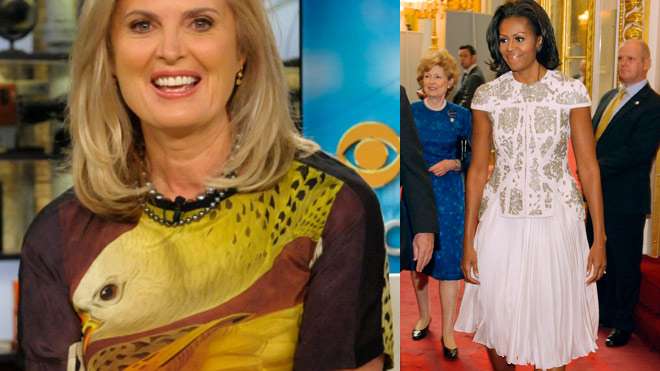
If It Weren't For Double Standards They'd Have No Standards At AllI think we’re seeing why, it’s a huge deal when Ann Romney wears a blouse that costs a thousand dollars, but no biggie if Michelle Obama wears a jacket that costs seven times as much. She’s entitled. She’s the “queen.”

* * *

On a related note, I’m noticing a plurality of libs are taking issue with my definition of “Architects,” as in, Architects and Medicators, when I cite Hammurabi’s Code 229 (actually codes 229 through 233), which Wikipedia claims “is generally accepted as the first building code.” That’s the one where, if a family is killed because you built them a house and the house falls apart over their heads, you get crushed to death.

Their incredibly flawed thinking seeks to entrap me in a “gotcha”: Since I approve of 229, and why else would I make a reference to it, why that must mean I similarly approve of government regulation! Weird. So, I define something, with a reference to a nugget of history; that is tantamount to personal approval of it, so I’ve been caught contradicting myself…I guess I’m supposed to go “homina homina homina” off in a corner somewhere while everything I’ve said is expunged from the record or something.

I’m wondering, with unease, if such people have occupations in which they produce something I use. To make liberal ideas look sensible, I notice once again, it becomes necessary to make meaningfully similar things look like they’re different, and meaningfully different things look like they’re identical. “Government regulation,” as we use the term today, and as conservatives criticize it, is not quite like Hammurabi Code 229. It isn’t even close. I’ve actually worked with regulators and, frankly, I have to wonder if these people have. They sure talk a lot about “nuance” when it comes to the proper interpretation of their own arguments, it’s odd how clumsily they noodle out the other guy’s…

The distinction is between codes that are outcome-based, and codes that define the process. Architectus, from the Latin: Master builder. Hammurabi Code 229: If you screw the pooch on this thing, you will be crushed. You’re on the hot seat. You’re the big cheese. That is not what regulators regulate, today; if what we follow today, in terms of “government regulation,” indeed enjoys some kind of solid line of descent from Hammurabi’s “I will suffer no foolish pie-eyed liberals in my kingdom” law, there has to have been a major twisty going on somewhere. But I do not accept that there is any such solid line of descent. They are, in fact, polar opposites. Modern regulation says, the what, where & how are to be decided by people who do not actually build anything. It regulates that production is to be decided by those who do not produce.

Liberals do not understand what it is they are really advocating — in no small part because, when you listen to them criticizing the opposite, you find they have no idea what it is they’re really opposing.

Cross-posted at Right Wing News and Washington Rebel.

Virtue Junkie Goes to Chick-Fil-A

Thursday, August 2nd, 2012

What a cocknozzle…mommas, don’t let your babies grow up to be this…

From The Examiner, which sez…

When he got to the window, he told the young lady at the window that Chick-fil-A is a “hateful organization.”

The woman disagreed politely and said the company does not treat any of its customers differently.

“But the corporation gives money to hate groups,” he said, meaning organizations that believe in traditional marriage.

Even after berating her over Chick-fil-A, the employee remained professional and friendly.

“It’s my pleasure to serve you always,” she said as she handed him his water.

“Of course,” he said. “I’m glad that I can take a little money from Chick-fil-A and maybe less money to hate groups.”

Addictions are always ugly to see.

What starts the virtue junkie addiction, I wonder? Is it something small or something big? I’ve thought for a long time these people were trying to compensate for something they did, like the guy driving a fancy Corvette who has a small dick, they did something awful. Perhaps something in childhood that only seems to be dark, terrible and nasty to a child…like they had their first shot of impulse from what matures into their conscience, and it doesn’t start this growing process quite properly.

Well, the end results are obviously quite ugly. The deeds themselves, from harassing honest and hard-working employees who are just trying to make a living, to passing city codes telling restaurants what sizes of soda they’re allowed to sell, aren’t really the problem — it’s the lack of awareness of something wrong with the cunning plan, or something potentially wrong. This misconception that, if the intentions are honorable, there can be no blemish in the results.

That leads to the very worst of the whole lot. Even the Great Society legislation is caused by this.

Guy’s got some growing up to do, but I’m not sure he’s capable. Also, he used the word “totally“. Blegh.

Vindicated

Tuesday, July 31st, 2012

Feelin’ vindicated here. I’ve been saying, ever since this issue took center-stage that gay marriage is not a civil-rights issue, it’s a freedom-for-everyone-else issue.

Find someone who is actively keeping gay people from being together, or trying to at least, then we can have a different conversation. But when we start talking about freedoms being taken away, the first thing we have to do to assess the situation as it really exists, is to look at who’s trying to stop who from doing what.

People who say gay marriage is a civil rights issue, haven’t done that. Or, if they have, they’ve been making up stuff that hasn’t actually happened, while denying other things that are really happening. Like this

It’s only fair to ask what’s next. Litigation? A church getting sued for not holding the ceremony? When it comes to that point, and it looks like we’re practically there — keep tellin’ yerself that you’re free, little man. Aren’t businesses in America allowed to refuse service to anyone?

Same-sex marriage is a personal thing. So is the decision not to be a part of it.

And regarding the woman at 0:57…I must say I’m getting tired of hearing that. “This community will not allow.” That’s the kind of nonsense people say, when they think they can speak on behalf of such a community.

Buckley was right; they claim to tolerate other points of view, and then are shocked and offended to discover there are other points of view.

New Skyfall Trailer

Tuesday, July 31st, 2012

Memo For File CLXIV

Monday, July 30th, 2012

Given the choice between a sound knowledge base of verifiable & verified factual information, and the ability to think logically, I would choose the latter.

If I have a good understanding of how to figure out what a fact means, but my head is crammed chock full of silly “factoids” that aren’t really true even though they may be repeated by others verbatim, I should be able to ultimately determine some of these conflict irreconcilably with others. From there, I should be able to figure out which ones are suspect and, eventually, which ones should be questioned, and then reconsidered.

If I have a good solid repository of verified fact, but I don’t know how to figure out what these facts are really telling me, I might as well have nothing.

Fact is merely foundation. You can’t live in a foundation.

The Vampire Problem

Monday, July 30th, 2012

One of the most widely appreciated denizens of my blog goes by the name of Severian; no one has a clue who he really is, which is just the way he likes it. All I personally know of him is his first name, and I suppose if I bothered to check, his apparent IP address. This tells me nothing useful, save for that it’s probably safe to use masculine pronouns to refer to him.

The rest of us learn much, perhaps more than any of us would like to admit, when Severian engages those who are progressive of mind who have also seen fit to participate in greater frequency this summer. Out of the resulting fireworks, two observations have become eminent.

First: Many among those who are so passionately devoted to modern liberalism, especially those who claim to be able to provide logical support for the points they seek to make and then resoundingly fail to do so, are virtue junkies. The term means exactly what it seems to mean. You discuss the merits and possible pitfalls of a voter ID law with them, and things get strange when you ask them to describe reality as they perceive it. In our case, number of legitimate voters potentially “disenfranchised” by such a new law, ONE MILLION — in a single state, while the number of fraud incidents prevented or stopped, ZERO. And, the interested observer picks up the vibe: Hey why stop at a million? But reality, once measured reasonably, is probably not that way. The virtue junkies do not care, they want their fix. If you quibble about the million, all you get back is a bunch of tear-jerking prose about old ladies in wheelchairs who’ve voted non-stop since FDR, et cetera…

I warned you, things get strange. The virtue junkie, like all other junkies, has an unstable, flickering relationship with reality itself. He experiences the reality that you’re not open to the emotional arguments, and he reacts the way you should’ve expected: He doesn’t. He just recites the same arguments he just got done reciting. He’s tying it off, slamming it into the main vein. Not really discussing anything at all. All the impulses of a wild animal, with none of the comprehension of real objects and real events that all wild animals must acquire and sustain, in order to survive. The worst of both worlds.

The second thing to notice is a bit more complex, and is going to require a few more paragraphs. It is derivative of the first. The virtue-junkie is hooked on this virtue, which is actually a cosmetic display of virtue and not the real thing; this is to be concluded because the virtue is relative, not absolute. Example: Two election cycles ago, democrat presidential nominee and Massachussetts Senator John F. Kerry said something awkward about voting for an allocation before he voted against it…he was pilloried over this all summer long, mostly because it fit into the ongoing narrative that he’s a flip-flopper who cannot be relied-upon to stick to a position. During the first of three presidential debates, he acquitted himself of this in a most remarkable way:

…when I talked about the $87 billion, I made a mistake in how I talk about the war, but the president made a mistake in invading Iraq…Which is worse?

Now, one may argue all sorts of things about this. Kerry lost the election, narrowly, and it’s certainly plausible that the mistake talking about the war was a deciding factor, so this defensive remark didn’t get the job done. One may further argue that presidential elections are all about highlighting differences. To those of us who are experienced in arguing with left-wingers, such objections, while legitimate, do not distract from the main point which is: Our friends on the left, far, far more often than those on the right, are seen to seek shelter through the exploration of personal virtue as measured in relative terms — when, according to logic and reason, it is not germane to the discussion at hand, and does very little to add persuasive weight to what they’re trying to argue. But they don’t care about any of that. They just keep doing it. Reflexively.

Very much like vampires retreating from sunlight.

It’s worse than losing track of the discussion, it comes across as an abandonment of it. After all, what does Kerry’s mistake-magnitude-comparison exercise do, to clarify his position on the $87 billion? You have no idea where he stands at the beginning of the debate, and certainly you haven’t learned a thing about it at the end. Also, when we vote for presidents, we are not trying to vote in the guy who’s been caught making a less-glaring, or less-damaging mistake. We’d prefer not to, anyway…and we’re not trying to vote in the guy who can, given a few months to mull it over, come up with a cutting, if childish, remark to throw down in defense of his mistake…we’re not supposed to vote that way, anyway…

This thing we’ve noticed is a problem that comes from measuring the virtue in relative terms. Severian, in an off-line e-mail to me, recollected a work of fiction he’d once read about vampires that made this point. I Googled and found a page that explains it over here: “The vampire population increases geometrically and the human population decreases geometrically.” I’ll try to summarize it briefly: The vampire, feeding on a human, changes the human into another vampire, and after a relatively brief time another feeding will be required by both the old vampire and the new vampire.

The vampire, by feeding, not only incrementally depletes the food supply, but in so doing manufactures a new competitor for consumption of this limited supply. That’s at each feeding. There isn’t any way for the math to work in the vampire’s favor, none at all. All scenarios considered, lead to an all-vampire-no-human planet, on which the vampires are starving to death.

Thus it is with our friends, the liberals. They have to get their virtue-fixes — which means, virtue in relative terms, playing up the fact that they have ascertained and asserted themselves to be morally superior to some “control” specimen. An act which is forbidden when a fellow liberal is the control specimen, just as vampires cannot feed on other vampires.

They enter these “discussions” supposedly to coolly, logically and rationally exchange ideas and win converts. They’re sincere about the “win converts” part of it, at least. But, vampire problem: What if it actually works??

This is exactly what I was noticing shortly after Obama was elected President: Liberals get a lot of ego gratification out of being superior, in their own definition of “morals” and their own definition of “education,” compared to others, and it is also part of their vision that all of the “others” should eventually be converted. Converted, or…well, let’s not go there. They want everyone, everywhere, to be like them. This represents a doublet of mutually-exclusive goals. They cannot both happen. It isn’t logically possible.

My two favorite quotes from The Incredibles, become apropos:

Helen: Everyone’s special, Dash.
Dash: Which is another way of saying no one is.

Syndrome: Oh, I’m real. Real enough to defeat you! And I did it without your precious gifts, your oh-so-special powers. I’ll give them heroics. I’ll give them the most spectacular heroics the world has ever seen! And when I’m old and I’ve had my fun, I’ll sell my inventions so that *everyone* can have powers. *Everyone* can be super! And when everyone’s super…[chuckles evilly] – no one will be.

That’s the trouble with everybody possessing some nifty new attribute…which is measured relatively and not absolutely. If everyone’s got it, then nobody does.

And then, the planet full of vampires is doomed to stagger around, starving to death.

Most problematic for them, the most likely outcome by far is that both objectives will fail: They won’t convert everybody, and in spite of this they still will be doomed to painful withdrawal symptoms. Because, it seems, deep down they understand the terrible truth that a virtue fix is not duly shot up, until the other party acknowledges this measurement of superior virtue.

Eventually, they will have converted everyone who might have been converted, leaving only the hardcore sloping-forehead types who aren’t going to grant this implicit-permission, this acquiescence of “Yes, you’re ethically better than I am and/or more truthy,” even in a sarcastic, “whatever” kind of tone.

And then, their frustration will be complete. They’ll be surrounded by, and very often outnumbered by, all these walking, talking unfinished-conversion tasks…and…starved for a fix, in an addiction from which there is no cure.

Perhaps our society has been in that state for quite some time now. Perhaps that is the real reason why they’re so agitated.

Cross-posted at Right Wing News and Washington Rebel.

Rubber-Banding a Watermelon

Saturday, July 28th, 2012

Hat tip to Bob’s Blog.

The “Japanese video” mentioned could be any one of several candidates…one such example follows…

“C’Mon Man, I’m Serious”

Saturday, July 28th, 2012

From Barracuda Brigade.

Memo For File CLXIII

Friday, July 27th, 2012

The case against Obama’s re-election, in thirty-eight words:

If the economy improves, people prosper. If people prosper, Barack Obama sees them as the problem. If a leader thinks people are the problem when they’re making the economy stronger, clearly the economy cannot improve under His leadership.

I started with fifty words over at The Hello Kitty of Blogging…this drew more responses and “likes” than I expected, so I resolved to improve the wordsmithing to whatever limited extent I’m able, and move it over here.

It’s important.

You’re either on the side of human progress, or you aren’t. And Pharoah Barry is all about “you didn’t build that”…

I LOL’d at 3:07

Thursday, July 26th, 2012

You’ll see why.

The Other Point

Wednesday, July 25th, 2012

We’ll shelve this whole issue, until such time as some other aspect of it becomes worthy of discussion and has not received that discussion…right after we get done discussing those aspects worthy of discussion that have not received the discussion. Really, promise, a break is coming. “Passing Lane, One Mi. Ahead.” But it isn’t here quite yet…because there is still one undiscussed aspect. We’ll fix that puppy up right now.

The point. The whole point. The Zachriel provides it, for our edification, at 07/22/2012, 09:21…

The point is, is that when we succeed, we succeed because of our individual initiative, but also because we do things together.

The Zachriel further edifies us, 07/23/2012 at 06:20…

“The point is, is that when we succeed, we succeed because of our individual initiative, but also because we do things together.”

The Zachriel educates us even further, at 09:11…

Second things second: “The point is, is that when we succeed, we succeed because of our individual initiative, but also because we do things together”…

In case we still haven’t gotten it, The Zachriel applies further effort at 09:55, to make sure we have…

“The point is, is that when we succeed, we succeed because of our individual initiative, but also because we do things together.”

The Zachriel then schools us again, the next morning, at 05:02…

“The point is, is that when we succeed, we succeed because of our individual initiative, but also because we do things together.”

The Zachriel then clarifies at 06:38…

“The point is, is that when we succeed, we succeed because of our individual initiative, but also because we do things together.”

The Zachriel then expounds, or at least allows the Presidents words to get that done…for our further enrichment…

The point is, is that when we succeed, we succeed because of our individual initiative, but also because we do things together. There are some things, just like fighting fires, we don’t do on our own. I mean, imagine if everybody had their own fire service. That would be a hard way to organize fighting fires.

So we say to ourselves, ever since the founding of this country, you know what, there are some things we do better together. That’s how we funded the GI Bill. That’s how we created the middle class. That’s how we built the Golden Gate Bridge or the Hoover Dam. That’s how we invented the Internet. That’s how we sent a man to the moon. We rise or fall together as one nation and as one people, and that’s the reason I’m running for President — because I still believe in that idea. You’re not on your own, we’re in this together.

Nightfly observes, at 08:44:

I went back and counted, and you have used the “individual initiative/also do things together” quote 9 times…including twice in one comment…It seems to me as if this quote is this thread’s version of that .gif you kept linking, or maybe “3°-5°C in the upper range.” You just repeat it mechanically as if it proves your point, instead of being the point of contention.

Top of the hour, The Zachriel clarifies what exactly it is they mean to prove, by doing this…

Just to be clear, we are the only one who pointed to context for the first two days of the discussion. And no one has bothered to explain how the context is consistent with the original post’s interpretation.

“The point is, is that when we succeed, we succeed because of our individual initiative, but also because we do things together.”

The Zachriel fail to understand the point of a “point.” Let’s look it up. Defs. #15 through #17 are applicable, I should think…

15. An objective or purpose to be reached or achieved, or one that is worth reaching or achieving: What is the point of discussing this issue further?
16. The major idea or essential part of a concept or narrative: You have missed the whole point of the novel.
17. A significant, outstanding, or effective idea, argument, or suggestion: Your point is well taken.

Now, we could quibble endlessly about whether The Zachriel are intending this to be taken as Definition #16, when The President actually meant #17, or so on and so forth…I notice all three of them leave some room for subjective interpretation. In #15, how do we define “worth reaching/achieving”; in #16, how do we define “major or essential”; in #17, how do we define significant, outstanding, effective. These are important questions to ask, when we are considering the words of a President who is clearly sorry and regretful — well, as much as it is possible for Him to be any of those things, I suppose — wishes He could take back what He said, and is, it’s painfully obvious to see, in full-bore damage-control “what I meant to say” mode.

I have a good way of defining points, I think: A point can be Pillar II or Pillar III; the inference or opinion, or the thing-to-do. If you arrive at one of those, it can be compellingly asserted that you have made a point. If you do not, then this would have to be called into question.

The key is actionability. Have you made a point that prevails on us, or somebody else, to do something…or, at the very least, to conclude something. Something that might ultimately translate into a thing to be done, or not done.

According to this test I have devised, which I am not devising specifically to damage Him or the “point” He has sought to make, but rather to meaningfully address the question at hand “what is a point?”…the President’s “point” fails. But it doesn’t have to. It meanders off into the direction of making a real “point,” it’s just that a gap remains. What do we need, to close the gap? All we have to do, is infer something meaningful, or figure out that something has to be done.

The business owner did not “build that” all by himself or all by herself…”the point is, that when we succeed, we succeed because of our individual initiative, but also because we do things together”…what are we to conclude from that, to make an actual point?

Inferences/opinions…well…we are capable of success. We are capable of individual initiative. We are also capable of working together. Those things are undeniable, but I’m not entirely sure what good they’re going to do anyone. I mean, once people have done it, does it really have to be pointed out they’re capable of doing it? Seems to me, the successes should stand on their own.

Things to do: Something is owed! Those businesses have been gettin’ away with shenanigans. Ah, now this is much more convincing…and, if you listen to the murmur of the crowd, you will notice, this intended meaning seems to fit right in. Like a good rhythm fitting a good melody.

YEEEAAAAAHHHHH!!!! They didn’t do that on their own! They had help! Somebody else made it happen! YAAAYYYY!!!

Here we come to an other point: For this other work to become relevant, for it to become a “point,” we need something that tends toward actionability. What we need, is an unpaid bill. Those businesses, they made use of this labor and they haven’t made recompense. Relief is owed, and sought.

President Obama, the lucky stiff, cannot be burdened with such an albatross around His neck, because He didn’t actually say this. But the crowd certainly is energized by the sentiment, make no mistake about that. And seriously, to cut through the crap, to acknowledge even for a moment that the businesses paid for the products and services they used to realize their success, provided and manufactured by others — why, that reduces the President’s remarks to just so much hurr durr derp. “The baker didn’t harvest the wheat to make the bread, the farmer did that” — eh, yeah, like freakin’ duh. And, once the baker gets done baking, it is the baker’s product because the baker paid the farmer. That’s how it works, and that is how it’s supposed to work.

So the other point is, capitalism is a great economic model and the President is wrong to try to inflict damage on it. If His speech has any other “point” to it, it is that the farmer deserves credit for the bread…which, through the magic of capitalism, he receives in the form of payment for the grain. The same is true of the teacher, and the construction workers who built those “roads and bridges,” along with the boss of the construction company that received payment from the city, county, state or federal government, and met payroll and bought the equipment and supplies to get those roads built.

The point is — the other point I mean — no economic model can succeed over the long term, unless it provides a sustaining reward for the credit that the President says all these people are due. Which the free market does, and has done long before President Obama ever came along. No “change” needed.

And there is, yet, another point to be made. Marxism is lately resurfacing, in the form of some desire for a compromise between the free market, and other things that are not the free market. When this desire solidifies itself into recorded speech, there has to come soon afterward, as we’re seeing now, a follow-up spin-control effort of “I/he/she/they didn’t really mean to say that.” It is a fairly consistent pattern…which is a defining attribute of a bad idea.

See, the whole argument is bad, because it has to keep shifting from foot to foot and back again, to keep from falling down. The compensation for these services that other people provided; either it was paid in full, or it was not. So the Marxist’s answer to the quandary, is to “strobe” the issue, to talk it up under terms of “it is relevant and worth talking about when I say it is.” The business wouldn’t succeed without a bridge! That is relevant! Okay…so the business paid for the bridge. Not relevant! And this is an enduring weakness with redistributionist economic models, and the propaganda that surrounds them: Is something still owed? They have to keep tap-dancing around it. They can’t address that question head-on, and discuss it honestly. They’d lose if they did.

So now, the President-didn’t-really-say-that, and what He really meant to say was, when success is realized, a lot of people had a hand in it. They worked together. He meant to say that, and nothing more…so anybody who says He meant to say something else, I guess we can call ’em racists or whatever.

But then that leaves the question:

So, what? A whole bunch of people did something — so what? If I’m to conclude anything from that, it is that we’d better keep this free market capitalist system around, since we rely on it to deliver things that, were we to try to acquire them through some other means, would just lead to cynical comedy at best and disaster at worst.

Ross’ Research

Wednesday, July 25th, 2012

Something has to be said about it, and Jon Stewart says it very well.

At 2:58 Stewart uses the word “narrative.” Let me go down a bunny trail here, I think it’s worth it.

This is an absolutely correct use of the word, but we probably need a new word because this one doesn’t describe enough:

a story or account of events, experiences, or the like, whether true or fictitious. [ital. emphasis mine]

We have a whole lot of these “narratives” going around right now; it’s an election year. We need a new word that offers greater precision, drawing a periphery around those situations which together constitute a subset of situations for which the actual “narrative” word would apply. That is to say, all of the situations I have in mind, would be described accurately by the word “narrative,” but all of the situations described by the word “narrative” would not necessarily fit into the definition of this new word.

I recall the H. G. Frankfurt book On Bullshit

What bullshit essentially misrepresents is neither the state of affairs to which it refers nor the beliefs of the speaker concerning that state of affairs. Those are what lies misrepresent, by virtue of being false. Since bullshit need not be false, it differs from lies in its misrepresentational intent. The bullshitter may not deceive us, or even intend to do so, either about the facts or about what he takes the facts to be. What he does necessarily attempt to deceive us about is his enterprise. His only indispensably distinctive characteristic is that in a certain way he misrepresents what he is up to.

This is the crux of the distinction between him and the liar…A [liar is] responding to the truth, and he is to that extent respectful of it…For the bullshitter, however, all these bets are off: he is neither on the side of the true nor on the side of the false. His eye is not on the facts at all, as the eyes of the honest man and of the liar are, except insofar as they may be pertinent to his interest in getting away with what he says. He does not care whether the things he says describe reality correctly. He just picks them out, or makes them up, to suit his purpose.

This is really good for our purposes, because it’s a great point. A liar has to show some interest in what is true, and the bullshitter is distinguished from the liar because he maintains little to none. From all I can see here, that’s the Brian Ross story in a nutshell.

Still more definitional work remains to be done, however, after these two concepts of “narrative” and “bullshit” are melded together, for a bullshit narrative does not precisely describe what we are targeting. Which, in turn, has to do with a great deal of passion aroused toward the objective of reciting something, late in the narrative, which provides fuel for the fire that is the bullshitter reciting the earlier items of the narrative. A true “bullshit narrative” may lack this passion. Example: I work for a newspaper, boss wants a story all set to go for the evening edition, so I threw together some bullshit narrative. Such a situation would be excluded from what we are trying to define here, although it would make effective and accurate use of such words, in the way we have defined them here. Since — again, I’m speculating this about Mr. Ross, but it certainly is not going out on a limb by any means — there was a desire here to connect such senseless violence with the Tea Party. The lazybones trying to make a deadline would lack such a desire.

Granted, so does Brian Ross, from the way things have been presented by Jon Stewart. But that’s the point. I don’t think Stewart nailed everything here. Great job, but he missed a spot. I don’t think Brian Ross…or, whoever put this bit of information in his hands…was lazy. I think he was the opposite of lazy. He was anxious.

Not so much hyper or sweaty. But…and this is key to this new word I’m trying to define…already many steps into this narrative. You get halfway through a book that’s good, you want to finish it. Eat half a candy bar, you wanna eat the other half. That’s the way a lot of people do their “thinking.” They pursue narratives. Some bit of inconvenient evidence from reality, comes knocking to throw things off track, and they’re just not ready to accept it. The bits of fact that do make it into the pleasure dome, all have it in common that they elicit this response of “Ah ha!! The narrative continues!!”

Maybe what we need to be naming, are these bits of evidence that throw the narrative off track. This other thing we used to call “science,” is made up of such things. These two stars are so many degrees, seconds and minutes apart in September…the angle is discretely different in March…and so, we discover parallax. Like that; that is how science works, that is how all disciplined thinking is supposed to work. Discard the overly simplistic theories by way of inductive reasoning, and exclude the inapplicable possibilities by way of deductive reasoning.

Of course, you could say a reporter’s job is not to reason, but to bring the facts — and you could further say, in fact, Brian Ross did exactly that. Problem was, the fact Ross reported was unhelpful in the extreme. He got himself into a spot of trouble…or rather, should have, and we’re still trying to find out if that’s the case…because he went chasing off after these facts in order to help flush out one of these bullshit narratives.

That is not research, that is telling a story. We’ve got a lot of people doing that lately.

Even Squirrels Know How to Store Nuts

Wednesday, July 25th, 2012

From Prof. Sowell’s random thoughts:

Even squirrels know enough to store nuts, so that they will have something to eat when food gets scarce. But the welfare state has spawned a whole class of people who spend everything they get when times are good, and look to others to provide for their food and other basic needs when times turn bad.

The welfare state we know, is a government-sponsored, long-term, inter-generational effort to tilt the balance of Architects and Medicators. “Architect,” used here, refers not to the profession but to the personality type; it is a reference to the Code of Hammurabi, specifically Law 229 which says a bad architect who builds a house that falls down upon the family living in it, should be crushed to death. That is what Architects do; their efforts are toward building houses that will not fall. They think ahead. They perceive the world around them in terms of the complex systems contained in that world, and the simpler parts that make up those systems. They therefore make it their business to figure out how those parts fit together, so they can gauge how well the system is likely to work, whether it be built by someone else or by themselves, whether it’s already in operation or in the process of being constructed.

Medicators are stewards of their own emotional state, in the moment. They enjoy a much keener insight into the emotions of other people who are in proximity to them, but they fortify this at the expense of their own grasp on reality. They do not see the world as made up of complex working systems made up of simpler parts, instead they see it as a big, universe-wide blob, which is then divided conveniently depending on the situation so that good things can be separated from bad things. Once that’s done, it becomes a universe-wide monolithic blob all over again. Medicators, for all the talking they do about the bad things, don’t have much of an opinion about where the bad things are supposed to go; they just want them gone.

Medicators medicate. That, as I’ve written before, is what they do. They participate in politics to medicate themselves. If their children require better discipline, they literally medicate the children. They shun details. If you have a rash or a burn and you put a medicinal balm on it, you don’t need to concern yourself with what the balm is doing to that part of your body; you just put it on, it feels good, you get relief, and you take it as a given there’s some kind of healing going on. A perfect encapsulation of the Medicator’s solution to every problem. Apply X to Y, some big ol’ mystery thing happens, things get better.

So, yes. Saving for bad times is not the Medicator’s thing. They tend to live in the moment. I’m hungry, what’s for lunch? — without a single thought about tomorrow’s lunch, or tonight’s dinner. It isn’t first-&-foremost a discipline thing, or an intelligence thing. It’s got to do with how the world is perceived. For the purpose of going about the business of living in it.

Architects think and Medicators feel. Out of all of the vexing human conflict and dysfunctional relationships, most of those problems come about when Architects and Medicators come in contact with each other. They aren’t really supposed to.

Medicators have their own justice system, one based on “toddler’s rules.” And they have their own economic system. When the miscreant who’s stolen something that someone else “wouldn’t miss,” and didn’t pay his child support, ends up in front of a judge — what you are seeing there is a conflict between worlds, with the trouble-maker representing one world and the judge representing the other. It’s chaos versus order. Each of these “worlds” could be justified, and seen to be working just fine, if only spared from the angst of coming into contact with the other. The only real difference is that the Medicator’s world is not self-sustaining.

Want an iPhone!Our free market system depends on an Architect mindset, by which the protagonist views himself, and the thing he wants to get, and then the system of transactions, with legal tender and products and services changing hands, all as objects that should interact in some way, with a vision toward him getting hold of the thing he wants or needs. It is wholly inadequate for the individual who views all of the universe as a warm gooey mess. And so, if we get some more new individuals coming to “maturity” dedicated to this Medicator mindset of “I’m hungry, what’s for lunch?,” then we have a very effective Cloward-Piven strategy in place, fit to bring the whole capitalist system crashing down like a house of cards.

The irony is, this would rely on focusing human thought on imminent wants and needs, with such intensity and such popularity of parallel thought & desire, that such individuals will, through their actions, destroy the economic system that has shown the greatest promise for fulfilling those wants and needs. Even squirrels know how to store nuts, but these people don’t; and, too many among their number don’t seem too enthralled with learning how.

It is hard to blame the people themselves, since so many are born into it. But we certainly should blame the politicians who spend so much effort and energy trying to make it happen.

The Fact Checker Will Come Get You

Wednesday, July 25th, 2012

…if you have the, er, audacity to notice and say something about the inimical attitude the President has against small businesses. Three Pinnochios is the verdict:

Romney immediately began jabbing Obama on the campaign trail and the Romney campaign rushed out an attack ad focused on Obama’s words — though, as we shall see, it sliced and diced the president’s quote to make it seem much worse.
:
The Facts

The president, during a campaign speech in Roanoke, tried to make the case that wealthy people need to have higher taxes in order to help serve the public good. Here is what he said, with the words used in the ad in bold type:

“There are a lot of wealthy, successful Americans who agree with me — because they want to give something back. They know they didn’t — look, if you’ve been successful, you didn’t get there on your own. You didn’t get there on your own. I’m always struck by people who think, well, it must be because I was just so smart. There are a lot of smart people out there. It must be because I worked harder than everybody else. Let me tell you something — there are a whole bunch of hardworking people out there.

“If you were successful, somebody along the line gave you some help. There was a great teacher somewhere in your life. Somebody helped to create this unbelievable American system that we have that allowed you to thrive. Somebody invested in roads and bridges. If you’ve got a business — you didn’t build that. Somebody else made that happen. The Internet didn’t get invented on its own. Government research created the Internet so that all the companies could make money off the Internet. The point is, is that when we succeed, we succeed because of our individual initiative, but also because we do things together.”

The biggest problem with Romney’s ad is that it leaves out just enough chunks of Obama’s words — such as a reference to “roads and bridges”— so that it sounds like Obama is attacking individual initiative. The ad deceivingly cuts away from Obama speaking in order to make it seem as if the sentences follow one another, when in fact eight sentences are snipped away.

How awful of Mitt Romney. Here is President Obama trying to play down the credit that should be given to the businesses and their owners for their success, and Romney makes it look like Obama’s playing down the credit that should be given to the businesses and their owners for their success.

Let’s inspect this: In spite of the fanfare we’ve heard over and over again about President Obama’s oratorical skills, there is open question about the “that” in “If you’ve got a business — you didn’t build that.” Perhaps that means the business, which would mean Romney’s summary if dead-on accurate, and the Washington Post Fact Checker has been taken for a ride. Or, perhaps that means roads and bridges, and Romney’s ad does take the quote out of context…because the point, as we’ve been reminded repeatedly, is that “when we succeed, we succeed because of our individual initiative, but also because we do things together.”

How to figure out which one it is?

The Fact Checker’s solution is pretty simple. Wait a couple weeks for President Obama to figure out how damaging this is to His campaign, by way of the media flap that followed as well as by way of Romney’s attack ad; and then, y’know, find out from Him what He meant to say.

Oh, miracle of miracles. He was really talking about roads and bridges! The whole point of His speech was to let the small business owners He has their backs, or something…by…reminding them not to get too big for their britches. You didn’t do that on your own. “You didn’t build that.” Oh, but Let Me Be Clear…roads…bridges.

As Boortz said: “‘roads and bridges’ aren’t a ‘that.’ They’re a ‘those.’ If Obama was directing his comments to the roads and bridges he would have said ‘you didn’t build those.’ Obama is, they say, the smartest man ever to hold the office, so certainly he can handle simple grammar.”

I’m not sure how people miss that clear and obvious point; there is singular, there is plural. That, and those.

We do have a gadfly who’s seen fit to paste and re-paste the thing about “the point is…blah blah blah do things together” ten times or thereabouts. This doesn’t address the singular versus plural issue, which proves that the sentence is functionally stand-alone. “If you’ve got a business — you didn’t build that.”

President Obama wasn’t letting the businesses know He was standing behind them and ready to help them. He was delivering a beatdown. Opening up a can. You didn’t do it on your own!

Boortz again, on Fact Checker’s three Pinnochios:

Washington Post fact-checker Glenn Kessler is apparently so good at his job, that he was actually able to climb into the mind of Barack Obama and determine exactly what he meant by his comments. Amazing! Who knew that Glenn Kessler was capable of reading Obama’s mind and interpreting his thoughts as facts? This guy should be getting paid the big bucks.

Boortz also has a link to Weasel Zippers, where there is a hilarious mash-up of the media coming out and slipping on their shit to get the wagons properly circled…

At 0:17 Chris Matthews claims to have heard this the first time essentially the way Obama now wants it to be heard, punctuating this now-popular narrative with “the reference is clear” — eh, no Chris, that’s a fail there pal. We may disagree on what Obama meant by “that,” and we may disagree with legitimate points made on both sides…and that is being exceedingly charitable toward your point-of-view, you should accept that intellectual compromise…but, that there is any ambiguity at all, is proof that the reference is not clear.

In fact, I will go further on that. The reference is not clear — and, the cloudy grammar is only part of the reason that the reference is not clear. There are other reasons why the reference is not clear. Primarily that, when Obama gave His speech, He was not using words to communicate clear thoughts. If there was a “point” to His speech at all, the point was discontentment. It was the same ol’ Marxist drivel…lots of rumbling, lots of “Yeah!” and “Right!” — watch the videos, this stuff doesn’t make the transcript. Lots of peevish resentment from the proles. Those darn businesses! They didn’t make it without us!

They owe us! That was the real “point.” Those business have been making use of things we built, for which they have not compensated us.

And that’s what makes this kind of rhetoric so inherently dishonest. The point to it is that there is remuneration that has not been done, and therefore, it has to get done, because it’s due. But, on the way there, these other points are conveniently brushed aside, that the businesses do pay for the things they use. And that includes the use of the roads, bridges, et al. Businesses pay taxes. Arguably, more than their “fair share” of taxes, depending on how you want to define that…so the point is, there is no point.

Could the whole discussion be somewhat more productive if we take the President’s words at face-value, that “when we succeed, we succeed because of our individual initiative, but also because we do things together”? Well, you tell me. Let’s do that thought experiment. We succeed because we do things together — and, everyone involved in this business, has been fairly compensated. So, what? What’s the point of this?

There must be one. The crowd surrounding President Obama seems pretty enthusiastic!

And peeved. Like a Marxist marching mob, demanding “social justice” or some such. So, how were you planning to channel all that…uh…energy, Mr. President? I see by this video your campaign put together that you’re really all about helping the small businesses…eighteen tax cuts (1:03) or some such.

Was that the point of the speech You were making? More tax cuts for small businesses…because they need to be reminded they didn’t build roads and bridges? Huh, funny, that really doesn’t come across in the video, or in any of the transcripts, no matter which ones I read, or what they choose to leave in or throw out. In none of those versions does it appear, even remotely, like you’re championing the cause of small businesses, or trying to lower their taxes. Not even close.

You’re supposed to be some kind of great orator, huh?

Context, my left nut.

And The Washington Post owes the country an apology.

The Banana Czar

Wednesday, July 25th, 2012

Brilliant, absolutely brilliant. And I’m lucky to have found it again. Thanks, Google Books:

Pretend Congress appointed you U.S. Supermarket Czar charged with making all the arrangements for Americans to have…bananas. How will you get people in Costa Rica, some of whom may not like Americans, to work hard to grow, harvest, and ship bananas? What are all the arrangements necessary for the shipping crates? Do you know how to make a chain saw or axe to chop down trees for the wood to build crates? What’s necessary to mine iron ore so as to make nails and wires for the crate? Then we have to keep in mind that the bananas have to get from Costa Rica to the supermarket. That means ships and trucks are needed. What do you know about truck and ship building and navigation?

There are literally millions upon milloins of inputs and people cooperating with one another to get just one of those twenty thousand items to your supermarket. Somehow these inputs show up to do their job at the right time and right place, as if, to use Adam Smith’s phrase, they are “guided by an invisible hand.” All that good effort occurs without lovve and caring. The Costa Rican farmer, the crate manufacturer, and the ship captain don’t give a hoot about you but you have the bananas as if they did.

The coordination that makes all those other items available at your supermarket is nothing short of a miracle. To think that one human being, or group of humans, can possess the knowledge and information to accomplish the task is the height of human arrogance and conceit. That knowledge and information is widely dispersed across society in bits and pieces. That’s why top-down central planning always produces disappointments, shortages, and bottlenecks. The banana czar might have remembered everything except a compass and the banana boat is lost at sea. Think back to the 70s during our government-sponsored energy crisis. Our energy czar had some parts of our country awash with gasoline and home heating oil while other parts were dry. Better yet, how would we like our groceries to be delivered by the same people who deliver our mail?

That’s from More Liberty Means Less Government: Our Founders Knew This Well, Volume 0, pp. 218-219, by Walter E. Williams.

Same point, when you think about it, that Milton Friedman was making.

The Enthusiasm

Tuesday, July 24th, 2012

When Elizabeth Warren went and said her dumb thing there was a lot of enthusiasm about it, as I recall.

…the high level of exuberance that swirls around this little observation she has made, creates another question. Like, why? Why the excitement? What makes people so enthused about noticing how hard it is to acquire a little prosperity anymore, without government interference?

And it seems the bulk of this enthusiasm was clustered around the part of her quote that says…”There is nobody in this country that got rich on his own. Nobody.”

We’re seeing a relapse, because President Obama has said a dumb thing very much like Elizabeth Warren’s dumb thing. We’ve examined the context in detail over here, and then we have one of our favorite liberal gadflies “educating” us about that context, as if we didn’t already understand it, over here. The rules from Planet Liberal apply: Liberal gadfly repeats the same morsel of information over and over again, ad infinitum, as long as everyone else hasn’t come around to the liberal gadfly’s way of thinking. After all, lack-of-comprehension, due to inadequate repetition, is the only possible problem!

As I was noticing yesterday, liberals are frequently caught using an opinion as a metric to gauge all kinds of things…character and personal integrity, intelligence, the ability to think logically, quality of information used in making decisions. There is something fair about this — these things do all factor into the making of opinions. The problem is, you can’t use the output as a metric to gauge the input, when there’s more than one input. You can be a brilliant logical thinker, and if your facts are messed up, then in the end your opinion is going to be hosed. It works the other way, too; your facts can be accurate, verifiable, even complete, but your opinion will end up being a bad one, or a good one only by good fortune, if you are missing the ability to think things through logically. These are all vital ingredients, so if the opinion is a bad one, it only says something is missing, it doesn’t say what. Therein lies the leap to conclusions displayed by our liberals when confronting those who dissent. It is the extravagant leap taken by the fool, who is not accustomed to testing things systematically, and thinks an optimistic vision is all that is needed.

Very often, I notice they fancy themselves to be experts…instant experts…on what the disagreeable person does & does not know. Perhaps conservatives do this as well. But not nearly as often.

In leaping to such a conclusion, they communicate unmistakably, if unintentionally, that their own ability to think things through logically must now be called into serious question. Because they’re failing to do it — and then bragging about failing to do it. That, in turn, calls their opinions into question. Which, in turn, tends to magnify the blight placed on their own positions, since they are frequently caught repeating this sin in the opposite direction: “Whoever agrees with me, must be well-informed, gifted at thinking logically, and have lots of character and personal integrity.” That’s worse than being merely mistaken, or needlessly insulting. It’s reckless.

But I’m interested in this enthusiasm — again. It merits study, maybe even some formalized research. As a psychological phenomenon, perhaps. Anyway, I simply don’t understand it, and after all this attention paid to “What Obama really meant to say, was…” the time has probably come to shift attention, slightly, and figure out what parts resonate, and how, and why. I remember when Prof. Warren’s quote was going around, out on the liberal web sites if you looked up the posts about it, and skimmed over the comment threads, there was this huge swelling of excitement. As in, oh, she is just so, so right about this!

Right about what?

Take a look at Obama’s speech on video.

At 0:56 to 1:00, He makes the point that “if you’ve been successful, you didn’t get there on your own” and there are these multiple, affirming cheers. Some of this enthusiasm I wish to study, exists there, I think…of course it’s lacking in the spontaneity you would expect of real crowd enthusiasm. Sounds like it’s paid-for. Maybe it is. “There are a whole bunch of hard working people out there” at 1:19, huge uproar…”YEEEEAAAAAAAHHHHHH!!!! (applause applause applause)” The “great teacher somewhere in your life” comment at 1:33 gets a “Yeah!” Some “Right” and “Yeah” at the notorious “If you’ve got a business…you didn’t build that, somebody else made that happen” (1:46).

Lots more wild cheering at the end, where He makes the point about building the Golden Gate bridge, going to the moon, “you’re not on your own, we’re in this together.”

What’s going on in my mind, is: How inexperienced and ignorant do you have to be, of this kind of technically-demanding problem solving, like the calculations involved in going to the moon — to think it’s some kind of committee project? I realize He doesn’t come out and say that, but there is no mistaking that there is a lowering of a beatdown here, and the beatdown is being lowered upon the ingenuity of the individual.

Go back through the clip and listen to the cheering again. You’ll notice it has a particular crescendo to it during the parts where Obama gets tough with the businesses, lets ’em know that this isn’t all theirs. There is an unmistakable anti-business pattern to it all.

What I’m picking up here, is a conflict between brain and brawn. Someone figures out how a light bulb could work, and after a number of failed prototypes, comes up with a working model. This is put into mass production, and a town is illuminated — hey, he didn’t build that!

Dozens, maybe hundreds, of dedicated assembly line workers translated his working design into reality! That’s the message. And, it is a valid one…they did do that, and the town would not have been lit if it were not for them.

But, on the other hand, the town would not have been lit if it were not for him, either. Our friends from the left side of the aisle seem to be forgetting that part of it; rather habitually.

And so I’m picking up something else here: That the committee project is being used as a sort of a bully pulpit. Or, rather, a decoy. A horse-blinder. You see, it is undeniable that the illumination of the town depends on a successful design, just as much as on the brawn…and so, we have the “we’re all in this together” to help blind us to the contribution of that one guy, who figured out if it would work, and how. You didn’t build that! Somebody else made it happen! We’re all in this together!

It is a conflict, being triggered by the one side that cannot be too forthcoming about what its position really is. It’s a conflict between the brain and brawn, which translates into — the individual, coming up with a complex, capable design, and the group, which…well, doesn’t. Groups don’t do that. Groups arrive at compromises, groups reconcile competing desires and competing interests. And groups fund.

But they’re not so good at experimentation, and they don’t design.

And, let us not forget, this is ultimately about the final conflict: Higher taxes versus austerity. I said some of those cheers & yelps sounded paid-for, and that I think this is likely. But I don’t wish to pick on the labor unions. They do have it coming, but anybody who isn’t aware of their influence by this time, isn’t interested in finding out about it.

There is an amateur part of this enthusiasm, about which I have a much greater interest in doing my learnin’s. The psychology behind it. I don’t think the enthusiasm is about “let’s all participate in this together” — if that’s the motivation, then the planning isn’t very effective because our system of taxing and governing doesn’t do that. Quite a few people who are part of this “everybody” don’t pay any taxes into the system at all, and of those, not too many of them are actually working on building these roads and bridges.

So. Getting “everybody” to do their part, is not the objective. There’s way too much of the real “everybody” being excluded from the semantic “everybody.”

I think the motivation is denial. This is the only viable explanation for the enthusiasm: Somebody designed the light bulb, or a part of that rocket, and that means there is an individual doing remarkable things — we are individuals, but we’re not doing remarkable things as individuals, so we don’t want anybody else doing anything remarkable either.

Not unless they are part of a big, big group. So that we can take all the human effort that goes into something noticeable, and safely anonymize it. So that no one single person can put his name next to something that is good, and receive credit for it, on an individual basis. We’re opposed to that.

Unless it’s Barack Obama.

Or one of His close friends.

“Lazy American Dream”

Monday, July 23rd, 2012

“Anything worth having, we should have it all for free.”

Hat tip to Gateway Pundit, by way of Conservative Byte.

“Sunny Makes a Sandwich…Or Does She?”

Monday, July 23rd, 2012

These Hands

Monday, July 23rd, 2012

Questions for Liberals

Monday, July 23rd, 2012

There’s an uptick lately in their activity on my own site, as they head to the comment form and enter their…ah…their counterpoints let’s call them. Good, this is an opportunity.

Thought it might be good to get a list going of questions I have never been able to have answered in any meaningful, coherent way, by liberals — anywhere. Maybe I’m not asking these questions right, but it’s more likely that the questions themselves are the problem. The responses consistently lead off into some kind of monologue about “There’s no use discussing such an issue with a person such as this,” or some such…with the ultimate result that the questions remain unanswered. That situation has been going on for awhile, with all ten:

1. What is “middle class”? Specifically.
2. What is “fair share”? Numbers, please.
3. What does it mean to have a “strong” or “robust” or “vibrant” middle class? Does this refer to people in the “middle class” making more money, such that they stop being middle class? How does that work, exactly?
4. How big should our government be, in terms of the resources we allocate for it, per year, per capita…? Is there a limit at all? Should there not be one, especially if the livelihood earned by the taxpayers is to be limited?
5. If a woman has absolute control over her body, and the rest of us have an absolute right to vote in whatever way we see fit, do I then have a right to vote in politicians that will make abortion illegal?
6. I’ve heard several times of this test for premature babies, that if they’re capable of “surviving outside the womb” then fine, they can be people, and if they aren’t then they aren’t. Um, what is the rationale for this? Does this not conflict with that other acid test, that it becomes a “baby” and stops being a “fetus” when it is delivered?
7. This country has gone full-tilt on left-wing big-government solutions before, quite a few times in the last century. So if it works so well, how come the country didn’t say to itself “Golly! That works really well!” and just stick with it? How come we keep doing this sixteen-year merry-go-round of right, left, right, left…President Obama was supposed to be this unstoppable political juggernaut, His luster has clearly worn off, needs all this money raised just to get re-elected — is that what we should expect to see happen, when the left-wing ideas work so undeniably well? Looks to me more like, young voters taking awhile to learn something, learning it, and then being outvoted by the next generation of young voters that need to learn the same things again. How would you explain it? Eisenhower, Nixon, Reagan, George W. Bush, the midterms of 1994, 2010…this is all Diebold tampering with voting machines?
8. How are voter ID laws racist? What color is voting-legally?
9. How is English-as-official-language racist? What color is English?
10. What is exceptional/remarkable/superior about Hillary Clinton? Nancy Pelosi? Barack Obama? Elizabeth Warren? What are their unique skill sets, and how do these skills benefit the country…or, show promise of providing a benefit to the country? Specifically. Can any one among that whole sorry lot point to a uniquely wise decision that changed the outcome of a situation for the better, that someone else wouldn’t have succeeded in making?

Update: A bit more of a “discussion” proceeds, reminding me of a recurring theme. The theme is that personal opinions, off in Planet Liberal, are very simple things. Therefore, they can be used as metrics. Think of the thermometer you hang outside to tell you how cold it is; ideally, the outside temperature and only the outside temperature drives the reading. Any other variables factoring in would bollux up the measuring process. You can do the measurement because there is one variable working on the readout, one and only one.

Here on Earth where all the normal people live, an opinion comes from many things, to wit: A rational thinking process, a good source of relevant information, personal biases that come from prior experience. You would never think to yourself “I can trust this complete stranger with all kinds of stuff, because he or she agrees with me on X.”

Our left-leaning friends do this — or represent themselves as doing this — without a care in the world about it. And I am reminded of 11 and 12 which I have also posed on occasion, and repeatedly failed in every possible way to extract a rational answer:

11. Is there anybody who dissents from the liberal’s summation, even in just an arcane, nearly-microscopic way, who knows what they’re talking about — actually, scratch that, is such a thing possible?
12. The reverse. Is it possible for someone to agree with the liberal, and not know what they’re talking about. To reach the so-called “correct” conclusion by way of incorrect thinking?

Everything I Need to Know I Learned From Batman

Saturday, July 21st, 2012

“What I Said Was Together We Build Roads and We Build Bridges”

Saturday, July 21st, 2012

Good grief.

President Obama, one week after his controversial “you didn’t build that” remark, claimed Friday that the criticism he’s taking from Republicans is “bogus.”

Though Republicans say the president was implying that business owners didn’t build their businesses, Obama said he was just talking about roads and bridges.

In an interview with WCTV-TV in Tallahassee that aired Friday, Obama said: “What I said was together we build roads and we build bridges.”

He added: “That’s the point I’ve made millions of times, and by the way, that’s a point Mr. Romney has made as well, so this is just a bogus issue.”

As Charles Krauthammer points out in the clip, it’s completely obvious from watching the original video from a week ago as well as from seeing the statement in print — the President was not talking about building bridges.

If He isn’t out-and-out lying (and it’s difficult to see how a man possessing any intelligence at all would think He could get away with such a fib), then He sure is good at rationalizing. In our elected leaders, is there any practical difference between those two things?

“I Built This!”

Saturday, July 21st, 2012

The “Underlying Social Contract”

Friday, July 20th, 2012

Another thing to be explored in this you-didn’t-build-ism, which I was going to tack on to the end but I decided it’s worth a post of its own…Thomas Sowell, as he very often does, states it better and more clearly than anybody:

People who run businesses are benefitting from things paid for by others? Since when are people in business, or high-income earners in general, exempt from paying taxes like everybody else?
:
Since everybody else uses the roads and the schools, why should high achievers be expected to feel like free loaders who owe still more to the government, because schools and roads are among the things that facilitate their work? According to Elizabeth Warren, because it is part of an “underlying social contract.”

Conjuring up some mythical agreement that nobody saw, much less signed, is an old ploy on the left — one that goes back at least a century, when Herbert Croly, the first editor of The New Republic magazine, wrote a book titled “The Promise of American Life.”

Whatever policy Herbert Croly happened to favor was magically transformed by rhetoric into a “promise” that American society was supposed to have made — and, implicitly, that American taxpayers should be forced to pay for. This pious hokum was so successful politically that all sorts of “social contracts” began to appear magically in the rhetoric of the left.

If talking in this mystical way is enough to get you control of billions of dollars of the taxpayers’ hard-earned money, why not?

Prof. Sowell discusses this Croly character, in the context of these invented mythical “social” obligations, on p. 89 of his book Intellectuals and Society under “Intellectuals and Social Visions.” You should run out and snap up a copy if you don’t have one yet. It is a critique sited in on a very specific target:

Jonas Salk’s end product was a vaccine, as Bill Gates’ end product was a computer operating system. Despite the brainpower, insights, and talents involved in these and other achievements, such individuals are not intellectuals. An intellectual’s work begins and ends with ideas, however influential those ideas may be on concrete things — in the hands of others. [emphasis Sowell’s]

The unstated question that repeatedly bobbles up to the surface is, how might the intellectual’s idea change if the intellectual were to assume personal responsibility for implementing it, and then availed of the opportunity to revise the idea with the lessons learned from toiling away within that unforgiving plane of reality.

Some of this “social construct” stuff might end up on the cutting-room floor, I think. It’s rather easy to speak of magical, here-from-nowhere contracts when it’s the other guy who has to meet them.

You-Didn’t-Build-ism

Friday, July 20th, 2012

Enrollees over at the Hello Kitty of Blogging, who happen to be friends with Don Surber, were given a real treat this morning. Call it a “column prototype” of sorts, it was going to be going into the paper, but Surber decided to commit it to that medium instead:

EVERY politician says something stupid in any campaign. Usually people give them a pass. President Obama recently said that if people feel faint in the heat, they should call a paralegal.

Amusing but no big deal. It sits besides his 57 states comment as something conservatives drag out now and then to mock him.

What scored was his statement in Roanoke, Va.: “If you’ve got a business, you didn’t build that.”

That line marked a turning point in the 2012 election just as John Kerry’s statement that he “actually did vote for the $87 billion before I voted against it” turned the 2004 election around.

Of all the dumb things Kerry may have said that year, that quote because it revealed something about Kerry that a majority of voters had suspected all along: that he is a sneaky opportunistic politician who always has his finger in the wind.

His supporters argued that it was taken out of context in the speech. Perhaps.

But voters put the quote in the context of the character of the man himself — the Vietnam War hero who then turned on his fellow warriors in false testimony to Congress.

In that context, Kerry was untrustworthy. His statement confirmed that.

Liberals have argued that Obama’s words are taken out of context. They argue that he was making a point about no man being an island, even though he said no such thing at all.

Voters, again, are putting the politician’s words in the context of his actions.

Americans gave Obama $787 billion for a stimulus. He spent it on government programs. The unemployment rate went up. Slowly it has come down, but it is still higher than when he started spending the stimulus.

“If you’ve got a business, you didn’t build that” confirms for many people — a majority of voters, I believe — that [this] president is a big government blowhard who does not understand business and is to blame for the lack of a recovery from this recession.

Context is not simply reading the whole speech but placing the speaker in context.

If your preacher says, “you didn’t build that,” you agree because you know and I know that God created the universe and we should humble ourselves before the Lord.

But when a smarty pants who just graduated from an Ivy League school says it, you and I know this kid has a lot to learn.

I like those last two paragraphs because they highlight a differential between classic Judeo-Christian teachings, and modern liberalism. Both of which, by the way, seek to tone down the credit claimed by the mortal builder for the glory of his creations, but for very different reasons. The religion says the glory should go somewhere else, the modern libs essentially say the glory itself is a problem, and should just go away.

Of course, like any other contaminant, the glory can’t just “go away,” it has to get sucked up somewhere. That’s why we capitalize the H in pronouns like “His” and “He” when we refer to President Barack Obama: Liberals honor Him exactly the same way the devoted honor their deities. Glory should not go toward ordinary mortals, no matter what, so it should go to Him instead. He’s like a vacuum-cleaner-bag for glory. All the rest of us are essentially just the same, all milling about pointlessly in this lower layer of human strata, in which nobody really built anything; only The Obama is on a different plane.

It is an Architect/Medicator conflict, as I later wrote:

The “you-didn’t-build-ism” is an example of the endless battle between “architect” and “medicator” personality types. The difference between these types is the source of most human conflict. Architects flesh out details and get them defined, not as an end but as a means toward an end; Medicators, in turn, are threatened by this process of definition. That’s what President Obama was doing; it was not His intention to insult the business owners, nor was He really trying to give credit to the “someone else” people who did the real building or whatever. What He was trying to do was erase the distinction.

I’ve disagreed with Rush Limbaugh about this part of it for many years now — NO, these people we call “liberals” do not see government as the source of all good things. They don’t really like government any better than most conservatives…They see it as a great anonymizer, like an IP masking service on the Internet. The function provided by government, the way they see it, is the same as the function of distributing blank bullets among a firing squad so nobody knows who really killed the guy standing in front of them.

They don’t want to believe in God — because, they don’t want to believe in anything good. In their world, stuff just kinda happens.

That’s what you-didn’t-build-ism really is: It’s just simple fear. Fear of acknowledging a detail. “So-and-so built such-and-such” is the loathed, feared detail.

For the record, no, this was not a winning move for the President; it was a dumb stupid thing to say. And I mean that purely in the practical sense. Yes, some people were very enthused about it, but those people were going to vote for Him in November anyway. Contrasted with, there were people who were purely undecided about which way to go, who will never support Him now, certainly not if they care about what’s going on with jobs, and the economy. Because now it’s revealed, this is a guy who not only didn’t start a business, probably doesn’t know anybody who ever did, but wouldn’t.

Like Cylarz said under the other post I put up about this…

This is nothing new. Back in the 90s, Clinton was always talking about “government giving people the tools they need to succeed.” The man was such a skillful liar that I never knew for sure what he really did or didn’t believe, but I wrote back in college, “Like any good liberal, he has it exactly backwards.” It probably never even occurred to him that maybe it was the people who give the government the tools IT needs to succeed – they fund its operations and its powers derive from “the just consent of the governed.”

Yes, there are customers. Yes, there are employees, and roads built by other people, and bridges. But the guy starting the business has to carry all of that. He takes out the loans. He pays the employees, along with the taxes involved in hiring them. Secures the permits, rents the space, pays the taxes that get those roads built and maintained. When customers give him money, he sees to it they receive a greater share of product & service, and if he fails to do that then they stop being customers. Everybody else involved in the building of this business, has to be compensated at a profit for their involvement or they cease to be involved. The people building the businesses have to see to all that, or the business goes un-built.

Just statin’ the obvious, here…although, looks like it isn’t obvious to everyone…

“Sh*t You Don’t Say at a Job Interview”

Thursday, July 19th, 2012

…but don’t take my word for it. Frankly, I’m looking at the “I like money” thing and thinking to myself…”Well, what’s the problem??”

“A Generation Awakens”

Thursday, July 19th, 2012

Memo For File CLXII

Wednesday, July 18th, 2012

Commenter Severian posts some thoughtful remarks that inspire more thought. And I’m thinking…I still don’t have liberals figured out, and Sev’s comment does not get them figured out for me, nor do they go too far in that direction. But, they inspire what might be the correct question to ask.

Let’s see if I can jot this down.

A Socreatean syllogism, posed from their point of view…let us say, I am a liberal and you are not.

1. I’m a better person than you are, in all kinds of ways.
2. (Underpants gnome missing step)
3. Therefore, we need a purely-collectivist system of exchange which, among other things, conceals the disparity among individuals in terms of their virtue and worthiness of their habits & efforts.

Item #3 summarizes the “Elizabeth Warren” ethos: President Obama put it very well, I thought, if you’ve done something good then you didn’t really do it. Somehow, there’s a lot of enthusiasm around for the idea that no individual does anything for which there should be any enthusiasm. My observation is that #3 seems to be in conflict with #1…problematic, since both #1 and #3 seem to be ever-present in all this liberal monologuing. I don’t see any liberals discarding one of those for the other. In fact, #1 and #3 appear to be engaged in some kind of symbiotic relationship with one another.

The thing I cannot quite grasp is, of course, #2. It can be:

2a. I love you with the love of a soldier who lays himself down on a grenade for the other members of his platoon, and only want the best for you…or…
2b. ???????

And, for reasons that will be obvious to all others who’ve similarly “discussed” things with their liberal friends and neighbors — into which I shall not go, here — I’m ready to discard 2a as a possibility. Think it’s pretty safe to eliminate it.

So, I think, “What t’heck is going on in 2b?” is the appropriate question to ask. Liberals think they’re better, evidently just because they’re liberals…be that the case or be it not, they definitely think they’re better. And so, because of [blank], they have all this passion for a new, better society in which it doesn’t matter who’s better than who, a future in which relative individual merit becomes pointless.

It seems, once that future comes about, they’re still better than everybody else, that part of it will not change. And since they have so much identity invested in that truism, that they’re better because they’re liberals — in this envisioned future, that remains their purpose in life. Or, at the very least, it matters to them, is fulfilling to them, that they’re still better than you, and you are not as good as they.

Which remains true. But has become entirely irrelevant. Or not?

Side note: On envisioned futures. A couple weeks ago I came up with a definition for people with a certain problem here, whom I described thusly:

These are the people who take:

1. What they perceive to be likely to happen
2. What they perceive is merely a remote possibility
3. What they would like to see happen

and
4. What is certain to happen

and, like a toddler clutching milk duds and jelly beans too tightly for too long on a hot summer day, smoosh them all up together.

My son and I were talking about this yesterday, about his antipathy for the Voluntary Human Extinction Movement (VHEMT). Aside from being anti-human, VHEMT’s mission statement pegs the organization as being deeply mired in this “future fondue” problem; in fact, it ranks among many other left-wing anarchist organizations, sharing this attribute that its members are “activists” who are active first and foremost in the action of envisioning something. Hmmm…nice gig if you can get it. Wonder what the hourly calorie expenditure is on that.

I also recall the twenty-dollar chocolate bar, imported in all its carbon-neutral glory, by means of sail-powered cargo ships. The spokesman of the company operating said cargo ships, making this jaw-dropping remark, revealing his company’s mission statement to have much to do with this future-fondue thinking:

“This is only a beginning. The next step is to build a much larger sail-powered cargo ship, a 3,000 tonne EcoLiner equipped for container traffic and fully competitive with the oil guzzling competitors”, says Fairtransport director Jorne Langelaan. “We want to re-establish sailing ships as a natural alternative to an anti-ecological culture. We want to see a revival of the great age of sail, as a means of Fair transport for cargo around the Atlantic”.

Nevermind the idea itself — there is something going on with how it is envisioned. The future-fondue people have a most peculiar understanding, one that belongs solely to them and is all their own, of this simple human-thinking concept of doubt.

As I’ve written many times in many places, since our most educational exercise about the matter: They speak of future events, as if they have occurred in the past. The very word “envision,” applied to future situations and future events, seems to have a very special, and peculiar, meaning.

You and I envision future events with hope, or dread, depending on whether our vision is inspiring or dark. But they don’t dread. Even when they’re warning about bad things, like the Earth ceasing to support life as we know it due to our pollution, or terrorist attacks due to our bad behavior or failure to provide foreign aid, they’re still full of hope. Or, their words have dread, the lilt in their voices is full of what could not be described as anything but real hope. That’s when it gets creepy.

Only they would say something like “There’s a serious problem, the world might not be ending,” or “not to worry, we’re still doomed.”

Update: A further thought. Perhaps we can achieve much illumination of thought with very few words of prose — not historically my forte, but let’s give this a try nevertheless, shall we? — to sum it up this way:

This lately-popular “Elizabeth Warren economics” brand of modern liberalism simply seeks to make definition and personal excellence mutually exclusive things.

What the President is saying is, when you have a successful business, you have this definition. Therefore personal excellence is simply not to be allowed, hence the “you didn’t build that, somebody else made it happen.” His fabulous remarkable campaign from four years ago, on the other hand, is the opposite. Personal excellence without definition. “He’s the real deal, I’m telling you! There’s just something about Him! I can’t explain it!” Barry’s personal wonderfulness is to be permitted…even obligatory, in classic affirmative-action style…because the definition has been reduced to nonexistence. Berry is elected President, Barry wins the Nobel Peace Prize — for nothing in particular. If there was definition, the individual exceptionalism would be prohibited. But there is no definition, therefore acknowledgement of this undefined excellence is required. It is demanded. Just like the praise for the Emperor’s new clothes.

Just a thought.