Archive for the ‘Uncategorized’ Category

“What I Said Was Together We Build Roads and We Build Bridges”

Saturday, July 21st, 2012

Good grief.

President Obama, one week after his controversial “you didn’t build that” remark, claimed Friday that the criticism he’s taking from Republicans is “bogus.”

Though Republicans say the president was implying that business owners didn’t build their businesses, Obama said he was just talking about roads and bridges.

In an interview with WCTV-TV in Tallahassee that aired Friday, Obama said: “What I said was together we build roads and we build bridges.”

He added: “That’s the point I’ve made millions of times, and by the way, that’s a point Mr. Romney has made as well, so this is just a bogus issue.”

As Charles Krauthammer points out in the clip, it’s completely obvious from watching the original video from a week ago as well as from seeing the statement in print — the President was not talking about building bridges.

If He isn’t out-and-out lying (and it’s difficult to see how a man possessing any intelligence at all would think He could get away with such a fib), then He sure is good at rationalizing. In our elected leaders, is there any practical difference between those two things?

“I Built This!”

Saturday, July 21st, 2012

The “Underlying Social Contract”

Friday, July 20th, 2012

Another thing to be explored in this you-didn’t-build-ism, which I was going to tack on to the end but I decided it’s worth a post of its own…Thomas Sowell, as he very often does, states it better and more clearly than anybody:

People who run businesses are benefitting from things paid for by others? Since when are people in business, or high-income earners in general, exempt from paying taxes like everybody else?
:
Since everybody else uses the roads and the schools, why should high achievers be expected to feel like free loaders who owe still more to the government, because schools and roads are among the things that facilitate their work? According to Elizabeth Warren, because it is part of an “underlying social contract.”

Conjuring up some mythical agreement that nobody saw, much less signed, is an old ploy on the left — one that goes back at least a century, when Herbert Croly, the first editor of The New Republic magazine, wrote a book titled “The Promise of American Life.”

Whatever policy Herbert Croly happened to favor was magically transformed by rhetoric into a “promise” that American society was supposed to have made — and, implicitly, that American taxpayers should be forced to pay for. This pious hokum was so successful politically that all sorts of “social contracts” began to appear magically in the rhetoric of the left.

If talking in this mystical way is enough to get you control of billions of dollars of the taxpayers’ hard-earned money, why not?

Prof. Sowell discusses this Croly character, in the context of these invented mythical “social” obligations, on p. 89 of his book Intellectuals and Society under “Intellectuals and Social Visions.” You should run out and snap up a copy if you don’t have one yet. It is a critique sited in on a very specific target:

Jonas Salk’s end product was a vaccine, as Bill Gates’ end product was a computer operating system. Despite the brainpower, insights, and talents involved in these and other achievements, such individuals are not intellectuals. An intellectual’s work begins and ends with ideas, however influential those ideas may be on concrete things — in the hands of others. [emphasis Sowell’s]

The unstated question that repeatedly bobbles up to the surface is, how might the intellectual’s idea change if the intellectual were to assume personal responsibility for implementing it, and then availed of the opportunity to revise the idea with the lessons learned from toiling away within that unforgiving plane of reality.

Some of this “social construct” stuff might end up on the cutting-room floor, I think. It’s rather easy to speak of magical, here-from-nowhere contracts when it’s the other guy who has to meet them.

You-Didn’t-Build-ism

Friday, July 20th, 2012

Enrollees over at the Hello Kitty of Blogging, who happen to be friends with Don Surber, were given a real treat this morning. Call it a “column prototype” of sorts, it was going to be going into the paper, but Surber decided to commit it to that medium instead:

EVERY politician says something stupid in any campaign. Usually people give them a pass. President Obama recently said that if people feel faint in the heat, they should call a paralegal.

Amusing but no big deal. It sits besides his 57 states comment as something conservatives drag out now and then to mock him.

What scored was his statement in Roanoke, Va.: “If you’ve got a business, you didn’t build that.”

That line marked a turning point in the 2012 election just as John Kerry’s statement that he “actually did vote for the $87 billion before I voted against it” turned the 2004 election around.

Of all the dumb things Kerry may have said that year, that quote because it revealed something about Kerry that a majority of voters had suspected all along: that he is a sneaky opportunistic politician who always has his finger in the wind.

His supporters argued that it was taken out of context in the speech. Perhaps.

But voters put the quote in the context of the character of the man himself — the Vietnam War hero who then turned on his fellow warriors in false testimony to Congress.

In that context, Kerry was untrustworthy. His statement confirmed that.

Liberals have argued that Obama’s words are taken out of context. They argue that he was making a point about no man being an island, even though he said no such thing at all.

Voters, again, are putting the politician’s words in the context of his actions.

Americans gave Obama $787 billion for a stimulus. He spent it on government programs. The unemployment rate went up. Slowly it has come down, but it is still higher than when he started spending the stimulus.

“If you’ve got a business, you didn’t build that” confirms for many people — a majority of voters, I believe — that [this] president is a big government blowhard who does not understand business and is to blame for the lack of a recovery from this recession.

Context is not simply reading the whole speech but placing the speaker in context.

If your preacher says, “you didn’t build that,” you agree because you know and I know that God created the universe and we should humble ourselves before the Lord.

But when a smarty pants who just graduated from an Ivy League school says it, you and I know this kid has a lot to learn.

I like those last two paragraphs because they highlight a differential between classic Judeo-Christian teachings, and modern liberalism. Both of which, by the way, seek to tone down the credit claimed by the mortal builder for the glory of his creations, but for very different reasons. The religion says the glory should go somewhere else, the modern libs essentially say the glory itself is a problem, and should just go away.

Of course, like any other contaminant, the glory can’t just “go away,” it has to get sucked up somewhere. That’s why we capitalize the H in pronouns like “His” and “He” when we refer to President Barack Obama: Liberals honor Him exactly the same way the devoted honor their deities. Glory should not go toward ordinary mortals, no matter what, so it should go to Him instead. He’s like a vacuum-cleaner-bag for glory. All the rest of us are essentially just the same, all milling about pointlessly in this lower layer of human strata, in which nobody really built anything; only The Obama is on a different plane.

It is an Architect/Medicator conflict, as I later wrote:

The “you-didn’t-build-ism” is an example of the endless battle between “architect” and “medicator” personality types. The difference between these types is the source of most human conflict. Architects flesh out details and get them defined, not as an end but as a means toward an end; Medicators, in turn, are threatened by this process of definition. That’s what President Obama was doing; it was not His intention to insult the business owners, nor was He really trying to give credit to the “someone else” people who did the real building or whatever. What He was trying to do was erase the distinction.

I’ve disagreed with Rush Limbaugh about this part of it for many years now — NO, these people we call “liberals” do not see government as the source of all good things. They don’t really like government any better than most conservatives…They see it as a great anonymizer, like an IP masking service on the Internet. The function provided by government, the way they see it, is the same as the function of distributing blank bullets among a firing squad so nobody knows who really killed the guy standing in front of them.

They don’t want to believe in God — because, they don’t want to believe in anything good. In their world, stuff just kinda happens.

That’s what you-didn’t-build-ism really is: It’s just simple fear. Fear of acknowledging a detail. “So-and-so built such-and-such” is the loathed, feared detail.

For the record, no, this was not a winning move for the President; it was a dumb stupid thing to say. And I mean that purely in the practical sense. Yes, some people were very enthused about it, but those people were going to vote for Him in November anyway. Contrasted with, there were people who were purely undecided about which way to go, who will never support Him now, certainly not if they care about what’s going on with jobs, and the economy. Because now it’s revealed, this is a guy who not only didn’t start a business, probably doesn’t know anybody who ever did, but wouldn’t.

Like Cylarz said under the other post I put up about this…

This is nothing new. Back in the 90s, Clinton was always talking about “government giving people the tools they need to succeed.” The man was such a skillful liar that I never knew for sure what he really did or didn’t believe, but I wrote back in college, “Like any good liberal, he has it exactly backwards.” It probably never even occurred to him that maybe it was the people who give the government the tools IT needs to succeed – they fund its operations and its powers derive from “the just consent of the governed.”

Yes, there are customers. Yes, there are employees, and roads built by other people, and bridges. But the guy starting the business has to carry all of that. He takes out the loans. He pays the employees, along with the taxes involved in hiring them. Secures the permits, rents the space, pays the taxes that get those roads built and maintained. When customers give him money, he sees to it they receive a greater share of product & service, and if he fails to do that then they stop being customers. Everybody else involved in the building of this business, has to be compensated at a profit for their involvement or they cease to be involved. The people building the businesses have to see to all that, or the business goes un-built.

Just statin’ the obvious, here…although, looks like it isn’t obvious to everyone…

“Sh*t You Don’t Say at a Job Interview”

Thursday, July 19th, 2012

…but don’t take my word for it. Frankly, I’m looking at the “I like money” thing and thinking to myself…”Well, what’s the problem??”

“A Generation Awakens”

Thursday, July 19th, 2012

Memo For File CLXII

Wednesday, July 18th, 2012

Commenter Severian posts some thoughtful remarks that inspire more thought. And I’m thinking…I still don’t have liberals figured out, and Sev’s comment does not get them figured out for me, nor do they go too far in that direction. But, they inspire what might be the correct question to ask.

Let’s see if I can jot this down.

A Socreatean syllogism, posed from their point of view…let us say, I am a liberal and you are not.

1. I’m a better person than you are, in all kinds of ways.
2. (Underpants gnome missing step)
3. Therefore, we need a purely-collectivist system of exchange which, among other things, conceals the disparity among individuals in terms of their virtue and worthiness of their habits & efforts.

Item #3 summarizes the “Elizabeth Warren” ethos: President Obama put it very well, I thought, if you’ve done something good then you didn’t really do it. Somehow, there’s a lot of enthusiasm around for the idea that no individual does anything for which there should be any enthusiasm. My observation is that #3 seems to be in conflict with #1…problematic, since both #1 and #3 seem to be ever-present in all this liberal monologuing. I don’t see any liberals discarding one of those for the other. In fact, #1 and #3 appear to be engaged in some kind of symbiotic relationship with one another.

The thing I cannot quite grasp is, of course, #2. It can be:

2a. I love you with the love of a soldier who lays himself down on a grenade for the other members of his platoon, and only want the best for you…or…
2b. ???????

And, for reasons that will be obvious to all others who’ve similarly “discussed” things with their liberal friends and neighbors — into which I shall not go, here — I’m ready to discard 2a as a possibility. Think it’s pretty safe to eliminate it.

So, I think, “What t’heck is going on in 2b?” is the appropriate question to ask. Liberals think they’re better, evidently just because they’re liberals…be that the case or be it not, they definitely think they’re better. And so, because of [blank], they have all this passion for a new, better society in which it doesn’t matter who’s better than who, a future in which relative individual merit becomes pointless.

It seems, once that future comes about, they’re still better than everybody else, that part of it will not change. And since they have so much identity invested in that truism, that they’re better because they’re liberals — in this envisioned future, that remains their purpose in life. Or, at the very least, it matters to them, is fulfilling to them, that they’re still better than you, and you are not as good as they.

Which remains true. But has become entirely irrelevant. Or not?

Side note: On envisioned futures. A couple weeks ago I came up with a definition for people with a certain problem here, whom I described thusly:

These are the people who take:

1. What they perceive to be likely to happen
2. What they perceive is merely a remote possibility
3. What they would like to see happen

and
4. What is certain to happen

and, like a toddler clutching milk duds and jelly beans too tightly for too long on a hot summer day, smoosh them all up together.

My son and I were talking about this yesterday, about his antipathy for the Voluntary Human Extinction Movement (VHEMT). Aside from being anti-human, VHEMT’s mission statement pegs the organization as being deeply mired in this “future fondue” problem; in fact, it ranks among many other left-wing anarchist organizations, sharing this attribute that its members are “activists” who are active first and foremost in the action of envisioning something. Hmmm…nice gig if you can get it. Wonder what the hourly calorie expenditure is on that.

I also recall the twenty-dollar chocolate bar, imported in all its carbon-neutral glory, by means of sail-powered cargo ships. The spokesman of the company operating said cargo ships, making this jaw-dropping remark, revealing his company’s mission statement to have much to do with this future-fondue thinking:

“This is only a beginning. The next step is to build a much larger sail-powered cargo ship, a 3,000 tonne EcoLiner equipped for container traffic and fully competitive with the oil guzzling competitors”, says Fairtransport director Jorne Langelaan. “We want to re-establish sailing ships as a natural alternative to an anti-ecological culture. We want to see a revival of the great age of sail, as a means of Fair transport for cargo around the Atlantic”.

Nevermind the idea itself — there is something going on with how it is envisioned. The future-fondue people have a most peculiar understanding, one that belongs solely to them and is all their own, of this simple human-thinking concept of doubt.

As I’ve written many times in many places, since our most educational exercise about the matter: They speak of future events, as if they have occurred in the past. The very word “envision,” applied to future situations and future events, seems to have a very special, and peculiar, meaning.

You and I envision future events with hope, or dread, depending on whether our vision is inspiring or dark. But they don’t dread. Even when they’re warning about bad things, like the Earth ceasing to support life as we know it due to our pollution, or terrorist attacks due to our bad behavior or failure to provide foreign aid, they’re still full of hope. Or, their words have dread, the lilt in their voices is full of what could not be described as anything but real hope. That’s when it gets creepy.

Only they would say something like “There’s a serious problem, the world might not be ending,” or “not to worry, we’re still doomed.”

Update: A further thought. Perhaps we can achieve much illumination of thought with very few words of prose — not historically my forte, but let’s give this a try nevertheless, shall we? — to sum it up this way:

This lately-popular “Elizabeth Warren economics” brand of modern liberalism simply seeks to make definition and personal excellence mutually exclusive things.

What the President is saying is, when you have a successful business, you have this definition. Therefore personal excellence is simply not to be allowed, hence the “you didn’t build that, somebody else made it happen.” His fabulous remarkable campaign from four years ago, on the other hand, is the opposite. Personal excellence without definition. “He’s the real deal, I’m telling you! There’s just something about Him! I can’t explain it!” Barry’s personal wonderfulness is to be permitted…even obligatory, in classic affirmative-action style…because the definition has been reduced to nonexistence. Berry is elected President, Barry wins the Nobel Peace Prize — for nothing in particular. If there was definition, the individual exceptionalism would be prohibited. But there is no definition, therefore acknowledgement of this undefined excellence is required. It is demanded. Just like the praise for the Emperor’s new clothes.

Just a thought.

Wrong, “In Context”

Wednesday, July 18th, 2012

Right Sphere:

Team Obama and all the little OFA lemmings are out in full force crying “context! context!” over Obama’s ridiculous comments last Friday. For the sake of sanity, and to provide you with an easy way to combat their latest attempt at damage control, here’s how Obama’s comments were wrong, no matter how you look at it.

First, the comments… in full context.

We’ve already made a trillion dollars’ worth of cuts. We can make some more cuts in programs that don’t work, and make government work more efficiently…We can make another trillion or trillion-two, and what we then do is ask for the wealthy to pay a little bit more …

There are a lot of wealthy, successful Americans who agree with me, because they want to give something back. They know they didn’t — look, if you’ve been successful, you didn’t get there on your own. You didn’t get there on your own. I’m always struck by people who think, well, it must be because I was just so smart. There are a lot of smart people out there. It must be because I worked harder than everybody else. Let me tell you something – there are a whole bunch of hardworking people out there.

If you were successful, somebody along the line gave you some help. There was a great teacher somewhere in your life. Somebody helped to create this unbelievable American system that we have that allowed you to thrive. Somebody invested in roads and bridges. If you’ve got a business. You didn’t build that. Somebody else made that happen. The Internet didn’t get invented on its own. Government research created the Internet so that all the companies could make money off the Internet.

The point is, is that when we succeed, we succeed because of our individual initiative, but also because we do things together.

Obama’s first mistake was erecting a gigantic strawman to knock down…“Limited government” has never meant, nor does it mean now, “no government.” It’s a ridiculous argument used by those who wish to pretend that conservatives, who favor limited government, are really anarchists, who favor no government.

The second mistake was this notion that business owners (aka “the rich”) aren’t paying their fair share for the stuff tax payers pay for, like roads, bridges, etc…
:
The third mistake Obama made was revealing his government-centric view of the world. In his mind, government is the innovator and people simply do what the government instructs them to do. It’s profoundly unamerican. This country is great because of the ideals upon which it was founded: Life. Liberty. And the pursuit of happiness. Obama thinks that is only made possible by government. It’s exactly backwards.

There’s a very cool graphic to go with it, “People in this income group, make this much of the national income, and pay this much in taxes.” I’d embed it, but the exact numbers are likely to change while the overall trend is not so likely to change…

There is a certain symmetry that is lacking here. It has already been asked, repeatedly, who else might have “helped” in the case of businesses that were not so successful; is someone going to help that poor business owner as he deals with the resulting personal and/or business bankruptcy?

Liberals have such a funny idea of numbers. Ed Darrell, for example, is out there trumping up a purely emotion-driven argument in favor of foreign aid. His argument all comes down to, and I quote, “That’s a pittance.” Well, I’m not so much against foreign aid, so I shall not examine the merits of it (since he doesn’t) — I’m more interested in the argument resting entirely on the numbers, the numbers, the numbers, they should be higher, higher, higher. Ever try to corner a progressive on the other end of it, though — how much should the federal government be spending, on everything? Either in a net dollar amount, or per capita. How much is too much?

Quicker than you can say wham, bam, thank you ma’am…the numbers, the numbers, they lose all meaning.

In truth, the numbers never had anything to do with anything in the first place. This “Elizabeth Warren” part of modern liberalism, is just a well-organized and well-funded attack on individual accomplishment. This is why I think Obama’s third mistake was His biggest one; He tipped His hand.

One of my “Hello Kitty of Blogging” friends posted an Atlas Shrugged excerpt that concerns itself with this…oh yeah, probably not paying a decent respect to President Obama’s intended “context”…

“He didn’t invent iron ore and blast furnaces, did he?”

“Who?”

“Rearden. He didn’t invent smelting and chemistry and air compression. He couldn’t have invented his Metal but for thousands and thousands of other people. His Metal! Why does he think it’s his? Why does he think it’s his invention? Everybody uses the work of everybody else. Nobody ever invents anything.”

She said, puzzled, “But the iron ore and all those other things were there all the time. Why didn’t anybody else make that Metal, but Mr. Rearden did?”

I think there is a Republican mole in Obama’s inner circle. This is devastating because it fits easily on a bumper sticker: “You Didn’t Build That.” And as an election-year issue, it is viable. Now we can have an election between the “Yes You Built That” people and the “You Didn’t Build That” people.

It’s so sad that, even with the conflict crystallized in those terms, the year-end outcome is still difficult to predict. Of course, there was difficulty involved in predicting 1980, and the difficulty proved to be illusory; perhaps that is the case here. If not, that’s a sign that we’ve lost our bearings. We really have that many voting people who are passionately stirred up against the understanding of human achievement, of identifiable people accomplishing things? That much enthusiasm for burying constructive work beneath a permafrost of anonymity?

Looks like we do have our election-year issue.

The Stick-Out Pockets

Wednesday, July 18th, 2012

So glad right now I don’t have a daughter.

Attention ladies, particularly the young ladies: This…

…looks…bad. Bad with a capital B. That thing with the pockets. If it’s in fashion, it should not be.

I guess I’m just not very well-educated about this stuff. I always figured, these young ladies made themselves some cut-offs for the summer months, failed to calculate the lengths of the pockets, didn’t want to do without ’em and figured they had themselves a garment for hanging around the house casual-style, maybe possibly hauling the trash out to the curb.

Yesterday morning at brunch I saw a youngish type walk into the restaurant with accentuated pocket liners, with glitter. Oh, so that’s intentional now? Turns out, it’s not only a feature and not a bug, but a highly desirable one…so says somebody somewhere.

I struggle to imagine what other things a girl-woman could wear that would look more hooker-ish. And to think, somewhere, there’s a mother allowing her to go out of the house like that.

Update: I spent all that time waiting for the never-ending so-called fashion of “guys pants sagging down around their underwear” and this seems to be just a continuation of it.

We seem to be living, in real life, the imaginary fashion world depicted in this highly forgettable Ryan O’Neal movie. Images associated with the idea that the wearer forgot to clothe him- or her-self somewhere around the pelvic region…suggesting lack of competence in attending to personal tasks dealing with attire, and probably hygiene I suppose, that’s desirable in some way?

Sticky Theory

Wednesday, July 18th, 2012

Sonic Charmer does his best to help Matt Yglesias understand the ultimate in economic models, which is Model Zero: reality. Yglesias is upset with the final sign-off from “A Short Lesson About the History of US Employment”, which is

Once again, we are not as wealthy as we thought we were. And there really is a significant structural component behind today’s sluggish labor market.

…leading to higher unemployment.

Paraphrasing Yglesias’ response: Yes, it’s all true, we’re not as wealthy as we thought and yes, the labor market is sluggish, but…blah blah blah demand-side blah blah blah reserve wage blah blah blah shouldn’t be happening blah blah blah China.

Imagine a reverse situation. A town full of working-class people sees its unemployment rate suddenly shoot up from 11 percent to 27 percent. Concurrently, it turns out that the town’s residents were much wealthier than they thought they were—each one of them actually had a check for $1 million sitting in their pockets. We might say it’s pretty clear what’s happened here. These folks are wealthier than they thought they were so they raised their reserve wage. But then suppose it turns out the checks were fraudulent and they all bounce. The reserve wage should fall and joblessness should decline. That it seems to me is the supply-side story about the relationship between wealth and employment.

It’s certainly not systematically true that richer countries have low unemployment rates—if that were right the United States would have less unemployment than Germany, and Chinese unemployment would be through the roof.

Giddyap, reality; whoa, reality. You shouldn’t be headed that way, go here instead. Scott Summers agrees with every word, evidently with some enthusiasm…and I’m not sure how, let alone why. It’s like applauding Phlogiston theory, is it not?

It seems there are two things going on here. One, this notion of “sticky” wages, which I understand to mean a negotiated price for labor that is resistant to change, for whatever reason, therefore it can have a disruptive effect on the supply/demand signals communicated within a free market. Seems to me to be a simple concept: The compensation is frozen, or “stuck,” but the commitment is not, thus the entire deal becomes a take-it-or-leave-it. Firm price, no haggling, do you want it or not? So, not. That’s what I’m getting out of Sonic’s ten-step “help” for Mr. Yglesias. And the other thing is: Reality is upsetting the theory, so out comes the blah blah blah, and the reality must yield. Why, how dare it.

It’s a form of Red Dot Science, these left-wing liberal economics. Let’s all just close our eyes and wish with all our might, as hard as we can. We can beat this sluggish employment!

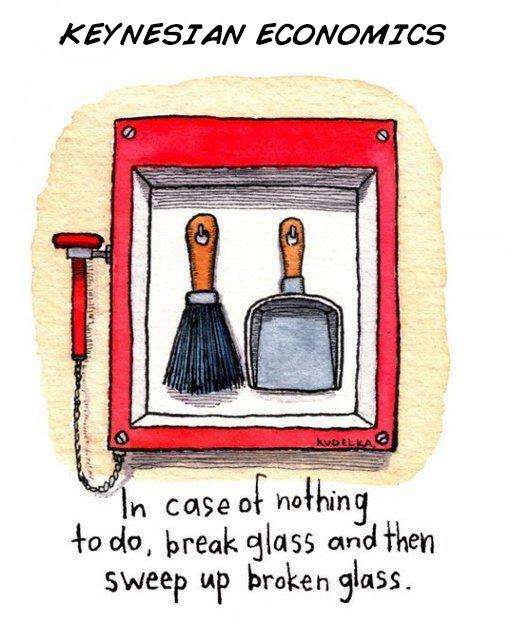
Break GlassPerhaps the better, more descriptive term is “educated beyond one’s hat size”
I like to say that people who are, while educated, lacking in real wisdom, are educated beyond their hat size. What I mean is that they do not possess the ability to apply their education to the real world. They are, at times, lacking common sense, and do not, apparently have the capacity to accept simple truths. These people are too enamored with nuance. I have worked with such people. Yes they are intelligent, well educated, but they can never seem to grasp that the solution to a problem, or the answer to a question might be the simplest one available. Maybe to them, simple always equals stupid. Their addiction to over thinking and over analyzing everything prevents them from accepting that some things just are what they are.

This is not to say, of course, that every answer or solution is simple, but often times they are. Our Founders had great wisdom. Yes, they were thinkers, that IS part of being wise. But wisdom also comes from accepting simple truths. Truths that are self-evident. Truths like we are created with certain rights, and simple truths like people are best left to do for themselves in most situations.

The entire science of economics seems to be educated beyond its own hat size, at least the kind practiced by Yglesias & friends. When the people educated in the theory struggle to reconcile it with the reality that has just dealt it a blow, and the people not so versed in the theory (or who don’t give a rip about it) are left on the sidelines, like me, going “Yeah, that’s what I’d expect to see happen, what’s the problem?” then the theory is not only ripe for a re-think, but it’s getting in the way. Yeah, less wealth, lots of people less wealthy, wealth has to do with the ability to afford something — so there’s less affordin’ goin’ on. Uh, like duh…so now, you’ve got some economic theory that says it shouldn’t be happening? Well, go off in your garage and twiddle with that there, Sparky.

It seems there is a blind spot with regard to the “free” in free-market. This is the dangerous thing about red-dot science; this notion of “If I wish for it hard enough, it will happen that way” contaminates not only the unified, big conclusion to be drawn about something, but the finer, more detailed conclusions as well, like transactions within the market. What’s truly worrisome is the realization that the explanation is immediately available to anyone experienced in buying things. What can stop the sale from being made? Lack of money is only the first of many things; once you have the money, or credit, there is a level of need to be evaluated. The proposal may involve an expenditure that is low, and therefore affordable, but if there is some alternative available then there will be a path-of-least-resistance factor. The liquidity of the cash reserves is an asset, just like any other, so that may factor in. And last but not least, there is consumer confidence.

The science of economics being evolved and refined as it is, it takes all this stuff into account. But these fine educated minds drawing their conclusions about will happen, don’t necessarily weigh it all correctly — it is, when all’s said & done, a science dedicated to predicting what total strangers will decide to do. Therefore, there will always be doubt in this particular scientific discipline. It’s not like astronomy, or history, in which there is some precise truth to be measured and the thing being refined is our measurement of it; economic theory either takes all the meaningful variables into account, or else it does not, and if it does not then it’s worth about as much as that wet paper filter I have to go change out of the coffee pot in the kitchen just now, and maybe the used coffee grounds within it.

And when reality steps in to let them know they biffed it, which should mean something…it is reality that must yield, say they.

People educated beyond their hat size scare me, especially when they turn their enthused scrutiny and loud opinion-making toward economic matters. It tends to emerge that they have this weird vision of employment: Good things come after it, but the employment itself, in turn, comes after bad things, so if we want more of this employment we have to make bad things happen, like Godzilla wrecking an entire city or something. The excessive “super-practical” education, if you will, seems to interfere with envisioning employment as what it really is, which is services activity associated with an ownership entity attempting to fulfill some kind of a mission…the mission being either obligatory, as is often the case in the public sector, or creation of wealth (and/or hedging against the loss of said wealth) as is generally the case in the private sector. There’s something in the over-educated mindset, that they just can’t see it that way.

Five Ways Liberalism Destroys Virtue

Saturday, July 14th, 2012

John Hawkins briefly summarizes each of the five, in reverse-order Letterman style, kicking off each tiny essay with a salient quote.

Commenter suz summarizes even more briefly, one line apiece:

5. they’re horny, they know everything and their [sic] going to live forever…so that works out;
4. the inability to see themselves as flawed;
3. lazy and whining snot-nosed punks;
2. their inability to know the difference between having a free mind compared to sound policy — it’s all one and the same to them; and
1. completely void of all moral code.

To which commenter Carlos7 replies…

It all starts with #4.

And, based on my experiences “discussing” things with some of the more intransigent ones, I would have to agree. That isn’t true of your beloved politically-uninvolved politically-unaware “Aunt Mabel” who just wants to do right by the impoverished and disenfranchised, and just hasn’t thought things out. But it’s true of the younger airheads registering for their wedding gifts at Obama’s web site; they, unlike you, were not descended of Adam and Eve who ate of the fruit, therefore they’re not flawed. You’re flawed because you cling to your guns bitterly, and believe in angels and what-not — they’re part of an evolutionary process gliding toward perfection a micron at a time.

The irony is, that while they’re running around being so much more science-y than you are, they’re missing out on a basic key component to evolutionary theory, which is: The progress is achieved solely by means involving birth and death. Each organism, and that means people, has its associated evolutionary stage carved into its DNA, flaws and all, and it carries those flaws from womb to tomb. That necessarily means that, no, sorry, Barack Obama did not become more “evolved” when He made up His mind that gay marriage was alright, and liberals don’t grow bigger brains with extra lobes the day they decide to become liberals, so you can’t transform overnight into the Jetsons, or the X-Men, or those aliens from Star Trek with extra big mushroom-shaped brainy veiney heads.

I think, deep down, they realize this already. That’s the source of the bile, the nastiness; they can’t separate from the riff-raff by means of this overnight-evolution, even though they’d like to, because they’re not happy with themselves the way they are. So snarking at those around them who don’t “believe,” is the next best thing.

Your Aunt Mabel who bakes the yummy sugar cookies, she’s a different story altogether. She doesn’t want this separation, she wants the opposite. But she’s not on topic because the subject is destroying virtue, and bless her heart, she still has tons and tons of it. She just has no idea what she’s talking about, that’s all — no way of knowing what a higher minimum wage or a stricter gun control law really does, and no way of ever finding out.

I thought there was something else special about #4, it’s the most quotable part of Hawkins’ column:

Liberals begin with the proposition that conservatives are unwitting dupes at best and evil at worst while other liberals are on the side of the angels. This leads them to excuse just about any and every behavior from killing cops, to terrorist bombings, to treason as long as the perpetrator has the right beliefs and is useful to the movement. When you think that the only real crime is disagreeing with your ideology, you can make a hero out of a drunken, disreputable coward who left a woman to die in a tidal pool or even come up with justifications for why it’s fine for the Department of Justice to help Mexican cartels get weapons they used to kill more than 300 people as part of some misguided political stunt to encourage gun control.

Precisely.

When a liberal does something wrong, you can probably find lots of other liberals who will say “that was wrong,” but to a man, they’ll all insist on sticking that word “but” after the word “wrong,” followed by some obfuscating and distracting filibuster. That’s a consistent formula: Fellow liberal + “that was wrong” = filibuster. They can’t ever, ever say “that was wrong” and just end the sentence right there: end of sentence, dot, new paragraph, new topic. That’s completely out of the question. Against the rules.

Peace and Quiet: Trigger the Vote

Saturday, July 14th, 2012

This has been out there awhile, but no I hadn’t seen it before.

Credit goes to Generational Dysfunction, a blog which has since shut down.

If You Don’t Want More Voter ID Laws, Stop Registering Dogs and Dead People

Friday, July 13th, 2012

Assoc. Press, by way of AJC:

The voter registration form arrived in the mail last month with some key information already filled in: Rosie Charlston’s name was complete, as was her Seattle address.

Problem is, Rosie was a black lab who died in 1998.

A group called the Voter Participation Center has touted the distribution of some 5 million registration forms in recent weeks, targeting Democratic-leaning voting blocs such as unmarried women, blacks, Latinos and young adults.

But residents and election administrators around the country also have reported a series of bizarre and questionable mailings addressed to animals, dead people, noncitizens and people already registered to vote.

Brenda Charlston wasn’t the only person to get documents for her pet: A Virginia man said similar documents arrived for his dead dog, Mozart, while a woman in the state got forms for her cat, Scampers.

“On a serious note, I think it’s tampering with our voting system,” Charlston said. “They’re fishing for votes: That’s how I view it.”
:
The group at the root of the questionable mailings — the Voter Participation Center — acknowledges that the databases it uses to contact possible voters are imperfect because they are developed from commercially collected information. The group also says it expects people who receive misdirected mail to simply throw it away.

Several election officials said they believed the voter registration systems were secure enough to catch people who might improperly submit the misdirected documents.

But administrators in New Mexico, a potential swing state in the 2012 presidential race, warned that ineligible voters who complete the documents could make it onto the rolls.

Summing it all up: The whole thing is on the honor system. If you’re not eligible to use these materials, then don’t…wink wink, nod nod.

And then when some effort is made by Republicans or anybody else to get more laws on the books to check the integrity of the election process at voting time, which is when it really counts…democrats and their supporters presume the worst. Without any evidence at all. Honor system, again, but working in the other direction. Honor system all the time. Or more simply: Argument based on emotion and not reason. I can envision the GOP engaging in a premeditated effort to disenfranchise minorities from the voter rolls based on pure racial animosity — that must mean, since I can envision it, that’s what they’re doing.

Well let’s think about this. There’s this theory…or narrative…or perhaps the most accurate term to apply would be “excuse”…the registration form reaches someone who is not eligible to vote. And with this “honor system” in place, the eligible person will say “Hey, this isn’t right! I’m not eligible!” and throw it all away. All of the time. Alright…now, if you think for some reason there might be some holes in that particular part of the process, you don’t need a bigoted racist Republican to push for a voter ID law, it’s actually a sensible conclusion to reach. Don’t our democrat friends say exactly the same thing about arsenic in the water? There’s a standard to be applied, the input falls short of the standard, so the standard has to be reinforced somewhere in the system before we get to the output. Right?

The same is true of any system with an inflow, and and outflow, and a standard. Somewhere the standard has to be applied, or else there isn’t one. This isn’t a left-wing right-wing thing, it’s something that simply is.

So the democrat position, from what I’ve seen around the innerwebz, is that you have to oppose voter ID laws with every fiber of your being or else you’re a racist. Because you don’t have proof of any shenanigans that meet the daunting standards of the democrat who is calling you a racist. How, without some voter ID process in place, would you meet that standard of proof? The mind boggles. I suppose, you’d make a point of catching every hundredth or every tenth or every third voter in a great big net…apologize to them for the inconvenience, take them back to a lab and check their credentials. Short of that, the voters are in & out within five to ten minutes, hopefully they are who they say they are. In my polling place, the only time I talk to anybody is when I say “Yup, that would be me,” and then at the end of it when I get my “I voted” sticker.

And yet, when these registration materials are mailed out to dogs and convicted felons and fictional people and dead people, it’s all on the honor system…so…where…

Eh, well. There I go again, applying a process of reason to an argument that is based on emotion.

Whatever Happened to Occupy?

Wednesday, July 11th, 2012

Daniel Greenfield, FrontPage Magazine:

Yesterday I took a walk down to the oldest part of New York City, where the Dutch landed and planted their flag near the current location of the Staten Island Ferry, where George Washington stood his officers rounds at Fraunces Tavern, now filled with Wall Street types, and where a bunch of smelly hippies stirred by an anti-Semitic Canadian magazine decided to squat a park in order to make a statement about their own need for attention.

Zuccotti Park has returned to its original function as a place where secretaries, construction workers and off-duty cops go to eat quick lunches bought from local fast food places or disease-ridden Halal Mafia food carts. The few plants wave in a breeze that blows between the narrow lanes of the financial district, which has some of the oldest and narrowest streets in the city. An information desk for OWS is the only sign of the occupation, with cardboard signs denouncing the NYPD and sarcastically informing the Indian and Russian tourists taking snapshots of the under-construction Freedom Tower; “And to think these ‘People’ are the ‘Heroes’ of ’911′… Right.”

Occupy Wall Street has gone east, one block east. It no longer occupies Wall Street, instead it has transformed into Occupy Trinity Church. The media, which served as the unofficial PR corps for OWS, is not too enthusiastic about reporting that a movement which they hailed is busy trying to seize land from a historic Episcopalian church that dates back to 1697, in whose cemetery lie several signers of the Declaration of Independence and several delegates to the Continental Congress, not to mention several Revolutionary War generals and a fellow by the name of Alexander Hamilton.

Trinity was also an enthusiastic supporter of Occupy Wall Street, providing them with bathrooms and private conference rooms, but turning over Duarte Square was asking too much. After being evicted from Zuccotti Park, the OWS crowd assumed that they could bully Trinity into giving them the land with the “fact of their occupation.” Instead Duarte Square, named after Juan Pablo Duarte, a founder of the Dominican Republic, has become OWS’s Waterloo.

Despite several attempts to occupy Duarte Square, Trinity Church has held firm. After half a year, OWS has made less impact fighting Trinity than it has fighting Wall Street.

When I passed by, the sad remnant of Occupy Trinity Church was down to three people, one of them sitting with a plastic bucket designated for the “OWS Laundry Fund” and another with a sleeping bag marked “Occupied.” A cardboard sign proclaimed that Trinity Church had stolen Duarte Square from the Indians and should give it back to OWS, as representatives of the native peoples.

One sign accused Trinity Church of greedily sitting on 200 million dollars while refusing the homeless trustafarians of Occupy Wall Street a small measly strip of land for their campsite. On its websites, OWS has blasted Trinity for being aligned with the “1 percent” and spun conspiracy theories about its parish vestry, which they allege holds over 10 billion dollars in real estate assets.

More on the Occupy Trinity Church movement

Yesterday, demonstrators marched outside Trinity Church with signs reading, “Who would Jesus prosecute?” and “Trinity Church: Real Estate Company or Church?” in reference to the business practices that critics, and exiting board members, say have eclipsed the religious organization’s holy mission. One demonstrator, Jack Boyle, “has been on a hunger strike since May 23 and has denied himself his HIV medication since May 19, trying to appeal to Trinity’s sense of humanity, demanding the charges be dropped,” according to an organizer.

Yes, by all means let’s dismantle our existing economic system and replace it with a new anarchy, in which people demand things and appeal to the “sense of humanity” of others…threatening not to stop hitting themselves in the head with a hammer until they get what they want. Food, shelter, water, gasoline, oh and don’t forget the Starbucks Caramel Macchiatto.

Actually, the analogy doesn’t hold; a guy hitting himself in the head with a hammer doesn’t pose a threat to anybody else, but an HIV patient refusing to take his medication…

Curious posting in the comments —

I totally supported OWS, but if it was my lot I wouldn’t want them there, either.

Um, what?

Actually I think that sums it all up; that’s why the movement is no longer around. We have these people who are not in it, who “totally support” it from without…I’m reading that as, they are part of the middle class, maybe even upper class, people of property who support the effort to dismantle our system of property rights and property exchange. But only for others, not for themselves.

Occupy was not a movement, it was a manifestation. As a “movement” it hasn’t really gone anywhere. It remains among us, in the hearts and minds of those who think it’s possible to find a halfway compromise between order and anarchy. Maybe we can have a quasi-socialist system, kind of a halfway-capitalist utopia.

Their credo, although they will not admit it, is to honor and respect the right to accumulate and own property as long as it’s about me, me, me, me, me…and then, for everybody else, we have to put some system in place inimical to the property-rights thing, that distributes all the goods equally, therefore all the misery. But keep me, me, me out of it because I’ve got mine, mine, mine.

Help those people who don’t have anything…but not with my wallet, just tax those other people over there, and get it done. So I can claim credit for having supported it even though it’s somebody else’s money that was given to those poor people. Oh, and hire some government bureaucrats to do this dirty-work of robbing & giving, so that if it all turns to crap I can claim non-involvement. Decades ago it was joked that a democrat is someone who’s nice enough to give you the shirt off someone else’s back — it never was a joke, and it never changed, it surfaced from a murky ocean, via Occupy like a vile and detestable sea serpent so we could catch a glimpse of how well it does not work.

It is false, cosmetic charity. It is vanity. It is a big fancy bundle of all sorts of strain of human sin. It is modern liberalism. Things will improve when we reject it, society-wide, and continue to deteriorate as long as we tolerate it.

“Regular People Should Decide Elections”

Tuesday, July 10th, 2012

His Most Unifying Holiness wrote to me again, under the subject line of “RE: I will be outspent‏.”

Friend —

We’re getting outraised — a first for a sitting president, if this continues. Not just by the super PACs and outside groups that are pouring hundreds of millions of dollars into misleading ads, but by our opponent and the Republican Party, which just outraised us for the second month in a row.

We can win a race in which the other side spends more than we do. But not this much more.

So I need your help. If you believe that regular people should decide elections, then please chip in $3 or more today.

This isn’t about me or the outcome of one election.

This election will be a test of the model that got us here. We’ll learn whether it’s still true that a grassroots campaign can elect a president — whether ordinary Americans are in control of our democracy in the face of massive spending.

I believe we can do this. When all of us chip in what we can, when we can, we are the most powerful force in politics.

But today is the day to prove it. Donate now:

https://donate.barackobama.com/Outraised

Thank you — for everything you’ve done before and everything you’re doing now. It matters.

Barack

I must say I’m perplexed by the cognitive dissonance: “Barack” is bringing us all together, by declaring some among us deserve to have a voice and others do not. Habitually, I write this off to the two contradictory messages being spaced sufficiently far apart that the average Obama fan’s attention span has been exceeded. But here they both are, big as life, within a relatively brief shakedown letter from the President…”We’ll learn whether it’s still true that a grassroots campaign can elect a president — whether ordinary Americans are in control of our democracy in the face of massive spending.” It seems to be lost on whoever wrote this, that Americans are in control of the democracy through the massive spending.

Michelle Malkin had a gigglesnort moment about this, and she was right to so indulge, for was it not just four years ago we were told what a super-duper mega-awesome champion of these “ordinary Americans” Obama was, because of the historical magnitude of His campaign war chest? Three quarters of a billion dollars or so…now how is that 2008 war chest to have been described, if not with the word “massive”?

Is it only “massive” when it belongs to the bad guys?

Well, not much detail is required where there is not much curiosity applied. And if there is one thing about which the Obama-loving community lacks curiosity, it is about who their enemy is. Is it people in America who can make money? Are they the enemy? That would make sense; the way the economy has been doing lately, it does look like there’s someone in charge, who believes it’s a problem when Americans make money. That would explain quite a few things.

My one-line reply:

“Regular people should decide elections”? I’m confused; who exactly are the non-regular people you have in mind? Aren’t we ALL supposed to have a voice?

The Planet is Fine

Monday, July 9th, 2012

Worth posting again, just because.

It’s sad, you know…George Carlin tried so hard to be a proper lefty-nihilistic hippy-dip. For a lifetime. And because of this hard-whiplash eco-friendly leftward-lurch the country’s been doing since the first run of this routine of his, his immortal words come off now like talking points straight out of a GOP convention.

Sounds a lot more Republican, in fact, than the average corporate marketing campaign. Really. “Our peanut butter is friendly to the environment!”

I suspect it’s plenty enough to send the skeleton into a whirling-dervish dance.

Which, incidentally, the planet will survive just fine. Like the man said, the planet isn’t going anywhere. WE are.

Our Dysfunctional Relationship With Work

Monday, July 9th, 2012

Hat tip to Gerard.

Pretend History

Monday, July 9th, 2012

Burt Folsom:

Earlier this week, President Obama gave listeners a history lesson on why he was running for higher office. “The reason I ran for president,” Mr. Obama said, “the reason I ran the first time for a state senate seat [in 1996] on the south side of Chicago, was because . . . we had gone through a decade where people were working harder and harder but we didn’t see an increase in income. . . . Jobs weren’t growing fast enough. And the cost of everything . . . kept going up faster than people’s income.”

Was high unemployment, high inflation, and low growth what the U.S. was experiencing in 1996, or in the decade before that? No. That describes the 1970s–a decade of big government with price controls, the war in Vietnam, price fixing in oil, and massive inflation of the currency by the Federal Reserve. The Dow Jones Industrial Average, which topped the 1,000 mark in 1966, was at about 800 fifteen years later. The 1980s, however, began a change. We saw a more stable currency, tax rate cuts, decontrol of oil prices, and relative peace abroad (and the collapse of the Soviet Union).

In 1996, the year President Obama ran for the Illinois state senate, President Clinton downsized government through welfare reform. By cutting welfare benefits, the welfare rolls were cut by almost 50%, and President Clinton had budget surpluses his last two years in office. In 1996, the U.S. saw 2,500,000 new jobs created and only 3% inflation. Americans, contrary to the president’s statement, experienced massive job increases, and they watched their growing incomes outpace inflation. The U.S. economy had strong decades in the 1980s and 1990s.

So, why the pretend history? Because pretend history is the only way to make increases in debt and in the size of government appear to be the correct political move.

On Taxes

Monday, July 9th, 2012

Seeing a lot of nitwits out there, as the Bush tax cuts close in on their latest sunset, insisting that we need taxes to go up.

In response to this, wisdom, again, from my Hello Kitty of Blogging account:

An observation about the debate over taxes:

As is the case with some other issues, it is a more complicated matter than it should be to define the “moderate” position. In fact, this passion for higher taxes is not only out of the mainstream and extreme, but weird, strange and surreal. We don’t see it, because by the time you have taxes you have to have a government demanding it, and of course by the time you have a government you have politics muddying everything up.

But “my taxes are too high” is a natural, heartfelt, honest plea (whether something should be done about that, is the question).

“The taxes are not high enough” is not natural, heartfelt, or honest. It is an insincere protest. It is driven by a desire to please others, to pay someone back for favors received, lust for control over the resulting receipts, old-fashioned jealousy, or some combination among those.

Suppose we were to start all over again, and we had to take stock of what was needed. We would identify food, water, shelter, then hygiene, and then somewhere along the line we would say we need a right to property and a system of laws to maintain it…and we need to make sure everyone has enough to live, if they work for it. But we wouldn’t say “We have to make sure everyone is taxed enough.” You have to endure as a civilization long enough to get sloppy, lazy and silly to identify that “need.” You have to use technology’s gifts to drive a wedge between yourself, and reality. That is what is happening here.

I’m wondering if people understand what it says about them, as thinking people, when they insist tax cuts lead to the dissipation of jobs, and tax increases lead to job growth. “Tax” means to “deplete.” The dictionary defines the word as “a burdensome charge, obligation, duty, or demand.” It is something that, by necessity and often by intent, diminishes the thing upon which it is laid; that is what it does, and that is what it is supposed to do.

A nation having a debate about whether they need to go up, is a nation that is having a dishonest and contaminated debate. That’s us.

I’ve written previously about the meaningful differentiation between efforts involved in building and preserving things, versus the efforts involved in destroying things. There can be some difficulty involved in differentiating this, but it is worth the trouble, because it seems to me we as a species make our greatest and gravest mistakes when we bollux it up. It’s often a murky question. A sniper, for example, destroys something so that something else can be preserved. The terrorist he’s sniping, on the other hand, is trying to preserve something so that something else can be destroyed.

There can be no question that a tax raised to a higher level than what is needed, has a destructive effect; and there can be very little question that this initial destructive effect is a net effect, once the loot flows into the government coffers it is unlikely in the extreme that there will be some creative process to offset the destruction. (If there is one, better-than-even odds it will have something to do with hiring more IRS agents or something of the like.)

Once again, I see our national discourse has become, as I said, contaminated; we have permitted something to become a part of it, that should not have been so allowed in. When a wife says to her husband “I have a problem with that new dishwasher, we did not pay enough for it” that is grounds for divorce, is it not? It is, right? No? Well, I guess maybe I’m in the minority on that one…nevertheless, I’m right. A wife who pushes for a household to spend more money on things, is analogous to your stockbroker pushing for your profits to be lower, or for a general doing what he can to make sure more of his troops are killed.

The same is true for pundits and politicians pushing for taxes to be higher. If your agitation is toward more destruction, why are you part of the process? You don’t belong in here. Debates about taxes are debates about more bang for the buck. We don’t need people to be part of the discussion, who are trying to make things cost more. It’s as simple as that.

This Is Good CII

Sunday, July 8th, 2012

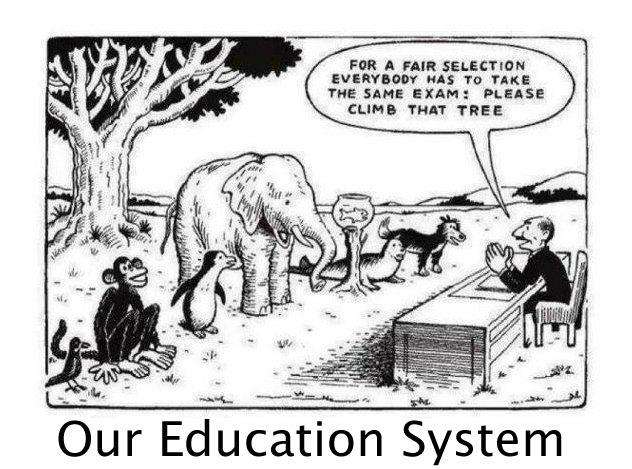
Yup, prettymuch.

It’s a good vision to have if “climb that tree” equates to a hard and fundamental skill that has something to do with being productive in society. The problem comes up when the test is applied to other things that aren’t so essential, that are personality-driven and developed (or not) before the school years even start. That’s when it starts to become as absurd as asking a goldfish to climb a tree.

Boortz’ Link-Whore Filter

Friday, July 6th, 2012

Neal Boortz is working on a Unified Grand Theory on why people vote democrat:

Scientists, for instance, have been looking for a grand theory of the universe; some theory that would completely answer all questions regarding the formation and operation of our universe from day one to the present.

Well I’ve been looking for theory – some grand theory – to explain why people vote Democrat. Why, in this election, would they vote to retain a ruler dedicated to the proposition of “fundamentally transforming” the greatest nation, the greatest system of governance, into a centrally governed behemoth destructive of liberty and everyone’s sense of individualism. Just WHY would people vote for this guy?

Some people will vote Obama because he’s a Democrat and they’ve always voted Democrat and that’s just the way it is. Others will vote for Obama because they’re black, he’s black, and they’re going to vote for the black guy. Period. End of story. Others will vote for him – and this is getting closer to the Unified Theory – because they think he will put more money in their pocket than the other guy. And then there’s just pure mental illness to consider.
:
…I think I’ve found it. Here it is:

People vote for Democrats because they believe that Democrats will give them access to other people’s money.

I’m working on this theory .. ironing out all of the wrinkles. Soon I’ll write my paper and submit it for peer review. I’ll keep you posted.

Hey, he asked for feedback. So Morgan The Lurker signed in, and posted a rebuttal.

It’s true, and you’re on the right track, but it falls short of a Unified Grand Theory because there are some people voting democrat, thoughtlessly as all the rest, who really don’t care about money…If there are many case studies that fall outside your UGT, then it doesn’t work as a UGT.

Thing I Know #401 says: “People who refuse to work with details don’t fix things.”

I believe this comes closer to that for which you are seeking. Voting democrat, is all about going through the motions of fixing something, without working with any of the details. You see a lot of this behavior with complex appliances, such as personal computers: “Oh I don’t know what this thing is doing, let’s just get rid of it and go Apple.”

I’m sure you’ve noticed some people take great pride in going the other way, figuring out the motherboard is the problem or the memory is faulty, replacing only the troublesome part and keeping the rest. Well, a lot of other people take pride in the opposite: Replacing the entire thing, “solving” the problem without learning the tiniest detail about what was amiss. Lots of people go through life that way, fixing things without really fixing things.

And, yes, you’re right, a lot of them would like your money, too. But my UGT explains your UGT; that is the evolution of the thought process.

Sadly, Boortz’ website stripped out the <a href=""> HTML tag, so the “Thing I Know” linky goodness didn’t find its way through. Which, in addition to making my comment look a little bit silly, is Boortz’ loss; four hundred things represents a lot of stuff worth knowing.

But the facts back up what I said, I think, and it does fall within the Architects and Medicators split. Some people see a complex system is not functioning as it should, their first impulse is to start testing the simpler components to find a root cause. They’re frustrated if they are prevailed upon, by some higher authority or perhaps by a looming deadline, to throw it all out. See, they’re in the middle of a lifetime process of building a knowledge base about how things break, so they can continually accumulate and refine the skills involved in fixing them. Others are more inclined toward the throw-it-out-start-again approach. It can be a challenge to pick them out when replacement makes sense — sometimes, replacement does not make sense, and you’ll find they’ll still counsel toward it, in fact their speeches and screeds start to grow in length when they have less to say. Ultimately, when they start repeating things they’ve said many times before, it becomes evident they’re just displaying their personality type, grasping for an identity. They want to become “Mister Throw It Out Guy.” Or alternatively, “Captain Change.” Remind you of anyone? It should…

Miller Lite Man

Thursday, July 5th, 2012

I didn’t know how to title this. It’s just plain good

From Thoughts and Rantings. Naughty language warning in effect (about eight seconds in).

Here’s some reading that would be helpful for the clue-challenged profanity-in-public-places edgy sunglasses guy…

…bitterly clinging to his non-religion.

“A Summer of Blockbusters Audiences Have Already Seen”

Thursday, July 5th, 2012

From Gerard.

As I said, I think Scott Adams is on to something here. And I’m afraid it’s gonna get worse before it gets better.

In the next year or two, we’re going to see a remake of this:

Parma, Ohio

Thursday, July 5th, 2012

Oh, dear…

The Daily Caller:

Protesters fought with supporters of presumptive Republican presidential candidate Mitt Romney during a speech by former Minnesota Gov. Tim Pawlenty in Parma, Ohio on Thursday.

Protesters chanted, “Pawlenty go home, Pawlenty go home,” as he took the stage before a 200-person crowd, according to Cleveland.com

A skirmish erupted when Romney supporter Richard Brysac, 77, confronted protester Al Neal, a 25-year-old union worker, by placing a bottle of water in Neal’s mouth.

“He seemed thirsty, so I tried to shove the bottle in his mouth,” Brysac told Cleveland.com. “I thought it was wrong to interfere with [Pawlenty’s] freedom of speech.”

After the bottle failed to silence Neal, Brysac attempted stuffing Neal’s mouth with a handkerchief.

Neal quickly removed the handkerchief and continued to shout until he was removed from the rally — which took place on private property at Kentown Plaza — along with other protesters.

Pawlenty reportedly maintained his composure on stage alongside several local Republican officials and Louisiana Gov. Bobby Jindal. Speculation persists about whether Pawlenty or Jindal are being considered for Romney’s running mate.

New civility?

Conservatives Fear Van Jones!

Thursday, July 5th, 2012

Says Ed Darrell, based on this clip:

Hmmm…

Patriotism:

devoted love, support, and defense of one’s country; national loyalty.

Liberty:

1. freedom from arbitrary or despotic government or control.
2. freedom from external or foreign rule; independence.
3. freedom from control, interference, obligation, restriction, hampering conditions, etc.; power or right of doing, thinking, speaking, etc., according to choice.

This Van Jones character can’t even survive a chance encounter with a freakin’ dictionary. His Orwellian use of words to describe things that are the opposite of what the words are classically intended to describe, becomes crystal-clear with a couple of quick virtual-page-flips.

Much like his former boss, come to think of it:

And how did America’s First Holy Pharoah, He Who Argues With The Dictionaries, come to be Van Jones’ former boss?

It came about as a result of Jones’ own idiotic comments:

White House officials offered tepid support Friday for Van Jones, the administration’s embattled energy efficiency guru, who has issued two public apologies this week, one for signing a petition that questioned whether Bush administration officials “may indeed have deliberately allowed 9/11 to happen, perhaps as a pretext for war.”

He believes in “liberty and justice for all”; apparently that means, making up a bunch of stuff and acting outraged. Go back and watch the clip again, that’s exactly what he does — tell you what the conservatives really mean, just take Van Jones’ word for it, then he acts all Hawkeye-Pierce-NPR-male outraged.

Just like any other penny-ante left-wingers…right before they lose.

So I don’t know. We get to read about Jones because of his connections, not because he actually won an election anywhere. Which is not to say he cannot win one. But let’s see that happen before we hold him aloft as the conservatives’ worst nightmare…on the other hand…if he does win an election, it’s clear to me he would be winning it on the basis of the constituents’ resentments, as opposed to any kind of emboldening and encouraging vision, which is an entirely different thing. He doesn’t seem to have built much of anything based on what I’m reading here. Just some “lawyer-referral service” to make a bunch of legal trouble for cops, that’s the only thing that jumps out…everything else in his entire biography is just making the right friends.

Thanks to America’s First Holy Pharoah, I’ve got a feeling that’s going to go out of style for an extended period of time — politicians elected on the basis of resentments. Vision-free politicians, smooth-talking, using words for the opposite of their intended meaning. Van Jones, running at the ballot box, would be buying a commodity high and setting up to sell it low.

Conservatives fear Van Jones? Please, please, do allow our progressive friends to go on thinking so. Just like libs to bring a knife to a gun fight. Sarah Palin would clean this guy’s clock.

Stupid Motivated People

Wednesday, July 4th, 2012

Just a Facebook comment…the GoogleGodz are not smiling upon my effort to locate an original source, or even evidence of replication:

I am reminded of a quad chart I was introduced to a few weeks back, apocryphally from Erwin Rommel, but who knows where it came from:

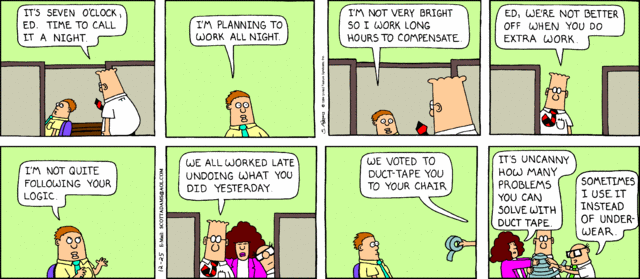
Duct TapeImagine two axes, of stupid/smart and motivated/lazy. This gives you 4 quadrants of [personality] types: Smart+Motivated, Smart+Lazy, Stupid+Motivated, and finally Stupid+Lazy.

Of the four, the worst for your organization is the stupid motivated person. Either Smart Lazy or Stupid Lazy people can at least be managed with supervision and the carrot and stick method works nearly as well on them as on anyone else. They still add value. When unsupervised, they tend to do nothing of note.

The Smart Motivated person does what’s right with minimal carrot and stick. They are self-actualized. They do what they do largely because it’s the right thing to do and they get a sense of accomplishment form it.

However, the Stupid Motivated person is too stupid to understand the incentive strutcure and respond to it appropriately. They must be supervised all the time- can’t even neglect them and expect them to stay neutral. They will do something positively stupid when left alone. [They] are the one[s] you need to eliminate from your organization at all cost.

Gee, hope that hasn’t been me.

Update: Come to think on it awhile longer, I think December of ’94 was right around the time I started my ≤40 hours “overtime is bullshit” rule. It’s just a simple, observed fact: If you’re working it when there’s no need, you’re already committing an error in judgment about as basic as any other, which sets up a real possibility that you’re this human-contaminant stupid/motivated guy…and hey, you know when there’s a need, it can almost always be traced to something that was done the wrong way. Which does nothing to address the current crisis, of course. But you can safely bet money that if the wrong-thing-done is accommodated, by way of heading off the impending crisis with this huge and noble investment of human effort and midnight oil, the wrong-thing-done will continue to happen. There aren’t too many exceptions to that, when all’s said & done.

I think we all have what it takes to be this stupid/motivated person, from time to time.

“So These People Become Our Slaves”

Wednesday, July 4th, 2012

This is Bill Whittle at his best. He explains the problem with the theory, front to back, patiently, for the benefit of people who can’t figure it out right away — but without becoming a condescending twit. Also, his logic is sturdy, straightforward…and unanswerable…which means, it will be dismissed of course.

But it should be circulated anyway. It’s a good day for it.

Maybe we should apply a special tax to anyone who still can’t figure it out…

My Tough Week

Tuesday, July 3rd, 2012

I suppose I should give my brother credit for providing a link to this stuff. I found this clip which is a perfect summary of ALL the things going wrong lately…(frowny face).

And then it got MUCH WORSE…

And it’s only Tuesday. Poor me, poor me.

Update: The way I see it, our brave state legislators are busy at work tackling the ultimate First World Problem. I’m guessing, from this, that all the bigger problems in our noble state have been resolved since they have time for this.

“Manufacturing Unexpectedly Shrank in June”

Tuesday, July 3rd, 2012

Uff-da, it’s like a bad opera.

The word “unexpectedly” is in both the headline and in the lead paragraph.

It’s a joke that done run out of steam in the blogger world…but in the “real journalism” world, it seems they haven’t even caught on to it yet.

Unbe-freakin’-lievable.

The Institute for Supply Management’s index fell to 49.7, worse than the most-pessimistic forecast in a Bloomberg News survey, from 53.5 in May, the Tempe, Arizona-based group’s report showed today. Figures less than 50 signal contraction. Measures of orders, production and export demand dropped to three-year lows.

Treasury yields fell on concern Europe’s debt crisis and a slowdown in Asia are taking a bigger toll on the world’s largest economy and hurting manufacturers like DuPont Co. (DD) and Steelcase Inc. (SCS) Assembly lines are at risk of slowing further as consumers temper purchases and companies cut back on investment.

“Manufacturing is gearing down,” said Neil Dutta, head of U.S. economics at Renaissance Macro Research LLC in New York, whose 50.5 forecast was the lowest in the Bloomberg survey. “It’s consistent with the idea that the uncertainty is weighing on businesses. Europe is taking a bite out of the export sector.”

There are some hopeful signs…but none that suggest this is any sort of real recovery.

From Instapundit.

“Healthcare Explained”

Sunday, July 1st, 2012

This would be the “I” in the “STACI” quintet of fail-points with progressive ideas…although this isn’t progressive, per se (except for the ObamaCare part), it’s just a fubar’d market built up by an overly intrusive henpecking nanny-state government.

Hat tip to Kate at Small Dead Animals.