



One of my Hello-Kitty-of-Blogging friends, knowing of my family’s struggles with the “fAuxtism Spectrum” racket, tagged me yesterday afternoon with this most-excellent video and I couldn’t “like” it hard enough…
But with things working all screwy for some reason, I couldn’t find the e-mail notifying me of it when I got home from work. It wasn’t showing up on my wall, I only knew there was this person and she tagged me with something. So I had to scroll through her own wall to find it. Where I came across something else I liked even more:
If you are a freakin’ Communist, get off my friend list. You are vile, disgusting and evil. Yes, I said it. Yes, I mean it. Go.
Apparently, that had already been done, because there was quite a conversation that ensued and it didn’t have any of the usual rot about “There’s no such thing as communism today because nobody today meets the dictionary definition, which is blah blah blah means of production blah blah blah.” Which, if there are any communists around to interject, that’s usually the first boring-bromide to be tossed into the conversation about communism. Followed shortly by “But it is nothing more than the elimination of classes! You’re not for the preservation of classism, are you?” Those are the two go-tos for communists who’ve been called out for being communists now: There’s no such thing as a communist, and each of us is obliged to be one.
Well, what do you expect from an economic model & political ideology that has to eliminate definitions in order to make itself look good.
Instead, what we saw here, was an enlightening collection of interesting observations. Although nobody outdid this person:
Yesterday, a few of us got together for bible study, and someone mentioned that a friend of theirs said to them that at this person’s church, they all get together and sew outfits for everyone in the church – the exact same outfit for everyone with only size variants – and this person said that they do it seasonally there, so that every season, they have a new assigned clothing item, and that’s what everyone there has to wear to church. This person in our group was talking about how great they thought this was, because then no one looked down on anyone else and they had this apparent unity, this, that, and the other thing, and no one was jealous of anyone else. And my pastor (God, bless him!) just says, “Yeah, that’s wrong. That’s really wrong.” And she was saying, “Well, yeah, but…” And he just kept with it, “But you can see how that would be dangerous? You understand what’s so wrong with that, right? You need to understand…” And he just ripped into it. He said such a thing causes love to be found in jealousy, and true love to run cold. He said a society or social structure which finds its foundation in jealousy encourages jealously, reaps corruption, and causes love to run cold. He said that was one of the most fundamental flaws of communism – that is left no place for genuine love. He got kind of fired up about it and went on for awhile about how communism destroyed the uniqueness, talents, insights, skills, and giftings which our Lord gives to each individual person. He said that it left no room for love, but cast it out for fear of jealousy, really only favoring increased jealousy and ungodliness. He said we have to love people as the people God made them to be and value their uniqueness rather than envying them and despising them and being jealous over what they have that we don’t and getting caught up in materialism. He went into how completely opposite Christianity and the Christian mindset communism is, and said how much the whole thing just repulsed him. He was just really getting worked up about it.
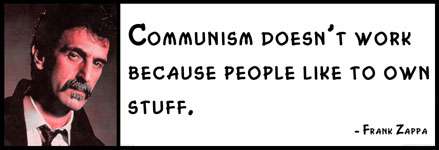 Someone else came up with a good question: What about moderate-communists? “Sane, mild-mannered communists”? And is there such a thing? Can there be? The time stamps say that this person was kicking off the “early shift” of sorts, the hubbub had died down for the night some six hours earlier as the night-owls finally retired for the evening.
So it was left to me to field that one.
Let’s think through on that, presuming charitably that there can be such a thing as a mild communist. The “Aunt Petunia democrat” does not want to control everybody else, doesn’t want communism to overrun the globe, doesn’t know that much about politics but has some opinions in which the intensity of her passions expand past the breadth of her knowledge. She has no jealousies, she thinks, but worries herself into a state of agitation about all the poor people, and how we aren’t doing enough for them.
“The rich get richer, the poor get poorer,” she says. OOPS. Already, it’s no longer about the poor people not having enough; she’s managed to transform it into a whole new issue, of the rich having too much! I guess crusading for the poor people having a better life gets boring after awhile…always more fun to crusade for stealing loot from the people who have it, playing “Robin Hood.” What did she forget before she got tired of helping the poor people? If you actually KNOW some people who are, or have been, desperately poor, you know “not having enough cash” was not the root of the problem. Someone in their family had a temporary but catastrophic physical illness. Or, a more permanent and mental one. Or they did. Or they lived beyond their means. Or maybe the heartless conservatives were right in this case, they, or someone in the household, didn’t respect the value of hard work. In all these cases, it isn’t accurate to say they’re poor because they don’t have enough cash. The cash comes from the work. And you can skimp when you spend it. Events can disrupt this, but aside from the catastrophic health crises, in three to five years those events are just memories. That’s how “let’s get the government involved in health care” was sold to us, the catastrophic health issues have the potential to disrupt the American dream like nothing else does.
So the bottom line is, there is no, or very little, reason for anybody in America to say to himself “The reason I’m poor, or that that other person is poor, is because that guy over there is rich; we don’t have enough because he has too much.” There is only ONE reason for anybody to say something like that: However long they’ve been trying to make anything better, for anybody, their patience with the effort has been exceeded, they”re tired & bored of doing it, and now they’re into destroying because it’s so much quicker, more gratifying, more fun. That’s the simple truth of it.
Four words explain most of the “unsolvable” mysteries we see in America today: “McCarthy was not wrong.”
Of course, there is a shorter answer: We already know from history that communism cannot tolerate a world, or any sort of geographic region, filled with a disparate assortment of nations that are & are not on-board with communism. It’s an all-or-nothing proposition. You have Country A that is communist and Country B that is non-communist, if there is a point of contact between the two then there is going to have to be a wall. Not to keep people out, but to keep people from leaving.
As the technology that birthed communism forces the world to shrink, such walls become ineffectual, so communism has two choices: Cease to exist, or take over the world.
Also, it’s based on an unworkable contradiction because it’s supposed to get rid of “Keeping Up With The Joneses.” Think about how the Pastor walked through all this. The jealousies are not going away just because you think you eradicated clothes, or whatever else inspired the jealousies. They will not disappear, or even recede a little bit, after they become the fabric from which your new society is woven, or the bricks from which it is mortared. Nothing that important can ever retreat. To the contrary, the jealousies will intensify, engulf, as everybody starts to tattle on everybody else. It’s quite unavoidable.
In fact, what is the ultimate consequence of keeping-up-with-Jones in a capitalist society? Everybody does it, everybody does the same thing, and yes sometimes individual pursuits will be discouraged for just a little while…then someone says, yeah but I’m not making enough at my job to make these credit card payments, so they stop. Or, they start a business or invent something. Maybe some combination of all these things. Meanwhile, in the Fatherland of Russia people are still waiting in line for toilet paper. The point is, “Keeping up with Jones” may be a silly activity at times, but one thing you can say for it is that it IS activity. It is effort. You can get rid of it by getting rid of effort, but ultimately that has to involve getting rid of achievement as well, since without effort there can be no achievement.
This is not theory. We’ve seen it play out like this a few times by now, and there isn’t any excuse left for failing to notice.
 1) If it wasn’t intended to offend you, then you shouldn’t be offended.

 While Indiana’s law includes language prohibiting the state from creating a “substantial” burden against an individuals’ exercise of their religion, Connecticut’s does not use the “substantial” qualifier. It reads that “The state or any political subdivision of the state shall not burden a person’s exercise of religion.”
 At the White House daily press briefing today, Press Secretary Josh Earnest criticized a religious freedom bill signed by Indiana Governor Mike Pence on Thursday.
 Boys are no longer judged by their developmental standards. We have lost sight of a very basic tenet of humanity, one that our ancestors understood since the beginning of time: girls are very different from boys. Boys with uniquely masculine strengths, once prized, are no longer valued. In fact, these traits of boyhood are considered dangerous, even pathological.

 The 5 Stupidest Ways People Try to Look Smart
 “Today’s decision by the FCC to encumber broadband Internet services with badly antiquated regulations is a radical step that presages a time of uncertainty for consumers, innovators and investors. Over the past two decades a bipartisan, light- touch policy approach unleashed unprecedented investment and enabled the broadband Internet age consumers now enjoy.
 Modern urban man is much too “smart” for religion. At least his own. He wants to add an ethical dimension to life without having to believe in anything except the sense of fairness that he already has, but which he does not realize is not nearly as valid objectively as it is subjectively in his inner emotional reality.