Archive for the ‘Poisoning Individuality and Reason’ Category

Time Machine Lunacy

Tuesday, January 23rd, 2007

It occurs to me that if one wants to be committed to a looney-bin, without lying about anything or deceiving anyone in any way, a time machine set to the right year will do the trick. The right year, and a carefully-selected tidbit of factual disclosure.

Hello good people of 2006! I’m from the future. Democrats are going to take over Congress, and one of the first things they’ll do is ask for direction from those whackjobs at DailyKOS. You think I kid! I’m as serious as a heart attack.

See what I mean? Off you go, and here’s your straightjacket. And yet…here we are.

Hello good people of 2005! I’m from the future. Democrats are blaming George Bush for hurricanes. Yes. They really, truly are.
Hello 2004! George Bush is thought by many to be the most “hated” President ever, and it looks like he is, even though he’s won more popular votes than any President in history.

It’s just awfully tough for me to believe we would be allowed to keep our freedom as responsible, sane people, after uttering such drivel. It all makes sense now; in fact, in some quarters you’ll be subjected to some form of verbal assault if you don’t go along with it. But we wouldn’t be able to explain it to the people of yesteryear. We’re like the frog sitting in a pot of water, raised to a rolling boil degree-by-degree.

Hello 2003! We have captured Saddam Hussein and he’s been executed; we’re having a lively debate about whether this makes the world any safer. The folks who think it was a bad move, have pretty much won the debate, even though they are never — ever — called upon to say what should have been done differently.
Hello 2002! Evidence has been produced that the people in the U.N. voting against an invasion of Iraq, are on Saddam Hussein’s payroll through the oil-for-food program. To the tune of billions of dollars. What are we doing to bring them to justice? Nothing. Actually, hardly anyone ever talks about it.
Hello 2001! I dunno what to say to you…just hug your kids. And may God be with you.
Hello 2000! If you give Republicans control of all three branches of government, Democrats will try their very best to win you back by…calling you a bunch of fucking goddamned idiots and hoping that will change your mind. Ultimately, it will.
Hello 1999! Don’t worry about President Clinton’s legacy. He’s doing more to try to hide it, than anyone.
Hello 1998! Arnold Schwarzenegger is the governor of California.
Hello 1997! Little kids are going to start performing oral sex on each other because the President said it wasn’t really sex. He’s going to stay just as popular as he is now, if not moreso.
Hello 1996! We’re debating about whether Saddam Hussein was ever a dangerous fucknozzle; the people who insist he was a harmless misunderstood old teddy-bear, are winning.
Hello 1995! We got a “Pelosi Revolution” that’s just like your “Gingrich Revolution.” It involved between a quarter and a third as many House seats changing hands, as what you just went through…but our media tells us it means far, far more. And you wouldn’t believe how differently they’re treating it. It’s working, too.
Hello 1994! Your “co-President” is going to get her husband’s ass handed to him in the upcoming mid-terms with her socialized-medicine scheme. It’s going to make history — and yet, twelve years later, she’s going to start pushing the same product all over again, running for President “in her own right.”
Hello 1993! I’m from the future. Your brand-new President is going to lie to you. About a marital affair. On television. Waggling his finger at the cameras…and I mean that literally. And then he’s going to get caught by his own spunk, spurted all over a blue dress. DNA tests and everything. He won’t be run out of town on a rail, in fact, there will be a cult following devoted to him and how he “got away with it.”
Hello 1992! James Bond is gone for awhile, but eventually he’s going to come back. But while you’re settling into this era of political-correctness and female-friendliness, I can’t begin to describe what you’re about to do to the White House.
Hello 1991! Saddam Hussein’s going to be left in charge. This will be proven to be the wrong decision. The United Nations will make every single mistake about him they possibly can, including — get this — taking billions of dollars in bribes from Saddam himself, to veto enforcement of Resolutions 678 and 687. And yet, I daresay, there is no one in my time who is opposed to the U.N., who isn’t also opposed to it in yours. Not a soul, so far as I know.
Hello 1990! In about five years, it will become highly fashionable for mens’ pants to slip WAY down so their butt cracks stick out. You won’t be able to get away from it, and it will remain highly fashionable for about a dozen years.

These things make some measure of sense to us because we’ve been acclimated to them slowly. They would make sense in no other time.

The Vast Power of Certification

Monday, January 15th, 2007

Well, I have personal reasons for stopping to read news like this. We live in an accredited world. You have to have a diploma to get work…at pretty much anything. When your father’s father became a man, people told him the same thing, and they were right to. Get that diploma, son. And so back then, success depended upon sheepskin…nowadays, it likewise does…it just seems logical to assume, every single day in between it was the same way, right?

Well, of course there is that problem with the early eighties, when we got an entire industry going by a bunch of college drop-outs. And the industry actually gave us stuff. That worked. That we use. That defined what a career really was, for millions of people, including me.

Some say I have formed a personal bias from a skewed perspective. They’re right. I’ve learned some things that I just can’t ignore. Back in the olden days, I was a high school graduate…and a “champion.” Not, as in, best of the best of the best — not that by any means. I’m referring to the old-school definition of champion. The Middle English version. You want your side to prevail, you pick a knight, and you declare victory or suffer defeat, based on the victory or defeat of that knight. I was that knight. Employers would dip into their savings accounts to give me paychecks, and to earn those paychecks I would sit down in front of a computer network and make it do what it was supposed to do. I was the “best bet,” college degree or no. And I set out to make sure it was a winning bet.

And so while I do have my personal biases, my real concern is what I’m seeing happening to business. I come from a time when those who made the decision to hire, had a personal stake in seeing things come out right.

Look what we got going on nowadays…

Are highly educated teachers worth the extra pay?
Those with master’s paid more, but studies cast doubt on benefit
06:53 AM CST on Monday, January 15, 2007
By ANDREW D. SMITH / The Dallas Morning News

Dallas-area school districts spend nearly $20 million a year on extra pay for teachers with master’s degrees.

The payments make intuitive sense: Advanced training must help teachers teach better.

But scores of studies show no ties between graduate studies and teacher effectiveness. Even among researchers who see some value in some master’s programs, many urge dramatic reforms and an end to automatic stipends.

“If we pay for credentials, teachers have an incentive to seek and schools have an incentive to provide easy credentials,” said Arthur Levine, a researcher who once headed Columbia University’s Teachers College. “If, on the other hand, we only pay for performance, teachers have an incentive to seek and schools have an incentive to provide excellent training.”

Count James R. Sharp Jr. among the defenders of the programs. The first-grade teacher in the Garland school district says his recent graduate studies at Texas A&M-Commerce in Mesquite improved nearly every aspect of his performance.

“I learned to maintain discipline. I learned to manage time. I learned to communicate better,” he said. “It was a tremendous experience.”

Yet a large body of research casts doubt on the value of master’s programs, of any kind, in the classroom. A roundup published in 2003 by The Economic Journal, a publication of the international Royal Economic Society, unearthed 170 relevant studies. Of those, 15 concluded that master’s programs helped teachers, nine found they hurt them, and 146 found no effect.
:
“We teach practical matters: curriculum, law, reading, classroom management,” said Madeline Justice, [Texas A&M] interim department head for educational leadership. “Students tell us wonderful things about our program.”

Asked if she knew of any studies that showed systematic benefits of master’s degrees, Dr. Justice said her school was conducting a study of its master’s degree students but that data had yet to be tabulated.

William Sanders, who pioneered many analytical techniques while at the University of Tennessee, has found no clear benefit of master’s degrees from any education school.

“I did one study that compared graduates from 40 different schools of education, everything from tiny no-names to national powerhouses,” Dr. Sanders said. “Each school produced great teachers, mediocre teachers and lousy teachers in roughly the same degree.”

Look, I’m not going to sit here and type in something to the effect that a Master’s Degree doesn’t mean anything. It seems like a given that someone who has one, has achieved something that has not been achieved by someone who does not have one.

But at the same time, it’s pretty easy to see how the Dallas-area school districts got here. The requirement for a formal education, is a requirement that tends toward absolutism. In other words, you insist this position over here be filled by someone with a degree, you have to insist that position over there also be filled by someone with equal credentialing. And then you insist on the same thing for that other thing over there too. Before you know it, everyone has to have the same degree.

And position after position after position is filled this way, with no one ever called on the carpet to account for how this helps to accomplish the job at hand. Yeah, the certified people are going to be performing at-or-above the level of the non-certified people…more or less. But from working with highly educated people, I’ve noticed something over the years: A problem one of them can’t solve, tends to be a problem many of them can’t solve. Their backgrounds tend to overlap to the extent that it becomes an occasion when someone “brings something to the table” that hasn’t already been offered by someone else.

Kind of like giving your children a narrow gene selection by marrying your sister.

But of course when the higher-education folk can do everything asked of them in their positions, that is fulfilled by someone without the same credentials, is that so wrong? I suppose maybe not. The article makes mention of some $20 million allocated for teachers with Master’s Degrees. I guess whoever’s paying that $20 million would be in the best position to answer that question.

But I think that explains my concerns. There is cost; there is lack of diversity. Real diversity, as in, diversity of backgrounds and diverse personal capacities to competently confront challenges that come with the position. Thing I Know #40 is “We are a tribal species, although we’re loathe to admit it, and when people extoll the virtues of “diversity” they tend to talk about skin color and nothing else.” Obviously, I’m talking about something else, and this goes unsatisfied when a department is packed full of people with degrees, when their positions don’t actually demand them.

And finally, there is the marriage between those who make the decision to hire, and those with a stake in having the requirements of the position filled well. Performance goals being met or exceeded. The unthinking insistence on degrees that may or may not be related to the demands of the position, tends to drive a wedge between those two parties.

For example, in hiring a zookeeper, most people would be unable to articulate just how a candidate’s application could be bolstered by a degree in…let us say…astronomy. But, hey. It’s kind of technical to deliberate that issue, isn’t it? We can’t burden our human resources guy with the chore of figuring out if astronomy has something to do with hosing shit off the floor of a bear cage. Maybe there’s some overlap. Maybe there isn’t — but we know it takes something to get an astronomy degree.

So once the job offer goes out to the guy with the astronomy degree, can the human resources guy who made the decision, really bet that he’ll make a good zookeeper? That’s the question. And the answer is…well, nobody knows. You see, the human resources guy isn’t betting that. What he’s betting, is that if the candidate turns out to be a lousy zookeeper, he will not be blamed. It won’t be his fault. See, he hired someone with a degree.

That’s a ludicrous example, since of course zookeeping is a far cry from astronomy. But it’s not that distant from…botany. Or climatology. Shift the degree to those, and it becomes more realistic. And the ramifications remain the same. The human resources guy, is effectively outsourcing the vital decision-making that he’s earning good money to do. He’s leaving it up to an outside source, in the form of the degree-criterion. It’s human nature to do this. You have to make decisions day-to-day, you find ways to take the decision-making out of it.

That isn’t to say I think higher education is meaningless. But I think it’s fair to say that sometimes, we get a little too caught up in confusing “certification” with “having accomplished something related to the job at hand.” So I’m not surprised that some studies have gone out looking for payoff from hiring teachers with Master’s degrees, and have come up a bit empty.

After all, you probably don’t have too many people ready, willing or able to say, “THIS is how a teacher with a Master’s degree is going to do a better job than a teacher who doesn’t have one.” Yeah, you’ve got James R. Sharp. And I’ll wager everyone in his position, is going to say the same thing. He’s simply saying he had an experience that makes him better at his job. Hell, I’ve had lots of experiences that made me better at every job I’ve ever held. That’s what experiences do…formal ed, or other.

That doesn’t mean a prospective employer is going to come out ahead, by insisting every candidate have the same experiences. If they were to do such a thing, an honest study would come to the conclusion that employer had effectively been wasting money. And it looks like that’s what has happened here.

But there’s more…

“America has 3.2 million teachers who together make up the nation’s most powerful political lobby, and more than half of them hold master’s degrees. They’ll fight for that money,” said Kate Walsh, president of the National Council on Teacher Quality, a Washington-based nonprofit that funds and reviews education research. [emphasis mine]

Ah…there ya go. Read back up at TIK #40. We are a — what? Tribal species, although we are loathe to admit it. It’s demonstrated that a big chunk of this “money for people with degrees” thing, is nothing more than “I want everyone to be exactly like me, and if they aren’t I just want them to go away.”

Again, it’s just how we work. Human nature.

Saddam Hussein’s Last Negotiation

Monday, January 8th, 2007

On Saturday I was citing a Gallup poll that says — essentially — none of us trust the media reports from Iraq. I would argue this is about the only correct decision people are making on a large ocean-to-ocean scale nowadays. We’ve come to realize the reports from Iraq are saturated with unsubstantiated, personal opinion from those who bring them; more often than not, the bias is apparently injected without the conscious knowledge of those who are the source of it. It seems Iraq would be a big mystery-land, a “Dark Continent” of sorts, save for one thing and one thing only. It has to do with everyone having an opinion about what to do about it. None of our politicians seem sufficiently talented to shape these opinions into a course of action that will appeal to a critical mass among us — it looks like a chore not unlike building a castle out of dry sand. And, among the individuals, what to do about Iraq is a matter of principle. And so, with the vortex that appears between those three forces, we have a situation where we “know” what to do about it, without achieving a good understanding of what’s happening there.

Some of us believe in making any conflict go away by simply ignoring it, and thus setting an example for those engaged in the conflict. Others of us believe this is foolish. We believe in Churchill’s definition of “appeasement”: “An appeaser is one who feeds the crocodile hoping it will eat him last.”

And that brings me to Deb Saunders’ latest. She’s noticed, about Saddam Hussein’s execution, exactly what I’ve been noticing. We have all been instructed to believe it was “botched.” By contrast with an American execution, Saddam’s last public performance had some chaotic elements to it that could inspire a reasonable observer to think it was botched, but it’s oversimplistic to simply ponder whether the adjective applies. It’s disingenuous. Saddam’s execution was pre-botched. Those who tell us it was botched, were ready to tell us this, breathlessly, probably since Saddam was wrestled out of his spider-hole.

These days, the first rule of war coverage is that nothing — not even military victory — will improve Iraq’s prospects.

The second rule is that everything is botched. So Hussein’s trial was not fair, the appeals process was too swift and the execution was insufficiently solemn.

In the 24-hour news cycle, you can kill your own citizens with impunity, subject them to starvation and lead them into an avoidable war. But, if later you are brought to justice, coverage of your trial will be not so much about the carnage as about the “deeply-flawed” trial.
:
Indeed, critics are so busy trying to transform Iraqi prosecutions into an O.J. Simpson trial that they fail to notice that the families of Kurds and Shiites who were tortured and murdered for rebelling against Hussein now know that the Butcher of Baghdad can no longer hurt them. That’s why there was dancing in Dearborn, Mich., home to a large community of Iraqi Americans who fled their homeland while under Hussein’s rule. Hussein cannot come back, as he did in 1963 after he fled to Syria and Egypt. He will never terrorize his countrymen again. He will hold no more power on this earth. Somehow, that’s no biggie.

Don’t ask me to explain it. I do think we have something broken in our system of reporting anything. The problem goes beyond Iraq. Those of us who are not in journalism, get to read things online and watch television and buy newspapers, and learn what’s going on from people who are in journalism — as they see it.

And they don’t see things the way “real” people do. It’s like the old joke where God decides to end the world, and they see women-and-minorities as hardest hit. Superman himself could be swooping around Iraq fishing kittens out of trees, and they’d say that was botched too.

Why The Hatred

Sunday, January 7th, 2007

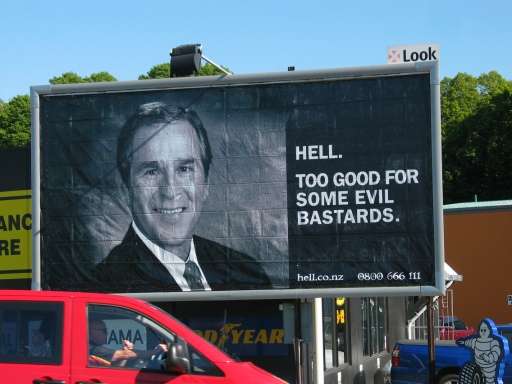
Not Going To Hell After AllPresident Bush is hated. I think it’s fair to say President Bush is the most hated persona to occupy that high office, probably since the office has been there. The time has come to ask why this is. In nearly four years following the invasion of Iraq, and six years after he took office, none of the explanations make any sense whatsoever. I have been repeatedly preached and scolded and counseled and upbraided and reproached, that I must do certain things and vote certain ways because this emotion exists. I think deep down, everyone agrees it’s unwise to do things because of emotions even when emotions are understood easily. The more I learn of this emotion, the more convinced I am that I don’t understand it, and I don’t think anyone else does either…even the people who advertise that they have it. A lot of people stand to gain an awful lot if they can get people like me to understand what’s going on here. And after all those years, no explanation has been forthcoming, satisfactory or otherwise.

Oh yeah, why I’m supposed to join the ranks of those who hate him — people tell me that. They have a catalog of reasons. They add to it whenever they think of something, and they seem to think there’s something wrong with reciting just a piece of it. The whole list must be rattled off. And replication must be instantaneous; if one Bush-hater thinks of something new, all the other haters must add it to their own catalogs. So I hear these items fairly often. But the thing I want, continues to be left out. It’s like an itch I can’t scratch. Why George W. Bush is a walking superlative in the history of hated-people…such a rich history that is…no one’s given any justification for this.

I’m going to try to do it here.

He got 3,000 American troops killed, they tell me. The notion that these deaths are really his fault, is subject to reasonable debate. The notion that, if he has some blame for these casualties, he’s going to have to share it with others — is something that can only be subject to unreasonable debate. A lot of people could have done a lot of different things, and those dead troops would be smiling and eating and laughing and joking and burping and farting like you and me. But allowing for all this anyway — we’ve had other Presidents who got many more troops killed. Many, many more troops. This is according to the same logic. They weren’t nearly as hated. So that’s not it.

He “waged an illegal and unjust war.” That’s a matter of opinion…but allowing for that, again, going by the same logic, we’ve had other Presidents wage illegal and unjust wars. In the minds of some, anyway. They weren’t so hated.

He’s pro-life. We’ve had other Presidents who were pro-life.

He’s from Texas. We’ve had other Presidents from Texas.

He is thought by some to have shirked his military duty. We’ve had other Presidents thought, by some, to have shirked their military duty.

He swaggers. We’ve had other Presidents who have swaggered. One of them was in a wheelchair.

He spies on people, in the process, alienating them from the rights to which they are guaranteed by the Constitution. That’s what I’m told. Is anybody going to advance the assertion that this is unprecedented? When President Bush is said to “wipe his ass with the Constitution,” this is a figure of speech…invariably, it is pronounced without a citation from the U.S. Constitution in mind that is being violated. Other Presidents BLATANTLY violated specific amendments and/or articles/sections. Unapologetically, and without precedent. That includes the wheelchair-guy by the way. They weren’t so hated.

The economy is lackluster. In America, the economy has been quite a few measurable notches below lackluster, and we’ve had sitting Presidents who were decidedly at fault for some terrible economies. We’ve had Presidents who actually wrecked the economy with their bad policies — economies that would certainly have done better if something different were done. We’ve had Presidents who were still in office when the chickens came home to roost and there was broad agreement about the link between the poor policies and the sputtering economies. President Bush is hated more than those Presidents were…so…we continue looking for the underlying reason. It’s clear we have not yet found it.

A lot of people say he’s a dimwit. That seems, at first blush, to be the answer; I rarely hear anyone confess their hatred of President Bush, without throwing in the apparently-essential scolding that he’s anti-intellectual and stupid. But there are problems with this. Throughout recorded history, if the human equation has shown one consistent sentiment toward simpletons wielding real power, that sentiment would be tolerance. Tolerance to a fault, actually. We can adapt to dimwit bosses, and as a species we have done so many times before America came along. Based on the information I’ve reviewed, if President Bush has managed to arouse bumptious demands for his removal from office based on his addle-mindedness, with all other motivations for the acrimony being decidedly subordinate, he’s made history. Human history. It’s really hard to make that kind of history. I don’t think that’s it.

He’s inarticulate. So was Lincoln, according to some contemporaries. Benjamin Harrison was characterized as speaking in an annoying, high-pitched squeaky voice. Grant was shy. Coolidge didn’t say much.

None of these Presidents were quite so hated.

I think, what it is, is he took a bad guy down. We’ve had Presidents do that before, too…but President Bush did it in the modern age, when good & evil are supposed to be matters open to individual interpretation. In an age where evil is supposed to be a subjective viewpoint…he targeted someone. He’s an unwelcome paradigm shift, and the shift is in an direction that makes a lot of people uncomfortable. Once you go down the road of insisting there is no such thing as “absolute” evil, you can stay there as long as you choose to…until someone else comes along, defines evil as being really evil, and does something about it. This makes the nihilist/anarchist crowd look bad.

It hurts their P.R. You stand there “helplessly” watching a house burn, you look okay. Someone else grabs a hose while you sit there on your ass watching…now, you’re embarrassed. If the other guy didn’t happen along, the house would have burned to the ground. But you’d look good. Nothing else really counts, right?

It’s like the guy watching a woman being mugged and raped, making a calculated, brazen decision to allow the attack to commence uninterrupted because it’s “not my concern.” Inaction resulting from purely pacifist interests. He looks all right…until someone else gets involved. And then the pacifist looks bad. And silly. And cowardly. And impotent. And then the pacifist begins to harbor some decidedly un-pacifist feelings, toward the other fellow who made a decision to help out.

Come to think of it, the anger these leftists have toward President Bush, is not at all unlike the anger felt toward a masculine, self-assertive, virile interloper, from a cuckold, whose lonely and bored wife has finally been reminded what a real man can do. It’s not unlike that kind of anger at all.

One exception, though. In our society, we do not value the idea of strong, effective men stealing women from weaker men. We do not raise our sons to sleep with other mens’ wives. We do raise our boys to stand up for what’s right; to get involved, to lend assistance if evil is sure to triumph for lack of that assistance. That is what President Bush did. I’m glad it was done, and history will be glad for it too.

To those who insist on hating him and continuing to build that reasons-for-hate catalog, I say, go ahead. Hate him if you want; hate him all you want. I think it would be good for your own mental well-being to identify, in your own mind, WHY it is you hate him. If you come up with the reason, and are too ashamed to admit to anybody else what it really is, you’re still better off than the guy who hates President Bush but won’t put the effort in to figuring out why.

Wish For 2007

Monday, January 1st, 2007

Happy New YearMay the road rise up to meet you.
May the wind always be at your back.
May the sun shine warm upon your face,
and rains fall soft upon your fields.
And until we meet again,
May God hold you in the palm of His hand.

Old Irish Blessing

I would update this to say, let us all stand guard against those who would erode our freedoms, under the guise of protecting us; and, from those who would expose our jugular to the blade of our enemies, under the guise of holding us to some inchoate standard of higher morality.

And if you can’t quite remember what we just finished up, thanks to Instapundit we have tripped across the traditional Year In Review From Dave Barry. I’ll just tease this by extracting…

NOVEMBER

… when [Senator John] Kerry’s “joke” causes widespread outrage, prompting Kerry, with typical humility, to insist that it was obviously humorous, and anybody who disagrees is an idiot. Kerry is finally subdued by Democratic strategists armed with duct tape, but not before many political analysts see a tightening of the race to control Congress.

As the campaign lumbers to the finish line, the Republicans desperately hope that the voters will not notice that they — once the party of small government — have turned into the party of war-bungling, corruption-tolerating, pork-spewing power-lusting toads, while the Democrats desperately hope that the voters will not notice that they are still, basically, the Democrats.

The first major casualty of the GOP defeat is Defense Secretary Donald Rumsfeld, who, the day after the election, is invited to go quail hunting with the vice president. He is never seen again. As Rumsfeld’s replacement, the president nominates — in what is widely seen as a change in direction on Iraq — Barbra Streisand.

In other celebrity news, Michael Richards, a graduate of the Mel Gibson School of Standup, responds to a comedy-club heckler by unleashing a racist tirade so vile that even John Kerry realizes it is not funny. A chastened Richards apologizes for his behavior, citing, by way of explanation, the fact that he is a moron.

Back to Sixth Grade

Thursday, December 28th, 2006

This blog, which nobody actually reads anyway, is one of the last places on earth where people are respected for knowing things — specifically, knowing how to do things. All over the civilized world, this respect is in a rapid decline. It is receding faster than my hairline. You doubt me?

Check out the word “qualified.” Listen real close the next time you hear it used. Does it have anything to do with ability…anything at all whatsoever?

No, nobody uses it that way anymore. “Qualified” no longer means you’re experienced doing things equal to, or greater than, the task to be done, and have made a success of yourself as you do that. That’s what it used to mean. Qualified, today, means you have some kind of accreditation. That would be bad enough if said accreditation had to do with demonstrating that you know things, but this has been corrupted too. Today, it has to do with holding the right opinions about things. Yet-unproven opinions. As in…you think boys are better at three-dimensional problems and girls have better social skills, you fail — you think boys and girls are equal in everything they do, you pass. Opinions like those. That’s what it takes to be what we call “qualified” for things now. We’ve become a rather pasteurized, utopian society, in which promotions to higher offices of trust have less and less to do with merit and competence, and more and more to do with ensuring people with good opinions outrank people with bad ones.

For an even more incandescent example, listen a little more closely next time you hear the word “unqualified.” A generation ago this would have meant someone was about to mention inexperience in whoever was unqualified. That’s no longer the case today. Again, it’s got to do with holding unpopular opinions…or failing to present credentials, which would have proven a candidate holds the right opinions.

And every once in a great while we see evidence of this problem, said evidence usually not quite as damaging as it could be, when you think about it. File this one under “cheap warning about where we’re headed.”

Talk about a high-stakes test. The radio audience was live and the question for teachers union president Randi Weingarten involved sixth-grade math: “What’s 1/3rd plus 1/4th?”

Weingarten, however, is a not a sixth-grader or a math teacher. She’s a lawyer and a union boss who once taught high school social studies – and no one told her there was going to be a quiz. “I would actually have to do it on paper,” she said when asked yesterday to complete the math problem on WNYC’s “Brian Lehrer Show” where she was a guest. Mike Pesca, who was filling in for Lehrer, introduced the show’s education topic by saying American college grads can’t do basic math while high school grads in Canada and middle-schoolers in India have no trouble.

After Weingarten stumbled, another guest quickly produced the correct answer: 7/12ths, leaving Weingarten to explain herself.

“I do it the old-fashioned way,” she said. “You take your paper, your pen, you add it up and get the fractional whatever.” “And you show your work,” Pesca offered. “And you show your work,” Weingarten agreed. “A good teacher will look at it and talk to you about what went right and what went wrong, like they do in Singapore.”

Math expert Alfred Posamentier, dean of the City College school of education, said most Americans can’t add fractions in their heads, leaving Weingarten in good company. “I hate to say it, but I would cut her slack on that one,” he said.

I wouldn’t. You know, just take a look at what’s happening here. It’s a case of one class of people, entirely abdicating their rights and responsibilities, surrendering them to be administered by a different class of people. The assumption in place is that these non-producing, life-and-death-decision bureaucrats know something that “qualifies” them to make these decisions. Everybody knows that isn’t really true; everybody understands it’s really about having the right names in your Palm Pilot. Nobody says that out loud, everyone understands it’s so.

And the President of a teacher’s union can’t do sixth-grade math.

Oh yeah, I understand that’s the way of the world. I understand the dunces are in charge, and we’re instructed to believe they’re oh so much smarter than everybody else when they’re really not — unless the name of the guy on top is George W. Bush, anyway. I know things have worked this way for a long time, and anyone who expects anything different, is simply showing their naivete. I get that. What I don’t understand is this:

Things are this way, because we put up with it. Why do we put up with it?

Best Sentence IV

Wednesday, December 27th, 2006

ShapiroI’ve never particularly cared for Ben Shapiro. The man is a good writer, but so are many others, and I always got the impression he was getting a lot of attention because of his pedigree, his educational history, and his age. The habit he has that gets under my skin, is to write about what he thinks is going on, and comment about it as if it’s an established fact. Now, in all fairness, everybody who writes about current events ultimately has to do this, over and over again. I try to sprinkle mine with “I can’t prove it, but” or words to that effect. To me, when I write about something, there’s a situation involved. The situation has become worthy of comment, because something has been left unexplained — so you start with what has been left unexplained. And within that, you start with what you know for a fact. Only then do you opine about what could be going on, to explain what has been left unexplained.

Shapiro seems to be opposed to this…which is fine, it simply means he is creating a product intended for consumption by others.

ObamaBut early his morning I was looking for an article on this weird phenomenon I don’t understand, called Barack Obama. Obama is a freshman senator from Illinois, a possible candidate for the presidency in ’08. He is a candidate the way Julia Roberts is a movie star: A good one, the evidence says only a good one and not a great one. But the hype says he’s more than great, he “walks on water” and he’s the “real deal.” NOBODY knows why this is, as far as I can see. To reason and common sense, he’s simply more articulate than our current President. And many others are that much.

And I was googling for an article that was wondering the same thing, and sought to explain it — the way I would have. I’m not sure I was able to dredge it up again; this thing in the Seattle Times has a few phrases that set of some bells. Maybe that’s it. But by mistake, I run into this thing by Ben Shapiro. Once again, Shapiro has it down cold, he knows everything. This is no great offense mind you — where he speculates, he speculates safely. And, again, other people are just eating his product up and demanding seconds, so that’s great. It’s just, once again, I’m seeing a younger man who hasn’t learned things about what-you-don’t-know-yet, that I’ve had to learn. He’s a living pictogram of lessons I’ve already been taught, that I have no desire to learn again.

But Ben Shapiro is becoming an excellent writer. He’s a better writer than Barack Obama is a presidential candidate; not just good, but great.

And hey, if he thinks he knows something about this Obama character that I’m just starting to figure out, there’s a pretty good likelihood that he’s right. I’m still more confused and befuddled than young Shapiro, so for the time being I’ll read what he has to say about Sen. Obama. Nothing, absolutely nothing I say, has come to my attention that would directly contradict the explanations Shapiro has to offer. And he seems to have turned that corner that aspiring writers sometimes turn, where his output actually becomes a source of education and entertainment at the same time. In that sense, he’s more senior than I am.

He has virtually no voting record; he has virtually no articulated positions. Ask his advocates, and they will describe him as “a breath of fresh air” — but ask them about a single position he holds, and they will stare at you as though you are speaking in tongues. They will tell you, however, that Obama “understands” every position you hold…Where’s the meat? It’s all well and good to campaign on the basis of “common sense” and “smart government,” as Obama did in his softball interview with Tim Russert, but no politician in history has ever campaigned on any other basis. Where does Obama stand? His own writings display the weakness inherent in his platform of “understanding”: If you profess to understand everything, you understand nothing. Not every conflict can be glossed over by “hugging it out.” Focusing more on “understanding” and less on questions of morality coddles the immoral.

Take, for example, Obama’s “understanding” with regard to our enemies in the war on terror. In his new introduction to his first book, “Dreams from My Father: A Story of Race and Inheritance,” Obama writes, “My powers of empathy, my ability to reach into another’s heart, cannot penetrate the blank stares of those who would murder innocents with abstract, serene satisfaction.” Except, of course, that Obama proceeds to “understand” those he has just dismissed, blaming terrorism on “the underlying struggle” between “worlds of plenty and worlds of want” — a neo-Marxist interpretation of the rise of Islamofascism. “I know, I have seen, the desperation and disorder of the powerless,” Obama writes, “how it twists the lives of children on the streets of Jakarta or Nairobi in much the same way as it does the lives of children on Chicago’s South Side, how narrow the path is for them between humiliation and untrammeled fury, how easily they slip into despair and violence.” This is a sickening comparison; even the worst inner city youths generally do not join up with Al Qaeda.

What makes him a good writer? Many things in this piece do, but this sentence stands out: “There is a thin line between being open-minded and empty-headed.”

Bingo. You nailed it.

Although my indictment against Mr. Shapiro stands — what it comes down to, is, like a teenager he’s “young enough to know everything” — this is not necessarily bad. In fact it can come in handy. People like me need people like him.

Here’s a case where I would like to apply the energies of one who is quick to figure things out, and slow to uncertainty: How the Republicans will handle Barack Obama should the freshman senator be nominated. With questions like the ones I have, it’s impossible to find the Achilles’ Heel of a given target; but I have high confidence Mr. Shapiro has identified it correctly. Senator Obama is weak. Weak is a one-syllable word, easily understood, with a primal meaning for those interested since prehistoric times.

I’m taking it as a mostly-established tradition, now elevated beyond any possible doubt, that the Republicans won’t use this against him. If they do, they won’t do it properly. To much of the electorate — especially those who re-elected President Bush in ’04, but voted for a Democrat Congress in ’06 — it is a highly relevant issue. Why is it, that the issue of Sen. Obama’s weakness on issues, will not be exploited?

Why will it not be discussed by the Republicans — not even to a tiny fraction of the volume and rage, with which Democrats excoriate George Bush for his public-speaking failures?

Have we reached a point where Democrats and Republicans agree, that the spoken style is everything, and positions on issues mean nothing?

This is still something I must conclude with a question mark. Other folks, Shapiro included, are far more certain about what’s going on. I’d sure like to hear from them.

The Last Milestone?

Tuesday, December 26th, 2006

Okay, so here is where we note that the death toll of U.S. servicemen in Iraq has just passed blah blah blah blah blah…

…those of you reviewing this much later on, the yardstick today is, the official Associated Press death toll of the September 11 attacks. Wowee, this is a really important occasion. Well you know, for those who personally knew the recently deceased, I’m sure it is. But not as far as U.S. policy. In fact I couldn’t help noticing the following…

The deaths — announced Tuesday — raised the number of troops killed to 2,974 since the beginning of the Iraq war in March 2003. The figure includes at least seven military civilians. The Sept. 11, 2001, attacks claimed 2,973 victims in New York, Washington and Pennsylvania.

“The joint patrol was conducting security operations in order to stop terrorists from placing roadside bombs in the area,” the military said in a statement on the latest deaths. “As they conducted their mission, a roadside bomb exploded near one of their vehicles.” [emphasis mine]

Yeah, a roadside bomb that was set by someone. Now, what did they want, I wonder? Could it be…propaganda? Because, yeah, I’m sure to a left-wing war protester it’s going to come as a huge shock that terrorists fight propaganda wars. But they do. And the fact is, that bomb had a purpose. It’s been settled for a long time now, that when the American media knows about something, the terrorists that our guys are fighting in Iraq, know about it too. And the media has been salivating over this “greater than the 9/11 death toll” thing since last week.

And so now that we’ve passed 2,973, news outlet after news outlet after news outlet plays it up. And let me guess…oh this is so hard to predict…if I dare to say this might have a positive effect on the endeavors of our enemies I’m going to be hit with a tidal wave of sarcasm, and I will become the latest evidence of the chilling effect, that those who dare to dissent are called unpatriotic. Right?

So thanks to sarcasm and paranoia, we aren’t allowed to think such a thing. Hey, there’s a chilling effect all by itself. But meanwhile, we know the terrorists want our anti-war protesters to win more arguments. We know this. It’s an established fact. And we know the roadside bombs are just a way to make this happen. That’s an established fact, too.

Well, I’d just like those who assign some special significance to this event, to highlight for the rest of us what it actually means. I’ll bet they can’t. What, Iraq is a failure in some “official” way now? If it is now, and it wasn’t before, then there must be some rule that the military death toll in a given engagement is not supposed to exceed whatever enemy attack somehow inspired that engagement. And yet we have no such rule, so that’s bullshit. What else? Anybody? Buuuueeeelller?

On the whole, the citizens of FARK have recognized this to be a bullshit milestone that means nothing. Let me repeat that…the denizens and derelicts that hang around FARK. FARK, where most of the account holders have never come up against something bad that wasn’t George Bush’s fault. Where people who haven’t been sober after 10 a.m., since they first started going to college nine years ago, spout off about George and Don and Condi plotting the September 11 attacks with the terrorists. Where the “thermite theory” of the collapsing towers, lives on indefinitely. Where Ralph Nader is the man best qualified for the White House, unless Rosie O’Donnell can somehow be pursuaded to run. On FARK…they see through this bullshit milestone.

Well, if they see through it, anyone can.

And yet, all the disgusting morning coffee-table “news” shows, are covering it wall-to-wall. The most common-sense insight you can use, is going to tell you the terrorists have been working their skinny asses of for this milestone for weeks, months maybe. Always working for the next propaganda push. And now that they’ve gotten it, the media is happy to oblige, and make sure the win is as big as it can possibly be. Only too happy. And none of this is going to stop at the water’s edge. Whatever renewed calls for “immediate redeployment” are issued as a direct or indirect result of this meaningless milestone — they will become public knowledge, all the world over. And, as always, the terrorists will watch what we do, refine their tactics, and re-engage, as they’ve been doing since Day One.

Just disgusting.

Yeah, we’re supposed to leave this whole process undisturbed because of the First Amendment. And yet…you wouldn’t be able to have this kind of “news” in World War II. And nobody seems to be able to explain to me how a constitutional passage ratified in the late eighteenth-century, mandates us to a slow, passive suicide today, when in 1943 it did no such thing.

Anybody? Buuuuuuueeeeeeelller?

On Crying Men

Monday, December 25th, 2006

WahThis blog, which nobody actually reads anyway, challenges the prevailing viewpoint. It’s an idea whose time has come. “Prevailing viewpoint” has never, I daresay, been easier to define with regard to any issue that comes down the chute. What’s the prevailing viewpoint on whether President Bush lied to get us into a war? What’s the prevailing viewpoint on global warming? Like never before, the size, shape and texture of things-you-are-supposed-to-think is laid out and colored in, with crystal clarity.

But what’s really correct? Nobody knows…and few seem to care.

Now I can’t prove it, but I would seek to assert that the prevailing viewpoint also — as never before in human history — is starkly at odds with what the evidence supports on each issue. It’s either non-correlative to the truth, like a stopped clock is non-correlative to the correct time…or it is antithetical to it. And with each matter brought to my attention as I go over the news and find out what’s going on, it seems the prevailing viewpoint is leaning farther and farther in the direction of hostility to the truth, rather than simple apathy toward it. It seems to all start with the pursuit of this sense of irony. To suppose that the United States government was blindsided by the September 11 attacks like the rest of us, may net someone a certain amount of attention…to opine that the government was engaged in a conspiracy theory, will attract a great deal more. And so the truly attention-starved will lean toward conspiracy theories.

Who’s willing to bet a substantial portion of their personal fortunes that there was a conspiracy, though? I’ve not seen anyone do such a thing. And yet the theories still roll on in.

Now, it occurs to me with this thoroughly brain-damaged opinion piece in the San Bernardino Sun, that the crying-man is an even better example of this.

Alfred Baltazar considers himself a weak man.

At the tender age of 40, Baltazar cries with such frequency that his sisters have labeled him “Weeping Wanda.” It’s a habit he’s always had, but one that became more commonplace when his mother died five years ago because, as he explained, she meant the world to him.

Perhaps, though, Baltazar has confused his perceived weakness with being a man who is confident enough to show his emotions.

These are tough times for Baltazar, who finds himself one of tens of thousands of parents and spouses waking this Christmas morning with a loved one serving in Iraq or Afghanistan. Baltazar’s son, Steven, is a navigator on a tank in a unit serving in Baghdad.

“I’m not strong,” said Baltazar, who separated from his son’s mother about four years ago, although the two remain close friends. They had no other children.

“This is just so hard,” Baltazar said. “I just miss him.”

But really, is a man weak because he fears for his son’s safety and shows that emotion through the tears that roll down his cheeks?

Strength, it would seem, should be evaluated not by emotions but by actions that overcome those emotions, which could make some people roll themselves up in a little ball and surrender.

Threadbare cliches all around.

Now look…I’m pretty sure it’s easy to find a man who’s genuinely strong, in several of the ways that matter, who’s going to start boo-hoo-hooing at the right time. And yet the author makes reference to a man “confident enough to show his emotions,” implying that men who cry are stronger than men who do not.

The article goes on to tell an anecdote about how the non-crying son just flabbergasted the blubbery dad, by refusing to come home because…

[The son] Steven’s tank was damaged from an attack while on patrol. An explosive device rocked the tank, causing Steven to hit his head, knocking him out for a few hours, his father said.

Baltazar learned of the attack quickly, but for three days had no news about his son’s health. He was of course relieved when he finally heard his son’s voice, but he was struck by the sound of fear that he had not heard in his boy.

“I know he’s not going to come back the same, whether it’s physically or emotionally,” he said. “I can hear it in his voice.”

Baltazar hoped unsuccessfully that the Army would send his son home.

But the little boy he used to hold in his arms told him he would not have wanted to come back. Suddenly, confidence and maturity replaced the fear. His duty, his son explained to his father, has not yet been fulfilled.

It’s a moment that continues to startle Baltazar.

“I don’t know where he got the strength,” Baltazar said. “I am so proud of him. He’s surpassed everything that I thought he could accomplish in his life by this point. And he’s done it on his own.”

The editorial clings to the notion that men who buck up & suck up & soldier on, are not as “confident” as the weeping wallflowers. Anybody want to bet a LARGE amount of money that this is the case, overall? Anybody want to bet the 401k that we have the wrong family male out there patrolling the area in a tank, that the stoic son has something to learn from the weeping dad? That his tank buddies are going to do a superior job of carrying the fight to the enemy if they’re blubbering away?

How about the younger mans’ boot camp drill instructor, what would he say? Has he done his level best to prepare a batch of hardened killing machines, if they’re stumbling out of camp and into battle with tears bravely rolling down their faces and adams-apples bobbin’ up and down?

I’d venture to say not.

But Google the innernets sometime. How many opinion pieces do you find that support common sense…that enduring adversity, and keeping your head together, is a traditional manifestation of masculinity for a reason? That being a real man is all about taking on your challenges — and — at the same time, making it easier for everyone to take on theirs?

That’s just so self-evident, there’s really no reason to ponder it anymore. We had a time here in the United States where it was very fashionable to say a “real” man, was an emotional man. It didn’t last terribly long. It went out with mutton-chop sideburns and leisure suits, and there’s a reason for that.

It wasn’t so much about defining manhood, as about re-defining it. Simply put, we learned it was a lot of bullshit and we moved on.

And now we have the innernets…which, weighing the content as a whole…promotes, some more, and with remarkable and alarming consistency, said bullshit.

We have this artcle here, just a scraping off the top of the big ol’ cow patty. Somehow, it likes to turn my Firefox browser, itself, into a blubbering, whining, dysfunctional mess due to some problems with the hosting site or the ad banners or something. I find that metaphorical for the message it seeks to deliver.

Most men have been socialized to view crying as a sign of weakness. It is an act that symbolizes an inherent lack of self-control, which they expect from women and ridicule in men.

This simply is not true.

In fact, crying is thought to serve a number of important physiological functions. Having the courage to express your emotions in public should be considered a sign of strength, not weakness.

Okay, we know what the lady wishes to say and we know what she seeks to prove. Crying is not a form of weakness…in fact, once again we have this worn-out little talking point about “courage to express your emotions in public.” The intent is obvious: If you don’t cry in public, you lack courage. Some would say I’m putting words in her mouth. But if she doesn’t want to say that, then why use the c-word in the first place? The thing to be proven, is that it hasn’t been demonstrated or put into doubt. So why battle some stereotypes by spreading others?

I’ve seen all of the important men in my life cry. My father, my husband and my best friend are males who have shed tears in public.

Does this make them weak?

Or does this mean they are stronger than the men who allow their actions to be controlled by the fear of being judged or labeled?

I agree with the Big Lebowski when he says “Strong men also cry.”

The young lady who wrote this two years ago was some kind of college student. This is indicative of something terrible going on in higher-level education. When someone graduates from college, I expect them to be skilled in pursuing logic and common sense. Mathematically, if no other way — as in, the I.Q. test question that asks if all freeps are gloops and all gloops are fraps, what do we know about freeps and fraps?

And clearly, this lady can’t solve problems like that one…or couldn’t in 2004. She seeks to support the notion “strong men cry” — some freeps are not gloops, therefore, anyone saying all freeps are gloops, is wrong. She then supports this by stubbornly insisting: You’re a better freep if you’re un-gloopish. Before she’s done, she’s protesting you can’t be a freep at a gloop at the same time, or something in that direction…something different from her stated thesis. No anecdotes about crying men, going on to demonstrate their strength. That is something that would support the theme of her article. She simply self-indulges the stereotype she seeks to promote, and battles against another stereotype she seeks to defeat.

By herself, she doesn’t show anything is wrong here. But she’s got a lot of company. Behold the prevailing viewpoint.

As far as the central issue, I have little to say on the subject here. Except, simply observing the way women behave around me and other men, and comparing what people in general do against what they say…I don’t think anyone truly believes crying men are strong. They say such a thing, sure. It’s kind of like saying money doesn’t make you happy. People say it, they don’t really mean it. They’re just concerned about how they are perceived, when they say things.

But take this much to the bank. The prevailing viewpoint, again, has failed us and a crisis situation will surely crystalize that failure. When a burglar is breaking into the house at three in the morning, no woman is going to be too interested in her husband or boyfriend confronting the threat downstairs…blubbering away. Doing something to make the intruder do the crying — yeah. That’s a lot more like it.

And NOBODY disagrees with the above. Anybody who says they do, is lying.

Memo For File XXXVI

Sunday, December 24th, 2006

Blogger friend James Bostwick over at Newsblog Central has performed an excellent fisking job on some silly blow-dried airhead piece in SFGate about the minimum wage. He gets two shiny gold stars for this one. It’s not for the great smart-alecky job of fisking, since I’m not a big fan of fisking anyway. It’s for 1) correctly pointing out that the minimum wage is all about outlawing jobs, rather than about giving people money; and 2) linking to an insightful and well-written column over at the Mises Institute explaining in detail, for those who need to have it explained, Point 1). And as far as the fisking goes, it does have a place — and this is one of those places. Example:

Alice Laguerre is among the millions of workers now earning less than $7.25 an hour. She makes $6.55 an hour driving cars headed for the auction blocks in Orlando, Fla., and says a boost in the federal minimum wage would help her build a nest egg for emergencies.

Really? ‘Cause somehow that just doesn’t mesh numbers-wise with this passage:

That can be tough these days, acknowledges Laguerre, 53, after paying the monthly rent and utilities on her two-bedroom apartment and after recently buying a car — a blue 1994 Buick Century.

Check out monthly rents for two-bedroom apartments in Orlando, Florida–you’d be lucky to find something under $800. And the Blue Book value on a 1994 Buick Century is between $2000 and $2500, depending on four or six cylinder models (maybe blue ones are cheaper.) With a typical 40-hour work week, Laguerre makes $1,048 gross a month. And she still has to pay food, utilities, etc. Even if she has another job as the breadwinner, it doesn’t compute.

Ding ding ding ding ding, we have a winner. A problem is identified, and a solution is proposed — yet the solution is ineffectual against the stated problem, and no one with a reputation worth defending seeks to assert anything different. Not only do we go ahead and implement the ineffectual solution once, we do it many times, over several generations — and act surprised when the problem remains.

You know what is unique about the issue of the minimum wage, is it reveals the failure of the liberal mindset to adhere to the plane of reality, like no other issue before us. You go down through the list, there’s a conservative outlook on the effect of a given proposed policy, and then there’s a liberal outlook. Conservatives think wars may be necessary some of the time, to keep larger wars from happening later — liberals think war can be avoided forever, when one interested side has decided to simply stop fighting them. Conservatives think global warming is part of a natural cycle, liberals think it’s an extinction-level event. Conservatives think the death tax is double-taxation, liberals figure that just because the taxed party is seeing the loot for the first time, this is somehow not the case. The same goes for gun control. Conservatives say if guns are outlawed, only outlaws have guns. Liberals say if we don’t (in the words of Michael Moore) “have all these guns lying around,” there won’t be any gun violence because it won’t be possible. Like Obi-Wan said, you come to find out a great many of the truths we cling to depend greatly on our point-of-view…

…but in the case of the minimum wage, it’s different. It’s much simpler. Conservatives say it’s all about outlawing jobs. This is not a point-of-view. It’s simply what the policy does. To extrapolate any more complicated mission from a minimum wage law, is to indulge in fantasy.

And yet, from sea to shining sea, untold millions of people so indulge. And they think they’re commenting intelligently on the policy. Nobody seeks to assert any minimum wage law, federal or state, anywhere, engages in an effort to collect revenues to supplement these wages. That would probably be shot down as “corporate welfare” if it were ever proposed. So lacking that, we borrow from Bostwick’s terminology to illustrate what the law really does: make “free and voluntary wage contracts illegal.”

There really isn’t any disagreement about the minimum wage as a job killer. Not among those who make the policy. It’s like arguing over whether a higher prime interest rate has a retarding effect on the economy. There’s a reason why the federal minimum wage hasn’t been raised in a decade, and there’s a reason why the amount of the proposed increase is proportional to the number of years since the last increase. The minimum wage is already indexed to inflation, for all practical purposes; we just have this ceremonial knock-down-drag-out, just before the increase kicks in. When Congress increases it, it increases it as much as can be afforded. Over the long haul, adjusted for inflation, it doesn’t increase. Not really.

And that is why we’re allowed to argue over the job-killing effect. It’s made into a matter of individual perspective, artficially.

Suppose we had some genuine curiosity about whether the minimum wage is deleterious to the job situation, and were willing to make some real changes to policy in order to settle the matter. There’s almost no limit to what we could do, save for our imagination. We could, just for starters, increase it after inflation. We could index it to the inflation rate over a period of several years — doubled. Or tripled. Inflation for Fiscal Year 1 is 3.5%, minimum wage automatically goes up by 10.5%. Do that for a decade. Or, we could go the other way. Rather than freezing it over a period of several years, thereby asking for sob-story articles like this one — “imagine what it would be like to work without a pay raise for nearly 10 years” — we could cut the dollar amount. We could even sunset that measure. For the next thirty-six months, the federal minimum wage nosedives by a buck fifty an hour, just so we can see what happens. That would effectively legalize the “free and voluntary wage contracts” that were, up until then, illegal. Maybe more people would then be hired. Perhaps not? At the end of the three years, we wouldn’t have to argue about it. We’d know.

In my lifetime, and beyond, we haven’t done any of those things. We just keep it at a posted dollar amount across several years, which is silly because inflation is always around and never goes away. And at the end of some period of time, we have our predictable Republican/Democrat knockem-sockem routines, and of course the Democrats always win. They must. The debate is about the theory, only on the surface, only cosmetically. In substance, the debate always turns to what a rotten time Alice Laguerre is having of things, and whether she could use a few more dollars in her purse.

That’s just stupid. Of course she can use them.

What is to be gleaned from the data, if we were to sit down with our state governments, our fifty-one social laboratories, to figure out what the minimum wage does? Not much. Conservatives theorize this would prove the minimum wage kills jobs, liberals say it would exonerate the minimum wage. Some hard-core leftists will insist the minimum wage reduces the unemployment rate, and they’re all too willing to offer cherry-picked examples to support what they want supported. Never, in my experience, has anyone sat down with all of the data at a given time, and presented it in a simplified way so cause-and-effect could be examined with some intellectual sincerity. Well, a few months ago I actually did this. I went through 51 states and I plotted it. Not that hard. Turns out conservatives and liberals are both wrong. What one gleans from the data, is that different parts of the country have different economies. The scatter diagram that results, presents no correlation whatsoever between the state’s effective minimum wage, and the unemployment rate of that region:

You can review my data for the effective minimum wage levels here and you can check my data on the unemployment figures here. The chart was last refreshed back in July, so admittedly there’s an issue of currency. But nothing that would impact the cause-and-effect between wage controls and unemployment figures; and anyone who doesn’t trust the scatter, in an hour or two could repeat the exercise entirely. The data is all there and it can be accessed by anyone who wants to.

You see over on the left side, we have several states with no minimum wage. In the eyes of the law, the effective minimum there reverts to the federal rate of $5.15. The latest reported unemployment rates from these localities is between 3½ and just over 8 percent, which is roughly on par with the other states that yank it between one and two dollars over the federal minimum. THERE…IS…NO…CORRELATION. None. What you’re seeing here, is a disparity amongst the states as far as how draconian of a minimum wage you can afford to have — based on what’s going on there.

I would expect “most” Americans, if they were to explore this honestly, would opt for a “moderate” approach to the minimum wage. If such an argument were then to be pursued honestly, we would then see those Americans would end up supporting a full repeal of the federal minimum wage. That would be moderate, would it not? In twenty-five states, this would have no effect whatsoever. Among the states that remain, doubtlessly most of them would pass state-level measures to re-institute the federal minimum that had just been nullified. The states that would seize the opportunity and ratchet the effective minimum downward, I expect, would be down in the single digits. The states leaving the minimum-wage concept non-existent, leaving everything up to the employer and the employee, I would probably be able to count on the fingers of one hand.

Let us then plot those on a scatter diagram like the one above, with some contrails to show how things are moving around. Who knows what would be revealed two or three years afterward? Truth be told, I think I’ve got an idea. Deep down, I don’t think anyone disagrees with my idea. Not if they were to bet some real money on it, they wouldn’t.

Once again…if we did that, we would know.

But decade after decade after decade…we do none of these things. We just let conservatives and liberals argue over what the minimum wage does to the job market. We all know the conservatives are right — all they’re saying, is when you make a commodity more expensive it’s less likely to be consumed. That’s Econ 101 stuff. And yet…we also know whenever the argument comes up, the liberals will win. So it’s known, the way we engage the argument, the wrong side will win. It isn’t just conservatives who know this. Everybody knows it. We just don’t want to admit it.

This is an issue that is supposed to be really, really, breathtakingly, important. We don’t act like it is.

You’re A Racist If You Want Lower Taxes

Saturday, December 23rd, 2006

Derrick Z. Jackson links the issue of race, to the decidedly non-race-related issue of taxes.

“Taxes” has become a code word for “we got ours, forget the rest of you all.” “Taxes” avoids real discussion of white privilege. “Taxes” avoid s how old-line white families were able to transfer wealth and property during slavery.

Why does this guy have a column?

Uphold First Amendment Or Resign

Tuesday, December 19th, 2006

Some damn dirty foreigner is telling our politcians what to do, and to resign if they don’t do what he says. Well, this time, I’m on the damn dirty foreigner’s side. And it’s not because I agree with the damn dirty foreigner’s position, which I do. It’s because the damn dirty foreigner didn’t bring up the matter of U.S. politicians doing what damn dirty foreigners say. The objects of his excoriation, on the other hand, are the ones who brought it up. Yeah that’s right. They started it, and he finished it.

Lord Monckton, Viscount of Brenchley, has sent an open letter to Sens. Jay Rockefeller and Olympia Snowe, which says in part…

It is inappropriate for elected Senators such as yourselves to suggest that any person should refrain from exercising that right [to free speech], as you have done in your letter of October 27 to the CEO of ExxonMobil. That great corporation has exercised its right of free speech – and with good reason – in openly providing support for scientists and groups that dare to question how much the increased concentration of CO2 in the air may warm the world. You must honour the Constitution, withdraw your letter and apologize to ExxonMobil, or resign as Senators.

You defy every tenet of democracy when you invite ExxonMobil to deny itself the right to provide information to “senior elected and appointed government officials” who disagree with your opinion. You are elected officials yourselves. If you do not believe in the right of persons within the United States to exercise their fundamental right under the world’s greatest Constitution to petition their elected representatives for the redress of their grievances, then you have no place on Capitol Hill. You must go.

No question about it, Lord Monckton is a “Must-Tard.” Which is this blog’s terminology for persons who seem incapable of stating their position on anything, without using words like “must,” “ought,” “should,” “gotta.” In other words, folks who want short-circuit the cogitative process, by leap-frogging forward to the thing that needs to be done. Often, because they can’t state, to others or to themselves, how and why they think it should be done. And usually, such persons are from Europe.

But Lord Monckton is a must-tard who is not only able to articulate why it is the thing must be done…but he makes a water-tight case. Upholding the Constitution, after all, is a duty sworn by all members of Congress when they begin or renew their services. Surely it makes very little sense, to have a Congress curtailed from prohibiting speech, but able to bully whoever it wants when it comes to funding certain positions.

What was the original letter sent by the Senators to the CEO of Exxon-Mobil? James Taranto wrote it up recently; the full text is here. Excerpt below:

We are convinced that ExxonMobil’s longstanding support of a small cadre of global climate change skeptics, and those skeptics access to and influence on government policymakers, have made it increasingly difficult for the United States to demonstrate the moral clarity it needs across all facets of its diplomacy.

Obviously, other factors complicate our foreign policy. However, we are persuaded that the climate change denial strategy carried out by and for ExxonMobil has helped foster the perception that the United States is insensitive to a matter of great urgency for all of mankind, and has thus damaged the stature of our nation internationally. It is our hope that under your leadership, ExxonMobil would end its dangerous support of the “deniers.” Likewise, we look to you to guide ExxonMobil to capitalize on its significant resources and prominent industry position to assist this country in taking its appropriate leadership role in promoting the technological innovation necessary to address climate change and in fashioning a truly global solution to what is undeniably a global problem.

And I believe that explains my earlier comments. Where in tarnation does Lord Monckton get off telling us what to do? Where, indeed. The Senators started it; he finished it. From out of a relative vaccuum, emerged this dictum that it is a priority of paramount importance, or of relatively high importance, that research by private interests in the United States, should only be carried out if the damn dirty foreigners would approve of it.

And along comes a damn dirty foreigner who disagrees with the dictum. Maybe the dictum is still right; maybe the damn dirty foreigner is wrong; but if that is the case, an unworkable contradiction has been knotted together, and it seems to possess a certain Gordian quality to it such that it can only be undone by sword. We’re beholden to the damn dirty foreigners, only when the damn dirty foreigners agree we’re beholden to them, but we should ignore what the damn dirty foreigners have to say when they remind us of our own Constitution? How in the world would that work?

I hate to say it, but the Constitution is a decidedly second priority here. No, I really think so. The Constitution is a bunch of rules that tell us what we should and should not do. Science, on the other hand, is what we know — and, like the Constitution, science has its neck stretched across a chopping block as well. Look what you’ve got going on here; just look at it. We have two members of our upper legislative house releasing an open letter. The letter says hey — scientists are to agree with us, or else they are not to be funded. In fact, they aren’t scientists at all, they are “a small cadre of global climate change skeptics.”

Now, elsewhere, as water pipes freeze and then as sidewalks get so hot you can fry bacon on ’em…all around the year…we’re going to hear from several outlets “scientists are (more or less) unanimous about the man-made influences on global climate change.” Unanimous means all. All the scientists agree — is that before, or after, the inquisition has come along to silence the “small cadre”?

Rockefeller and Snowe make reference to an “echo chamber” of skepticism, and to a “climate change denial confederacy.” There is a campaign to muscle, to bully, to intimidate, to coerce, to silence anybody who doesn’t toe the line on global warming, especially if they’re scientists. We know this campaign exists. We know it for a fact. Rockefeller and Snowe, are just the ones who’ve had the balls to make their threats public, under the auspices of enabling “the United States to demonstrate the moral clarity it needs across all facets of its diplomacy.”

Those two are open with their threats. God only knows how many thugs are not.

Is this what we’re supposed to call “science”? It isn’t what I call science.

Eighty Percent?

Wednesday, December 13th, 2006

Some egghead has estimated that eighty percent of us are racists.

University of Connecticut professor Jack Dovidio, who has researched racism for more than 30 years, estimates up to 80 percent of white Americans have racist feelings they may not even recognize.

“We’ve reached a point that racism is like a virus that has mutated into a new form that we don’t recognize,” Dovidio said.

He added that 21st-century racism is different from that of the past. “Contemporary racism is not conscious, and it is not accompanied by dislike, so it gets expressed in indirect, subtle ways,” he said.

I don’t have any questions for the egghead; I have questions for the other twenty percent. Give me five minutes of Q&A with each of them and I’ll jack that eighty percent figure all the way to the top. Then give me the same five minutes with people who aren’t white, I’ll demonstrate they could be called “racists” too.

It’s all in how you define the R word. We don’t do it; we don’t define it. Which is odd, considering that the meaning of the word is all-important to the importance of the article and everything in it. A definition, therefore, is all-important. Do you go by the dictionary definition of the word? The dictionary is confused. The dictionary says racism is “a belief or doctrine that inherent differences among the various human races determine cultural or individual achievement, usually involving the idea that one’s own race is superior and has the right to rule others.” Verticality must therefore be involved. But wait! The dictionary also says racism is “discrimination or prejudice based on race.” Discrimination OR prejudice…not AND. Discrimination, in turn, is “to note or observe a difference; distinguish accurately: to discriminate between things. Okee dokee — no verticality involved. Simply observing, and reacting to, the difference in races makes you a racist. In fact the reaction isn’t necessary. If you aren’t color-blind you are a racist, or at least you could be.

Thing I Know #165 is “A word has a definition not when you can look it up in a dictionary, but when there is widespread agreement about what it means. There is no definition for the word ‘racist.'” There is NO definition. We don’t agree about what that word means. We don’t even agree enough about what it means, to use it in conversation — which, I would point out, we do all the time. Try this. Just try it…find someone who has disagreed with you, sometime in the last five years, on an issue involving race. Just ask them to define racism for you. You will be shocked at the answer. Shocked. You may even find out you don’t disagree on the issue like you thought you did, or at least, your disagreement is legitimately rooted in differences in your backgrounds. And yet seldom does anyone take the time to define the word.

Here’s a great question for a non-racist. Let’s say Michael Richards apologized for that silly outburst thing. Again. You’re at home watching the boob-tube, and Michael Richards made yet another apology for his outburst, this one somehow more fascinating than the other apologies. You go to work and you want to talk about the apology with someone. Or…you don’t care, but when you go get some coffee there are people in the breakroom talking about the latest apology. And you happen to have an opinion about it yourself. You think something needs to be pointed out and you don’t see it being pointed out, so you want to share it.

Are you going to select the points you want to make based on who is within earshot? Maybe modify it in some way, re-word it somewhat, show some “good judgment” about what to leave unsaid?

Would you feel uncomfortable if you made your comments in front of a monochromatic group of people — whatever that one color may be — and you turned around, and noticed a person of different color was listening in? Would you be wondering, perhaps, how long he had been listening?

Racist. You’re changing your behavior based on the skin color of those around you. Such a person would have to qualify for the definitions, above, at least as solidly as anyone else. And by the way, anyone answering “no” to the above is a liar.

Or, a dick. I mean, think about it. You’ve got something to say, and common sense would tell you that because of the color of someone’s skin, maybe the things you have to say would be viewed in a different context. Maybe, because of a person’s background and some things they experienced that other people did not experience, some of the things you have to say could be construed as hurtful. People of different backgrounds, after all, don’t look at things the same way. You don’t care? You’re going to, for the sake of being color-blind, just go ahead and say what you’ve got to say even thought it might make someone feel bad? That’s being a dick.

So you see this bizarre dichotomy we’ve got going on. We’re not supposed to discriminate — which, over the years, has come to have nothing at all to do with depriving people of opportunity. It has more to do with simply noticing differences and reacting to them. But then we’re supposed to be sensitive. In fact if you’re insensitive, we’ve come to agree, you should realize the limits of your existence fairly low to the ground. Positions of authority should be cleansed of “insensitive” people.

So don’t discriminate. But be sensitive. Be sensitive. Don’t discriminate.

Those are polar opposites. You can’t do both.

And so, the one thing you can do that shows the most common sense, is to act like “management.” Just stay out of it. Have no opinion.

And that may be the most racist thing you can do. Without a doubt, that kind of behavior has contributed to the friction that’s been going on through the years. We’re supposed to have a problem; we’re supposed to work on solving it; we aren’t allowed to even think about it. How much potential can possibly exist for solving any problem at all?

I wanna be an egghead who studies racism, I think. Looks like some great job security. Everyone’s supposed to be concerned about it, and nobody has any documented standards or guidelines about what it is exactly…nor is anyone allowed to jot any down. That would be — you-know-what.

No really, it would. A lot of people define “racism” as “failure to support the political movements I think should be supported.” And to actually define it in writing, in any way at all, would be to define a goal. If you define a goal, you can either reach it, or create a circumstance where it has to be re-defined in order to be reached. You reach the goal of getting rid of “racism,” in whatever way you define it, and the race struggle stops…and a lot of people don’t want the struggle to stop. Too many people have their careers tied to it. It’s not that they want racism to hang around forever — they want the struggle to hang around forever.

So the word remains undefined. As, I would argue, no other word remains similarly undefined. Nobody knows what this word means, and nobody’s going to sit down and create a concrete definition for it. Yet here we are reading articles about such-and-such-percent of us believe in this thing nobody wants to define. Go figure.

Happy Birthday Kirk Douglas

Monday, December 11th, 2006

When I was a young-adult type of guy, it was…what? About twenty years ago. So fifteen years ago I was a medium-youngish adult type of guy, and twenty-five years ago I was a teenager-type kid. About that time, I knew my share of ninety-year-olds. There was a consensus among them that while things in “the world” might look a little bit on the dark side, no challenge in insurmountable, and if we keep our heads about us “it will all work out.”

Ninety years is long enough to learn a thing or two. I found that reassuring.

I dunno if Kirk Douglas agrees with all my opinions about how to solve things, but he’s certainly achieved the easy part which is to agree with me about what’s busted. And as far as this 90-year-old is concerned, the “will all work out” stuff is history.

This is the first time, I daresay, that I’ve seen an old guy announce in a public forum — you’d better pull your heads out of your asses and fix some stuff, or this ship’s going down. I’ve never seen that before. Well…not from a sane, literate old person. I’m almost halfway to the 90-year-mark myself, so since the words of Spartacus represent a paradigm shift, they carry weight with me.

Let’s face it: THE WORLD IS IN A MESS and you are inheriting it. Generation Y, you are on the cusp. You are the group facing many problems: abject poverty, global warming, genocide, AIDS, and suicide bombers to name a few. These problems exist, and the world is silent. We have done very little to solve these problems. Now, we leave it to you. You have to fix it because the situation is intolerable.

No, I don’t agree about the global warming and AIDS; one is a proven scam, and the other has received so much money that it is plagued more by black markets, and scandal, than by indifference. But the numero-uno among his concens, it seems, is that we have a tendency to identify problems and then not do anything about them. Or…to invoke solutions to the stated problem, that have very little to do with mitigating it or solving it.

Mr. Douglas, this forty-year-old is on-board with that concern, if none other. One hundred percent.

Look at it this way. President Bush identified terrorism as a problem. In response to this, he did a bunch of things: Pass the PATRIOT Act, re-invoke the legal definition of Enemy Combatant, invade Afghanistan, invade Iraq. Not a week goes by, wherein as an interconnected people, we are invited to re-examine whether his solutions are suitably connected with the identified problem. And in using the verb “re-examine” I’m being exceedingly generous. Most of this stuff isn’t examination or scrutiny at all, it’s just liberal propaganda masquerading as legitimate criticism. And most of it has to do with that last one, Iraq.

The “average” American conducts this “scrutiny” by announcing the tired old cliche (and falsehood), “No W.M.D.s have been found in Iraq!” Or…”Saddam Hussein was not a threat to America!” And puffing out his chest, strutting around, peacock-like, before receding back into the world of Starbuck’s, Netflix, iPods and PS3 consoles. Like an ostrich. We’ve become a curious peacock-ostrich hybrid. Postriches. Ostcocks. Whatever. Point is, by-and-large this is our method for solving problems. Our “leaders” have been reduced in stature to the point where we don’t expect leadership out of them. We want lightning-rods, and nothing else.

AIDS is still a problem. Hey, you know what? We’ve been fighting AIDS longer than we’ve had a Global War on Terror. Do our solutions have something to do with the identified problem? Like the liberation of Iraq versus the terrorism problem? Perhaps there are some issues there; it isn’t politically correct to call them out, or to try to. After twenty-three years, with millions of lives on the line, why do we have this taboo? Why so many words and so much heat spent, instead, to invoke a bunch of foolish nonsense from a Michael Moore movie? Nonsensical slander about our efforts to rid the world of terrorism, which we’ve only just begun?

Poverty is an even better example. Sam Kinison, trying to be funny, might have had a good point — what are all these people doing, in place where you can’t grow food? It’s certainly related to family planning. And yet, we only connect with each other to solve the crisis, when we’re presented with a plan to prune the leafy part off the weed…adopt this kid or that kid, not a peep about solving the overpopulation problem. Or when there’s an ulterior motive involved. Bono gets some P.R. out of it. Why is that? Why can’t Bono quietly work at this thing? There are a lot of Hollywood celebrities donating their money and time to help good causes, quietly. Why have we become so accustomed to seeing this guy’s face when he talks about poverty? And where are the damned condoms?

I’m venturing into territory where my knowledge falls short of all-encompassing. Forgive me. I’m trying to figure out why a ninety-year-old is gloom-and-doom now, and in years past, this was not the case. I find it alarming. It could just be Mr. Douglas’ personality; I don’t find this likely. I don’t know the man personally, but there are some movie stars who have a “rep” for seeing the darker side of everything, and he is not among them. And I must say, if I was ninety instead of forty, my comments would be very much the same. Throughout those four decades — and, I expect, in the five ahead, assuming I’m lucky enough to have them — my most wonderful plans are doomed to failure when I don’t take a step back and say, “okay…this solves the problem I identified, HOW?” It’s a simple question. Asking it, sincerely, is tougher than it might seem at first. And if you can manage to pull that off, I’ve learned you get surprised more often than you might expect.

But if I ask that question, with a genuine desire to make sure I’m sticking to my knitting, success is almost always mine. And we haven’t been doing that. Since 2001, what we do, for the most part, is find reasons to blame things on George W. Bush. I don’t want to put words in Mr. Douglas’ mouth, but it seems he has some criticism for us, and it appears to be heading somewhere in that direction. We can disagree about the smaller details, but if I’ve gleaned the overall spirit of his message correctly, I can certainly see where he’s coming from.

We’re All Such Independent Thinkers V

Sunday, December 3rd, 2006

If you could bring John F. Kennedy back from the dead, what would he say about our current happenings? The author of this video would have you believe our only Catholic President would be horrified at the actions of the Bush administration, based on a speech he gave in the spring of 1961.

Seems like an open and shut case, right?

Not so fast. This summer, in response to the video above someone on LibertyForum named HolyKnight was able to find this complete transcript.

Some parts of it which I’ve highlighted in light blue made it into the YouTube clip. Some parts which I’ve highlighted in red, did not. That might be because where the font is red, John Fitzgerald Kennedy is talking an awful lot like John Fitzgerald Bush.

I

The very word “secrecy” is repugnant in a free and open society; and we are as a people inherently and historically opposed to secret societies, to secret oaths and to secret proceedings. We decided long ago that the dangers of excessive and unwarranted concealment of pertinent facts far outweighed the dangers which are cited to justify it. Even today, there is little value in opposing the threat of a closed society by imitating its arbitrary restrictions. Even today, there is little value in insuring the survival of our nation if our traditions do not survive with it. And there is very grave danger that an announced need for increased security will be seized upon by those anxious to expand its meaning to the very limits of official censorship and concealment. That I do not intend to permit to the extent that it is in my control. And no official of my Administration, whether his rank is high or low, civilian or military, should interpret my words here tonight as an excuse to censor the news, to stifle dissent, to cover up our mistakes or to withhold from the press and the public the facts they deserve to know.

But I do ask every publisher, every editor, and every newsman in the nation to reexamine his own standards, and to recognize the nature of our country’s peril. In time of war, the government and the press have customarily joined in an effort based largely on self-discipline, to prevent unauthorized disclosures to the enemy. In time of “clear and present danger,” the courts have held that even the privileged rights of the First Amendment must yield to the public’s need for national security.

Today no war has been declared–and however fierce the struggle may be, it may never be declared in the traditional fashion. Our way of life is under attack. Those who make themselves our enemy are advancing around the globe. The survival of our friends is in danger. And yet no war has been declared, no borders have been crossed by marching troops, no missiles have been fired.

If the press is awaiting a declaration of war before it imposes the self- discipline of combat conditions, then I can only say that no war ever posed a greater threat to our security. If you are awaiting a finding of “clear and present danger,” then I can only say that the danger has never been more clear and its presence has never been more imminent.

It requires a change in outlook, a change in tactics, a change in missions- -by the government, by the people, by every businessman or labor leader, and by every newspaper. For we are opposed around the world by a monolithic and ruthless conspiracy that relies primarily on covert means for expanding its sphere of influence–on infiltration instead of invasion, on subversion instead of elections, on intimidation instead of free choice, on guerrillas by night instead of armies by day. It is a system which has conscripted vast human and material resources into the building of a tightly knit, highly efficient machine that combines military, diplomatic, intelligence, economic, scientific and political operations.

Its preparations are concealed, not published. Its mistakes are buried, not headlined. Its dissenters are silenced, not praised. No expenditure is questioned, no rumor is printed, no secret is revealed. It conducts the Cold War, in short, with a war-time discipline no democracy would ever hope or wish to match.

Nevertheless, every democracy recognizes the necessary restraints of national security–and the question remains whether those restraints need to be more strictly observed if we are to oppose this kind of attack as well as outright invasion.

For the facts of the matter are that this nation’s foes have openly boasted of acquiring through our newspapers information they would otherwise hire agents to acquire through theft, bribery or espionage; that details of this nation’s covert preparations to counter the enemy’s covert operations have been available to every newspaper reader, friend and foe alike; that the size, the strength, the location and the nature of our forces and weapons, and our plans and strategy for their use, have all been pinpointed in the press and other news media to a degree sufficient to satisfy any foreign power; and that, in at least in one case, the publication of details concerning a secret mechanism whereby satellites were followed required its alteration at the expense of considerable time and money.

The newspapers which printed these stories were loyal, patriotic, responsible and well-meaning. Had we been engaged in open warfare, they undoubtedly would not have published such items. But in the absence of open warfare, they recognized only the tests of journalism and not the tests of national security. And my question tonight is whether additional tests should not now be adopted.

The question is for you alone to answer. No public official should answer it for you. No governmental plan should impose its restraints against your will. But I would be failing in my duty to the nation, in considering all of the responsibilities that we now bear and all of the means at hand to meet those responsibilities, if I did not commend this problem to your attention, and urge its thoughtful consideration.

On many earlier occasions, I have said–and your newspapers have constantly said–that these are times that appeal to every citizen’s sense of sacrifice and self-discipline. They call out to every citizen to weigh his rights and comforts against his obligations to the common good. I cannot now believe that those citizens who serve in the newspaper business consider themselves exempt from that appeal.

I have no intention of establishing a new Office of War Information to govern the flow of news. I am not suggesting any new forms of censorship or any new types of security classifications. I have no easy answer to the dilemma that I have posed, and would not seek to impose it if I had one. But I am asking the members of the newspaper profession and the industry in this country to reexamine their own responsibilities, to consider the degree and the nature of the present danger, and to heed the duty of self-restraint which that danger imposes upon us all.

Every newspaper now asks itself, with respect to every story: “Is it news?” All I suggest is that you add the question: “Is it in the interest of the national security?” And I hope that every group in America–unions and businessmen and public officials at every level– will ask the same question of their endeavors, and subject their actions to the same exacting tests.

And should the press of America consider and recommend the voluntary assumption of specific new steps or machinery, I can assure you that we will cooperate whole-heartedly with those recommendations.

Perhaps there will be no recommendations. Perhaps there is no answer to the dilemma faced by a free and open society in a cold and secret war. In times of peace, any discussion of this subject, and any action that results, are both painful and without precedent. But this is a time of peace and peril which knows no precedent in history.

II

It is the unprecedented nature of this challenge that also gives rise to your second obligation–an obligation which I share. And that is our obligation to inform and alert the American people–to make certain that they possess all the facts that they need, and understand them as well–the perils, the prospects, the purposes of our program and the choices that we face.

No President should fear public scrutiny of his program. For from that scrutiny comes understanding; and from that understanding comes support or opposition. And both are necessary. I am not asking your newspapers to support the Administration, but I am asking your help in the tremendous task of informing and alerting the American people. For I have complete confidence in the response and dedication of our citizens whenever they are fully informed.

I not only could not stifle controversy among your readers–I welcome it. This Administration intends to be candid about its errors; for as a wise man once said: “An error does not become a mistake until you refuse to correct it.” We intend to accept full responsibility for our errors; and we expect you to point them out when we miss them.

Without debate, without criticism, no Administration and no country can succeed–and no republic can survive. That is why the Athenian lawmaker Solon decreed it a crime for any citizen to shrink from controversy. And that is why our press was protected by the First Amendment– the only business in America specifically protected by the Constitution- -not primarily to amuse and entertain, not to emphasize the trivial and the sentimental, not to simply “give the public what it wants”–but to inform, to arouse, to reflect, to state our dangers and our opportunities, to indicate our crises and our choices, to lead, mold, educate and sometimes even anger public opinion.

This means greater coverage and analysis of international news–for it is no longer far away and foreign but close at hand and local. It means greater attention to improved understanding of the news as well as improved transmission. And it means, finally, that government at all levels, must meet its obligation to provide you with the fullest possible information outside the narrowest limits of national security–and we intend to do it.

III

It was early in the Seventeenth Century that Francis Bacon remarked on three recent inventions already transforming the world: the compass, gunpowder and the printing press. Now the links between the nations first forged by the compass have made us all citizens of the world, the hopes and threats of one becoming the hopes and threats of us all. In that one world’s efforts to live together, the evolution of gunpowder to its ultimate limit has warned mankind of the terrible consequences of failure.

And so it is to the printing press–to the recorder of man’s deeds, the keeper of his conscience, the courier of his news–that we look for strength and assistance, confident that with your help man will be what he was born to be: free and independent.

That’s your First Instinct Fallacy playing out in the YouTube clip above, right there. You have a first-instinct, and subsequently all evidence that becomes available to you is filtered according to whether it fits the instinct.

The fact is, Kennedy was walking a pretty thin line here. He had just botched the Bay of Pigs invasion and three of his officials had to resign over the failure. The best information we have today, is that his administration was planning the invasion to a depth of detail he was still dodging at the time of this speech, and at the same time he was tut-tutting the press for being too diligent in exploring the matter that was an embarrassment to him. But he also wanted to extoll the virtues of leaders in democratic societies welcoming criticism of their errors…and exploration of what those errors may be.

But genuinely welcoming such inspection? Really? History doesn’t support this.

And here it is 45 years later, the speech is hauled out and put on YouTube — just carefully cherry-picked pieces of it, though — to make the current presidency look bad. Yet in the final analysis, what JFK had to say about the communists, is fundamentally no different from what GWB has to say about the Islamo-fascists. It’s exactly the same argument. Our enemy is “monolithic” in all the ways that matter; our enemy is controlled, and therefore has a cosmetic advantage over our own society, which is free; we will ultimately prevail because our society works in greater harmony with the human spirit; but victory is only possible if we respect transparency and, at the same time, national security.

Neither President, when you parse the words all the way down, is supporting an idea that transparency should be absolute. The 35th and the 43rd have it in common that they’d like to keep some things under wraps.

And the secrecy carefully embraced by the Bay State President, as it relates to the matter he was addressing in his speech, was needed to protect his image and not to protect national security. Is the same true of our current President? Time will tell. Meanwhile, the clip is just so much bull. The words are correct. To suppose Kennedy would approve of the way it is shown, depends on how sincere, and intellectually honest, our former President would want to be. He had no standing to criticize our government as it operates today. Not as far as the secrecy-vs.-transparency issue.

What’s sad is people take this kind of thing at face value. There’s actually a frame in the movie that says “GOOGLE MUTHAFUCKA, DO YA USE IT??” And if you really do use it, before you find something that embarrasses the White House, you find other things that embarrass the video…so the author of the clip better hope the answer is “no.” But in most cases, that’s the correct answer. People see images, they presume the Government is out to get ’em with every little thing it does, they find a couple quotes by Thomas Paine telling them this is what they’re supposed to be thinking, and they then labor under the belief that they must have noodled this through with some good mind-sweat, spent some good mental elbow-grease on it. All they’ve done is watch a five-minute video and believed every word in it without question.

And then if/when a Democrat takes the White House, they’ll stop being suspicious. They won’t outwardly admit that’s the process…but they’ll drop the “Big Brother’s Out To Get Me” act for forty-eight to ninety-six months straight. You won’t hear a peep out of ’em about it.

And then they’ll watch a made-for-TV movie about the Kennedy family, watch a few scenes with touch-football, Jackie in her pillbox hat, Bobbie courageously mouthing off at J. Edgar, and they’ll think they’ve become authorities on “Camelot.” Oh, I do hope people are better informed than that…before receding again into the world of Starbuck’s and Blockbuster and Krispy Kreme. I hope so. I doubt it.

Like O.J. Loved Nicole

Saturday, December 2nd, 2006

I Hate Ann Coulter“I Hate Ann Coulter” showed up in the mail last night, in fulfillment of my Amazon order. It’s dedicated to Ms. Coulter herself, “whom we love like O.J. loved Nicole”; a teeny-tiny book with huge type written by “Unanimous” and I’m wondering if you can make a lot of money writing a book under the nom de plume of Unanimous. I don’t see why not. Maybe I should give it a try sometime.

I’m left with the impression that the bar has been lowered for writing books, although I must say pp. 35-40 were pretty funny. Nevertheless, the book’s fatal flaw is that it begins with a premise that Ann Coulter owes someone, perhaps everyone, some sort of apology for doing a lot of stuff…and then the book proceeds, with unintentional irony, to do exactly that stuff. So you can’t take it seriously by any means. But in all fairness, you aren’t supposed to take it seriously. Not completely. “Unanimous” does appear to labor under the delusion he’s got some kind of a valid beef here, and that’s a problem.

Anyway, the bathroom scale had said unkind things to me so I was taking a long, incendiary bath trying to melt the lard off my body. During said bath I chopped through half the book rather effortlessly. At the end of it, the radio guys explored in some depth Gloria Allred’s quasi-legal shenanigans with regard to the fellas who were oh so injured by Michael Richards, including quotes from the lawyer in red herself…and I was left thinking. I believe I know why the writer is “Unanimous.” It is impossible for me to track the guy down and find out what he thinks of Gloria Allred.

I would really like to know.

Dark Times

Thursday, November 30th, 2006

Historians look back on the thousand-or-so years between the fall of the Roman Empire and the Renaissance, and call them the Dark Ages. This is because science took a back seat to sectarian issues, and y’know, the big “we” didn’t do a whole lot. History during that time, for the most part, is a bunch of people bonking each other over the head and taking land back after it was taken away from them by some other guy bonking someone over the head. No cool theories about gravity, not much going on with communications or the written word, no real value placed on the acquisition of new information.

Well, there’s bound to be some similarly derogatory name invented for the twenty years or so in which we’re living right now. Our handicap, however, is not so much cognitive as it is cogitative. A thousand years ago, people weren’t too good at, or too keen on, acquiring information; nowadays they get ahold of it, and for the most part just jerk off into a wet paper bag when it comes time to figure out what the information means. The whole thing has some hope, just a faint one, of making sense to you only if you live in these times. To a future generation looking back, it is sure to be unexplainable, just as the things people did a millenium ago, to us, are incomprehensible.

A perfect case in point: The letters page of the Sacramento Bee from yesterday (third one down) (link requires registration). The burning of the six Sunni Muslims as they were leaving prayers over the long Thanksgiving weekend. Supposedly, in retaliation for attacks on a Shiite slum earlier, someone doused a family of Sunni worshippers with kerosene and set them alight. Iraqi police stood by and did nothing. Some other folks who tried to put the flames out, were stopped by the attackers. The Sunni Muslims burned to death.

Well, Flopping Aces has been looking into this and finding more and more and more problems with the story. You can get started on the whole sorry saga here. As of this writing, it’s probably most accurate to say the Associated Press has been working with the Iraqi police to try to verify the story — and, collectively, they’ve hit a rough patch. It would not be a departure from the realm of the undisputed, to go a bit further and say some parts of the story have been proven false. Like for example the employment status of a certain “spokesman” who got the whole story going.

So as a supporter of the war, I’m getting this finger waggled in my face about how I voted for it therefore I own it. But the basis for this argument is based on pure bullshit. Easily-detected bullshit. And furthermore…assuming the Sunnis and Shiites are fighting in something that could be called a “civil war,” since obviously there is some sectarian violence going on, nevermind the facts getting in the way…doesn’t this all just go back to the old debate about people & guns? I get mugged, I get shot, I get killed, who’s to blame. Society, or the asshole who pulled the trigger.

What is the argument being made with all the talk about civil war? People are killing each other and it’s America’s fault? That’s laughable. People were killing each other before we invaded. Is this all supposed to support some thesis about how Iraq was a lot better off when Saddam was in charge? If so, why has it become so rare that anyone has the balls to just come out and say that. Someone like Jonathan Chaitt, who thinks we should put Hussein right back in.

Or is it just that our hands are dirty. That it’s better to have people killing each other without our involvement, than with our involvement. Hey, it’s an argument worth making, all I ask is that when people make it they have the honesty to admit that is the argument they’re making. Is that too much to ask? Maybe we should come up with a name for this. They think everybody should behave like the cowardly citizens of Hadleyville in High Noon. That’s it. The Hadleyville Paradigm. The dictum that civilized people, when bad guys come around, crouch in their living rooms and peek out from closed shutters.

Yeah, yeah, you know what the Hadleyville shutter-peekers are going to say. They’re going to say if I believe so strongly in this war, I should be over there fighting it, and since I’m not it proves I’m some kind of hypocrite.

Problem with that argument: One guy goes over to fight the war — just one — and the argument is defeated. Forever. You need only one Marshal Will Kane to walk the lonely streets, and the Hadleyville shutter-peeker is reduced to the position of saying, “he shouldn’t be out there, he should be in a living room, pretending not to be home, peeking out from between shutter slats just like me.” And everyone’s going to understand this is a ludicrous argument, fitting only the Darkest of Times. It’s going to look like exactly what it is: Someone taking the easy way out, getting nasty because other people are taking a more courageous stand, thereby making him look bad.

And so instead, they’d rather talk about people like me. That, too, looks like exactly what it is: A distraction. It is an argument that must be inconsistent, and must everlastingly stay that way. I think we need to do a lot of things. I think we need to cut some taxes, and yet, I’m not running for Congress. Does that make me a hypocrite? I think the United Nations should be doing a lot of things differently, and yet if they have elections whereby I’m given the opportunity to energize this opinion into action, I’ve missed every single one. Does that make me a hypocrite? I like beer. I am not in the business of brewing beer. I have not put any of my investment dollars into beer companies. Hypocrite?

No, it really comes down to law and order. How long do we think bad guys should have, to just run around being bad guys? Saddam Hussein had twenty years before the invasion even got started. The shutter-peekers, picking up all this enemy propaganda and old-wives’-tales and urban-legend-gossip, and translating it into some argument of “we never shoulda done it” are trying to support a position that twenty years was not enough. Saddam Hussein should have had unlimited freedom to be a bad guy — forever. Which means all of the bad guys should have that long.

Shutter-peeking, forever.

And note, it’s an absolute position. Much was done before the invasion of Iraq, to get other countries “on board” with it, to justify it with broad factions of people with disparate interests in human rights, weapons threats, etc. Seventeen resolutions ignored! Surely, it’s an absolute position to take, that this is somehow not enough; it’s a moderate position to take that y’know, maybe seventeen is enough, and it’s time to do something.

Future generations are sure to look back and raise the question: If the war is going so badly that the shutter-peeking can be made, somehow, to look good…wouldn’t this have been possible while relying on true things? Why all the urban legends? Why the propaganda?

And if anyone asks me, I’m going to have to give an answer to the effect of…well, even though a few years after the invasion we’d been snookered by an awful lot of stuff…somehow, at the end of 2006, verity was an attribute that still didn’t have a lot of value for many people. I don’t see any way around giving that answer. I hope nobody asks me to explain it. The best I can come up with, is that truth has a connection with justice; you need the former to get the latter. If what you want is anarchy, just bad guys marching down the streets of Hadleyville, while shutter-peekers peek out their shutters and hope the bad guys get bored and walk away — maybe this has an effect on you. Maybe this causes truth to not have much importance for you.

Maybe it comes down to that: justice through boredom. What is the attention span of a bad guy? Do bad guys get bored and stop being bad guys? Is boredom an adequate substitute for Gary Cooper? Can we have an orderly society in which, whenever there’s trouble in the town, we just come up with some arguments as to why it doesn’t concern us and then shutter ourselves up in our living rooms, until the bad guy gets bored?

Yeah, it does make sense. Facts wouldn’t matter too much to someone who thinks that way. Come to think of it, there’s only one question on which such an ostrich-type shutter-peeker would have any interest whatsoever, all others being trivial: Is he gone yet?

Things That Make You Go Hmmm… III

Tuesday, November 28th, 2006

Rawlins Gilliland, commenting on “mock outrage”:

Years ago, I was the emcee at a fashion store’s recognition breakfast. Between awards, I cracked inside jokes indigenous to retail culture. In one shtick, I lampooned about another ‘perk’ being added to the non-existent prizes, zanily announcing: “winners will have their phone calls to alterations answered in English.”

See, you groaned. So did half the audience. I was mortified, later crucified. This, despite hourly complaints from store employees who resented being forced to physically go to alterations to get an item (while customers waited) rather than having it delivered, because people on the phone spoke only Spanish and they spoke none.

This is when I was first introduced to the “‘Gotcha’ Thought Police”, a militia mindset where thinking one thing but saying another has become America’s disingenuous piety game.

Meanwhile, quoting the smarmy department manager who condemned my “racist remark”: “I don’t call them ‘Mexicans.’ I call them ‘Spanish people.’ It doesn’t sound so low class.” So who’s the racist here?

Read the whole thing

For The Benefit Of The Victims

Saturday, November 25th, 2006

The quote for the day over on Spiced Sass is a gem from C. S. Lewis. I wish I were laboring under a bit more difficulty to see how it is about to become relevant; but I fear, we’re about to live and breathe the truism of this bit of wisdom, day in, day out, for two long years at least.

Of all tyrannies, a tyranny sincerely exercised for the good of its victims may be the most oppressive. It would be better to live under robber barons than under omnipotent moral busybodies. The robber baron’s cruelty may sometimes sleep, his cupidity may at some point be satiated; but those who torment us for our own good will torment us without end for they do so with the approval of their own conscience.

I would add, further, that when injustice is brazenly thrust upon a minority for the sake of bringing artificial comfort to a majority, we’ve set down a treacherous road, something desirable in politics but deeply offensive to common sense. One reasonable observer, no matter what his leanings, would acknowledge that where a little bit of injustice might be acceptable, a whole lot of it would be far less so. And where a little bit of comfort might be a decent thing, a whole lot of it is something that shouldn’t be needed quite so much.

And so, to our notions of common sense, a crop that yields both injustice for some and comfort for others, should be harvested only in small doses. If at all.

It just doesn’t work that way in politics. In politics, if a little of something is good, a whole lot of it must be better. You oppress the electorate for the electorate’s own benefit, fleecing the rich to provide for the poor…it really doesn’t matter if the poor spend the public treasury money on big-screen television sets or baby formula. It doesn’t matter. We already “voted” on whether they need the money.

Thing I Know #81. There are a lot of people walking around who seem to think “politics” is the process of re-defining “justice” to be something pleasing to many and unpleasant to few. That isn’t what “justice” is.
Thing I Know #87. In the past few years I notice the people with the largest television sets are the ones we are supposed to call “poor”.

Memo For File XXXIV

Thursday, November 23rd, 2006

I was notified by bulk e-mail of a new article in Ziff-Davis, a name which I have come to associate with quality musings on state-of-the-art technical developments for twenty years now. I do not remember how my address came to be added to the broadcast list; it’s intended for Information Technology geeks as well as healthcare professionals, and I have been both of those. Unfortunately, there is very little in the article having to do with leading-edge technology. In fact, it appears to be written up to provide a service, not to those who would read it, but to someone, somewhere, who wants it written-up.

Health insurance provider Aetna hopes to use the Internet to make doctors and nurses more culturally sensitive.

The company on Nov. 17 announced that clinicians who are part of the Aetna network or who have filed a claim with the insurer can take online courses in cross-cultural care for free.

The online course is part of a suite of other resources for ethnically diverse populations, including a training video as well as multiple brochures in Spanish that cover issues from diabetes and patient safety. Physicians and nurses who complete the training receive credit toward their continuing education requirements.

Several studies have found that minorities receive worse care than white patients, even if differences in severity of disease and income disparities are considered. Separate studies have found that patients who are better-trained in self care actually do take better care of themselves and are less likely to require more expensive treatments and hospitalizations. However, both initial diagnosis and subsequent counseling by clinicians are less effective if they do not account for cultural factors, such as attitudes toward accepting help, traditional medicines and reporting problems, according to the studies.

Now, one of the things that gave me some initial confusion was this fairly unpolished passage which seeks to assert “minorities receive worse care than white patients“. It was not so long ago that I was being treated to a feast of articles boasting that, boom chucka lucka lucka, “whites” have become, or are about to become, a minority themselves in urban areas in the United States. Here it is a few years after that, and even in the most PC article celebrating one of the most PC events, generously sprinkled with all the PC platitudes, “white” and “minority” are still thought to be antonymous terms.

Well, the population-shift information seems to be genuine in substance as well as in the ramifications involved, so it’s clear to me we’re turning some kind of corner here. So I thought before I read too much meaning into the word “diverse” I should go look it up…as usual, in Wikipedia, the online encyclopedia anyone can edit. And boy, what an eye-opener I found there. Seemed like a great idea to record it for posterity. It may not be up there too much longer.

The term “diversity” has no fixed definition upon which sociologists can agree. The term was used by the Supreme Court in the original decision regarding Affirmative Action in the 1970s. Thus, it has been tied to Affirmative Action, and could be considered a legal term, but in recent years has been used more broadly in relation to Globalism. It has also replaced “multiculturalism” on college campuses in the US and assumed much of the same meaning.

Recently diversity has been used to justify recruiting international students or employees. In this context it could be more like eugenics, which is quite different and potentially the opposite of Affirmative Action. In Biology a natural ecosystem needs a diversity of life forms in part to support Evolution and the idea is extended to modern society. (Interestingly, many recent college Biology books use the word Diversity in their title.) This mixing of science and racial issues was common during the era when Eugenics was popular, and it appears to be making a come back. Like Affirmative Action the word Diversity appears to be non-controversial but is highly controversial, particularly if it is made to mean Eugenics. (Eugenics is associated with Nazism.) Of course, diversity has different meanings in other parts of the world where it does not have the same political history.

The term “diversity” is often used in conjunction with the term “tolerance” in liberal political creeds which support the idea that both are valuable and desirable. Many critics of diversity claim that in the political arena, diversity is a code word for forcing people to tolerate or approve people and practices with which they might not otherwise voluntarily associate. Other critics point out that diversity programs in education and business inherently emphasize some minority groups (e.g. blacks, Hispanics, and homosexuals) and do not give equal time to groups (e.g. Jewish immigrants, Filipinos, Asian-Americans, Roman Catholics, and European immigrants) which lack the “disadvantaged” label. These critics claim that “pluralism” is a more accurate term for the presence of variation, and that, under the banner of “diversity,” groups actually forbid criticism of groups that are, in essence, privileged by their minority status. Many politicians, such as Tony Blair, José Luis Zapatero and Gerhard Schröder have praised the ambiguous concept of diversity.

Supporters of the contention that “diversity” is a social goal worth sacrificing for hold that cultural diversity may aid communication between people of different backgrounds and lifestyles, leading to greater knowledge, understanding, and peaceful coexistence. However, modern critics of diversity counter that bringing people together in a forced way often results in some breakdown of social cohesion, especially when the perception exists that diversity goals take precedence over quality in hiring, contracting, and/or academic admissions.

“Diversity” is a confusing term in American politics since no single ethnic group can claim majority status in the United States. When the “Caucasian” label is broken down into its component parts, dramatic differences can be seen between those of Arab (including Egyptian, Lebanese, Syrian, and Palestinian), Celtic, Dutch, Armenian, German, Persian, Hebrew, and Eastern European descent, all of whom share the overly broad label of “Caucasian.”

In this political context, the word diversity is often differently understood outside of North America: for example in the UK and most parts of Europe, Asia, and Africa, the US concept of diversity does not wholly exist as there are few US-styled affirmative action programs. This is not to say that others are not supportive of the underlying agenda of US diversity, but it is usually described in different words, such as the terms “respect”, “tolerance” and “multi-culturalism.” “Respect for Diversity” is one of the six principles of the Global Greens Charter, a manifesto of Green parties from all over the world subscribed to.

In the US, diversity may be a euphemism for the inclusion of individuals or groups thereof who are not of European descent. For example, the National Football League’s “Diversity Committee” has imposed a mandate overtly favoring African Americans by fining organizations who do not interview enough African Americans for positions which have been historically dominated by whites. There is no such policy imposed for failure to ethnically diversify positions, such as wide receiver, running back, and defensive back, which are traditionally dominated by blacks. In other words, the “diversity committee” is concerned with coaches and coordinators, but not with positions that are nearly 100% black.

This use of “diversity” as a buzzword also extends to American academia, wherein an attempt to create a “diverse student body” typically supports the recruitment of African-American and Latino students, as well as women in such historically underrepresented fields as the sciences.

Recently the term “diversity” has been used to encompass a much wider range of criteria than merely racial or ethnic classifications. The term is now used to express dimensions of diversity such as age, gender, religion, philosophy, and politics.

It is hazardous to use such a loaded term in such a dynamic environment where the meaning of the term is subject to such rapid and meaningful change. “Diversity” is supposed to convey lots of positive implications, but the trouble is that the concept exists on multiple levels. And connections exist between those levels, so that these level-protuberances move together.

On a social level, “diversity” is a decidedly positive thing. On a purely linguistic level, it is not. It is decidedly nothing, except neutral. My dictionary says the word is supposed to address a plurality of things, and means “differing one from another.” And on an engineering level, it is a negative thing, or at the very least used to describe some sort of challenge that is supposed to be overcome. That is, after all, how the word is used in the ZD article — “the online course is part of a suite of other resources for ethnically diverse populations…”
Captain ObviousI’ve come to be highly suspicious of the word “diversity” and no, it isn’t because I’m a six-foot-tall sandy-haired white guy who’s straight and right-handed and possessing all ten fingers. All of which I am. No, the D-word should be promising me something, I figure. Where it is celebrated as something positive, I perceive it to represent a busting-out from the good-ol’-boy network. I have been seduced into believing that…perhaps…since it’s been quite a while, looking back, since anyone has strung together the words that would out-and-out promise such a thing. But I think most of us would agree, that’s supposed to be the implication. Diversity is a condition, or a goal, and where it is either one of those the status quo just isn’t going to fly. People will think outside of the box — or else they will be forced to. Diversity is, or should be, or is expected to be, antithetical to TTWWADI which means “That’s The Way We’ve Always Done It.” The diversification of a clientele, or any kind of audience, is an event by which it will become necessary and unavoidable that a different way will be found to do those things. That should have enormous appeal to people like me. White or not, I notice my contributions to any group endeavor decline steeply where TTWWADI is worshipped like the false god that it is. I’m one of those free-thinkers that isn’t so good at the TTWWADI thing.

That’s the promise — by implication, if by no other means. And yet, that isn’t the way things work out. When the rubber meets the road, wherever people talk about diversity and other related glittery terms, you can be sure TTWWADI reigns supreme. Part of the reason for this, it seems, is that management is in a state of perpetual confusion about what “diversity” is supposed to mean. There’s an awful lot of urgency involved in broadcasting the cosmetics of it, almost as a market device — “we honor and respect diversity here!” — and that has a lot of value for upper-management. I’m using “upper-management” as pejorative term there…the layer of management that is sufficiently high up, so as to avoid actual work, or contact with those who do the actual work. In those enclaves, the middle-managers and lower-managers who are more concerned with day-to-day meeting of objectives, have the attitude of, yeah, oh well, whatever.

It’s the philosophical separation between the two, I’ve learned, that helps to promote an environment of TTWWADI and stifles creativity. When the managers who are closest to the work, begin to distance themselves from that feeling of ownership, they become actors instead of managers. It seems to be unavoidable. They start to re-define their own jobs downward, evaluating themselves based on their execution of “correct” steps rather than on their successes. The two words “supposed to” start to fuse into a singularity, which is common in such situations: “We aren’t going to do it that way because you aren’t supposeda.” “When you do this, you’re supposeda do that.”

Such middle-managers probably don’t go home and start handling their own stuff this way, especially when it comes to spending money on goods and services. When resources are scares, the goals are personal, and success is within reach but still a good distance away, “supposeda” goes flying right out the window. When you go to work and your whole job is all about “supposeda” and not an awful lot else, it negates the feeling of ownership. You don’t act, in corporate parlance, like you “own the company” anymore. Your job is no longer to ensure success, but instead, to guarantee that if & when failure does arrive it isn’t your fault.

And at that point any of the benefits to “diversity,” whether they were promised outright or merely imagined, are effectively blocked. Not only have they not materialized; they no longer can. You aren’t functioning, anymore, in an environment where people think outside the box — or at least, are rewarded for doing so.

Another problem with diversity, or rather, what we call that: It is negative. It is hostile. The Wiki article quoted above makes a rather thorough point of this, probably in violation of the online encyclopedia’s neutral-point-of-view policy:

In the US, diversity may be a euphemism for the inclusion of individuals or groups thereof who are not of European descent. For example, the National Football League’s “Diversity Committee” has imposed a mandate overtly favoring African Americans by fining organizations who do not interview enough African Americans for positions which have been historically dominated by whites. There is no such policy imposed for failure to ethnically diversify positions, such as wide receiver, running back, and defensive back, which are traditionally dominated by blacks. In other words, the “diversity committee” is concerned with coaches and coordinators, but not with positions that are nearly 100% black.

One of my favorite challenges to this, has been to ask the following hypothetical: You manage a staff of four, all of whom happen to belong to a minority group. Two of your staff quit, and you end up replacing them with two six-foot straight right-handed white guys. What did you do to the “diversity” of your group? Did you increase the diversity, decrease it, or did you keep it the same?

Nobody who had the true meaning of the term in mind, would dare say you “decreased” the diversity of your group; but in the accepted contemporary meaning of this intangible noun, that is exactly what we are supposed to say you did. If you accept that, then necessarily, you have to accept that diversity has come to mean an absence of white guys. To argue against that, is to argue in favor of the traditional meaning of the word…the mathematical meaning, you might say. The dictionary definition. Which would logically determine that when you hired the white guys, you increased the diversity of the group. Well, I don’t see anyone, anywhere, using the word “diversity” that way.

Eugenics? That seems to be taking the concern a bit far. Nazis? That’s even more questionable. I don’t think we’re in the process of herding white people into concentration camps. But let’s be clear: What we have come to call “diversity” is, without a doubt, a racial term. It applies to race. And it applies differently to some races than to others. It has something to do with being self-policing…your racial makeup becomes too white, and you aren’t going to need an outside entity to point it out to you. You’re making a promise to wake up, on your own, and say “Hey! We’re too white! We gotta do something.” On whether this applies to being too — something else — nobody has made any pledges anywhere, let alone lived up to them. Nobody claims to discipline their own organization, to keep it from becoming too this-or-that, too female, too Spanish-speaking. Actually, if they did make such a promise, I’m gathering that would be an affront to what we call “diversity.” So, yes, it’s an anti-white thing. We accept this. We just don’t talk about it much.

The third problem I have with what we call “diversity” is that it is bathosplorific. It seeks accolades for exploration but exploration has to do with conquering previously unimagined and unexplored frontiers. Exploration is exponential and has to do with expanding things. To engage in a process of removing what might be offensive, is a sterilization process and where it is concerned with movement at all, it has to do with movement inward. The dichotomy reminds me of the South Park episode “Mr. Hanky The Christmas Poo” where the Mayor promises to “put together a crack team of my best workers to make sure this will be the most non-offensive Christmas ever!” When did Guinness start that entry, and who the hell ever asked for it? There is a huge difference between saying “such-and-such a Christmas display offends me”…which we hear quite often nowadays…and saying “I’ll be sure to remember whoever can put on the most non-denominational and non-offensive Christmas ever” which is something we don’t hear at all.

I coined the term “bathosploration” to point out the fundamental difference between laboring in perpetuity toward a superlative and laboring in perpetuity toward an ideal. We have a tendency which is instinctive, to remember people who achieve things in the direction of a superlative. Columbus discovered such-and-such a continent, so-and-so walked on the moon, this guy was X many feet & inches tall. Breaking records. When you endeavor toward an ideal you can break records too. But we don’t remember accomplishments like those, and there’s a good reason why. At some point, they are guaranteed to become trivial and counterproductive. Guaranteed.

Now as we engage in the more glorious objective of laboring toward superlatives, the labor toward an ideal may be tied into this. One example that comes to mind, would be a faster car. Last year’s model might have gone 204mph, maybe you can get this year’s model to go 207mph. That would be exploration…expanding…innovating upward instead of downward. At two hundred mph, the wind resistance is enormous, so an important contribution toward increasing the maximum speed would be changing the aerodynamic drag. We’re at 0.29, maybe we can get it to 0.28. That is laboring in perpetuity toward an ideal. The ideal would be zero, which is logically impossible, but we can certainly get closer and closer to it. Just like the South Park Mayor trying to come up with the “most non-offensive Christmas ever.” Always some room to make it a little less offensive than before, right? So sometimes, laboring toward a standard of purity, is a prerequisite to laboring elsewhere toward a new frontier…breaking a new record.

In such situations, though, the trudging-toward-zero is a means-to-an-end. It is decidedly subservient to the opposite trudging-toward-infinity…the effort to break the speed record, and go upward from where we were before.

In what we have come to call “diversity,” the endeavoring toward the ideal, becomes an end in itself and this is what makes it bathosplorific. What we’re trying to accomplish by being diverse, is never quite spelled out, nor can it be. It has something to do with equal opportunity regardless of race — although due to the other matters explained above, plainly, it isn’t that. And it’s certainly competitive. My department may be more diverse than it was before; but your department may be more diverse than mine, and if that’s the case, whatever gains I’ve managed to make my department diverse, don’t mean a whole lot. To recapture the meaning of diversity, I have to diversify my department to an extent greater than yours. And if/when I manage to achieve that, the diversity in your department will come to be effectively meaningless.

So although it is competitive, it is doomed, like all bathosplorific efforts, to triviality and wheel-spinning. You can get only so “diverse,” which means no two people have the same (or similar) backgrounds if we’re talking dictionary-diversity, or there are absolutely no white guys if we’re talking real-world diversity. Whatever your definition is once you sort out all the confusion, there’s some point where the struggle must end — at zero. Once you’re there, if you want to do an even better job next year, what exactly do you do? There’s no good answer to that, and that’s what makes it bathosplorific. Diversity may want all the credit of being an explorative, record-setting enterprise; but it’s an enterprise of getting rid of things, not of setting wildly extravagant goals and then reaching them. In short, it’s a process of destruction and not creation. It’s a process of sterilization. And nobody ever achieved anything with that, other than to avoid getting fat, dirty or sick. That’s about all.

Haute Monde Hoi Polloi

Friday, November 17th, 2006

haut monde
n.
Fashionable society.

hoi pol·loi
n.
The common people; the masses.

On the list of Things I Don’t Get, the iPod is #6. It’s an electronic appliance, which means a lot of things to me. It’s supposed to involve a medium-high initial investment, and then the value of that investment is supposed to decline sharply over time. In exchange for this rapid asset deterioration, you’re supposed to get back convenience and functionality. And in the case of the iPod family of products…zowee. Lots of bread. Lots of amortization. Five hundred clams or so, to get in. Functionality? Practically nothing. It plays tunes, yipee.

Now, this belongs on the list of Things I Don’t Get, not some corresponding list of Things That Are Scams, because there really is something I don’t get about it. I think. So the guys at work were educating me about this…except, I wasn’t learning an awful lot from the experience, and I got the distinct impression the information was flowing in the opposite direction, with the horseshoe arrangement around me trying to figure out what makes me “tick.” In that enterprise, I’m afraid for most of the session I was a big disappointment to them. One thing I said, though, raised some eyebrows.

I said that based on what little I knew about iPods, if I were to be placed in a position where I had to pronounce my impressions about them, my impressions would come down to this: It looked to me like a case where parents should intervene. I don’t think parents should allow kids to even want one, let alone give them one.

Most people aren’t going to agree with me. But on the concept of parental intervention, and the limited application of such, I think most people do agree with me. When do parents intervene? Sometimes; not always. Kid forms a taste for scary movies: No; butt out. Kid wants Milk Duds for breakfast, lunch and dinner: Yes, put your foot down. Kid learns to interact with other kids: No. Kid wants to beat the crap out of other kids: Yes. Kid likes a certain girl at school: No. Kid wants unprotected sex with her: Yes. For the most part, we all agree with this. Parents let things happen however they will sometimes, not at other times. On when a parent should butt in, the family values are sovereign even though the rest of the community may chafe at the choices made. At some point, the community may overrule the sovereign family.

So we “all” agree on the rules. Or most of us do.

Here’s the opinion I have where most people might disagree.

I think iPods are an example of parental intervention being needed. Kids shouldn’t want ’em. And if they do want them, the parents should speak up and infuse the maturing mind of the principles and values it is lacking.

Yeah that seems really crazy, I know. But wait awhile; hear my argument. The kid, somewhere between 10 and 13, wants an iPod. What does the kid want out of the iPod? “All the other kids have one.” Okay, kids have wanted things other kids already have, probably for as long as there have been kids. But there’s something going on here beyond that. All the kids, after all, do not have an iPod. If they did, the appeal would go away, because there wouldn’t be an allure involved in having one. If you still can’t see where I’m going, try this. Take a pre-teen who wants an iPod because all the other kids have one, and get him something all the kids had a couple of years ago. There ya go! All the other kids are tired of looking at the damn thing, and you’ve got your very own copy of it for the first time. Now you get to go to school and tell all those other kids “Look at me! I finally have one too!”

He’ll hide it. I guarantee it. All parents of teenagers, reading this, know I’m right. The fashionable teen or pre-teen, wants to fit in…and be “hip.” Which means special. Which means not fitting in too much. So there is a tightrope to be walked here. There’s a balance.

So no, this isn’t about having something everybody else has. It’s about being better than everybody else. Now, this presents us with two problems: First, the child is equating “carp at someone with money until they buy you something” with “achieve something worthwhile.” Those are two different things, and it seems obvious that between here and adulthood, the child should be learning that. But I wish to remain disciplined in the scope of my bitching here, so let’s set that one on the back burner. The second problem we have is with this so-called “balance” mentioned above. It’s not really a balance. It’s a wretched mutation that contradicts itself internally. The child wants to be better than all of his peers; but at the same time, he wants to be just like them. I have a smartphone that came out on the market two years, maybe eighteen months ago. It’s not very fashionable anymore. But it does a lot more than what the iPod does, and is therefore “better.” Would a fashionable teenager be interested in something like that? Three guesses, and the first two don’t count. So, again, we’re off on the wrong track. It’s not about being better. It’s about being the same. Except better. But not so much better that the other kids wouldn’t understand it. Better-ish. Uniquely similar. Extraordinarily ordinary. Looking just like everybody else…except doing a better job of looking like everybody else, than what anybody else is doing. Yeah. That’s where it’s at.

Therein lies the contradiction. When your goal in life is built around a contradiction, you are destined to be unhappy. How can you not be? Ever?

How are all those other kids supposed to admire you? “There goes Bill, I wish I was just like him. He does a better job of being just like everybody else, than anybody else I know.” Oy, it’s enough to give you a headache. It’s like the “man who wasn’t there” poem.

Now, skip back a few paragraphs and go over that list of scenarios under which parents should intervene…and the other ones under which parents should not. What’s the common pattern? What’s the defining criteria? Speaking for myself, I would say when the child begins to labor toward goals that, in the long run, are going to leave himself and others around him unhappy and unfulfilled — that’s when the parents should be jumping in. That’s when their superior experience with life, is needed. Once the parents have begun to so intervene, and the tone of the intervention is “He’s doing things that will keep him from being a carbon copy of me, so I have to make him more like me,” I would say that is when the line has been crossed and the parents should butt out.

Speaking as a parent, I can say with authority that this is a tricky line. But you have to get to know it. You have to let your child develop his own personality, do things that he thinks are right. If he isn’t given the latitude to do this, he won’t be able to develop the skill set needed to develop a sound method of judgment. But his goals, whatever they may be, should make enough sense so that success is at least possible. If not, parental interference is required, whether it’s welcome or not.

And the iPod represents a life-goal, a way of noodling out throughout one’s mortal existence, where success is not possible. It is an objective of “superior conformity.” Extraordinary ordinary-ness. A self-contradicting goal with the potential to blossom into a whole lifetime of unhappiness. Haute Monde Hoi Polloi. As parents, we do not necessarily have the job of making our children happy, but we should make sure, by the time they become adults they at least have what is needed to achieve that on their own. Too many children have already reached adulthood as Haute Monde Hoi Polloi, doomed to wander through life unfulfilled as their various ambitions in life battle out the internal contradiction therein. OMYGAWD, I’m too much like everybody else! OMYGAWD, I’m too different! And so back & forth they go. Unsatisfied, in perpetuity.

PS3We have a lot of businesses that have been self-positioned to make handsome profits off this mental weakness, but a mental weakness is what it is, and there’s nothing desirable about it. It is rooted not in psychological injury or lack of sanity, but simple immaturity. This is the kind of situation parents are supposed to help prevent.

Now, where was I going with that. Ah, here we go

On Thursday morning approximately 50 customers were lined up outside the Wal-Mart in West Bend. The customers were waiting to purchase Sony Playstation 3 game consoles.

At 7 a.m. an assistant manager of Wal-Mart announced to the waiting customers that the store anticipated getting only 10 of the game consoles. The game consoles are first available for sale at 12:01 a.m. this Friday.

The assistant manager explained he was going to put 10 chairs out, and the first 10 customers to get to the chairs would be eligible to purchase the game consoles when they go on sale.

The assistant manager then lined up the 10 chairs outside the store and directed the waiting customers to another area outside.
He then gave a signal for the customers to run to the chairs.

As the customers ran to the chairs a 19-year-old male ran into a pole and struck his head injuring himself. The 19-year old was conveyed to an area hospital where he is being treated.

Chris Friedrich was one of the 10 people to reach the chairs but he was also hurt.

“I went flying in there. I got shoved in my seat I hit my head. I bruised up my knee pretty bad.”

The matter is being investigated, but there is no current evidence of any criminal activity.

Criminal activity, sheesh.

Now, once again. You got a PS3…people want that. They will injure themselves for it. You got something that isn’t a PS3, but does everything the PS3 does, people would not want that. You got a PS2, that would be okay, but people wouldn’t be willing to get beat up over it. Promise someone a PS3 a year from today, people would take it for maybe a hundred bucks. Maybe a little more. They may or may not leave the house for that.

It’s the desire to have what everybody else has, to acquire it when you’re supposed to acquire it, but be better than everybody else; to be in a club all by yourself, but nevertheless to rate yourself based on the adulation you get from others, and therefore to let other people decide how much you are worth.

The worse this gets, the more empty and unfulfilled people are going to be. I don’t know if we are going to recover from this. History suggests not.

Update 11/18/06: Via this blogger, we come across a handy compilation of the three highest bids on e:Bay for a 60GB PS3 gaming console, $15,000 and up.

This complicates things significantly. For one thing, there’s a certain opaqueness to the phenomenon — we can never know for an absolute certainty, what it is we’re seeing. Obviously, the market is flooded with buyers who have no intention whatsoever of owning a PS3 console themselves, and just want to turn the thing around for a quick profit. Capitalism at it’s finest.

I wonder who these people are who bought it for fifteen large. Did they really want one?

What does a $15k price tag have to do with Haute Monde Hoi Polloi? Perhaps when you get that high, it has more to do with speculative investing…with emphasis on the “speculative” part. Really high-risk investment stuff. It’s simply the kind of thing you expect to have happen with any hot commodity.

And yet, what makes it hot? New technology comes out all the time. The gaming consoles are unique in this class of events, because their financial worth is a derivative of the gravitas. It is “normal” enough that people recognize the name, and sufficiently unique that it’s still highly difficult to get your mitts on one. What the damn thing does, for the most part, nobody really has a clue…at least, they can’t get into specifics about it…certainly, functionality doesn’t have much to do with the market demand.

We have so many ways for buyer and seller to communicate with each other, and this is what sends the asking price shooting upward into the stratosphere. If the fifteen thousand dollar bidder is a middleman, he has a good chance at coming out ahead in this thing; at least, even odds. That is a sign of health for our society. And yet, still, it’s a toy. Sometimes, things come out on the market that are tools that can actually do useful things. What we see happening with the PS3, for the most part, doesn’t happen with them (PS3’s built-in blue-ray DVD player notwithstanding). No, for the most part, we see this phenomenon happen with toys…not tools.

And that is not a sign of health. It’s a sign of lunacy. The folks who wring their hands with worry about these $15k bidders, giving voice thoughtlessly to cliches like “people are stupid,” are probably wrong. A lot of these higher bidders must know what they are doing, or at least have an idea of what they want to do. But I’m on board with those cynics about the state of our civilization in general. We are in an infected and gangrenous state. We are in a state of rapid collapse. We are just about where Rome was as it was running low on lions and Christians.

Best Sentence III

Tuesday, November 14th, 2006

This morning’s best sentence, out of all I have read lately, is this one from Mike Adams discussing affirmative action. He’s talking about competent individuals who want to achieve on the merits of their own skills, but are not given and cannot be given credit for such things. And why not? Because they happen to be members of some class that is supposed to benefit from affirmative action rules. I can’t state such a situation with brevity, at least not much, but he can.

Once a class of people is given credit for something its members did not achieve, individuals in that class forfeit credit for the things they actually did.

Bingo. Says it all. Read the rest. You’ll find an intriguing idea down toward the very end: Suppose all applicants worked together to bring an end to affirmative action, from sea to shining sea, everybody — universally — by “checking the box for ‘African American’ on every university form.”

That’s an idea worthy of a book. Racism and blatant fraud brought to a permanent and inglorious end, by means of — just-plain-fraud. Well, that isn’t what’s about to happen. We got us a Democrat Congress now. Get ready for some more reverse-prejudice at all levels, some “temporary” reverse-discrimination to be cemented into permanence; probably, like nothing we’ve ever seen before. And who’s going to be victimized more than anybody else? The individuals who happen to belong to the protected classes, who desire to succeed simply on their own merits. Individuals of all races, are going to find it to be tougher and tougher to do that very thing. As Yoda might say, begun, the war on individuality has.

Hey all you “conservatives” who watched re-runs of “Full House” and “Married With Children” on election night, because Republicans “didn’t deserve your vote.” Feelin’ good about it now? Just askin’.

“Helicopter” Parents

Sunday, November 12th, 2006

The problem is getting worse.

Now they are inserting themselves into their kids’ job search — and school officials and employers say it’s a problem that may be hampering some young people’s careers.
:
Donnell Turner, assistant director of the career center at Loyola University in Chicago, is just starting to notice the trend. He couldn’t believe it when he saw the first of a few parents walk into a recent job fair for students.

“What is she doing here?” he thought to himself. Some students had the same thought.
:
Barbara Dwyer, a career coach in Sacramento, Calif., says she spoke at a Future Farmers of America meeting and met a mother whose son wanted to raise sheep for a living. The mom excitedly told Dwyer how she had done extensive research to find out what it would take for her son to get started in the business.

“I asked, `Why did YOU do it?’ And she looked shocked,” Dwyer says.

Indeed, while many people have heard about the helicopter parent phenomenon, it’s tough to find moms or dads who consider themselves one.

“You know, somebody called me that,” says Diane Krier-Morrow, whose son recently graduated from Saint Louis University and is now teaching English in Taiwan. She came to the Loyola job fair to get information from employers for her son and brought copies of his resume to hand out.

“But believe me, I’m just going to hand him the bag,” she said of the stack of jobs brochures and business cards she had gathered. “The rest is up to him.”

Oh my Gawd, it’s one of those things like out of Sixth Sense where the dead people don’t know they’re dead. Well, if that’s the case I hope someone’s around to slap me good if I ever turn into one of these things. Whup-whup-whup-whup-whup…

Just damn. Bird-mommas shove their little chickies out of the nest, and if the chickies don’t fly, they fall to the ground and go boom. Us humans aren’t as smart as a bunch of stupid birds. Hey…is there any hope?

Flesh! Oh, No! II

Tuesday, May 16th, 2006

Just half-an-hour ago I commented that

…if the human brain is indeed like one of nature’s most perfect computers, then there are two themes of discourse that act like powerful electromagnets and get all that information-processing all bollywonkers and screwed-up in a great big hurry. Those two themes of discourse have to do with girls and young ladies in skimpy outfits, and terrorist attacks, specifically the attacks of 9/11.

There is a tendency, when an even fairly intelligent and reasonable commentator offers his or her views on these two subjects, to emit a powerful and perpetual stream of pure doots.

Today’s example of lunacy about ladies in skimpy outfits, well, I’ll get to that in another post.

This is that other post. It should be noted that, between terrorist attacks and ladies in skimpy outfits, the latter has a slightly stronger tendency to pull crap out of people’s mouths, and if I were to pass on this example, I don’t imagine I’d have to wait long for another.

Sheri Doub of Chattanooga is suing her former employer, Citizen’s Tri-County Bank, for half-a-million. The issue is wrongful termination, the bank having fired her from her position as vice-president and branch manager, after she appeared in a local swimsuit calendar. Wearing a swimsuit. Oh, the horror!

The article [in the Chattanooga Times Free Press, May 6, 2005] apparently gave her name and information about the swimsuit, but revealed nothing about her job or her employer. Nevertheless, Doub said management approached her the same day the photo appeared and fired her.

She was told that she ought to consider a career in modelling because her career in banking was over.

I have linked to the Canadian article about this, because it seems to be the best write-up about it. No pictures yet, dammit. There are two other prominent sources describing this incident here and here. Meanwhile, I defy anyone, anywhere, to string together some words and sentences describing for me, in a compelling, convincing way — how can the assets, liabilities, revenues and expenses of Citizen’s Tri-County Bank be impacted by Ms. Doub’s wearing of a swimsuit in a year-old photograph? In any way whatsoever?

I’m not taking issue with the idea that the bank has a right to fire her. Of course they do. Undoubtedly, this is why Ms. Doub has said “if a man did the same thing, Tri-County bank wouldn’t fire him.” In many states, a little whispering about discrimination is about the only thing that can undermine a business entity’s ability to make decisions about its own personnel. Outside the perimeter of “discrimination” issues, she probably has no case.

The bank likely has the right to let her go. Just like I have the right to notice what they did, ponder what a nonsensical decision it is, and criticize them for it. Oh no, they won’t be hurt by it, but they wouldn’t have been hurt by ignoring the whole thing, either. Assholes.

Just last week I was able to write up about 25-year-old teacher Erica Chevillar who was embroiled in a huge bubbling stewpot of trouble over her old swimsuit photos, which had come to the attention of some anonymous troublemaking parent. In her case, it appears the photos were taken years before her teaching career ever started.

Something is in the air. We appear to be suffering from an epidemic.

Thing I Know #55. Aside from providing one of life’s simple pleasures, young ladies in skimpy outfits are wonderful whackjob detectors. Anyone objecting to their presence or their attire, is someone I don’t want to know. I can think of several reasons for this objection and none of them are the least bit healthy, helpful or benevolent.