Archive for the ‘About Me and My Blog’ Category

21 Tips for the Real World

Sunday, June 22nd, 2008

I’m pretending that I graduated from college, so I can figure out which one, if any, among these twenty-one tips for college grads I actually followed.

I followed 5, because I liked my job…9 was a non-issue because I never went to a job interview without landing the job…I followed 12 until the day I met her (wife #1). You could say I followed 15 because I didn’t buy any furniture. Number 20 came naturally. The common theme is that where I followed these rules, I was being a cheapass.

I was perhaps a little bit intoxicated with my success. The rules I broke, I don’t know if they would have made that big of a difference. My huge mistakes had to do with living a double-life, now that I look back on it, coupled with a lack of interest in refining my skills at judging people. Friends in low places, you might say.

There is something else that comes to mind, that is even more important. Difficult to explain in one rule. Except — there is something about forming a five year plan. With the benefit of hindsight, I would propose a corollary to that: Look at your life today, try to figure out if you would have been willing to make a plan five years ago, that would culminate where you are now. If the answer to that is no, then it’s a red flag because it indicates if you have some kind of control over your life, you’re not exercising it. And that’s a very productive alarm to sound, because there’ll be a lot of times where everything else seems to be rosy, but you’re still riding for a fall and might not know it.

Neither of those cover where exactly I needed to do most of my learning. If I had to express that in one rule, it would be: People don’t communicate. For the most part, people achieve syndication and harmony by agreeing about the important things through pre-selection — refusing to associate with those who might think differently. These words they jot down and read, these sounds they make with their voice boxes when others pretend to listen…that is mostly for show. When you see a guy telling somebody else something, that somebody-else will nearly always have known just as much before he got “told,” as he did afterward. Out of a hundred rituals ostensibly engaged for the purpose of exchanging ideas, maybe one idea will be exchanged one time, if that. People telling you things in person, for the most part are telling you what they’ve anticipated they need to tell you to get you to go away. And you’d better believe if they’re telling it to you on the phone, it’s really what they think will be the most likely thing to get you off the phone. Promises, truth, illustrations of breakdown-of-responsibility…that isn’t what these things really are, even though they might look like that. They’re verbal concoctions calculated to make you disappear. People who are given instructions proceed to do whatever they were going to do without the instructions. The only exception seems to be when the instructions have something to do with keeping a livelihood.

As for people giving instructions, you’re on safe ground presuming they give the instructions for the purpose of being seen giving instructions. Ditto for people asking questions; they want to be seen asking the questions and don’t really want to know anything they don’t already know.

Gawd, what I’d give for someone to have clued me on on that in my twenties.

That, and the things I know about people that nobody told me when I was a child, should just about get you prepped and ready to go.

Plastics.

Why Your House is a Pigstye

Sunday, June 15th, 2008

My help was solicited from one of the subscribed members in an off-line; the challenge is to write a three-page essay on why people collect things.

I really can’t think of anything that’s more my calling, than an exercise making such a rigorous demand of 1) a talent for writing endlessly about very little, and 2) personal knowledge of how & why otherwise well-organized people become slobs. This, clearly, is a feat for which I was born.

There’s no need to alter my reply for posting here. Not even by so much as a single word.

Oh wow, what a hot button. I think I might be in a great position to help meet this challenge. There’s the “deliberate” form of collecting stuff, as in, “I think I’ll start a baseball card collection.” I’ll avoid that completely and concentrate on the accidental variety.

I’d break it up, because right off the bat I can see three distinctly different reasons people accidentally collect stuff, that have nothing to do with each other. You’ve come to the right place because I’m richly experienced in all three, and as you know when it comes to filling up X many pages with bloated crap, I’m without peer. Accept what follows as my contribution; take what you like, leave the rest.

There’s the personality-driven motive. One of the characteristics of the Myers-Briggs INTP personlity type (I read somewhere, can’t find it now) is a very narrow viewpoint at any given time with respect to tangible objects. We think about the project underway, not about the things we own — even tools we need to do those projects. And so, when a person fitting this personality type is doing something with the movie collection, and he has to trip over eight pairs of shoes that weren’t put away properly, the shoes simply don’t exist in his mind. Until there’s a project underway to pick up shoes, the shoes sit.

There is the psychologically-driven motive. Feelings of guilt, anger, resentment and grief can bubble to the surface in the form of a compulsive need to stockpile things. This is usually a hard case, reaching extraordinary dimensions in volume, intensity of chaos, and length of time. The tip-off is that the state of order itself is treated as an inimicable entity. If the pack-rat has an attic, the attic will become a junk pile. If he has a basement, it will be flooded with garbage. Every place a mess can be made, it’ll happen.

There is the motive driven by the domestic situation. When you’re living with someone you take turns going through the “White Tornado” hot flash (usually the gal, sometimes the guy). The challenge that comes up is when you get a piece of paper in your hands that belongs to your sweetie, but you can’t tell if it’s important or not. Doesn’t look like it is, but it might be. And you have dozens and dozens of these…s/he’s out doing errands, or off doing something. So these pieces of paper all go into stacks. Nice neat stacks, but getting taller and tippier and more and more top-heavy.

I’m looking at a few stacks like that right now. I’m pretty sure they’re 90% crap. But neither one of the two of us has the independent authority to make those decisions…and the dirty little secret is, while couples might collaborate on a bunch of other things, they don’t collaborate on this. So the stacks grow. Funny thing is, this is hitting us especially hard at the moment, even though we’re both home all day. She’s recovering from surgery, sleeping a lot, and I don’t want to get in her face about stuff. So there’s an interesting paradox: If you happen to like the person and want to be something of a sweetie-pie, the ultimate effect this has on the mess, is to make it grow.

Sometimes, the domestic situation can be very different and still contribute to this. Like when you despise each other. In the household that is about to be divided, we have an inclination to credit ourselves for whatever is good about the united household, consistently blaming the other party for whatever is unattractive or unappealing about it. And so we pile it high with junk. This is overlapping somewhat with #2, the psychologically-driven motive. Except this one is fused with a simple failure to accept responsibility.

I’m afraid we’re still short of the three pages, so I’ve let you down. Sorry, I really don’t have much more of an opinion about it.

I should add that since I sent that off, he wrote back and was extremely grateful. Also, my lady woke up from her nap and used her one good arm to clear off all those stacks of useless crap. Without getting up, I’m very sure there are some new stacks of paper junk getting ready to tip over in the study, with my name all over ’em.

Proper Credit

Sunday, June 15th, 2008

We attributed one of the cartoons in a previous post to Rachel Lucas, which was technically correct but when Ace wanted to link to the same image he did some superior research via one of his contributors and found the original source.

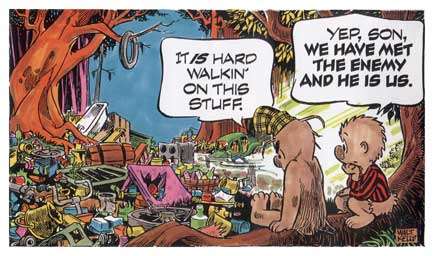
We’ll give proper credit with a brand new post, and in so doing highlight another image we think hits even closer to home:

Just a suggestion for everyone else who linked the first cartoon…since it resonated so well and became an “everyone else is linking it I might as well do it too” thing. We all have the same task of attribution ahead of us, let’s make it sort of a “Getting To Know You” deal. Pick out the cartoon that you think describes you the best.

I know, nobody ever reads this blog, so that one won’t quite set the world on fire. It’s just a suggestion.

Like Underpants Without Cling-Free

Wednesday, June 4th, 2008

Twenty-five funniest analogies from high school essays, from Writing English.

2. His thoughts tumbled in his head, making and breaking alliances like underpants in a dryer without Cling Free.
:
6. Her vocabulary was as bad as, like, whatever.
:
15. They lived in a typical suburban neighborhood with picket fences that resembled Nancy Kerrigan’s teeth.
:
21. The young fighter had a hungry look, the kind you get from not eating for a while.

This blogger has been known to grasp for similes, metaphors, nouns and adjectives…much more awkwardly and much more frequently than his readers would expect (I hope). So in consideration of self-interest and good old-fashioned humility, if nothing else, I counsel restraint.

But great googly moogly, those are funny.

H/T: Bookworm.

I’m A Freedom Crusader

Wednesday, June 4th, 2008

How to Win a Fight With a Liberal is the ultimate survival guide for political arguments

My Conservative Identity:

You are a Freedom Crusader, also known as a neoconservative. You believe in taking the fight directly to the enemy, whether it’s terrorists abroad or the liberal terrorist appeasers at home who give them aid and comfort.

Take the quiz at www.FightLiberals.com

H/T: Ms. Underestimated.

Wally, Exit, Stage Left

Tuesday, June 3rd, 2008

The author of this work just shucked his mortal coil this last month, and the passage therein on pp. 99-100 has special meaning to us. It is autobiographical, and it describes the divided loyalties between the urban and rural areas, felt by a family of five during a trying time in our nation’s history.

The Rogue I RememberDanny, who was now driving the old Stevens and displaying an active interest in girls, needed a regular income to sustain his racy life style. I had achieved varsity status on the Prospect High basketball team and was looking for new and larger worlds to conquer. Bobby, two years my junior, had not yet exhibited the same restlessness, but soon his strong commercial inclinations would involve him in the general revolt. For the moment, however, our fathers’ firm opposition thwarted all of these noble aspirations.

Then one day Mom stunned us with an altogether unexpected announcement. As we finished our supper and prepared to troop upstairs she informed us, a trifle awkwardly, that there would soon be another place at the table.

“Who’s coming” Bobby asked. “Relatives?”

Mom and Dad exchanged a conspiratorial smile. For a change, Dad’s mood seemed less somber than it had been of late.

“Well, yes,” said mom; “but not the kind you are thinking about.”

Our mouths fell open and for once we were at a loss for words. Danny was approaching sixteen, I was fourteen, and Bobby was twelve.

“You mean a baby?” Danny finally blurted out.

“That’s right,” Mom said, obviously pleased with herself at taking us so completely by surprise. Mom was then forty-two and, by our unenlightened reckoning, light-years beyond the proper — or biologically possible — age for childbearing. Up to that moment the possibility of any further increase in our family had no more entered our minds than had the prospect of entertaining a visitor from outer space.

From that moment this great coming event dominated our every waking thought and overshadowed all other considerations. The spare room was cleared and converted into a nursery. Dad set to work making a crib. We boys were at pains, for once, to spare our mother any undue effort.
:
For the time being the dolor of the Depression was relieved at our house by the prevailing mood of expectancy. Not a little of the excitement hinged on the question of the newcomer’s sex. Another boy? Our parents looked at each other and paled. Surely, not another boy!

Ten days into the new year of 1934 a healthy, squalling baby girl arrived and settled all the speculation. She was christened Mary Ann and immediately became the center of all our attention.

The baby girl grew up to become my mother, who passed away from a brain tumor in early ’93. Of the six of them — my grandparents, Dan the Drinker, Wally the Writer, Bob the Blood Pressure and Baby Mary Ann — Uncle Wally was the last. He finally found rest on May 6.

He was also the author of The Accidental Missionaries and Defiant Peacemaker.

The Freeberg family tree has been getting hacked and whacked pretty good by this first decade of the new century. Six years ago, there were…lessee…five uncles and a grand-uncle, who are all resting now. Marriage relations aside, that leaves my Dad and one more uncle on his side. After those, my generation will be senior, then I’ll really be old. Huh. Wonder how that happened.

It’s a punch in the gut when a writer dies, whether you’re related to him or not. Any old goat can live through some events, and remember them. Only a few folks bother to jot it down as it happens…or to discipline themselves to record it accurately, if they scribble away about it afterwards. And when they’re gone, the past, including even the most precious pieces of it, becomes much more profoundly distant.

You Know That Feeling…

Saturday, May 24th, 2008

…you get when you suddenly realize you’re never going to see someone again, ever?

It just hit me. I realized he was dead about two weeks ago, by e-mail.

Seems the closer you are to someone, the more fond of them you are, the longer it takes. But it always happens…it’s always a delayed reaction. I tried to see him one last time…I really, really tried. It just wasn’t in the cards.

It’s becoming an all-too-familiar feeling.

Happy Happy, Joy Joy

Wednesday, May 21st, 2008

Because y’know, I’m tired of bellyaching and I’m tired of listening to & watching other people bellyache.

Click the picture. You know you want need to.

Are Kids Coddled?

Sunday, April 27th, 2008

MSN, which is convinced I’m female — regularly plying me with such delightful tomes as “Make Him Commit” and “Slim Down for Bathing Suit Season” — today, parades before my eyeballs, a subject on which I am uniquely qualified to comment.

Would you let your fourth-grader ride public transportation without an adult? Probably not. Still, when Lenore Skenazy, a columnist for the New York Sun, wrote about letting her son take the subway alone to get back to her Manhattan home from a department store on the Upper East Side, she didn’t expect to get hit with a tsunami of criticism from readers.

“Long story short: My son got home, ecstatic with independence,” Skenazy wrote on April 4 in the New York Sun. “Long story longer: Half the people I’ve told this episode to now want to turn me in for child abuse. As if keeping kids under lock and key and helmet and cell phone and nanny and surveillance is the right way to rear kids. It’s not. It’s debilitating—for us and for them.”

Lenore’s interior plumbing notwithstanding, there is a clean and tidy demarcation between the hens and the roosters on this issue: The mother attends to the child’s daily needs, making sure he is safe, happy and whole, while the father has a stronger tendency to plan for his own demise, to make sure the next generation can get along without him.

Each of these gender roles reaches across the divide from time to time. But not much.

As our son’s face loses it’s spherical shape and becomes elongated with looming adolescence, this has become more of a thorny issue between “Kidzmom” and me. The cosmetic presentation is that, as his parents, we both have the same interests at heart. I want him to live to see another day just as much as she does; she wants him to grow up to be an independent man just as much as I do. But that is packaging. That’s not substance. The wiring that was put in place by thousands of years of evolution, is gender-based, and you really don’t have to listen to us go back and forth about it for too long before it becomes not only obvious, but undeniable.

I remember once, in exasperation at her latest umpty-fratz protest that he can’t cross a street by himself because he’ll get hit by a car, I yelled back “then the human race would be better off overall, if he’s such a weakling that he can’t manage that at his age” or something. I think she knew I was kidding about that. But there’s a point to it: We, as parents, don’t get to decide that our children are disposable chaff. Nor do we get to decide they are not. The world will make up it’s own mind on that question, based on what the specimens can and can’t do.

The other recent event to make this a more prickly issue, is her relocation. She’s not twenty minutes up the road anymore; she’s eight hours away. So instead of handing him off back-and-forth throughout the week, we hand him off back-and-forth throughout seasons. I think, overall, that’s a good thing. He’s shown signs of understanding that the “packaging” of his parents’ arguments, does a poor job of reflecting truth — different things are expected of him in different households. Better to shake the soda can once every couple of months, than twice a week.

But are kids coddled? Oh, absolutely yes. I remember that dirt field down the street; the one my brother and I explored, in our bare feet, sometimes with each other and sometimes alone. Where the hell was it? How am I supposed to know…we left that neighborhood right after I turned SIX.

That’s unthinkable now. When’s the last time you heard a mother bitching away that her kid(s) failed to turn up by dinner time? Or, in exasperation, sending a brother/sister out to collect them? It’s been awhile for me. And now, we have a childhood obesity epidemic:

The prevalence of overweight children tripled from 6.5 percent in the mid-1970s to 18.8 percent today for children between 6-11 years old, and 5 to 17.4 percent for those 12–19, according to a survey by the National Health and Nutrition Examination Survey.

There is more evidence. Men don’t have gab-fests like women do, usually; but there was one that came to mind after one of the more talkative fellows in our office announced his plans to acquire a sidecar for his newly-restored motorcycle, for the benefit of his eight-year-old daughter. One Monday morning he reported on his weekend long-distance argument with his ex-wife, about the safety merits or lack thereof. Enter that male-female divide. Look, it’s not like I’m going to do something to her that will make it likely she’ll get hurt — she’s my daughter, too! Exactly.

It’s those two things: They’re our kids too, and we’re not going to put them in situations involving certain doom. And — Ms. Skenazy’s point — if the kids aren’t ever challenged in anything, they’ll grow up being able to do exactly nothing.

Sorry, gals. I know when you act all funny, it usually means I’m the one missing out on this-or-that critical point. But on those two items above…looks to me like the fairer sex hasn’t quite yet thought things out. Not, I hasten to add, that they have a monopoly on this.

If you think this is going to turn into a bitch-pitch about video games, you’re right. My kid’s got it pretty bad. I blame myself, and Columbine. Back when he was about to turn two, the Columbine school got shot up, and the big controversy was about whether kids could play violent video games and still have respect for human life afterwards. I was distracted by this, looking back on it. The evidence clearly indicated our son remained concerned about the health and well-being of his playmates, even after hours spent shooting at zombies with shotguns. And so, I insisted, a mentally healthy child will be able to distinguish between reality and fantasy.

Well, I was right on that. But I lost my sense of perspective on the other issue…a good old-fashioned addiction. He’d form bad habits, we’d take away the video games, he’d do things right and then get his video game back. Then he’d go back to being weird.

I think we’ve got a handle on it now. Once he got a little bit older, we’d discuss this with him at a higher level. It started with Pokemon. He’d ask why I don’t like it, and I started to explain it doesn’t have anything to do with personal tastes: Frankly, after you’ve been playing/watching Pokemon for awhile, you start to act like a helpless whelp and I get tired of watching that.

Pokemon, if you’re not familiar with it, is a series of cartoons and games in which these kids mouth off at each other and challenge each other to fights, and then get these adorable creatures to do all their fighting for them. The kids only do one thing to alter the outcome of the fight toward their favor: They whine. All the work is left up to these imaginary creatures.

It got worse before it got better. Pokemon became the “Forbidden Fruit.” But, sooner than I thought, he outgrew Pokemon. He won’t admit it, but I think he began to see it my way. The kids talk smack to each other, and then pull out their adorable creatures and explain to said creatures, “Okay I just got us embroiled in a fight with this mouthy kid, now you have to do the dirty work.” If the boy has any streak of independence whatsoever, he’s going to get tired of it. Really, I never understood the appeal of it in the first place.

Pokemon is both a symptom and a cause, the way I see it. A generation ago, it would not have had appeal. It’s going to be fun to imagine yourself as the cockfighter — er, I mean, the mouthy kid — if you imagine yourself winning all the time. Permit an old man his own generational turn to utter the timeless words “back in my day” — in my time, we got our butts beat constantly. We were forced to learn to cope. We lost at baseball. We lost at football. We lost races. We lost Capture The Flag. We learned to imagine ourselves losing, because we had no choice but to so imagine.

To the best I can perceive it, Pokemon’s allure depends on never imagining yourself losing. Yes, on the TV show it happens pretty regularly, about a third of the way through. There really aren’t too many things the protagonist can do. You’ve never seen anything more pathetic. There are no skills to be sharpened, there are no post-mortems to be conducted on the match-up that was just lost…just whining. “Awww, Pikachu, why didn’t you listen to me?”

So I think the latest generation does have a problem, and I think the problem begins there. Not with Pokemon, quite so much…but with reckoning with the potential of defeat. And that is why it’s scary, lately, to let them do simple things like cross the street. Peripheral vision, taking the initiative to look both directions, etc., these are all secondary. The primary skill is understanding the potential of failure. If he has mastered all the skills of crossing the street, but doesn’t understand that the possibility exists of his getting killed, then the skills aren’t going to very much matter and he’ll probably end up getting killed.

Oh, how’d we solve the video game problem? I’m knocking on wood, imagining the worst is behind us. Now that Pokemon isn’t cool anymore, that’s probably a safe bet. We began a “minute for minute” program. You do an hour of playing outside doing dangerous things, playing ball, riding something with wheels — doing something in which it’s possible to get physically hurt — you get an hour with the damn game. It’s barely better-than-nothing…but it works. I think it addresses what’s really busted.

Parents have to be conscious, not so much of what their kids are doing one hour to the next, but what kind of world it is in which they are living. And not so much what is in that world, but what is missing from it. The irony is, that without that potential for defeat, the child won’t comprehend a potential for victory either because the whole concept of competition will be foreign to him. And so confidence won’t germinate and grow until some losing has been goin’-on.

What’s written above is fairly obvious. The real puzzle is, how come we have this new generation of parents, that needs to have it pointed out to them. Perhaps it’s our fault; the problem began with us. This spirit of “If I do not play, then I cannot lose.” Insisting on more safety, and more, and more, and more until life itself is no longer being lived.

That really is the crux of the whole problem, isn’t it?

Five Words

Wednesday, April 16th, 2008

Freakonomics held a contest to find the best six-word motto for the United States, and in my book it was a smashing success because the grand prize winner was a work of art:

The United States of America:
Our Worst Critics Prefer to Stay

The runners-up are plenty good enough to reproduce here, each and every single one of ’em.

Caution! Experiment in Progress Since 1776

The Most Gentle Empire So Far

You Should See the Other Guy

Just Like Canada, With Better Bacon

When Gerard wrote this up, he graciously accepted a late entry, an unforgivably smarmy tidbit that percolated in the frontal lobes of one of the writers for The Blog That Nobody Reads…the blog you’re reading right now. The nobodies who don’t come by to not read The Blog That Nobody Reads, will relate to the observation that this was quite out of character for us — our entry was shorter than par. We nudged up against the gauge at a trim, slim five words, sixteen percent less than what was originally requested.

Yes, that’s right! We expressed an idea in less space! Five little words…and by the time they’re done, without a single additional syllable, the reader is offered proof of what makes this country truly, uniquely great. They’re so inspiring you almost want to run, walk or jog to the Bay State and chuck a couple crates of tea in the harbor all over again.

To find out about content thereof, you can follow the link to Gerard’s site…or…you can use your mouse clicker and highlight the text below…drum roll, please…

The United States of America:
Our Poor People Are Fat

The Dark Age

Saturday, April 5th, 2008

In our relatively recent memory, there is a micro-era just 76 months long that shook the world. That this tiny epoch exists in our past, says a great deal about how we live with each other, how we’re slaves to fad and fashion, and how we’re not nearly as independent as we like to think we are.

My son’s been having this interest in cultural events that immediately preceded his birth, which was in ’97. This could be a sign of genius, if he knows what he’s doing…something that is always open to question. It could be hereditary. In my case, back in my childhood I had an interest in what was going on in the sixties and seventies, barely conscious of the fact that “big things” were going on, and I didn’t quite understand what they were. But they were bigger than me. My similar interest was decidedly a case of not knowing what I was doing. If I had my childhood to live all over again, knowing back then what I know now about post-modern feminism and the effect it’s had on our culture and on our public policy, I would have read every single newspaper I possibly could have gotten my hands on.

There are cycles, waves, and other such patterns involved in the way we value things across time. We’ve always had this tendency to elevate one demographic onto a pedestal, and bury another one shoulders-deep into the ground for a vicious virtual-stoning. We take turns doing this, and throughout it all we have this self-deceptive way of telling ourselves we’re treating everyone “equally” when we all know it isn’t true. It’s a delicious and intriguing piece of human hypocrisy, something woven deeply into us inseparable from our body chemistries.

Maybe we picked it up when we bit that damned apple. Who knows.

And we exercise it as individuals. In a couple of years, my son will be a teenager and the “My Dad Knows Everything” phase will come to a bitter end. I’ll be the clueless dolt who doesn’t know a damn thing.

James BondIn the meantime, my son likes James Bond movies. He seems to be in search of the elusive James Bond question that his father can’t answer. And always, always, we keep coming back to the above-mentioned chapter. He’s figured out that the history of the movie franchise is inseparable from the history of modern America…double-oh seven’s adopted parental country. How it is connected, he’s not quite completely sure. But he understands there is a connection.

Always, we come back to the elephant in the room. The one thing about the superspy that cannot be ignored…but defies explanation because it defies definition. The one things in Bond’s timeline that is absolutely intermingled with and inseparable from ours. I’ve made several casual references to it, but have never thoroughly explored it before in these pages.

The Dark Age.

The time when the Knight of the Cold War underwent a timeless and decidedly female fantasy — the story of Persephone, Sleeping Beauty and Snow White. He was taken away. He slept. The world tried, and arguably failed, to get along without him.

This has been an educational experience for me; the one facet to this Dark Age that fascinates me, above all else, is that it is a classic case of the few dictating the tastes of the many. We recall it — when we do — as a grassroots event, a natural consequence of the everyday folks getting fed up with an over-saturation of machismo. It simply isn’t true. It wasn’t bottom-up; it was top-down. Our elders decided they knew what was best for us, and they decided we were tired of James Bond. It was part of a much larger thing. Manhood was out of style. Masculinity, it was thought…although nobody came out and said straight-out, for it made far too little sense…was something that enshrouded us in the age of warfare, and now that the Cold War was over manhood no longer had a home. Anywhere. It was time for it to go away.

And so it became obligatory for the Lords and Vicounts and High Priests to instruct the peasants not to like James Bond. Or cigars, or martinis, or…well…anything you might’ve seen your “daddy” doing, be it Yankee or Anglican.

Working on cars on a summer day in an old greasy tee shirt. Drinking beer. Knowing best. Peeing on a tree. Opening jars for the wife. Telling dirty jokes. Growing facial hair. We were “above” all that, as we explored this new chapter in which 007 would be 86’d.

James Bond’s long slumber, the span between the sixteenth and seventeenth film installments, neatly bookends a small era in which we wanted none of these things…because we were told we should want no such things. And this year, as my son teeters on the brink of teenagerhood and is about to lose his curiosity about the Dark Age, and as Senator Hillary Clinton repeatedly struggles and fails to bring the Dark Age back again, perhaps it would be fruitful to re-inspect exactly what happened to us.

Supposedly, what happened was that Ian Fleming’s creation stalled out with the always-crescendoing legal troubles that arose from ownership disputes. There is certainly some truth to this; the evidence seems to suggest, on the question of Fleming taking indecent liberties with Kevin McClory’s contribution of the storyline in Thunderball, that Fleming is actually guilty. But it doesn’t really matter, does it. The very thing that makes this explanation plausible, is the thing that makes this explanation all bollywonkers and gunnybags. James Bond, at least in film form, has always been in legal trouble over this McClory issue. It is the reason there were two James Bonds in 1983. It is the reason that, in For Your Eyes Only two years previous, there was that surreal “Blofeld” appearance nobody can explain completely — the one with the smokestack, the wheelchair, the helicopter, and the delicatessen in stainless steel. Yeah, that.

Personally, I’ve never completely bought into this line that James Bond went away because of legal problems. He went away because he was out of style. Our feminists didn’t want us watching him. They told us what to do, and we obeyed our feminists. Starting with Hollywood, which made the regrettable decision — and today, looking back, the most ludicrous one — that the most profitable years of double-oh seven were in the past.

When one inspects what James Bond really is, one can easily see why our feminists have always hated him so much. He isn’t really a British spy, you know. He is the very apex of male fantasy. Let’s face it, international espionage doesn’t really have a great deal to do with saving the world from a madman with a laser orbiting the planet. It certainly doesn’t have to do with Aston-Martin automobiles, or sleeping with a lot of women. Or wearing a two thousand dollar suit and a three thousand dollar watch, when a couple hundred bucks divided among the two of those acquisitions will do quite nicely.

No, what those things have in common is that they typify male fantasy. They define manhood. Being entrusted with an important job, going about it, noticing something is about to happen that will injure millions of people you don’t even want to ever meet, preventing an enormous disaster and then retreating back into the shadows to go about your more mundane daily duties. Huh. I’ve just described the typical Superman episode. I’ve also just described a day in the life of any knight sitting at King Arthur’s round table. This is male fantasy that goes back a good stretch before Ian Fleming’s parents ever met.

And as frosting on the cake of feminist hatred toward the British superspy…once these male fantasies solidify into a newest James Bond movie installment, and the knuckledragging males like myself move heaven and earth to go see it…we don’t go alone. No, we bring our women along. Yes, women following men into the theater to watch a man’s movie. And we don’t jam our “honey do jars” full of bits of paper promising to do this or that pain-in-the-ass thing in compromise. We don’t have to. Our women want to go. Our women want to see the next James Bond movie more than we do.

This is what earns James Bond a fatwa from the feminist movement. He reminds us that men are noble creatures, and that women are complicated. Our feminists tend to hunger for the exact opposite, you know…they like men to be disposable and they like women to be simple. But with not a single sign of Meg Ryan crying, or Hugh Grant acting like a dork, the simple woman isn’t supposed to be having any fun. And she wouldn’t be. Yet the latest Bond flick comes out, and our women are practically jumping in the car, warming up the engine for us, offering to buy the popcorn.

James Bond is a sign that feminists may have more to learn about women, than anybody else.

And so, during the Dark Age, they killed him. They did what feminists desire to do: Shape our culture and define the values we exercise therein. Glittering recruiting-buzzwords like “power” and “freedom” and “choice” really have very little to do with any of it.

But…when angry women want us to do things, we find it hard to tell them no.

For the two thousand three hundred and thirteen days that began in the summer of 1989, James Bond slept.

The world went un-saved.

And when the experiment was over, it turned out — maybe the world doesn’t need saving after all — but it certainly does need James Bond. That male fantasy that he’s really all about. We depend on it; that’s just the way it is, and the feminists can get as grouchy about that as they want to get, but it’s true and will always remain such.

The feminist edict that James Bond should go away, began the way all cultural impulses do: With a tailwind, and on a downward slope. It caught on because resistance was at a low ebb. Certain external events created a climate in which it was handy and convenient to suggest a retirement from MI6 and from Hollywood. The AIDS crisis had reached a plateau, and some would say it was still on a sharp upswing. The baby boom generation, always numerous, always powerful, and always hostile to anything that might have been identified with the generation previous to them, had reached middle age and they started to occupy positions that were powerful, positions in which “real” decisions were made about things. And with Russia’s troubles, anything even remotely connected to a “cold war” seemed naturally headed to the trash heap.

It was Timothy Dalton’s second venture in this role. It is sometimes said that his style, notable in fidelity to the book version of Agent 007, grated on the movie audiences and there may be some truth to this as well. But another thing about Dalton that doesn’t get a lot of mention is that he was the first “Fountain of Youth” James Bond. Fans were expected to believe this was the same guy who outwitted Dr. No in 1962 and wrecked that railroad car on the Orient Express with Red Grant the following year; here he was, maybe seventy years old, wrestling control of an airplane in mid-flight after waterskiing behind it in his bare feet. The storyline was original enough, involving Bond’s defection from the British Secret Service and carrying out a personal vendetta on behalf of his friend Felix Leiter. And Robert Davi had all kinds of things going for him as the bad guy. He was dark, sinister, bloodthirsty, cruel and charming.

But — and looking back on it, this was probably the nail in the coffin — the bad guy was also a drug lord. In the previous film, The Living Daylights, it turned out that bad guy was also a drug lord. James Bond fighting the war on drugs. Nothing says “past the prime” quite like that.

The only sense of continuity was that Dalton had signed up to do three movies, and this was the second. Other than that, there was no momentum at all.

The death knell also came from bad returns, and the bad returns undoubtedly resulted from bad promotion. The film competed with Batman; Indiana Jones and the Last Crusade; Lethal Weapon 2 and many others. Bond had been a summer phenomenon with every film appearance since The Spy Who Loved Me, but evidently the time had come to re-think that, and perhaps it was re-thought a bit too late.

When the thumping came from the dismal revenues, feminists, and others invested against Bond’s success, trumpeted that we were tired of men saving the world from disaster, conveniently ignoring the success of Die Hard just a year ago. The talking point stuck. They talked it up and talked it up. Meanwhile, MGM/UA sued Danjaq, the parent holding company of Bond-related trademarks and copyrights…another outgrowth of the McClory mess.

That winter, in a dark omen about the times in which we were about to live, carefully sanitized of any male heroism or derring-do or respect for same, Marc Lepine murdered 14 women at the University of Montreal. The Montreal Massacre has come to epitomize what’s wrong with feminism, why it is the very last mindset that should have anything, whatsoever, with the formation of public policy.

Let us summarize it here: Feminists talked down male heroism. They opposed it at every turn. They poured vast sums of money and energy into sneering at it, indoctrinating entire generations of people to the idea that the Real Man is a myth, and if he is indeed real he serves no purpose, in fact is something toxic and ugly. And Mark Steyn, quoting himself after the Virginia Tech shooting, fills us in on what happened next:

Yet the defining image of contemporary Canadian maleness is not M Lepine/Gharbi but the professors and the men in that classroom, who, ordered to leave by the lone gunman, meekly did so, and abandoned their female classmates to their fate — an act of abdication that would have been unthinkable in almost any other culture throughout human history. The “men” stood outside in the corridor and, even as they heard the first shots, they did nothing. And, when it was over and Gharbi walked out of the room and past them, they still did nothing. Whatever its other defects, Canadian manhood does not suffer from an excess of testosterone.

The conclusion is inescapable. Masculinity was killed, and soon after it the real women it had been defending.

Well, Mark Steyn has his opinion about what it all means, but the prevailing viewpoint has another take on it…

Since the attack, Canadians have debated various interpretations of the events, their significance, and Lépine’s motives. Many feminist groups and public officials have characterized the massacre as an anti-feminist attack that is representative of wider societal violence against women. Consequently, the anniversary of the massacre has since been commemorated as the National Day of Remembrance and Action on Violence Against Women. Other interpretations emphasize Lépine’s abuse as a child or suggest that the massacre was simply the isolated act of a madman, unrelated to larger social issues. Still other commentators have blamed violence in the media and increasing poverty, isolation, and alienation in society, particularly in immigrant communities.
:
The massacre was a major spur for the Canadian gun control movement. One of the survivors, Heidi Rathjen, who was in one of the classrooms Lépine did not enter during the shooting, organized the Coalition for Gun Control with Wendy Cukier. Susan and Jim Edwards, the parents of one of the victims, were also deeply involved. Their activities, along with others, led to the passage of Bill C-68, or the Firearms Act, in 1995, ushering in stricter gun control regulations. These new regulations included new requirements on the training of gun owners, screening of firearm applicants, new rules concerning gun and ammunition storage and the registration of all firearms. The gun registry in particular has been a controversial and partisan issue, with critics charging that it was a political move by the Liberal government of Jean Chrétien that has been expensive and impractical to enforce.

Who’s right? Form whatever opinion you wish to form; I’ve formed mine. This culture conflict between male-friendly and male-hostile forces had been going on for awhile, and ultimately it culminated in the death of James Bond, the greatest family-friendly male fantasy material ever put to the big screen. And then the Montreal Massacre showed us the horrific consequences in store for us if we eradicate masculinity…and in response to that…our neighbors to the North, in their infinite wisdom, eradicated masculinity some more. Day of Remembrance and Action on Violence Against Women — as if deranged gunmen pay attention to such things, before making the fateful decision to go charging through a college campus shooting people.

Little things began to happen in popular culture about this time, poisoning the well just a little bit further. The Simpsons premiered — the madcap adventures of a little poorly-drawn cartoon boy named Bart. It turned out his doofus dad Homer had special resonance with our now thoroughly-vaginized audience, and in the years to come the family patriarch would steal center stage. Homer Simpson, in this way, continued the trend set by Al Bundy in Married…With Children — albeit as a less sympathetic character — and the Age of the Doofus Dad began in earnest.

On the big screen and the little screen, things started popping up “geared toward” girls and women…which means deliberately excluding men. The studios discovered women were feeling a special attraction toward things that not only entertained them, but were assured to provide little-to-no entertainment for anybody else. They called it “tailoring” or “customizing” or “specially targeted” or whatever. The meaning was all the same: Men wouldn’t like it.

Makes sense. Guys, when you take your sweeties to the movies, it should hurt. Makes as much sense as that ring that should cost a lot. Sacrifice is the point.

So we were buried in an avalanche of things men wouldn’t like. The Little Mermaid marked the beginning of what became an annual pilgrimage — Disney would market the hell out of their next big feature cartoon, full of strange people and animals with eyes the size of dinner plates, with obscene volumes of merchandising tie-ins. Next year, they’d go back, Jack, and do it again. All of it “tailored.” Cleansed of anything that might be interpreted as even residual masculine appeal. All of it calculated to make Dad barf.

Steel Magnolias. That spring, Pretty Woman. Ghost. Feelings, feelings, feelings…bits of fluff to make you cry, tossed up there for the purpose of pulling in the little gold statues of the man who has no face.

Ryan White died of AIDS. Such poignant deaths tugged at our heartstrings, and helped to remind us that the era of feelings could not have crested out just yet. It was just getting started. After all, if you resolved to confront the AIDS crisis with your brain instead of with your heart, what in the world would you do? There was nothing to do in the Realm of Thought except throw a little bit more money at the disease. And then a lot more money. Well, when people can’t form a plan that seems complete, they like to feel their way through things so with every AIDS-related news event we did some more feeling.

Manhood being coupled with stoic, rational thinking, it was buried a little further in the ground as we continued to bury our brains. We had to be more sensitive. People were dying of AIDS. Nobody ever explained how being more sensitive would stop AIDS deaths, but that’s the beauty of feeling your way through things — no explanation necessary. Just think happy thoughts. Or sad ones. Whatever fits the occasion. Just be compatible. Doing constructive things, that was out of style now.

The era of James Bond continued to slip into the past. In August of 1990, movie producer Albert “Cubby” Broccoli parted company with screenwriter Richard Maibaum, and John Glen, director of the previous five films. Half a year after this unfortunate event, Maibaum would be dead.

The environment took center stage, now that we were being extra-feminized and sensitive. We had a new Earth Day, to commemorate the twentieth anniversary of the 1970 event, and that summer Captain Planet and the Planeteers premiered on TBS.

Men were understood to be inherently bad and women were understood to be inherently good. We began an endless fascination in women doing those heroic male things, like catching the bad guy. This is the year in which Clarice Starling became famous, as portrayed by Jodie Foster in Silence of the Lambs. And then there was Thelma and Louise. Of course, the Tailhook scandal helped out a lot. Women were heroes — and hero status was incomplete if it was even suggested that maybe, just maybe, there might be some things men could do that women could not…that wouldn’t do. We pretended otherwise. And if anybody dared to get tired of it, we’d simply explore how women were victims — and that would return them to “hero” status.

The dysfunction that took hold in our society, wasn’t so much that we saw good things in women. The most “patriarchal” societies, contrary to popular belief, have it in common that they have seen women as innately good and worthy of protection — hence the necessity of strong men. No, in the 76 months of this Dark Age, the real damage was irony. Things seemed, to us, to be the opposite of what they really were…starting with strength and weakness. Weakness was now the new strength. In the news as well as in fiction, people were shown to be strong through a ritual of showcasing their frailties. Rodney King was worthy of our attention because he got beaten up. The beating was worth talking about. His leading the police on a high speed chase through a densely populated suburban neighborhood…wasn’t worth talking about, because this didn’t service the goal of portraying King as a victim. Starling was strong because she was a victim. Thelma and Louise were strong because they were victims. The Tailhook ladies were strong because they were victims.

Strong didn’t have anything to do with being ready, willing or able to defend someone in need of a defense. That would be too patriarchal.

In July of 1991, Patricia Ireland succeeded Molly Yard as the head of the National Organization of Women. This was a pivotal event because it was a generational hand-off; Ireland is a baby-boomer, and Yard came from the generation previous. Three months after this, Susan Faludi published her book, Backlash: The Undeclared War Against American Women. Strength-through-victimhood continued.

Feminists, during this time, could be as nasty as they wanted to be. If anyone called it out they’d just call it a “backlash” and do some more complaining about dark and sinister undercurrents in our society, working against them. Meanwhile, James Bond was dead…along with countless other “patriarchal” trinkets, involving far less meaning to us item-by-item than they meant collectively. The feminists were being exactly what they called others. Rodney King’s famous query was “can’t we all just get along?” The irony was, those who worked day and night to make sure everybody heard the question, also labored with equal gusto to make sure the answer was a resounding “Hell, no!”

Jeffry Dahmer was arrested. For eating people. The police got in trouble when it was discovered Dahmer fooled them into returning a bleeding, naked little boy to his care…who he later had for dinner. He ate lots of other people, but the police got in trouble because of this one boy. Don’t worry about Dahmer, he’s probably the last cannibal we’ll see for awhile, but we’d better fix the police because they’re feeding little boys to cannibals!

So the pattern continued. Those who did harm, were presented to us as nothing more than a curiosity…maybe even something deserving of our sympathy. Those whose job it is to protect us from the harm, are presented as part of the real problem. Ostensibly, this is done to make sure our protection is worth something. But every crime needs a protagonist, doesn’t it? If I’m a cop I can’t very well feed someone to a cannibal if there’s no cannibal around, can I? The police were a danger, the protagonist was not.

In November, Freddy Mercury died of AIDS. The feeling-over-thought continued. Bohemian Rhamsody, that winter, blared from every loudspeaker on every radio and every television.

Disorder was the new order. Justice was dispensed, not from the courtroom in which Stacy Koon and his colleagues were acquitted for the Rodney King incident, but in the riots that followed in downtown LA. Again…it was all about solving problems with feeling instead of with thought. Justice becomes a myth when you do that; just a glorified system of might-makes-right. More irony: People who want to disclaim masculinity, manhood, “patriarchal oppression” and so forth claim that as their goal — to elevate themselves and society above an anarchy in which might-makes-right. But that’s exactly what they cause to happen.

Meanwhile, nobody noticed that the Maastricht Treaty had been signed. This was the beginning of the European Union. Just like any other union, it was constructed to “level the playing field” against someone who had an “unfair advantage” — which means to attack that someone. In this case, it was the United States.

The importance of the Maastricht event cannot be overstated. Sixteen years later, we have been dutifully fed our talking points that the United States is seen by our “allies” as an oppressor. Most people who believe this uncritically, fail to comprehend how intricate and robust is the organization that is really responsible for all this “seeing.” It is an international union formed for the purpose of gaining more power…against the United States. With a little bit of a longer memory, one can see there is more to that story than just President George W. Bush. The hostility against America has roots in it, that go all the way back to this event. This quiet event.

Then came the Year of the Woman. It was part of a global fashion trend. That year, Betty Boothroyd had been elected as the first woman Speaker of the House of Commons in the United Kingdom, and Stella Rimington became the first woman head of MI5, the domestic counterpart to Agent 007’s MI6 international espionage branch. The movie industry continued to assault us with their feeling-over-thought anti-man pap: A League of Their Own; Lorenzo’s Oil; Prelude to a Kiss.

Dan Quayle, technically correct, perhaps even prophetic, but hopelessly tone-deaf, gave a speech on the harm Murphy Brown was doing to our society. It was something we needed to have pointed out, but we weren’t ready for it at the time. Our sense of direction was utterly destroyed by now. Chaos looked like order, women looked like men, cops looked like robbers and robbers looked like cops. When cowardliness led to piles of womens’ dead bodies, we thought the best way to protect our women was to embrace more cowardliness. Murphy Brown’s dysfunction? It looked like function.

As Quayle’s boss faced re-election that fall, the worst debate-question ever was asked by pony-tail guy at the debate in Richmond, VA: “How can we, as symbolically the children of the future president, expect the two of you—the three of you—to meet our needs?” Rush Limbaugh provided more context for the quote here (link requires registration with Rush 24/7):

RUSH: Shall we go back to March 30th, 1993, from my Television Show, I played this sound bite from October 15th of 1992. This was the presidential debate, Perot, Clinton and Bush 41 in Richmond, Virginia.

THE PONYTAILED GUY: The focus of my work is domestic mediation, is meeting the needs of the children that I work with by way of their parents and not the wants of their parents, and I ask the three of you, how can we as symbolically the children of the future president expect the two of you, the three of you to meet our needs?

RUSH: That’s the famous Ponytail Guy from the Richmond debate in 1992. These presidential candidates are our fathers, the president’s going to be our father, and what can we expect from our father, you, to meet our needs?

The irony continued. Dependence was independence.

As the Danjaq/MGM case wound its way through the courts, The Crying Game was released…continuing the irony, women were men. Superman, the defender of Truth, Justice, The American Way, died. Just as well. We had some significant questions about what exactly all three of those were…and at the time we didn’t even realize we had those questions. But Superman just plum ran out of ways to save the day — without offending insecure women with his masculine oppression and what-not. So down he went.

Clinton appointed a whole bunch of women to his cabinet. Had he been seeking the best and the brightest for these important positions, he might have accidentally picked some pretty ones, and that would have been threatening. So he made sure they were all physically unappealing. Reno. Shalala. Albright would come later…and of course later that year Ruth Bader Ginsburg would be nominated and confirmed to the Supreme Court. I don’t wish to be unkind, but these ladies are homely. To doubt that there was an agenda in place to select them that way, is to doubt the evidence of our senses. If you sent me out to find some that look like this, I’d be out there all day long…probably finding none at all, or no more than one. In one of his first acts of office, not quite content with his retroactive tax increase, he passed the Family and Medical Leave Act, or FMLA.

Because as anybody knows, the first step to making the economy stronger is to make it godawful expensive to hire people. Yeah, that’s the ticket.

Country music didn’t escape the Age of Dysfunction either. Eilleen Regina Edwards, better known as Shania Twain, released her debut CD. Country Music purists became apoplectic, and the schism helped to channel this seemingly limitless supply of anti-tradition anti-male energy into lifting the nascent career of the gorgeous Shania…whom, apart from that, had no shortage of assets appealing to the male psyche. There was little or no animosity involved in her lyrics, but a darker culture arose to consume her. No bitter, angry single-mom was complete without a cheap little CD player belting out one Shania Twain cut after another. It was all just so fresh…which sounds deceptively positive. Under the roots of it all, was a underlayer of raw, naked animosity toward anything that was traditional, and/or not yet quite as feminized as it might possibly be.

The Supreme Court decided Wisconsin v. Mitchell, signaling the readiness of our modern culture to consider hate-crime legislation. Who exactly is ready for it, nobody is willing to say; for a judicial-branch decision to drive what the legislative-branch is supposed to do, isn’t quite the way things are supposed to work. But work that way it did, as the Supreme Court decided states have latitude in considering motive for a crime in enhancing the penalties for it.

What’s been mostly forgotten is that the Wisconsin decision concerned an assault on a white fourteen-year-old boy, Gregory Reddick, by a gang of black individuals in Kenosha, who had just seen Mississippi Burning. Todd Mitchell asked the group “Do you all feel hyped up to move on some white people?” — Reddick was in the wrong place at the wrong time, and the rest is history.

Todd Mitchell’s penalty was enhanced due to thoughts in his head. The Wisconsin Supreme Court had determined there was something wrong with that, that such an enhancement would have a “chilling effect” on free speech. The Supreme Court overruled, finding “no merit in this contention.” Those are unfortunate words. Penalty enhancements due to thoughts-in-the-head may, with a little bit of trickery, be shoehorned into some functional compatibility with the spirit of our Constitution, or at least with the letter. But “no merit” is a little on the strong side. To say penalties can be enhanced because of free speech exercised, might have a chilling effect on free speech…it does, at the very least, have some merit.

In an act that symbolized exactly what was going on, Lorena Bobbit cut off her husband’s penis and flung it at a stop sign, to fall into a field where it was later retrieved and reattached. Good thing she picked the summer of 1993 as the best time to do it. She was hailed as a feminist hero. The jury found her not guilty by reason of insanity, and after a court-ordered 45-day psychiatric evaluation, she was released.

She got away with it.

And the feminists said she was exactly what they wanted to be. Good for them. I wonder if, in 2008, they have the decency to be embarrassed by that. But it might be a good idea for the rest of us to remember what exactly “feminism” meant fifteen years ago: Cutting off dicks, or wishing you had the guts to do it.

Kim Campbell was sworn in as the first female Prime Minister of Canada.

President Clinton passed the “Don’t Ask, Don’t Tell” policy, then went out to the Rose Garden for a photo op as Yasser Arafat and Yitzhak Rabin shook hands in a sham peace ceremony. The age of fakery, of built-in irony, of feeling-over-thought, of pretending things weren’t what the cognitive lobes understood them to be…staggered on. Meanwhile, John Wayne Bobbit flirted with porn. It seems he was restored to his potency much more quickly than we were restored to ours.

Sleepless in Seattle assailed our senses, followed closely afterward by the premiere of Mighty Morphin Power Rangers. Jocelyn Elders was confirmed as our Surgeon General, and the Maastricht Treaty came into effect, forming the European Union.

As Madonna slipped into her Dominatrix outfit, Clinton signed the Brady Handgun Violence Prevention Act into law, then sent his wife down Pennsylvania Avenue to babble some kind of nonsense at Congress about socialized medicine.

On November 13, Star Trek: The Next Generation had an episode called Force of Nature that nearly killed Star Trek. It was about environmentalism. It turns out, when you take a starship above Warp 5 you do some incremental damage to the fabric of the space-time continuum. At the conclusion of this episode, Starfleet, in its infinite wisdom, imposed a galactic speed limit on all starships, bringing the fictitious age of exploring the “final frontier” to a virtual end.

Another metaphorical event of profound poignancy: Ripping apart the fabric of a space-time continuum, was exactly what was taking place in real life. With manhood, our spirit of exploration was dying. And with that, our fastening to logic and truth. We wanted Don’t Ask Don’t Tell. We wanted the thoughts in our heads to be regulated, while we were told no such thing was happening. With all the exploring done, we just wanted things extra safe…we wanted our Hillarycare universal health plan.

Lani Guinier, the “quota queen,” was nominated as the Assistant Attorney General for Civil Rights.

Colin Ferguson, accused of killing six passengers and wounding nineteen on the Long Island railroad, employed the black rage defense. His attorneys tried their best to retroactively declare open season on people, but to no avail. He received six life terms. Hey, at least they tried.

Black rage was first proposed by black psychologists William Grier and Price Cobbs in their book Black Rage (ISBN 1579103499). Grier and Cobbs argue that black people living in a racist, white supremacist society are psychologically damaged by the effects of racist oppression. This damage causes black people to act abnormally in certain situations.

Irony continues. The victim has strength, and is to be respected. Inequality is equality.

Since everybody was instantly good and wonderful if they would just let women do things they previously couldn’t, the Church of England began to ordain female priests. Hugh Grant typified his perpetual role as the hapless clumsy “git” in Four Weddings and a Funeral.

Timothy Dalton went on record, announcing his official abdication from the role of James Bond.

Michael Jackson married Lisa Marie Presley. The World Series was canceled, and the FIFA World Cup began in the United States. Enter soccer, exit baseball. But the real insult to the United States was just around the corner: Michael Fay used his American origin as an excuse for spray painting cars in Singapore. You see, we Americans are meek and mild and we’re just not tough enough for that caning punishment they have over there. The skin on our buttocks is especially thin, I suppose. So, you should just let us get away with it. I have a social disease, Officer Krupke! Grasping for the chance to show that chaos is really order and strength is really weakness, President Clinton intervened and bargained the ritual six strokes of the cane down to four.

With our national identity confused, lost, given away, we went through our summer ritual of being buried in annoying, glurgy, anti-male, feeling-over-thought movies. When A Man Loves A Woman. Natural Born Killers. Bad Girls. Blue Sky. Exit to Eden.

Woodstock ’94 commemorated the twenty-fifth anniversary of something that wasn’t really worth the trouble. Hippies smoking dope listening to music having sex in the mud. It was kind of a bust. The hippies had grown up, gotten jobs, mortgages, heads full of gray hair…and some nice suits that couldn’t get muddy.

ER premiered.

Hillarycare was quietly abandoned. We just weren’t going for it…yet.

A new Star Trek movie came out in which Kirk and Picard would appear together. This started lots of Kirk/Picard comparisons…wonderfully entertaining, all of them…but again, metaphorical toward the confusion and dysfunction we felt during these 76 months. The overall trend was that Kirk was more dependable and effective when confronted with a crisis, but Picard was more desirable…for reasons left unstated, or stated only vaguely. His propensity to surrender was thought to be an asset. Again, weakness is strength.

Disclosure came out, asking us to imagine an event in which a woman is guilty of sexual harassment (including an unfortunately ludicrous and silly scene in which Michael Douglas is given a blow job against his will).

We showed some signs of an early bloom in this 330-week winter. We voted in a Republican Congress, and Dr. Elders was finally forced to resign. Peter Jennings said we were having a “temper tantrum.”

When the Alfred P. Murrah federal building in Oklahoma City was blown up, they blamed talk radio and angry white men.

Bryant Gumbel, then co-host on the NBC News Today show, reported that “The bombing in Oklahoma City has focused renewed attention on the rhetoric that’s been coming from the right and those who cater to angry white men. While no one’s suggesting right-wing radio jocks approve of violence, the extent to which their approach fosters violence is being questioned by many observers, including the president…”

We were being told what to think and what not to think. But dependence was independence.

Women continued to take on male roles in fiction. One expensive production after another failed, either in the short term or over the long haul, but the producers insisted on believing women could look appealing just by doing manly things. Real entertainment is expensive, after all. And so Hercules had an episode called “The Warrior Princess” which spun off into its own show; “Star Trek: Voyager” premiered. Of the latter, the only draw was that the Captain of the vessel was a woman. Who acted a lot like a man. It was rather painful and boring to watch, but it did endure for seven seasons, the Warrior Princess for six.

In those early days, success was sure to be had so long as the personalities showcased were not straight, white and male. And so 1995 brought in the now-ritual summer of glurgy anti-male-ness and anti-family-ness and anti-thought-ness…Babe, Pocahontas, Boys on the Side, Bridges of Madison County. Copycat, Scarlet Letter. And, let us not forget the Macarena being released. Looking silly is serious business.

Sandra Bullock, in the first movie appearance since she lit up the screen in Speed, embarked on a new rejuvenated career dedicated to chick flicks — with While You Were Sleeping. Funny. Thirteen years later, I have yet to remain awake all the way through that movie.

Nearly three years after Barbara Boxer began her vendetta against him, Sen. Bob Packwood was forced to resign. A few years later, she’d circle the wagons around President Clinton for doing something much worse…I guess inconsistency is consistency. But with Packwood gone, we could talk about women being victims again, especially with Shannon Faulker’s adventures at The Citadel. Victims are strong because weakness is strength.

On November 13, 1995, the 2,313 day winter was finally brought to a thaw as Goldeneye was released. It received two BAFTA nominations and earned $26 million during its opening, the most successful Bond movie since Moonraker.

Why?

It should be obvious by now. We had been starved. We had been denied what we, men and women, really want: That old story, the knight-of-the-round-table story. Disaster prevented. Good thing that strong smart resourceful guy was where he was.

Women, somewhere, may be capable of doing what men can do. But there is no fantasy there. Nor do we have any inner lust toward this phony irony, wherein victimhood is strength, femininity is masculinity, unfairness is justice, thought control is freedom, chaos is order, dependence is independence. We know, deep down, all of us, that that’s all crap — we can only snack on it for so long before we get sick of it. Three hundred thirty weeks…it’s far too much to ask of us. Can’t keep it up.

Eventually, we have to return to our programming and our programming has to do with truth, logic, and order. That is what our programming is all about, for our programming has to be consistent with nature. If it were not, we would not be here. And so we like to see a strong masculine figure preventing disaster, for the benefit of people he has never met and never will meet. A man…defusing a bomb. A man…lifting a concrete slab off a baby who is miraculously unharmed. A man…fishing a kitten out of a tree…or shooting a terrorist who was about to wear a dynamite belt to a pizzeria. Men see that, and they feel better about themselves because they want to be that guy; women see that, and they feel better because they understand someone somewhere believes they are worth defending.

What was this long winter, the Dark Age in which James Bond slumbered away, really about?

It was about abjuring reason…for the sole purpose of feeling good…and failing. Once it was over, we felt better than we’d ever felt since it began. Let that be a lesson to us: To plagiarize Franklin, those who disclaim logic, reason and masculine symbiosis for a good feeling and “self esteem,” deserve none of these things and shall ultimately have none of these things.

The Single Mom Problem

Saturday, March 29th, 2008

Fair disclosure: I’m a single dad. I didn’t marry the mom.

It’s been a pretty rocky road and it hasn’t been all good for the boy. But I will say this: Of all the things we have done that have hurt him the most, the biggest thing by far has been all the yelling and arguing. And one thing I can say for an absolute certainty is, if I’d married her, there would have been a lot more of that…and not too much of the other stuff would have changed. We still wouldn’t have “made it” because we still would be two different people who look at life in two different ways.

This is the problem with arguing about marriage in simplistic terms. The institution has become a complicated, wrinkled-up mess. We think of it as some kind of a “promise” when it isn’t anything even resembling that anymore. It’s a change in legal status; a change made to get some bennies. Promising doesn’t have anything to do with it. It’s become just a shrink-wrapped bundle of weird benefits and equally weird (toothless) obligations, all of which are re-defined one week to the next according to what lobbyists and activists tell politicians they want done.

Have I made wise, good decisions? No. Should I, therefore, have gotten married? Uh, erm………no. Pretty much everyone I knew at the time, told me to do something, I said I shouldn’t, and in the long run I turned out to be right. But I’m not proud.

Others have done the same thing. And for reasons that escape me, they are proud.

Stephanie FlandersNow, do you know what is going on in jolly old England? The time has come, once again, to put some floral wreaths and candies on the graves of the gentlemen who threw the tea into Boston Harbor…and maybe think about tossing a few more boxes in. Across the pond, they’re having a row and a ruckus about how everyone should live.

On a Newsnight programme in August 2007, [Stephanie] Flanders interrogated Conservative Party leader David Cameron about his proposed policy of tax breaks for married couples while questioning him with other journalists, asking him whether he had ever met anyone who would get married for an extra £20 per week. As an unmarried mother, she also asked Mr. Cameron whether the Conservative Party would like her to be married.

So. We got this nanny-state pro-marriage guy who wants to give a stipend to married couples, and he is rightly upbraided by a single mum.

Lashing out at him in honor of the libertarian spirit of the individual, and the God-given right to live life as you choose?

Erm……no, it doesn’t appear so….

Meet the Credit Crunch Crumpet: The unmarried mum who clashed with Cameron on Newsnight

…Next Tuesday Stephanie officially takes up a new job as economics editor of the entire BBC. It is one of the most senior jobs in broadcasting, and about as authoritative as it gets without actually being Sir David Attenborough.
:
Quite a responsibility, then? “Hmmm. Immense,” she says. “It’s all extremely exciting – this is the best job in economic broadcasting, without a doubt – but it’s daunting, too.

“It’ll mean treading that fine line between being accessible and authoritative. I’ll have to get across very complex economic ideas in a way that is easy to understand and interesting.
:
She gives a half-giggle. That she is the first woman to become one of the BBC’s senior editors – she is taking over from the flamboyant Evan Davis, who is off to present Radio Four’s Today programme – seems slightly shocking in this day and age, but good news all round. Isn’t it?

“No one can remember there being a woman in any of these senior positions before,” she confirms, choosing her words carefully. “I’m sure the BBC would admit that’s not ideal.”

That she is up to the job doesn’t seem to be in doubt. She is widely regarded as one of the most capable economic analysts in the country. Her clever-clogs qualifications are second to none – degrees from Oxford and Harvard – and she spent time speech-writing for the U.S. Treasury under the Clinton administration, before working for the Financial Times.

But aren’t we afraid of overly clever women in this country – unless they bring out diet books on the side? Isn’t the nation going to be intimidated by her?

She smiles again. “I’d prefer them not to be intimidated, but if they think I am talking with authority, then I’ll have got it right,” she says.

Perhaps surprisingly Stephanie hasn’t encountered that much sexism so far, “although there will always be men who simply think women aren’t up to the job”.
:
Yet I’m astonished at how open she is about how her sex will, or won’t, affect how she does the job.

Indeed, she asks for this interview to be conducted at her home, where her 22-month-old son, Stanley, is running around. This makes it inevitable that we will talk about her new kitchen and the perils of finding a good nanny. She is pregnant, too, which makes things even more tricky. Baby number two is due in June.

I don’t know why we are motivated to treat women this way. By asking the rhetorical “aren’t we afraid of overly clever women in this country” — and then later eeking out “Stephanie hasn’t encountered that much sexism so far,” the article seems to me to be ‘fessing up to looking for discrimination where it doesn’t really exist in meaningful volume. She’s a child born into privilege, perhaps more energetic and ambitious than most, I don’t see anyone anywhere fighting her. Why do we have to imagine her battling some unseen force in her every waking moment when efforts to define said resistant force culminate in such a lackluster presentation? She seems to be swimming downstream, not up. Who — on the entire planet — has any hostility to this woman’s career, whatsoever, with any kind of ability to influence it?

If the story is all about her battle with day-to-day obstacles and barricades, then I’m still waiting for the story.

The other thing that’s funny about how we treat women, is we seem to imagine they don’t really have a “choice” to do anything until substantial energy has been depleted championing that choice, cudgeling other women into making the same one. Where, I wonder, did we get this rule? Stephanie is all about choosing to remain unmarried if that’s what you want to do. But Stephanie has to become a celebrity. Stephanie needs a splash page.

But Stephanie, according to the article itself, wasn’t born into humble beginnings. Stephanie has connections. Stephanie has friends and relatives. Stephanie went to schools that not-just-anyone can attend.

And Stephanie has a stud. He’s mentioned in paragraph 23. And in the context, it would appear he is expected to do some things about daddy stuff, childcare, bringing-home-bacon, whatever, to lighten Stephanie’s load a little bit.

Why paragraph 23? Why not in paragraph five? Why isn’t he in the splash picture with the hen and the chick, if the rooster is part of making it all work? What’s this drive to make the story read like a story of “we made it all work without a man.” I mean, it doesn’t come out and say it in those words, but can anyone deny that this is an intended central thrust of Stephanie’s story? She did it, girls, so you can do it too…except Stephanie isn’t really doing that. She depends on her man — and wherever she doesn’t, she depends on a lot of other resources she has in her personal life, that millions of single mothers don’t have in theirs.

Or as Richard Littlejohn wrote,

“If Stephanie Flanders speaks for Britain, then I’m a gnu ” (recalling a famous song by her father [Michael Flanders] and Donald Swann).

Meanwhile — the European tradition continues. Everybody’s nose is in everybody else’s business. Every couple that gets married is a victory for Mr. Cameron and his friends. Every couple that doesn’t is a victory for Stephanie and all her friends.

Mass communication is a wonderful thing, but sometimes I think over the course of its relatively short history it can be shown that we really haven’t used it that well. It has become very popular over the years to use the medium to bludgeon those among us in the most rustic circumstances, to make decisions that aren’t going to pan out very well for them or their children in the long run.

Here’s the question I’d really like to have answered:

Is it by sheer accident that we use mass communication this way? Or does that have some sort of appeal to somebody somewhere? It seems like we’ve been really working at it. Pregnant girls should stay single…kids should think of their daddies as idiots…if your boss doesn’t give you four months vacation out of the year, you should strike. Every single nugget of this modern-day electronic “advice” seems to be advice that is wonderful for someone else, that no one with a brain would accept as their own.

I Made a New Word XIV

Friday, March 14th, 2008

NetflixNet∙Whoops (n.)

1. The chill that hangs in the air of the living room after the Lady of the Manor opens all of those little red envelopes, which were sent according to the movie queue that was last rearranged by the Lord. Without the level of coordination within the couple that would be advisable.

2. The dimple that forms alongside one corner of her mouth as she smirks on this occasion.

3. The stammering excuse or list of excuses offered by the Lord of the Manor right after this takes place.

It’s gotta be a universal thing, folks. It’s just gotta be. I’ve only been sufficiently close to two women, since the service came out, to couple-up my movie queue with theirs, and it happens that those two women are as different as night-and-day. Generally, if there’s any one thing both of them habitually do — and there are very few of those, let’s be clear on that — it’s fair to say most-to-all women do it. I see them as bookends of the female species. Having consorted with the two of them, has been just as educational as some hypothetical otherwordly immortal serial coupling-up with everything with a verginer that ever walked the earth on two feet.

There’s a gender thing going on. I know this. I’ve seen That Smirk on both those faces.

But I don’t think this time we can blame it on the man-bashing feminist movement, or the industrial revolution. It’s in our wiring. It’s inter-species. The caveman drags in a carcass…the cavewoman pronounces yea or nay on whether it is suitable for cooking. The daddy bird brings back a worm, the momma bird chews it up for the chickies. Dudes bring things to babes. Babes accept-or-reject. That’s the way it is.

We tried going the other way…with some apple or something. Didn’t work out too hot.

I’m now up to nearly a decade of envisioning this fun family ritual of, right after the last batch of red envelopes is sent off, “sitting down in front of the queue together.” I have not yet seen it happen. Not once. I’ll bet there aren’t too many other guys who have seen it happen either.

Gals don’t hunt. I think back on women I’ve seen looking for things…and they can certainly produce some bounty that takes us guys somewhat longer…but you know what pops up? The whole ask-for-directions thing. They do it. We don’t. And so the comparison is flawed. Flawed by a contaminant that is, in all likelihood, related to what we’re trying to find out. Whether the females outperform looking for this-or-that thing, correlates strongly — and is probably on average determined by — whether this-or-that thing can be located through a process of inquiring directions. Women ask for directions and men do not, because both sexes are laboring under the time-honored proverb of “when you have a shiny new golden hammer everything looks like a nail,” and there are two distinctly different shiny golden hammers.

And so we manufacture, and the ladies apply quality control. Use the profiles or don’t use the profiles, share the password, do whatever you want — it will not be, very often, a truly collaborative effort. Netflix is here to stay, I’m convinced of that. But it is fated to fall short of its slogan, “The Perfect Movie Every Time.”

Yes, there are exceptions. Once again: Comments about groups, comments about individuals. Know the difference. Netflixers do not treat the queue the same way as the Netflixettes.

g0 ah32d and ca11 m3 a n00b

Monday, March 10th, 2008

Tomb RaiderYesterday afternoon stood out as a momentous occasion, for not only did I finally get two loads of laundry done in a single day, but I got this silly girl out of that cistern she’d been trapped in since, oh, I dunno, Christmas or Thanksgiving or something.

The one right before she corners Pierre at that second tomb, and has to raise & lower the water levels and stuff.

What’s aggravating is that this is a mock-up of an earlier game that came out a whole decade ago. My long term memory isn’t working that well anymore. I don’t remember how far I got in the original game. I haven’t even passed any point where I get to say to myself “Aha, nothing lately looks familiar, I must have played past the point where I gave up ten years ago.” Nope, doesn’t work like that at all. And you’re dreaming if you think I have the slightest idea what to do when I get somewhere.

I remember back in the Age Of Zits, the age where I was old enough to drive but not old enough to suck down a beer, the “old” people would marvel at my abilities to figure things out. There must be some amino acid or something that fritters away after awhile, like that stuff that helps you digest your food or grow hair on the top of your head. Because it doesn’t seem like it’s all that much time later, and damned if I’m not one of those “old” people now. Some Lady or Tiger choice pops up, and instead of relishing the opportunity to test my resourcefulness like I would’ve twenty years ago, I just get testy and irritated.

Maybe it’s experience. Maybe challenges and puzzles just look different after the first zillion times you’ve bolluxed them up…with some real consequences. Why, yes, that theory makes me feel much better. That would mean I’ve dissolved over time into a craven coward instead of an old fart.

Anyway, that’s a record. Four months while the bimbo was trapped in the well. Lots and lots of life happening, which has to do with my spotty attendance in trying to get ‘er out again. Maybe I can use that as an excuse, too — the “I’m So Busy” excuse. But you know what would really be fair and feel better than anything else, is blaming her. I keep telling her to run this way, she keeps running that way and ending up dead.

Related: In the “Suspicions Confirmed” department. Yesterday’s Pajama Diaries comic strip had to do with some proposed activist groups, things that “don’t exist, but should” or some such rot. The “Can I Get An Amen Here” type humor proposed that the busy working moms (lowercase-m, for reasons you shall soon see) band together, set their sights on those among their peers who have better looking bodies, and get rid of them somehow.

So it is true. Frumpy women don’t want ordinary guys like me, guys in whom the frumpy women aren’t even interested, to be able to observe better specimens.

And I would presume that includes pixelated specimens as well, so I figure I’ve got two years, tops, to beat this silly game before some nanny-state constable barges into my home and nabs it off my shelf. If Hillary wins, better cut that in half.

Time’s a-wastin’, bitch. Do what I tell ya. And quit falling off of stuff.

Alcohol May Be Good For You

Sunday, March 9th, 2008

Not news to me.

People who do not drink alcohol may finally have a reason to start — a study published on Friday shows non-drinkers who begin taking the occasional tipple live longer and are less likely to develop heart disease.

People who started drinking in middle age were 38 percent less likely to have a heart attack or other serious heart event than abstainers — even if they were overweight, had diabetes, high blood pressure or other heart risks, Dr. Dana King of the Medical University of South Carolina in Charleston and colleagues found.

I started noticing this a few years ago. The oldest living guy, lady, person in the world at any given time — you know, it’s a depressing thought but they do have to replace that record every now and then — we started working our way through ’em like Reese’s Pieces a few years ago. I can’t remember the year and it was pre-innernets as we know the innernets today so there’s no links.

But I do remember what I noticed.

Every single patriarch/matriarch that popped up — without fail — said something about a daily ritual involving exactly one glass of red wine. And it made a deep impression on me that the news stories weren’t trying to play it up, they just saw it as a cute little tidbit of human interest to toss into the story. But for three or four of ’em in a row, the tidbit was always there. One glass. Red wine. Every day for eight decades or more.

And we’re talking…oh, nothing of Methuselah spans or anything. But well north of a hundred. One hundred teens…I think one woman was 121.

I have some Pinot Noir in the fridge. And some Cabernet. Not that I plan to be around in the 2070’s or anything, I see the odds as decidedly against it, but if you’re still here you might want to Google me and see if I’m still on this side of the dirt. Just on the off-chance.

Via FARK.

What I Learned Today

Tuesday, February 26th, 2008

One. It isn’t butkus; it’s bubkes.
Two. There’s a little bit of a pain-in-the-ass side to having a professional editor perusing The Blog That Nobody Reads.

During our off-line I was given cause to think about this exchange

The final proposed revision to the Declaration is brought by Adams himself. He indicates that the grammatically correct term would be “unalienable,” not “inalienable.” Jefferson insists that “inalienable” is correct. Adams defends his assertion with his Harvard credentials, which Jefferson counters with his studies at the College of William and Mary. In the interest of proceeding with the vote, Hancock asks Jefferson if he will agree to the revision, to which Jefferson says no, grinning at Adams. Annoyed, Adams withdraws his request, earning Franklin’s praise, but retorts that he will speak to the printer later.

Three. Even with Seattle natives, it seems a linguistic disagreement may occasionally be settled with broadswords (whether it looks like this is something that will remain unknown for now).
Four. “Bubkes” is Yiddish! It also is a reference to goat droppings. Who’d a-thunk.
Five. It isn’t good enough to use the urban dictionary to make sure you’re doing it right. It’s always been one of my favorite reference materials. I claim ignorance. Nobody told me bubkes about it.

How Many of Me

Monday, February 25th, 2008

There are no Morgan Freebergs other than yours truly…according to this, anyway.

HowManyOfMe.com
Logo There are
0
people with my name
in the U.S.A.

How many have your name?

Car and Driver

Thursday, February 21st, 2008

Car and DriverI have a soft spot for the picture to the left. Part of the reason is it’s one of the few pictorials of me at the wheel of Bessie, my faithful mare. This is in October of ’05, which means I’m 39 years old and the car is a year beyond the 300k mark…maybe 312 or thereabouts.

Here and there another driver has been more seasoned, but you’d have to search far and wide for a car/driver pairing that has carved through more history together. And the seat under my butt? It’s just about had it. I believe it had bare metal springs poking through clear back then. But the seat belt hasn’t sprung quite yet…it’s about a year and a half away from that.

The other thing I appreciate about this photo is that it somewhat conceals my enormous Buddha-like gut.

This is about five or six months before my sweetheart moved out here permanently, and in this shot I’m showing her the sights during one of her many fly-ins. We took turns back then, sometimes me over to New York, sometimes her out here.

An interesting conundrum developed when my son asked about the new car, “Is this Bessie II?” Answer: NO. Yes, it’s very snazzy and has a lot of features the Real Bessie never had. It’s missing that busted old hand crank window on the driver’s side, in its place it has a quiet, powerful, zippy electric window. Moon roof. CD player, XM ready, yadda yadda yadda. One problem — Bessie never was “Bessie” until she was something past 250k. There are some dues to be paid, dammit, and until then the new car is just “The Car.”

Besides, I’m really going to miss those pop-up headlights Bessie had. I kept them working, in sync with each other, ship-shape until the last bloody yard.

The new car does have its advantages. We’ll get a portfolio uploaded on that one of these days. And it was nice spending $40 on a wash-and-wax, for the first time since…I think 1995, if I remember right.

This is a local shot, I think we had just finished a trip to Lake Tahoe.

I Can Dream Too

Friday, February 15th, 2008

One of Duffy’s best ones: Thoughts going through his head when a mystery package of Triple Bock showed up on his doorstep.

“Open it.”
“What? Me? Why don’t you open it when you get home?”
“What, you think this is a bomb or something? Who would want to blow me up?”
“Anyone who knows you really?”
“Very nice. Just open it.”
“There’s no note.”
“What’s in it?”
“Sam Adams Triple Bock.”
“Hmmm…Complete strangers sending me rare and expensive beer unsolicited. My reputation reaches far and wide. I’m hoping this is the beginning of a new trend. People will send me beer for free. That would be awesome.”
“Don’t you find this very strange?”
“Of course I do. But free beer in the mail is a good kind of strange. Body parts in the mail is the bad kind of strange.”

It’s even better when he launches into his wish list of other things he’d like to have sent by anonymous donors. The man certainly knows how to dream. And you know, lately my memory’s so bad I was wondering if I’d ordered it for him and forgotten about it. Eventually, the mystery was solved.

Well like Satan says, everyone can dream, I can dream too. I want one of these:

Not In It For The Attention, Mind You… XVII

Saturday, February 9th, 2008

Oh, this is good. A little bit of good-natured ribbing from our blogger friend Buck

You have to watch until about 3:30. Buck thinks the beard is fake and that it’s really yours truly. Hmmm…could be…could be…I did vote that way. And it gets worse, because in November I might very well be voting that way again.

And yes, Buck. That may or may not be the chief cook & bottle-washer at The Blog That Nobody Reads, but I have subscribed to Travis and Jonathan’s YouTube channel for quite some time. Very amusing toothsome twosome, they is.

Update: I drink beer out of bottles, though. Cans make it taste like deer piss.

Rush for Mitt

Tuesday, February 5th, 2008

My state’s primary is tomorrow, so I suppose his words are for me.

I want to clarify something that I said in the last hour. I had a caller who was talking about the three legs of the conservative stool, and I said that one of the reasons why voters on our side are going to three or four different candidates is because not one candidate embodies all three legs of the stool. The more accurate way to have stated that was that at the outset of our campaign, there wasn’t one who had all three legs. Well, there was one. Fred Thompson did, but he was never really a factor, for reasons we can only guess about. But after that, Romney, McCain, Huckabee, Ron Paul; each one of these guys had a strength on one of those legs of the stool, and so our guys, our side, went off on their single-issue preferences.

I think now, based on the way the campaign has shaken out, that there probably is a candidate on our side who does embody all three legs of the conservative stool, and that’s Romney. The three stools or the three legs of the stool are national security/foreign policy, the social conservatives, and the fiscal conservatives. The social conservatives are the cultural people. The fiscal conservatives are the economic crowd: low taxes, smaller government, get out of the way.

Well, I’m probably not going to be doing as The Godfather expects tomorrow morning. And it’s not because I’ve managed to dig up anything horrible or sinister about Romney; it’s got to do with messages. I can only send one, and I have my priorities to consider.

For the first time in my life, the “Don’t Throw Away Your Vote!” priority will not be taking center stage. And I’m inclined to think this sidebarring is overdue. After all, I’m a red voter in a blue state. Which Republican I would like to see nominated…how in the world does it matter?

I’m much more concerned about communicating my displeasure with the primary process. Everybody we know damn good and well shouldn’t rightfully have any say in the matter whatsoever, gets to, essentially, all-but-determine the outcome. Look, who’s in the lead right now: Barack Obama — media construct; Hillary Clinton — another media construct if ever there was one; and John McCaine, media construct extraordinaire.

How did we get down to these three losers?

They were selected as finalists for their respective abilities to giggle like maniacs, to cry on cue, to obfuscate and change the subject. And to tell us what to think, how to think it, when to be depressed and when to be hopeful — everything we do not want a sitting President to do.

It’s crap, I say. I’m going to write in the name of a candidate who already dropped out — because he would have been perfect for the job. And the reason I’m writing in a candidate who doesn’t really have a shot, is because I know why he was eliminated from the running. And the reason he was eliminated from the running, is that…he would have been perfect for the job. He was emotionally stable, his competition was not, so we pitched him out and stuck by the lunatics.

It’s crap, I tells ya. Crap.

By the way — we had one of our associates fly in from halfway across the country. A big-time lefty libbie. Team team team, loves to talk about football, loves to debate politics…know what? This time out, I didn’t feel much like discussing it at all. Know what else? It wasn’t a problem at all. He didn’t feel like it either.

Both sides are highly, highly discouraged with the way the field has been whittled down. I say again…BOTH sides.

I think on a subconscious level, we’re afraid of commitment. We narrow the field down to the candidates who we know won’t really make us very happy as serious contenders. It’s a way of absolving ourselves of responsibility.

On Marital Counseling

Tuesday, February 5th, 2008

Some among my extended family have hit a “rough patch”; it matters not who, because it would be indecent to refer to specific individuals even with the names withheld. And every single thing I notice about them now, pertains to other handfuls of other couples I’ve met and known across generations.

I found the words I scribbled down late tonight, to be sufficiently generic not to betray the confidence of anyone. And they describe something in our ultra-sophisticated society that has caused me countless years of frustration —

What the hell am I missing here? Everything below applies to couples that have gone in for all kinds of counseling. Spiritual, dollars-fer-minutes, kownsulers-R-us, some combination of those. The flavoring of the counseling doesn’t seem to matter. The results always seems to shake out the same way.

Again, the prevailing viewpoint has found my opinions and observations to be deplorable, and the prevailing viewpoint won’t say why. It only instructs me to shape up.

They keep telling me counseling “does wonders.” They keep implying in a bullying way, without coming out & actually saying it, that when one spouse suggests “we go to counseling” and the other spouse says “no,” that the second spouse has committed some kind of awful sin; a violation of vows that were in fact never taken; an injustice, even.

As seems to always be the case, I enter into conflict with the prevailing viewpoint simply by remembering what I have learned from my own senses and long-term memory.

I see that couples who go into counseling, with impressive consistency across the decades, graduate rather breezily and casually into the toxic chapter of matrimony that might be called “The Time of the List.” You know. Where, when one spouse has a list of liabilities, shortcomings, faults, call ’em what you will — any occasion is appropriate for the other spouse to recite it. To whomever. Anytime. At least, that’s the way couples behave when they go into counseling. And I find it even more disturbing that, if the list is some thirty items in length, the counseled spouse seems to have some unbearably tall explaining to do to some invisible authoritarian figure if s/he has presence of mind to recite only 29.

My senses and memory also tell me that no couple ever bounces back from The Time of The List. It’s terminal. If the marriage does survive, it’s a shell of what it once was. But it seldom does.

I’ve never been to counseling myself. But the desperation these counseled couples seem to feel as they spin the wheels in their minds, struggling to add yet another item to The List — oh dear oh dear, I very well may have missed something, think harder! — is palpable. It doesn’t look to me at all like the kind of effort that goes into prolonging a marriage, or making it more mutually nurturing or beneficial. I have to ask, what are these counselors telling these counseled couples?

Update: Actually, it occurs to me that I’m not the first to have noticed this about counseling. Not by far. I remember in this comedy — it’s considered a far-from-serious effort, unworthy of praise, but I’ve always admired it and I shelled out a premium price for it even though you can only get it on VHS — they addressed all these observations, and more, head-on in a scene involving Richard Benjamin’s character and his wife.

Other than the foregoing, I haven’t noticed much. Except that there will never be another Natalie Wood.

I Made a New Word XIII

Monday, February 4th, 2008

Bweep Bweeper

Someone who just bought a new car and can’t yet recognize it in a crowded parking lot.

They walk through the aisles turning their heads from side to side pressing the little button and waiting for the “bweep bweep” sound.

No, I don’t have the “bweep bweep” sound, I have lights. But now that I have a car that looks exactly like everybody else’s, I must say I’m having my share of challenges adapting to this. I know from my experiences renting cars that the range I’m granted by this feature, is a little on the short side…something like thirty feet or less. For these reasons and others, it often ends up being a toss-up between the license plate number and the bweep-bweep.

Oh well. I’m sure I’ll figure it out eventually.

Write In Fred Thompson

Saturday, February 2nd, 2008

I’ve been wrestling with a decision, and now I have decided. In fact, for those who have wrestled similarly and decided similarly, I am donating the artwork below to the public domain in the hopes that the message spreads far and wide.

In that spirit, I am pleased to announce the latest blogosphere campaign starting here, at The Blog That Nobody Reads…

Anyway. That’s my solution to this thorny problem. All you other sunzabishes do what you want…

Update: Before you other sunzabishes decide to decline this friendly advice and pull the lever for McCain so that you don’t “waste your vote”…watch this…

Would you buy a used car from this Guy Smiley, slicked-haired, oily-skinned, gift-o-gab professional jibber-jabberer? He is John McCain’s Hispanic Outreach Director.

And this really isn’t a very complicated situation at all. The man’s a liar. By which I mean, he tells big fat disgusting whoppers. He wants you to think that people who break the law, don’t. Millions of ’em. He’s telling us these people are really good at following the law, when he has no way to know such a thing, and in fact the matter doesn’t require any scrutiny because by their very definition, they break it.

C’mon…do we really want to say America is a place where we all pretend you didn’t break the law, when, at the time you broke it, your standard of living was a little on the rustic side? Do we really want to go down that road?

Thing I Know #196. Real freedom is actually pretty boring. It has very little to do with noteworthy events, save for the one event marking its arrival. When classes of people take turns, over time, enjoying special privileges, not one man among them enjoys genuine freedom.

Phil’s Observation

Friday, February 1st, 2008

This may come as an enormous shock, but I’ve been occasionally known to lower myself to arguing with lib-ruhls on the innernets.

Just every now & then.

It’s like getting phone calls from credit card companies over missed payments, or to be more accurate about it, passing gas. We all want to criticize others for doing it, but not too harshly, because those who are truly virginal to it are much more a rarity than you might think.

Anyway, I’ve been noticing something for years now. Often, when the left-wingers show me how incredibly wrong I am about things and what a deplorable knuckle-dragging neanderthal I really am…I get the distinct impression they aren’t really even engaged in conversation with me. I miss a point, even a point nobody really is willing to say is very important, it is obligatory to point out that I missed it. If they miss a point…oh well…and in fact, even though they’re willing — eager — to admit they missed the point, they still have the knowledge necessary to pronounce the point irrelevant, and furthermore, anybody who would bother to point out this thing they missed, is stupid.

It’s like — they aren’t trying to explain anything to me — they’re putting on a show, for others who might be reading the thread (a generation ago we called that “being in the room”). I’m simply an object in their sideshow performance, the mission of which is to ingratiate themselves with others who already agree with them.

I’ve always wondered, why, then, does the conversation go on and on? Is their need to ingratiate themselves such an unquenchable thirst, that even a bottomless well of atta-boys cannot satiate it?

While I mull that one over, Phil has some things to point out in one of his comments over here

Long ago I came to the conclusion that Progressivists are people who take pride in being able to interpret any action, anywhere, at any time, to somehow support their position and discredit their critics.

This is usually done with a series of logical discontinuities bandaged together with fuzzy assertations that sound like they might make sense on the surface — but in fact under any scrutiny turn out to be nonsense.

Therefore they end up with something that mimics a logical argument when in fact logic was something that had to be systematically factored out of the “argument” in the first place for it to be made.

This doesn’t answer my question, but I think it does provide the means to arriving at one possible explanation.

I think there’s a curious economy going on at the left-wing side. These “fuzzy assertions that sound like they might make sense on the surface,” are like assets. They are precious commodities. There is a chasmic differential between their demand and their associated supply, with the demand enjoying the upper hand, round after round after round. The left side of the spectrum is in a constant need of fresh sound bites — sound bites that sound like they might make sense, nevermind if they really do.

And so within the leftist collective, we have the same thing going on that we ultimately have with all human collectives: The human need to demonstrate one’s individual worthiness, although culturally suppressed, fights its way to the surface. Should the collective ship run into some rough seas, deep down the collectivist passengers understand the noble egalitarian vision will be the first casualty. And then, when it’s time to toss some of the crew overboard, all individuals-at-heart wish to demonstrate why they should be the last ones pitched over the side.

And so they “argue” with philistines like me, to demonstrate themselves to be authors of fresh, new sound bites. The precious commodities of the left wing. New, innovative ways to make bad ideas look good…on the surface.

Which would explain Phil’s observation, and mine as well. They really aren’t having a dialog; they’re just going through the motions of having one. That’s why their effluence doesn’t make any sense. They’re smart enough to realize this themselves, they’re just in a desperate search for more suckers who might be fooled, and offering creative new packaging to other hucksters who are looking for the same suckers.

It’s kind of like a multitude of used-car salesmen sharing information to help each other out, but at the same time competing for the “Salesman of the Month” parking spot.

On The 4A-GE

Thursday, January 31st, 2008

There might be a little bit of a deluge of car stuff in these parts in the days ahead. We’re going to go ahead and try to save Bessie. It is out of the question for me to do the actual saving, but I have managed to find just a few gentlemen who feel up to the challenge of doing a transplant. The bad news is…and this is probably just an excuse on their part…they’re all gun-shy about the cost side of the equation, and the who-knows-how-long wait in line to get a working 4A-GE DOHC 1.6L EFI.

Excuse or not, that one factor has scuttled every deal so far. And who can blame them.

Real WoodBut my research has landed me on a few pages worth bookmarking. There’s this guy…and this guy…and then a slightly-related engine transplant project, not exactly the one for which I’m looking, that made me chuckle.

Check out the broomstick hood suspension device here. It’s real wood!

We love a good engine swap around these parts, and, ever since the very first Project Car Hell, I’ve been interested in the Toyota-engine-in-Sprite/Midget idea. Not that I’d ever do such a thing, mind you… well, actually, I might! This site is a very well-written and carefully documented account of just how a total raving madman resourceful gearhead goes about stuffing a 160-horsepower Toyota 4AGE into a microscopic British car designed for 65 horsepower. Lots of good stuff here, engine swap fans!

As for Bessie’s second life…I dunno…I just don’t know. As popular as the old 4A-GE has been, well, that works on the demand side as well as the supply side. And they aren’t exactly growing on trees. Looks like a custom rebuild, and honestly, I don’t have the first clue about what that actually entails.

I got the Carfax report. Thirteen records. Most of them “failed emissions test…passed emissions test…failed…passed.” They seem to be under the impression I had 111k on her before I moved to California. But I distinctly remember that night I clicked past 100 on Greenback, between Madison and Main. On the other hand, it was fifteen years ago.

Toyota Finance Corporation found my record. That’s good. I need to resolve this title stuff before I can do anything…the release-of-lien is headed here, should be in hand by Monday.

Then I get to argue with the DMV. The Kah-lee-FOH-nee-yah DMV. My good friends…oh…hello, boys and girls. We just get along like oil and water, me and the DMV folks.

Not In It For The Attention, Mind You… XVI

Tuesday, January 29th, 2008

…but it would seem lately we have become a flappy bird.

We’ve been popping up & down this scale like a whore’s drawers, but a flappy bird is a notch higher than our previous record…assuming that prior status as “marauding marsupial” was just some kind of fluke, which seems to be the case. We’ll take it.

A Dowager Finds Rest

Tuesday, January 29th, 2008

Reading about death is a relatively easy thing. This deals with mortality, which is slightly different, and considerably more difficult. This thing over here dies…that thing over there dies…but mortality is something we all have in common with each other. Death is an event, mortality is a condition. And deep down we all know we have it, and can’t get away from it. It’s part of us, and that’s the theme here — not for the timid.

I bought “Bessie” and drove her off the lot way back when she had 6.3 miles on the clock, and the maps were different. The Berlin Wall would fall in another four months. Hayden Panettiere was over a month away from being born. Batman had just been released, which inspired Bessie’s ultimate nickname — The Batmobile. The woman who would later be my wife, picked her out. I often joked this was the one choice that she made, ever, that wasn’t injurious to my prosperity…which wasn’t a joke. I’ve thought many times that when we split up and Bessie went with me, this was contrary to some master plan that was pursued much, and discussed little. I, and Bessie, represented a ticket to a “good life” for someone who had spent many years chasing it, but not honestly.

For Bessie to be at my side for so long, didn’t figure into my plans either. She was a leased vehicle, leased without any options. I just loved the way she coasted; when she was new, I used to take her out of gear and see how many miles would click on by, as the engine just idled away. It wasn’t until a couple years after that, when I was separated, neck deep in debt, during that wild and crazy summer of ’91 when the collection agencies were kind enough to inform me my wife was hanging bad paper all over Seattle in my name, that I realized — hey wait a minute. Nothing is working out here, financially. My boss is late on his payroll, and I suspect he’s in Vegas gambling something, trying to earn my paycheck from two weeks ago on Black 17. Or maybe he’s given up…maybe I’m just laid-off and I don’t know it. Everything sucks. Only one thing has panned out here, and that’s this little black car.

Final Odometer
The final odometer reading

And Bessie and I took on the world, like a lost soldier from the Civil War trying to find his regiment again, with his faithful horse. Us against the world. Seattle continued its slump, and when a new job prospect opened up in Detroit I was greeted by a rather wretched choice. Move away and turn things around, maybe, or see Mom a few more times after she got that tumor in her brain. There was much weeping and wailing and gnashing of teeth in our family over this, but pointedly, Mom was not participating in it. She could see people were putting life on hold for her, and she did not approve. Mom was all about life…yes, we should be together as a family, but we should live life first, as it is meant to be lived. Ultimately I did as she wished.

And that’s when this life we should be living, got really exciting — when I spent a year driving a Toyota in Detroit. Detroit, where the livelihood of everyone depends on the sale of American cars. They didn’t appreciate me. They let me know. Since that time, I’ve often commented that if I can do freeway lane changes in Detroit in a rice-rocket, I can do ’em anywhere in anything.

The divorce came through in November of ’91, and I engaged my two thousand mile commute. To work. Three time zones away, in Detroit. In Bessie. Bessie, whose 60,000 mile warranty expired 20,000 miles ago.

Well, there are other cities where more fun is to be had, than Detroit. But I wouldn’t know one way or the other. I lived the life of a man who had none, who was instead trying to put the remnants of one back together. Working, sleeping, working some more…paying some bills…maybe eating…occasionally drinking. Drinking more than I should. I did have some fun…I learned how to sky-dive in Detroit. Life was such an empty proposition during those months, I’ve often thought that the timing was a little off. Thinking back to the moments where I looked up, and saw my chute deployed properly after all, I’m sometimes unsure if that rush of emotion I felt really was relief.

Fate interjected again, when a contract came up out here. And so, toward the end of ’92, this became my assignment: Sacramento. The family drama kicked into high gear by then, as Mom outlived diagnosis after diagnosis, but it was clear if she made it to the Christmas that was coming up, it would be her last.

Bessie was shipped out to me. This was a condition of my accepting the Sacramento assignment; I had planned for her to facilitate my journey home for the holidays. But it seems someone had been saying whatever needed to be said to get me off the phone, and had instead resolved to talk some sense into me at some later time. Which meant — on December 22, Bessie was not en route according to plan. She was in the Motor City. I was in Sacramento. Immobile. It was far too late to book a flight for Mom’s final Christmas…or catch a Greyhound…or…whatever. My reaction to this was not pleasant. Something had been building up in me during these previous two miserable years. And over the phone, I released it. I know not how. I know not what I said. I knew nothing but rage.

But I do know at 10:00 in the morning on December 24, 1992, Bessie was delivered, Detroit to Sacramento, one way.

I hopped in, gassed her up, and drove like hell. Bellingham, WA: 864 miles. Redding by two in the afternoon, Ashland by that early midwinter nightfall…somewhere up there I stopped for some grub, and reached Portland by eleven-ish. Welcome to Washington. Onward we go. Kelso. Olympia and Nisqually basin, deep into the wee hours of the morning…just drive…

What follows is a sickeningly-sweet Hallmark commercial, where the parents rise for Christmas morning at six, to find coffee being made by the wayward son who just finished an all-nighter to get home in time for Christmas. Mom hadn’t seen me for over a year by now. It was to be the last time.

For the funeral, once again, people tried to talk sense into me, and again I made the mistake of listening. I went by air. I left Bessie parked up in Reno, and took a thoroughly miserable three-leg itinerary up to Bellingham. It took twenty hours to do what I had previously achieved in fourteen…and this inspired a cynicism toward air travel that continued for many years afterward. After that, my point of diminishing returns was thrown WAY out there. A thousand miles or so. Up to that point, the travel agent could rest. Bessie would handle things for me.

And she always did…all those years, if the key turned, the engine would start — no ifs, ands or buts. It was shortly after Mom’s burial, which put some closure on all the drama taking place up north, when I began to settle into something of a normal life in the Big Tomato…where Greenback meets Madison in Orangevale…in the wee hours of the morning, late spring to early summer of ’93, she crossed 100 thousand miles.

And I resolved to learn a bit more about her. The Toyota Corolla GTS was produced as a three-year family, from ’87 to ’89. The engine was a naturally-aspirated double overhead cam 1587cc inline-4 with EFI, a novelty back in those days. It was a third-generation 4A-GE, a popular one for refitting for auto racing. When the lease came to an end, I bought her out. She ran problem free, until — in the summer of ’95, oil started to fall on the exhaust manifold. At 150 thousand miles, she got a new valve cover gasket. That is as close to the heart as any repair ever came throughout her long life — the only procedure ever performed on the engine, regular maintenance aside.

Then I got someone pregnant. About this time it had became trendy and fashionable for people, when they learned of such impending arrivals, to shove expectant fathers into their anticipated life-changes, celebrating the male angst and discomfort in the new role. They came from all over, zooming in like angry hornets, upon whatever parts of the former bachelor’s life he found most pleasing — and in my case they put Bessie in the crosshairs. And so one well-intentioned goo-gooder after another nudged, cajoled and coerced that I should “upgrade” towards one of those trendy minivans.

By 1998, as the boy completed his first year, I came close. But I demanded to see something to show me that the new vehicle for which Bessie would be exchanged, was to be as reliable, and peppy, and carefree, as she had been. The salesmen showed less than overwhelming enthusiasm to demonstrate this to me, and so we walked. Bessie became a family car, albeit an unlikely one.

By this time, we had our little adventure with wrapping Bessie around the tree, miraculously getting her back again. That was another instance of defying the odds. She wasn’t “wrapped around,” instead she was cut in half with the tree rammed square between the headlights. The engine was spared but the radiator was destroyed. It was that dreaded fool-behind-steering-wheel problem that comes up from time to time.

This was the start of a mild decline…although she did snap out of it, in a sense. New parts were found, and plugged in again — and we kept finding out the mechanics didn’t do it quite right. There was that adventure in Williams that we had after it became clear the new radiator had been plugged in all cockeyed.

Bessie continued to service our daily transporation needs, and we continued to service her. New timing belt at 216. New clutch at 238.

I remember during that dramatic breakdown in Williams, we were on our way to visit Dad. I remember we tried again, later that summer, and that was when Bessie crossed a quarter million.

I remember three hundred thousand happened just after “Kidzmom” and I had split up. We tried to keep the home together for the boy’s sake, but in the end, it just amounted to a wonderful lesson for both of us that all people cannot necessarily share their lives with all other people. We’d made our plans in late ’03, during which time it turned out Bessie’s new radiator from the tree-wrapping incident was substandard. A pinhole, in the neck. I was far less distressed about depriving my son of a united household, than I was about doing the smog test to find out if it was worth getting a new radiator. Fortunately, it was…although by now, everyone was convinced I was nuts. February ’04 came, the Mom moved out and took that dreadful stupid dog with her. Life got bleak. I saw very little of the boy over the next three or four months. And then I set up a new household and life got somewhat “normal”…June, his seventh birthday…and that August is when the Big Three Oh Oh happened.

At that point, the life of a single-dad began in earnest, and Bessie’s mileage demands skyrocketed. Fourth of July of ’04 was unforgettable. It was the first father-son thing we did after the split. We piled into ol’ Bessie at three in the morning, and headed out to the Balloon launch. I think it was in Willits. Saw the new Spider Man movie, then waited up for fireworks. It was a good lesson in what a twenty-hour day is like when you’re 38 years old — not the same as when you’re 26.

Single parents treat their cars a little differently. When ya gonna pick him up. When ya gonna drop him off. You forgot to bring his coat. School needs you to pick him up. He wants to see you tonight. Are you taking him this week. This is your weekend. We can’t meet you, can you pick him up here. This one is not your weekend, but do you want him anyway. We won’t be home, can you drop him off over here.

Bessie, by this time, was over fifteen and she handled all these demands with less complaint than a brand new car would’ve. She handled them like she was expecting them. It was an amazing thing.

Looking back on it, I think the final decline came with a single event…the way it does with people who are blessed with longevity, you know? Grandma caught a cold a year before she passed, or she broke her arm, or she slipped on something…and from that point was never the same again. Well, that’s how Bessie went. I parked Bessie unwisely it turns out. Someone backed in to her, destroying the hood. The radiator was unscratched, but the bracket that held it in place was destroyed.

By this time, she was past 330. The insurance company of the woman who didn’t look where she was going when backing up, pronounced this latest repair to be well above the car’s worth. And this, at last, was fresh ground for Bessie. I had to salvage her.

The DMV sent me through this daunting process this last Christmas, and I was working to get it all tied up within the sixty days. She’d need a new set of plates. Little pain-in-the-ass things became items of concern, as they would have caused the inspection to fail. So it was off to the junk yards to get replacement parts for an eighteen year old car.

Bessie (left) lies in state, next to her replacement (right)

Well…

…it was exactly like something my mother would have done. Who knows, maybe that was her in there all this time — some otherwordly scheme for the Perfect Grandmother to actually see her grandchildren. Just like Mom, Bessie seemed to understand the trouble that was being taken on to keep her going, had risen above some threshold that was no longer acceptable. It was as if something deep inside her reasoned that while life was worth living, for her it came at the expense of others living less of theirs, and she cared not if this sacrifice was freely given or not — she would not accept it. If there was an awful choice to be made, and others would not make it, she would.

On Friday morning, the boy and I hopped in the faithful jalopy to drop him off at his Mom’s one more time. I turned the key and the starter eagerly pushed on the engine…

…and for the first time since the Soviet Union fell, the engine pushed back.

I realized immediately that something had just gone terribly wrong. I checked for the cheapest problems first, but the battery was full of life. You could feel the car lurch slightly when the engine was supposed to turn over. This was the first problem, ever, inside the power plant.

After “Kidzmom’s” new husband drove down to collect the boy, I gave it another whirl and she started right up. The repair shop was about ten miles away, and she was running alright now…except I saw coolant vapors in the exhaust. Not good.

I chanced it.

I made it part of the way. To The Spot. The spot, which I’d spent a decade wondering where exactly it would be…now I have my answer. Latitude 38° 38′ 38.40″N, longitude 121° 09′ 28.05″W, final mileage 341,092.3 — never an inch above that. The idle had suddenly lost what smoothness it had. And then the power fell away. The coolant temperature gauge began nudging treacherously upwards. I powered down one last time…and coasted to The Spot.

End of an era.

My son’s involvement in the salvage operation gave him a new understanding of how faithful this machine had been to us, and he had a tough time with it when he finally realized what happened. It wasn’t like losing a car at all, it was more like losing a very dear pet, or relative. The lectures I found myself dishing out were exactly the same…except for that bit about machines being machines, someday they’ll go, they don’t heal.

But really, are the machines so different. People are the same way. Just like machines. Built to fall apart. Born…terminally ill. We don’t live forever, we just live to see another day.

Bessie navigated her way through a stretch of time that had swallowed up so many other things. But — her time did come, and it will eventually come for us all.

In watching its pendulum
Swing to and fro,
Many hours had he spent while a boy;
And in childhood and manhood
The clock seemed to know,
And to share both his grief and his joy.
For it struck twenty-four
When he entered at the door,
With a blooming and beautiful bride;
But it stopped short
Never to go again,
When the old man died.

Not In It For The Attention, Mind You… XV

Thursday, January 17th, 2008

Can I be blamed for it — Keith Olbermann making a colossal ass out of himself one more time hardly seems to me to be an occasion for inspection anymore. And so my observations about Olby were buried in the comments section.

(Buck thought it difficult to see any value, whatsoever, in Mr. Olbermann and his form of infotainment; I was volunteering to our friend in New Mexico that perhaps Olbermann is useful as a diagnostic warning light, tattling to us about three things that are going horribly wrong in our society today.)

But Gerard didn’t agree with my decision to bury this in a thread. He gets the final word. This is the nature of blogging; it is not for the timid. Whoever thinks things need or deserve more publicity, wins the argument. If you’re the original author, and you have regrets about what you said, well that’s all on you.

It’s a good thing that doesn’t apply here.

The ever-popular (with me and discerning readers across the web, Morgan Freeberg knocks off world’s worst anchorclone, the logorrhea-infected and pale imitation of Bill O’Reilly, Keith Olbermann in a shoot from the hip comment at his site. A masterful bit of jazz. His three point program for Olbermann sinking:

One, we got a bunch of people walking around free as you & me, who think the word “courage” applies to some washed-up sportscaster who regularly babbles his five-minute clips of foolishness, in a sovereign state whose government guarantees nothing bad will ever happen to him because of it. No harm can come to him instigated by the government, and with very few exceptions, said government will be obligated to prevent any harm coming to him when instigated from elsewhere. I struggle to think of a safer thing anybody can do, anywhere, and still be called “courageous” for doing it.

Two, is his cookie cutter approach. He’s given props for, if one allows for synonyms and euphemisms, something that could be fairly encapsulated by the word “originality.” Mr. Bill from Saturday Night Live, as I recall from memory, was far more original than Keith Olbermann. He could be dragged off by a previously-thought-instinct flying dinosaur at nine o’clock tonight, and with a modestly artistic touch to the recycling of his old clips at regular intervals thereafter, nobody would ever notice.

Three — partisanship. Naked partisanship. Waitaminnit … purely naked partisanship wouldn’t be such a big problem, because it wouldn’t involve such staggering cognitive dissonance. This is partisanship dressed in a tastelessly cut speedo. A “Bizzaro-Olbermann” could be manufactured that would hurl exactly the same brand of bile at well-known democrats, using exactly the same voice inflections. Keith’s most devoted fans would sneer and snark away at Bizzaro … you know it … and you also know, they’d never admit it, either in prospect or in retrospect.

See, I don’t think of Olbermann as the disease, I think of him as the symptom. None of the three of these things would be going on, in a healthy society. At least, they wouldn’t be so widespread.

The fans are to blame. Olbermann is to be credited with educating us how many people are bouncing around in this thing we call “life,” lacking even basic skills to discern fact from act, truth from fiction.

And so, when a bridge collapses due to a design flaw that was implemented forty years ago, it’s blamed on the controversial policies of a current administration, and the blaming achieves mobility and currency.

We’ve become a little too safe and comfortable. In a culture where the survival of the individual depends on cognitive wherewithal, we’d be a little bit less reckless.

“Don’t Take It Easy”

Wednesday, January 16th, 2008

I have mixed feelings about this advertising/awareness campaign. Having gone through those “why is my child getting sick so often” years myself, there is certainly a need for more thinking out of the box. And I did have the distinct impression we were treating just the symptoms of something without getting to the underlying cause. Thank goodness it didn’t turn out to be what’s described here.

Nevertheless, I have to ask the following about this advertising campaign. Is this really appropriate? Or beneficial to anybody? I mean, check out those radio spots, especially #4, at the very end. The borderline-frantic mother can tell something is wrong, she can feel it in her bones. But she’s surrounded by the voices of all these clueless dolts, mostly the blissfully ignorant paleochauvinist male sawbones.

As a macho male dad guy, raised somewhat comically in an unnecessarily nineteenth-century environment, and in adulthood growing more and more concerned about this world into which I emerged probably 150 years too late, which in turn even now is becoming more and more pasteurized and sanitized and feminized…I must say I see a connection. It’s become unthinkable to allow kids to do things that kids my age did all the time — the wandering through the neighborhood in bare feet unsupervised, riding bicycles without helmets, and yes, eating dirt. Now, things are clean. Things are micro-clean.

And our kids have allergies and disorders like never before.

Almost as if they were designed to be confronted by little everyday beasties that they no longer have to face down, so that their little bodies aren’t allowed to grow the robustness that used to be commonplace.

He is usWhy, the peanut allergy thing seems to substantiate these concerns pretty solidly, all by itself. If you’re my age, 41, how many kids did you know in the third grade who had an allergy to peanuts? In all of K through 12 — how many times did you see that? Or even hear of it? And now…everyone knows someone who knows someone. Anything made with peanut products…anything made with machines that have come into contact with peanut stuff…has to be clearly called-out.

So our kids have all these weaknesses they did not have before. After we have made everything ultra ultra ultra extra safe, nonthreatening, soft, cuddly and — most of all — clean. Oh, so clean.

Hmmmmmm……naw, let’s just ignore that some more.

But getting back to the Jeffrey Modell Foundation. I think what they’re talking about is probably legitimate and there’s probably a genuine need to raise awareness about it. And I don’t doubt for a minute there are some doltish docs neglecting to run tests that they probably ought to think about running.

But these radio spots — especially toward the end of #4. Have any of the people making these spots, ever been parents? No — check that — have they ever been fathers? Fathers raising young children in the presence of borderline-hysterical moms, whose solution to every single malady that comes down the line is to go to the doctor and get a prescription for an antibiotic? Have they ever been in that position where you have to ask yourself “waitaminnit…I can’t remember ever having been put on an antibiotic once…and my kid’s been on six of them in the last two years, and I suspect the last two times were because the Mom messed up the dosage.”

At that point, it becomes a public health issue. Missing dosages of an antibiotic is not a trivial matter. That’s one of the reasons you have to go to a doctor to get put on one in the first place.

This is not a “battle of the sexes” thing. Moms have a lot to worry about. It’s to be expected that they mess up doses of things now and then. That is really the point I am making here — mothers are fallible. Nobody really has a serious thought to the contrary. That’s why these hysterical moms in the radio spots are being shushed up by the blissfully ignorant pleasant condescending male docs. There is logic in this.

And it is somewhat unhelpful when the motherly instinct is presented as a holy yardstick, trumping some universality of realizations dealing with reason, logic and fact. That is not what the motherly instinct is.

But you wouldn’t know it from listening to these. The smooth-talking, time-warped good-ol-boy doc breezily dismisses her concerns, and the mom’s voice fairly warbles “I don’t know — something’s WRONG!!” Chauvinist grandpa doc croaks out, “take it eeeeeaaasssy!” And the much wiser, stern, strong, self-assertive female narrator comes on and intones “DON’T take it easy!”

Sure, I agree in some isolated cases there might be a situation where that is a helpful message to have. But this isn’t really all about a message, it’s about an attitude. And I can promise you, that’s not a helpful attitude. When you’re in that chapter of life, the mom has about a hundred concerns every damn day, and she’s already not inclined to “take it easy” on any one of them. We dads do not need some mass-produced radio spot instructing the mom to get MORE hyped-out about these everyday things, steamrolling over anybody and everybody who might have justifiable reasons for urging calm. It’s just not needed.

And for the reasons stated above — it’s not so extravagant to suppose this kind of attitude might be the cause of these problems in the first place.

One other thing occurs to me. I have to ask, what kind of medical system do we have going on here when the best way to raise awareness about some previously-unrealized malady, is through the moms? I don’t pretend to know all about how that works. Maybe this really is the right approach. But think about the awful ramifications of that for a minute…why can’t this medical information be disseminated through the doctors, the way we expect it to be? If that’s ineffective, why do we even have doctors in the first place?