Archive for the ‘Uncategorized’ Category

2015 Year in Review

Monday, December 28th, 2015

Dave Barry:

Are we saying that 2015 was the worst year ever? Are we saying it was worse than, for example, 1347, the year when the Bubonic Plague killed a large part of humanity?

Yes, we are saying that. Because at least the remainder of humanity was not exposed to a solid week in which the news media focused intensively on the question of whether a leading candidate for president of the United States had, or had not, made an explicit reference to a prominent female TV journalist’s biological lady cycle.
:
FEBRUARY

…NBC suspends Nightly News anchor Brian Williams after an investigation reveals inaccuracies in his account of being in a military helicopter under fire in Iraq. “Mr. Williams did not actually come under fire,” states the network. “Also technically he wasn’t in a helicopter in Iraq; it was a Volvo station wagon on the New Jersey Turnpike. But there was a lot of traffic.” A contrite Williams blames the lapse on post-traumatic stress disorder resulting from killing Osama bin Laden.
:
APRIL

…there is troubling news from Baltimore, where the death of an African-American man in police custody touches off a conversation on race that lasts several days, resulting in 250 arrests and extensive property damage. The Rev. Al Sharpton rushes to the scene but is unable to prevent things from eventually calming down.
:
JUNE

In a historic decision on gay rights, the nation’s highest legal authority — Kim Davis, clerk of Rowan County, Kentucky — overturns the U.S. Supreme Court’s ruling that state laws banning same-sex marriage are unconstitutional.

Meanwhile, in what is widely hailed as a brave and courageous display of bravery and courage, a 65-year-old woman allows herself to be pictured on the cover of Vanity Fair wearing only a corset.
:
OCTOBER
:
Meanwhile the Republican candidates’ debate on CNBC takes a lively turn when Ted Cruz, responding to a question about the federal budget agreement, throws a chair at moderator Carl Quintanilla, setting off a round of applause so loud that it awakens Jeb Bush, who notes that as governor of Florida he had a strong record of promoting furniture safety.

Well, I dunno, it doesn’t look like a bad year to me. Although I do understand how someone could see it that way.

I can’t write funny stuff like Mr. Barry, but I must have some talent for noticing things, since I get in trouble so often for noticing things I’m not supposed to notice. Human behavior, for instance. The pattern is pretty clear: People see a problem, they come up with a wrong solution, they chase that for a little while…or a great while. Maybe forever. But if they’re capable of learning something, they eventually figure out the solution they’ve been chasing is the wrong one, and they go to work on their solving skills and start chasing a solution that is, at least, not quite so wrong.

Yes, Barack Obama won re-election in 2012. That doesn’t really prove anything, though, other than for a lot of people it took more than four years to figure out they’d been chasing the wrong solution. For the people like Mr. Barry who see 2015 as a year of pain, the feeling is not imaginary. It is real. This paradigm shift of figuring out you need to re-evaluate the solution, that you’ve been chasing after the wrong one, is never a comfortable one. It is the scraping of the blade of theory getting shaped and sharpened against the stone of practice. And 2015 seems to have taken form as the year of the Great Sharpening.

The sharpening is not over. The blade is still dull. This year, after all, saw a man win the title of “Woman of the Year”. You can’t get much less-real than that, since men are not women. But on this I refer to a particularly inspiring sentence we heard from the audio book version of Glenn Beck’s The Christmas Sweater. Paraphrasing from my increasingly fallible memory, now loaded up beyond capacity with useless holiday details. The passage pointed out that the most challenging part of a journey is before the first step, wherein the traveler makes the decision that he is worthy of the journey.

That’s where we are. “Hope! Change! I want to be a part of this thing! Fundamentally transform!” These are all just code words for “I’m not worthy of the journey, I want someone to pick me up and carry me.” Another flawed mortal, playing God; the blind leading the blind. The discomfort of 2015 is growing-pain, a mass figuring-out among all of us, or at least most of us. Maybe only some of us, the loudest and most outspoken “some.” The much needed paradigm shift. No other flawed-mortal is carrying us. Flawed mortals can only pretend to do so. It’s up to us.

Proof God Exists

Sunday, December 20th, 2015

Frank J. Tipler, Pajamas Media:

Recently, a “physicist” by the name of Lawrence Krauss claimed that “all scientists should be militant atheists.” On the contrary, any scientist who is not a theist is incompetent.

Let’s define “God” as the “supernatural being who created the Universe.” That is, God is the cosmological singularity. To see this, unpack the definition of “God.” The word “supernatural” literally means “above nature,” or outside of space and time, and not subject to the laws of physics…the cosmological singularity is the cause of everything that exists, but is itself uncaused.
:
So now that we know that God is the cosmological singularity, the question of God’s existence is now a question of physics: Does the cosmological singularity exist?

If we accept the laws of physics, the answer is yes.

It’s an interesting summation of the argument. One might accuse Tipler of transmogrifying the dispute away from “Is there a God?” to “Is there a causative agent existing outside of space and time?” But if you’ve ever watched people wrestle with these accusations that the faithful are the ones displaying incompetence, you know that this is exactly what’s being debated. It’s chicken-and-egg, with “things that exist in space and time” being the egg.

I’m less interested in the final answer, than in the methods being used in the argument. Those who assert that the secular types are the ones who have it right, look exactly like what the Christians say we all are: flawed mortals, stained with the sin of Adam and unable to do anything about it, flailing around within an earthly dominion for an answer that exists well outside of it, with our understanding of what lies beyond limited in ways we can’t even assess. We don’t even know the true magnitude of what we don’t know.

From the comments:

Anyone that believes in an invisible sky wizard are [sic] insane.

Those who doubt, at least share the doubt with swelling ranks of sophists like this one. Rhetoric-people. The ones who place all their faith in the cosmetic outcomes of shouting matches, ignoring the metaphysical.

Many among them have this perception that the belief in God is merely a wallowing-around in comforting pablum, a belief in a deity not very much different from a child’s belief in the Tooth Fairy. Atheism, supposedly, is something outside of religion, the final embracing of the scientific method. Yet they do not object when their ranks are infiltrated by persons like the above, who do not use the scientific method.

And ask them how the universe came to be, sometime, without God. They do have an answer, and the answer defies the cosmological singularity, asserting that all things existing within space and time, were caused by other things within space and time. But you will quickly find that this doesn’t use the scientific method either, it uses the method of “It is that way because I say it is that way,” just like “they’re insane because I say they’re insane.”

It isn’t a trivial task to come up with proof that there is a God, but I find it way-easy to provide the proof that atheism is a religion. It is far easier than proving a liar is telling a lie, because when you look at how people arrive at their opinions and how they comment on it all, you see people tend to be consistently and refreshingly honest about this. They’re all too eager to share the innards of how they came to think a certain thing. Even when there are no innards. “I just decided that, and look how emphatically I’m repeating it, look at all the passion I have about it.”

To which they would object, I’m quite sure, that the above is the very definition of a church service. And that’s a fair point. But it’s like declaring yourself to be a transformative figure after you become President of the United States, and then spending your entire time in that office hiding behind the “other guy did it too” defense after every misstep. Atheism, in a very similar way, overpromises and underdelivers. It says: “Stop forming beliefs using the religious method, use the scientific method instead — gather the facts, form the theories, validate them by way of experimentation, decide what you believe after all of that. Like this…” And then it doesn’t do it.

Placemats

Saturday, December 19th, 2015

“Conservatives, avoid accusing your liberal friends & relatives of reading from canned talking points. It can be hard, especially when they’re bringing laptops and tablets to the dining room table, and reading from them…Liberals, try actually discussing, rather than reading from talking points at the dinner table.”

From a brain fart I had over at the Hello Kitty of Blogging, which drew five likes. Not many, but far more than I expected. One of those things that resonated.

Hosts:
1. Go light on the booze, unless & until you’re sure everybody can handle it.
2. If you MUST talk politics at the dinner table, swivel onto something else when it seems like the time is right.
3. Conservatives, avoid accusing your liberal friends & relatives of reading from canned talking points. It can be hard, especially when they’re bringing laptops and tablets to the dining room table, and reading from them.
4. Liberals, try actually discussing, rather than reading from talking points at the dinner table. Use something besides mockery, just to shake things up a bit, and to see if you’re up to the challenge.
5. Don’t neglect your guests to defrost the freezer. By hand. With a screwdriver. For three hours or more.
6. If the guests are going to be bringing Christmas presents, move stuff out of the way. Like, beforehand. Prioritize.
7. Toilet paper in all the bathrooms. You know, act like you’ve been looking forward to your guests arriving, and being there.

Guests:
1. Contribute! Bring food. And wine, both red and white. Drink responsibly. Designate a driver.
2. Get ALL the work done for the year, before heading to the Christmas party. Don’t be that guy pecking furiously away on his laptop off in the corner because this just has to be done first of the year.
3. If you’re a child, that goes for your schoolwork, too. FRONT-load the effort. Get it done so it doesn’t impose on others.
4. If you’re a vegan or are allergic, shoulder the burden. Discuss. Ask, don’t tell.
5. If church services are on the agenda and you’re a secular type, or belong to a different denomination — bend, flex, and zip. Embrace the embiggened horizons.
6. If there’s a viewing of a Christmas movie on the teevee, participate. Don’t talk about the funny thing your BFF said about the wart on the back of your hand when Scrooge is being dragged down to Hell, or Hans Gruber is falling from the top floor of the Nakatomi Plaza.
7. Help out in the kitchen.
8. Leave ’em wanting more. Check the body language of your host(s). If any of them are horizontal, with their eyes closed tight, and snoring, it might mean you’ve stayed too long.

It was from a few days ago. Some relatives, and I, have differences of opinion about the virtues of basic planning. Just venting a bit of frustration, and attempting to put some positive course-correction on it, so maybe others could benefit or at least get a chuckle. You’ll have to take my word for it, I knew nothing about this, although I’m sure it likes like I must’ve known something…

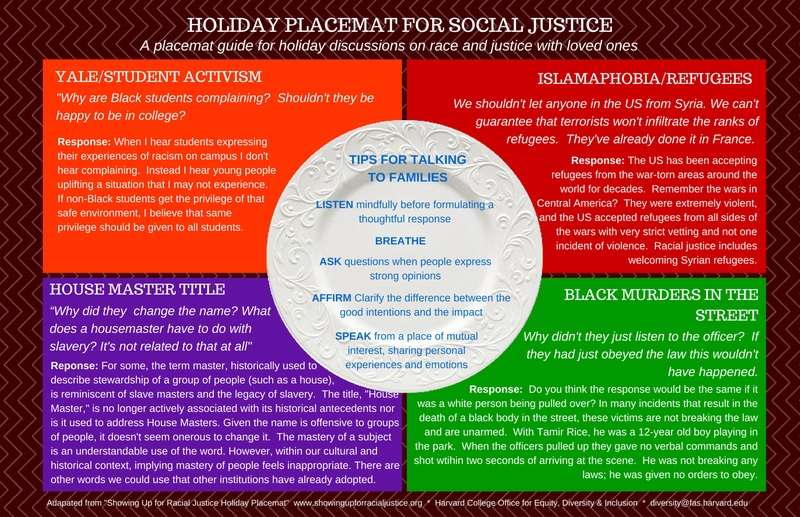
It used to be that Harvard produced some of the best and brightest minds in the world. Now, those minds are so fragile and delicate that have to hide behind talking points on a placemat when they’re talking with their own families over the holidays.

Uff da…

It bears repeating: I knew nothing about this. It was just something I said. “Liberals, try actually discussing, rather than reading from talking points at the dinner table.” Sometimes, I guess, I just don’t know how right I am…

But what-ho, what’s this? Every action has an equal and opposite reaction? Or no, not equal in this case…superior.

Remember we told you about the Harvard talking points placemat that the school’s office of “diversity, microaggression, and ZOMG – HELP ME, I’m being triggered!” gave to their special snowflake students who can’t handle talking to their families over the holidays? Harvard Republicans came up with their own version of the placemat. And I have to applaud these guys and girls for their ingenuity and humor…
:
Well played, Harvard Republicans. Well played.

Update: Oh dear…President Clinton’s Labor Secretary wants to get in on the action. Well his arguments are not good ones, so he’s sending his fan base into a joust with a short lance. But, it’s a free country.

Whom to Ask

Saturday, December 19th, 2015

These things are ailments, moral shortcomings, other set memberships that have the effect of blinding those on the inside. When we discuss what is going on with these things, we value the opinions of people who are not part of them. If you are part of these things, we do not, and should not, value your opinion about that thing.

1. Alcoholics
2. Adulterers
3. Liberals
4. Senility
5. Personality disorders and other behavioral health issues, including homicidal ones
6. Government regulators
7. People who fall for scams
8. Tyrannical dictators
9. Cults
10. Any sort of addiction

These things are religious denominations, ideologies, associations that determine some ways of looking at life. They are situations in which, you have to be on the inside to comment credibly. A question about “What does X think about Y,” where X is any one of the following, is equivalent to a question of “What did YOU mean when you said something?” You don’t ask people on the outside about what people are thinking on the inside. That would be daffy.

1. Christians
2. Jews
3. Libertarians
4. Conservatives
5. Gun owners
6. Software engineers
7. Boy Scouts
8. Homeowners
9. Taxpayers
10. Parents

These things may belong on the first list, or on the second list, depending on the person. You can’t generalize about them, you have to take it on a case by case basis.

1. Atheists
2. People who scam other people
3. Environmentalist whackos
4. Children
5. Homosexuals and homosexual activists
6. Public school teachers
7. Radio talk show hosts
8. Bloggers, commenters on social media
9. People who are opposed to illegal immigration
10. City engineers responsible for designing really bad intersections, like the one on Bidwell in Folsom, by the Highway 50 overpass, in front of Starbucks

I’m sure nobody is going to agree with me entirely about the content of the three lists. But I would hope we can achieve near-universal agreement among thinking persons who observe the behavior of other human beings, and ponder what it means, about the concept. Sometimes you rely on the comments from the people on the inside, sometimes you don’t. Sometimes you merely probe; maybe find a polite way to ask “What the heck are you people thinking?”

I’m also reasonably sure someone who had something to do with city street planning in Folsom, was dating someone who had something to do with Starbucks, and got dumped.

Now this

…borders on the obscene. I doubt very much that a Christian was responsible. Such a Christian would have to be capable of sketching, coloring and finishing something that demands a great deal of time and attention to detail, without ever reading up on Luke 2:1-7. Nobody really seems to know who first created or displayed the image. One commenter took on a search, which he says was not exhaustive, and the oldest embed at the end of that search was was here but that doesn’t look like the true origin.

There are those Christians who rely on their faith to think through their various problems in life, some of them going so far as to say it’s required for clear thinking. I don’t find that objectionable at all; I’m probably in that camp myself. And it’s mostly because of stuff like this. I see non-Christians forming ideas about Christians, apparently without ever once talking to any of us. Crazy. No I mean that literally; to presume it makes sense to do it this way, these people have to be off their nut.

They’re not following my three lists — which is fine, they’re mine. Someone else’s lists are going to be different. But, they’re not making any such lists, not stopping to ask themselves “Who knows something and who doesn’t? Whom should I be asking?” They just do what feels right and good.

Most troubling, since a lot of these people are in real positions of authority to say what is true, what is happening. Like cartoonists, reporters, politicians and those who write speeches for them. They consistently get Christianity backwards; they fantasize about what it means to be one, without ever thinking about becoming one, or asking anybody who is one.

They get the conservatives and liberals backwards a lot, too. Liberalism is an addiction. You don’t ask an addict for his opinion about what his addiction is, or is not. You don’t ask a liberal what conservatives think. The ignorance liberals have about their opposition is a special kind of ignorance. They don’t know, they’re proud of not knowing. They don’t care to learn. They’re proud of not caring. And they make up a lot of stuff that isn’t true because, again, it feels right and good. That’s their idea of gathering facts. Why would you ask them?

Related: Kirsten Powers: Becoming a Christian Ruined My Love of Christmas — But then I learned to see the beauty of Christ’s coming like never before (via Bird Dog at Maggie’s Farm).

May I Suggest These New Years’ Resolutions

Friday, December 18th, 2015

Yesterday afternoon was crazy. I suddenly realized 1) I’m working on five things at once, 2) a lot of these things were put on my plate by somebody else, 3) because they realized I’m going to be clocking-out and hitting the road real soon, 4) and that nobody else can do it, and 5) I’ve helped them before, so why not hit me up with the latest crisis?

I suspect other people who actually get things done, have this problem at this time of year. I don’t want to disparage the people who were piling stuff on my plate, some of them were trying to be considerate and respectful — in fact, in one case, the crisis existed because they were being too respectful. I was the one in error, having procrastinated on their project too long. Nevertheless, there’s a problem. There has to be a problem if all this stuff is getting thrown into the pot, in “crisis mode,” at the eleventh hour. It doesn’t have to be this way.

Put the following up on the Hello Kitty of Blogging, before I realized it’s a better fit here. (The people who really need to see it have unfriended me and can’t see it; of course they don’t read this page either, I don’t think…but still…)

Two weeks from now people will be wondering about what resolutions they can make. I suggest these.

1. FRONT LOAD the effort. If the current block of time you’re using, as in right now, this very moment, is not allocated toward a defined purpose already, find something on your unfinished-tasks list that will fit into it. The time has to be burned somehow. If you have stuff that has to get done, burn the time on getting the stuff done. Simple, right? Procrastination is cute and all, but when it leads to consequences that impact others, that means you have taken it too far.

2. Don’t be a helicopter mom. Whup whup whup whup whup…don’t enable others. Helping is alright, but be mindful of when the targets of your help are ignoring consequences and ignoring deadlines, because you’re allowing them to do this. That means you’ve gone too far.

3. If you have found someone to be a valuable source of assistance to you, treat them with respect, not like some dumb beast of burden that hasn’t got anything else to do but stand around, chew a cud and wait for your next crisis.

4. Your observance of #1 and #3 should lead to this one: Think about prerequisites. Figure out what you’re going to need people to do. Do this early, so you can ask them how your latest need, should they choose to accommodate you, can fit into their schedules best.

5. DEFINE. I notice when collaborating with people on things, if I make a list of any sort I often hear this smack-down: “Looks complicated.” Or “You’re over-thinking it.” Or “I find it overwhelming.” Alright alright, I’m sure in a lot of cases I am guilty. Probably most of the time I’m guilty. But when the list is nothing more and nothing less than what it needs to be — five things that have to get done, and the list is of those five things — you will hear me offer a rebuttal something like this: “It is what it is, I didn’t make it that way.” The fact of the matter is, too many people among us have reached adulthood, taking on responsibilities, with other people counting on them to get it all done, without ever having learned to define what has to get done — let alone getting it done. They see a list of any kind, they turn up their noses at it, figure they’re too good for something like that, think of it as “nerd” stuff. THERE IS NOTHING OVERWHELMING ABOUT A LIST. It’s just a list! You want overwhelming? Lists are just the first stage. Man up, Nancy.

6. PRIORITIZE. If everything is important, then nothing is.

7. SCHEDULE. You generally should be doing the high priority stuff first, but that isn’t necessarily always the case.

8. PLOT AND SCHEME. When did these become evil words? Go ahead, be evil, plot, scheme. There’s nothing nefarious about figuring out whether the Dry Cleaners open at 9 a.m. or 10 a.m. This is the age of Google, sit down and do your research.

9. LEAVE THE COMFORT ZONE. Don’t be Beaky Buzzard!

10. Begin with the end in mind. What exactly is it you’re trying to do? Are you laboring toward a goal — see #5 — or are you just frittering away time doing whatever you like to do?

These are things we often don’t discuss, under the premise that it’s a person’s private business to manage his time and his projects the way he wants to manage them. The reason we think about it that way is we want to be considerate to others. But when people neglect this stuff, they end up being inconsiderate to others, so in situations like that, the objective defeats itself. And of course, there is nothing intrusive about suggesting New Years’ resolutions, even to strangers — if you don’t like ’em, ignore them. Just keep blowing deadlines, having crises, imposing on people who have helped you the most…

Further thoughts:

When you break #5 and don’t define, you offer a powerful motivation in others — the persons upon whom you are counting to get the work done — to break #1, to start procrastinating. Think about it: If they’re giving you solid deliveries so that they become your “go to” guy, then they’ve become someone else’s go-to guy as well. If you’re giving them things to do without offering specifics they need to do it, it just makes sense for them to attend to the other stuff while waiting for the necessarily details to, just maybe, possibly, somehow, materialize. It would be ludicrous to expect something different, am I right?

If the thing you’re doing involves the word “each,” or “all,” or “none,” then the thing you are doing demands a list. First thing you need to ask yourself is how many things are on the list. Ten? Twenty? Five hundred? If you don’t know the answer, then that means you don’t have access to the list yet, and the first step of your task couldn’t possibly be clearer. So are you at least in the process of making the list? If you aren’t, then you aren’t doing the thing, you’re just deluding yourself into thinking you’re doing the thing while you watch YouTube clips about cats, or playing games on your phone, or whatever.

Lists are necessary. Nobody is really too tender to work from a list. The next step up from a list is a sequenced list, and the next step up from a sequenced list is a matrix, or grid, a two-dimensional version of a list. That’s still entry-level stuff, and most things worth doing in life, if represented in a way that fulfills #5, are represented most accurately on a grid. If it pays money, and uses your head as something other than a hat hook, it’s going to involve performing each and every single one of X actions, upon each and every single one of Y objects. That is most work. The mundane sort. It can still be quite boring. The challenging stuff demands even more complex levels of tracking framework.

I do have to confess, in this bracket of life I’m fermenting a higher level of contempt toward people who balk at the supposed excessive-complexity of a list. I’m seeing it as the purest form of balderdash. I’m seeing it as, with the layers of bullshit stripped away, a confession that they don’t really do any work at all. I can hold seven things in my head without jotting any of it down, maybe, and that’s if I’m not juggling other projects, which I usually am. Seven. No more. You probably can’t hold any more than that either. How the fuck are you doing anything that involves more than seven tasks without making a list, you poser?

And on that note, I must make preparations to begin the day, lest I be guilty of breaking #10.

Yanking Solutions Off the Table

Friday, December 11th, 2015

A timeless anecdote about flawed problem-solving…it is timeless because it has accurately reflected the reality of human behavior for awhile, and continues to reflect it, to our discredit…

A few night ago a drunken man — there are lots of them everywhere nowadays — was crawling on his hands and knees under the bright light at Broadway and Thirty-fifth street. He told an inquiring policeman he had lost his watch at Twenty third street and was looking for it. The policeman asked why he didn’t go to Twenty-third street to look. The man replied, “The light is better here.”

We, like the inebriated fellow in the tale, know exactly where the watch went missing

…[P]erhaps the most important question about racial preferences is one that’s not directly raised by the case: do they even work? Do they help underrepresented minorities to achieve their goals, and foster interracial interaction and understanding on elite campuses? Or do large preferences often “mismatch” students in campuses where they will struggle and fail?

Scholars began empirically studying the mismatch issue in the 1990s, but in the past five years the field has matured. There are now dozens of careful, peer-reviewed studies that find strong evidence of mismatch. None of the authors of these studies claim that mismatch is a universal or inevitable consequence of affirmative action. But in my view, only demagogues (of which there is, unfortunately, no shortage) or people who haven’t read the relevant literature can still claim that mismatch is not a genuine problem.

It does me no pleasure to report from personal experience, that six-foot straight white protestant guys still in possession of all twenty-one digits can be “mismatched.” It’s not at all hard to do, and it’s no picnic.

But someone on the Supreme Court read about the problem, out loud, and in so doing committed thought-crime.

“Senate Minority Leader Harry Reid on Thursday took to the Senate floor to attack Supreme Court Justice Antonin Scalia’s comments during an affirmative action case as ‘racist,’ ” CNN reports:

“These ideas that he pronounced yesterday are racist in application, if not intent,” Reid said. “I don’t know about his intent, but it is deeply disturbing to hear a Supreme Court justice endorse racist ideas from the bench on the nation’s highest court. His endorsement of racist theories has frightening ramifications, not the least of which is to undermine the academic achievements of Americans, African-Americans especially.”

Here’s what Scalia had to say yesterday, during oral arguments in Fisher v. University of Texas (we’re cleaning up some repeated words):

There are those who contend that it does not benefit African-Americans to get them into the University of Texas where they do not do well, as opposed to having them go to a less-advanced school, a less—a slower-track school where they do well. One of the briefs pointed out that most of the black scientists in this country don’t come from schools like the University of Texas. . . . They come from lesser schools where they do not feel that they’re being pushed ahead in classes that are too fast for them. . . . I’m just not impressed by the fact that the University of Texas may have fewer. Maybe it ought to have fewer. And maybe when you take more, the number of blacks, really competent blacks admitted to lesser schools, turns out to be less. And I don’t think it stands to reason that it’s a good thing for the University of Texas to admit as many blacks as possible.

In denouncing Scalia, Reid was following the lead of the liberal media. A New York Times editorial accused Scalia of positing an “offensive premise”—never mind whether or not it is true—“which has not gotten such a full airing at the Supreme Court since the 1950s.” The paper’s Adam Liptak reported that Scalia’s remarks “drew muted gasps in the courtroom.”

Living up to its reputation as the Times for infants, New York’s Daily News put Scalia on its front page, with a headline that screams “SUPREME DOPE.” The subheadline reads “Justice Scalia’s racist rant ripped.” Below it is a paraphrase of what Scalia said, which the News misleadingly puts in quotation marks.

The lead paragraph of the News’s “news” story by Adam Edelman: “What a supremely outrageous thing to say.” Edelman’s story includes this dubious appeal to authority: “Scalia’s comments…troubled civil rights activists across the country, including the Rev. Al Sharpton.”

Well now, there is a litmus test for you.

There is a term to describe this, and it fits so well that those who aren’t aware of it are derelict in their duties as learning, thinking humans not finding out about it; those who knew of it already, like me, have been derelict in our duties of using it at least some portion of all the occasions in which it fits, so that others may learn about it. Not only does it fit occasions, which aren’t even occasional, I would go much further to say it governs our entire existence as an information-based society.

Or not so much governs, but hangs around it like a bad stink.

“Overton Window”:

…“The window shifts to include different policy options not when ideas change among politicians, but when ideas change in the society that elects them.”

The Left — dominating the media, the academy, and pop culture — is unmatched at moving the Overton Window. Consider gay marriage, a subject once so far outside the mainstream that less than 20 years ago, Republicans and Democrats united to pass the Defense of Marriage Act to define marriage under federal law as the union of one man and one woman. Now? That view is such an anathema that it’s difficult to get — or retain — a job in entire sectors of the economy if you openly hold to the traditionalist position on marriage.
:
The leftward pressure on the Overton Window has been relentless, with conservatives reduced to applying herculean effort to simply maintain the cultural and political status quo. Yes, the Tea Party has nudged Republicans just a bit to the right, but it’s a sign of the success of the Left that a relatively unchanged GOP can be labeled as ever more extreme and “reactionary.” And few realities show this leftist success better than the fact that the Window now enables expressions of overt leftist hatred and bigotry — against Christians, against conservatives, against whites, and often against Jews.

Then along came Donald Trump. On key issues, he didn’t just move the Overton Window, he smashed it, scattered the shards, and rolled over them with a steamroller. On issues like immigration, national security, and even the manner of political debate itself, there’s no window left. Registration of Muslims? On the table. Bans on Muslims entering the country? On the table. Mass deportation? On the table. Walling off our southern border at Mexico’s expense? On the table. The current GOP front-runner is advocating policies that represent the mirror-image extremism to the Left’s race and identity-soaked politics.

But is Donald Trump rolling over the window with a steamroller, really? Or is the window rolling over him with one?

According to the famous satire site The Onion, we’re still waiting to find out which is which:

‘This Will Be The End Of Trump’s Campaign,’ Says Increasingly Nervous Man For Seventh Time This Year

Repeating identical comments he had made in June, July, August, September, and twice in November, increasingly nervous local man Aaron Howe responded to Donald Trump’s call to ban Muslims from entering the U.S. Monday by once again stating this would be the end of the Republican frontrunner’s campaign, sources confirmed. “Well, that’s it—you just can’t say those kinds of things and expect to be taken seriously any longer,” said an anxious Howe, his voice quavering slightly as he spoke aloud the very same words he had previously uttered in reaction to remarks about Mexicans, women, the disabled, former POW John McCain, and a number of other targeted parties. “That’s the final nail in the coffin right there. There’s no way he’s coming back from this one.” At press time, a visibly tense Howe was steadily amassing the angst and exasperation that would be unleashed in his seventh expletive-filled exclamation of the year when he catches sight of the newest set of GOP poll numbers.

Yeah…”GOP poll numbers,” I get it. Bashing Republicans as being racist. Well, not all “onions” can be “fresh,” all of the time.

Fact is, there is something going on here that is much, much bigger than the Republican party. It’s going into my imaginary, but ever-thickening file, of things you could never explain to a space alien renting space in your laundry room. Just imagine: Thoroughly unacquainted with our culture, but adequately intelligent and curious, he approaches you and asks you to explain — CANDIDATES want to be seen as problem-solvers. VOTERS want to be seen as problem-solvers. EVERYBODY is making a great show of being sick and tired of the problems…they seem sincere about it…but when it comes time to actually come up with solutions, so few people are coming up with any solutions, and so many people are declaring the solutions already suggested to be unacceptable. For every Donald Trump putting solutions “on the table,” there are perhaps millions of opinionated busybodies yanking solutions off the table. And not putting any other ones back on the table, in their place. And all these people are in line, demanding their high-fives for being problem-solvers when they aren’t solving anything.

Question: Could this be how you Earthlings “solve” problems? You wouldn’t be able to answer. I wouldn’t be able to answer. Actually, I’m genuinely starting to wonder myself.

When these problem-not-solvers yank the solutions off the table, offering their bumper-sticker-slogan-sized statements of rationale for doing so, they can’t even manage do it with any accuracy:

President Obama claims that restricting immigration in order to protect national security is “offensive and contrary to American values.” No-limits liberals have attacked common-sense proposals for heightened visa scrutiny, profiling or immigration slowdowns as “un-American.”

America’s Founding Fathers, I submit, would vehemently disagree.

Our founders, as I’ve reminded readers repeatedly over the years, asserted their concerns publicly and routinely about the effects of indiscriminate mass immigration. They made it clear that the purpose of allowing foreigners into our fledgling nation was not to recruit millions of new voters or to secure permanent ruling majorities for their political parties. It was to preserve, protect and enhance the republic they put their lives on the line to establish.

In a 1790 House debate on naturalization, James Madison opined: “It is no doubt very desirable that we should hold out as many inducements as possible for the worthy part of mankind to come and settle amongst us, and throw their fortunes into a common lot with ours. But why is this desirable?”

No, not because “diversity” is our greatest value. No, not because Big Business needed cheap labor. And no, Madison asserted, “Not merely to swell the catalogue of people. No, sir, it is to increase the wealth and strength of the community; and those who acquire the rights of citizenship, without adding to the strength or wealth of the community are not the people we are in want of.”

Madison argued plainly that America should welcome the immigrant who could assimilate, but exclude the immigrant who could not readily “incorporate himself into our society.”

George Washington, in a letter to John Adams, similarly emphasized that immigrants should be absorbed into American life so that “by an intermixture with our people, they, or their descendants, get assimilated to our customs, measures, laws: in a word soon become one people.”

In fact, the case could be made…at least, to anyone open to having a case made to them…maybe in lieu of discriminating against any one particular religious denomination, we should just slam the doors shut for now altogether. We are overdue, after all, the same way I find myself overdue for a salad diet when my jeans don’t fit.

…[A] lot of Americans have very legitimate concerns about assimilation, the massive amount of crime committed by illegal immigrants, and whether our government can properly vet immigrants. Additionally, given what’s happening, we should all be worried about American citizens losing out on jobs. Right now, the workforce participation rate in America is 62.6 percent, which is the lowest that number has been in 38 years. America DESPERATELY needs to focus on getting those Americans back to work instead of bringing new immigrants to take those jobs or alternately get on welfare themselves.

After all, it’s not as if the United States hasn’t already done our share when it comes to taking in immigrants. Currently, we have an all-time record population of 41.3 million foreign-born citizens. That’s an enormous increase,

“The 41.3 million immigrant population (legal and illegal) in 2013 was double the number in 1990, nearly triple the number in 1980, and quadruple that in 1970, when it stood at 9.6 million.”

Given how many Americans are out of work, how many immigrants are on some form of government assistance and how poor our vetting system is, doesn’t it make sense to halt the flood of immigration into our country for a few years?

That would give us time to get more Americans hired, fix our vetting process, secure the border and set up a merit-based immigration system that would assure we’re consistently getting the cream of the crop instead of bringing people here to take advantage of our welfare system.

Immigration has been a tremendous boon to America in times past and it can be again, but under our current system immigration can only make America weaker.

The issue isn’t quite so much that the situation has deteriorated to some meaningful level; the issue is that nobody with any clout, and interest in preventing harm from being done, is keeping an eye on it. We aren’t keeping an eye on it. Someone like Trump will say something, and the alarm bells will sound, screeds will be written, all sorts of pundits paid and unpaid will opine about the remarks, on Sunday talk shows and on social media, blisteringly. They’ll preen and preen some more…as they, almost systematically, and in the same breath as professing to be super-duper concerned about the stated problem, proceed to yank solutions off the table. It’s like someone forgot to tell them: That problem is not yet solved. It isn’t getting better. We don’t even know if we’re ever going to see it solved, that’s still a lingering question. The impression somehow didn’t get made on them, that we are not suffering from a glut of workable solutions to this, we’re toiling away under a scarcity.

And smack in the middle of an election campaign season — that, nowadays, lasts just short of two full years. Well that would mean we’re in “campaign season” all of the time, or close to it, which is a whole different problem. But it still raises a question: If we can’t come up with solutions now, as opposed to eliminating them, then when can we? And can we really claim to be concerned about solving problems if the noisiest and most opinionated among us are not, you know, coming up with solutions to them? When all they can manage to do is crawl out of little holes in the ground, like skunks, spray their “That guy isn’t as good a person as I am” stink-spray in as many different directions as they can manage, and scurry back into the hole again? That doesn’t make anything better. But we seem to have become accustomed to seeing something like that, nothing else, and somehow, coming away from the experience not demanding something more or different. The problems “addressed” this way continue to deteriorate and rot…and there’s little-to-no genuine surprise manifested anywhere about that, which I suppose stands to reason.

The “Hoover Vac” Immigration Policy

Wednesday, December 9th, 2015

No, I can’t completely support the Trump plan “for a total and complete shutdown of Muslims entering the United States until our country’s representatives can figure out what is going on,” and I also cannot support House Speaker Ryan’s rebuke against it, that it is “not what this party stands for and more importantly it’s not what this country stands for.” Both statements have dangling prepositions at the end. But there are worse things than that involved with both of them; and, it just so happens, these worse-things are things that the dangling prepositions are connected to.

The snooty, snotty, condescending phrase “that’s not who we are” has overstayed its welcome by a good long stretch, much like the house guests reminding of the dictum that “guests, and fish, smell after three days” — and then continuing to squat for another year or two. It’s at the point where we all should start asking ourselves how it came to be that we tolerated it this long; it reflects poorly on the nation. Aren’t we supposed to have guts and conviction in this country? And can you claim to have them, if some gasbag at a podium can persuade you to engage, or even consider, a complete one-eighty-degree course correction by throwing out some paternalistic, hackneyed catchphrase? The solution makes more of the same problem, for that is not who — you know the rest.

Seriously, I’m ready to cock-punch the next one who uses it. Inside or outside the teevee. Leave it in the dirt where it belongs, Speaker Ryan; leave it to that fellow up the street.

Apologists for an overly lax immigration system should be the least-entitled to use this. You want to open the borders and then, anyone who wants in can just waltz through the gate, whether they intend to assimilate into our society or not — alright, if we do things your way, and the argument can certainly be made we’re doing them that way already…who and what are we? It’s impossible to say. That’s kind of, you know, the whole point. If we aspire to be anything definable, there are going to have to be some restrictions. That’s how any organism or construct declares what it is, by way of rejecting the unlike, not by way of embracing the like. It says “I’m absolutely incompatible with that thing, over there,” and the definition is made. Such things also protect themselves against threats this way, by forming policies, written and unwritten, essentially saying “I’m not going there, and if it comes here, I’m moving.”

Speaking of definition, Trump is not completely in the right either: Until our representatives can figure out what’s going on? What exactly does he mean by that? There’s no question, or not much, that such a proposal is legal and constitutional, and it’s clear what it is intended to prevent — but what is it intended to do? Exactly what questions are to be answered that, at this point, remain unanswered? I can’t think of any.

But he’s opened a very worthwhile debate that his opposition, perhaps deliberately, has turned into a very silly one. The citizenry has been led down a primrose path here; a lot of people don’t understand how much precedent such a plan has, or how unprecedented our current “Hoover Vac” immigration policy is.

So I think it would be very useful and helpful here just to review a little history to let you know that what we propose today and what many Americans support today is actually traditionally American. It is not new. It is not unprecedented. It is historical. No immigration, 1924 to 1965. The reason was that we had seen a flood of immigrants to the country and we had to assimilate them. We took time to assimilate those who had come to America. They wanted to be Americans. They wanted to assimilate. They did not want to establish Balkanized beachheads of their countries. [emphasis mine]

We hear often that we should be seeking not the Republican answer or the democrat answer, but the American answer to our problems. This is one example in which that’s really true. And, therein lies the problem. The “American answer” is one that is open to immigration — open to the possibility of accepting each immigrant who wants to take on the associated responsibilities, to assimilate. But, Americans think about what they’re doing. We weigh consequences. We look down the road — and that, right there, if you look at history, that’s what has made things work here.

The American solution is to look at what sort of immigrant is trying to make a life here. What kind of life is to be made? And what nobody is discussing is, the democrat solution: Go ahead and look into it, and make sure that life is one of dependency. To get on the welfare systems, stay on them, and create whole new generations of second- and third-generation immigrants, also made dependent and embracing dependency, from the crib to the crypt. So that democrats can win more elections.

That is the plan they’re trying to sell, and that’s the real reason they’re trying to stir up rage about Mr. Trump’s comments about this. As for whether or not that is who or what we are, well, I guess that’s for the rest of us to decide…

As far as the theatrical outrage about crossing some uncrossable line of bigotry, or some such. I find it thoroughly revolting that anybody, anywhere, would reach up to take solutions off the table, before it’s been made clear in any way that there are still solutions on the table that might work. Or even, that anything will work. This is not a fight our country has won yet, so who are these people working so hard to eliminate possibilities? It’s become such a regular thing, nobody seems to question it anymore; it’s yet another primrose path down which we have been innocently toddling, for years, decades, generations — we approach a particularly vexing problem that has evaded any promising solution for some indeterminate length of time, and before anybody can shed some rays of hope upon it here comes some jackass trying to make himself sound more important with a lot of “No no, oh heavens no, win or lose we can NEVER do X.”

Real Americans might say something like that…maybe. After the battle has been won. But not until then.

Because that, ladies and gentlemen…really and truly…is “not what we are.”

The Brain-Damaged Case for Progressive Taxation

Tuesday, December 8th, 2015

George F. Will, by way of The Barrister at Maggie’s Farm:

The nonexistent case for progressive taxation

Progressives are increasingly preoccupied with income inequality, and their current hero, Sen. Bernie Sanders (I-Vt.), favors increasing the tax system’s progressivity. So, in this 103rd year of the income tax, it is timely to note that there still is no intellectually sturdy case for progressive taxation.

Arguments for it are invariably arguments for increased equality of social outcomes. Because individuals have different vocational desires and different aptitudes for adding value to the economy, inequality is inevitable. Because individuals have different social sensibilities, opinions will differ about what degrees of inequality are intolerably unlovely. But inequality, even when unlovely to some, is unjust only when it arises from unjust social arrangements…

“Individuals have different vocational desires and different aptitudes for adding value to the economy” — that is being most charitable. We don’t talk too much about what interferes with that. Every now and then some politician or pundit will make some noise about “education,” when they may or may not be referring to the process of actually educating anybody, because the buzzword affords an opportunity to force the expenditure of Other People’s Money.

But “adding value to the economy,” when you get right down to it, and in the context of what ordinary people expect to be discussed under such labeling, has to do with people helping other people. There are those among us who simply aren’t into it. So for the altruism-challenged, the free market forms an attachment between the helping of others and the enrichment of oneself; it’s an incomplete solution, for there are some among us who still aren’t interested.

We deal with that particular problem, by refusing to discuss it. You won’t see it inspected or probed, or even mentioned, on Sunday morning talk shows. It’s up to crazy wild-eyed right-wing bloggers like me. Which is a bit odd, really, because doesn’t everyone have one friend or relative like this? At least one?

There are people who hate money. No seriously. They bring it home, and figure the odds are stacked against them because after they’ve paid the essentials and made the minimum payments on the credit cards, which are maxed, there’s nothing. If this is ever discussed anywhere, it leads to some dirge about how the situation came to be, the high debt is the aftermath of some health crisis or what-not…but, nobody ever plotted a decent course forward by looking back at where he’d been. The real issue is that if the debt wasn’t high, they wouldn’t know what to do. If the debt was somehow gone tomorrow, and they had ten grand in the checking account, they wouldn’t see it as the end of a calamity but rather as the beginning of one. The money would represent an unfinished task, an unsolved problem.

Hand them $50, they start looking for things that cost $60. These are people who will never have money left at the end of the month. Ever. Because the simple fact of the matter is that isn’t what they want to have happen.

Such people have a comfort zone. It’s over there. Starting a savings plan and sticking to it…that’s off someplace else. High debt and low cash reserves, that’s all part of the zone. If they’re making as much as they’re ever going to make, and “happy” with that, because developing a new skill and finding new ways to help other people would be becoming a cog in “the machine” and that’s just a non-starter — well then, the simple truth of the matter is that there’s no journey ahead of such people, no road for them to travel, they are where they want to be.

Sometimes they put things on the backs of their cars to show off their insanity…things like this…

Isn’t that funny? Makes you want to say something like…”Ooh! I’ll vote the way you vote then, and maybe I can be poor too!”

We’ve done nothing to “fix” this; even worse, we haven’t even begun to discuss it. Haven’t even come up with a name for the mental illness. Our “solution,” thus far, is to mold and tailor the capitalistic system to suit people who have no desire to participate in it. This is a plan that can “accomplish” a lot of things, but making the system healthier can’t be one of those things. But there is no defined goal, anyway. What should a progressive taxation reform be trying to accomplish, exactly? Poor people end up with more cash? Rich people end up with less? Both? Neither?

Will continues…

Progressive taxation reduces the rewards of investments and the real rate of return on savings, thereby encouraging consumption over saving and hence over capital formation. When progressive taxation slows economic growth, it makes inequalities of wealth more durable by retarding the accumulation of new fortunes. And by encouraging constant tinkering with the tax code to perfect equity, progressive taxation gives a patina of altruism to rent-seeking by economic factions, whereby government enriches those sophisticated at manipulating it.

Because other arguments produce only “uneasy” cases for progressive taxation, this is the argument of last resort: All striving occurs in, and all success is conditioned by, a social context. Each individual’s achievement, like each individual, is derivative of society, which is entitled to socialize — conscript — whatever portion of each individual’s acquisition that society calculates is its rightful share. Because collective choices facilitate individuals’ strivings, the collectivity, represented by government, can take as much of created wealth as it decides it made possible. Being judge and jury in its own case, government will generously estimate its contributions and entitlements.

Bull-eye. Progressive taxation creates a government-to-citizen relationship that is purely parasitic, and no longer symbiotic. The host must live within its means, whereas the parasite is in a position to simply demand more, and — should a shortfall continue to ensue from any newer arrangement — blame the host. In the end, nobody prospers except for opportunistic politicians with careers built on the creation of new jealousies, and the further aggravation of existing ones.

Bad Theory

Monday, December 7th, 2015

Breitbart: Supreme Court on Verge of Banning Affirmative Action:

In the education case of Fisher v. University of Texas, at least four Supreme Court justices appear ready to strike down affirmative action.

The U.S. Supreme Court, in a pivotal test of affirmative action in education, will hear arguments on December 9 for the second time that Abigail Noel Fisher was discriminated against by the University of Texas.

A blanket ruling outlawing racial and ethnic preferences entirely would follow Chief Justice John Roberts’s 2007 dictum, “The way to stop discrimination on the basis of race is to stop discriminating on the basis of race,” from the opinion in the 4-1-4 vote case of Community Schools v. Seattle School District No. 1.

The Court at the time found the public high school district’s racial tiebreaker plan unconstitutional under the Equal Protection Clause of the Fourteenth Amendment.

Justice Clarence Thomas has steadfastly supported a ban on affirmative action, but swing voter Justice Anthony Kennedy has consistently upheld the validity of the theory of affirmative action, even if he has voted to strike down specific practices as unconstitutional.

I don’t know why Justice Kennedy, or anybody else, upholds “the validity of the theory” now or at any other time. It is a so-called “theory” that unequal treatment is, when the rubber meets the road, equal treatment; it is a theory that calls for opposites to become equivalents. Any argument that persuades toward acceptance of such a theory, if effective, you’d better bottle that stuff quick and keep it around for a good long time — because that could be applied to any and all premises that are wrong, no matter how wrong they are. Such an argument, in seeking to assert that a thing is the opposite of itself, seeks to triumph against the ultimate test of delusive, mistaken arguments.

Or rather, you’ll notice, in practice it doesn’t seek any such thing; like the mold that covers your bread, it confines its existence to a picky sub-spectrum of environments in which it can hope to survive. High courts, committees, and other adjudicating bodies in some position to accurately anticipate the outcome of what limited avenues of appeal there may be, hiding behind the lectern of “Our Finding Is.” Or, in situations in which the avenues of appeal are not so limited, something more like “I/We Feel”:

Not only I don’t find affirmative action unconstitutional, I believe it’s the proper action a government should take in case there are severe disproportions in society. We can argue if present general social status of certain ethnicities is or is not a consequence resulting from slavery and oppression in the past, but the fact is both slavery and oppression took place. Let’s consider affirmative action a form of repatriation.

That’s where the argument is stated, and not only does it fail to directly address the question of “does Affirmative Action Violate the 14th Amendment?” with anything other than a flat, unreasoned “no” — it fails to address the opposing argument, that there is in fact a violation here:

Well, as you know the 14th Amendment says very clearly that “no state shall deny any person equal protection under the law.” That means that all laws passed by the 50 states have to apply to everyone, equally. Affirmative Action gives a racial preference to some Americans in hiring, in school admissions and other competitive areas. If an individual American gets a preference, then he or she is not being treated equally with everyone else. It’s simple as that.

This nets six votes, to zero for the argument of “let’s consider it a form of repatriation.” But of course six votes is not many, and there are many environments, some natural, some constructed artificially, in which it could go the other way.

Supporters of Affirmative Action, I notice, fail to see their own argument as what it is: Suspension, and therefore betrayal, of the written code to which unwavering fidelity had already been pledged. The structure of the argument is “Yeah, yeah, I know, the Constitution says that…but I want to appear compassionate. THEREFORE I FIND that this preference does not violate the written word (that it would otherwise, undeniably, be violating).” Like I said: If this stuff works, you’d better bottle it, because if it can work here it can work anywhere.

Losing argument goes on to say: “You made several very valid points where I couldn’t agree with your more. I’ll get into that later. Firstly, let me say I understand your frustration…”

Hoo, boy. Anybody ever talk with a bureaucrat, one who’s clearly in the wrong, before? They do that a lot. You point out, what you’ve just stated is the wrong answer, it’s this simple — up is up, down is down…and they come back with “I understand your frustration” as if what you just stated is feeling, not fact. Might as well say “I understand your frustration and now I’m going to add to it.” Except they seem to have missed, what you just explained was not frustration. They’re being taught how to do that, I suppose.

Anyway, getting back to the main article, there’s another passage that is not quite so much frustrating, as despairing:

The arch-supporter of affirmative action on the Supreme Court is expected to be Justice Sonia Sotomayor, a child of Puerto Rican immigrants who won acceptance and a full scholarship to Princeton based at least partially on affirmative action. In Schuette v. Coalition to Defend Affirmative Action, she stated: “Race matters because of the slights, the snickers, the silent judgments that reinforce that most crippling of thoughts: ‘I do not belong here.’”

To those who understand how the world, and the people in it, actually work — it inspires despair. The sentence clearly articulates exactly what the problem is that the policy is supposed to solve. First flaw in her reasoning is, the problem is unworkable because it is unmeasurable, it’s proggie leftists announcing their grievances in passive voice, yet again, no identifiable individual or group engaging in the incorrect behavior. So you can proclaim “It’s still happening” until the sun goes nova, and beyond…which is kind of the point. “Coalition to Defend Affirmative Action” — if you need a coalition to defend it, you probably intend to keep the coalition around, justifying its own existence with all sorts of legalistic hooey, forever. And why do you need a coalition to defend it, anyway? I said someone should bottle up the infinitely effective, wrong arguments, for use later, and it looks like someone did exactly that.

The second, and far greater, flaw: Affirmative Action inspires these “snickers,” in no small measure. And it’s rather useless to blame those who do the snickering. Whenever anybody of any national origin, sex preference or skin color is elevated to a position of any sort of power, it goes without saying they’re going to have to be making some decisions that someone else will not respect. Have we collectively lost sight of that point? There seem to be an awful lot of people with power, great and small, nowadays who have it on their minds “Now I have power, everyone has to respect me” — that isn’t the way it works, not even close. There will always be people who disrespect you because you have some sort of power. Because you can make your decisions stand when they think, for whatever reason, those decisions should not stand.

Affirmative Action creates an environment in which, when the white guys do this, dissenters continue to wonder endlessly “How the heck did that fuckwit get this job, anyway?” — and when someone of a different demographic does exactly the same thing, the unidentifiable dissenters mutter to themselves “Oh…I see, I get it now.” Since there always will be dissenters, no matter what decision is being made or what type of human is making it, the Sotomayor-supported solution works against the grain of the Sotomayor-stated problem.

Environments

Saturday, December 5th, 2015

Now that it’s late enough in the year that we can play Christmas carols, we’re thinking an awful lot about environments. You probably are, too. This is the season for, among other things, guesting and hosting; if you’re hosting, you’re constructing an environment, and if you’re a guest you’re going to be venturing into one. If you are neither a guest nor a host, your environment is certainly changing. Stores and streets are getting decorated. There’s a whole different genre of music being played wherever you go. Environments change people. That’s why we change our environments. It is, when you get right down to it, a method of communication. It is messaging.

We also tend to think a lot, this time of year, about material needs and wants, placing emphasis on filling them and relaxing the concerns we would usually have about how the resources are being depleted. We think a bit more about poverty, and we focus on curing it in the here-and-now, not thinking too much about whether it will stay cured in the new year, or what caused it in the first place. For the conservative mindset, this is a seasonal change of pace. It might be a bit uncomfortable to some of us. And, given that it’s a bit under a month out of the year, it might be a healthy thing. We’ve been working our butts off to try to increase the savings, or at least not reduce them, and pay down the credit card balances — all year. We can go a tiny bit in the other direction for a week or two, right? For good causes: Charity, fellowship, happiness.

Swimsuit 1I don’t know what liberals do about Christmas. There is so much required & expected paradigm shift, anywhere on the outside, that within their stately pleasure-dome is just business as usual. They think about spending, and neglect long-term consequences, all the time. They “cure” poverty, without a care in the world about whether it’ll stay cured, using other people’s money — all year long. No wonder they have a tough time getting into the spirit.

And getting back to that thing about environments: They think about that all of the time, too. That’s what these Yale and Mizzou protests were all about, right? “Safe spaces” and what-not. Lefties love to complain, even when there’s no substance to the complaint — when things are already being done the way they want…

By my rough count, Yale offers 26 courses on African-American studies, 64 courses on “Ethnicity, Race and Migration, and 41 courses under the heading of “Women’s, Gender, and Sexuality Studies.” I am probably low-balling the real numbers (they don’t include independent study) and the extent of the indoctrination, since you can be sure that many seemingly conventional courses are chock-a-block with left-wing treacle. How many courses are there on the Constitution? Well, from what I can tell: two…

As for safe spaces, there is already an Afro-American Cultural Center, a Native American Cultural Center, an Asian American Cultural Center, La Casa Latino Cultural Center, and the Office of LGBTQ Resources. Included among the 80 or so official student organizations:

– A Learning and Interactive Vietnamese Experience
– Asian American Students Alliance
– Asian American Studies Task Force
– Association of Native Americans at Yale, Undergraduate Organization
– India at Yale
– IvyQ (as in “Queer”)
– Japanese Undergraduate Students at Yale
– Latina Women at Yale
– Liberal Party
– Reproductive Rights Action League at Yale
– Sex and Sexuality Week Planning Board…
:
And the response from the activists? A loaded-diaper tantrum about how Yale is a hotbed of bigotry against people of color and women.

There is justice in this. As Bret Stephens wrote in the Wall Street Journal,

For almost 50 years universities have adopted racialist policies in the name of equality, repressive speech codes in the name of tolerance, ideological orthodoxy in the name of intellectual freedom. Sooner or later, Orwellian methods will lead to Orwellian outcomes. Those coddled, bullying undergrads shouting their demands for safer spaces, easier classes, and additional racial set-asides are exactly what the campus faculty and administrators deserve.

Not a very festive thought. But then again, universities are supposed to — are entrusted to — build a better world of tomorrow, to benefit their students along with all of society. And they’re hardly fulfilling the promise by working according to Saul Alinsky’s Rules for Radicals.

Swimsuit 2Amid these thoughts of Schadenfreude, and the self-inflicted knuckle-rapping that arrives right afterward given how unfitting it is for this time of year, it’s easy to lose sight of another point. That The Left actually deserves credit, on no small scale, for taking the initiative. They understand the very first point I made, up top, that an environment has a powerful effect on the people in it. This is another thing conservatives just begin to understand, and exercise on a regular basis this time of year, but as a novelty — whereas the liberals understand the same thing, and do the same thing for the same reasons, all year long. And year after year it works that way, too.

Consequently, our environments are liberal. If you’re unfortunate enough to sit in family court, you sit in a liberal environment. Even if you don’t, you probably have to go to work. Surely that must be a conservative environment, since liberals don’t work…right? Wrong. Unless your “office” is someplace outside, and you have to wear heavy gloves on your hands to do what you do, and you get dirty doing it, it’s safe to say you work in an environment liberals have created for you. And furthermore, they did that because they know it has an effect on you, what you think about, how you behave. And furthermore, although you don’t want to admit it, it’s probably working.

Can you put a picture of Jordan Carver or Kate Upton on the wall, in all their swimsuit-wearing wonderfulness? No, you can’t? Well of course not. And why not? Because of the Yale/Mizzou issue, the “safe spaces.” This is a relatively new thing. It comes from Meritor Savings Bank vs. Vinson, Harris vs. Forklift Systems, Robinson vs. Jacksonville Shipyards…and other acts of judicial terrorism. Yes, terrorism. The word applies, accurately, perfectly.

[T]he use of violence and threats to intimidate or coerce, especially for political purposes.

So an image of Kate Upton in a bathing suit where it can be seen…an image of your wife in a bathing suit where it can be seen…can end your career. As an extension of that, any visual reminder that you’re a straight male who appreciates the imagery of women in bathing suits, can end your career. Acting too much like a straight male can end your career. Liberal-looney-ville on steroids. And people tend to forget: We’re not talking about some geographic region, or family court, or traffic court, or some stuffy living room in the house of some loathed lefty-liberal sister-in-law or any sort of edge-case like those. We’re not even talking about government offices. Liberals know where to hurt us: We’re talking about all workplaces, anything potentially under the authority of the American judicial system.

Any vocation that is not overwhelmingly male-dominated, they’ve got men living in fear. They’ve even got men talking in pitches a whole octave, or more, above what’s natural for them.

We’re going to be on the road this Christmas, visiting; we plan to grab one household by the scruff of the neck, meld it with our household, and drag it to yet another household. That’s a net of three, which is quite the cocktail. As we put together the plans for what we might be doing and how we might be doing it, we have been constantly reminded that people have been spending all year long functioning in different environments, and so they have become acclimated to thinking differently. We’re not liberals, so this is a novelty for us. The rest of the year, we have goals, then there is an environment that might make some of the goals a bit more difficult, and we think of the environment as just an “oh, well.” Like driving through bad weather on your way to work, or trudging up a hill on your way to a corner grocery store: The environmental factors might make things a bit more challenging but they’re not going to stop us. That’s how conservatives think about environment. It isn’t something you try to control, or build, more like something you endure. It isn’t going to change what gets accomplished at the end, worst-case it will only slow it down a little tiny bit.

Swimsuit 3Liberals are much smarter about this. They never stop thinking about environments. That’s because when you engage this messaging to your fellow humans by way of controlling the environment, it’s purely a monologue and not a dialogue. This is exactly the sort of conversation liberals like to have, and all the time. Purely one-way. Even when they call it a “dialogue,” that’s what they have in mind. So it is natural that they think about this all of the time, whereas to the conservatives, it’s a change of pace to be thinking about it at all.

The irony is that, to the leaders of the progressive movement, this is as easy as taking candy from the proverbial baby. Just keep walking through Alinsky’s rules, keep the resentments sharp, keep the jealousies high, do a lot of complaining, get others to do a lot of complaining. Everything is on your side — five justices on the Supreme Court rule your way, the very next day you can lose that five-vote majority and the decision is already locked in to the nation’s jurisprudence, for all practical purposes forever. The followers of the movement, on the other hand, never actually get what they want, because the people around them won’t be behaving the way liberal doctrine demands they behave. People don’t lose their fondness for an object because they are denied access to it by way of an artificially created shortage, nor do they acquire a new fondness for something because they are deluged with it by way of an artificially created abundance. That just isn’t the way the human condition works.

So when liberals take control of an environment to change human behavior — all year long — they are engaging a plan that works great for the leaders of their movement, but never can possibly work for any of the rest of them. A year later, or in two years, or ten, they’ll still be nursing exactly the same grudges about “society expects such-and-such” or “it objectifies me” or “shoving religion down my throat” or “the rich get richer and the poor get poorer.” Be that as it may, they do at least get the practice hours in at this, which keeps them smarter than their friends and relatives who are conservative. Or, not-liberal. To us normal people, it takes all of the time between Thanksgiving and Boxing Day to get adjusted to the idea that an environment is something we can affect. And we use up most of that time trying to adjust to the belated discovery that our extended-family relatives, having spent all year long in different environments, don’t think the same way, don’t cope with life the same way. It’s particularly challenging when we see this is as the root cause of some of the gaps in material wants and needs, that for the holiday season’s sake, we’re trying to cure. The festivities require that this train of thought be confined to the here-and-now, since it’s a drag to be thinking about January and onward. That’s challenging to the conservative mind, which when laboring to come up with a solution to a problem, tends to place undue emphasis on…yeah, it’s crazy-talk, I know…actually solving it, like, as in, for reals.

Who’s Got the Database?

Thursday, November 26th, 2015

National Review: Adverbs are hurting people.

According to a piece in the Huffington Post, the word “too” is sexist and hurts women by constantly making them feel like they’re not good enough.

In a piece titled “The 3-Letter Word That Cuts Women Down,” University of Vermont freshman Cameron Schaeffer explains that she had an “epiphany” about the word after talking with a friend about how she should cut her hair.

“Our conversation ended with, ‘Well you don’t want it to be too short or too long,'” Schaeffer writes.

“There is no proper way for a woman to cut her hair, let alone do anything right in this world…Everything is too this or too that,” she continues.

Now, when she says “everything,” of course what she really means is “everything as it applies to women.” After all, the very real damage inflicted by this word is yet another tragedy that only affects us: “In my experience, I rarely hear too thrown around about men,” she explains. “You hear someone say, ‘He’s short,’ but you seldom hear ‘too short.'”
:
“I never realized how deeply a three-letter adverb could cut,” she writes.

Alright, we’ll have to stop using that adverb then…along with maybe all adverbs? Soon as we get it figured out what we’re not supposed to use — don’t want to cut anyone, after all — we’ll just tack it on to the list.

Which arouses a rather fascinating question: What list?

For the natural disasters we’re supposed to be blaming on climate change, I see we do have a list, although I notice it doesn’t look like any one of the thousands of climate change advocates, paid or unpaid, could be bothered to compile it; seems to be the work of someone who’s sympathies are not with the movement. I know of no counterpart registry of items found to be offensive lately. No, not just lately. We wouldn’t want to forget about all the things we’ve already been taught are offensive, right? We should stop using all of them. Well, in order to stop using all of them, you have to know what “all of them” are.

Here and there, you find someone has taken the time and trouble to accumulate a lot of them…

Am I taking the complaint too seriously? Not at all, judging by what I’m reading here, and I can only judge by that. Schaeffer herself writes,

So what can we do? Well, there are an avalanche of issues women face — from rape to pay inequality to the defunding of Planned Parenthood. I would love to wake up tomorrow morning and see a completely egalitarian world outside, but I am not naive. Women are still objects to a disturbingly large number of people. If society continues on in this way, women will always be unfairly judged. But there are small and achievable steps we can take. We should call on both genders to cut the word too from their vocabulary when discussing women. If we ever want an end to the way females are put in boxes, this is the beginning of an important and tumultuous journey ahead.

Seems to me, it’s only reasonable to ask, at “the beginning of an important and tumultuous journey ahead,” where the journey ends. Banishing the adverbs should involve plenty enough tumult, but that’s only one complaint out of maybe thousands. Soon as the adverbs have gone the way of the Dodo bird, we’re going to have to remember what Item #2 on the list was…and so on, and so on, until we reach the end and women are no longer put in boxes.

And then there’s racism! “Hard Worker,” along with zillions of other things, is racist. Again the question arises: What are the zillions of other things, exactly? If we’re supposed to labor tirelessly to get rid of all of something, then what is it? Where’s the high-level map? How do we add things to the list, or check things off the list?

Is it web-enabled, where we can all get to it? Hosted in the cloud somewhere? Or would that be “ist” too? Er, I mean, also?

Related: If James Madison had been a liberal, Crowder supposes he might have seen the necessity in jotting out the entire list right there at the very beginning…and taken a pass on it, since a quill pen on a parchment can only do so much, right?

“Republican Uncle”

Wednesday, November 25th, 2015

Two e-mails yesterday, one from Media Matters and one from the DNC, referring me to this site and this site, respectively. So that I can figure out how to argue with my “Republican Uncle” during the Thanksgiving feast.

It would be interesting to look into what, exactly, do these starry-eyed young proggies envision as the link between winning these arguments, and fixing problems. I think I can see what the DNC has in mind: All across the country, the idealistic young progressive crusaders will argue their slope-foreheaded, doddering old Romney-voting senior relatives into stunned silence — and next year that will translate into more votes for Sanders/Clinton/whoever. But, then what? Because I’ve noticed, voters on both sides of the fence look at elections differently from the way these candidates, campaign-managers, advocacy groups, et al look at them. They don’t see an election as the end-game. More like a down payment, from them to the politicians, and then the politicians are supposed to start making life better. So, Media Matters and the DNC wish to remind the starry-eyed democrat voters that their interests are different from the voters’ interests?

Did they think this through all the way?

No time available for me to make any sort of exhaustive cross-reference between these two lists of bullet points. I did notice, however, that under “climate” they both rely on the throughly discredited “97% of scientists agree” thing…so if you find yourself embroiled in a silly talk over the mashed potatoes with young idealistic crusaders from your family tree, with stars in their eyes and air in their heads, and you catch wind that they have been imbibing intoxicating elixirs from these lists; go easy on ’em.

I haven’t got a single e-mail from a rightward-leaning organization of any sort, offering me some sort of talking-points list that goes the other way. Don’t think it’s going to happen. Which is indicative of a lot of things, I’d say. The right wing seems to be operating from the a premise that if the point has to be prepped and carried into such discussions, such that it takes shape without any direct involvement in what was actually said, it’s probably not a point worth making. Also, they’re concerned about actually making a living. Yes, even today, on the day before. Some of us have accepted the responsibility of bringing some portions of the feast…main course perhaps, jellied cranberries, squash, maybe some of the firewood. Whereas, the left wing is making preparations of its own. To win arguments.

I think that says quite a lot, don’t you?

Update: This is a rare example of me catching up on what’s happening slightly ahead of others. I heard Rush Limbaugh discussing the “Republican Uncle” retort-supply website, for a few minutes this morning, and then James Taranto had a few thoughts to add as well.

There’s an asymmetry here. After all, if liberals have annoying right-wing relatives who pick arguments at Thanksgiving dinner, it follows that conservatives also have annoying left-wing relatives who do the same thing. But as far as we know, the “How to Win Thanksgiving” genre is the exclusive province of the left.
:
If we were offering advice on how to talk politics at Thanksgiving (or in other ordinary social settings), it would come down to two points: 1. Think for yourself. 2. Be respectful, and prepare to back off or change the subject should things get heated.

The latter point runs counter to the spirit of the left-wing advice, which treats conversation as a contest and futilely aims at victory. The former runs counter to its substance—namely, prepackaged talking points. Liberals have no monopoly on truculence, but the need to be told what to think does seem to set them apart.

Limbaugh went a bit further. Quite a bit. So far, in fact, that he started in on what I had been thinking all along:

The thing that is striking about all of these is that the Washington Post and the New York Times and the DNC all assume that their readers are rational and reasonable, and it’s only their family members who are the kooks and the extremists and the racists. But remember: To other families it’s quite likely the person reading the Washington Post or the New York Times is the kook in the family.

It’s quite likely that the liberal reading all of these advice pieces is the real kook in the family, and the rest of the family is trying to figure out how to deal with this wacko showing up armed and loaded for bear after having read all this liberal talking point stuff to get ready for Thanksgiving dinner.

“Deserves to be Believed”

Tuesday, November 24th, 2015

Ah, her poor dumb inevitableness…the jokes just write themselves, don’t they?

Well, unfortunately for Queenie, the jokes don’t need to write themselves. We have the Internet, all ready to jump in and remind people of things. Should they ever need it.

And, someone on Hillary’s staff did. Could this be some sort of clever ploy I’m not bright enough to understand? Well, humility is important…Hillary’s side is running things, right now, kinda-sorta. But simplest explanations are usually the best, the millennials are running quite a lot too. And, by definition, they had not yet achieved awareness way back when. Or adulthood anyway. This shows all of the signs of someone having their finger on the “Tweet” button, thinking they knew exactly what to say, when they hadn’t heard the back-story. I’m rather likin’ it. Hillary tends to champion a lot of causes that don’t have my support, and in this case she’s suffering massively from ignoring something I think should be getting a lot more attention, which is the problem of rape hoaxes. The “victim deserves to be believed” ploy has a back-story of its own, going back quite aways in our society, enjoying all along the support of those with authority. Well, of course they don’t mean due process should take a back seat! They don’t, do they?

But there’s something else going on here that’s escaping notice. We’ve got this Thanksgiving holiday coming up, in which relatives will gather around a dining room table, start arguing about politics, of course very little will be actually learned by anyone, very few minds will be changed one way or the other…certainly it’s a lot less likely with the time limit imposed by the Cheesecake Nazis, or someone reaching up to drown out what they see as a lot of petty bickering with some classical music, or pop tunes, or heavy metal or whatever. Before that happens though, the subject of the Syrian Refugees is going to surface…and with that, a lot of dishonesty, since it’s pretty easy to cherry-pick some statistics that make it look like President Obama’s taken the correct position. And let’s face it, cherry-picking statistics to get that done, is what a lot of people in media seem to see as their guiding mission, each and every day. But this is not a statistical issue, it’s a national security issue.

It’s also a philosophical issue, and this is where it ties back to the “Hillary says rape victims deserve to be believed” thing. Awhile back, off-line in the e-mails, a couple of my blog brethren and I delved a bit deeply into the difference between the sophists and the dialectics, and how each one of those two sides sees truth.

The bottom line is, sophistry — boiled down to its crude essentials — is winning the argument, period. Not quite so much at the expense of the winning argument being a useful one, but more like, with complete apathy toward that. An example would be…well, we can go back to the last time I blogged about something. A dead lawn looking cool — there isn’t much truth involved in that, since dead lawns look like shit. But the statement has a good shot at being the winning argument, if the value embraced has something to do with laziness. No need to water a dead lawn; no need to cut one either. A dead lawn is the lawn of a do-nothing. It is also the lawn of a sophist. You get to look cool (even if your lawn doesn’t), and act smug.

It is the contrast between the Architects and the Medicators, the former of whom think about things the way one must think about them, when one sets about the task of trying to build things that will actually work. And, to the latter of whom, the point of life is to be happy. The former demands thought, the latter involves feeling.

After seven or eight years of man-crush on Emperor Obama, an entire generation has figured out a new way of “thinking” and it isn’t healthy. You can’t create anything that will actually help anyone, thinking this way. You can’t grow turnips, or rice, or tomatoes, or slaughter some beef, pork or chicken, thinking this way. “This soil is good for growing grapes! Not only is it good for growing grapes, but it is the best soil for growing grapes on the WHOLE planet! And if you do not agree, unhesitatingly, my friends and I will all get together on Facebook, and mock you!” Just like “survivors of sexual assault deserve to be believed.” As is the case with sophistry, the conclusion has nothing to do with whether the soil is really good for growing grapes, or whether the survivor of a sexual assault really did survive a sexual assault.

Great PumpkinWhat Hillary — or her staff — did here, though, is arguably outside the realm of sophistry, since classic sophism is all about Arete, or “moral virtue“. It looks like this fits the definition as far as intent, if not achievement. But there’s something else, isn’t there? Authority figures, and advocates, who drone on about this “victim deserves to be believed” stuff endeavor to create a symbiotic relationship of sympathy, which persists even when the objectives of truth and justice are not being served, and there’s nothing morally virtuous about that. Their message to the rape-hoaxer is quite clear: Don’t worry about all that stuff, sweetie. You’ve got me. My loyalty goes above and beyond, and outside of, the evidence and the truth it speaks about what really happened. This is a prominent feature of what’s being offered, not a hidden one. It is a part of the packaging as well as the substance.

Oh what, she didn’t mean it? Well there were other ways to word the statement, and it was “tweeted” the way we see it above. Now there are two good reasons to wish things had been left unsaid, not just one. Hey, that Hillary Clinton is a real savvy political figure, right? Smartest woman on the planet.

This “deserves to be believed” aspect of the modern American progressive’s flavor of Arete, seems to have achieved dominance. Just as a belief that the accuser really did survive sexual assault, has nothing whatsoever to do with this conviction that she “deserves to be believed”; so too did a belief that Barack Obama would serve as a healing balm of the country’s race relations problems, have nothing whatsoever to do with the conviction that He deserved to be seen that way. It’s just like the crappy, toxic soil that deserves to be perceived as excellent for growing the vineyard — best on the whole planet! And don’t you dare say otherwise! Or even hesitate to believe it! Or we shall mock you!

The sophists of millennia ago who aroused the enmity of Socrates and Plato, would have stopped short of this. There is no “moral virtue” involved, cosmetic or genuine, in claiming to have been named after Sir Edmund Hillary. What there is, is a weird sort of group cred. Just like sophistry, it ignores truth, or rather makes a fair-weather friend out of truth, showing support for truth only when truth happens to take the side of the superior goals. But its goals are unique.

Today’s liberals have adapted themselves to take a place within a society in starvation mode. They believe the soil is the best in the world for growing the doomed vineyard, not because such a belief is in line with the truth, and not because once they’re seen professing the belief they’ll have a better chance of ensconcing themselves within a cloister of elites wielding real authority. They’re more like rats on a sinking ship, climbing over each other to reach the highest ground. Even their political animals drunk on power, like Hillary, are in this mold because we see them lose their enchantment with power as soon as it involves some actual responsibility. Hillary is just an example of this, but she’s a good one. For decades now, when power involves the power to remember key events in her latest shenanigans, and her butt is in a seat before a Senate hearing trying to figure out what really happened — she’s lost her famous lust for that particular power. Power will have to wait ’til tomorrow, today I’m a victim. Help me! I’m melting!

And They Bought ItThis is a fine distinction. It is between a desire to ingratiate within a peer group for the purpose of wielding this power and running everything; versus, for the purpose of mere survival. To be among the last to be cast out of the fortress on the eve of a deadly winter.

The takeaway? It could very well be that rape hoaxes are nothing more than a thing of the past, from here on every single accuser can be believed; and furthermore, that the Syrian refugee crisis is not being used as a Trojan Horse gambit by our enemies, and every single case can be safely admitted without negative consequences. And, that Muslims have nothing whatsoever to do with terrorism. But it doesn’t matter — these are not the people you want in charge when the ship really is sinking, or whenever there’s a reef, iceberg, another ship, or anything else that might sink it. These are not the people you want running things when there is a threat. Because containing and managing a threat, like dispensing justice, or growing a vineyard or building a bridge, is something you do competently only reckoning with real truth. Measurable truth, dialectic truth. “Doesn’t matter who’s cheesed off about it” truth.

And these people do not belong in the front seat, that’s not their bag, baby. They are political-animals through and through. Every now & then they are guilty of pretending otherwise, pretending that their hands really do belong on the steering wheel, but only rarely and only weakly. Behind closed doors, they’re probably amazed they’re getting away with so much, that it’s taking the country so long to come to grips.

We’re All Argus

Saturday, November 21st, 2015

Are we not?

The Preen

Friday, November 20th, 2015

Me, on the Hello Kitty of Blogging, earlier this morning:

Ever notice?

Things to do if you buy the conservative narrative:
1. Work hard
2. Find ways to enhance your skill set, so you can make more money
3. Spend time with your family, let your kids see what responsible adults do
4. DON’T turn in your weapons
5. Pay your taxes, but get angry when they’re wasted
6. Hold politicians accountable for wasting money on useless social programs
7. Invest
8. Give to charity
9. CHOOSE your own charities!
10. Start a business, if you’re really sure the time is right

Things to do if you buy the liberal narrative:
1. Support Obama’s latest plan to do X
2. Don’t resist
3. Go on Facebook and help us argue with people
4. Sign Joe Biden’s birthday card!!
5. Did we mention, don’t resist?
6. Do less something, do more nothing, emit less carbon
7. Get angry at businesses for…you know, being in business
8. Wait until WE tell you to work hard! — Keep waiting…
9. Send in extra money after you’ve paid your taxes! Nah, just kidding…
10. Just, like, you know, whatever liberal politicians say from one day to the next…just do that, whatever it is…

Point is, liberals talk a great game about “coming together and working together.” Very often they’ll get busted for trapping schoolkids in some activity that will never promote the growth of any sort of useful skill, and their defense will be “Well the little cherubs are learning to work together, and that’s worth at least as much as all that data, electricity, stuff.” But when you look at what they want people to do, you see there isn’t much opportunity for us to work together.

Here & there they’ll build whole narratives around some activity they want us to do together, but when that happens you’ll notice the “what are we doing together” amounts to just a big ball o’ nuthin’. Like #6 in that second list.

Follow the liberal narrative, and what happens is, to the extent any of us are doing “work” at all…ironically, it ends up being uncoordinated work. Stovepipe work. There’s a lot of chatter involved in coordinating, but that’s about all it is, chatter. Regurgitating Item #1, “Call your representative and tell him to support Obama’s plan.”

Comparing them to the workplace, liberals are — and they really wouldn’t have much chance to learn this, since it’s a workplace analogy and all — just like that guy who talks up a great game about how he did this, he did that…he’s got no clue what you’ve been doing, you don’t know the workings of whatever it is he’s doing, wouldn’t be able to coordinate with him if you tried. And behind closed doors, he’s telling the bosses “And this place would fall apart without me!! These other guys, I dunno what they do around here. I’m the guy who makes it all happen!!” If that guy has any influence, layoffs follow him around, like a shadow. Whether he does or not, bad morale follows him around like a shadow. Because, while he may talk a lot about teamwork, he does nothing whatsoever to promote it, and quite a lot to diminish it.

The Syrnian-refugee thing? Just another example. What is there, should we decide to follow the liberals’ plan, for us to DO?? Nothing. Just support Obama. Don’t oppose, don’t resist. Log on to Facebook and help us argue with people.

I got three e-mails from the DNC this week. They were asking me to host a Syrian refugee in my home…oh no, just kidding, no they weren’t. They were asking me to sign Joe Biden’s birthday card.

What inspired this? So much! The Biden birthday-card thing…the G20 remarks from America’s First Holy Emperor and the whining that was subsequent to that. A little bit of family stuff. And some frankly rather idiotic ideas I’m seeing about gun control, making college campuses more “safe” and infantile…

It’s not that the people peddling these ideas are looking down the road and saying, “Yes, I want people to be completely defenseless when a madman opens fire in a crowded public space.” I think they’re being honest, for the most part, when they focus on what they say is the big payoff…in that case, “If nobody has any guns, it won’t happen, because nobody will have any guns, like duh.” I think they really do have faith that that’s going to work somehow. Some of them, anyway.

But a lot of them aren’t looking down the road at all. This is the trouble with preening. All of this effort being plowed into shaping and molding a narrative: “Good thing we were here! See how much better we are than those other people?” Just like that hot mess on the workplace I was describing up above. Good thing I was here! Got no idea what those other people are doing boss, why do you bother paying them?

You can’t reliably, or regularly, generate good results when you do this preening. Because those who preen are not predisposed to improve, to repair flaws. To do that, you have to 1) hang around to see how the Awesome Wonderful Grand Plan works, 2) find some flaws and 3) be honest, with yourself first of all, that the flaws are there. That gets in the way of The Preen.

Which means, ultimately, that The Preen has to get in the way of improvement. Any improvement. All learning. The beginning of all learning is “I don’t know,” and you can’t say that when you’re preening. Because when you’re preening, you already know everything. Just like the guy who’s had a few too many, is the best dancer in the room and his jokes are all funny.

For an example of how practitioners of The Preen behave when confronted with these flaws, I can’t think of anything better than what I saw yesterday over at Obamacare Facts. The comment thread is absolutely priceless. Especially the contribution, directed toward the moderator who was scrambling around trying to polish the turd, from sue on 11/5/15:

You’re on glue. You have the stupidest solutions and suggestions I’ve ever heard. Just be honest and admit this is a sham, a shake down of hard working citizens and the freedom of this country. This is a cash cow for the government and the health care industry and we’re all held hostage and being forced to buy into something we don’t want and can’t afford.

We see this with discussions about: Social programs, income taxes, foreign policy, refugees, abortion, religion, campaign finance, free speech issues, gun control, the savings-and-loan mess, climate change, prayer in schools — pretty much everything.

And it wasn’t always like this.

What’s different, I think, is that people are grasping at straws for ways to show what good people they are. We have an epidemic of GoodPerson Fever which is really nothing more than a spike disrupting the supply-demand equilibrium. A generation or two ago, there were ways to naturally show what a good person you were, that didn’t require any actual showing: Pretty much, the ten items on that first list.

Nowadays, they’re all getting more difficult to do, and people are being offered incentive after incentive to not do them. So they’re stuck. Preening. Can’t do anything else, other than maybe vote for a black guy to be President to prove they’re not bigots. Or a woman, to show they’re not sexists.

It’s been a constant drumbeat for a decade, it’s never left us for more than a day or two at most in all that time. It has ruined just about everything…

If it gets any worse, we’re going to have to start considering that maybe it’s a real problem.

Was the Pharaoh Left Wing?

Sunday, November 15th, 2015

A rather fascinating discussion unfolded this last week under the comment thread under the “Were the Nazis Right Wingers” post. Severian was challenging some of my definitions, trying to figure out where I stood, making me go “hmmm” here and there; eventually he went back to the Rotten Chestnuts site, and jotted down some of his thoughts about the whole left-wing right-wing thing. Some of what I’m doing doesn’t quite fit in the orthodoxy, because with the left-wing you have to separate outcome from intent — the ideology has yet to achieve, in any significant measure, any of its stated goals. And I’m going by outcome.

This brings about a perception of orientation that has attracted some questions, since scholars tend to classify ideology by intent. Left-wing, according to that, should be about the elimination (or at least, the toning down of the effects) of social classes. In America, we see it always seems to follow the same pathway: “Social class” is re-interpreted to have something to do with actually working for a living, or not. Continuing on with that train of thought honestly would then mean, “Well then, let’s see to it that everyone who wants a job, has one.” Politicians on the left often say something similar to that, but their policies make it much harder for anyone to find work. So we see them taking the path of least resistance — raising the standard of living of those who choose not to work, and diminishing the standard of living of those who do work. That much “equality,” and that’s about all. As far as political power? That’s a bust. Sure, advocates on the left do work hard to increase the number of people who have power; but only insofar as bringing into the fold, people who are likely to agree with them. That’s not a real test of commitment, is it?

So as far as I see it, the distinction in ideology has something to do with maturity. At the extreme “left” people want what they want when they want it. If someone gets in the way, well, they shouldn’t be there. Toddler Rules. Dictatorships, therefore, are inherently left-wing, at least from an American perspective, because it is in our heritage that government power should be shared and not concentrated into a single point.

“Liberal,” according to the more orthodox definition, is supposed to have something to do with equal rights. It is a rejection of primogeniture. If you get a month in jail for jaywalking, and the son of a high government official gets just a stern lecture for exactly the same offense, that’s supposed to be an offense against liberalism. Doesn’t work, does it? We only have to recall how “liberals” reacted with Bill Clinton was caught in his shenanigans with a White House intern, to pop that soap bubble. Liberals are also supposed to reject absolute monarchy…which in the Age Of Obama also doesn’t work. Here in the United States, liberalism is associated with Franklin Roosevelt’s New Deal program, and all that went with that. And herein lies an irreconcilable contradiction with that “absolute monarchy” business, since FDR had to threaten to pack the Supreme Court in order to get his way. For his plans to be adjudicated impartially, wasn’t good enough for the American Caesar. This is the trouble with judging by intent; you have to go by stated intent when you do that, and in politics, statements of intent are so unreliable.

“Conservatives” are supposed to be all about retaining social institutions. This is supposed to make them more resistant to new ideas, which are welcomed by the liberals. Well, Greg Gutfeld came up with three good exceptions to that one, those being school choice, flat taxes and market-based health care reform. There are others though. Conservatives came up with the idea of welfare block grants to the states, teaching girls and women how to use guns, the Laffer Curve, and the Balanced Budget Amendment — many of which, like Gutfeld’s three, pose threats to liberal-friendly and liberal-favored “social institutions” like deficit spending and teachers’ unions.

In other countries, there is a distinction to be made between “liberal and conservative” and “left-wing and right-wing.” The Left Wing opposes social inequality and social hierarchy, is friendly to communism and socialism, as well as to anarchy. It is much friendlier to the welfare state. Again, because of the historical backdrop involving FDR’s programs, these terms “liberal” and “left-wing” mean much the same thing in America, although it’s important to remember that these meanings diverge in different directions once you start talking about elsewhere.

The “right wing” defends, not so much inequality itself, but rather the institutions that might have contributed to it: Natural Law, economics and tradition (as in, a royal blood line). Communism intends to create a classless society, the “right wing” opposes communism. But then, see, there is that problem again: Intent. What communist society was ever class-less? Ten, maybe twenty hippies toiling over a garden patch back in the sixties; any bigger of a “society” than that, you have classes. And just maybe, the “right wing” is resisting that because they can see where it’s going.

In the United States, we have additional meanings for these terms since we have federalism, or at least, are supposed to have it. Liberalism, in the U.S., has a lot to do with undermining that particular constitutional concept. This gets back to that thing about a dictatorship again, the Toddler Rules. If the feds say it should be a certain way, it should be that way — nice and simple. The right wing, pain-in-the-ass that it is, keeps going on about “states’ rights” which the left wing says is just a code-word phrase for re-instituting slavery, or racism, or something. The right wing, on the other hand, points out that when the federal government can practice supreme authority over the states in all transactions, interstate or not, it invites abuse and that’s why the left wing likes it that way. Which side to believe? Well…we know abuse flourishes in the U.S., whereas slavery has been abolished. But I guess that’s a side-issue. Again, these are uniquely-American complications, so it’s important to maintain an understanding of whether we’re talking about global left/right-wing, or U.S. left/right-wing.

What is written above has to do with definitions made, or recognized, elsewhere. What follows has to do with the observations we can make about the events around us, and how they may affect those definitions.

We see certain behavioral characteristics in those who affiliate with The Left, of course. Joe Biden, before he became Vice President, let loose a famous “racist slip” when he talked about how you can’t go into a 7-Eleven without an Indian accent or something like that…yeah, that’s stereotyping, something left wingers aren’t supposed to do. But he stereotyped because he was grasping at straws for something positive to say that might have a connection with the person he was meeting, and he seized on a group, not an individual, accomplishment. And that’s textbook American left-wing thinking, that groups accomplish things, individuals don’t. Furthermore, that the accomplishment is decidedly bereft of any true excellence, just “fastest growing” and that’s it. It’s just one of many examples. On Planet Lefty, groups, not individuals, accomplish things; and groups, not individuals, have rights. This is distinguished from Classic Liberalism, which is concerned with the rights of the individual.

Rights, in turn, are not necessarily “rights” as you and I know them to be. You have a “right” to a free college education, if we can make enough people angry that this right doesn’t exist yet, nevermind that someone else has to provide it somehow. Or a right to get married, which actually isn’t a right at all. And far from obliterating social classes the way liberals and the left are supposed to be wanting to do, all around the world, American lefties are power-drunk on group privileges. It’s their bread and butter. Chief among these privileges is the privilege of bellyaching about statistical deprivation. Example: Female engineers are paid less, on average, than male engineers — that’s a thing. Heterosexuals are, on average, less well-educated and paid less than homosexuals. That’s not a thing, not worth mentioning. So there is a “bellyaching privilege” enjoyed by some classes and not other classes. And that privilege, in the Lefty Pocket Universe, is a “right.”

If defining is all we want to do, and we only need the definition to work in the United States, we can define the Left Wing around a sort of fairy tale, the Leftist Fantasy that is never quite told all the way. There is the status quo, in which the richer are getting richer and the poor are getting poorer; all is despair and darkness. Then comes the revolution. A hero, or band of hardy compatriots, busts open the walls of the treasury with their battle axes and sledge hammers and what not, inviting all of the poor, oppressed villagers to gather around and scoop up as much of the golden coins as might be practically carried. Which the villagers do, then they haul the lucre off in their aprons back to their humble mud huts. After that, all is lightness and good, and there is equality. The defenseless are defended, the guilty are punished, everybody is on equal footing and all is right with the world. That’s the fantasy.

Their difficulty is, it’s hard to keep an awareness of the concept of time while you’re telling this story. The Toddler Rules say, they want everything the way they want it, all of the time. So if the revolution is happening tonight, then that means tomorrow there won’t be one. It’s like trying to drug yourself into a high without crashing afterwards, or trying to have sex without a real orgasm. That darn “time” thing, it says that if this is your moment, then the moment’s going to end soon. They can’t quite get with that part of it, so they live out their entire lives on a hairpin-turn of sorts.

Because a “right” is whatever a regional society declares it to be, The Left has an awful lot of trouble with the whole “good and evil” thing. They have a deserved reputation for failing to see evil when it’s right in front of them. And when the job is one of confronting it, these are not the guys you want leading the sheriff’s posse. They’re great for when non-aggression is the right answer, the problem is they can’t tell when it stops being the right answer. The enmity that they bear, as an ideology, against George W. Bush for the invasion of Iraq is a lifetime superlative. Political anger isn’t supposed to be something that’s measurable, but by any measurement, this is at the top. And the funny thing is, they can’t say why. “Illegal, unjust war” they say. Illegal how? They can’t answer. What would’ve happened if the U.S. hadn’t invaded? They can’t answer that either.

As easy as it is for The Left to proclaim brand new “rights” here and there, even when they cost actual money, they’re not quite so quick to figure out if they’re affordable rights, or who is going to be affording them. It doesn’t even rate an afterthought to them. Health care is a right that should be free? You’ve just revived the institution of slavery, and imposed it upon health care workers. College education is a right that should be free? You’ve just done the same thing, to the college professors. Oh wait though, no…doesn’t quite work that way for the profs. But anyway, this is yet another adequate distinguishing characteristic of the Left Wing in the US of A. Such-and-such is a right, we don’t know who’s paying for it, and we don’t very much care.

They do, though, put some thought into sticking the bill to classes of people they don’t like. “The one percent,” in the case of the video clip linked above. So there’s that.

Their level of commitment with running a check on the distribution of politcal power, or lack thereof, ties into this. You don’t have to study this very long to figure out their game plan: If the indigent have more power at election time, democrats win more elections. This creates, for us, another distinguishing characteristic. Anyone with some common sense, and a desire to see the republic endure, would have to have some feelings of dread about “One Man, One Vote”: Should work out fine as long as a majority of people can see fit to back some plans that are good for the community as a whole, and resist plans that are not good for the community as a whole. But as long as there are economic classes, it stands to reason that the classes with the greatest class membership will be the ones more further removed from actually producing anything. What is to be done to protect this system of government from the wreckage that may result? The Left Wing may be distinguished by their answer to this: Nothing, and isn’t that great? And, by their desire to exacerbate the problem. Greater political influence is to be placed on those who don’t actually pay the bills. All in the spirit of “One Man, One Vote” of course. But The Left would be plum-peachy with the idea of depriving the producers in society, of that one vote, so that isn’t really what motivates them.

And you see this, all throughout the modern world. Wherever you have a “leftist regime,” you’ll see a configuration that has become most familiar to us throughout the twentieth century: One man has all the power in the country. And still, there is some sort of phony charade going on, where they can pretend it’s all about one-man-one-vote. In fact, the dictator just recently won 100% of the vote in some sham election. I’m talking about who, exactly? I haven’t even offered enough criteria to narrow down these regimes just yet — could be any one of ’em. One guy, self-promoted to Sooper-Dooper Field Marshal Ten-Star-General Supreme Blah Blah Blah…sinuses long-ago eaten away by cocaine, mind half-gone with venereal diseases, since the whole damn country exists solely for his amusement, and men like this are running out of ways to amuse themselves. If any one of his entourage looks at him funny, he has them shot or worse. Thus, my remark that led to the question that is the title of this post.

The American Left, far from being in favor of any sort of “equality,” is all about castes. The apex of the power pyramid, with his syphilitic problems and his weird military title and funny hat, is the dictator. Easily identified — “no one is above the law,” but if the law ever comes into conflict with his will, the law changes on the spot. He’s in charge of separating the nation from reality. If the question is “square root of sixteen” and he says five, the answer becomes five. Then you have his entourage, climbing all over each other for the coveted position of second-in-command. And then, within the enclave, those who support the dictator — and, those who do not. Those are the four castes in a leftist regime. Dictator, entourage, supporters, pariahs. Again, I’m talking about who exactly? A plurality of regimes, and far more than just a plurality in fact, fit; so it’s a generalization, but as generalizations go it’s not unsafe.

Lack of critical thinking is a key ingredient of the Left Wing, a core requirement. They live in the ad hom, even while they project this onto their opposition. Many who have endured the frustration of arguing anything with them, or merely discussing anything with them, have seen this-or-that subtopic come to an abrupt halt within a cul de sac of sorts, with “Oh you can’t put any credibility on that, it came from Fox News!” or, “Are you seriously going to question this, when 97% of climate scientists say it’s the right answer?” Point after point after point they throw out there, for which there is no rebuttal — and no way to agree, either, really — and you’re constantly asking yourself “Yes maybe, but what can we do with that within this discussion?” The question does have an answer: Nothing. These are weighty matters, for the Pharaoh and his entourage to solve, not fit for discussion among the riff raff. Our place, in the leftist universe, is merely to support what the powerful have decided. Remember our place. The science is settled. In fact, any definition of the decisions made by the powerful elites, more granular than what the elites are willing to provide, is anathema. Definition of their strategy is very often not forthcoming, and it is wrong to ask the question. It isn’t even fitting to ask for a qualify definition of the problem they’re trying to solve. The Left, in general, is opposed to definitions. They like ’em so long as they may lead to broader and/or more passionate public support. Outside of that, the process of defining anything is to be shunned, along with anyone who calls for it. Quoting myself on where the definitions fit into it:

What exactly does conservatism seek to conserve? Civilization, the blessings that come from having it, and the definitions that make civilization possible. From what does liberalism seek to liberate us? Those things — starting with the definitions.

Such passion The Left holds against definitions, that it seeks to obliterate definitions that don’t even pose any sort of a problem for it. Like gender. They hold that this is nothing natural, nothing more than an artificial societal construct, and yet at the same time there is one gender that is vastly superior to the other one. How to reconcile all this? You don’t. You’d have to define things to recognize the problem in the first place, and they’re opposed to defining anything. They think, correctly, that definitions get in the way of what they want to do, which creates fascinating conundrum because the question that naturally arises is, what exactly is it they want to do? And you’re not allowed to ask it. Not unless you’re prepared to take their stock answer word-for-word, and move on to the next question like a good leftist, with total apathy about the conflicts kicked up as this stock answer brushed up against reality. The People, it turns out, are just a bother when they ask too many questions. In fact, people are a bother anyway, a pestilence upon the planet. Children are to feel good about themselves, all of the time, but what are they really? Just an expense. They don’t have jobs, paying or otherwise, other than to sit, do as they like, feel happy. But they cost an arm and a leg. When they reach adulthood, they become what the rest of us are: A blight. A plague upon the planet. Not really part of nature.

Because they refuse to define anything to any useful level of detail, and are perpetually intent on dismantling the definitions we already have, they are a hot mess upon what they themselves call “the economy,” which they constantly brag about strengthening — somehow. A typical argument between a right-winger and a left-winger about the economy, in the Age of Obama, might go something like this:

Right: It stinks.
Left: You think so, because you won’t stop watching Fox News. Truth is, we have X many more jobs this quarter than last quarter.
Right: Yeah, that’s because if someone lost a good full-time job due to ObamaCare, they have to take 2 part-time jobs and that counts as 2…
Left: You just have to stop watching Fox. And anything else I’ve decided you shouldn’t watch.

What’s interesting in this exchange is that the Right Wing antagonist has left himself open, with some speculation entirely (or mostly) unfounded. We don’t really know that this is what’s happening, we just have some data that supports parts of it. A good enlightening discussion could unfold from that, probably with some good points made on both sides. But The Left will have none of it. They’re missing the mark of the educated mind:

It is the mark of an educated mind to be able to entertain a thought without accepting it.

They can’t manage it. They’re fanatics. Control-freaks, too: “Don’t watch anything I’ve decided you shouldn’t watch.” Just like a controlling husband telling his wife which friends she shouldn’t have.

The idea that the economy is doing better when there are more jobs, is one that has outlived its usefulness. You don’t have to be a practicing economist to see that this has done us great harm, by being what it is: A metric that is just plain wrong. It’s not unlike pulling a car out of a ditch by attaching a cable to a part of the car that’s not part of the frame. Is it possible to construct a scenario in which this flawed metric is doing just great, while the “real” economy is capsizing? Absolutely. In fact, it’s easy. We’re living it now. You just have lots of people “employed,” busting their butts doing work that doesn’t actually help anyone — provides no useful service, manufactures no valuable product. Then you leave the citizenry to wonder, year after year, why the standard of living seems to be on a long, slow decline, even though they’re working their fannies to the bone. Sound familiar? And here we have another distinguishing characteristic: The Left thinks that’s just wonderful. They think the “economy” is “strong,” when there is a lot of activity.

Part of that is because their appreciation of “hard work” is nothing more than fakery. They don’t really believe in it; if they believed in it, they’d have been doing it at some point. You haven’t long to wait to listen to an impassioned leftist describe, in graet detail, the evilness of the “Koch Brothers,” but so many of them couldn’t even get started on telling you what the Koch Brothers did to make their money. The truth is, they don’t think there’s anything noble about making it. They think the nobility is in being impoverished — not just in poverty, but dependent. That’s important. A mountain man who has figured out how to get by on zero dollars, therefore labors under the burden of poverty but not dependence, brings them no value. They value the inner-city dweller, the panhandling bum. Same income level, different level of dependence. The panhandler is the yardstick by which we measure the compassion of society, as such he possesses infinite importance. The mountain man, on the other hand, can be ignored. It’s all about getting democrats elected. So their value system is fixated on the impoverished, so long as they’re properly dependent.

Does that mean they don’t want the economy to do well? Why yes, it does; it means exactly that. How are you going to get democrats elected, when the average American citizen sees a pathway to his own prosperity, by way of thinking for himself, and providing valuable products and services to others?

They don’t think money is earned. They think it’s distributed. They themselves will have no qualms about admitting this, since with each new election cycle, the economic plans put forward by their politicians are concerned mostly with tinkering with the distribution. Tinker, tinker, endlessly; so-and-so has “slipped through the cracks” and we need to “shore up” something. Oddly, this doesn’t mean we should ever revisit any plans of theirs that were implemented before. They can’t ever bring themselves to admit that reality fooled them. I suppose that’s true of all politicians, but The Left is an interesting case study because their politicians are essentially trotting out more-or-less the same plans every two to four years. So if they could ever bring themselves to admit, hey we tried fixing this, our fix didn’t take because of this thing we’ve learned since then; it would sound perfectly credible. I think they avoid doing this because they know if they’re going to do that 2 or 3 times about the same problem, they might as well do it 30 times, and by the time you say it that many times people will start to figure out you’re either lying, or don’t know what you’re doing.

Those would be the two messages The Left wants to avoid most avidly, because there is some truth to both of them. Truth is dangerous to a leftist.

No, each new plan has to be inspired by new outrage. The classifications of the outrage do not change: Someone died in police custody, or someone else has too much money, or power, or racism still exists, or women aren’t making as much money as men. Fresh anecdotes bring value to the leftist, because their real estate is limited there, and as the election cycles tick by they can’t keep feeding on the same ground. They need these stories of discrimination lawsuits getting thrown out of court, so they can stir up fresh, new outrage.

Those are the distinguishing characteristics of The Left; the politicians, advocates and voters. The Right comes into conflict with them, mostly because The Right — being composed of people who actually work for a living, build things that have to work properly so they can get those things sold — is concerned with something that doesn’t even rate an afterthought to The Left: Sustainability. The Right looks further down the road. Their mindset is the one that says: “If I paint this brick and sell it as a gold brick, it might work one time but that buyer won’t be back, so what good does it do over the long term?” Their understanding of human nature is vastly superior to The Left’s, which doesn’t say very much at all really. They may be repulsed by the newer generation’s music, but they’re not going to write angry letters to the radio station to stop playing it. They’ll just turn the dial and listen to something else. Partly because that’s practical, but partly because they know that if Katy Perry fans go months or years without being able to get access to her music, those fans will just start to miss her and they’ll like her music even more. This sets them apart from The Left, which is constantly inundating us with things they want us to learn to like, and scheming to deprive us of things they want us to learn to dislike. We’re looking for distinguishing characteristics to support our proper definitions, and in this case we get two-for-one. The Right is more mature; they understand absence makes the heart grow fonder. And they don’t work so hard to try to control others.

The Right is much less likely to be satisfied with “experts say” statements, even when such statements happen to be friendly to their pre-existing biases. If the details are missing behind such a statement, rightward-leaning people are going to want to have those details; they’ll at least go through the trouble of initially wondering about them, which is another characteristic that distinguishes them from The Left. The latter, upon hearing “Ninety-seven percent of climate scientists believe in global warming” will ask very few questions about that. This gets them into trouble over and over again, as they use the “hammer” for its intended purpose, ending arguments once and for all, only to be confronted with these bothersome questions for which they’re unprepared, like: Do 97% of climate scientists agree we can head off a calamity by moving money around the way Al Gore wants us to move it? The Right Wing is much less likely to make this mistake, although it still does occasionally. It has nothing to do with intellectual capacity or intelligence. It is the curiosity that naturally arises when you build something upon which you, yourself, will be depending later. Did I tighten the lug nuts on this wheel? They understand that the same goes for any effort to build anything that possesses genuine value: You have to define things.

The Right doesn’t see the “leaders” or the experts as part of any sort of deity class. They just see these people as people with jobs. And they see them as strangers. Trust is earned, not given. Politicians, climate scientists, pundits — if these people have influence, that just means these people have the ability to break things, just as much as the ability to make them any better. So these impressive offices filled with these impressive people with impressive titles, to the Right Wing, are just nothing more than responsibilities. Which might not be met. And We, The People also have a responsibility, to keep an eye on those people. They’re our servants. They work for us. It’s a tradition that goes all the way back to George Washington. No royalty here; we don’t need it.

The Right is further distinguished from The Left, in that its adherents are much more likely to have actually read the Constitution and the Declaration of Independence. As such, they know this country is not founded on any sort of fundamental premise that government provides our rights; it is the place of government to merely recognize that we have them. The way The Right sees it, humans are sacred, dignified creatures; we are a part of nature, in fact we’re the most important part of it. And children are not just expenditures, or cudgels to be used against estranged fathers by vindictive mothers. Children are precious. You put them all together, and you have the generation that will be living in, and leading, the world of tomorrow. That’s another natural consequence of The Right looking two steps down the road, whereas The Left can see only as far as one step.

Because people are sacred, it logically follows that the work they do is also sacred. This puts The Right in the position of being far more open to the likelihood that work can help others. The Left very often envisions The Right as retrograde, some sort of throwback to a past time — “conservative.” This is as fitting a situation for that observation as any other: The Right hails from an earlier chapter in our developmental history, in which profit was a way of assessing the net value of work. The Left seeks to depart from that plane; and this isn’t helpful. Profit is how we figured out what activities were worthy of blossoming into businesses, and what businesses were worthy of launching leviathan industries. The Right still sticks to that, and assesses the performance of the economy by how easy it is to make a profit. That’s our “yes” and “no” signal, it tells us where to steer the economy, allows us to figure out what is worthy of greater investment, and what should die on the vine. The Right Wing dreads the day when, anytime and anyplace an investor makes the inquiry by participating in some new venture, the answer that comes back is always no. They understand that on that day, the oxygen supply will have been cut off for all of us. It comes back to definitions, again. If you invest in something and make a profit, not only do you know that there must have been a demand for that product or service, but you also know there had to have been some quality work and some good decision-making involved too. You have to have all of those things to make a profit.

If there aren’t any profits, that’s exactly like a network device acknowledging every single packet with a failed checksum. With the behavior unaltered, the sending peer will re-send so many times, and then come back with an error that the transmission couldn’t be completed. Then you could reprogram it, but how do you alter the behavior? There’s no right answer. Network no go. The same is true of our economy, and The Right is unique in understanding this. Some things, every now & then, are going to have to work. “Investment” is really nothing more than a question, “Profit or Loss” is an answer. That’s how we find our way around, figure out where to go. On The Left, these are dirty words.

Because you can only make a profit if you make correct decisions, there is a certain nobility about being able to provide for yourself. Like the network packet checksum, it shows everything is aligned and working, in the correct sequence. There’s no such thing as “excessive profit,” because more profit simply means more productive, hard work, and more correct decision-making, more investments that are possible. See, The Left has spun this highly successful deception, this Big Lie, that because they’re looking forward and the Right Wing is looking backward, they must be the ones for progress. But you can’t be for progress if you see profits as evil, or good only in certain situations, in which the level of the profit has to be contained beneath some limit. That’s not progress, that’s anti-progress. Also, the Right Wing’s political leaders are not committed to selling more social programs for the benefit of the indigent classes in order to ensure their longevity — therefore, there’s no vested interest in increasing the population of the indigent classes. This is supposed to be heartless, or lacking in compassion, or some such. That’s actually the way it’s supposed to work. Successful, strong economy, that means more rich people, easier to make a profit, fewer indigents. That’s the desired outcome.

Because The Right has this check routinely run against their suppositions, whereas The Left only has its beliefs, its zealous statements in support of those beliefs, and navel-gazing self-appreciation for how it makes these statements, it follows that The Right is much more strongly tethered to reality. Anybody who’s ever tried to do anything that relies on a strong tethering to reality, will be able to attest to the fact that it isn’t always easy to maintain one. Constant testing and re-evaluation, these are important things, the most precious tools in the toolbox. And you can’t continually test and re-evaluate without the strong definitions, mentioned previously. Gender is not something to be “re-assigned” or re-thought or torn apart, or anything of the like: It is a part of nature. Our place is not to meddle with it, but to accept it for what it is. The Right, also, has a much better understanding of this thing we call “science”; they understand that it is a method. It’s not a club of credentialed elites, it’s not a great dusty thick sealed-shut book full of engraved catechisms. It isn’t a seal of approval affixed by some authoritarian body. They understand that science is a means of discovery, and they understand that when someone says something asinine like “The Science Is Settled,” that person is either trying to hoodwink someone else, or has been hoodwinked himself.

Those are the available distinguishing characteristics between Right Wing and Left Wing; at least, the ones that come to me, and apply in the United States. Again, you see (thanks to FDR) we here in the U.S. have the luxury of conflating “liberal” with “left wing” and “conservative” with “right wing,” which doesn’t work so well in other countries, for a lot of reasons. Primogeniture never really was much of a thing here, so we don’t have “conservatives” harkening back to a bygone era in which the firstborn son got to live in the castle and pass the title down to his firstborn son, etc. etc. If anything, they’re merely “harkening back” to the bygone era in which people aspired to work for a living.

Still and all, it’s a bit wordy. So I would distill all of those paragraphs down to the following three broad categories of distinction.

Cultural Drive: The Right Wing seeks to drive our culture in one direction, where the Left Wing seeks to drive our culture in the opposite direction. We could pose to each side, or to an opinionated-person of unknown orientation, the following question: Is work just for suckers? This lacks the virtue of tact, but certainly does get right to the heart of the matter. Leftists will certainly object to it, but it would be silly and counterproductive to try to deny that they look at “work” very much differently compared to their Right Wing counterparts. To them, if someone has to work in order to survive, and work harder than they’d like to be working in order to survive, that means something is broken and needs fixing. The Right Wing, on the other hand, figures that if it’s “work” it goes without saying that you’re going to have to do some work, and you’re going to have to do some things you don’t want to do — that’s why they call it that. If you got to pick everything, it wouldn’t be work.

Relationship Between People and Government: One of my left-leaning Facebook friends said he doesn’t believe there is any such thing as “Natural Law,” and as I mulled over this I realized this is a good way of locating the surveyor’s twine, to draw the boundary. Is there such a thing as N.L.? This leads up to a question that has been asked, for ages, by Americans who couldn’t be bothered to read the Declaration of Independence: Do our rights come from government? And that leads to: What is a “right,” anyway? Is a right a right, if someone else has to pay for you to have it?

Foreign Policy: Where the above two have to do with domestic matters, The Left is divided from The Right (as well as from common sense) when it comes to overseas situations, and how to handle them. Having been born in the sixties, I’ve often had the impression I’d have a better idea how this came about, if I were born, oh, somewhere around three decades earlier. Liberals don’t define “peace” the way normal people define it. They seem to understand that for a peace to endure, someone has to do some compromising; but they don’t want to be the ones doing it. So if there is peace, but they’re not getting everything they want, then there can’t be any peace. Somehow, this means every military conflict that comes along is the fault of their opposition. It’s all unnecessary. They seem to go so far as to say, without saying it, that the military itself is a useless relic from an earlier time, and if we work at it we can get rid of all armed conflict, like Smallpox. They don’t say so; and this would directly contradict their hero-worship of FDR, who “won World War II” and so forth. But such a belief would pose no contradiction whatsoever, against the ideas they have for the problems that confront us in the present. In fact, going by the policy proposals they advocate for foreign policy today, it’s difficult to see any use they have for international borders, at all. And that would make sense. Borders are, among other things, definitions.

So these are the meanings I have in mind; the long and the short of it, literally. Severian objected, at least at first, to the realization that under this perception of what the ideologies really mean, every dictatorship in the history of the human race, going all the way back to the Pharaohs, would be “left wing.” To which I say, yes of course this is true, how can it go any other way? “Right Wing” is a belief in, among other things, Natural Law — which would get in the way of a good, honest dictatorship.

To which he replied, with his description of the five buckets. This is great stuff. Had to Facebook it right away. His explanation of it:

Imagine that we set a whole bunch of famous leaders down and gave them a pop quiz: “What is the purpose of government? What is the State for?” Then we sort them into buckets.

One common answer would be “the State exists to create Utopia here on earth,” and guys like Lenin, Hitler, Mao, and Obama would be in that bucket. Their Utopias would all look different, and they’d employ different means to get there, but all those guys would agree that their governments are trying to create a perfect world.

Another bucket contains guys like Oliver Cromwell, Suleiman the Magnificent, Charlemagne, and Ferdinand and Isabella. Their answer is something like “government exists to give greater glory to God, and/or punish His enemies.”

A third bucket is full of guys who answered “the purpose of the State is to give me and my entourage the highest possible standard of living” — Genghis Khan, Louis XVI, pick your ancient empire-builder.

A fourth bucket reads “the State exists to keep the natural world in balance.” Egyptian pharaohs and Confucian emperors fit here — they have to do their daily rituals or the world falls out of whack.

A fifth — very small — bucket reads “Government exists to protect its people’s life, liberty, and property.” Here you find George Washington, Jefferson Davis, William Pitt, and (arguably) guys like Pericles and the consuls of the Roman Republic.

I’d argue that the guys in the “state as utopia” bucket are the Left, and the “protect the people’s rights” bucket are the Right. That leaves the vast majority of all governments that have ever existed in the middle three buckets. Doing it this way, I think, helps clear up some of the confusion about behavior and attitudes — Obama, as you note, behaves as if he believes His presidency has kept the seas from rising, but I don’t think He actually does. Nor do His followers.

Here, I think we are wrestling with another question that, although it might not serve adequately as a distinguishing characteristic, nevertheless highlights the difference between how left-wingers and right-wingers think: Believe. The more we look into it, the more we return to that pivot-point, like a homing pigeon, which is the difference in consequence. The Right Wing has to work with it, the Left Wing does not. It’s almost as if…I would say, exactly as if…the Left Wing formed its relationship to reality, when it got busted by its mom for taking cookies out of the jar, and pulled a fast one on her with a bit of nonsense about “Actually, I was putting it back.” And that worked, either because the small-em mom wasn’t into confronting them about the obvious falsehood, or she wasn’t the sharpest tool in the drawer.

Whereas the right-winger, in the same situation, ended up having to carve his own switch.

Truth, therefore, to a left-winger is whatever successfully sells the pitch. Belief is a dedication to whatever that “truth” is. It is only the right-winger — and, true, genuine centrists — who see truth as truth, something that is inextricably fastened to consequences. This brings us back to the analogy of “Did I put the lug nuts on the wheel the right way?” It inspires a whole different way of thinking, a whole different direction of thinking.

So it is belief, but not as we know it. Over here. They do “believe” that Obama has something to do with the rising of the seas. They’re willing to say it…and there’s nothing more to it than that, in their world. Say this thing, get to keep my cookie.

Anyway, as I said at the beginning, Severian found the topic sufficiently engrossing, as do I, to go over to the “daughter site” and jot down a few extra thoughts. “Three Signs You Might Be a Secret Leftist.” The three signs are:

1. You think the world is perfectible.
2. You never trust your own lying eyes.
3. You claim dictatorial powers for yourself, because you’re the victim in everything.

It seems to me that he and I disagree about the “Pharaoh,” because we see different things in that example. It’s too late to psychoanalyze Ramses The Great, but we can put together some crude profiles of dictators more recent, and the traits we see in dictators we know are pretty much the traits we should expect to see. Toddler Rules. There is an atrophied ability to resolve conflict, or no ability to resolve conflict at all, because there’s never been any need to do so. “I want what I want when I want it.” They do a lot of twiddling once they’re in charge of things, but they don’t grapple with consequences, don’t spend a lot of time wondering “did I tighten the lug nuts,” since they don’t put in a lot of lug nuts, and in any case won’t be the ones driving the car.

I should say something about their destructive impulses. Somewhere I noted that the leftist regimes we see here in the U.S. recently, over the last forty years or so, all have it in common that they make a big show out of building something great and grand, but can never quite articulate what exactly that is. If you were to ask them “All fine and good, but what are you destroying?” they’d be able to tell you. Now if someone can tell you what he’s destroying but can’t tell you what he’s building, doesn’t seem to have that figured out himself, that might be a good tip-off that this person is a destroyer and not a creator. The Left Wing, in our country, can’t quite make that leap. They want to think of themselves, and be thought-of by others, as creators and not destroyers; but, that seems to be nothing more than spinning a wild yarn about putting the cookie back in the jar.

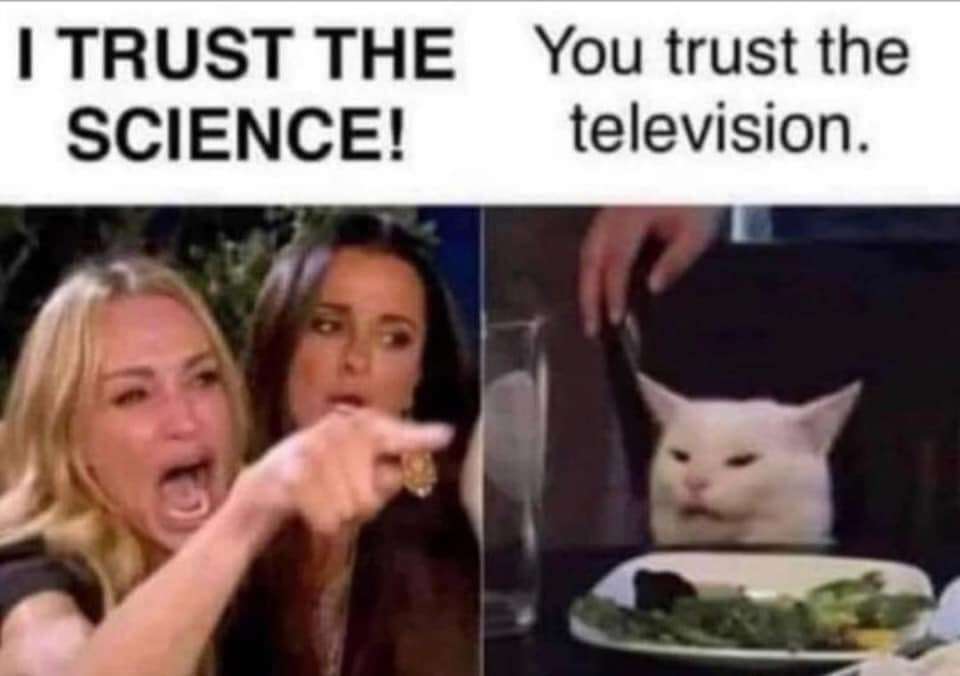
Eleventh Blog Birthday

Thursday, November 12th, 2015

Yay. Yes, we’ve slowed down quite a bit as of late, but we’re still ticking, at 8,079 posts and 25,806 comments.

Onward…

“Who Made These Monsters?”

Thursday, November 12th, 2015

Brendan O’Neill, editor of Spiked, finds a link between the Yale rioters and the generations that came before:

Video footage of Yale students losing the plot over a faculty head and his wife, who said everyone should calm down about Halloween, has caused much head-shaking in liberal circles. And it isn’t hard to see why. The head’s crime was that his wife sent an email suggesting academics and students should chill out about ‘culturally insensitive’ Halloween costumes. It’s okay, the email said, to be a ‘little bit inappropriate or provocative or, yes, offensive’ on this one day. For his wife issuing this mildest of rebukes to over-sensitive over-18s, the head was accosted by a mob of students insisting the email made them feel unsafe. When he told the crowd that he thinks university is about providing education, not a ‘safe home’, they screamed at him to ‘step down!’. ‘Who the fuck hired you?!’, the most unhinged of the students cries.

Generation Butt HurtIt’s unnerving, odd, a terrifying snapshot of the new intolerance. We could see the culture of ‘You can’t say that!’ in all its swirling, borderline violent ugliness. It wasn’t a whispered or implied ‘You can’t say that!’, of the kind we see all the time in 21st-century public life, in response to people who criticise gay marriage, say, or doubt climate change. No, this was an explicitly stated ‘You can’t fucking say that, and if you do we’ll demand that you be sacked!’ That it was stated at Yale, and in response to a bloody email about Halloween, has added to the hand-wringing among liberals, who want to know what’s gone wrong with the new generation.

Okay, fine. It is indeed interesting, and worrying, that students are so sensitive and censorious today. But I have a question for the hand-wringers, the media people, academics and liberal thinkers who are so disturbed by what they’re calling the ‘Yale snowflakes’: what did you think would happen? When you watched, or even presided over, the creation over the past 40 years of a vast system of laws and speech codes to punish insulting or damaging words, and the construction of a vast machine of therapeutic intervention into everyday life, what did you think the end result would be? A generation that was liberal and tough? Come off it. It’s those trends, those longstanding trends of censorship and therapy, that created today’s creepy campus intolerance; it’s you who made these monsters.

I think it’s even worse than that, though. The prior generation is not acting just as an enabler of this sort of behavior; it has been a forerunner. The ramifications of this are heavy, in that they would mean this whole lunacy is inter-generational, it didn’t just start this year because it’s never really stopped.

I’ve also noticed something about it: It’s theater. Correcting whatever caused the offense is not nearly as important as manifesting that the offense took place. Also, the drama that ensues has a lot of value nobody ever seems to discuss, as a diversionary tactic; the expression of offense alters the outcome.

The perpetually offended, therefore, have a loathing against whatever conclusion would most likely have been produced, had the discussion not been interrupted. It’s not just an isolated defensive outburst against “offense,” it’s a whole way of life. Down in Missouri, that Melissa Click woman who called for “muscle” to block that reporter from covering a protest — I’m still having trouble with the concept of a protest that isn’t supposed to be seen — just did it again, citing “death threats” as the reason for canceling her class as she deals with the ensuing troubles. Death threats, yes it’s always death threats…

PussyLosing the argument? Stir the pot a bit. Death threats, not feeling good, sprained ankle, being offended. These are people who start arguments, and figure they ought to be the ones to finish them. If ever it doesn’t go that way, they reach for a sort of “ejection seat lever” and there’s your real cause of offense. That’s why we’re seeing so much of this. It isn’t an ever-evolving society reaching new heights of sophistication and learning that certain things should be taboo, and it isn’t even (completely) a thing with thinning skin, upon those who are getting offended. It’s a tactic. A tactic used by those who just want to skip ahead to the fun part, where they win the argument, without slogging through that boring thing that involves some actual arguing.

Viewing it through that lens, we see this embiggens the ramifications involved somewhat. Quite a bit, actually. These are not isolated incidents at Yale and Mizzou. Like Rush Limbaugh said, “It’s only getting started here, folks.” Even that isn’t completely right, “it” isn’t just getting started.

These are people, being groomed to run the world of tomorrow, to make all of the Big Decisions That Really Matter within our society of the near future — being taught how to start arguments and not to, in any civil way, finish them. Now think of that. That’s really not much different than teaching a whole generation of passenger airplane pilots how to take off, but not how to land. Tomorrow’s executives, professors, politicians and other authority figures are being taught how to hit the emergency-eject button when they figure out they’re losing the argument, so they can get their way even when they find out in mid-course that they’re wrong. Taught that, by the precious snowflakes of yesteryear, who were taught precisely the same thing, and have been getting offended constantly since then — and have taken over academe.

The point is, nothing significant just happened, except that we’ve been forced to give a greater share of our attention to something that’s been happening already, for a long time. When we bring it to a stop, that’s when life starts getting better for everybody.

Veterans Day 2015

Wednesday, November 11th, 2015

Nothing to add.

US Marines’ 240th

Tuesday, November 10th, 2015

Happy Birthday, United States Marine Corps.

Gasbag Theory

Saturday, November 7th, 2015

I’ve long had a theory percolating away in my cranium about the English language. That’s about all I can do with it, since the theory, while refutable, is not provable. Until it’s directly refuted, I have found it occasionally worth mentioning because it explains what is baffling to so many people, but it’s a bit involved and weighs somewhat on the listener’s capacity to pay attention. So perhaps if I spell it out here, this will ultimately be revealed as a more proper forum, down here in the blogging “basement” where it can hang around, dehydrate, molder just a bit, while I see fit to link to it. Or not.

One of the virtues of this theory is that it explains not only what is baffling about the English language, but also about software engineering; not only the challenges that arise when one coordinates a team effort to build something new, but why it is we’re surrounded by so much stuff already built that…that…well, you know…

Perhaps I should just dive into it.

English LanguageThe many observed and mostly-unexplained inconsistencies involved in the English language come from two simple causes. One, the language was defined & refined back in the olden days, obviously before the Internet. Of course, there were other things back then to serve as precursor substitutes for the functionality of the Internet — but, not the Internet’s ability to offer up some sort of instantly accessible, centralizing “Oracle” resource, like for example a time server. The language, therefore, accumulated all its various permutations through an implementation of what we in software engineering call the Stovepipe Antipattern.

Publishers acted like software developers. Publishers, and dictionary-editors. They processed a bit until ambiguities arose, and then they coped a bit. Process, cope. Cope, process. They didn’t work completely in these “stovepipes” while settling their encountered ambiguities, in fact I’m sure they were more conscientious about the necessary coordinating than today’s software engineers, even when today’s software engineers are trying hard. But they did all their “networking,” of course, within walking distance. If an encountered question was truly perplexing, it would be escalated as high as any other pressing question…but, again, within walking distance. All the way to the (local) top: Some old gasbag. The senior senior editor guy, whose WordsCarriedGreatWeighttm. That gasbag, in turn, would create the problem.

He, of course, did not enter the question on some listserv, or search engine. In resolving the thorny problem, he drew from his massive personal experience — and that’s all. How else could it have been done? So he would have had to have harkened back to his previous experience, which was after all the commodity he possessed that drew all these other professionals to him, seeking his counsel. Perhaps back to when he was just a freckle-faced copy boy running around on the publishing-house floor…when some answer had been produced to the thorny question. By that previous generation’s local senior gasbag.

And that previous, generations-past old codger who “had” the answer; was he giving the question the attention it commanded later? Almost certainly not. Ambiguities, I’ve noticed, have a way of becoming visible only after the passage of time. It’s pretty often people discover they’ve been wrestling with them without realizing it, offering up the “right” answer that is so certainly and so unanimously right, only because no one has ever questioned it. So this old codger whose WordsCaarriedGreatWeighttm would “answer” the question, once and for all! — locally. Which would create a wrinkle, because if there was an ambiguity in that publishing house, there almost certainly was another encounter with the same ambiguity over in some other publishing house, which in turn relied on the vast accumulated wisdom of some other old duffer with big bushy gray eyebrows in which you could hide cigarette lighters. And he, I think, within the same timespan would resolve the same question. Differently.

It’s undeniable, isn’t it? To deny it would mean to presume the questions did not arise, which would be daffy. Or, that they arose, and were settled, conveniently, exactly once per generation, with one single answer for each — just as daffy. We can test that. At least, if we have spent any time in a career that deals with words. How many places have you worked in which someone was wondering where to put the ‘M’s in “commemorate”? Or why the word “inflammable” exists? From such tests, we postulate that the same questions must have arisen in many different places, within relatively the same span of time. And we know for a fact they didn’t have any convenient or expeditious ways to coordinate the answers.

We further know, without a doubt, that this “Ask Yoda” method must have worked — but only for the immediate need, just to resolve the pressing issue so the day’s work could be completed. Just to get an answer. Acquire the best and most informed opinion that might be acquired…within a few footsteps.

James Bond is NOT a Code NameA cultural grudge or two, brought on by previous historical events, can do wonders to keep these “right” answers to a common question anchored in opposite directions, even after the discrepancy has come to light. This is easy to prove, if one is honest about one’s own passions. I have no problems admitting I’d like to chuck an extra crate or two of tea into a harbor, whenever my browser settles on the idea that I’m some sort of cockney or canuck writer and starts underlining words like “honor” or “theater” as if they’re misspelled. It’s human nature to arouse a little bit of ire about it, as in “THIS way’s right, that way’s wrong…fuck those people.” One does tire of seeing the same idea re-presented over and over again, when one “knows” how wrong it is. I’ve just about had my fill of this idea that “James Bond” is just a code name, and lots & lots of different characters in the franchise have been having these adventures using the moniker. Fuck those people who keep coming up with this bad, wrong, terrible idea.

Anyway, yes, the English language is broken in lots of ways. So it necessarily follows that it’s a real tragedy it has become dominant, right? Wrong. I said at the beginning, there were two causes of these many fractures. The above paragraphs explain just one cause. The other cause is, simply, that the English language was used, and therefore, abused. Had another language achieved dominance, the same questions would have surfaced in the same publishing houses with that other language, and it would have been exposed to the same abuse, just as you find more bugs in a software system when you run more tests on it.

“Being Wrong”

Wednesday, November 4th, 2015

The Z Blog:

There’s a genre of expository writing where the author explains in detail how he got something completely wrong. The name for this form is “nonexistent” because no one ever does it. Similarly, you will never hear a lecture from an economist explaining how he got some prediction totally wrong. For instance, Obama’s economic team swore that the stimulus bill would set off an economic boom through the magic The Multiplier. They were wrong and it was a flop, but no one talks about it because it is simply not done.

This is something you see in all fields, not just public policy. You never read about scientists discussing how they screwed up an experiment or fell for some nutty idea that sounded good at the moment. What we expect and what we get is equivocation, denial and when that does not work, an attempt to flush the incident down the memory hole. It usually works too. Paul Ehrlich was hilariously wrong about human populations, but he has paid no price.

Well, I can explain it, I think. Opinion-makers and opinion-distributors like Ehrlich pay no price for being wrong, because very few people care; and people don’t care because they, in turn, also pay no price. “Turned out to be right/wrong” has little practical meaning anymore. Our system of forming and governing societies, our style of discussing weighty issues, come from times in centuries past when being right or wrong meant the difference between living or starving. Now, it means the difference between strutting like a peacock on Facebook, or…fuming away on Facebook.

It has almost as insignificant a bearing on our station in life, families, fortunes, careers, all the things that matter, as…the outcome of an organized sports event? Well no. Nothing has less impact than that. But it’s pretty close. Been that way for awhile, and our dedication to the dialectic has suffered as a consequence.

“How Much is Liberalism Like a Religion?”

Wednesday, November 4th, 2015

Tyler O’Neil writes in Pajamas Media:

Political views and religious belief are indeed two very different things, and many liberals have even criticized the pseudo-religious trends in their movement and party. Nevertheless, some recent events should make us wonder just how religious liberal orthodoxy has become…Perhaps liberalism is more like a religion than we thought.
:
“When a group confuses politics with moral doctrine, it may have trouble comprehending how a decent human could disagree with its positions,” [David] Harsanyi explained. This, he suspected, “is probably why so many liberals can bore into the deepest nooks of my soul to ferret out all those motivations but can’t waste any time arguing about the issue itself.”

The accusations are endless. If you don’t believe in liberal positions about climate change, the minimum wage or social justice programs, you must have been bought off — there simply is no other possible explanation. How could you hate the poor so much? How could you doubt established facts? How could you hate yourself?

“Don’t like big government? You’re a nihilist,” Harsanyi adds. Supporters of traditional marriage and sexuality are “transphobic, homophobic.” Pro-life advocates “may claim that you want to save unborn girls from the scalpels of Planned Parenthood, but your real goal is to control women — even if you’re Carly Fiorina.”

This move to silence the debate does not end with Twitter. Last month, 20 climate scientists petitioned President Obama to use the Racketeer Influenced and Corrupt Organizations Act (RICO) — a law intended to fight organized crime — against people who “denied” climate change.
:
Any mature Christian who has struggled with his or her faith has likely encountered the idea of theodicy, answering the question “if there is a good God, why is there evil in the world?” Christian history is rich with this perennial struggle — to explain God’s goodness to a world where injustice prevails.

Recently, liberal pundits seem to have taken up the cause of explaining why bad things happen to good people: we don’t have a large enough federal government. In May, an Amtrak train derailed, making national news. Who better to blame than congressional Republicans, who capped federal funding for Amtrak (a private for-profit corporation) at a measly $1 billion? Even as preliminary reports suggested the driver was to blame, liberals argued that a lack of “infrastructure spending” was the real culprit…congressional Republicans are to blame, because they were unwilling to dedicate more taxpayer dollars to the nebulous, job-creating savior “infrastructure.”

This thinking is so off-base it also proves an insult to religion, but sometimes liberal ideas can only be explained by comparison to faith.

Whether self-styled progressives question your ideas by calling you psychotic, demands that you “check your privilege” or blames all our woes on the insufficiency of big government, please understand that they are merely acting on the basis of firm convictions. We must not stoop to their level by questioning their motives or mental health. Only acknowledge that their faith can be as bigoted and entirely wrong as the most benighted religion.

If We Were All Arrested For Making Our Kids More Prosperous…

Tuesday, November 3rd, 2015

One of the most effective bumper-sticker slogans that spiritual leaders have used to encourage their flock to re-think their dedication to the faith, has been some variation of “If you were accused of being a Christian, would there be enough evidence to convict you?” It’s a good question in that it directly targets the fair-weather friends. Christ, like anyone else unfairly persecuted in the times in which they lived, would not have too much use for fair-weather friends. It’s not too hard to find some New Testament scripture that confirms this.

I have long been wondering the same thing about elevating the next generation, and giving that next generation the tools it needs to elevate itself, to a platform of independence and prosperity. There, too, we need a test of fair-weather friendship. I’ve noticed quite a few people are pretty good at slinging around the stock phrases. “Get him the help he needs to succeed in school and life” and so forth. My all-time favorite has to be “We don’t teach them what to think, we teach them how to think” — so seldom does it turn out to be true.

Old people fear outliving their savings. Now that I’m fast approaching the stage of life where one becomes an old person, or can at least start to see the “old person zone” looming on the horizon, I notice what life has to teach old people, as much as what old people have to teach others about life. I’ve noticed life is teaching them they didn’t save enough. There were all sorts of problematic expenses they didn’t anticipate, and in some cases, brand new expenses they did not predict. The young, the old, the in-betweens, seems everybody’s problem is not enough cash. How come the old people don’t say something like: It’s far better to overestimate your expenses than to underestimate them?

Or: Find a livelihood in which the money comes from helping others, work your ass to the bone at it, see to it you pay yourself first?

What’s the measure of dedication? If we were all arrested for making our kids more prosperous, or for giving our kids the tools and skills they need to become prosperous, would there be enough evidence to convict us? There would? Are you so sure?

You may need to read John Hawkins’ latest for a reality check. We actually do quite a lot to keep kids poor, and over their entire lives.

The 7 Keys To Trapping As Many Americans As Possible In Poverty

Keeping Americans poor in a prosperous country like America is not as easy as you think. After all, this is the “land of opportunity.” Legal immigrants pay tens of thousands of dollars and wait years for the opportunity to come legally and illegal immigrants often risk their lives just so they can get here and do menial work. This is the country that made Bill Gates, Steve Jobs and even OPRAH into billionaires and it’s a nation where you can have everything from hoverboards to medicine for your pet delivered right to your door. So when there’s so much wealth and opulence everywhere, how do you lock Americans out of that success?

No matter what you do, there will always be a few poor people around, but to really maximize those numbers there are very specific government policies abetted by a few cultural attitudes that will make all the difference.

The seven pointers are: Keep taxes and regulations high, encourage dependency, encourage people to have babies out of wedlock, demonize success, screw up the education system, have massive immigration, and ratchet up expenses.

The babies-out-of-wedlock thing is a sticky problem for me, since I’m guilty. For others, I’d say the biggest problem is the “screw up the education system” because it is the most subjective. To follow the conversation along, you have to have a little bit of what they used to call an attention-span…which is something I notice lately is going out of fashion, and maybe that’s an eighth point that could go on this list. Within my own history of making money, not that I’ve made a lot, but it’s been a consistent observation of mine that the money follows the paying-of-attention. This new generation, which I sometimes call a “Not a Lifeguard Worth a Damn” generation, concerns me most of all because so few within it possess the ability to just stop, watch a designated target, and invoke some sort of plan when the target changes state in any way. It’s way too far above them. Or beneath them.

I’m generalizing, of course. There are exceptions.

But the education thing — the worst offenders are going to say, of course education is critical and that’s why we started this curriculum that…blah blah blah. And if you happen to notice, some of this blah-blah-blah is only weakly connected to, or isn’t connected in any way to, the actual making of money, you get back this half-truth litany. Something about how, the point to it is not to make money, necessarily, but to broaden horizons or some such.

There is truth in this.

But, it just brings us back to my original question. If the crime is one of elevating the next generation to prosperity, and we’re arrested for it, is there enough evidence to convict?

In other words, where is the level of commitment? The spirit of dedication? Same thing people asked me all the time when I didn’t marry somebody…which turned out, when all was said & done, to be the correct decision. But in this case, we don’t need to worry about the correct decision. Life is being quite consistent, with regard to all sorts of age brackets, womb to tomb, in its repeated teachings and it doesn’t very much care if we learn it or not: Not enough savings. Not enough funding. Not enough margin for error. You forgot about how to pay for X.

Before free trade was possible among the hoi polloi, the way you elevated your stature was to capture territory, which usually involved killing. Or you could take the direct approach, and bonk someone over the head for the money in his purse. Capitalism gives us a way to realize our fortunes, change the future for our descendants for the better, while helping others. What a wonderful gift the ages have given us, by unfolding this relatively young chapter in human development during this lifetime. Do we have sufficient appreciation for it?

Well, if we were arrested for & charged with the crime of showing proper appreciation for it, would there be enough evidence to convict?

Were the Nazis “Right Wingers”?

Tuesday, November 3rd, 2015

This thing at about 2:00 has always bugged me. The idea of a “guy who can do no wrong” at the very apex of a nation’s power-pyramid; to believe Nazis were right-wingers, you have to believe that configuration is left-wing here, here, here, there, there, there and over there too…but with that guy with the tiny mustache, suddenly that’s right-wing.

From the comments:

I think the problem we have is that people have no idea what Conservatism is. It’s baffling to think that someone could even associate Conservatism with the Nazi’s, when we support limited government, and we’re against socialism.

Directional Sanity

Saturday, October 31st, 2015

This week I learned two things about American politics — as improbable, at this late date, as that may be. Some among us can study things quite awhile and still miss fairly obvious things. Anyway, the two things I learned are 1) All, or nearly all, of the disagreements have to do with which direction to go; and 2) the electorate is being subjected to one lie after another about this.

Over and over I’ve been seeing disputes about direction, falsely represented to the people as disputes about extent. A great example of this was CNBC moderator Carl Quintanilla’s question that set off Sen. Ted Cruz on his rant-heard-’round-the-world:

Congressional Republicans, Democrats and the White House are about to strike a compromise that would raise the debt limit, prevent a government shutdown, and calm financial markets of the fear that a Washington crisis is on the way. Does your opposition to it show you’re not the kind of problem-solver that American voters want?

And, depending on who summarizes what follows, for your benefit, you’re going to get a story about a brave Senator speaking truth to left-wing biased media power — or a story about how Republicans can’t handle tough and honest questions. As usual, everyone’s got an opinion. But how many remember the actual question?

It has the appropriate punctuation at the end, but I don’t really see a question there.

The premise is shaky. Is a resolution to raise the debt limit really about where a debt limit should be? Or is it about…just getting it raised? “…prevent a government shutdown…calm financial markets…”

One of the most wrong-headed people I know, is fond of saying “It’s true to a certain extent.” She says this when something is undeniably true, but to acknowledge the undeniable truth would be to concede defeat about something she wants. And I don’t think she’s ever been compelled to go without something she wants, so she goes after this “certain extent” thing. She doesn’t really have any such certain-extent in mind, she’s just avoiding things. The same is true of liberals when they argue with you on the Internet.

Them: Tax cuts hurt the economy, raising taxes would help the economy.

Me: A tax, by the very definition of the word, places a burden on whatever it is taxing. Therefore, that is just the sheerest nonsense.

Them: Well look here now, taxes hurt when they’re too high OR when they’re too low, what we have to do is find the optimum level.

Which is really just more nonsense. I reply with the analogy about the drag being imposed on an engine by the fan belt, the alternator, the power steering pump, fuel pump, oil pump, water pump. These devices help the car, true enough, but the drag isn’t what makes the car go. If science could provide some way of achieving the same functionality while cutting the drag in half, you’d go for it right? And it has, and we did.

Furthermore, progressives are — progressive. If the application of the word contains a shred of honesty to it at all, it is because they don’t believe in standing still. There’s no “certain extent” or optimal level of anything. We all know it. Liberals argue as if we could achieve this optimal level, and they’d go away happy. The ensuing years would not bring any of them back to say something like “It’s a problem that the rich aren’t paying their fair share” — they wouldn’t say that, because everyone would be paying their fair share already. Does anyone believe that? If you do, you’re just wrong. Progressives progress.

Why do they lie about it, and pretend to be struggling with the fine location of some midpoint? Simple. If people knew what The Left really does want, very few among us would ever support them.

I suspect most guys understand the problem here. Not all of us, just the ones who ever said: “She thinks I’m invisible even though I treat her like gold, she’s lavishing all her attention on that guy who’s an asshole and a jerk.” Any guy who’s been in that situation. Which is most of us. But, eventually we do solve the problem. How did we get that done?

Turns out, there’s always one reason why women don’t make any damn sense, it’s because women are people and people don’t make much sense. Young dudes, you want to write that one down and keep copies of it? You’re going to find in the upcoming years there’s a lot of wisdom in it. Chicks don’t make sense, because chicks are people and whoever said people make sense? You think dudes make more sense than chicks? To solve the problem: Discriminate. Start discriminating, and don’t ever stop. There are two kinds of chicks, because chicks are people and there are two kinds of people.

Some are assholes to people who are nice to them, and nice to people who are assholes to them. Others — including you, without a doubt, if you’ve ever been inclined toward this business of “She’ll spend more time with me when I treat her well” — at least have the polarity hooked up properly. You may be learning some things right now you’ve been needing to learn, but it does take a certain level of maturity to do that: Be nice to people who do good things for you, and when people are assholes, just leave them be. Oh yes, that’s a maturity thing, a growing-up-right thing. So now the next thing is: She’s broken, you’re not, you want to try and fix her? Be careful. Don’t waste your time on others who have yet to get this basic wiring diagram hooked up right, those who have the polarity reversed. This will suck the life right out of you. You’re running through this thing called “life” just one time, and it isn’t a dress rehearsal. The future is not guaranteed.

The point is, everything is like that. All the disagreements, anyway. “Oh no, we don’t want to get rid of the debt limit entirely,” they might say. “We just want to up it to nineteen or twenty trillion dollars or something.” Nope. That’s not an honest expression of the disagreement. The disagreement is about whether there should be a ceiling at all. It’s about whether debt matters. It is, like everything else, a dispute between broken-people and not-broken-people.

There are disagreements about Caitlyn Jenner being a female or a male. Again, an honest presentation of that disagreement wouldn’t involve that particular individual at all. The disagrement is not about whether s/he is a man. It’s about gender itself. And again, it’s about directions and not increments. One direction says gender is natural, irreversible, and maybe disguisable but nevertheless undeniable. The other direction says gender is nothing but a social construct.

The Left, as we know it today, pulls this crap pretty often. “Oh but it’s not one or the other, there are shades of gray in between.” They have yet to define how that matters. Increments show that a measurement is relative; when we observe that a point on the Earth’s surface is East of one thing but West of another, this proves the relativity. It does not, however, show that East is West, or vice-versa. And the same is true of relative measurements that deal with abundance and absence, like heat & cold, light & darkness. So, no. Even if you can define your increments of something like gender, which would really just be more nonsense, this still wouldn’t show that men are women, or women are men. These are two different things.

This has been invading our culture for a long time now. You see it in our movies. One of the things kids today don’t understand about Star Wars, for example, is that when it first came out back in the 1970’s it was commonly called a “Space Western.” What does that mean? It means, right up until Darth Vader turned out to be Luke Skywalker’s father, it was about good and evil. The Grand Moff Tarkin, and then the Emperor, were Rufus Ryker; Darth Vader was Jack Wilson; Luke and Obi-Wan shared the role of Shane. Today they’ve gotten rid of that, and it’s lost to history that the franchise held an appeal to us because it was a tale of good versus evil. Bad guys, nowadays, can be bad just by wanting to hang on to their stuff. Good guys are “good” in the sense that they have good excuses for stealing stuff. All sorts of crimes are ultimately redeemable, as the bad guy becomes a good guy. Nothing’s off-limits, not even slaughtering unarmed “younglings” in a Jedi temple. It’s heartbreaking to see, but today’s kids are lost in the same desert that surrounded us, back in the day, within which the first two Star Wars movies were a welcome oasis. But it isn’t just Star Wars. Good and evil are just relative terms, all over the place, with the result that the characters are uninteresting and nobody wants to see the movies a second time. But Hollywood just keeps doing it.

You see sanity taking an extended holiday with the “isms,” too. Racism, I think, is when you are picking winners and losers based on race. Silly me! Nowadays, you’re a racist if you don’t discriminate against white people. And if you do discriminate this way, it shows what a wonderful not-racist you are. It’s just one more example, we’re not debating increments, we’re debating directions. It’s a conflict between people who do, and do not, have their directional bearings in order. It’s about the direction in which you’re marching, not about how far you go before you stop. And, about half of us have our wiring throughly screwballed.

All lives matter, or black lives matter? Supposedly, there’s something wrong with “all lives matter.” But what?

Liberals, being twiddlers, are continuing to twiddle and twiddle away, twiddling to find the perfect set of laws that will make us all perfectly free. Laws, of course, don’t do that. They prohibit, by their very nature, things that otherwise would be allowable. This makes us less free. In response to this, their counterargument is the same as it is with all of the above — well, yes, but what we have to do is find this perfect balance. More nonsense. If liberals ever did find the perfect concoction of laws in Year N, they’d be right back in our faces in Year N+1 to say “there ought to be a law.” The progressives have to keep moving. So again, this is about directions and not about increments. And their direction — that we need to outlaw more things, in order to make ourselves more free — is not reasonable, rational or sane.

Directional sanity eludes us yet again, when we go to a mandated “sexual harassment course” in the workplace. These courses, I have discovered, offer very little by way of helpful instructions about how to sexually harass. What they’re about, is a whole new set of rules that are put into effect whenever someone has decided harassment has taken place. In short: She gets an itch between her ears, and everybody’s guilty. Does “she” have good judgment about such things? A sense of fair play? Is the bitch even sane? None of it matters. And why do we have these rules? Drum roll, please: to foster a workplace environment that is non-hostile, non-threatening, and fair to everyone. Yes, they say that with a straight face. Being forced to work one cubicle away from a crazy cat lady who’s spoiling for a legal fight, and being guilty until you can prove your innocence, means you’re in a “non threatening workplace” somehow. Again, we’re not arguing about incremental stops within the spectrum, we’re arguing about the endpoints and about nothing else. When it comes to sexual harassment, the endpoint that’s won the argument for the time being is the nutty, nonsense-universe one.

Part of that is because the concept of “everyone” is being teased and tortured through endless, nonsensical debate, as well. The workplace that is “non-threatening to everyone” is only non-threatening to some. The others don’t count.

And then there is one of my personal favorites: If you’ve got a business, you didn’t build that. This was a jump the shark moment for President Obama, because for a brief moment the whole country could see that liberalism is based on falsehood. It is a sick game of make believe. Lots of liberals have come out since then, to protest that what President Obama really MEANT to say was that the business couldn’t exist without these roads and bridges and what-not. Indeed, this was all part of His remarks when He said that silly thing. The problem is: None of that provides any justification, not even in the slightest, for saying “you didn’t build that.” This is just further evidence that we’re not really arguing about increments, we’re arguing about directions. And President Obama’s direction, as He accidentally revealed, is: That business is not yours. Property is not yours. I’m a popular dictator, so that means the entire country is going to engage in this game of make-believe, that you didn’t really build anything. He was quite explicit, after all.

I suppose from the above, it might look like I’m saying with some more years of living, more years of accumulating experience, some more clear-headed thinking about what people really want other people to do — the increments start to lose relevance entirely. That life, ultimately, with this greater experience, eventually is reduced down to just the compass points. That as the airplane of this experience gains more altitude, the bearing becomes more critical. That people who say “Oh we don’t want to go all the way, we just want a little bit” are to be ignored, because their supposedly intended stopping-points are mythical. Which would have to mean, as we learn more about the true motives, the disagreements become much simpler, not more complicated. And that when all’s said and done, everyone doesn’t necessarily share the same ultimate goals, after all.

Why, yes. That is exactly what I mean.

Every Sports Press Conference

Friday, October 30th, 2015

By way of Chicks on the Right.

Memo For File CXCIX

Saturday, October 24th, 2015

Hillary Clinton’s non-testimony testimony this past week has me waxing philosophical. Next year I’m closing out my first half-century on the planet. That’s a rather ethereal, fluffy reality that’s hard to grasp. I know how to grasp it though: The probability that I’m past the midpoint, has ceased to be a likelihood and is now a certainty. What am I to do with that bit of cheerless information? First, we can distill it further: If life is a book, maybe I’m not yet on the final chapter but I know I’m in the final part of it. My perspective on the whole thing no longer matches the perspective of: A young adult, a teenager, a toddler, a baby. My dreams and complaints bear only a passing similarity to their dreams and complaints. Whereas, the complaints of those with one foot already in the grave, assuming they still possess all their faculties, match mine thought for thought and syllable for syllable.

One should strive for the most uncomfortable paradigm shifts, both large and small; that’s how we learn. Have I got any more earth-shattering humdingers headed my way, from this point forward? Perhaps, but the evidence suggests I should keep an eye out for just the smaller ones. On the other hand, if I’m wrong, it would be beneficial to jot down what I don’t expect to see changing, throughout the course of my second-half-century…or beyond. Think of it as a bread crumb trail.

The geezers have it in common with me — I have it in common with them — that we’re distressed the younger minds don’t show some more curiosity. This lament from the middle-agers precedes me by a great deal: “Leave home, pay your own bills and solve all the world’s problems while you still know everything!” Exasperation gives way to humility. We ask ourselves, “Was I that arrogant at that age? Did I show that much confidence about so little understanding?” and after just a moment or two of honest reflection, someone like me has to answer: I was worse.

Maybe that closes the matter. Sit down Grandpa, drink your Ensure and stuff a sock in it. I’d actually be open to this, but for one thing: That’s one of the things I’ve been noticing. The “Beverley Hills 90210” societies in which the young enjoy a complete monopoly on coolness, cachet…it being their turn to talk, all of the time…they don’t do well. Sometimes they prosper, on paper, as in pulling down very high numbers of dollars at their jobs, and blowing very high numbers of dollars on frivolities as well as essentials. But they don’t do well over time. How could they? The wisdom doesn’t accumulate, doesn’t get passed down from one generation to the next. No one in his sixties has anything to say that’s worth saying unless he looks like he’s in his thirties. And on average, whatever that guy’s saying isn’t going to reflect reality too well, since his facial features don’t. You can’t fight reality on one front, and claim to be its ally on another. That’s another thing I’ve noticed.

You want to find someone you can trust? Or, apply some test of trust to the people you’ve found already, or who found you? Look for the man who is willing to admit to his faults. Not, I hasten to add, eagerr to admit them. Just willing. Eagerness to admit faults is yet another problem, and that’s yet another thing I’ve been noticing in this first half-century. It stands to reason that men who are eager to discuss their mistakes are also eager to make some more. No, look for the guy who is eager to inspect the effects, to identify what he wants to do better next time. And to compile an inventory of mistakes from that.

Before I learned those things, I had very little interest in politics. I remember my revulsion against Ms. Clinton’s husband, when he came on the scene, had a lot less to do with political ideology than it did with public behavior. It was connected to my profession. Bill Clinton reminded me a lot of many people, not just one or two, who had made my life a bit less bearable. In hindsight, I know their role was to educate me, show me how to take responsibility for communicating details, by taking very little responsibility for it themselves, or none at all. This is something I needed to learn. Had I spent the entire time around people who took this responsibility on my behalf, I wouldn’t have learned it.

I haven’t been putting much thought into whether other people needed to learn the same thing. Maybe that’s a mistake. I’ve been blogging here & there about a bit of this and a bit of that, but I haven’t explored this particular bunny trail too much. Grandpa’s been sitting down and shutting his cakehole, as ordered. Anyway, I had this flash of inspiration about my “real job”: I excelled at making complex computer network systems behave a certain way, but ultimately this talent wouldn’t be worth a whole lot if I couldn’t communicate what these certain-ways were, or what they were supposed to be. This was a very sobering, even unpleasant, realization because that meant I would have to figure out how to communicate with people who thought differently, saw life differently. I would have to achieve some skills in places where I had no talent at all, in order to make use of the other places where I had more to offer. Rather like a potato or cabbage farmer, who knows how to grow the biggest produce for miles around, but can’t drive the cart to get it to market. I still remember that little jolt of economic panic, as if it was yesterday. What to do?

I noticed there was a certain personality type that always seemed to be around when I failed this way. President Clinton served as a living archetype of this, back then, and he still does, now his wife does too. These people make good leaders and colleagues for someone else, not so much for people like me. At least, I used to think that. Lately I have begun to entertain the idea that they don’t make good leaders for anybody at all. And as far as good colleagues…well, I suppose that happens now and then. You can make entire collectives out of people who think and strategize and speechify this way. And they’ll be very happy working together, and be fun to watch occasionally. Although they won’t get a lot done. Very little that’s positive, anyway.

But that’s not a problem for me to solve. People like me need to avoid having people like them, as colleagues or bosses. They aggravate me, and I anger them. That’s a fourth thing I’ve learned. I learned it awhile ago. My revulsion against the modern liberal, actually, came out of this. Until that point, I thought Jimmy Carter’s streak of failures was some sort of an anomaly, hanging like an albatross around the neck of one failed past president. Around this time, I began to realize that Carter’s pattern of failure was the modern liberal’s idea of success.

A fifth thing, which continues from the fourth thing, would be a list of the things we don’t want to see in these leaders. Or shouldn’t want to see, anyway. This is perhaps the one realization I’ve had, from the five decades, that would have helped me out at an earlier time.

1. The first thing we should not want to see in our leaders, is eagerness to be the leader. People who harbor this kind of zeal to bark out orders to others, make bad leaders. I remember one gentleman, no longer with us, who didn’t work this way. He’d hang back, let everyone make their own decisions about how to do their work from one hour to the next, one day to the next, one meeting to the next. Then he’d come alive, like a fly-eating house plant, when a question surfaced that would require some authority to be answered properly. Until that happened, he knew how to lie dormant and let the team resolve the smaller issues the way the team saw fit to resolve them. Contrasted with that style, the “little emperors” constantly barking out orders cause a lot of trouble. They destroy morale, because they want to hog all of the credit whenever something good happens, and when something goes awry you can count on them hunting for somebody to blame.

2. A very close second: We should make a much better effort to weed out those who work the crowd’s emotions too much. It really isn’t very important which emotions, positive or negative, make up the candidate’s stock-in-trade; doesn’t matter if they’re working up the crowd’s enthusiasm, wistfulness, loneliness, fears. When you’re talking about people who can achieve results no other way, have made a Maslow’s Golden Hammer out of strangers’ emotions, you’re talking about people who only pretend to have any control over the situation at all. This is why you see leaders looking for scapegoats. If they generate the results they want by working the crowd’s emotions, and they’re not getting the results they want, well…yes, that has to be someone else’s fault, of course. How could it be otherwise?

3. We should be paying very close attention to how leaders delegate. Be wary of the leaders who shun details. This is tricky because delegation is a necessity in even the simplest of projects, and it is in the nature of delegation to entrust details to someone else. The question is, what does the leader do with these delegated-details? The leader we don’t want, thinks he’s too good for them. Think about the relationship between the captain of your passenger ship, and the ship’s engines. Yes there are layers of officers and engineers between the skipper and the engines, nevertheless the former “owns” the latter, and should be ready to go down with the ship if he doesn’t know them as well as he thinks he does. In fact you, “captaining” your commuter vessel, have a similar relationship to the rivets that keep the bridge intact that supports your combined weight. Such captains are captains of not just the ships, but the parts, the crew, and most importantly, the strands of trust that form the webbing that keep it all afloat. So stay away from leaders that delegate, as a way to discard, duties and details.

4. In the same way we need to be avoiding leaders who shun details, we should be avoiding leaders who conceal them. We should be making a particularly keen effort to avoid leaders who make a sport out of this sort of (occasionally) clever obfuscation, as we’ve now seen both Clintons do.

5. Process and outcome. I’ve noticed things about this before. What’s the job, is it one of generating a certain desired end state, or is it one of following a defined process? The leader should match the job. The litmus-test question is only obvious: What do you do if you’re put in a position where you have to pick? Sometimes it’s appropriate to blow the results, because the process demands that you fail. Some leaders are a good match for this. Others are a bit like James Tiberius Kirk with the Kobayashi Maru Scenario.

6. We should stay far away from leaders who mistreat rules. I mean, the ones who seem to think the whole point of having rules is to hurt society. These would tend to be the ones who, overall, can be seen citing rules as reasons for not doing something. Can’t build that dam, it would violate the Endangered Species Act; can’t prosecute that crime, don’t have enough evidence that the guy did it. Most murder mysteries on the teevee have someone like this, it’s usually the killer: “Fine Lieutenant Columbo, you know I killed him but you have no proof!” During the five decades I have noticed, both in fiction and in real life, that it’s the same people who are everlastingly wandering around in these stink-clouds of stalemate, constantly coming up with new ways to say the same thing: “Aw shucks, I guess that’s the end of the trail and we’re going back empty-handed.” It isn’t that these people lack vision. They have a very strong vision, and it’s a vision of not getting the job done. A real leader is someone who starts the exercise with a vision that the goal WILL be attained, the question that lingers is how. What’s it take to do it, what has to be done, who’s the best person to do them. In my fiftieth year, I’m old enough to remember when that was part of the definition of “leader.” I guess that’s changed, somehow. We need to change it back if that’s the case.

7. A real leader believes in the rising tide lifting all boats. You’re looking at the wrong guy if he’s often seen to make a big deal out of who has how much; whose “turn” it is to pull out a victory; “everyone has to get a trophy or else no one does.” Call ’em what you will, the pivot-point people, the see-saw people, pie-people, zero-sum, balancers. They don’t have their eyes on the prize. This gets into outcome over process, again. Like Gen. George S. Patton said, “Have taken Trier with two divisions. What do you want me to do? Give it back?” That’s how you see it when your bus is teetering on the edge of a cliff, and someone manages to pull it back — you don’t care if that person is a man or a woman, gay or straight, right? And you’d never think of saying “Let it fall, we’ve had plenty enough [blank] people saving the day for now, we need to see some saves by someone in a different ethnic or economic group.” A real leader sees victory in victory. The team scores, the team succeeds, the team prospers. That’s the right mindset.

The distinction we’re really making here is between excellence and mediocrity. It can be hard to recognize this because the mediocre leaders have their followers, and the followers don’t see those leaders as mediocre. Jimmy Carter was a good example of that, and so are Hillary Clinton and Barack Obama. That’s what makes these spectacles embarrassing, even by proxy against those who are merely watching, not supporting. It’s awkward because there’s supposed to be something special and extraordinary about Obama and Clinton, and even their most exuberant fans cannot say what this is.

They can’t, but I can. What makes them extraordinary is their ability to sell liberalism. Period, full stop. This has a powerful potential to convince people there is something remarkable about the people, because there is something remarkable about this feat. Liberalism is not easy to sell. At least, not across a decent stretch of time, throughout a sustained cycle of “buy some, experience it, buy some more.” It isn’t easy to sell that way because it’s not a good idea. It takes a special liberalism-salesman to sell it that way.

When these “fans” of rock-star liberal politicians talk up how special and amazing these rock stars are, they’re talking about that.

Feminism Wants Your Soul

Tuesday, October 13th, 2015

About three minutes in, the video-collage of the cishet white males doing their — whatchamacallit? Confession or something? That was really creepy.

I can certainly see why, in a saner time, college professors tasked their students to read Atlas Shrugged, one of the core points of which is what a valuable and vital tool guilt is, to people who wish to make oppressed lower-class playthings out of other people. Thinking persons who are not shackled by guilt, cannot be ruled this way. Such complete inter-class subjugation requires either brute force, or the “sanction of the victim.”

It’s really true.

By way of The Barrister at Maggie’s Farm.

Twiddlers

Sunday, October 11th, 2015

Ten posts a month, then six, now down to about four. I suppose I should say something.

I’ve been working evenings and weekends, since about the beginning of summer, on a project that demands some specialized skills offered by not too many other people. I’m already gainfully employed the forty hours a week, and I’m learning that in spite of my past experiences working many more hours than that, these days I’m not too gifted at time-management with the 41st hour and onward. But, because of what I did manage to get done, along with other achievements on other things, I learned a couple of weeks ago I scored Employee Of The Month. Which is actually a real thing, where I work. Lots of people you have to beat to make it to the final round, I mean up to a hundred, really smart futhermuckers too. And there’s money involved. A good-sized chunk of it, when you consider that every month someone is snagging this spot. Ruth’s Chris Steakhouse levels of money. Ruth’s Chris…mmm…

Om nom nom nomI am honored. I am humbled. I am…befuddled. There’s a bit of a story behind that. More about it later.

While all this is going on, at the beginning of the month a screwball opened fire with several pistols in a community college, taking out nine and hurting another nine. It happened up in one of my favorite cities, Roseburg, OR. Not that I know anybody who lives there or anything. But Roseburg is a handy halfway-point between my boyhood hometown, and where I live now. We’ve spent many a restful night in the North part of the city, when journeying there by car. Which is something we haven’t done for awhile. Nevertheless, we’re very familiar with the place.

Those who wish to know my thoughts about it, could peruse my Facebook page, which has been updated pretty constantly on that as well as on life’s little events. While the blog languishes. This is not a courteous or proper way to treat my readers…and although we’ve been calling this “The Blog That Nobody Reads” for over a decade now, the truth of the matter is that there are some. The question that may be lingering now is whether someone’s writing.

To summarize. I’m shocked and saddened like anyone else — and, I am just completely blown-away by the lack of shame, and knowledge, on the part of those who seek to further restrict the American citizen’s ownership and responsible use of firearms. The deficits seem to be embiggening, in the shame as well as the knowledge. They’re reached bedrock in both of the pits, and are continuing, against all odds, to dig further. It’s as if every active-shooter event makes them more ignorant than they were after the one that came before, and more brazen than they were after the one that came before.

A common refrain is that doing something is better than doing nothing. This is yet another example of liberals failing to understand the motives of their opposition. This is a special strain of ignorance that is shrink-wrapped with a companion-brand of matching apathy, with a side order of pride in the apathy. See, liberals don’t know what motivates conservatives, because they don’t care what motivates conservatives. They’re proud of not knowing and of not caring. They’ll be the first to tell you so, and they’ll also be the first to opine about it. If you merely recognize all of these things at the same time and point out what this means, that they’re forming opinions about a matter on which they have yet to gather any reliable facts, they’ll surely take offense. It is not within their method of understanding the world around them, to recognize that their offense is taken at the mere calculation of the sum of the parts, which they have so unabashedly provided.

They speak of magazine capacity restrictions. So far, reports have held up that the shooter had six weapons on him, seven more at his home. So although the state of Oregon doesn’t have these restrictions in place, nevertheless it seems that whole topic has already gone ’round and ’round in this case, and screwballed its way into irrelevance. They want background checks, but the shooter, again according to the information we have thus far, acquired his weapons legally and therefore in accordance with these background checks. They want registration databases. Again and again I’ve asked the question: How does that work? Alright you have a database record that says one person has all these guns. Then what?

They are displaying their deficits not only in relevant knowledge, and in shame, but also in strategic thinking. These questions of “How’s that work, exactly?” consistently fail to evoke any sort of reaction, let alone coherent response. Like a small child who wants a toy, they just want their stuff and that’s pretty much the end of the conversation.

I don’t trust them when they say they want to stop these shootings. I believe they do have emotional reactions in the wake of the incidents, and there may be some revulsion mixed in there. But I think if they were to stop and self-inspect for a bit, they might discover there is some lust mixed in there too. As in “Oh, maybe with this latest shooting we can get some of the things we want that we couldn’t get last time.” Not so much preocuppied with preventing the next shooting, as with exploiting the last one.

The repeated discussion does not seem to be getting us anywhere. The time has come, I think, to recognize this as what it is: A mental enfeeblement.

I’ve discussed this before. And it isn’t even a groundbreaking idea, psychologists have been exploring it for years. People tend to want to control other people, and when people experience difficulty maturing naturally, when their growth is stunted, of when they’re damaged for whatever reason, they start to go off on some endless question for The Perfect New Rule to make everything better.

As far as these feelings of loss of control go, every mass shooting certainly does — pardon the pun, it’s unintentional — trigger them. The feelings are reasonable. It is the response that is in error. It isn’t even sane.

The American citizen’s right to keep and bear arms goes all the way back to the founding of our Republic. The gun culture which forms a symbiotic relationship with that right, actually predates the written constitutional recognition of it. They’ve both been with us all this time; and the active-shooter phenomenon as we know it today, is a relatively recent thing. Gun-grabbing advocates know this, understand this, and are willing to admit to all of it. Once again, they have no problem with the parts but object to the sum of them, bristle at the act of mere calculation. For the sum of the parts is simply that gun control is not, and cannot be, the answer. This is clear and obvious proof that there is something else busted, some other gasket blown, some other gear stripped. Hacking away at the leafy part of the weed gets us nowhere. And worst still, if implemented, it may diguise the deeper problem.

If I write a web service and it crashes and with a malformed error message, that is two problems, not just one. Part of the reason my wife and I got our fancy dinner last night — oh yes, I’m starting to get outspoken about this, I figure I’ve earned it — is that I treat that as two problems, not just one. And ALWAYS, always always always, fix the problem with the error-reporting first. No exceptions to this. If there’s a time constraint in place and you need things working now-now-now, that’s an organizational problem and not a software problem. Take your time. Make it fail correctly, then worry about making it succeed.

There’s something else broken. Anybody who thinks it’s acceptable behavior to gun down innocents to make some sort of statement, has some threads stripped in their bolts upstairs. We’re all going to be safer if these people can somehow be denied access to the hardware? Who can conclude such a thing, save for the most mentally lazy, and the most assuredly removed from the immediate situation?

It’s just another “Those People” Conversation, about what most-recently-tweaked New Perfect Rule should be imposed upon distant strangers. How should we twiddle with the public policies, under which those people shall be living? There are people walking around, among us, building (hopefully not often) things we actually use, sharing highways with us, voting, and even accumulating levels of influence far greater than what’s available to the average voter. But not thinking. My questions about How Does This Registration/Background Check/Magazine Capacity Restriction should actually WORK, remain for the most part unanswered…can we stop pretending there is rational thought going into this rule-twiddling?

It’s a mania, a psychological malady.

We see it across a whole spectrum of other issues. Communism itself, is really little more than this sort of zaniness, rolled out to ultimate consequences. Just a bunch of shameless twiddlers, wrecking their havoc upon the innocents, the “Those People.” кто кого? They have no strategy in mind. They certainly have no desire to live under their own Perfect New Rules.

They are the McDonald’s fry cook who gets a half hour for lunch break, and can be seen sprinting over to Carl’s Jr. as fast as his little legs can carry him. No wait, they’re less like the fry cook than the executive who gets the job of revamping the menu.

Trump Built This, Obama Built ThatIn fact, this gives way to a whole nother complaint I have about twiddlers. They are not people who twiddled with the actual work — and settled on a method they discovered to be superior, through the school of hard knocks, repeated practice, process of elimination, all that good stuff. They are idea people. Thomas Sowell’s “Intellectuals”:

At the core of the notion of an intellectual is the dealer in ideas, as such — not the personal application of ideas, as engineers apply complex scientific principles to create physical structures or mechanisms. A policy wonk whose work might be analogized as “social engineering” will seldom personally administer the schemes that he or she creates or advocates.

When one reads the history of their perseverence in the face of repeated failure, until they ultimately prevail after many years, sometimes decades, or even a full century — one is tempted to credit them with a positive attitude. The temptation subsides when you realize how little the upper layers of consciousness have to do with the struggle. It’s a lot more like a sexual urge, or some involuntary reflex like a cough, sneeze or hiccup. They’re not invested in the slightest, not even so much as sunbathers on a beach being surprised by a mock-interviewer with questions about an entirely fictitious “White Privilege” tax.

Nevertheless, they’ll hop on that stupid bandwagon, and every time. It shows what good people they are.

Why is it they’re never quite done showing what good people they are? After awhile, it comes off looking like an attempt to hide something. One has to wonder what that is. Are they hiding it from themselves? Just how much salving does a non-guilty conscience require?

We cannot keep our rights, any of them — except perhaps by random, and increasingly unlikely, happy accident — unless we fight these twiddlers. And all of the time, about everything. It is a chore of necessary upkeep, just like an oil change. Just like controlling any other sort of parasite. Driving the locusts away from the corn, or the moths away from the sweaters. It’s a pain in the ass, and sometimes you feel a bit foolish about it. It doesn’t matter, it’s a job that has to get done.

We’ve tried ignoring them, and we lost our health care system as a result.

They contaminate our processes. In an increasingly complex society such as ours, process is important. Not a one among us can afford, any longer, to try to be an experienced practitioner in everything. Here and there, now and then, the endeavor will call upon us to pick up a rulebook, checklist or execution script, and implement each step, with faith in the axiom that someone who assembled this was doing something to validate what they were saying, or at least talking to someone else who had so validated. But, we have the twiddlers. Twiddling is not validating. So…today, the technologies we use are complex. We all have to follow processes and we don’t have time to validate everything. Which processes were built by a validator? Which ones were built by a twiddler? It’s the same problem you have looking over a family tree constructed from dozens of different sources, going back hundreds of years — all content, no foundation. This fellow way up here on the upper branches, was really the father of all his children? There’s no way to know for sure. Questions of verity, much of the time, weren’t raised until the fingers that wrote down the names and dates had long ago crumbled into dust. Thus it is with our processes; no way to know.

My Book SaysThis touches back upon the celebration last night, with the Missus and me. We were celebrating the triumph of outcome over process. “Process” and “Outcome” loom large in the “weaknesses” section of my employee performance review, at the close of my first year back at The Place Where It Didn’t Go So Well. The powers-that-be put it right there in writing that I made my contributions to outcome, and in so doing showed the benefits of my experiences working at previous employment situations that placed a premium value upon this. But I caused distress to engineers who were more concerned about process, which is something I still don’t fully understand to this day. After about three years, the tension exacerbated over the differences between my processes and theirs, and I had to walk the plank. Interested friends and relatives urged me to consider the whole experience a one-off, ignore the bad feedback. But, my confidence was shattered, for a time.

Hence, my befuddlement. My own processes have not changed. How could they? I’ve been at this too long and I know what I’m doing. But I suppose these don’t work everywhere. These are processes built, in fact evolved over time, to generate a good outcome; they do not justify themselves through any other means. And once I’m left to implement them in a place where the importance of outcome is subjugated, and process becomes the point, they don’t work.

They work where I am now, and in other places, places where the project stakeholders ask “Does the damn thing work?” It is not a slope-foreheaded moron‘s question. It may be a simple question, and therefore it may even be an unsophisticated question. But it’s important. The distinction between process and outcome is important. What’s the goal?

Public safety is one area of life where outcome should be the supreme goal. It isn’t that process doesn’t have a place. Visit a gun range sometime, one where accidents have never happened. You’ll see process flying thick and fast. But it is process that, and this is key, is justified by positive outcome, with a history to support that. The process does not take the top spot. The bosses do not say, as they are heard to say in certain circles where twiddling reigns supreme, “If you didn’t follow the steps we’d rather leave the problem unsolved.” That way, you see, lies disaster.

The best-case scenario possible, ever, in an environment of process-over-outcome? Over time you will discover you are building a golden fortress of “perfect” process, that is a static structure sitting on a dynamic foundation of reality. It will be perfect within the snapshot of time. But it won’t last. Only a dynamic structure will endure on dynamic ground, and to get that you have to have people who think for themselves. That’s what it takes to react to situations on the ground.

Hey, if this was all baloney — well, I suppose that’s what we would’ve been eating last night. Baloney. Mmmm…fillet mignon…mmm…

Only downside, for Mrs. Freeberg anyway, is this. Following the events of my disgrace four years ago and the shattered self-confidence that went with them, I made a point of keeping my silence about how people did their jobs. Who am I to say, after all? They’re probably keeping those jobs; I hadn’t kept mine. (So I have been opting to confine my opinions to how they were doing their voting.) Now, the genie has been let out of the bottle.

First time I ever intoned, “As August Employee of the Month, my verdict on how that person did his job is THIS…” I got back an exasperated eyeroll. Along with a quite understandable inquiry of, Omigosh. Is that going to become some sort of a thing now? The start of pattern?

The answer to which is: You’d better believe it cupcake. Yes, there is a humility aspect to being a good Christian, and pride goeth before a fall, of course. But this is a business that requires confidence. Genuine confidence, not just cosmetic bluster. You have to form a vision of what you’re doing and why you’re doing it that way, then implement all sorts of tiny pieces for some extended period of time, confident that the eventual results will be what you have in mind. Without that, you can’t do anything. But if there somehow still is something virtuous about nursing such self-doubt, well, ya know I’ve more than done my time.

I always did know I was doing it right. I think we all know that on some level, everyone who’s actually built anything. Just like we know the twiddlers are wrong, and that they’re not harmless. This isn’t a complicated problem for us to solve. Herbert Spencer said it best:

The ultimate result of shielding men from the effects of folly, is to fill the world with fools.

And there you have it. The definition of what a “twiddler” is, a statement of the problem, and a strong suggestion of the ultimate answer, all rolled up into a single artful, elegant statement.