Archive for the ‘Ayn Rand Spins’ Category

Obama Underwear Run

Saturday, June 21st, 2008

UCLA students show their support for the Obamessiah — you’ll notice, there seems to be something terribly wrong with keeping that kind of support secret — by streaking in their underwear.

There’s another first in the Barack Obama campaign, and it came from UCLA students. Hundreds of UCLA men and women donned designer underwear with Barack Obama’s picture on the front, and dashed across campus early Thursday.

The briefs were the creation of designer Andrew Christian. A silhouette of Obama was on the front, and “08” on the back. Christian said the Obama underwear run were a perfect vehicle for him to premiere his campaign-themed garments. He might consider a Hillary Clinton bra, if she makes the ticket as vice-president.

There won’t be any John McCain underwear, since Christian is a Democrat.

My gal came up with a priceless retort to this. Okay, so a President Barack Obama is in favor of unruly kids running down the street without any clothes on — duly noted.

The underwear run is an annual event at UCLA. It’s a way for students to blow off some steam, before final exams.

Why bother? This kind of gets into the previous bunch of ramblings about critical thinking, and the paradox called out there certainly applies here.

College is a place where you or your parents pay some premium tuition so you can learn how to think critically — it costs more now than it used to, and you have a lot more time to learn how to do it than your parents ever did. And yet, what passes for college-level decision making today, is looking around, seeing that your pals are streaking in their underwear, and deciding to vote the way they’re voting because it’s so coooooooool.

Tomorrow’s leaders.

Color me unimpressed. Umptyfratz-and-eleventy thousand dollars should be able to buy some better critical-thinking skills than that.

Scott McClellan Doesn’t Know

Saturday, June 21st, 2008

Over in Ed Morissey’s corner at HotAir, he points to Anchoress, who notes something interesting about Scott McClellan’s testimony regarding the +++rolls eyes+++ Plame “scandal”:

Well, I’m sure Congress feels like they accomplished something today with their interrogation of former White House press secretary Scott McClellan. After making a series of inflated allegations in his memoirs, What Happened, he told Congress that he really doesn’t know what happened — at least not in l’affaire Plame. When asked whether President George Bush knew about any effort to leak Valerie Plame’s identity to the press, he said Bush didn’t know about it — and McClellan doesn’t know anything about anybody else’s efforts, either:

U.S. President George W. Bush did not know about a White House effort to leak the identity of a CIA agent but tried to protect staffers who were involved in one of the biggest scandals of his administration, former Bush spokesman Scott McClellan told Congress on Friday.

McClellan said he did not think Bush was involved in a 2003 effort to blow the cover of CIA agent Valerie Plame Wilson, whose husband had accused the administration of twisting intelligence to justify the Iraq war. …

Vice President Dick Cheney’s involvement in the leak might have been greater, McClellan said.

“I do not think the president in any way had knowledge about it,” McClellan told lawmakers. “In terms of the vice president, I do not know. There is a lot of suspicion there.”

McClellan said that Bush ordered him to tell the press that Karl Rove and Scooter Libby didn’t have anything to do with the leaks, through the chief of staff at the White House. However, that might be because Bush believed that they didn’t. If Bush didn’t know about the supposed effort to leak Plame’s identity, then it stands to reason that he believed the assurances of both men that they didn’t have anything to do with it. And since neither of them had talked with Robert Novak, in whose column the leak occurred, that may well have been the case — at least as far as Bush was concerned.

Anchoress opines further at Pajamas Media. This is why I like Anchoress — the subject to be explored, is what immediately popped into my head when reading Mr. McClellan’s “testimony,” indeed pops in there just about any time I’m reacquainted with my disgust over this Plame thing: Critical thinking, and the desperate fit of thrashing around it’s doing lately on its deathbed.

“Yeah, it is that simple. He lied, and we all know it. So STFU. Now.” — Marecek

That was one of 1,643 comments left in response to Fred Hiatt’s June 9 piece in the Washington Post, entitled “Bush Lied? If Only It Were That Simple,” which covered the findings of the Select Committee on Intelligence, headed by Senator John D. Rockefeller IV (D-WV).

Marecek’s was the majority opinion.

In writing his piece for the editorial page of the Washington Post, Hiatt — that page’s editor — made the mistake of actually quoting passages of this report, which claimed that a host of “lies” of which President Bush has been accused since 2003 were “substantiated by intelligence.”

Vituperation and ad hominem attacks were left as commentary at the paper’s website, with calls for Hiatt’s immediate firing, for — apparently — his treason in quoting a report, written by a Democratic majority, that dared to depart from a narrative that has become conventional wisdom.

You know? The more I think about this lying idiot that edits WaPo, the more I realize how venal and corrupt the neo-cons really are. They really have no shame. No shame at all. Their corruption is complete. Frankly, the Emperor in Star Wars had more integrity than these neo-cons. Hiatt truly is a lapdog. — santafe2

I showed the article and comments to several friends of various backgrounds. One who works in media shot back: “if you don’t like the message, ignore it and kill the messenger!”

A friend who homeschools her children — and does it so well that the oldest has won a full academic scholarship to a university — was surprised that commenters would express such contempt not for the committee findings, which contradicted their worldview, but for the reporter who covered it. “It’s illogical,” she said. “Do public schools no longer teach critical thinking skills?”

Curious about that myself, I asked a friend who teaches social studies at a local and very well-regarded high school. “We’re supposed to be teaching critical thinking,” she said. “It’s in all the local and state standards, but in practice … there’s only so much time.” [bold mine]

I wish words could express my extreme lack of sympathy.

If, over the last two hundred years, we had somehow regressed from a technologically-rich culture stuffed chock-full with iced mocha vanilla lattes, iPods, a personal computer in every house running a 32-bit flat-memory-model operating system, flatbed scanners, twelve megapixel digital cameras, coffee cup warmers, Tivo, wireless hubs, tablet PCs, snips snails and puppy-dog’s tails…down to a dystopian wasteland in which everyone can do whatever they’re going to do after putting in their fifteen hours a day plowing fields for the spring potato planting, so that their ten or twelve children don’t starve to death, that is the ones that don’t succumb to smallpox or yellow fever or malaria — had we gone in that direction, then I could see it. Oh dear oh dear, there’s all that planting and harvesting to be done. We’d better just cover reading, writing and penmanship. Critical thinking they can learn to do at home (they’d have to do it anyway, huh?).

As it is, we’ve been trudging headlong in the opposite direction. We have comfort. Our grandparents did not. The widespread loss of critical thinking is something far more poignant than an event transpiring coincidentally with our accumulation of jewel-encrusted cell phones and dogs bred to be carried around in $600 purses. It is a symptom. We don’t think critically because there’s little need to. If you can’t think your way out of a paper bag — you’ll still have a warm dry place to sleep tonight, and a plateful of grub when you get up tomorrow. Necessity gone. Critical thinking, a thing of the past.

How tough do we have it, really? Our most threatening menace is a gallon of gas that costs four dollars and sixty cents. And we really don’t have much call for facing down such a menace; just bitching about it for a second or two, and we’re done with that. So we don’t confront threats. We don’t do it every day, we don’t do it once a month, we don’t even do it as the years roll by. Without the necessity of truly confronting a threat, in command of responses-to-stimuli that can actually change the outcome, the need to think critically becomes a memento from the distant past.

What you’re seeing here is the struggle to remain part of an accepted group. Hey look at me I still think Bush lied. Hey look at me I have all this dripping acrid venom for anyone who suggests otherwise. Look at me, look at me, look at me…I’m saying all the right stuff.

Please let me keep my membership card.

Meanwhile — Scott McClellan doesn’t know much of anything. There are no facts to back up this opinion that Bush, Cheney, et al, lied. There is only the big money of George Soros, spent to convince teeming millions of fellow citizens that they did. This provides reassurance that there will be a large group, ready to accept anyone who hates Bush and is willing to say so. And membership of a group — any group — has taken the place of a bushel of grain. It is the new coin of the realm, the new token of continuing survival. There has to be one, at all times, you know. It’s how we operate.

Without the necessity of getting that fall harvest in, or of killing diseases before they wipe out your whole family, or driving off a pack of wolves with a blunderbuss — or something like those — all that’s left is the challenge of staying socially accepted. And you’ll notice as these challenges continue to disappear, the challenge of staying socially accepted becomes something that has to be “confronted,” such as it is, more and more frequently. The membership is up for renewal every month, then every week, then multiple times a day they have to spew their nonsense to stay inside that glorious perimeter.

This acceleration over time rises up as an especially intriguing commentary on the human mind and how it works. I would almost call it an indictment; logically, no protective countermeasure should have to be brandished or deployed with greater frequency, as the associated threat is in a state of recession…but here we are. What we’re seeing is a short-circuiting that takes place, manifesting our collective conscious’ inability to deal with diminishing problems: With a constant voltage, current is inversely proportional to resistance, so with resistance removed the current skyrockets toward infinity, eventually melting down whatever hardware is used to carry it.

That’s what is happening to us. That is precisely what is happening to us.

How else to explain it? The social studies teacher has time to teach critical thinking, time that teachers of the post-civil-war era didn’t have. And she can’t quite get ‘er done. Not that I would blame her; the kids aren’t ready for it anymore. Their circuitry has melted down.

Collecting their news and information from Comedy Central and internet forums rich with satire and irony, everything has become a joke for our young — the “truthiness” that “feels” right, an acceptable alternative to solid facts or findings. But clever jokes and easy cynicism will not right the wrongs of the world or encourage serious governance over the cartoonish politics of the day.

I should mention I first learned of Anchoress’ fine piece via Rick, who has his own thoughts.

This is a great splitting-boundary between the stuff we call conservatism and the opposite stuff we call liberalism. It defines the boundary because it identifies an area in which we are adapting to a new set of challenges by jettisoning the abilities we needed to confront the older set of challenges. We are evolving, and in so doing, becoming less capable.

Boiled down to its essentials, modern-day liberalism asserts that all evolution is good, even if it incorporates weaknesses that did not exist previously, or expunges capabilities and talents that did. Conservatism is simply a more open-minded and curious opposite, daring to pose the question: Maybe all change is not necessarily good? Liberalism, being inherently closed-minded, has no response for this question but anger, scorn, ridicule and aspersion.

Nationalizing the Oil Industry

Wednesday, June 18th, 2008

Hello, Thomas Jefferson, George Washington, John Adams, Patrick Henry, James Madison, James Monroe, John Hancock, Benjamin Franklin…how y’all doin’? I’m from 230 years from now. Just flew in from the 21st century, and boy are my arms tired! Thanks for that Independence thingie by the way.

But I have some news you might find unsettling. Here in 2008, fewer than half of us oppose nationalizing the oil industry. Yup…but don’t worry, we think about you guys every summer when we chow down on hot dogs and beer and blow up mailboxes.

A Rasmussen Reports national telephone survey found that 29% of voters favor nationalizing the oil industry. Just 47% are opposed and 24% are not sure.

The survey found that a plurality of Democrats (37%) believe the oil industry should be nationalized. Just 32% of voters in Barack Obama’s party disagree with that approach. Republicans oppose nationalizing the oil industry by a 66% to 16% margin. Unaffiliated voters are opposed by a 47% to 33% margin. [emphasis mine]

The knee jerk reaction to this is that we need to license people to vote…and of course, the knee jerk reaction to that is we can’t start licensing people to vote — it is contrary to American ideals.

Hmmm…hmmm…hmm, hmm, hmm.

Well, it’s clear something has to be done. Maybe we can get around the objection about “American ideals” by nationalizing the votes of the socialist-minded and stupid? It’d be a little tough on them to argue against that, when it seems they’re not that emotionally invested in opposing it, and some of them who serve in Congress are hard-pressed to even remember what the word is.

Via Malkin, via Rachel.

Airplane of Babel

Saturday, June 14th, 2008

In January I complained that communication, in written and verbal form, seems to have diminished to a purely ornamental ritual. The evidence in front of my eyes indicates there has been a widespread resignation to the defeatist realization that, no matter how many words & syllables are used, very few ideas are going to be exchanged. You see it in quite a few places. Ordering food is the most common and frustrating example, but there are many others.

Via Boortz, we learn about a plane that nearly crashed because the pilots didn’t speak English.

The navigation problems occurred because the co-pilot had entered the wrong coordinates before takeoff, causing the navigation system — which also runs the auto-pilot — to shut down.

The pilots were then forced to use emergency controls and rely on directions from the ground.

On several occasions, the co-pilot steered the plane in a different direction than the air traffic controllers instructed, The [London Daily] Mail reported.

The airliner almost crashed into another airplane at one point, forcing the other plane to change its course.

My goodness, what are we to do about this? Oh wait, there seems to be a solution. The article continues…

Only a few Polish pilots understand English, which is the international language of aviation, The Daily Mail reported. Many countries have failed to ensure that their pilots were proficient in Engilsh by March this year, a deadline set by the International Civil Aviation Organization. [emphasis mine]

Hmmm…….

You know, I live in a country that speaks English. Except that is not the official language of this country; my country doesn’t have an official language. Some are of the opinion that would be racist. Now I don’t know if they’re in the majority, but the people who make the rules sure seem to be afraid of those folks so in my lifetime I don’t think I’m going to see English made the official language of the United States of America. Not on paper anyway…not without a whole lot of yelling. In something.

Well gosh. It looks like the international aviation world is way ahead of us. And the language they chose is — English! What a bunch of damn racists!

But it’s easy to see, this is a world in which babbling away and playing games of make-believe that the other guy understands what you said — which seems to be exactly what’s happening at the fast food counter, every time I see business transacted across one — are luxuries that can’t be afforded at ten or twenty thousand feet. And so they did what was necessary.

Down here on the ground, it seems we have things completely backwards. When it comes to thoughts you carry around in the privacy of your cranium, we “standardize”…you aren’t allowed to think certain things, even though those things make a lot of sense. Like, for example, the English language isn’t racist. Then when the standardized ideas are carried to our mouths suddenly the standardization falls away. Jabber away in valley-girl-rap-hybrid, ebonics, Leeloo’s Fifth Element language, Klingon, Pig Latin, surfer-dude, whatever you want. It’s the other guy’s problem to figure out what you’re mumbling.

This is the one place where we can really use standardization — where we try to convey and receive thoughts. If there isn’t a common platform, it’s a futile endeavor.

Our prevailing sensibility seems to be pushing us into an unhealthy habit of standardizing on everything else. Where that plane bumbled around and nearly crashed, there but for the grace of God fly the rest of us.

One Question For Our College Kids

Saturday, June 14th, 2008

If I were a perfesser — don’t worry, not gonna happen anytime soon — I would ask my class a single question with the opening of every semester. Maybe again at the close.

It would be a very dangerous question.

I’m looking at Boumediene, and I’m looking at Burge. I’m looking at one of the Things I Know About People Minus What I Was Told When I Was A Child

27. People who make a conscious decision not to offer help or defense to someone who needs it, don’t want anyone else to help or defend that person either.

…and I’m looking at what I had to say about Gerard’s essay a couple of weeks ago:

Twenty-first century American liberalism in a nutshell: That which builds or preserves must, at all costs, be destroyed; that which destroys must, at all costs, be preserved.

I’m looking at things that need defending, that I’m told don’t need defending, and I’m looking at other things I’m told do need defending and there’s something reprehensible and atrocious taking place if those other things aren’t defended.

I’m looking at the defense that is provided to people who are convicted of killing other people. I’m looking at the “defense,” if you can call it that, of those people who have already been killed, and who cry out for justice from beyond the grave. The defense provided to the ones who did the butchering, always seems to be more energized. There’s a steep differential there, and it seems the people in authority — those who were provided this privileged “education” a generation or two ago — are the ones who say we should keep that steep differential in place. Without coming out and saying so. Without even admitting it to themselves.

Funny. I’d have presumed when you’ve been afforded the benefits of an expensive education, the very first thing you would’ve learned is the meaning of the words coming out of your mouth.

I see how politicians pledge to fight terrorists, and I see how they pledge to fight each other. They’ve prevailed over each other many times, they’ll prevail over each other many times later on — yet they have not yet prevailed over the terrorists. But the battle to prevail one more time over each other, always seems to be worthy of the greater expense of energy and effort. Battling the terrorists, taking no prisoners, never saying surrender and never saying die…well, these same politicians seem to be caught in an endless-loop of telling me it can’t be done.

So my dangerous question for our Leaders of Tomorrow, that I’d ask, if I could…and I can’t…would be…

What things, in your mind, are worthy of a costly defense? A defense that can be provided only at the expense of something precious. Safety…treasure…limbs…lives.

Not necessarily yours.

But I want specifics. “The Constitution” is too vague. Even “Freedom of Speech” is too vague. Don’t hide behind “the environment” because that’s too vague, too. “Civil liberties?” Try again. That is a cliche that was built to be vague. I want specific items, I want stated consequences, I want well-thought-out cause & effect. Now, tell me what things are worth a real, not merely lip-service, defense.

What, in our society, is so sacred that it justifies a defense involving overwhelming, disproportionate force?

What justifies an exorbitant defense?

What justifies an unreasonable defense?

What justifies a devastating defense? A deadly defense? A defense involving entirely innocent collateral damage?

What justifies a defense that goes beyond mere lip service?

Because I’m looking around, and I see everything our “hip & with-it” leaders want defended and preserved…each thing that they think is worth the sacrifice of something else…each and every one of those things…is something that destroys. Or, it’s something that defends something else that destroys. Or — something that defends something that defends something that, in turn, destroys. The last link in the chain, it seems, is always a destructive agent — if it isn’t, they’re just not that into defending it.

Halfway through Atlas Shrugged there’s an ugly scene in which James Taggart, who’s verbally abusive to his new wife Cherryl on a constant basis, hops over the fence and beats her for the first time. The last thing she said before he struck her with his hand, was the one thing he dedicated his entire life to keeping concealed from everyone, even from himself. He went about the entire thousand pages of the novel, without ever acknowledging this purpose he had to his life. This primary, central purpose — this purpose that took a back seat to none other, even though he couldn’t admit the purpose was there.

The words she said to him, just before being sent sailing across the room by his hand to her chin, were…

Then the headlight she had felt rushing upon her, hit its goal — and she screamed in the bright explosion of the impact — she screamed in physical terror, backing away from him.

“What’s the matter with you?” he cried, shaking, not daring to see in her eyes the thing she had seen.

She moved her hands in groping gestures, half-waving it away, half-trying to grasp it; when she answered, her words did not quite name it, but they were the only words she could find:

You…you’re a killer…for the sake of killing…

It was too close to the unnamed; shaking with terror, he swung out blindly and struck her in the face. [emphasis mine]

And that’s why he had to give her a beat-down. He couldn’t admit this to himself. In fact, at the end of the book when he finally said it out loud himself, (SPOILER: Highlight To Read) his brain melted down and he became a vegetable.

Maybe we’re there. Maybe our leaders of today and tomorrow are destroyers, who do their destroying by carefully avoiding any admittance that this is what they are. The trend, so far as I can see it, holds up: They defend only that which destroys other things. Any other kind of defense is, in Gerard’s parlance, uncool.

We can be such deliberate destroyers without being James Taggarts. Let’s just admit what we are. Much better for your mental health that way.

Best Sentence XXX

Thursday, June 12th, 2008

That has nothing to do with porn, you horndogs, nor does it have to do with judges sentencing convicted people to things. It is the thirtieth Best Sentence I’ve Heard Or Read Lately (BSIHORL) award, which is announced at highly irregular intervals whenever I feel like it.

And it unquestionably goes to John Stossel. Who, writing about one of his favorite subjects, entitlement programs, compresses this beauty almost down to bumper sticker dimensions:

Why are people who favor compulsion called humanitarians, while those who favor freedom are stigmatized as greedy?

John McCain, there’s a Reagan/84 landslide victory waiting for you if you’ve got the balls to talk that sucker up.

Update: No, actually, Stossel needs to split that with this gem that rolled in from commenter Bill, regarding one of yesterday’s posts, in the very moment in which I was editing this one.

If fear were on a spectrum line, from “no fear” to “can’t leave the house”, you’d find the correlation between conservative and liberal matches quite well.

Of course — it’s slightly more complicated than that. Liberalness, personality-wise, is the big phalanx of “cool” girls you knew in high school, which consisted of a ring-leader and then a bunch of lackeys. This applies to the lackeys, but the face of any liberal movement is always the ringleader. But there are character defects that apply to all of them. Even the ringleader, separated from her group, loses her chakra. Can’t hold a conversation with anyone, can’t solve problems that require cognitive aptitude or stamina, can’t stand up for anything and can’t really do much of anything. But she can certainly leave the house.

Bill Clinton can leave the house. Barack Obama can leave the house. It’s said Bill Clinton couldn’t figure out how to work a blender, and Barack thinks we have 57 states.

I think commenter Bill’s observation would hold mostly true. The ring-leader is selected as the least-fearful individual out of the fearful. They cope with life, by carving these little human idols…which then emanate these signals about what to say, what to think, and what to do. And then, like the lackeys from high school, they do it.

It’s so easy. No decision made, is ever wrong; and if it is, it never was really theirs.

Yet Another Atlas Shrugged Update

Wednesday, June 4th, 2008

After two or three years writing about it, I feel like an ass even watching it let alone writing about it some more. The updates are so sparse and low-key, and it’s like half a year before I even become aware of them. Not exactly cutting-edge stuff.

Anyway, some other guy is going to play John Galt, and it’s not Brad Pitt. Good. They gots themselves a pretty picture…

I still say — Kristin Kreuk for Dagny Taggart, Mel Gibson for Hank Rearden. Because a yawning obscene age difference is a good thing. Kristin could pass for 35, and she looks like she knows something you don’t. And would melt you like the Wicked Witch in the Wizard of Oz, if you saw her in a business suit with librarian glasses. Mel can pull off the “absurdly rich guy who got his start in the coal mines” look better than anyone, not so much because of his acting ability — which is considerable — but because it isn’t that much of a stretch.

What really nails it shut for me, in my mind, about Kreuk is that although she’s young, I could spend five hours watching her try to figure something out, and fail, and not jump to the conclusion that she’s some kind of a dimwit. That’s a tough act. I don’t think Angelina Jolie can pull it off. Mixed in with that, is the feeling that Dagny knows what is happening to the world around her and is just afraid to admit it because she finds the thought to be opprobrious. That, too, is a role I think Kreuk can fill, that Jolie can’t.

Guy Pearce is on my list to play James Taggart. He’s just kind of…sneaky. He looks like he could fool people into trusting him.

Thirty-seven is the minimum age for the Atlas Shrugged characters. Hollywood likes to define that same age as a ceiling. If they do that here, it will ruin the movie. Dagny should be the only one who looks under 45.

And of course, everyone’s childless.

Atlas Shrugged producers, you need any other tips or bits of advice, you give me a call.

Update 6/5/08: Over on JamesBondWiki we were debating the merits of an American Bond, an idea to which I’m emphatically opposed. James Denton‘s name came up. I happen to like Denton because he’s a genuinely good actor, he’s supposed to make the ladies happy, and he’s older than me. This is something I find reassuring.

And dang, that guy’s got Hank Rearden written all over him.

I’ve been aware for a long time, that besides the marginal possibility that Hollywood will ignore my Atlas Shrugged fantasy casting list — there’s always that — Mel Gibson has demons, and he’d still be getting a little long in the tooth even if he didn’t have ’em. Denton would be great. I can see him in a tense standoff with Dr. Ferris in his palatial yet spartan office at the steel mill, and I can see him slaving away in a quarry or a coal mine.

Can’t see him delivering a two thousand word monologue when Dagny is (spoiler — highlight with your mouse to read) dumping his sorry ass. But that’s a problem that’ll have to be worked out no matter who lands the role. You know — I’m inclined to think that’s one of the bits that’ll be shaved down.

Stuff White People Like #101: Being Offended

Thursday, May 29th, 2008

Comedy gold, and I’ve come to expect nothing less. Naturally, I’ve highlighted the especially good parts:

To be offended is usually a rather unpleasant experience, one that can expose a person to intolerance, cultural misunderstandings, and even evoke the scars of the past. This is such an unpleasant experience that many people develop a thick skin and try to only be offended in the most egregious and awful situations. In many circumstances, they can allow smaller offenses to slip by as fighting them is a waste of time and energy. But white people, blessed with both time and energy, are not these kind of people. In fact there are few things white people love more than being offended.

Naturally, white people do not get offended by statements directed at white people. In fact, they don’t even have a problem making offensive statements about other white people (ask a white person about “flyover states”). As a rule, white people strongly prefer to get offended on behalf of other people.

What comes next…even better still. Read the whole thing.

Manna Manna

Tuesday, May 27th, 2008

Because it’s a classic, for reasons that make classics classic. Hard to get out of your head once it’s in there, making a commentary about society that is so subtle and so thickly veiled that it’s hard to see the message. And I just got done bitching and bellyaching for the zillionth time about people thinking in groups. Out of fairness, I should let the other side have their say.

And this is probably the best live-action replica uploaded to YouTube to date…

Someone on the Muppet Show agrees with me here; there’s a certain artful skill to the way the individual is shown deferring to the wishes of the group. Not so much “I’ll Defend The Alamo To My Dying Breath” — quite the opposite…”aw, screw it, it’s not worth it.”

Perhaps they’re making veiled commentary about genders too (although I’m way too smart to ever approach such a thing). How would the comedy delivery work, I wonder, if masculinity & femininity changed places in this skit? Hmmmmm…well…then you’d have two big strong men muscling around a poor defenseless girl, and that wouldn’t be funny at all.

But the “Manna Manna” guy seems to be an almost perfect depiction of men, at least, the subset of our attributes that make us different from women. Rugged, disheveled, sloppy-lookin’, reliable sometimes, other times not, kind of wandering around by ourselves out there, mumbling incoherently…acting weird…upstaging…getting off track and having to be yanked back in to proper protocol.

On Groups III

Tuesday, May 27th, 2008

It is said that people make better decisions meeting in large groups than they do on their own; rarely does anyone challenge this, but for some reason, there arises a need to keep saying it over and over again. I’ve not yet heard anyone seek to assert that a larger group of people can make better decisions than a medium-sized group of people, and I don’t think I will. The largest group I can see deciding things, is the group of United States voters deciding presidential and congressional elections; it remains an inter-generational constant that they, themselves, are terribly disenchanted and unhappy with what they, themselves, have been doing. So if there’s something to this theory of group-think superiority over individual-think, then there must be an optimal group size. There has to be a number, more than one but less than 300 million, inclined to make better decisions than groups of any other size. What an enormous benefit to humankind it would be to find that number. And yet, I’m not aware of anyone trying to look into it.

As mulish and resolute as these group-think advocates are when they argue the benefits of group-think, to the point of bellicosity, their defenses are limited to calling attention to the best of the group-think ideas, whereas when the virtues of group-think are called into question, the indictment is a consequence of — not the best ideas — but the worst ones. The defenses, frustratingly, are never organized around the question at hand, which is why & how we should tolerate the bad ideas. The meaningful disadvantage to the group-think authority is that the ether that binds the minds together concocts irrational, deplorable, indefensible and harmful ideas, speckles of scatology no single one of the minds would deign to claim. Ideas that make so little sense, do so much harm, and produce so little, that they are unworthy of an identity.

These items, which dwell at the nadir of the group-think performance curve rather than at the zenith, always inspire the indictment of the group-think model but are never the objects of it’s defense.

The group-think defenders impress me as wanting to be able to point at something and say “Aha! There, see, is an idea that is so ingenious, so beneficial for so many and harming none, so demanding of intellectual resourcefulness for it’s creation, that no individual could ever have conceived it, and behold, a group did so produce it. Thus it has been, thus it shall remain.” That seems to be the sentiment they desire to promote, desperately; and yet they cannot. It would be far more modest to say “at least the group has a mechanism internal to it to ensure no harm is done” — or that “said harm will be constrained, contained, and limited.” They can’t even say that. Perhaps that’s why I see the group-think model defended so often and so belligerently, when so few people are attacking it.

When you strip away all the embellishments of shoddy thinking and insincere portrayals of it, what you’re left with is: Examples of group-think production can be found, somewhere, if you look hard enough, that have more pleasing results than some of the most wasteful and least effective results of individual thinking. To put it another way: Group-think can be made to look superior if you do enough cherry-picking on both sides.

But the deleterious products of group-think, meanwhile, have become the plague against humanity in modern times. The idea no man owns and that no man should own, or would own, or could own. And we can’t get rid of them; we can’t stop them; we can’t even slow their approach or implementation. All of these countermeasures would require criticism of the group-think idea, and since the idea was born of the ether that binds the consciouses together rather than any one of the consciouses themselves, nobody is accountable to them. It cannot be ascertained what sort of enemy is being made by the man who would criticize it. So they can’t be criticized.

Maxine Waters — Inmate Running the Asylum

Friday, May 23rd, 2008

Two weeks ago I had observed about industries that seem to be illustrating for us the most treacherous, devastating and pure failures of capitalism:

These industries don’t operate on “capitalism.” At least, not to the extent that they can start screwing people over and failing to do what they’re supposed to do, and you can point at ‘em and say “Aha! See? There goes a prime example of the FAILURE of CAPITALISM!” No, these industries are hybrids between capitalism and something else. They are cooperatives in which we say, essentially…oh okay, let’s start exchanging goods and services, value for value…caveat emptor. But then let’s mix in a bunch of other bovine fecal matter with that. Let’s add in a regulating board, maybe one that sets prices at a certain level. And then let’s protect the “little guy” by guaranteeing some minimal provision, at the expense of someone else unwilling. Let’s have some people who don’t get any real work done, make rules about the people who actually do all the work.

And, as if some divine omnipotent kismet had said to itself, Hey, that Morgan Freeberg guy is spouting a whole bunch of gibberish, let’s make some stuff happen so his gibberish makes more sense —

Well, first of all, before I get to that. Neal Boortz brought in some news this morning about some neophyte in economic science, one Congressman Representative Paul Kanjorski from Pennsylvania, who happens to have a whole lot of authority in deciding what our laws are going to be — brandishing a brand new bill that would…that would…uh…

• H.R. 5800 would tax industries’ windfall profits.
• The bill would set up a Reasonable Profits Board to determine when these companies’ profits are in excess, and then tax them on those windfall profits.
• As oil and gas companies’ windfall profits increase, so would the tax rate for those companies.
• Kanjorski said his legislation will encourage oil companies to lower prices to prevent them from receiving higher tax rates.

“Reasonable Profits Board.” Let me guess, the name of this bill is the Anti Dog-Eat-Dog rule?

The Divine Kismet remains dissatisfied with my delusional ravings, and has decided more events on the plane of reality are needed to make them sensible. And so we have Congresswoman Maxine Waters, which our parent site Webloggin has — well, our parent site, along with Rush Limbaugh, has embarrassed the bejeezus out of her by letting people see what she’s doing lately.

This liberal would be all about socializing, er, ah would be about basically taking over and the government running all of your companies.

That’s just great, Maxine! I can’t wait to have my gas purchases work exactly the same way as all my Social Security investments. Believe me…that quote does not do it justice. You have to watch the clip. Two clicks of your mouse — what in the hell are you waiting for?

My original observation stands: Where is the purely capitalistic free-trade industry, or nearly-pure capitalistic industry, that’s doing such a swell job of showing us what a slipshod ramshackle system capitalism is? I’m looking at a growing list here of confiscatory, predatory, inefficient “capitalist” industries that are running on about an ounce and a half of capitalism and maybe a gallon or two of that good ol’ Marxist stuff…from each according to his ability, to each according to his needs…plus a stranglehold of regulations, and a crapload of compliance officers, lawyers, paper-pushers and bureaucrats. Wherever the compliance officers and bureaucrats and regulating statues and boards are missing…it’s something we don’t discuss very often, because there’s no reason to. You have some kind of ooze that you need on a regular basis, you run out of the ooze, you rummage around in your couch cushions for some nickels and quarters, you go down to the store and you buy some more of the ooze. Plain and simple.

When you get frustrated, because you have to pay a lot more for the ooze this week than you did last week — it’s usually because of taxes, regulations, or some unanticipated shortage that never would have happened, but for some type of “price cap” or “ceiling.”

Where, anywhere, are we screwing ourselves over by electively exchanging goods and services, for like amounts of goods and services? And so, I shall come up with a name for this observation of mine: To really mess things up, you need a politician. And some big ol’ stacks of rules that have nothing to do with capitalism at all.

Fewer Services, Lower Taxes

Wednesday, May 21st, 2008

A Rasmussen poll, about which we learn via Boortz.

The latest Rasmussen Reports national telephone survey found that 62% of voters would prefer fewer government services with lower taxes. Nearly a third (29%) disagrees and would rather have a bigger government with higher taxes. Ten percent (10%) are not sure.

Kinda funny. When President Bush’s approval rating is the same, 29 percent, we are instructed to believe the 29% are a bunch of…well…whatever. Stupid, drunk, crazy, either way the 29 might as well be zero.

On this issue, however, the 29% manage to end up running the whole freakin’ election. We’re all just squabbling on how exactly we’re going to get the 29% exactly what they want, even though 62% of us aren’t thrilled with it by a damn sight.

Hey — how many among that 29% who want “higher taxes” are talking about themselves? I mean golly, there’s just no way they could be talking about passing on the “higher tax” to someone else, is there?

Thing I Know #176. I’m slow to figure out what people expect when they clamor for higher taxes. They must expect their own tax bills to go down or to stay the same, because they’re consistently surprised when they’re expected to pay more like everyone else. And they must expect to unilaterally dictate where all the money goes, because they’re consistently surprised when other people have some kind of say.

Not Even Original

Monday, May 19th, 2008

Not OriginalGerard noticed that Tony Puryear “doesn’t even try to create original bullshit,” calling his work “Too little. Too late. Too derivative.” The question is, derivative of what. Commenter Len astutely noticed (#1), in his own words, “This brings back memories of a Chairman Mao poster.” And that’s what I was thinking. The beams of radiance emanating from from the illustrious cranium of Chairman Hill. There must be something about wanting to control the lives of millions of others, that makes your head glow in the dark; or shoot out ray beams, or something.

Is it the extreme height of intelligence that makes one uniquely qualified to be a communist stooge? What happens if they look right at the camera, does something come out their eyes? Is it really hard for them to play hide-and-go-seek in the dark?

Yes, the more I think on it, the more I’m sure I’ve seen something like this before:

Is this what Puryear had in mind?

You know, I don’t imagine it very much matters. I got busy with my ramshackle Photoshop-lite tools, and slapped together a subtle enhancement to Puryear’s work, which I feel quite confident would meet the approval of Her Hillaryness in these closing days of her presidential bid.

And Chairman Mao, too, for that matter.

What Has The Left Done to Reduce Gas Prices?

Saturday, May 10th, 2008

Isn’t it about time we started asking that question? So far, I have…

1. Don’t let us build nuclear power plants;
2. Don’t let us drill for oil stateside;
3. Tax our gas purchases, ostensibly for research of “alternative fuels”;
4. Make it more expensive to sell oil and gas, so those companies pass on the costs to US.

Anything I missed?

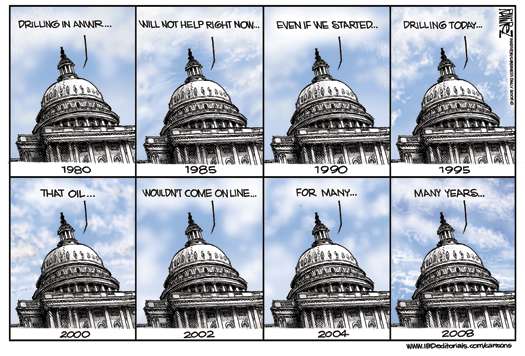
Well, Phil has been doing some slant-drilling in cartoon land, and he seems to have hit a mother-lode of sorts.

On Gas Prices

Wednesday, May 7th, 2008

Stumbled across this short nugget at NRO’s The Corner when I was trying to find some background information on some statements I heard from Sen. Clinton, which I found to be disquieting. You know, it’s the same ol’ Hillary Clinton crap…there’s this problem caused by a bunch of people who are trying to screw you, and I, The Great Hillary, am going to screw them longer and harder and you’re going to smile when you see me do it. (In this case, it’s something called “the big oil companies.”)

Anyway, Andrew Stuttaford makes the point…

Barack Obama isn’t right about very much, but he’s correct to say that the McCain/Clinton idea of a gas tax holiday is a bad idea, not least, I suspect, because it would probably have little impact on the price at the pump.

Then, as Ron Bailey notes over at Reason, there’s this:

Don’t both senators [Clinton and McCain] support imposing a cap-and-trade market on carbon emissions to combat man-made global warming? In a Washington Post op/ed last year, two RAND researchers calculated that a relatively modest $30 per ton of carbon price would boost gasoline prices by 35 cents per gallon (and household electricity bills by 20 to 30 percent).

Ooops.

Obama, here, is not to be given credit for his economic insight; he’s just being a typical liberal. As I pointed out awhile ago, the ideology has been twisted into something (presuming this isn’t what it was in the first place) dedicated to the premise that no two classes of people have, as of yet, any sort of symbiotic relationship. Of the plans you hear coming from liberals, perhaps about half of them are proposed for the purpose of forming such a relationship — Obama’s call for a “dialog on race” comes to mind as an example of this. Each and every single one of those ideas is faulty or disingenuous. That’s not my personal conclusion; it’s a simple article of sturdy logic. Just listen to a liberal talk about people of diverse economic circumstances, or races, or creeds, coexisting sometime. They’ll talk about their dreams in this regard. Never, ever do they say “A and B are living together in peace, and I want to make it easier for them to do so.”

Nope. In the liberal universe, all separate classes are fighting with each other — all the time. The liberal is here to promote a “peace plan,” or else the liberal is here to make sure things are less comfortable for B so they can be made more comfortable for A.

Drilling in ANWR, building power plants, starting businesses, employing people, keeping them. Liberals haven’t made it easy for anyone to do anything — except hostile things. Women getting divorces from their husbands. Unions of employees screwing their management. Lawyers sucking money out of people and employers. That’s all.

In all other aspects, they are here to make life difficult.

To simply acknowledge that two classes of people, with somewhat different economic interests just might have a symbiotic relationship, in some respects, is to make the argument for a conservative libertarian without the conservative libertarian even showing up, let alone saying anything. You pull oil out of the ground and sell it to that guy over there; he refines it into gasoline and sells it to me. The three of us exist in a symbiotic relationship — which the liberal doesn’t want me to think about, but that doesn’t change the fact that it’s there. You, he, and I engage in a cooperative effort to pull the oil out of the ground and use it to make my car take me places. Liberals exist to make that whole process more difficult. To make sure that by the time we’re done doing it, we’re all poor.

They restrict. They regulate. They tax. And then they ask for “contributions” to “offset” the “carbon”…which are voluntary…for now. They use this shell game where I’m supposed to pretend your interests, as a oil guy, are antithetical to mine, as a gasoline consumer — so that I consent to you being beaten up financially. But anyone with a brain knows as soon as it happens to you, you’re going to pass it along and I’ll end up paying it.

After which, I’ll drive my car someplace, with an artificial level of difficulty, and when I get where I’m going I’ll be doing something else the liberals have made more difficult. Like parent my kid, for example.

It’s based on lies. It’s based on the idea that it’s every man for himself — except they make it look like the opposite, because they’re doing this with classes of people. Women. Working families. Persons of color. But what they’re talking about, is this-or-that class doesn’t share any common goals with any other class, and so it needs to elect the liberals so they can screw that other guy. After that’s done, then we can live together in harmony.

But they don’t mean it. Because next year, they’ll be back in your face, selling you something else. Because symbiotic inter-class relationships don’t exist — that other guy is still screwing you over — and you need to vote for them so they can screw him over, and he can find out what it’s like.

There’s nothing centrist or productive about these ideas we call “liberal.” They are the nature of extremism, and we never should have gotten started with them.

Goldfish Rights

Thursday, May 1st, 2008

Via Gerard:

Government control over the citizens does not come about just through the legislation of the large issues a la the Canadian Hate Speech Tribunals. It also happens — and much more frequently — by the assumption of the government by fiat of the right to control all manner of little things. The recent best seller, “Don’t Sweat the Small Stuff,” has it exactly backwards. The small stuff is what has to be sweated. All the time.

If you are of a certain age you’ll remember the arguments against seat belt laws and motorcycle helmets mandates. In general it ran, “If they can do this to these things, they can do it to bigger things and everything.”

Nonsense, was the rejoinder, this is simply “for your own good.” An extension of this rationale was, “It is for the good of the children.” Fast forward a few decades and take a searching and fearless inventory of all the things you simply cannot do that are just things that involve you own personal behavior. You’ll find that they are numerous and growing. The new argument for laws and regulations that diminish your freedoms and liberty centers around “saving the planet.” This one is perfect since, simply by being alive, there are many things you do — such as exhaling carbon dioxide — that threaten the planet.

What inspires this tirade?

What indeed

Under a new Swiss law enshrining rights for animals, dog owners will require a qualification, anglers will take lessons in compassion and horses will go only in twos.

From guinea-pigs to budgerigars, any animal classified as a “social species” will be a victim of abuse if it does not cohabit, or at least have contact, with others of its own kind.

The new regulation stipulates that aquariums for pet fish should not be transparent on all sides and that owners must make sure that the natural cycle of day and night is maintained in terms of light. Goldfish are considered social animals, or Gruppentiere in German.

Good ol’ Europe; yeah liberals, let’s become exactly like them. Must! Ought! Should! Have to! Got to! Gotta gotta gotta! Must! Your dreams are coming true — we haven’t that far to go. Makes me want to put a brand new wreath on the tomb of the gentlemen who chucked the first crates of tea into Boston Harbor, or toss in a bag or two all over again.

Or as Gerard elegantly and expertly summarizes in the money quote…

In a way, it is a symptom of a civilization that has just ground to a halt. The Swiss have simply run out of rational things to regulate and so they move on to the world of compassionate bullshit.

On the Easterlin Paradox

Saturday, April 19th, 2008

I’ll let the New York Times guest-column speak for itself:

Arguably the most important finding from the emerging economics of happiness has been the Easterlin Paradox.

What is this paradox? It is the juxtaposition of three observations:

1) Within a society, rich people tend to be much happier than poor people.
2) But, rich societies tend not to be happier than poor societies (or not by much).
3) As countries get richer, they do not get happier.

Easterlin offered an appealing resolution to his paradox, arguing that only relative income matters to happiness. Other explanations suggest a “hedonic treadmill,” in which we must keep consuming more just to stay at the same level of happiness.

One criticism of the Easterlin report is that the data upon which it is based, comes mostly from survey responses and there is a psychological hobgoblin at work here because we don’t tend to think highly of ourselves when we admit we’re unhappy. So it stands to reason the responses are going to be skewed toward “oh yeah, I’m ecstatically happy.”

But another criticism I would have is that we have a societal taboo against acknowledging one of the possible — and I would label highly probable — outcomes: That money makes you happy. Let’s face it: Overly-simplistic as that may be, missing money when you need some really sucks!

But I think anyone pondering the situation for a minute or two would have to admit there has been, at least since the 1950’s or so, a swelling of pressure on people to presume out loud that wealth is only tangentially related, if it’s related at all, to a state of happiness. The pressure is sufficiently significant that it has an effect on people who have no personal experience at all, with being destitute & happy, or with having wealth in abundance and being dismal. And that’s my definition of significant pressure: When people are missing anecdotes within their personal experiences that would be needed to back something up, and will nevertheless sit there and say “oh yeah…uh huh, that’s right on.”

Well, the author of the column, Justin Wolfers, goes on to drop a bombshell:

Given the stakes in this debate, Betsey Stevenson and I thought it worth reassessing the evidence.
:
Last Thursday we presented our research at the latest Brookings Panel on Economic Activity, and we have arrived at a rather surprising conclusion:

There is no Easterlin Paradox.

The facts about income and happiness turn out to be much simpler than first realized:

1) Rich people are happier than poor people.
2) Richer countries are happier than poorer countries.
3) As countries get richer, they tend to get happier.

Moreover, each of these facts seems to suggest a roughly similar relationship between income and happiness.

Now, you can see from the reports and the cool graphics, that there is an abundance of data going in to these conclusions. So a disturbing question arises: Assuming this attack on the Easterlin paradox withstands scrutiny better than the paradox itself, are there some negative social ramifications involved in realizing this? Once it settles in that money does indeed make us happy isn’t there a risk that we’re all going to become a bunch of hair-pulling eye-gouging money grubbing zombies?

Well…to answer that we’d have to get into the debate about the “pie people”: Those who insist, like Michelle Obama, that when some among us have bigger pieces of pie then someone else must have smaller pieces, and in order to get more pie to those deprived persons it will be unavoidably necessary to confiscate pie from someone else. All transactions are zero-sum, in other words.

Seems to me, if you buy into that you have to agree there was at least a social benefit to the Easterlin paradox, even if it wasn’t true. And there must be a commensurately deleterious effect involved in repealing it.

I suppose, like the Easterlin paradox, the Pie Paradigm ought to be given a benefit of doubt, of sorts, so it can remain standing on clay feet across the generations without much supporting evidence. There must be a truth to it, and even if there isn’t, there must be a social benefit to believing it, and even if there isn’t, darn it it just feels so good to say it’s true.

Except, like Columbo, I can’t help noticing just one…little…thing.

So many of these Pie People, like Ms. Obama herself — are stinkin’ rich. What does that say about them, if they really do believe in the pies?

The Misadventures of President Talk-Over-Do

Friday, April 18th, 2008

Jimmy Carter did a lot of talking about unemployment, and did very little. He didn’t achieve much.

He did a lot of talking about inflation and did very little. He didn’t achieve much.

He did a lot of talking about Israel fighting with Palestine. The talking aside, he did very little. The problems that region had when he was in office, they still have today.

He did a lot of talking about the energy crisis. He put a solar panel on the White House, but apart from that did very little. He achieved probably less here than he did anyplace else, and it was particularly embarrassing for his defenders and apologists when Reagan got in and suddenly we didn’t have an energy crisis anymore.

From arguing with lib-ruhls on the innernets, which is my own way of talking-over-doing, I’ve found Jimmy Carter has a lot of fans out there. They’re very energetic and enthusiastic; really have their minds made up about him. Near as I can figure, they were all born after he was out of office. I haven’t found any exceptions to this pattern at all. I don’t know if that rule applies to people who write slobbering editorials like this one (H/T: Rick), but Former President Talk-Over-Do is really popular in something called the “international community,” which I’m gathering means “people you find if you grab your passport, fly around the world, and talk ONLY to people who agree…with certain other people.” Dignitaries. Ambassadors. Upper-crusters. People who are safely insulated from doing actual work, or having any of their family get hit with actual shrapnel.

The real issue here seems to me to be a fairly sharply defined, cut-and-dry distinction between talking about a problem and actually solving it. Carter seems inconsistent in this area. I know what he does when he’s the President of the United States…God help me, I don’t think I’ll ever forget it. What an incredible education that was. And the nonsense he’s doing now is quite consistent with what he did back then. Lots of talking. No doing. It’s like a rule.

JimmahBut when he poses for these Habitat-For-Humanity photo-ops, over half the time he’s holding a hammer in his hand, pounding a nail. Pound, pound, pound, pound. To which I have to say, waitaminnit. How come he isn’t talking to the nails?

Read some of these slobbery editorials sometime. Just look at the ones that purport to measure “results,” just going through the motions of so measuring. Just look at it.

Carter’s method, which says that it is necessary to talk with every one, has still not proven to be any less successful than the method that calls for boycotts and air strikes. In terms of results, at the end of the day, Carter beats out any of those who ostracize him.

Er, yeah…Hussein in Iraq…is that a result? Khadafi in Libya…is that a result? Apparently not. So I guess what the author meant to say was “Carter’s method…beats out any of those who ostracize him…provided you consistently ignore the results of those who ostracize him, and we certainly intend to do that here.”

You know, if this is the kind of comparison being made by the Talk-Over-Do camp then I guess we shouldn’t be surprised that President Carter achieved as little as he did. In fact, if their paradigm made any sense, then none of the nations around the world would have had any military resources at all…and never would’ve in all of human history.

And Carter himself never would have swung a hammer. He’d just be sitting at a conference table with a glass of water for himself, and another one for the nails.

But “at the end of the day” the house would remain a dusty dirty pile of lumber, and that would look very silly. And so I find it interesting. When Jimmy Carter actually wants to get some results, he goes all Ronald-Reagan all over those poor little nails.

Memo For File LVIII

Thursday, April 17th, 2008

I barely have the time this morning to deal with all of what’s busted in whiny, insipid, counterproductive, self-serving snotty immature screeds like this one…although I’m sure if I take a passing glance to it later, I’ll spot even more. The subject under discussion is why, oh why, aren’t there more female bloggers and how come the ones that are out there, don’t get more attention?

I asked around and heard a lot of different answers. Some say it’s because the men got a head start. Jen Moseley, the politics editor at Feministing says, “I think there are a lot of female political bloggers out there. But since most of the ‘old guard’ big political blogs (funny that something 4-5 years old can be considered old now), were started by men, so they’re still looked at as the only ones that matter.”

Amy Richards, an author and one of the co-founders of Third Wave, thinks that the amount of attention focused on the boys might be more than just their first-mover status—it’s an artifact of their historical control of the media. Richards claims that “Political punditry has always been dominated by men and thus blogging is likely to follow that pattern.” Richards agrees that women aren’t becoming blogospheric stars as quickly as some of their male colleagues. She says, “I know that women are jumping into this debate with their opinions and perspectives, but because they are doing so in spaces more likely to attract women—they aren’t being legitimized.”

Ezra Klein agreed with Amy about the ghettoization of female voices, noting that while male political bloggers are known as “political” bloggers, women are more often known as “feminist” bloggers. “There’s this rich and broad feminist blogosphere, which is heavily female and very political, but considered a different sort of animal. Is Jill Filipovic a political blogger? Ann Friedman?” he says. Male bloggers are seen as talking about politics with a universal point of view, but when we women bring our perspective to the field, it’s seen as as a minority opinion.

But does it have to be that way? Blogs are supposed to be populist and thus it would seem like women could more easily level the playing field here than in other media. Red State’s Mike Krempasky says, “You’d think the internet would be the great equalizer or the ultimate meritocracy. ‘far from it.”

What a festering, rotting open sore of microbial, infectious, stupid ideas. What a fetid, bubbling stewpot of poppycock.

It’s like an invasion of scavengers hitting your farm all at once. Coyotes, hyenas…buzzards…what have you. Craven. Cowardly. Seeking to survive on the merits of others. There is so much wrong with this, it’s like a big herd of such scavengers descending in unison, each scavenger blissfully unaware the others are there.

A fine buckshot approach to this invasion is to simply withhold my own fire and rely on a non-whiny female blogger like Cassy Fiano, who was responsible for me finding out about this in the first place. And Cassy lays out the hot lead in such a way that most of the scavenger-herd is…addressed…leaving few stragglers.

Whenever I read these kinds of articles, I just want to smack the author in the face. Here’s what they seem to be completely incapable of understanding: if you think you’re a victim, that’s all you’ll ever be.

First of all, is Arianna Huffington really the best example of a female blogger she could come up with? I can think of several right off the top of my head: Michelle Malkin (duh!), Pamela Geller, Em Zanotti, LaShawn Barber, Mary Katharine Ham, Rachel Lucas, Melissa Clouthier… the list goes on and on, and these are just conservative female bloggers.

Right Wing News even did two pieces on female conservative bloggers, and most of them looked at being a female blogger as an asset.

I’ve never had one single person tell me my opinion had less merit because I’m a woman, or that I wasn’t as good as the guy bloggers out there. I’ve seen no evidence of a “boy’s club” in the blogosphere; in fact, every single male blogger I have had any kind of communication with whatsoever has been gracious, helpful, and more than willing to assist me in building my blogging career.

And good grief, the “ghettoization” of female voices?! What the hell planet is this Megan Carpentier writing from? Because there are more male bloggers than female, female voices are being “silenced” and “ghettoized”?!

Uh, sorry, honey. Not quite. Maybe if you live in Saudi Arabia you could have a point. But here, the only thing keeping female bloggers back is… female bloggers.

Why, then, are there more male bloggers than female? The answer is simple, and it’s feminism’s favorite catch phrase: choice. Men, in general, are more interested in politics than women are. Sure, women are interested, but I don’t think that there are as many women who are diehard political junkies like there are men. Go ahead, feminists, rip my skin off for stating That Which Must Never Be Said: that women do not have the same interests as men do. Anyways, if you want proof, look at blogosphere readership. Most people reading politics blogs are men, so it stands to reason that most political bloggers would be men as well. This also means being a female blogger is more of an asset, and not just because it gives all your male readers something to ogle at (although that’s a plus, too). It means you stand out more, your blog stands out more. And that’s a good thing.

Women also tend to be more thin-skinned. The insults female bloggers get are very personal, and very hurtful. They very often have nothing whatsoever to do with what you’re actually writing about, unless of course you’re talking about how ugly you are or perverted sexual tendencies. A lot of women just cannot take that kind of thing. It’s like an arrow to the heart for them. After so much of that, a lot of them quit, because it isn’t worth the stress and heartache for them.

And why does the internet — the political blogosphere, specifically — need to be “the great equalizer”? Why does it matter how many female vs. male bloggers there are out there? There is not one blog I read because of the gender of the author. I read them because of the content in the blogs, what the blogger has to say. I could give two shits whether it’s a man or a women writing behind the computer screen. Putting the emphasis on something as shallow as gender accomplishes what? Instead of focusing on the skin-deep, why doesn’t this lady focus on the ideas different bloggers put forth?

I don’t know where feminists got this idea that all male-dominated careers were unfair to women unless there are an exactly equal number of women participating in these careers, but it’s ridiculous. They need to get over the bean-counting. Living in a state of perpetual outrage or victimhood will get you nowhere.

One blast. All farm scavengers tremble in fear before the fury of Cassy’s 12-gauge.

But some wounded furballs are still limping around. For example, Cassy’s retort to the “ghettoization” remark is limited to chastising Carpentier for her lack of perspective in identifying what might be amiss in the status quo. She did a fine job of dealing with that, but I’m more concerned with what thoughts were percolating away in what passes for Carpentier’s cranium before she jotted down her whiny bromide. If I want to “ghettoize” someone, or a class of someones, in the blogosphere — how do I go about doing this? What are my goals, exactly? Assuming the solution would resemble the problem, it must be up to the reader to fill that in because Carpentier admits ignorance in understanding how to fix it.

Megan Carpentier is kind of like Luke Skywalker wandering into the dark cave; she found in there what she brought in with her. Her point is “these blogs that I’m looking at are mostly male” but she could have looked at some other blogs. Prominence is measured, on the blogosphere, mostly in the eye of the beholder. What Carpentier has done, is confess — without even realizing she’s so confessing — that she comes from a weird, surreal universe in which that is not the case. She’s used to living in a place where some central kiosk tells everyone what to watch.

But it must be a two-way street, in some way, or else there’d be no point in Carpentier whining away. She must be an example of what I’ve noticed about most people who can’t cope without a central authority telling them what to do: Now and then, such complainers want to have a voice in telling the central authority what to tell others to do. So there’s a pecking order to this. Sniveling whiny complainer supplies instructions to the central kiosk; central kiosk radiates the instructions to the unwashed masses within line-of-sight.

I’ve never had any respect for people like this. I’ve always thought of them not only as tedious, thin-skinned banshees, but as shallow thinkers. They do their shrieking selectively. They only complain about the things we decide for ourselves, that have come to their attention at any given time, remaining agnostic and unconcerned about our choices of: Ice cream flavor, color of socks to wear today, stick shift or automatic, plain-cake or chocolate-with-sprinkles, the list goes on and on. One can’t help but nurture a fantasy that has to do with calling their attention to all these things at once, and kicking off some kind of carping-bitching-overload chain reaction. Like Captain Kirk and Mister Spock talking some ancient alien computer into a sparkling, smoky mess of paper mache and dry ice on the stage of Desilu.

We live as free men, deciding for ourselves and living with the consequences. Too many who pretend to walk among us are left unsatisfied by this state of affairs. Let posterity forget they were our countrymen, as the saying goes.

Cassy has been distracted by the great umbrage she’s taken — rightfully so — to the low pain threshold of Screechy Megan. What her criticism has allowed to walk away mostly unscathed is Megan’s mindset. The mindset of insects. Except insects, so far as I know, don’t bitch when the queen tells them to go someplace not to their liking.

I think my afterthought-comment over at Cassy’s place might address what’s left…

I was doing some more thinking about this. It seems we have some “dry rot” in the blogosphere, people who are blogging, and for the sake of their own sanity probably should not be.

How do we change that? How loud do women have to shout?

The ‘sphere promotes equality by failing to embrace it. Let’s say some left-wing pinhead says something on TV and it rubs Michelle Malkin the wrong way. Cassy Fiano is also piqued about the same thing. Malkin writes it up with something original; Fiano also writes it up with something original.

I like what Michelle said and I also like what Cassy said. Neither one linked or referenced the other, and they both said essentially the same thing. Linking both of them is pointless. I have a finite amount of time to blog and my readers have a finite amount of time to read.

So I must choose…

…and I’m going to link Malkin because she gets more traffic. And so, male or female, a blog “hits a groove.” It gets to the point where it is hit more because it does not need the traffic. It’s like a society with the ultimate regressive tax system — we all get together to help out whoever doesn’t need it.

The system works, because it achieves a blend of group-think and individuality. We’re all looking at the same stuff…kinda. But we’re also looking at our own stuff and forming our own ideas.

The exasperated inquiry “how loud do we have to shout” betrays an immature mindset, one that is accustomed to an all-powerful centralized authority. A “mommy” figure. But a weak mommy figure; one that panders to whichever “child” does the most bitching.

Not that I mean to imply Ms. Carpenter [sic] grew up that way. But if I had to bet some money, I’d bet it on the affirmative, and that would go for a random selection among her regular readership as well. The notion that some adequate amount of carping and bellyaching will change the universe to the liking of whoever’s doing it, is hideously offensive to me…to most men…and I would add to all “real” women as well. It’s a decidedly out-of-date 1960’s mindset, one that pays lip service to “choice” but only honors the choices made by certain, deserving people, and insists that everyone else has to follow along whether they like it or not.

How do you make more bloggers female? Might as well make more cars on the road listen to country music on their radios. It’s up to the dude/dudette behind the steering wheel, and it seems Ms. Carpenter [sic] just can’t handle that.

Bad Stuff About Warman

Sunday, April 13th, 2008

A couple days ago I had directed the following comments toward Richard Warman, or more precisely, his Wikipedia page:

His Wikipedia page contains four major categories as of this writing: Legal activism; Canadian human rights tribunal; Political activism; References. Who is he? The wonderful glittering text in the main article informs us…

He is best known for initiating complaints against white supremacists and neo-Nazis for Canadian Human Rights Act violations related to Internet content. In June 2007, Warman received the Saul Hayes Human Rights Award from the Canadian Jewish Congress for “distinguished service to the cause of human rights”. He holds a BA (Hons.) in Drama from Queen’s University, an LLB from the University of Windsor, and an LLM from McGill University.

He’s a Nazi hunter! Wow, what a great guy! And he’s got letters after his name and everything.
:
…wouldn’t you want to know some of the less flattering things about Mr. Warman? Especially if you’re sufficiently interested in him to go look up the Wikipedia entry about him? Well, it turns out at least some of the Wikipedia admins don’t seem to think so. They think you should only know the flowery parts. Or at least, they’ve so far come up with some wonderful excuses for excising anything else from the article.

Now, I don’t know if the Wiki admin in question is a Warman “fan,” per se, or if he’s simply scared that Wikipedia will face undesirable repercussions should it act as a repository for unflattering items about he who is demonstrably a hyper-litigation minded individual. But I do know this: I have never, in all the time I’ve been acquainted with Wikipedia, seen an article on a more controversial personality that made it so far without being pockmarked by so much as a “Criticism” section.

Well, it’s two days later. Guess who has a Criticism section now?

Criticism
Syndicated columnist Mark Steyn states that Warman abuses the intent of the Canadian Human Rights Act by personally appearing as the plaintiff about half of section 13 “hate speech” cases in the history of CHRA, and all of such cases since 2002.

Publisher and columnist Ezra Levant argues that Warman’s actions as plaintiff before the Canadian Human Rights Commissions are tantamount to censorship in the name of human rights. In response, Warman sued Levant for defamation.

Charlie Gillis of MacLean’s magazine asserts: “Richard Warman says he’s fighting hate. Critics say free speech is the real victim.”

It really shouldn’t have gone this far, though. I find it ironic — if there’s any one individual in all of its pages, who stands opposed to the way Wikipedia is supposed to work, that one individual would have to be Richard Warman. I mean look at that second paragraph again — Levant brings up, y’know, these lawsuits on behalf of “human rights” amount to censorship in the name of human rights. What does Warman do? Does he engage in vibrant, spirited debate to the effect of “Nuh-huh!” Or “You wouldn’t be saying that if your human rights were the ones being defended”? Or “Sometimes the greater good must prevail” or some such?

Nope. He just goes and sues him.

And one editor, or a plurality of editors, ends up slipping on his own fecal matter scrubbing the “Richard Warman” article sparkly clean of anything that might hurt Poor Richard’s feelings. And who can blame said editor for at least having the impulse? This guy, apparently, sues for a living. And so the great Wikipedia contradicts its own policy:

Wikipedia is not censored

Wikipedia may contain content that some readers consider objectionable or offensive. Anyone reading Wikipedia can edit an article and the changes are displayed instantaneously without any checking to ensure appropriateness, so Wikipedia cannot guarantee that articles or images are tasteful to all users or adhere to specific social or religious norms or requirements.

While obviously inappropriate content (such as an irrelevant link to a shock site) is usually removed immediately, or content that is judged to violate Wikipedia’s biographies of living persons policy can be removed, some articles may include objectionable text, images, or links if they are relevant to the content (such as the articles about the penis and pornography) and do not violate any of our existing policies (especially neutral point of view), nor the law of the U.S. state of Florida, where Wikipedia’s servers are hosted.

This is the trouble with thought policing. It is inherently non-egalitarian, because, as Mark Steyn has pointed out, Section 13 of the CHRA has ended up being Richard Warman’s personal law. Here’s an online encyclopedia well beyond the “Maple Curtain,” down in Florida, and they’ve been worried sick about offending this one guy up north. Seriously. After “Wikipedia may contain content that some readers consider objectionable or offensive,” you may as well have stuck in the four words “except to Richard Warman.”

But I’m delighted to see that the dam has been broken, and there’s finally three paragraphs of less-than-pleasing stuff about this guy. Couldn’t happen to a nicer fella.

And the version log says it happened just yesterday. Heh heh. All tremble in fear of The Blog That Nobody Reads.

I Made a New Word XV

Thursday, April 10th, 2008

bo∙lus∙te∙mo∙lo∙gy (n.)

A portmanteau of e·pis·te·mol·o·gy:

…a branch of philosophy concerned with the nature and scope of knowledge. The term was introduced into English by the Scottish philosopher James Frederick Ferrier (1808-1864).


…and bo∙lus

A soft, roundish mass or lump, esp. of chewed food.

Bolustemology, therefore, describes a system of intelligences and beliefs that cannot be justified or proven by any means intrinsic to the consciousness that maintains such things, because they have been pre-chewed and/or pre-digested by someone else. Bolustemology is soft and squishy intellectual matter, warm, wet, smelling of halitosis, more than likely infected with something. When you offer it to someone, you may be offering to put forth the effort they themselves cannot sustain, so that they can be nourished. But it’s far more likely that you’re engaging in an exercise to make them feel fed, without doing the necessary chewing…because you don’t want them to.

Very few among us will ‘fess up to consuming bolustemology, so infatuated are we with the fantasy of thinking for ourselves about everything. But at the same time very few among us can speak to the issue because most of us have not bothered to become bolus-aware. This is demonstrated easily. Last month, for example, Presidential candidate Barack Hussein Obama was forced by the inflammatory words of his bigoted pastor and spiritual mentor, to speak to the issue of racial disharmony. And so, swaggering to the podium as if it was his idea to do this, he droned on in that Bill-Clinton-like crowd-pleasing way of his for a few minutes, after which we were offered prime tidbits of bolus such as

Obama speech opens up race dialogue
Will it stand alongside the great speeches in US history?

:
Several students of political rhetoric suggest Senator Obama’s moving speech in Philadelphia Tuesday could stand with some of the great speeches in American history.

True, say some, the Democratic presidential candidate was forced into giving a speech that would explain his relationship to the Rev. Jeremiah Wright Jr., the outspoken minister of Obama’s church, known for some antiwhite and anti-American sermons.

While argument continues over whether Obama’s explanation was sufficient, his speech did seem to achieve this: It has sparked a conversation about race relations, one of the frankest Americans have had since the civil rights era.

And

The Obama speech was also a topic of discussion on Wednesday at the Washington office of the National Council of La Raza, a Hispanic advocacy and social welfare group. Hispanics can be white, black or of mixed race. “The cynics are going to say this was an effort only to deal with the Reverend Wright issue and move on,” said Janet Murguia, president of La Raza, referring to the political fallout over remarks by Mr. Obama’s former pastor, the Rev. Jeremiah A. Wright Jr., which prompted Mr. Obama to deliver the speech.

But Ms. Murguia said she hoped that Mr. Obama’s speech would help “create a safe space to talk about this, where people aren’t threatened or pigeonholed” and “can talk more openly and honestly about the tensions, both overt and as an undercurrent, that exist around race and racial politics.”

If there are any facts to back up this conclusion that the Obama speech stands alongside the great speeches of U.S. history…that it opens up a “race dialog”…that it creates a safe space to talk about this, where people aren’t threatened or pigeonholed…or where they can talk more openly and honestly about the tensions that exist around racial politics…such factual foundation is missing from the stories I’ve linked, altogether, and it’s missing from every single other item of discussion about this speech. The facts simply don’t back up any of this. Nor can they, because this is all a bunch of stuff that would be judged by each person hearing the speech. It’s all in the eye of the beholder. And the ivory-tower types writing about it in such sugary tones know nothing about this, nor can they.

No, the factual foundation says the “cynics” are quite correct. Obama’s speech “was an effort only to deal with the Reverend Wright issue and move on.” In fact, you don’t need any cynicism to conclude that. All you need to have is a decent and functional short-term memory.

But our High Priests of journalism, rushing to the press with their editorials built to be printed up in the wrong sections of the respective papers, weren’t interested in factual foundations, logical conclusions, et al. Nope, that’s all out of scope. They were all about bolustemology. About pre-chewing the food for others. About bludgeoning and cudgeling. About giving total strangers instructions about what to believe.

Obama may very well have given his speech in service of purely altruistic and idealistic motives. In doing so, he may very well have accomplished his stated goal of “opening up a national dialog” or some such…created a sounding board of safety for those who otherwise would have felt threatened participating in such an exchange. All those things could, in theory, be true. But all who desire to think independently for themselves, or at least to be thought of by others as capable of doing this, should be offended at the manner in which these cognitions were being handed to them. Valid cognitions have no need for pre-chewing. Each thinking recipient can figure it out for himself or herself. Yet, here, the pre-chewing was rampant.

I have some less subtle examples of the same thing in mind, in case the race-dialog item fails to illustrate the point properly. Michael Ronayne, about whom we learn via Gerard, distills the latest eco-bullying episode for us quite elegantly:
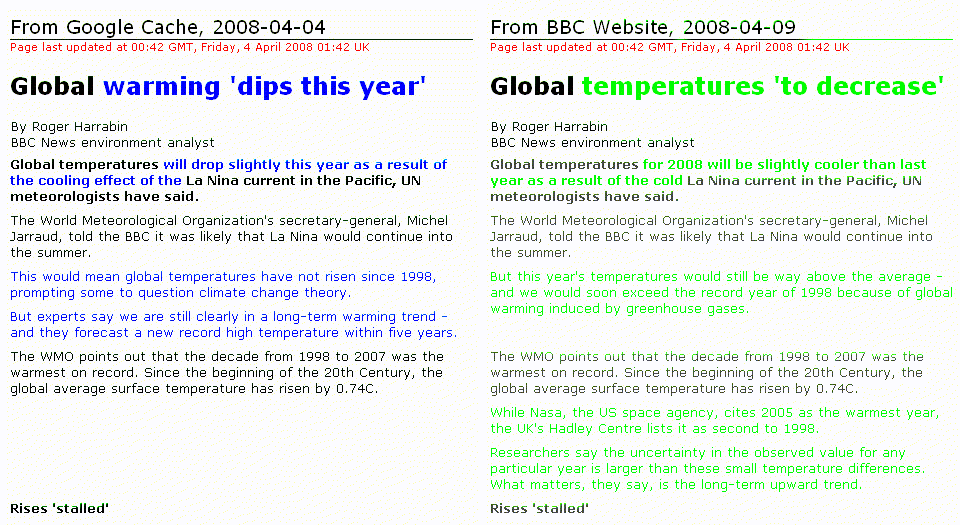
For the background, you can turn to JunkScience, which has a decent write-up including the e-mail exchange between a BBC reporter and a climate-change activist, reproduced in entirety here:

I have been emailed the following correspondence, purportedly between an activist, Jo Abbess, and BBC Environment reporter Roger Harrabin. It would appear that the result of the email exchange between the activist and the reporter was that the BBC changed its story. In particular instead of reporting the story as received from the World Meteorological Organisation, the BBC modified the story as demanded by the activist who was concerned that in its original form it supported ‘the skeptics’ correct observation that there has been no warming since 1998.

From Jo, April 4, 2008

Climate Changers,

Remember to challenge any piece of media that seems like it’s been subject to spin or scepticism.

Here’s my go for today. The BBC actually changed an article I requested a correction for, but I’m not really sure if the result is that much better.

Judge for yourselves…

from Jo Abbess
to Roger Harrabin
date Fri, Apr 4, 2008 at 10:12 AM
subject Correction Demanded : “Global temperatures ‘to decrease’”

Dear Roger,

Please can you correct your piece published today entitled “Global
temperatures ‘to decrease’” :-

http://news.bbc.co.uk/1/hi/sci/tech/7329799.stm

1. “A minority of scientists question whether this means global
warming has peaked”
This is incorrect. Several networks exist that question whether global
warming has peaked, but they contain very few actual scientists, and
the scientists that they do contain are not climate scientists so have
no expertise in this area.

2. “Global temperatures this year will be lower than in 2007”
You should not mislead people into thinking that the sum total of the
Earth system is going to be cooler in 2008 than 2007. For example, the
ocean systems of temperature do not change in yearly timescales, and
are massive heat sinks that have shown gradual and continual warming.
It is only near-surface air temperatures that will be affected by La
Nina, plus a bit of the lower atmosphere.

Thank you for applying your attention to all the facts and figures available,

jo.

=x=x=x=x=x=x=x=x=x=x=x=x=x=x=x=x=

from Roger Harrabin
to Jo Abbess ,
date Fri, Apr 4, 2008 at 10:23 AM
subject RE: Correction Demanded : “Global temperatures ‘to decrease’”

Dear Jo

No correction is needed

If the secy-gen of the WMO tells me that global temperatures will
decrease, that’s what we will report

There are scientists who question whether warming will continue as
projected by IPCC

Best wishes
RH

=x=x=x=x=x=x=x=x=x=

from Jo Abbess
to Roger Harrabin ,
date Fri, Apr 4, 2008 at 10:37 AM
subject Re: Correction Demanded : “Global temperatures ‘to decrease’”

Hi Roger,

I will forward your comments (unless you object) to some people who
may wish to add to your knowledge.

Would you be willing to publish information that expands on your
original position, and which would give a better, clearer picture of
what is going on ?

Personally, I think it is highly irresponsible to play into the hands
of the sceptics/skeptics who continually promote the idea that “global
warming finished in 1998”, when that is so patently not true.

I have to spend a lot of my time countering their various myths and
non-arguments, saying, no, go look at the Hadley Centre data. Global
Warming is not over. There have been what look like troughs and
plateaus/x before. It didn’t stop then. It’s not stopping now.

It is true that people are debating Climate Sensitivity, how much
exactly the Earth will respond to radiative forcing, but nobody is
seriously refuting that increasing Greenhouse Gases cause increased
global temperatures.

I think it’s counterproductive to even hint that the Earth is cooling
down again, when the sum total of the data tells you the opposite.
Glaringly.

As time goes by, the infant science of climatology improves. The Earth
has never experienced the kind of chemical adjustment in the
atmosphere we see now, so it is hard to tell exactly what will happen
based on historical science.

However, the broad sweep is : added GHG means added warming.

Please do not do a disservice to your readership by leaving the door
open to doubt about that.

jo.

=x=x=x=x=x=x=x=x=x=x=

from Roger Harrabin
to Jo Abbess ,
date Fri, Apr 4, 2008 at 10:57 AM
subject RE: Correction Demanded : “Global temperatures ‘to decrease’”

The article makes all these points quite clear

We can’t ignore the fact that sceptics have jumped on the lack of
increase since 1998. It is appearing reguarly now in general media

Best to tackle this – and explain it, which is what we have done

Or people feel like debate is being censored which makes them v
suspicious

Roger

=x=x=x=x=x=x=x=x=x=x=

from Jo Abbess
to Roger Harrabin ,
date Fri, Apr 4, 2008 at 11:12 AM
subject Re: Correction Demanded : “Global temperatures ‘to decrease’”

Hi Roger,

When you are on the Tube in London, I expect that occasionally you
glance a headline as sometime turns the page, and you thinkg “Really
?” or “Wow !”

You don’t read the whole article, you just get the headline.

A lot of people will read the first few paragraphs of what you say,
and not read the rest, and (a) Dismiss your writing as it seems you
have been manipulated by the sceptics or (b) Jump on it with glee and
e-mail their mates and say “See ! Global Warming has stopped !”

They only got the headline, which is why it is so utterly essentialy
to give the full picture, or as full as you can in the first few
paragraphs.

The near-Earth surface temperatures may be cooler in 2008 that they
were in 2007, but there is no way that Global Warming has stopped, or
has even gone into reverse. The oceans have been warming consistently,
for example, and we’re not seeing temperatures go into reverse, in
general, anywhere.

Your word “debate”. This is not an issue of “debate”. This is an issue
of emerging truth. I don’t think you should worry about whether people
feel they are countering some kind of conspiracy, or suspicious that
the full extent of the truth is being withheld from them.

Every day more information is added to the stack showing the desperate
plight of the planet.

It would be better if you did not quote the sceptics. Their voice is
heard everywhere, on every channel. They are deliberately obstructing
the emergence of the truth.

I would ask : please reserve the main BBC Online channel for emerging truth.

Otherwise, I would have to conclude that you are insufficiently
educated to be able to know when you have been psychologically
manipulated. And that would make you an unreliable reporter.

I am about to send your comments to others for their contribution,
unless you request I do not. They are likely to want to post your
comments on forums/fora, so please indicate if you do not want this to
happen. You may appear in an unfavourable light because it could be
said that you have had your head turned by the sceptics.

Respectfully,

jo.

=x=x=x=x=x=x=x=x=x=x=

from Roger Harrabin
to Jo Abbess ,
date Fri, Apr 4, 2008 at 11:28 AM
subject RE: Correction Demanded : “Global temperatures ‘to decrease’”

Have a look in 10 minutes and tell me you are happier

We have changed headline and more

Remember: Challenge any skepticism.

Now look at that graphic up there carefully: Blue is the old stuff, green is the post-capitulation, post-bend-over, post-take-it-up-the-chute-from-Ms.-Abbess stuff. And then read the nagging again…carefully. Jo Abbess doesn’t take issue with the facts presented, for she can’t — they’re facts. Facts iz facts. She objects to the conclusions people may draw from them, and nags this guy until he changes the presentation to her liking, so people will draw a conclusion more in line with what she expects. She’s trying to sell something here. Challenge any skepticism.

There are other examples around, if you simply take the effort to become bolus-aware and look around. There is, for example, the sad tale of Richard Warman. His Wikipedia page contains four major categories as of this writing: Legal activism; Canadian human rights tribunal; Political activism; References. Who is he? The wonderful glittering text in the main article informs us…

He is best known for initiating complaints against white supremacists and neo-Nazis for Canadian Human Rights Act violations related to Internet content. In June 2007, Warman received the Saul Hayes Human Rights Award from the Canadian Jewish Congress for “distinguished service to the cause of human rights”. He holds a BA (Hons.) in Drama from Queen’s University, an LLB from the University of Windsor, and an LLM from McGill University.

He’s a Nazi hunter! Wow, what a great guy! And he’s got letters after his name and everything.

But a quick visit to the “Talk” page reveals some intriguing conflict:

You removed what I believe were valid entries in support of the of criticism of Richard Warman.

You claim that the entries are not “encyclopedic”. Please explain what you mean, provide an example, and a Wikipedia reference in support of your position. Note also that one of the references was to another article in Wikipedia.

I am going to assume for the moment that you are acting in good faith, and will not censor valid criticism. Then there should not be too much difficulty in finding criticism of which you approve, since Richard Warman’s complaints before the CHRC are currently one of the most widely discussed topics on Canadian blogs. I provided just two references, whereas there are hundreds of others.

The entries you removed are:

Critics have charged that Warman abuses the intent of the Canadian Human Rights Act by personally appearing as the plaintiff in the majority of CHRA section 13 “hate speech” cases which have been brought before the Commission, a former employer of Warman. – – Critics further charge that many CHRC “hate speech” complaints such as Warman’s have had a chilling effect on the human right to freedom of expression.

I look forward to your prompt, reasoned response. Thank you.

Another piqued Wiki contributor writes in with an inflammatory sub-headline:

Bias in article maintenance and corrupt admins

This article is being maintained by politically motivated individuals trying to protect the information from being changed at all costs by removing any reference to well-sourced articles that don’t shed good light on this individual. These same individuals and admins have engaged in slander in other articles

What are these unflattering tidbits about Mr. Warman? Well, it seems lately he is in conflict with Ezra Levant, having served papers on the publisher. Levant paints a different picture of the former Human Rights Commission lawyer:

Today I was sued by Richard Warman, Canada’s most prolific – and profitable – user of section 13 of the Canadian Human Rights Act. As readers of this site know, Warman isn’t just a happy customer of section 13 and its 100% conviction rate, he’s a former CHRC employee, an investigator of section 13 thought crimes himself. In fact, he was often both a customer and an investigator at the same time.
:
It’s impossible to criticize section 13 without criticizing Warman, because without Warman, section 13 would have been defunct years ago – almost no-one else in this country of 33 million people uses it. I’d call it “Warman’s Law”, but I’ve already given that title to another law enacted because of Warman. Warman’s Law is a law brought in by the B.C. government specifically to protect libraries from Warman’s nuisance defamation suits. (We should find some way to set up a Warman’s law to protect universities from Warman, too.)
:
The more I learn about Warman, the more I write about him. And, like the CHRC, he hates public exposure. Earlier this year, Warman’s lawyer served me with a lengthy Libel Notice, which I posted to my website here, with my commentary on it here.

Again — you may read all of the above and end up still a big, slobbering fan of Richard Warman. You may decide to dismiss all of the reservations people like Levant have against him…which might be fair, since Levant is a defendant and Warman is a petitioner. You should expect that inviting Levant and Warman to dinner on the same night and seating them next to each other, would be a plan deserving of a re-think or two.

But…wouldn’t you want to know some of the less flattering things about Mr. Warman? Especially if you’re sufficiently interested in him to go look up the Wikipedia entry about him? Well, it turns out at least some of the Wikipedia admins don’t seem to think so. They think you should only know the flowery parts. Or at least, they’ve so far come up with some wonderful excuses for excising anything else from the article.

Hell, I’d sure want to know about this:

* Complaints filed to CHRC: 26
* Former employee and investigator at the Canadian Human Rights Commission
* In December 2006, the Law Society shows he works for the Department of National Defence
* Education: degree in Drama from Queens University
* Member: Law Society of Upper Canada and EGALE Canada
* Gave a Keynote speech to the Violent Anti-Racist Action
* Warman is a frequent poster on “Neo-Nazi” Stormfront website
* Warman is a frequent poster on “Neo-Nazi” VNN website.
* Pretends to be a woman named “Lucie”
* Has signed his posts with “88” (according to Warman means: Heil Hitler)
* Has called Senator Anne Cools a “nigger” and a “c*nt” on the internet

And I’d want to know what Mark Steyn had to say yesterday:

He has been the plaintiff on half the Section 13 cases in its entire history and on all the Section 13 cases since 2002. There are 30 million Canadians yet only one of them uses this law, over and over and over again, which tells you how otherwise irrelevant it is to keeping the Queen’s peace. Section 13 is, in effect, Warman’s Law and the CHRC is Warman’s personal inquisition and the Canadian Human Rights Tribunal is Warman’s very own kangaroo court. Whether or not the motivations were pure and pristine when this racket got started, at some point his pals at the CHRC and the “judges” of the CHRT should have realized that the Warmanization of Section 13 doesn’t pass the smell test: Justice must not only be done, it must be seen to be done, and when you see what’s done at the CHRC you understand it’s a cosy and self-perpetuating romance between a corrupt bureaucracy and its favoured son.

But the over-zealous Wiki editor(s) says no. They’re taking the Soup Nazi approach with these nuggets of unflattering information about Mr. Warman. Not-a For You!

Lying by omission — that’s a perfectly good example of bolustemology.

Perhaps you’ve heard of Matthew LaClure. He’s just like Richard Warman, it seems…standing for our rights, in his satin tights, and the old red white and blue-hoo-hoo-hoo…

Matthew LaClair, of Kearny, NJ, stood up for religious freedom and the separation of church and state in the face of ridicule and opposition. During his junior year in high school, Matthew had a history teacher who promoted creationism and other personal religious beliefs in the classroom. When Matthew confronted the teacher and asked the school officials to address this, he became the target of harassment and even a death threat from fellow students. Despite this opposition, Matthew worked with the ACLU of New Jersey to make sure that the First Amendment is respected and upheld at his high school. Matthew won the battle at his school and thanks in large part to his advocacy, the Student Education Assembly on Religious Freedom was created at his high school so that all members of the school community will understand their rights and responsibilities.

There follows an essay from the young LaClair about what he did, what happened to him as a result, and how it changed him. I suppose it might be encouraging to some who share his and the ACLU’s values, such as they are…but regardless, you have to notice the phrase “civil liberties” is peppered throughout, with negligible definition about what exactly this two-word cliche is supposed to mean.

I hope that what I did encourages others to stand up for civil liberties. I want to take what I have learned from this situation and apply it to other situations I will experience in my life. I now have a greater chance of making a bigger difference in the world, and I think that the experience will serve to expand my abilities further.

To figure out what “civil liberties” he’s droning on about, you have to consider what exactly it was that he did. And what he did was…start mouthing off at teachers when he was asked to stand for the pledge of allegiance. So the civil liberties in question would be…uh…the civil liberty to sit there while everybody else stands. Well, gosh, it turns out to the extent kids have that civil liberty post-LaClair, they had it before he ever came along. How about the civil liberty of doing that without some strutting martinet getting in their faces about it? Well, no change there either.

In the final analysis, the ACLU is making their apotheosis because Master LaClair mouthed off like a little brat. Any fantasy involving any more nobility than that, is bolustemology and nothing more.

But what’s he done for us lately, you might be asking? Glad you asked. Matthew LaClair, who has no axe to grind here, nosiree, has again impressed certain segments of the halfway-grown-up community by making a big ol’ racket about…exactly the same kind of stuff as last time.

Talk about a civics lesson: A high-school senior has raised questions about political bias in a popular textbook on U.S. government, and legal scholars and top scientists say the teen’s criticism is well-founded.

They say “American Government” by conservatives James Wilson and John Dilulio presents a skewed view of topics from global warming to separation of church and state. The publisher now says it will review the book, as will the College Board, which oversees college-level Advanced Placement courses used in high schools.

Matthew LaClair of Kearny, N.J., recently brought his concerns to the attention of the Center for Inquiry, an Amherst, N.Y., think tank that promotes science and which has issued a scathing report about the textbook.

“I just realized from my own knowledge that some of this stuff in the book is just plain wrong,” said LaClair, who is using the book as part of an AP government class at Kearny High School.

Yyyyyyeah. Uh huh. Just kind of blundered into that one, huh? Kinda like Murder She Wrote…have to wonder what dead body you’re going to find next week.

Just plain wrong. How interesting. Especially when one takes the trouble to actually read the report from the Center for Inquiry.

Unlike Matt LaClair, I’ll encourage you to do so. But just in the interest of saving time, the report boldly confronts six distinct areas of “just plain wrong” ness: global warming; school prayer; same sex marriage; constitutional government and “original sin”; the meaning of the Establishment Clause; and the significance of the Supreme Court’s denial of a writ of certiorari.

Of those six, the fourth and last are the two items that represent, in my mind, what you might call “a real stretch.” The CFI takes issue, there, with small snippets of the textbook in question, and reads meaning into them so that the whistle can be blown. For their criticisms to stand, a certain interpretation has to be applied to these snippets. The fifth objection is probably the most durable because it’s clear to me it is the best-researched. But here, too, the phrase “last minute” has to be given a literal interpretation (in the context of the time frame in which the First Amendment was ratified in the late eighteenth century) — so it can be properly debunked. So with all of the final three of the subjects, the authors of the textbook under review could respond to the CFI solidly and plausibly by simply saying “that isn’t what we meant.”

But it’s with the first item that my interest was really aroused:

The textbook‘s discussion of the science of global warming is devastatingly inaccurate. As explained below, the overwhelming weight of scientific evidence establishes that global climate change caused by global warming is already underway and requires immediate attention. The international scientific community is united in recognizing the extremely high probability that human generated greenhouse gases, with carbon dioxide as the major offender, are the primary cause of global warming and that this global warming will produce harmful climate change.

And much later…

In brief, debate within the scientific community over the existence and cause of global warming has closed. The most respected scientific bodies have stated unequivocally that global warming is occurring and that human generated greenhouse gases, with carbon dioxide as the major offender, are the primary cause of well documented global warming and climate change today. These conclusions are detailed in the landmark 2007 report of the Intergovernmental Panel on Climate Change (IPCC), the international scientific body organized to evaluate the scientific evidence for human-induced climate change.

Have you got any red flags raised when you read hackneyed phrases like “overwhelming weight”? If so, maybe you’re on the road to becoming bolus-aware. If not, then maybe you aren’t. Perhaps all six of the objections are legitimate, meritorious, and productive. But it’s easy to see the CFI report seeks — not to inform, but — to bully. To intimidate. To coerce. To get the whole world running the way certain people want it to…and since Matt LaClair is one of ’em, naturally he thinks they’re wonderful and vice-versa. None of this changes the fact that this is all pre-chewed pablum.

Notice — none of these observations have to do with truth. They have to do with who is recognizing it…and the subservient role others are invited to fill, as they are beckoned to slavishly follow along. The only other important thing to remember about this is that once one person is caught up in the undertow, he’ll piss rusty nickels to get everyone else sucked down with him. People who suck down bolus, don’t want to see anyone else do any chewing.

Oh, but I do have one thing to point out that deals directly with truth: The Intergovernmental Panel on Climate Change is not a scientific body, it is a political one.

The common perception of the Intergovernmental Panel on Climate Change (IPCC) is one of an impartial organisation that thoroughly reviews the state of climate science and produces reports which are clear, accurate, comprehensive, well substantiated and without bias.

One only needs examine some of its procedural documents, its reports and its dealings with reviewers of the report drafts to discover how wrong this impression is.

The IPCC is not and never has been an organisation that examines all aspects of climate change in a neutral and impartial manner. Its internal procedures reinforce that bias; it makes no attempts to clarify its misleading and ambiguous statements. It is very selective about the material included in its reports; its fundamental claims lack evidence. And most importantly, its actions have skewed the entire field of climate science.

As the saying goes, I’m much more concerned about the intellectual climate. Happy reading.

Class dismissed.

Update 4/11/08: You know, it occurs to me that even with all the examples above of strangers figuring things out for us and telling us what to think, not even handing us the glimmer of factual foundation so we could at least go through the motions of coming to the conclusions they want from us on our own…and with all the other examples we continue to be handed on a daily basis — Iraq is a quagmire, Boy Scouts is a hate group, etc. etc. — for some among us, the point still might not yet be pounded home. When you aren’t bolus-aware, you are very easily convinced of some things, but it’s an endless chore to bring your attention to certain other things.

It further occurs to me that it doesn’t need to be this complicated. Not even close.

We have three clear front-runners for the President of the United States in ’08, one Republican and two donks. Can there possibly be any example of our societal gullibility, than what follows. The one Republican is, by far, the most liberal left-wing Republican in the entire Senate. The two donks are, against all odds, the most liberal left-wing donks in the entire Senate.

If what I have used all those paragraphs to describe, above, is not an epidemic covering all the mass between the great oceans, lately reaching “I Am Legend” proportions and intensity…you would be forced to conclude that that is just a cohweenkadeenk. The odds? My calculator says one in 124,950.

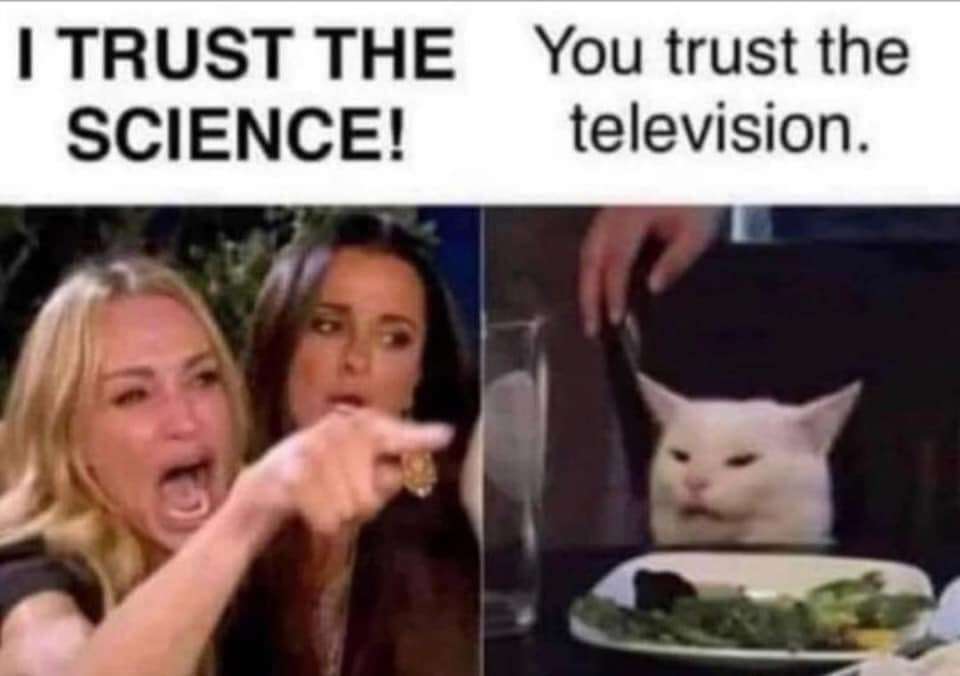
Obama Billionaires

Wednesday, April 9th, 2008

From Zombietime:

On April 6, 2008, Barack Obama visited the San Francisco region, zipping from event to event all day long, from one end of the Bay Area to the other.

What? you might ask. How did I miss that? If only I had known, I would have gone to see him.

Well, there’s a reason you didn’t know about it. Obama didn’t want you to know about it. Because the events he was attending weren’t for people like you.

They were for people with lots and lots of money, who use that money to gain access and influence with politicians — especially politicians who might become president.

So although the San Francisco Bay Area is probably the most pro-Obama section of the entire country, with Obama signs and stickers visible everywhere you turn, when Obama himself actually visited his electoral home base, he ignored the hoi polloi — all the little people who swoon over him — and instead, he spent the entire day with the rich.

Heh heh. Hope, change, hope, change, hope, change…the latest charismatic young Robin Hood campaigns on his message of hope-change, while hob-nobbin’ with the big boys just like any spoiled little rich old white Republican. Oh yeah, you riff raff, he really feels your pain.

H/T: FrankJ.

Who’s “Right”?

Monday, April 7th, 2008

Neal Boortz makes a point in only two hundred words. Maybe that’s still too long for some of the whiners who manage to trip across The Blog That Nobody Reads…and bitch away about my stuff being too long…

But if 200 words is beyond the capacity, I’d have to say that says more about them than it does about Neal.

It’s tough to “tease” something as short as 200 words. My best effort is…

Your “right to health care” would require some other person to give up a portion of their life or their property to either treat you or to provide you with drugs or medical implements. The Constitution does not provide for another individual to be indentured to you in this manner.

Therefore, you have no “right” to health care.

Deal with it.

Update: It should be noted that socialized health care has made the list of Stuff White People Like:

…it’s important that you understand why white people are so in love with free health care. The first and most obvious reason is “they have it Europe.” White people love all things European, this especially true of things that are unavailable in the United States (Rare Beers, Absinthe, legal marijuana, prostitution, soccer). The fact that it’s available in Canada isn’t really that impressive, but it does contribute to their willingness to threaten to move there.
:
But the secret reason why all white people love socialized medicine is that they all love the idea of receiving health care without having a full-time job. This would allow them to work as a freelance designer/consultant/copywriter/photographer/blogger, open their own bookstore, stay at home with their kids, or be a part of an Internet start-up without having to worry about a benefits package. Though many of them would never follow this path, they appreciate having the option.
:
Though their passion for national health care runs deep, it is important to remember that white people are most in favor of it when they are healthy. They love the idea of everyone have equal access to the resources that will keep them alive, that is until they have to wait in line for an MRI.

Memo For File LVII

Wednesday, April 2nd, 2008

I’m linking this column, about which I learned via Neal, for three reasons:

Firstly, Robyn Blumner is a “hyperlib.” She shows evidence of motivation for being a liberal, that goes well beyond any desire to impress or ingratiate herself with others. She seems to genuinely believe private-sector endeavors are harmful to her. Interestingly, once again we have the spectacle of someone who labors under this delusion but is mostly unwilling to state exactly why. Her supporting arguments are anecdotal, and her anecdotes are cherry-picked and slanted. Naturally, she comes to the conclusion that the motives of government are pristine by nature, and the motives of business are rancid and rotten by nature. Better than fifty-fifty odds she came to that conclusion because she wanted to. Why did she want to?

Secondly, she has interesting hair. But her facial features are distorted and weird-looking. I strongly suspect that the hair is a compensatory agent for something else far uglier, and I further suspect that this is a metaphor for her liberalism.

Thirdly, I’ve never heard of an online article that accepts comments that, when submitted, must be no longer than two hundred fifty characters. In addition to that, the comments are moderated. And the moderator seems to be exceptionally lazy. I mean, you just knew what I was going to do when I ran into that, I submitted a comment that was exactly 250 characters, not 249 or 251…a little on the smarmy side…and I’m just waiting to see if they run it. They haven’t posted my comment, but they haven’t posted anything since yesterday morning either.

This woman is warped. Her arguments cry out not so much for philosophical dissection, as for therapy. Consider…

What I can’t get out of my head is the way we’ve been suckered again into believing the malarkey sold by Milton Friedman, Ronald Reagan, Alan Greenspan and a long list of conservative think tanks, that the market is our savior. It is so convenient to make government the bad guy, the one who interferes with everyone’s pot of gold, and make open markets the answer to what ails, as Reagan did so often. But the historical reality is that the free market has a dark side that causes social displacement and instability, and by its nature it is an uncaring thing.

“Savior.” “Uncaring thing.” From where, exactly, comes this breathless quest in search of saviors and caring things?

How do you get this way, exactly? Has this woman never in her life experienced some kind of conflict about life’s goals, ambitions, etc. against some nanny-savior that was so “caring” about her? Never had that “ooh, I just gotta be me” feeling? About anything? Ever? She must not have. Or else…maybe she faced down a disaster that was so dark and dire and threatening, that pleading for a savior was the only thought that went screaming through her blow-dried coifed little red head and all “gotta be me” thoughts are long gone. If so, how bad was it? What is the worst problem she, personally, ever had?

So after the government’s done rescuing Wall Street, the rest of us could use some kind attention too. But we’d need a different government for that — a very different government.

This is what makes her, in my mind, a “hyperlib.” Consider the ramifications involved if this woman is being completely honest…and you’ll see why I have to doubt that so strongly. Government, according to her words, is kinda like Superman. We get into these fixes that are absolutely, positively, without hope…just like Jimmy Olson or Lois Lane falling out of an airplane, or getting lost in a forest fire. No internal resource, no mortal man, can help us; we need our savior.

But with George W. Bush in charge, the savior is an evil, perverted thing. A “Bizarro Superman” type of thing. So we need a “very different government.” We need to get that red Kryptonite out of here so Superman turns good again. Then we can go back to trusting him absolutely, completely, in every way possible. To save our kittens from trees, save our asses from forest fires, catch us when we fall off bridges, etc., etc., etc….and to run our lives for us.

To trust him completely.

Just as soon as he stops being evil.

So I don’t believe this woman or people like her. What they’re talking about is placing complete, unfiltered, undiluted, uncompromised power — and therefore trust — in this leviathan that is government. But only when the right people are in charge. Never a single syllable uttered about limiting the power to be invested in that resource just in case, you know, one day, from one year to the next — sometimes the right people aren’t in charge.

Which is one of the founding principles of this nation. We aren’t supposed to put that much authority in government, because we’re supposed to presume a good portion of the time the right people aren’t going to be running things.

“Hyperlibs” are people who say we can trust government, unconditionally. Just as soon as we get rid of George W. Bush and his crew. Until then, it is the essence of evil, malevolence, and darkness. According to their own words, we should get ready to bare our jugulars toward the fangs of government, right now, before the evil has been driven from it, while those fangs are still sharp, sparkling, and lunging at us.

Such a twisted edict must arise from an underlying philosophy that is either dishonest or incoherent. And I don’t believe it is incoherent. So a puzzle arises: What exactly are they hiding?

Update: The pattern continues. Yet another “hyperlib,” salivating for us all to live according to the socialist/collectivist model, ostensibly in response to our current day-to-day discomforts and problems — but one gets the unmistakable sense that the discomforts/problems have little or nothing to do with the impulse — turns out to be…GUESS WHAT?

I’m an atheist – so what?
By Robyn E. Blumner
Published August 8, 2004

“What is it,” asked German philosopher Friedrich Neitzche, “is man only a blunder of God, or God only a blunder of man?”

I vote for the latter.

Though I was brought up in a religious faith, it was at a very young age – preteen – that I realized I had no belief in God and no amount of indoctrination was going to change that. This sense of nonbelief has been so strong and abiding throughout my life that I find it virtually impossible to understand the psyches of people who believe in anything supernatural.

Just to be clear, it is not just God that I can’t fathom. I also reject the existence of Satan or any form of afterlife beyond the redistribution of the body’s matter. In my book there are no ghosts, golems, angels or spirits. I do not believe in psychic power, astrology or predestination – and forget about karma, kismet or crystals. My view is that the “soul” does not exist outside a functioning brain, nothing was “meant to be,” and things that seem inexplicable are not miracles or paranormal experiences, they are simply not yet explained.

If I was a foster parent to some being from another planet…if I had a genie living in my house…if I had thawed out a being frozen during the age of Atlantis…if it was, in any way, up to me to explain current events to some sentient being, capable of rational thought, but a stranger to recent history and our social customs — I would not be able to explain this.

Why are those who are so resistant to placing any faith in the “supernatural,” so eager to force everyone else to place faith in their socialist models of government?

If I were the thinking sentient being thawed out from the age of Atlantis, I would fully expect the faithful to be the socialists. Those who reject faith, I would expect to be rejecting socialism as well. That’s why you’re supposed to be turning your back on God, isn’t it? For the freedom? For the fatigue you have with “bigger” things “telling you what to do all the time”? And on the contrary, isn’t that supposed to be why a lot of the faithful are indeed faithful? The insecurity? They like to worship “together”? Like socialists? And so, I would expect my theory to make good sense…for it would…but it would be completely bass-ackwards wrong.

It is the godless who are socialists. Perhaps it can be explained because socialism doesn’t leave room for a god. But that doesn’t explain everything.

The consistency is just amazing. Oh sure, there are exceptions I know. But I could make a lot of money betting on the religious beliefs of those who want us to live like insects, surrendering our individual ambitions and desires for liberty, laying them at the altar of collectivism. I could bet they’re all atheists. Every single one of them. I could work my way through an endless Congo line of socialists, placing the wagers on one head after the next, without checking out a single thing about ’em. For the few times when I’m wrong, I could pay out ten-to-one odds and still end up a very wealthy man.

People who persist in this leftist, bug-like thinking, insisting everyone else do the same…are socialists. It is not a perfect pattern, but it is definitely a strong one.

Why is this such a consistent trend? The only explanation of which I can think, is that rejecting God leaves them hungry for a replacement, and so in socialism they have found the replacement.

Out of the Diversity Market?

Tuesday, April 1st, 2008

Well, this is interesting on a number of levels.

Elite colleges have been undermining their own efforts to diversify by giving much more weight to high SAT scores than they did before, according to an analysis of College Board data presented this morning at the annual conference of the American Educational Research Association.

Over the past two or three decades, the share of freshman-class seats that elite colleges award to students with high SAT scores has risen significantly—and risen more quickly than the number of high scores, according to an analysis by Catherine L. Horn, an assistant professor of educational leadership and cultural studies at the University of Houston, and John T. Yun, an assistant professor of education at the University of California at Santa Barbara.

What’s interesting is, to me, the way the whole college-admission thing was explained when I was a kid, I was told this is how it’s supposed to work. You’re smart as a whip but your scores are low on this-test or that-test, nobody’s going to care how smart you are.

And in life I’ve found as you get further away from the actual work that needs to get done, this becomes more and more true. Officials who are in charge of promotions, hiring and admission, being insulated from the actual work that needs to get done, but needing some kind of data on which to base their decisions, will start to rely on one or several arbitrary testing mechanisms.

The researchers say that, by focusing so heavily on high scorers, the elite colleges they examined are ignoring promising minority students with lesser scores, increasing the competition for high-scoring minority students, and potentially “simply ‘pricing’ themselves out of the ‘market’ for a more diverse learning environment.” Especially among the most prestigious of the 30 institutions, it is hard to believe that putting less emphasis on high SAT scores would cause the institutions’ quality to suffer. [emphasis mine]

Well, well, well. Talk about a darker skin color, and suddenly the most entrenched eggheads start to sound exactly like me. All of a sudden…we need to explore ways in which a single score from a single test, even a prestigious and well-known test like the SAT, might not be telling the whole story.

Whatsamatta? Why can’t we just go off the test score and very little, or nothing, else? Isn’t “promising students with lesser scores” an oxymoron? After all, if a student is promising, the onus is on him or her to bring up that test score right?

Once again it looks like I’m in trouble with the prevailing viewpoint. Back when it said skills/promise/aptitude were all synonymous with the value of a test score, that did seem overly simplistic but I could see the logic in it. Then it said no, there might be more to the story than that. There was logic in that too. Nowadays, the answer is all-of-one or all-of-another, but before we figure out which one it is we need to know the skin color under discussion.

And I’m sorry, but I can’t see any logic to that whatsoever.

And isn’t it interesting…if there was an explanation behind the phrase “hard to believe that putting less emphasis on high SAT scores would cause the institutions’ quality to suffer,” the entire article would have been justified. Since there isn’t one, all we have here is a bunch of colleges making decisions based on test scores, which is what they are conventionally supposed to be doing — and an egghead researcher who doesn’t think that’s the way it should be done. And can’t, or won’t, say why.

He and I could be kindred spirits, if the soft bigotry was dropped. Tests, even the Scholastic Aptitude Test, are exercises in following instructions. When you’re talking natural aptitudes, the aptitude of following instructions is oppositional to the aptitude of figuring out what needs doing & doing it. So even without the skin-color bean-counting, we already have a big problem there — leaders of tomorrow are filtered in to the higher educational system based on their abilities to follow instructions, not to actually lead.

Now we’re getting all hip to the idea that the process may be broken and in need of a fix or two…but only within the context of “minority” concerns. And on that subject we’re going to talk about nothing but minority concerns. Aptitudes that may be useful in roles of responsibility, that are beyond the scope of the testing mechanism, are things that I’m injecting into the subject myself in my own comments. The article itself doesn’t make any mention of them.

So the problem here is that we may be going through the motions of embracing excellence when we’re actually embracing mediocrity. We may be…it seems the researchers don’t want to commit on that one way or the other. For example, I can’t possibly be the only one who thinks the statement “‘pricing’ themselves out of the ‘market’ for a more diverse learning environment” is bizarre in the extreme. There, again, the article approaches an explanation of what is meant by this, but doesn’t actually pursue such an explanation. What exactly is a “more diverse learning environment”? Is it an exercise in excellence, or mediocrity?

Three decades after Bakke, with that phrase being tossed around with such a frequency and to such an extent that it has become tired and worn, I’ve never heard anyone in any position of authority say which one it is. Is “diversity” the pursuit of a zenith, or of an average?

And as a general rule, when persons in positions of authority refuse to explain things, bad things are about to happen.

The Single Mom Problem

Saturday, March 29th, 2008

Fair disclosure: I’m a single dad. I didn’t marry the mom.

It’s been a pretty rocky road and it hasn’t been all good for the boy. But I will say this: Of all the things we have done that have hurt him the most, the biggest thing by far has been all the yelling and arguing. And one thing I can say for an absolute certainty is, if I’d married her, there would have been a lot more of that…and not too much of the other stuff would have changed. We still wouldn’t have “made it” because we still would be two different people who look at life in two different ways.

This is the problem with arguing about marriage in simplistic terms. The institution has become a complicated, wrinkled-up mess. We think of it as some kind of a “promise” when it isn’t anything even resembling that anymore. It’s a change in legal status; a change made to get some bennies. Promising doesn’t have anything to do with it. It’s become just a shrink-wrapped bundle of weird benefits and equally weird (toothless) obligations, all of which are re-defined one week to the next according to what lobbyists and activists tell politicians they want done.

Have I made wise, good decisions? No. Should I, therefore, have gotten married? Uh, erm………no. Pretty much everyone I knew at the time, told me to do something, I said I shouldn’t, and in the long run I turned out to be right. But I’m not proud.

Others have done the same thing. And for reasons that escape me, they are proud.

Stephanie FlandersNow, do you know what is going on in jolly old England? The time has come, once again, to put some floral wreaths and candies on the graves of the gentlemen who threw the tea into Boston Harbor…and maybe think about tossing a few more boxes in. Across the pond, they’re having a row and a ruckus about how everyone should live.

On a Newsnight programme in August 2007, [Stephanie] Flanders interrogated Conservative Party leader David Cameron about his proposed policy of tax breaks for married couples while questioning him with other journalists, asking him whether he had ever met anyone who would get married for an extra £20 per week. As an unmarried mother, she also asked Mr. Cameron whether the Conservative Party would like her to be married.

So. We got this nanny-state pro-marriage guy who wants to give a stipend to married couples, and he is rightly upbraided by a single mum.

Lashing out at him in honor of the libertarian spirit of the individual, and the God-given right to live life as you choose?

Erm……no, it doesn’t appear so….

Meet the Credit Crunch Crumpet: The unmarried mum who clashed with Cameron on Newsnight

…Next Tuesday Stephanie officially takes up a new job as economics editor of the entire BBC. It is one of the most senior jobs in broadcasting, and about as authoritative as it gets without actually being Sir David Attenborough.
:
Quite a responsibility, then? “Hmmm. Immense,” she says. “It’s all extremely exciting – this is the best job in economic broadcasting, without a doubt – but it’s daunting, too.

“It’ll mean treading that fine line between being accessible and authoritative. I’ll have to get across very complex economic ideas in a way that is easy to understand and interesting.
:
She gives a half-giggle. That she is the first woman to become one of the BBC’s senior editors – she is taking over from the flamboyant Evan Davis, who is off to present Radio Four’s Today programme – seems slightly shocking in this day and age, but good news all round. Isn’t it?

“No one can remember there being a woman in any of these senior positions before,” she confirms, choosing her words carefully. “I’m sure the BBC would admit that’s not ideal.”

That she is up to the job doesn’t seem to be in doubt. She is widely regarded as one of the most capable economic analysts in the country. Her clever-clogs qualifications are second to none – degrees from Oxford and Harvard – and she spent time speech-writing for the U.S. Treasury under the Clinton administration, before working for the Financial Times.

But aren’t we afraid of overly clever women in this country – unless they bring out diet books on the side? Isn’t the nation going to be intimidated by her?

She smiles again. “I’d prefer them not to be intimidated, but if they think I am talking with authority, then I’ll have got it right,” she says.

Perhaps surprisingly Stephanie hasn’t encountered that much sexism so far, “although there will always be men who simply think women aren’t up to the job”.
:
Yet I’m astonished at how open she is about how her sex will, or won’t, affect how she does the job.

Indeed, she asks for this interview to be conducted at her home, where her 22-month-old son, Stanley, is running around. This makes it inevitable that we will talk about her new kitchen and the perils of finding a good nanny. She is pregnant, too, which makes things even more tricky. Baby number two is due in June.

I don’t know why we are motivated to treat women this way. By asking the rhetorical “aren’t we afraid of overly clever women in this country” — and then later eeking out “Stephanie hasn’t encountered that much sexism so far,” the article seems to me to be ‘fessing up to looking for discrimination where it doesn’t really exist in meaningful volume. She’s a child born into privilege, perhaps more energetic and ambitious than most, I don’t see anyone anywhere fighting her. Why do we have to imagine her battling some unseen force in her every waking moment when efforts to define said resistant force culminate in such a lackluster presentation? She seems to be swimming downstream, not up. Who — on the entire planet — has any hostility to this woman’s career, whatsoever, with any kind of ability to influence it?

If the story is all about her battle with day-to-day obstacles and barricades, then I’m still waiting for the story.

The other thing that’s funny about how we treat women, is we seem to imagine they don’t really have a “choice” to do anything until substantial energy has been depleted championing that choice, cudgeling other women into making the same one. Where, I wonder, did we get this rule? Stephanie is all about choosing to remain unmarried if that’s what you want to do. But Stephanie has to become a celebrity. Stephanie needs a splash page.

But Stephanie, according to the article itself, wasn’t born into humble beginnings. Stephanie has connections. Stephanie has friends and relatives. Stephanie went to schools that not-just-anyone can attend.

And Stephanie has a stud. He’s mentioned in paragraph 23. And in the context, it would appear he is expected to do some things about daddy stuff, childcare, bringing-home-bacon, whatever, to lighten Stephanie’s load a little bit.

Why paragraph 23? Why not in paragraph five? Why isn’t he in the splash picture with the hen and the chick, if the rooster is part of making it all work? What’s this drive to make the story read like a story of “we made it all work without a man.” I mean, it doesn’t come out and say it in those words, but can anyone deny that this is an intended central thrust of Stephanie’s story? She did it, girls, so you can do it too…except Stephanie isn’t really doing that. She depends on her man — and wherever she doesn’t, she depends on a lot of other resources she has in her personal life, that millions of single mothers don’t have in theirs.

Or as Richard Littlejohn wrote,

“If Stephanie Flanders speaks for Britain, then I’m a gnu ” (recalling a famous song by her father [Michael Flanders] and Donald Swann).

Meanwhile — the European tradition continues. Everybody’s nose is in everybody else’s business. Every couple that gets married is a victory for Mr. Cameron and his friends. Every couple that doesn’t is a victory for Stephanie and all her friends.

Mass communication is a wonderful thing, but sometimes I think over the course of its relatively short history it can be shown that we really haven’t used it that well. It has become very popular over the years to use the medium to bludgeon those among us in the most rustic circumstances, to make decisions that aren’t going to pan out very well for them or their children in the long run.

Here’s the question I’d really like to have answered:

Is it by sheer accident that we use mass communication this way? Or does that have some sort of appeal to somebody somewhere? It seems like we’ve been really working at it. Pregnant girls should stay single…kids should think of their daddies as idiots…if your boss doesn’t give you four months vacation out of the year, you should strike. Every single nugget of this modern-day electronic “advice” seems to be advice that is wonderful for someone else, that no one with a brain would accept as their own.

Everyone Gets a Raw Deal

Monday, March 24th, 2008

The post previous to this one inspected the possibility about whether the CIOs in our information management businesses might be causing the problems…about which…they do their grumbling. Said problems having to do with this alleged “IT skills shortage.” My answer boils down to Yes, but not in the way most people think. I believe a trend exists wherein everything in Information Technology is being distilled down to a step-by-step process, with no problem-solving skills necessary, no knowledge about how things actually work necessary. The goal is to make all skills economical — portable — easily transferred to the next person. And, IT being a big thing, all skills within it simply don’t translate that way. They’re trying to put fifty pounds of potatoes in a twenty pound bag. So yes, we should blame the CIOs.

I hope people found that one to be thoughtful. A lot of people decide this stuff with feelings, and you know, that’s the second sign that you are going insane.

What happens when you go insane? You can’t make decisions that are beneficial or productive anymore…or at least, are beneficial or productive on a frequency greater than random chance. You leave it to others to make things better, as a best-case scenario — worst-case scenario being, you jump in and bollux it all up for them.

And here’s a great example of that: Via ZNet Cartoons, via Alas! A Blog!, via Glenn Sacks writing in Men’s News Daily:

Niiiiiiiiicccceeee……….

Why do I find this cartoon to be insane? Because it derogates the accomplishments of white people, indeed is calculated and designed to do that very thing, and I’m a white person? No. Because it fails to navigate the first triad and it cannot culminate into a thought that will navigate that triad: FACT…OPINION…THING TO DO. The fact it seeks to point out is that white people benefit from racism without knowing it. What opinion are we to draw from this? That white people are, typically, less competent than they believe themselves to be? I think even among people who sympathize with the cartoon, most of them would be reluctant to jump to that conclusion. They’d need to see a few more facts.

And forget about the Thing-To-Do. Just forget it. What are we to do about this? Well gee, affirmative action with quotas might seem like the only reasonable way to go…that might seem like a sound plan…to people who feel their way around problems rather than thinking their way through them. All those who seek to define a goal before they make their plans, so they can assess their progress toward that goal…abandon all hope ye who enter here. What are you trying to do? Make everyone the same? Lay the smack down on whitey? Give persons-of-color opportunity? Cool down racial tensions? People who want the first two to happen, can’t say how that helps anyone. People who want the third thing to happen, can’t say how that’s supposed to work, over the long term. And people who want the fourth thing to happen, by supporting quotas in college admissions, hiring and contracting, work diligently against the goals they say are theirs.

Over on Alas!, there are just shy of a hundred comments about this cartoon. I’m particularly interested in #5, #6, #8, #10, #16 and #47.

Sailorman doesn’t seem to think too highly of the comic. He ‘fesses up that he can’t draw, but if he could this is the strip he’d do in response…what follows is a panel by panel description of what happened to the white folks and their ancestors — the darker side.

Jake Squid calls him a “right-winger.”

Sailorman points out that Squid is engaging in ad hom; Jake Squid denies it, then engages in it again.

Ampersand, who seems to be the CEO of the blog, does some backpedaling…

Sailorman, I’m not sure where the cartoon said that white people have it easy, or don’t work for what they get. The person was offered “a foot in the door,” not the keys to the executive washroom; the white couple was given a mortgage, not a free house.

What the cartoon does say (in my view) is that white people have it easier than black people, and that the system works in a way that makes it easy for white people to be unaware of how they’ve benefited from racism. I don’t think believing that requires believing that white people are handed the world on a silver platter.

I call it backpedaling because if one accepts the point of the original cartoon, and from that does navigate the first triad of fact/opinion/thing-to-do, albeit in an insane way — it’s almost certain that whatever navigation that was, it just got scuttled by Ampersand’s miniaturization of the original point that was being made. White people are being given, not free stuff, but opportunities. Oops. Well, here’s news for Ampersand — a lot of people who saw the cartoon and liked it, it doesn’t seem at all a logical leap to say, thought the stuff that belongs to white people should be taken away from them. What else is to be done? We shouldn’t do that? The cartoon seeks only to make white people more thankful for the opportunities they’ve had? Eh…if that’s the case, it’s not that good of a cartoon, because it doesn’t seem to stop there. I’m pretty sure Jake Squid isn’t stopping there. He thinks you’re a “right-winger” if you simply bring up some historical points the cartoon might’ve forgotten to mention.

Leora, also, doesn’t find much use in Sailorman‘s point. But interestingly, when she discusses why this is, she makes his point all over again for him. Read her entry, all the way to the last paragraph:

What this comic (and Sailorman’s response) reminded me of is a very personal interaction I have in my own life. It is not exactly the same, but humor me on this analogy, ok?

My sister and I are both white females, both came from working class parents with a strong work ethic, and are both first-generation college educated with advanced degrees. Inasmuch as we can be similar, we are as sisters. The main difference in our lives is that she is able-bodied and I am disabled. (I am very obviously vision and hearing impaired.)

My sister is a very hard worker and has a successful career. I would not say that she hasn’t “earned” her successes because she put her nose to the grindstone, made the right decisions to get to her goals, and met her goals by working hard.

The difference between her and I is that she has always had the OPPORTUNITY to work hard. For her, say the goal is “D”. If she worked hard at A, it would get her to B. If she worked hard at B, it would get her to C. If she worked hard at C, it would get her to D. She pretty much has always had the benefit of the assumption that A B C=D. There was an obvious return to her investment.

For me, A may or may not = B, which may or may not get me to C, etc. And the time I will have to spend at any one of these steps (working just as hard or harder than my sister, is usually longer and may offer me less return on my investment.)

To use real life examples: My sister could earn money in high school by babysitting or doing high school fast food jobs. It was relatively easy for her to get the opportunities to work hard. I sat around a lot in high school earning way less money because people were less inclined to hire a deafblind babysitter or fast food worker. She had the opportunity to work hard.

She was in honors programs and I was in special ed, which didn’t even allow me to take the qualifying tests for honors programs. She worked hard in her honors programs because she had the opportunity to work hard.

She got through college more quickly than I did because she was able to work to pay for college at a much increased rate than I did. I did work, in high school and college, but I spent much more time job hunting and doing volunteer work to get my foot in the door or begging for more hours than she did. She did work hard to put herself through college, as did I, but the benefits allowing her to work hard gave her more opportunities.

Most notably, she got many jobs and internships, etc. by word of mouth. Someone would recommend her and she would get hired. I had people who were also willing to vouch for me, and they would come back to me apologetically saying that they put in a good word for me but that the other person said that they just didn’t know if they could see themselves hiring a disabled person.

In her case, with all of these opportunities to work hard, she was able to build on her success over time. In my case, any accomplishment I earned in the past by hard work was not likely to count for anything past my disability. Her past accomplishments led to more opportunities to work hard and earn more successes. I have to start over proving myself at every opportunity as if I have no past. I have to defend myself for things that may or may not happen in the future. I have no past and no future in regards to earning things, her past accomplishments are step ladders for her and no one expects her to prove that she will never make a mistake in the future she cannot foresee.

So, I have never understood this argument that sailorman gives. No one is saying that white people didn’t work hard to earn their successes. But don’t they understand how fortunate they are to have those opportunities to work hard? And how frustrating it is when you want to work hard, you have the skills, you have played by the rules, yet there is no return? Working hard and earning success is a privilege that is not afforded equally to everyone in society. Why is that so hard to understand?

As an interesting epilogue here, my sister has now reached the proverbial glass ceiling in her career. She is finding that she has reached a point that she cannot move out of. A B C is no longer easily equal to D. She is seeing younger, less qualified men jump past her in promotions and opportunities. And I’m sure they worked hard, too.

So the privileged sister peaked out, and now must take her turn on the sidelines watching men leapfrog over where she is, just because they’re MEN. “And [Leora’s] sure they worked hard, too.” Uh huh…and I’ll tell you something else, Leora: Those men had to put up with a lot of guff that didn’t get in the way of your privileged sister…or you. They could have had their careers destroyed by some underachieving woman, not even all that good-looking, or for that matter even having anything to do with the guy at all — going to Human Resources and saying “when he walked into the room he made me feel uncomfortable.”

One wonders, further, how many opportunities this privileged sister had that were denied to the men who are now passing her up, back when it was fashionable to hand the plum assignments out to the gals. Can anyone deny there is such a force of nature at work here? We’re seriously considering putting a woman in the White House this year — a nasty, toxic woman who has accomplished very little, and doesn’t seem to have a kind word to say about anyone except when it’s in the context of bashing someone else. And for that matter, does Leora really expect me to think it is never in vogue to hand things out to a disabled person? It hasn’t happened in her case? Shenanigans. What if we went and talked to the privileged sister? What would she say?

I’m sure if we tallied up the unfair advantages and got into a subtraction game, net-for-gross, Leora’s point would still stand. But…a subtraction game is useful only if you’ve validated that you’ve collected everything that should go into it. In this case, there’s no way to validate it. We live in a big complicated world full of people gaining “unfair” advantages all the time. And there’s another question to be pondered — aren’t we supposed to be working together for some things? When did this become a competition against each other?

My point is that all this stuff is useless. All these arguments to be made are “valid,” on the most superficial level anyway, because they all have a kernel of truth to them. But just a kernel. You can’t really do anything with any of them…all they say is that this class of people, or that class of people, got a raw deal.

I like the idea of white people being more thankful for the advantages they’ve had — but that’s good advice for anyone isn’t it? Here and there, I know I’ve had benefits because of the friendships I’ve had, as well as whatever class to which someone thinks I’m a member. I’ve been hurt too — passed over for opportunities that went to persons far less qualified.

You really open a Pandora’s Box when you say because Morgan was passed over for something, Morgan is owed something by someone. We just shouldn’t get into that. Nobody owes Morgan anything…because everyone gets a raw deal. And it logically follows that for whatever opportunities I have had come my way…I don’t owe anybody anything either. Just some gratitude toward those who made it possible. Anything beyond that, we have to get into the whallopin’ countin’ business. Oh no, to make up for past opportunities he shouldn’t have gotten, we gave this guy three whallops, now we think on it some more we see he only had two whallopin’s comin’. He gets one back, so who does he get to whallop?

And once you start that crap, it never ends. Worse still, someone has to get the job of figuring out how many whallopin’s so-and-so has comin’ to ’em. And ultimately, that is a position involving so much power, we shouldn’t want anyone to have it.

Does that make someone angry?

Then that would be a sign someone is participating in the formation of our public policies, and they aren’t engaging any spirit of compromise before doing so — they just want things their way, period. If we’re looking for something somewhere that needs fixing, I think we should start there.

While You’re At It, Why Don’t You Just Kill Yourselves?

Friday, March 21st, 2008

Now, you see? What was I just telling you? You can’t ignore the evidence; it’s long ago stopped knocking, and has now climbed in the window and is giving us wedgies. People form their opinions about the issues based on their disgust with life — they don’t like living it and they don’t want anyone else living it either.

LC Rob sends us this:

Michigan Congressman Wants 50-Cent Tax Hike on Every Gallon of Gas

A Michigan congressman wants to put a 50-cent tax on every gallon of gasoline to try to cut back on Americans’ consumption.

Polls show that a majority of Americans support policies that would reduce greenhouse gases. But when it comes to paying for it, it’s a different story.

Rep. John Dingell, D-Mich., wants to help cut consumption with a gas tax but some don’t agree with the idea, according to a new poll by the National Center for Public Policy Research.

Making Dingleberry one and the same as the Hildebeest, Barack Osama, Joe Lieberman and, of course, McVain (Shit Sandwich – AZ), the “conservative” candidate, none of whom have the slightest idea what they’re talking about, which is the reason why none of them have a real job.

The poll, scheduled to be released on Thursday, shows 48 percent don’t support paying even a penny more, 28 percent would pay up to 50 cents more, 10 percent would pay more than 50 cents and 8 percent would pay more than a dollar.

And they’re certainly more than welcome to, should they so desire. All they have to do is to keep a running tally of their gas consumption, multiply the number of gallons with their chosen voluntary extra tax and write the amount on a check for the National Treasury.

But before they start clamoring for everybody else having to do so as well, we would like to remind them that the added cost of transporting everything they buy in stores, from paper clips over milk to plasma TVs, will have to be covered by somebody or the producers thereof will go out of business. You’ll get exactly three guesses as to who will get the honor of paying that.

And let’s not even think about the idiocy inherent in Michiganders wanting to hike the gas tax. As far as we recall, that particular state is known for a particular industry that wouldn’t do too well with rising costs at the pump, an industry that isn’t doing too well as it is.

Which brings us back to the headline of this post.

Imbeciles.

This is a plague, and a dangerous one. Nearly half of us would pay more? Just…to be able to say they did? Not for the purpose of paying for something, just to throw away their hard-earned dough on some perverted notion of the “common good”?

These people get just as many votes as I do? I have to ask the question: Why don’t they give that up too?

You know, you aren’t guaranteed the right to vote in the U.S. Constitution. I propose a test. A pencil-and-paper multiple-choice test…or something on a web page written in PHP…or a customized machine kind of like a lie detector. Call it an “I Like Life” test. An “I Think Life Is Worth Living” test; an “I Think People Are Not A Pestilence” test.

You pass it, you can vote, you don’t you can’t.

We’ve gotta do something to stop this.

Anti-Danger, Anti-Achievement, Anti-Defense, Anti-Life

Thursday, March 20th, 2008

This morning I was rubbing my hands together in giddy glee over the finding that the Nintendo Wii is not environmentally friendly, or at least, is not perceived to be that (Nintendo’s crime against the environment seems to be mostly related to a failure to divulge information about being clean, which is different from a substantiation of evidence about being dirty). My comment was,

The anti-corporate pro-enviro hippies, are hopefully going to be locked in a huge fracas with the video-gamers and therefore with the kid-dumbing-down people. I hope. It’s always fun to watch the anti-achievement types feast on their own.

Hundreds of thousands of e-mails have poured in and called my attention to…

…alright, nobody’s uttered a peep about it. But it nevertheless occurs to me, even though this is The Blog That Nobody Reads, that I should expound.

Surely you’ve noticed, haven’t you. The people here stateside as well as across the pond in Europe, who are so quick to rap us across the knuckles for taking out Saddam Hussein — offer little or no alternatives for us to defend ourselves in any other way from the threat of worldwide terror. Oh yes, I know, many among them will say we were “distracted” from the “hunt for Osama bin Laden” when he was “in Afghanistan.” They imply in a bullying way, but usually do not come out and say word-for-word in any true sense of commitment, that had we focused on Afghanistan they’d be behind our defensive efforts a hundred percent.

These are the very same folks who are all gung-ho about going after the globular-wormening ManBearPig, insisting that the climate of the earth is changing, we homo sapiens are the cause, it’s a done deal, the “science is settled,” and hey even if this turns out not to be the case it’s just as well that we act as if it is.

You can see where I’m going with this now. They insist that the benefit of the doubt be awarded to the course-of-action that involves doing…on this issue over here…and the option that involves not doing on that issue over there.

People like me, on the other hand, are “inconsistent” in the opposite way; I think we should not do, here, and do, there.

Who is more properly inconsistent? Well, the most jarring empirical evidence, which is people-gettin’-killed, it seems to me is on my side. This thing over here hasn’t killed anyone. That issue over there has killed thousands…oh yeah, oh yeah, I know, no solid evidence connecting Saddam to the terrorist attacks, but that’s kind of my point. These people, in addition to being inconsistent, are nuts. The “no evidence” is just as good as “close my eyes and yell la-la-la-la I can’t hear you.” The people who say we should act even though we don’t know anything, about ManBearPig, are the same ones who say we should not act because we don’t know anything on a different threat that really has killed people.

Chicks with GunsSo my point is this: Since there are so many of these people, and they all agree with each other in near-lock-step about both Iraq and globular-wormening ManBearPig…two issues on which their mindsets conform to completely opposite philosophies about how we should behave on important issues when certainty is not forthcoming and doubt is rampant. In fact, we can toss in a third issue without upsetting this solidarity one bit, I notice: Guns and self-defense. People who are pro-global-warming-curtailing, are anti-Iraq, and pro-gun-control. The consistency from one pair of ears to the next, is just amazing. It’s north of 99 percent. So I say, let us look for consistencies in the arguments. Let us look for common threads that are sustained among these three issues, in the way all these people perceive them and grapple with them. Are there some?

I see one.

Before I get to that, though, let’s inject a fourth issue in a round-about way…and let us do this, by exploring one of my favorite web sites: TrafficCalming.org, where you can learn how to thwart, obstruct, derail and generally bollux-up the efforts of your neighboring human beings to…well…to move their asses from one place to the next. Which means, now, just about anything else anyone would be able to do once they get there.

This deepens, but does not broaden, our chore of looking for common threads. If you think it’s settled RIGHT NOW that we should do something about globular wormening, but we need to shut down the War on Terror, but we need to grab everybody’s guns and lock ’em up — you probably think traffic calming is a wonderful thing. If you roll your eyes at it like I do, you probably think ManBearPig is a big ol’ scam, you probably think Saddam Hussein was just as much a dangerous spoiler jackass in 2003 as he was in 1993 & it’s a good thing he’s gone, and you think the Second Amendment actually means what it says: Right of the people to keep and bear arms shall not be infringed.

So traffic calming, you see, fits right into the mold.

Traffic calming consists of operational measures such as enhanced police enforcement, speed displays, and a community speed watch program, as well as such physical measures as edgelines, chokers, chicanes, traffic circles, and (for the past four years) speed humps and raised crosswalks.

Edglines.

Chokers.

Chicanes, traffic circles, speed bumps and raised crosswalks.

What are these things? Well, they are devices that make traffic safe by making assumptions about you, the driver, which in turn cannot be borne out as legitimate or truthful unless they are analyzed in a purely statistical venue. If you go faster than X speed, you must be dangerous. If you can be bullied and cudgeled and coerced into going slower than X speed, you must be safe. If it’s three thirty in the morning and nobody’s around, why, that don’ matter none. You have to go slower than twenty-five miles per hour, and once we make you drive that slowly, surely some lives will be saved.

It sounds like it came from…from…could it be? Why, yes it is!

European traffic calming began as a grassroots movement in the late 1960s. Angry residents of the Dutch City of Delft fought cut-through traffic by turning their streets into woonerven, or “living yards.” This was followed by the development of European slow streets (designed for 30 kph or 20 mph) in the late 1970s; the application of traffic calming principles to intercity highways through small Danish and German towns in the 1980s; and the treatment of urban arterials in areawide schemes, principally in Germany and France, also in the 1980s. [emphasis mine]

Gotta hand it to those Europeans. The European ego isn’t one bit bruised by the fact that we yankees came up with the telephone…the car…the airplane…the innernets. They’ve got their claim to fame East of Greenwich. When you’re a busy guy trying to get things done, relying on all this American technology to beat the deadline so that that other guy can beat his deadline so that the people depending on him can meet their deadlines…here come the Europeans to mess everything up for you!

Thought you were getting to Point B by two-thirty this afternoon did you? Not after our roundabouts and raised crosswalks get done. Now feel the wrath of the residents of Delft!

The really interesting thing about traffic calming, is its effectiveness is measured in traffic retardation on a miles/kilometers-per-hour basis, and a percentage basis — not on the basis of lives saved. I have to look at that a little bit funny. I have no choice but to do so.

I live in Folsom. We have our own “traffic calming” in terms of poorly-designed controlled intersections. Traffic lights that turn red just as you get to them, should you fail to exceed the speed limit by less than twenty miles an hour, and all that. You think that “calms” traffic, everybody in their shiny BMW’s having to stop constantly when they shouldn’t have to? Hell no. It turns them all into raging jackasses.

Sorry, fellow Folsom residents. You know it’s true. You know it damn good and well.

So on the notion that this makes traffic safer…I have to call bull poo. Even if you can pump out hundreds of studies showing the rate of speed has slowed. That’s a point in my favor, isn’t it? All the jackasses are spending more time inside city limits, after having been offered increased motivation for going all jackass?

There is a lesson here about human psychology. It is what ties together all these “let’s go ahead and stop global warming even though there’s no solid evidence we have to” types…in with the “naughty naughty naughty shame on you for taking out Saddam Hussein” types. It is what makes these two camps come together, even though their respective doctrines are 180 degrees opposed from each other. It is what makes them all such loud, bossy sunzabiches.

It is this:

Poor Widdle BabumsWhen you’ve made the decision that the stuff you do in your life doesn’t matter and shouldn’t be given much priority, you rankle at the idea of the stuff anybody else does with their lives being given any more priority than your stuff. The traffic-calming measures, with all the phony egghead studies “proving” that things must be safer because the traffic moves slower — they are metaphorical, of something much deeper and much more meaningful. When you’re in this boat, you want everybody to stop whatever it is they’re doing. To slow way down…until they stop. And sit. There’s really nothing rational about it. It’s a primal urge.

You don’t want anybody to make it anywhere on time to be able to do anything. Because you know you aren’t doing anything.

You don’t want anybody’s kids to grow up with a feeling of self worth, since your own kids aren’t growing up that way.

You don’t want anybody to consume anything, because you can’t justify consuming anything yourself. You can pretend you’re disturbed about the prospect of the whatever-it-is being depleted…but the truth of the matter is, you just want all motion around you to stop. Because you yourself aren’t moving.

That’s why the people who want to take your guns away are the same ones waggling their fingers at you about “emitting carbon” and those are the same people who prattle on about an “illegal and unjust war” — we should presume action is warranted in the face of doubt on one issue, and not on another issue. And those are the same people who think traffic is automatically safer if the drivers are frustrated in the efforts to get where they want to go. And those people, in turn, are the same ones getting all peevish if you buy your nephew a toy gun for his birthday. And those are the same people insisting that if said nephew is acting a little bit weird, he should be doped up on drugs and put in a special program.

And that once you’ve eventually triumphed over the round-abouts and traffic circles and gotten where you wanted to go, and made some money from doing it…you should be taxed up the ass. It’s human potential. It offends them.

This is easily substantiated. Because once you open your mind to the evidence involved — it’s really a little bit silly to try to argue Saddam Hussein was harmless. So people aren’t angry about the fact that Hussein was taken down, because he was a harmless guy. They’re angry Hussein was taken down because taking him down was a worthwhile thing that some brave, but ordinary, people did. That really gets in the craw of some among us. And that’s the truth.

Now, if you’re one among those “googooders” as Mike Royko used to call them, here, via Boortz, are some places where you can raise your kid. Notice how eager these googooders are to share notes on this stuff. Again: When you aren’t doing anything with your life, you don’t want anybody else to do anything with theirs, and when you aren’t raising your kid to grow up to be someone with guts and courage and resourcefulness, you don’t want anybody else’s kid growing up that way either.

To give you a quick idea of how much location matters, consider this: Kids are six times more likely to die from a violence-related injury in Alaska than they are in Massachusetts. In California, public playgrounds must meet all federal government safety recommendations, but 34 states offer no standards for where your kids climb, jump and swing. Connecticut and 20 other states have made big improvements in school-bus crossings, while 13, including Nebraska and Arizona, are way behind.

Location, location
1. Connecticut
2. Rhode Island
3. New Jersey
4. New York
5. California
6. Maine
7. Pennsylvania
8. Mass.
9. Maryland
10. Oregon

Oh, joy! Enough rules to crumple into a big ball and choke a horse to death! Or at least you could…if it wasn’t a federal crime to choke horses to death on things. And my Golden State is number five!

Of course, as any knuckle-dragging red-state real-man daddy like me knows, there’s a lot more to raising a boy into a man than just making sure he reaches Age Eighteen healthy and alive and whole. Us guys know that…but unfortunately, some eighty-eight years ago we went and gave them womyns the right to vote, and wouldn’t you know it the uppity females done gone out and started doing it. Now we have taxes up the ass…and rules rules rules, you can’t drive anywhere over thirty miles an hour because of those damn roundabouts, and in a few years you won’t be able to buy a car that can go that fast because we’ll have used the “carbon emissions” excuse to yank real cars off the road.

But our pwecious babums is going to be all safe. Won’t know how to do a God damn thing, but they’ll be safe.

Now you know the common thread. The common thread is — that people are cattle, and really aren’t worth anything. They shouldn’t be taught anything, they shouldn’t be raised to deal with danger, they aren’t worth defending, they can’t achieve anything and if they can, they should never be given the opportunity to do it. Might as well seal the damn things up in a great big jar and poke some holes in the lid.

This explains why when you face off against someone who insists we never should have taken down Saddam Hussein, and you ask well what should we have done instead — you don’t get anything. Just a deer in the headlights look, maybe a few stammering statements about George Bush being a really bad guy and his grandfather was connected to Nazis. Nothing about what to do. These people don’t come from the Land Of Do. They’re all about being, not doing…being…uh…well, happy. There’s nothing more in their lives than just that. So they don’t want anything more in your life than just that.

Funny thing is, though, when it comes to the anti-defense plank — they do think some folks are worth defending. Just the bosses. The kingpins of society. And you probably thought they were egalitarians, didn’t you?

I beg to differ. They’re aristocrats through and through. Earls Lords and Dukes are worth defending…Vicounts, Barons and anyone lower than that, are not.

Mr. Heller, the good guy in DC v. Heller, delivered one of the best slapdowns we’ve ever read when asked about the “safe streets” of DC:

At that point, a reporter interjected: “The Mayor (DC Mayor Adrian M. Fenty) says the handgun ban and his initiatives have significantly lowered violent crime in the District. How do you answer that, Mr. Heller?”

The initial answer certainly wasn’t expected – Dick Heller laughed. Ruefully.

Pointing at the Mayor who was making his way across the plaza, surrounded by at least six DC police officers, Heller said, “The Mayor doesn’t know what he’s talking about. He doesn’t walk on the street like an average citizen. Look at him; he travels with an army of police officers as bodyguards—to keep him safe. But he says that I don’t have the right to be a force of one to protect myself. Does he look like he thinks the streets are safe?”

There was no follow-up question.

We bet there weren’t.

The anti-achievement anti-defense subjects have that in common too. The Wizened Elders who run our Bottle City are worthy of protection…we low-life scum, are not. They don’t think they’re worth it, and so they don’t think anybody else is worth it either.

Not unless you have six bodyguards or more guarding your pampered ass.

So you see, opposing the right to defend oneself and one’s family, opposing the privilege of driving to get somewhere in time, opposing the natural exigencies of life…ends up being, quicker than anyone imagines, opposing life.

These are the same blue-state numb-nuts who want good-lookin’ women to wear short hair and be fully clothed all the time. Like wearing a bunch of damned burqas. Hey, nuts to you. Here, choke on this:

Self-reliance. Achievement. Self-defense. Supporting what makes life possible, and makes life worth living. And, good-lookin’ girls with long hair in skimpy clothes. Stuff that real men like. That’s what America is all about. It is the American way.

This ultra-pasteurized version of lowercase-l “life”…this continent called “Europe” seems to be cultivating a rich culture in supporting that. Seems to be something like growing sea monkeys in bleach, but if that’s what toots the horn of my fellow lowercase-a “americans,” I suggest they move the hell there. Stop trying to turn this place into that place.

And take your stinking round-abouts with you.

Thing I Know #168. People with limited attention spans get peevish when they see other people doing a better job of paying attention; people who consistently champion peace over justice, get downright pernicious when they see someone else uphold justice.

Ayn Rand on Phil Donahue

Wednesday, March 19th, 2008

I stumbled across it here. You’ve really got to watch this.

I wonder what she’d say if she had lived to see all the events that came after her eventual demise in 1982, especially Bill Clinton’s presidency. All these presidential trends that came post-Carter. The crying for the cameras, the thumbs-up — surely she’d have to amend this thing about suppression of male emotions. We’ve started living, since she passed on, in a Phil Donahue type of world, and I have to doubt she could be quite so chummy with him if she could see all the wreckage from the consequences of his ideas.

I know exactly where she’s going, though, and she’s right. A big manly man way out in the wilderness goes out to protect his family from a bear, and if he has fear he doesn’t show it — that’s being tough and strong. Then he comes home and, rather than thank him for shooting the bear, the wife yells at him for tracking blood and dirt in on her nice clean floor…which hurts his feelings…the natural thing to do, seems to follow-through on being tough and strong, and not say anything. Which shows the kids that real men kill bears, but then they do whatever their wives tell them to do and if they’re unappreciated — or even insulted — those real men should learn to live with it.

Here’s where I disagree: It isn’t the suppression of emotions that is the problem. It’s some of the crap women fling at men that is the problem. If a bear is nearby and has shown itself to be dangerous, for a man to defend his family is a logical, rational thing to do. For a woman to open a can of smack on her man for getting the floor dirty, after he’s saved her life, is not. Society has created the problem of which Ayn Rand speaks, not by insisting he suppress emotions, but by denying him all other options: For him to point out that it’s inappropriate to berate him for dirtying the floor after he’s just finished protecting everyone, is seen as something on par with back-handing her. We’ve embraced a false dillema: He can beat the crap out of her physically, or hunker down, accept her insults, and beg for more. We’ve deprived men of all options in-between.

In Installment 2 she makes a lot more sense, I think because Donahue allows her the latitude to state where exactly the problem begins — the problem being in “western civilization” we think you have to sacrifice in order to be a decent person. (I would call that arena “the world,” Phil, eastern half first, western half last). You really have to keep your hand on the volume dial because the audio in this chapter is all gunnybags and bollywonkers. She says it comes from spending lavish portions of finite resources on “special” children, for example, the handicapped — what we’re really trying to do is make everybody the same, when they’re not. She sounds like a character out of one of my favorite movies, The Incredibles: If everybody is special, the nobody is.

Her atheism is troubling to me. She does such a thorough job of substantiating all, or at least most, of her other beliefs. But when it comes to atheism she says it is the one true religion because we shouldn’t doubt the evidence of our senses. I know of no Ayn Rand statement, in written or in voice medium, providing an explanation about how that critical chasm is bridged: Senses being unable to provide any evidence supporting any religion, the atheism religion included, how does it win out? Like so many atheists who have engaged me on the innernets, she seems to just pull it out of her butt: There is no God because I just woke up one day and decided that.

Donahue says she’s very close to the dictators she deplores. He illustrates the folly of post-modern liberalism right there: Her resemblance to dictators is that she’s figured out what she wants everybody to do. That’s exceptionally weak. Everybody who has an opinion, regardless of how they have come to it, resembles the dictator in this way. People of Donahue’s persuasion escape this scrutiny by putting on little theatrical puppet shows, in which they pretend to extrapolate their instructions from some fuzzy phantom, usually “The Will Of The People.” Or that if we don’t do what France and Germany want, our “allies” might get cranky.

Hmmm…maybe that’s the real genesis of this destructive altruism in which we find ourselves submerged. Conservatives and liberals both have ideas about what people should do, and in that sense both resemble dictators very weakly — but liberals busy themselves with compiling excuses, and put on a convincing show that they’re just acting in the interests of somebody else.