


Someone wrote in with a comment, once upon a time, that my blog is very optimistic. Which came as news to me. I always thought of myself as grouchy, and pretty much everyone who knows me sees me that way. But the point the observer was making, was that every post is upbeat…which, I see, has some truth to it. This thing conservatives often say, like “We’re DOOOOOOMED!!!!” — I’m not part of that.
Mine are more like: Here is a complaint. It has to do with our society and where it’s headed. We’re headed in the wrong direction and we’d better check our bearings if we care about where we’re going — but each day offers some new hope.
Like, for example. Our young people. They are headed in the wrong direction. But…how many previous generations, in the history of humanity, looked at their young people and pronounced that civilization must surely be coming to an end, since the young were so poorly-adapted to shoulder the burdens being passed on by the old? I’d say that complaint has endured throughout all the generations, since the Great Flood. And yet we’re still here. So that has to mean, older generations complaining about younger generations, is part of the natural order of things. It’s okay. It’ll all work out over the long term. N-E-V-E-R-T-H-E-L-E-S-S — the time has now come for my own generation to turn soft, obese, gray, boring, “Get the fuck off my lawn”….and look down with sneering disdain on the younger generation that seeks to eventually displace us.
Let me tell you of the problems I see. Oh, yes there is some optimism. But before we get to that, there is this very short list of important things our young people don’t seem to understand…like…
1. WHY do we bother to study history? The youngsters do study it. They know something about Mahatma Ghandi being a nice wonderful guy and all, and the (mythical) Great Party Switch of the 1960’s. What I see the young people doing, is viewing history through the lens of a movie aficionado, with clearly defined heroes and villains. Well…that’s probably not history as it really happened. Also, we can’t USE history that’s made up of glittering generalities about certain people. Like, Genghis Khan had lots of children, Edward Longshanks was a very capable administrator, Mahatma Gandhi and Martin Luther King fought for the freedom of people…Louis XIV had an enormous penis and William The Conqueror was so strong he could mount a horse while fully clad in plate armor. Those things really don’t help us. What helps us is when we notice trends, when we see how human behavior works. That’s why we study history. To avoid the mistakes of the past. And it has not been lost on me, that the young people who are most ignorant of this, are the ones who are most enthused about proving they’re better people than the old people they seek to displace. Well…that’s actually how it’s done. Old people teach history to young people, so the young people have a shot at living better, more productive, better-informed lives.
2. Cause and effect. When you study history, the most useful thing you can learn from it by far, is the stuff that follows the pattern of “WHEN people do X, or have X done to them, the next thing that happens, is Y.” Like, when elected and appointed officials get power, they find ways to get more. When people are given things and don’t have to work for those things, they don’t take very good care of them. When you own a building and a gutter falls off the roof or a window breaks & you don’t fix it, you send a message…it’s okay for people to break all the other windows…
3. The correct way to generalize. A lot of young people are going to look at this list, come up with one or two exceptions to it, engage in a bit of mockery, then march away triumphant like a pigeon that just crapped on a chessboard or a dog that just piddled on a hydrant. It only takes one exception to prove it wrong! I win! Eh, not quite Skippy…there is such a thing as aggregate measurement. These metrics mean things. That’s why we take the trouble to gather statistics. And, while history is chock full of chubby middle-age generations like mine grumbling away about how the world is doomed because the newer kids don’t know what they’re doing…and the world has always managed to limp along…there’s something new & different going on with your age set. The alternative to noticing is to ignore it, and “ignore” is the main part of the word “ignorance,” because that’s how we make ourselves ignorant, by ignoring things.
4. The other side. I was noticing when I was reading this Cracked article…it’s supposed to be eighteen reasons why other countries are better than the United States. It ends up being sixteen reasons why the United States is better than those other countries, with an additional 2 items up for debate, because, well, older people are going to see the other side. Even if younger people do not. Like for example…
Cars are rare in Cuba, and as a result, all government vehicles are required to pick up hitchhikers (space permitting) to ensure they reach their destination safely.
Well…where to begin. I think anyone with a brain, over the age of forty, will see the downside(s). But, based on my experience watching other people notice things and form conclusions about what they mean, it seems lately you have to have been on the planet awhile before there’s a “form conclusion” process at all. Look over the article linked above, you’ll see what I mean. Win cash for obeying the speed limit! Ipso facto! You might have experienced this blindness yourself, talking with young people, having to explain to them: Well no, there actually are some reasons why we don’t want “guaranteed” paid parental leave. You might have noticed, it’s a blindness more severe than simply having never thought of it, a darker shade of pitch-black. Like the concept doesn’t exist in their universe. A downside? Who could imagine such a thing? Must be some sort of other-worldly creature or something.
5. Winning arguments. YES, your generation DID get its news from The Daily Show…NO, it is NOT “just a comedy show,” too many of you kids took it way too seriously for way too long and it’s done something to you. Too many among you think a wisecrack is a winning, even a definitively winning, argument. Well it’s not. Empirically observed evidence wins arguments…and then direct, not circumstantial, evidence. And then there’s logic. Also: “tl;dr” does not win arguments, in fact it makes you look like something of a tool.
6. Time. I really don’t know if “the majority of” people on welfare are chiselers who’ve selected the lifestyle because they don’t want to work…don’t very much care. You can’t measure it anyway. The issue is what happens over time. See #2, “cause and effect,” above. What are we to infer a new policy is going to do to such a ratio? Obviously if it’s very easy to collect welfare when you’re able-bodied, and very hard to find and keep a job, we should expect to see more people collecting welfare when they could work. People do what’s easy. And they, like all the rest of us, do not live inside snapshots. Time passes. Things move.
Update 11-11-17: 7. Conservatism, liberalism, socialism, fascism: No, conservatism is not a bunch of reflexive “no no no” against every new idea that comes along, the stuff we call “liberalism” today is not about liberty, socialism is not about making life fair, and fascism is not some spectrum-opposite of socialism with the forced redistribution of wealth removed. That’s not right at all. For conservatism and liberalism, you’re far better off referring back to what I had to say about it:
What exactly does conservatism seek to conserve? Civilization, the blessings that come from having it, and the definitions that make civilization possible. From what does liberalism seek to liberate us? Those things — starting with the definitions.
Socialism is many increments of power transfer on the way toward the elimination of private property; it is being governed as if civilization is dead already, the resources are not being renewed, and everybody has to receive an evenly distributed portion so that no one person dies last, the final heartbeat comes to everyone simultaneously. Fascism is not the opposite of socialism, if anything it’s the opposite of classic liberalism, in which the rights of the individual would have been supreme, with fascism it is the right of the state that is supreme. The state controls everything. Unless you’ve been living in a cave, you should understand modern liberalism is not opposed to this.
Modern liberalism comes up with new ideas, that are not new ideas at all, they have to do with transfers of wealth and power to the state. It makes these old/new ideas appealing to people who pay attentiopn only casually, by attacking definitions, and exploiting the audience’s lack of critical thinking and lack of maturity. Conservatism, far from rejecting these ideas out-of-hand because they came from a liberal, or a woman, or a black or gay guy, evaluates the proposal conservatively and asks questions about it. Most problematically, for the liberalism, Prof. Sowell’s famous three: “Compared to what?”, “What hard evidence do you have?”, and “At what cost?” You’ll notice, when conservatives object, very often the objection is framed around a concern for the continuance of civilization, with a prediction that has to do with cause-and-effect: Civilization cannot continue that way. And: When people discover they don’t have to do work to get things, they won’t do as much work.
Modern liberalism, you’ll notice, having positioned itself to exploit the lack of maturity among its chosen audience, will reply to these concerns with a bunch of accusations. What does a very small child think, invited for the first time to participate in a family decision, and then seeing his or her cherished idea rejected? If there is maturity, the child will conclude the decision was made in good faith and there were sound reasons, understood or not, for things going the way they did. But before the maturity sets in, the first synapse to jump the gap will be that those who made the decision are 1) evil, 2) stupid, 3) some combination of evil and stupid. Exactly what liberals say about conservatives, whenever liberals lose.
Suzy, Daddy and I have decided to include you on the decision about the family’s next pet. Puppy, or goldfish?
Great white shark!!
That’s nice sweetie…well, Daddy and I have discussed it, and we’re getting a puppy.
What the?? My parents hate me! You and Daddy are evil!! And stupid!!
It’s a civilization thing, a definitions thing, and it’s a maturity thing. The “new ideas” thing comes from liberals who have mistakenly been handed autocratic-level power in determining definitions, which is always a mistake because liberals don’t believe in definitions. They like defining themselves that way, because then they’re like the six-year-old wanting a great white shark in the family pool. It makes it look like everyone who’s not on board with the idea, has a phobia against new ideas. What’s really happening is the detractors are asking good, sound, grown-up questions, and thinking ahead to the ultimate consequences, something the liberal isn’t doing.
Which brings me to…
8. Change, progress, moving forward, lean[ing] forward: This is the one misunderstanding that most efficiently transforms good, honest, fresh little kids who were properly raised, who could end up going either way based on their honestly evaluated life-experience, into liberal dingbats.
All change is not necessarily good. People like that word, when they perceive that the change being proposed will bring no inconvenience to them, only to others. Of course, with this assurance in place, all change is positive and exciting. But, it’s implicitly understood that a fight is ahead, some people will not be welcoming of the change…and so, Barack-Obama-like, the advocate can always launch into a monologue about how change can be scary, for some, but we just need to nut up and get over it.
This is a three-fer for the liberal ideology, because they get to energize their base about this “change” and at the same time renew the slander against those “conservatives” who are resisting because they must be “afraid of change.” And then the base feels like it must be all big-and-bad, because these unmet other-people are afraid of something, and they themselves are not afraid of it. Well…it’s easy to be unafraid of something, if you don’t anticipate any negative consequences from it, either because the proposed change is carefully crafted to direct the negative consequences onto other classes of people, or because you’re just not thinking ahead. Takes no courage to remain-unafraid, in that set of conditions, at all.

 It’s tradition. The way it’s supposed to work. “Trick or treat” means, I’ve got a treat waiting for you, show me your trick. The rest of the world may have moved on to something else, something one-sided, but I haven’t.
 Well I mentioned up above about definitions. However you want to define a rude glance, buying a copy of Sports Illustrated Swimsuit Edition is not it, although that’s a prime example of what’s being targeted. But, to this offensive leering: There has to be some sort of criterion, somewhere. Everyone’s going to accept this. In fact we hear it all the time. “A polite glance is okay, a rude leer is not.” So what’s the threshold? Can we measure it in milliseconds? I think everyone would agree that’s a negative. A polite, loving, respectful gaze can stretch on and on, whereas this leering we’re supposed to be burying forever, could be over in a flash. So time is not the factor.
 The perfect family unit, for them, is the one we see much more often in the miserable urban pockets where their policies are enacted unchallenged: Children are raised in broken homes, with a little bit of income meandering in — taxed! — forcibly extorted from the parent they never see, who has a job and therefore a productive work ethic, which the kids are also never allowed to see. The one parent with whom they’re still allowed to have a relationship is a needy termagant who tells them when to jump, how high, when to come back down again…pummeling them into becoming unproductive little hellions, ready to defy all authority except the bellowing bossy female.
 But this time he tossed in a new boilerplate. It’s one you might have seen before somewhere else…the ol’ “Liberals actually believe in the right to [blank] too” thing. We’re supposed to take this stuff seriously, ponder it and then go: Huh. So why are we arguing? Must be because conservatives are racists or something…
 Also, think about the stuff they don’t bother to code. I’ve already listed several examples…which, if I were to list them here, that would be a distraction…
 “You’re not welcome here!”
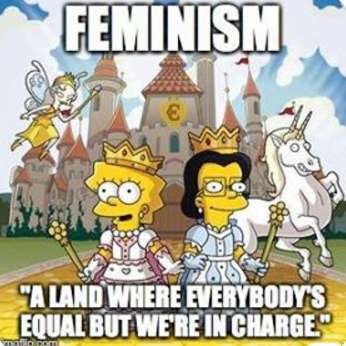 I did not make this problem. The Z-Man didn’t make it either. We did not make it so that “manly-behavior” and “womanly-behavior” have lost all meaning and can no longer be used to reliably communicate thoughts in writing. Feminism did that, and it did it by design. This is part of its own internal contradiction, the thing that makes it inherently dysfunctional even according to its own rules. Men, you see, are entirely disposable because women are strong, and capable of doing everything men can do…and yet, at the same time, any distinctions between the two are culturally driven, arbitrary, unnatural and therefore invalid. The two sexes are the same in every way, it’s just that one of them is so much better and should be running things.
 It’s been pinkified. It bears repeating, don’t go blaming it all on the chicks, the dudes are acting pink too and they’re getting pinker.

 One. Evidence establishing a limit. He certainly did look like a dope when He said
 This is all very black-and-white thinking. These days I hear a lot about how certain people, myself included, are doing a grave disservice to ourselves and to others by engaging in this simplistic, binary thinking, so I’ll consume the balance of my writing-space here to address that directly. It isn’t a lack of comprehension that dissuades me from reacting to these “shades of gray” I seem to be ignoring. It’s experience. I can’t play the shades-of-gray game. I know better.
 Passive voice vs. active voice is the ultimate either-or. A sentence that has a verb in it, can be one or the other of these, not both. An active-voice sentence has a subject; it identifies the thing that is doing the thing to the other thing. As lefty social-justice movements have become more sophisticated in recent years, they’ve taken to use “society” as a sort of null-placeholder, using sentences that are grammatically structured to be active-voice, to convey passive-voice ideas. Make it look like they have some actual goals in mind, when they really don’t. My favorite example of this is that “society imposes unrealistic beauty standards on women.” Well…yes. Society has lots of people living in it, and as such it imposes all sorts of beauty standards. In my lifetime, I’ve met exactly two straight, perpetually horny men who don’t like tits. One liked them flat-chested and pencil-thin, able to see her own toes without bending over he said…the other one was fixated on “the dumper.” Other guys have similar tastes, here & there, but the majority is somewhere else. I think. Point is, guys like what they like, no social-justice movement is ever going to change that. And a lot of “beauty standards imposed on women” don’t even come from guys. So when you say “society does this all wrong,” you’re talking about…whom? Do you even know?
 It’s a myth that the metric system is, as I hear so often, “vastly superior.” Do we even need to take the claim seriously? It hasn’t sent the other one packing yet. And no, you can’t blame stubborn troglodytes like me for being inflexible about it. Fact is, when people speak of landing the “Finish Him!!” killing blow against the imperial measurement system as if this was some episode out of Mortal Kombat, they don’t know what they’re saying. They fail to comprehend the sheer magnitude of destruction their fantasies would entail, should they ever meet up with reality. Trucks. Rail cars. Freight ships. The engines that make them all go. The bolts that hold the engines together. The buildings. The land. The townships. The sections. The U.S. is the only hold-out? Well…how much stuff we got. That’s a question someone needs to answer before we start throwing yardsticks in the wood chipper.
 No really, it has. All those more sophisticated countries that have “officially adopted the metric system”? What’s the bust-waist-hip measurement of a sexy girl in those countries, 36″ 24″ 36″? Nope. They haven’t bothered to compute it, have they? How about time-of-day? I know there are people who will not and perhaps cannot buy into the “easy to divide if not to multiply” argument, I’ve spoken with them about this at length. So how come they’re not measuring time-of-day in centidays, which would be 14 minutes 24 seconds each, or in millidays? One says, because it’s not a standard…when it’s a standard, I’ll do it. Okay. So we’re not talking about technology here, if anything we’re talking about the opposite of technology. That’s what “I’ll do it when everyone else is already doing it” is, the opposite of technology. But the real reason we don’t tell time that way is, it’s too hard. Dividing the day up into 24 and then 60 parts makes sense, because 24 and 60 are nice composite numbers.
 Somewhere along the line, all this has fallen out of favor. And it’s recent. Somehow, something got discarded, rather like a paddle thrown out of a canoe, and now our chosen form of discourse is a bunch of fluff-n-stuff that doesn’t have much to do with actual exchange of ideas. Seems like lately it’s all demonstrations, all “protests,” all of the time, with everything. Oh sure we have our Sunday morning talk shows, but have you actually taken the time to watch one of those lately?
 This is, therefore, all about social stature. You call out one party as having a problem, you’re supposed to add in “OnBothSides” to make it clear you’re not singling out a single party where the other party might be equally at fault. This is supposed to shore up your credibility as a neutral, sensible-centrist observer, or something…