Archive for the ‘Poisoning Individuality and Reason’ Category

While You’re At It, Why Don’t You Just Kill Yourselves?

Friday, March 21st, 2008

Now, you see? What was I just telling you? You can’t ignore the evidence; it’s long ago stopped knocking, and has now climbed in the window and is giving us wedgies. People form their opinions about the issues based on their disgust with life — they don’t like living it and they don’t want anyone else living it either.

LC Rob sends us this:

Michigan Congressman Wants 50-Cent Tax Hike on Every Gallon of Gas

A Michigan congressman wants to put a 50-cent tax on every gallon of gasoline to try to cut back on Americans’ consumption.

Polls show that a majority of Americans support policies that would reduce greenhouse gases. But when it comes to paying for it, it’s a different story.

Rep. John Dingell, D-Mich., wants to help cut consumption with a gas tax but some don’t agree with the idea, according to a new poll by the National Center for Public Policy Research.

Making Dingleberry one and the same as the Hildebeest, Barack Osama, Joe Lieberman and, of course, McVain (Shit Sandwich – AZ), the “conservative” candidate, none of whom have the slightest idea what they’re talking about, which is the reason why none of them have a real job.

The poll, scheduled to be released on Thursday, shows 48 percent don’t support paying even a penny more, 28 percent would pay up to 50 cents more, 10 percent would pay more than 50 cents and 8 percent would pay more than a dollar.

And they’re certainly more than welcome to, should they so desire. All they have to do is to keep a running tally of their gas consumption, multiply the number of gallons with their chosen voluntary extra tax and write the amount on a check for the National Treasury.

But before they start clamoring for everybody else having to do so as well, we would like to remind them that the added cost of transporting everything they buy in stores, from paper clips over milk to plasma TVs, will have to be covered by somebody or the producers thereof will go out of business. You’ll get exactly three guesses as to who will get the honor of paying that.

And let’s not even think about the idiocy inherent in Michiganders wanting to hike the gas tax. As far as we recall, that particular state is known for a particular industry that wouldn’t do too well with rising costs at the pump, an industry that isn’t doing too well as it is.

Which brings us back to the headline of this post.

Imbeciles.

This is a plague, and a dangerous one. Nearly half of us would pay more? Just…to be able to say they did? Not for the purpose of paying for something, just to throw away their hard-earned dough on some perverted notion of the “common good”?

These people get just as many votes as I do? I have to ask the question: Why don’t they give that up too?

You know, you aren’t guaranteed the right to vote in the U.S. Constitution. I propose a test. A pencil-and-paper multiple-choice test…or something on a web page written in PHP…or a customized machine kind of like a lie detector. Call it an “I Like Life” test. An “I Think Life Is Worth Living” test; an “I Think People Are Not A Pestilence” test.

You pass it, you can vote, you don’t you can’t.

We’ve gotta do something to stop this.

Anti-Danger, Anti-Achievement, Anti-Defense, Anti-Life

Thursday, March 20th, 2008

This morning I was rubbing my hands together in giddy glee over the finding that the Nintendo Wii is not environmentally friendly, or at least, is not perceived to be that (Nintendo’s crime against the environment seems to be mostly related to a failure to divulge information about being clean, which is different from a substantiation of evidence about being dirty). My comment was,

The anti-corporate pro-enviro hippies, are hopefully going to be locked in a huge fracas with the video-gamers and therefore with the kid-dumbing-down people. I hope. It’s always fun to watch the anti-achievement types feast on their own.

Hundreds of thousands of e-mails have poured in and called my attention to…

…alright, nobody’s uttered a peep about it. But it nevertheless occurs to me, even though this is The Blog That Nobody Reads, that I should expound.

Surely you’ve noticed, haven’t you. The people here stateside as well as across the pond in Europe, who are so quick to rap us across the knuckles for taking out Saddam Hussein — offer little or no alternatives for us to defend ourselves in any other way from the threat of worldwide terror. Oh yes, I know, many among them will say we were “distracted” from the “hunt for Osama bin Laden” when he was “in Afghanistan.” They imply in a bullying way, but usually do not come out and say word-for-word in any true sense of commitment, that had we focused on Afghanistan they’d be behind our defensive efforts a hundred percent.

These are the very same folks who are all gung-ho about going after the globular-wormening ManBearPig, insisting that the climate of the earth is changing, we homo sapiens are the cause, it’s a done deal, the “science is settled,” and hey even if this turns out not to be the case it’s just as well that we act as if it is.

You can see where I’m going with this now. They insist that the benefit of the doubt be awarded to the course-of-action that involves doing…on this issue over here…and the option that involves not doing on that issue over there.

People like me, on the other hand, are “inconsistent” in the opposite way; I think we should not do, here, and do, there.

Who is more properly inconsistent? Well, the most jarring empirical evidence, which is people-gettin’-killed, it seems to me is on my side. This thing over here hasn’t killed anyone. That issue over there has killed thousands…oh yeah, oh yeah, I know, no solid evidence connecting Saddam to the terrorist attacks, but that’s kind of my point. These people, in addition to being inconsistent, are nuts. The “no evidence” is just as good as “close my eyes and yell la-la-la-la I can’t hear you.” The people who say we should act even though we don’t know anything, about ManBearPig, are the same ones who say we should not act because we don’t know anything on a different threat that really has killed people.

Chicks with GunsSo my point is this: Since there are so many of these people, and they all agree with each other in near-lock-step about both Iraq and globular-wormening ManBearPig…two issues on which their mindsets conform to completely opposite philosophies about how we should behave on important issues when certainty is not forthcoming and doubt is rampant. In fact, we can toss in a third issue without upsetting this solidarity one bit, I notice: Guns and self-defense. People who are pro-global-warming-curtailing, are anti-Iraq, and pro-gun-control. The consistency from one pair of ears to the next, is just amazing. It’s north of 99 percent. So I say, let us look for consistencies in the arguments. Let us look for common threads that are sustained among these three issues, in the way all these people perceive them and grapple with them. Are there some?

I see one.

Before I get to that, though, let’s inject a fourth issue in a round-about way…and let us do this, by exploring one of my favorite web sites: TrafficCalming.org, where you can learn how to thwart, obstruct, derail and generally bollux-up the efforts of your neighboring human beings to…well…to move their asses from one place to the next. Which means, now, just about anything else anyone would be able to do once they get there.

This deepens, but does not broaden, our chore of looking for common threads. If you think it’s settled RIGHT NOW that we should do something about globular wormening, but we need to shut down the War on Terror, but we need to grab everybody’s guns and lock ’em up — you probably think traffic calming is a wonderful thing. If you roll your eyes at it like I do, you probably think ManBearPig is a big ol’ scam, you probably think Saddam Hussein was just as much a dangerous spoiler jackass in 2003 as he was in 1993 & it’s a good thing he’s gone, and you think the Second Amendment actually means what it says: Right of the people to keep and bear arms shall not be infringed.

So traffic calming, you see, fits right into the mold.

Traffic calming consists of operational measures such as enhanced police enforcement, speed displays, and a community speed watch program, as well as such physical measures as edgelines, chokers, chicanes, traffic circles, and (for the past four years) speed humps and raised crosswalks.

Edglines.

Chokers.

Chicanes, traffic circles, speed bumps and raised crosswalks.

What are these things? Well, they are devices that make traffic safe by making assumptions about you, the driver, which in turn cannot be borne out as legitimate or truthful unless they are analyzed in a purely statistical venue. If you go faster than X speed, you must be dangerous. If you can be bullied and cudgeled and coerced into going slower than X speed, you must be safe. If it’s three thirty in the morning and nobody’s around, why, that don’ matter none. You have to go slower than twenty-five miles per hour, and once we make you drive that slowly, surely some lives will be saved.

It sounds like it came from…from…could it be? Why, yes it is!

European traffic calming began as a grassroots movement in the late 1960s. Angry residents of the Dutch City of Delft fought cut-through traffic by turning their streets into woonerven, or “living yards.” This was followed by the development of European slow streets (designed for 30 kph or 20 mph) in the late 1970s; the application of traffic calming principles to intercity highways through small Danish and German towns in the 1980s; and the treatment of urban arterials in areawide schemes, principally in Germany and France, also in the 1980s. [emphasis mine]

Gotta hand it to those Europeans. The European ego isn’t one bit bruised by the fact that we yankees came up with the telephone…the car…the airplane…the innernets. They’ve got their claim to fame East of Greenwich. When you’re a busy guy trying to get things done, relying on all this American technology to beat the deadline so that that other guy can beat his deadline so that the people depending on him can meet their deadlines…here come the Europeans to mess everything up for you!

Thought you were getting to Point B by two-thirty this afternoon did you? Not after our roundabouts and raised crosswalks get done. Now feel the wrath of the residents of Delft!

The really interesting thing about traffic calming, is its effectiveness is measured in traffic retardation on a miles/kilometers-per-hour basis, and a percentage basis — not on the basis of lives saved. I have to look at that a little bit funny. I have no choice but to do so.

I live in Folsom. We have our own “traffic calming” in terms of poorly-designed controlled intersections. Traffic lights that turn red just as you get to them, should you fail to exceed the speed limit by less than twenty miles an hour, and all that. You think that “calms” traffic, everybody in their shiny BMW’s having to stop constantly when they shouldn’t have to? Hell no. It turns them all into raging jackasses.

Sorry, fellow Folsom residents. You know it’s true. You know it damn good and well.

So on the notion that this makes traffic safer…I have to call bull poo. Even if you can pump out hundreds of studies showing the rate of speed has slowed. That’s a point in my favor, isn’t it? All the jackasses are spending more time inside city limits, after having been offered increased motivation for going all jackass?

There is a lesson here about human psychology. It is what ties together all these “let’s go ahead and stop global warming even though there’s no solid evidence we have to” types…in with the “naughty naughty naughty shame on you for taking out Saddam Hussein” types. It is what makes these two camps come together, even though their respective doctrines are 180 degrees opposed from each other. It is what makes them all such loud, bossy sunzabiches.

It is this:

Poor Widdle BabumsWhen you’ve made the decision that the stuff you do in your life doesn’t matter and shouldn’t be given much priority, you rankle at the idea of the stuff anybody else does with their lives being given any more priority than your stuff. The traffic-calming measures, with all the phony egghead studies “proving” that things must be safer because the traffic moves slower — they are metaphorical, of something much deeper and much more meaningful. When you’re in this boat, you want everybody to stop whatever it is they’re doing. To slow way down…until they stop. And sit. There’s really nothing rational about it. It’s a primal urge.

You don’t want anybody to make it anywhere on time to be able to do anything. Because you know you aren’t doing anything.

You don’t want anybody’s kids to grow up with a feeling of self worth, since your own kids aren’t growing up that way.

You don’t want anybody to consume anything, because you can’t justify consuming anything yourself. You can pretend you’re disturbed about the prospect of the whatever-it-is being depleted…but the truth of the matter is, you just want all motion around you to stop. Because you yourself aren’t moving.

That’s why the people who want to take your guns away are the same ones waggling their fingers at you about “emitting carbon” and those are the same people who prattle on about an “illegal and unjust war” — we should presume action is warranted in the face of doubt on one issue, and not on another issue. And those are the same people who think traffic is automatically safer if the drivers are frustrated in the efforts to get where they want to go. And those people, in turn, are the same ones getting all peevish if you buy your nephew a toy gun for his birthday. And those are the same people insisting that if said nephew is acting a little bit weird, he should be doped up on drugs and put in a special program.

And that once you’ve eventually triumphed over the round-abouts and traffic circles and gotten where you wanted to go, and made some money from doing it…you should be taxed up the ass. It’s human potential. It offends them.

This is easily substantiated. Because once you open your mind to the evidence involved — it’s really a little bit silly to try to argue Saddam Hussein was harmless. So people aren’t angry about the fact that Hussein was taken down, because he was a harmless guy. They’re angry Hussein was taken down because taking him down was a worthwhile thing that some brave, but ordinary, people did. That really gets in the craw of some among us. And that’s the truth.

Now, if you’re one among those “googooders” as Mike Royko used to call them, here, via Boortz, are some places where you can raise your kid. Notice how eager these googooders are to share notes on this stuff. Again: When you aren’t doing anything with your life, you don’t want anybody else to do anything with theirs, and when you aren’t raising your kid to grow up to be someone with guts and courage and resourcefulness, you don’t want anybody else’s kid growing up that way either.

To give you a quick idea of how much location matters, consider this: Kids are six times more likely to die from a violence-related injury in Alaska than they are in Massachusetts. In California, public playgrounds must meet all federal government safety recommendations, but 34 states offer no standards for where your kids climb, jump and swing. Connecticut and 20 other states have made big improvements in school-bus crossings, while 13, including Nebraska and Arizona, are way behind.

Location, location
1. Connecticut
2. Rhode Island
3. New Jersey
4. New York
5. California
6. Maine
7. Pennsylvania
8. Mass.
9. Maryland
10. Oregon

Oh, joy! Enough rules to crumple into a big ball and choke a horse to death! Or at least you could…if it wasn’t a federal crime to choke horses to death on things. And my Golden State is number five!

Of course, as any knuckle-dragging red-state real-man daddy like me knows, there’s a lot more to raising a boy into a man than just making sure he reaches Age Eighteen healthy and alive and whole. Us guys know that…but unfortunately, some eighty-eight years ago we went and gave them womyns the right to vote, and wouldn’t you know it the uppity females done gone out and started doing it. Now we have taxes up the ass…and rules rules rules, you can’t drive anywhere over thirty miles an hour because of those damn roundabouts, and in a few years you won’t be able to buy a car that can go that fast because we’ll have used the “carbon emissions” excuse to yank real cars off the road.

But our pwecious babums is going to be all safe. Won’t know how to do a God damn thing, but they’ll be safe.

Now you know the common thread. The common thread is — that people are cattle, and really aren’t worth anything. They shouldn’t be taught anything, they shouldn’t be raised to deal with danger, they aren’t worth defending, they can’t achieve anything and if they can, they should never be given the opportunity to do it. Might as well seal the damn things up in a great big jar and poke some holes in the lid.

This explains why when you face off against someone who insists we never should have taken down Saddam Hussein, and you ask well what should we have done instead — you don’t get anything. Just a deer in the headlights look, maybe a few stammering statements about George Bush being a really bad guy and his grandfather was connected to Nazis. Nothing about what to do. These people don’t come from the Land Of Do. They’re all about being, not doing…being…uh…well, happy. There’s nothing more in their lives than just that. So they don’t want anything more in your life than just that.

Funny thing is, though, when it comes to the anti-defense plank — they do think some folks are worth defending. Just the bosses. The kingpins of society. And you probably thought they were egalitarians, didn’t you?

I beg to differ. They’re aristocrats through and through. Earls Lords and Dukes are worth defending…Vicounts, Barons and anyone lower than that, are not.

Mr. Heller, the good guy in DC v. Heller, delivered one of the best slapdowns we’ve ever read when asked about the “safe streets” of DC:

At that point, a reporter interjected: “The Mayor (DC Mayor Adrian M. Fenty) says the handgun ban and his initiatives have significantly lowered violent crime in the District. How do you answer that, Mr. Heller?”

The initial answer certainly wasn’t expected – Dick Heller laughed. Ruefully.

Pointing at the Mayor who was making his way across the plaza, surrounded by at least six DC police officers, Heller said, “The Mayor doesn’t know what he’s talking about. He doesn’t walk on the street like an average citizen. Look at him; he travels with an army of police officers as bodyguards—to keep him safe. But he says that I don’t have the right to be a force of one to protect myself. Does he look like he thinks the streets are safe?”

There was no follow-up question.

We bet there weren’t.

The anti-achievement anti-defense subjects have that in common too. The Wizened Elders who run our Bottle City are worthy of protection…we low-life scum, are not. They don’t think they’re worth it, and so they don’t think anybody else is worth it either.

Not unless you have six bodyguards or more guarding your pampered ass.

So you see, opposing the right to defend oneself and one’s family, opposing the privilege of driving to get somewhere in time, opposing the natural exigencies of life…ends up being, quicker than anyone imagines, opposing life.

These are the same blue-state numb-nuts who want good-lookin’ women to wear short hair and be fully clothed all the time. Like wearing a bunch of damned burqas. Hey, nuts to you. Here, choke on this:

Self-reliance. Achievement. Self-defense. Supporting what makes life possible, and makes life worth living. And, good-lookin’ girls with long hair in skimpy clothes. Stuff that real men like. That’s what America is all about. It is the American way.

This ultra-pasteurized version of lowercase-l “life”…this continent called “Europe” seems to be cultivating a rich culture in supporting that. Seems to be something like growing sea monkeys in bleach, but if that’s what toots the horn of my fellow lowercase-a “americans,” I suggest they move the hell there. Stop trying to turn this place into that place.

And take your stinking round-abouts with you.

Thing I Know #168. People with limited attention spans get peevish when they see other people doing a better job of paying attention; people who consistently champion peace over justice, get downright pernicious when they see someone else uphold justice.

Americans vs. Citizens

Tuesday, March 18th, 2008

Rick thinks commenter XtnYoda’s words are worthy of emphasis, and so do I. Looking long and hard at the Obama/Wright mess, he says…

I’ve been thinking about this today some more. Words mean something.

I think we use the word “American” in much to generic a manner. I think we need to deal with this in an honest manner. We need to do away with the hyphenated American moniker and form just two classes in this country. “Americans” and “US Citizens”.

“Americans” are those who are here to take responsibility for their lives. Red, Yellow, Black, or White. “Americans” are here to strive to better their lives and those around them. “Americans” live to not just better themselves, but they also live with a sense of gratitude for the price paid for their opportunity. “Americans” are proud to be “Americans”. “Americans” don’t live with their heads in the sand. They know that there have been mistakes made, yet they have a dogged determination to not repeat those mistakes and are willing to embrace all who have like aspirations. They know that by advancing and achieving they can give back, be a contributor.

“US Citizens” seem to have a tendency to castigate blame and seek ways to look to the faults of others to deflect their own shortcomings. “US Citizens” attempt to gain their strength by focusing on what they feel they are owed rather than what they can achieve.

Seems it would be much simpler to identify just two classes rather than five or ten or however many.

Conclusion:

All Americans are US Citizens, but not all US Citizens are yet Americans

There is a dangerous irony I see going on here, one in which it’s now likely for an American to lose his or her American-ness without even realizing this transformation is taking place. But there’s a bit higher level of difficulty involved in a non-American citizen gaining it.

For starters, there are — for a number of reasons — those who work to make this happen. At this point, I think that would be difficult to deny. All these phrases being tossed around breezily, without thought, mostly for the purpose of indicting America for this or that transgression and expunging national pride from any soul who may still have some.

And then there are all the subtly different notions of community. It seems to me when we fail to realize how many different ways you can regard yourself as being part of a community, we set ourselves up for this easy downward slide to take place. Some of the phrases that can be targeted by the anti-Americans are “here to strive to better their lives and those around them,” and “by advancing and achieving they can give back.”

It brings to mind what I thought of as a very awkwardly written passage in Atlas Shrugged, the one right before Hank Rearden signs over the “gift certificate” releasing his trademark rights to the metal he has invented. The statist bureaucrats supply the necessary motivation for this by blackmailing him, using the information they’ve collected about his extramarital affair. Rearden agrees to sign, not because he cares about his own reputation or that of his wife, but because he cares about his girlfriend Dagny Taggart.

Ayn Rand was cheating on her husband as she wrote this, so that’s probably why the passage comes off as so messy and incoherent. But there’s an interesting point to be made here about statism. Hank Rearden tells the bureaucrat something about “you must know the way you threaten to portray us is a lie, because you know if we were the kind of people you are ready to show us to be, your blackmail scheme would not be effective.” Or words to that effect. Hank Rearden and Dagny Taggart, being Ayn Rand heroes, care about the individual. But they also care about others. Rearden, threatened with an injury to his own reputation and nobody else’s, wouldn’t lift a finger to prevent damage to what others thought of him. He cares about Dagny. The bureaucrats who control the state would like to expose Rearden and Dagny as people who care nothing for others, only for themselves.

Sound familiar?

And so Americans are open to attack when we regard this sense of “helping others” as an all-or-nothing thing. It’s not.

Suppose you’re a U.S. citizen and, also, you’re an American. In addition to those, you’re a farmer with eighty acres. I move in next door, with another eighty acres, and show in a number of ways that I know very little about farming. You have a lot of options at your disposal.

You could let me learn from my mistakes, that I should be working sixteen hours a day plowing my fields just like you, rather than the six-and-a-half I put in before sitting on my back porch watching you work with a Martini in hand. You could just let events unfold. That might be fatal.

So we have a predicament here. But I think most people, before they’ve been poisoned by outsiders, approach this in a very common sense way: You should mind your own business, for the most part. Maybe come over and ask if something’s wrong with my equipment, do I need any spare parts. But when my harvest falls short in the fall, let me shiver and starve my way through the winter. At the same time, though, when things are really bad and I come knockin’, you’ll offer help like any American would.

Maybe I’ll have to get an earful. I think that would be most appropriate. But the first priority would be to make sure people get the assistance they need, when they need it — confident in the expectation that the lesson has been taught, and next year you’ll see new farming habits and longer plowing sessions on my spread.

That’s a very basic sense of community. You were the ant, I was the grasshopper, and we shared a sense of community strong enough for me to learn my lesson.

But here’s the funny thing about human nature. A mile away from us, there is another couple of neighbors in exactly the same situation. And they resolve it with a stronger sense of community: The ant ended up plowing the grasshopper’s fields for him.

At the annual county fair, the four of us get together and comment on this. You and I are a community. The other pair of neighbors is a commune. They have, in a very subtle way, lost their American-ness. They are the U.S. citizens of whom XtnYoda speaks, because they no longer enshrine American values.

And here’s how it will work every single time: They will say we should have resolved our conflict the way they resolved theirs. And they’ll probably convince us. They will be more inclined to use bullying maneuvers than we will. Why would they not? When you have a stronger sense of community, you just feel like a better person.

And you want everyone, within line-of-sight or not, to do things the way you do them. That’s what a strong sense of community is all about!

But you and I might say…with our way, Morgan eventually learned to be a better farmer. With your way, he would not have learned this. It’s a good point. It will be shouted down, sneered-at, shunted aside very casually.

Every single time.

And most of the time that scenario plays out, the COMMUNE-ists will win. It’s a human flaw. Unless we pay very close attention to what is happening here, we will discard a productive and beneficial sense of community, one that embraces the value of individual responsibility, in favor of a “stronger” but decidedly inferior and harmful sense of community that derides and derogates the value of individual responsibility.

And you know what will really shove that over the top? When we all get tractors, combines, harvesters. When the farmer’s day starts to shrink from sixteen hours, to twelve, to ten. That has a deleterious effect on this more modest, but more beneficial, sense of “community.” What it does, is make you socially into a bigger butthole should you choose not to plow your lazy neighbor’s field for him — because now you can.

Individual responsibility suffers. Individuality itself suffers. And ultimately, American nationalism suffers.

And I think that’s what has been happening here. We’re about a century past the later stages of the industrial revolution, give or take. Our sense — our SENSES — of community have become welded together so we are presented with a false dilemma, all moderate compromises artificially removed. We can become collectivist communists or individualist buttholes. To plagiarize the timeless metaphor about teaching a man to fish, this middle-of-road option has now been removed. We can let him starve, or give him all our fish.

And so the Americans of whom XtnYoda speaks, are constantly under attack, with their willingness to help others used against them. Citizens bully Americans into becoming just citizens and giving up their American-ness. Americans do not do very much, nor are they able to anymore, to encourage citizens to become Americans.

There is an accelerating quality to this sad metamorphosis. As this sense of community becomes more militant, people begin to get the idea that they are “giving back” simply by becoming an additional voice in micro-revolutions that are already several voices strong. A great example of this is one of the favorite recurring platitudes from the utterly anti-individualist social-butterfly Obama fan: “I want to be part of this.” And so across the landscape there arises a feeling that each individual has contributed, by “helping” to make something happen that would have happened anyway. This poisons the idea that an individual can make a difference, while offering a toxic disguise that what is taking place is precisely the opposite — we start to make what are thought of as “differences” by adding our support to things that would’ve hummed along just fine without us.

And so we stop being Americans, by bringing a stop to any belief in ourselves.

Which ultimately means we want everyone else to stop believing in themselves, as well.

Conclusion? The strongest sense of “community” is a relatively moderate affair, a hybrid of collective and individual values, drawing hungrily from the latter and only slightly from the former. Over time we have allowed the darker side of human nature to ensure there are more citizens than Americans, and more Americans becoming merely citizens every day. Because individuals will allow other individuals decide to be individualists or collectivists — but collectivists always have to make all other individuals into collectivists.

Text-Safe Street

Friday, March 7th, 2008

“Life’s tough; it’s tougher if you’re stupid.” — John Wayne

Rachel found it on Wednesday. Yesterday Gerard pinned down a “higgelty-piggelty” YouTube clip that explains the plain in nauseating detail.

You know, I can’t say “text-safe street” lots-of-times really fast. So where’s my protection?

Update: You know, I’m doing some more thinking about this and I have to consider maybe this is actually a wonderful idea, just implemented a little bit backwards. Nobody’s really concerned about protecting the lampposts, nor should they be; the object of our concern is the texting person.

So why waste this money protecting the lamppost? The texter, won’t someone think of the texter!

So let’s do this right. Strip those lampposts, and with the money saved, get some helmets. Knee and elbow pads. Shinguards. Nut-cups. Shoulder pads. Chest pads. Goggles. Boots.

Lastly, you wrap up the whole thing in a foam pad mess until the text messager is just like that little kid in A Christmas Story who can’t put his arms down anymore. Then send them out to text away to their li’l hearts’ content.

Because you know it and I know it: Nothing looks cooler than someone texting while strolling around.

Yes, Let’s Become More Like Europe

Tuesday, February 26th, 2008

There seems to be no down-side to it.

Who is allowed to break in to your house?
:
It may sound suprising, but according to a 2007 report by Harry Snook, a barrister for the Centre for Policy Studies, there are 266 powers allowing officials to enter your home, and not all require a warrant. Those who can break in include firefighters, in an emergency, and police arresting a suspect. The Environment Agency can gain access without a warrant where there is danger of pollution or damage to public health.

Electricity and gas companies can come in to inspect equipment or change a meter but have to give at least two days’ notice (though they can enter in an emergency).

Landlords are allowed to enter their property and seize goods in lieu of unpaid rent, and local authorities can enter your home for a number of reasons, including to turn off a continuous burglar alarm or pest extermination.
:
Then there are the more unusual Acts. Under the Bees Act, officers can enter to search for foreign bees. Under the Hypnotism Act, the police can enter a property where they suspect offences related to stage hypnotism are taking place. Stage hypnotism, strangely, is not an offence in itself.

The Pretty Piehole

Friday, February 22nd, 2008

Rachel Lucas takes the Obamamaniacs to task. It’s a wonderful bit of rightful snarking, the only hitch in the giddy-up being that she’s saved some words for yours truly as well.

You rightly feel no pointless need to burden yourselves with any responsibility for anything – that’s why you vote Democrat – and hell if this guy doesn’t fit the bill perfectly! You’ll put him in office because life’s too short to waste time learning about important issues and understanding the world at large. Oh, it’s so cute, I just want to pinch your faces! Really, really hard.

Hope!

Change!

Oops, sorry – go ahead and go change your panties, I’ll wait. I know how those words make all the blood run from your brain to your nether-regions. It’s perfectly understandable that you’d have a physical reaction at the thought of having your soul fixed by a politician.

But you don’t get all the credit, Democrats. Easy there! – don’t bogart all the glory. You may be the ones giving the Idea-Less Wonder the nomination but you’re gonna have to share some praise with a big chunk of the Republican base once he wins the White House.

See, a lot of Republicans, they HATE the guy who might defeat your Sexy Prophet of the Second Coming. This guy is known as the Great Satanic Eye-Poking Back-Stabber, and enough people will refuse to vote for him – on principle – that it pretty much ensures our souls will be safe and that we can finally be proud of our country again. Those people deserve our gratitude, too.

Well no, speaking on behalf of my fellow rats-off-the-ship, I don’t hate John McCain. I just damn sure don’t trust him.

I’ve written about this already plenty of times. Conservatism can have a shot at staying in, if & only if it re-defines itself through The Maverick. Which means all the classical points of it are done — for now. The personal responsibility, the deliberating about cause & effect before this-or-that social program is put into place. The notion that the individual is a glorious, wonderful creation of nature, capable of good judgments about his own life, entitled to freedom and the ability to defend his family.

People want, as the Obamamaniacs tell us, “change.” I say, go for it. Fight terrorism with a universal healthcare plan. Go ahead and make it prohibitively and artificially expensive to hire new people to a business or, God forbid, start a new business. Give ALL the money and power to our trial lawyers. Take all our guns away and punish violent crime with a finger-waggling and wrist-slapping or two, if you punish it at all. Pay criminals money to not misbehave. Negotiate with tyrants around the world — no exceptions. Let me know how that works out.

Yes, I know I’ll probably be around to see the wreckage in the wake of liberal policies — again.

Yes, I know that since the consequences this time might involve real bombs smuggled in by real terrorists, maybe this isn’t an appropriate time for the “go ahead and run away from home, sonny” approach.

I’m receptive to all these arguments. I agree with them. What I don’t agree with, is that McCain can spare us from any of this grief.

If he says he will, his policies will prove to contradict that.

If he names specific policies that will not, all Ted Kennedy has to do is say “stop” and McCain will do what Kennedy says.

Exceptions to that in history? I know of none.

My vision, you see, is exceptionally dark. I’ve come to think of liberalism is something that people just have to learn about every sixteen to twenty years. When a new generation runs for office, and (probably more to the point) a new generation starts voting, the first thing we have to try is a bunch of dumb ideas everybody already knows aren’t gonna work mixed up with a great big huge gob of emotionalism. I don’t think it’s a wonderful idea to embrace this tragic aspect of human nature; I’m simply unsold on the point in trying to avoid it.

But enough about my snivelling excuses. This one passage from Rachel is solid-gold:

My only regret is that we have to wait so long to install our new messianic overlord; I’m not sure my soul can wait that long for its fixin’. I’m broken here, people, broken!

And what if there’s another big terrorist attack before January 20, 2009? Our current Chimp-in-Chief might do something stupid like retaliate before sitting down with the world around a rainbow campfire and playing folk songs until harmonic convergence is achieved and they give him permission to kill the jihadist fuckers who did it. Can we risk that, America? Shouldn’t we accept the Rapture that is Obama and swear him in now? That way, there’ll only be potential action after possibly determining who might have potentially killed a few thousand people. Maybe. If France says it’s okay. We’ve alienated them quite enough.

Liberals will predictably say that Rachel has represented their position innacurately.

They will predictably be unable to say how.

This is exactly the same mistake we made with Carter and Clinton, and came very close to making with President Kerry. It’s a truism that applies to all aspects of life, outside of foreign policy. If something’s a great idea, there is no need to say “it’s a great idea because such-and-such an outside party likes it” — nor is there any need to say something’s a bad idea because so-and-so doesn’t like it. Good ideas can stand on their own, and so can bad ideas.

If you want to think rationally, you need to think about consequences. We all know this to be true. That’s why this dumb talking point prospers so well when we talk about foreign policy — in that arena, and in none other, the “what’ll happen if we do such-and-such” overlaps sloppily with “who’s gonna be mad if we do such-and-such.”

John Kerry very seldom said he’d actually fix anything, especially with regard to terrorism. I recall his preferred talking point to be that he’d bring credibility to the White House, and make people happy with the things he’d do…or more precisely, make them happy just that he’s him. These were “allies” — outsiders, people who don’t live here, people who can’t vote here and for good reason. Foreigners. And never, ever, once did I hear “allies” qualified as anyone besides France and Germany. The election in 2004 boiled down to this: Who elects Presidents in America, Americans or frenchmen? Answer: Americans. But that was then, this is now.

It’s the year of pretty pieholes. It’s the era of pretty pieholes. Pretty pieholes and bad ideas…bad ideas we seek to justify, not by arguing their merits, but by pointing out some external party would be pleased with them. The era of no-responsibility, bastard child of too-much-comfort and poor-memory. God willing, it will end slowly as we get tired of it, and not suddenly with a crash and an explosion and thousands of deaths and millions of tears.

Like Sheep

Saturday, February 16th, 2008

We all, like sheep, have gone astray,
each of us has turned to his own way;
and the LORD has laid on him
the iniquity of us all. — Isaiah 53:6

After just a few centuries, science is finally catching up. Most impressive.

Have you ever arrived somewhere and wondered how you got there? Scientists at the University of Leeds believe they may have found the answer, with research that shows that humans flock like sheep and birds, subconsciously following a minority of individuals.

Results from a study at the University of Leeds show that it takes a minority of just five per cent to influence a crowd’s direction – and that the other 95 per cent follow without realising it.

The findings could have major implications for directing the flow of large crowds, in particular in disaster scenarios, where verbal communication may be difficult. “There are many situations where this information could be used to good effect,” says Professor Jens Krause of the University’s Faculty of Biological Sciences. “At one extreme, it could be used to inform emergency planning strategies and at the other, it could be useful in organising pedestrian flow in busy areas.”

Dr. Krause is in some great company here. Of course, in his case, he either got a grant for this work or he is in a position to possibly get one later…probably both of those. So he could be just speaking as a pragmatist. But millions of people in his country and in mine see no down-side to this at all.

I’m one of the weird old guys who are hard-pressed to realize any advantage in it.

If Creation stands firm as fact and evolution is a myth, this is surely the work of Satan. If evolution is to triumph over Creation, then this is a relic of a bygone era when our needs were different, and will bring us nothing but pain and misery now.

Oh yes — I do understand, in urban areas where people congregate within a few square miles by the millions of noses, to exploit this attribute would make us all much easier to manage. Hey good luck with that. We all wanted to grow up to be that when we were little kids, right? Sounds like something you’d see in one of those Monster.com commercials: “When I grow up, I want to stay mediocre by always doing things the easy way.” Except this is an aspiration to be the machinery managed by those everlastingly-ordinary, easy-out managers.

Professor Krause, with PhD student John Dyer, conducted a series of experiments where groups of people were asked to walk randomly around a large hall. Within the group, a select few received more detailed information about where to walk. Participants were not allowed to communicate with one another but had to stay within arms length of another person.

The findings show that in all cases, the ‘informed individuals’ were followed by others in the crowd, forming a self-organising, snake-like structure. “We’ve all been in situations where we get swept along by the crowd,” says Professor Krause. “But what’s interesting about this research is that our participants ended up making a consensus decision despite the fact that they weren’t allowed to talk or gesture to one another. In most cases the participants didn’t realise they were being led by others.”

Other experiments in the study used groups of different sizes, with different ratios of ‘informed individuals’. The research findings show that as the number of people in a crowd increases, the number of informed individuals decreases. In large crowds of 200 or more, five per cent of the group is enough to influence the direction in which it travels. The research also looked at different scenarios for the location of the ‘informed individuals’ to determine whether where they were located had a bearing on the time it took for the crowd to follow.

It does impress me as some interesting research. Research into what is decidedly a human weakness, from my point of view, since you can’t rely on your internal aptitudes and follow the crowd at the same time — those are mutually exclusive. And if you don’t rely on your internal aptitudes, you’re derelict in taking ownership of whatever quandary is confronting you at the time. You can’t be a sheep and a shepherd.

Some things I’d like to know:

1. How was it established that in “large crowds of 200 or more, five per cent of the group is enough to influence the direction”? Does that mean what I think it means? It reads like in a group of 50 or 100, you need more than five percent, but the researchers found the critical-ratio dwindled as the critical-mass was reached. Which would necessarily mean their research involved an exhaustive exploration of both success and failure. And if that is the case, sometimes the “don’t know where they’re going people” won out over the “know where they’re going” people, and what we’re reading is the result of the diligent scrutinizing in an effort to find patterns in numbers and proportion. If that’s all true, this is fascinating, and almost certainly the product of an evolutionary trait.

2. Did they do the research after issuing mirrored or dark sunglasses to the participants? Probably not. But if eyeballs are visible, you can’t truly say “they weren’t allowed to talk or gesture to one another.” Actually, this would short-circuit nearly all the speculation in my Point #1. It would mean what the researchers really learned, all boils down to this: When you don’t know where you’re going, once it gets really crowded you follow people who look like they know where they’re going, perhaps without realizing it.

3. Any plans to repeat this experiment after introducing geographic diversity? That would be a cornucopia of scientific learnin’s, it seems to me. Geology. Sociology. Psychology. Anthropology. My girlfriend, for example, will tell me about some silly bollywonkers law out in New York State, and I’ll be shocked by it…one phrase I like to use on her is “Vehicle inspections…turnpikes…is your side of the country the one where they threw that tea into the harbor? Because I think you guys need to do it again.” It exasperates her because she knows there is truth in it — there is territory of individuality, of collectivism, and there is movement in both of those. This animosity toward individual characterization and achievement, does have geographic movement to it…kind of like an ocean current…or the snaky tendrils of some loathsome, evil leviathan being. Science would be doing a lot of good for us, and for itself, by gathering research with that in mind. By looking at collectivism as the form of pollution that it is, and researching how we have coexisted with it in times past, how it threatens us now, and the irrational impulse many millions of us have to cling to it, essentially avoiding full maturity.

The Fifth Most Important Issue

Friday, February 15th, 2008

As I noted toward the end of last year, before the field really started getting narrowed down, the four most important issues of the election are these:

One, and this still takes the cake over everything: Who is going to kill the most terrorists?

Two: Are the democrats afflicted with short memories or are they full-blown crazy?

Three: Is it even possible that twelve million illegal aliens all coming over here to do one thing? And even if you accept that, how is it that the extremely affluent Americans who are in a position to run for high political office, are in a position to say what that one thing is?

Four: Is it absolutely impossible for public servants to represent constituents who aren’t of the same race, gender, sexual preference and creed? And if it is, how on earth did we get to this point? And how many more gazillions of public service positions should we make in our federal, state, county and municipal governments to accommodate this, so that everybody can get what we all seem to be demanding now — officials that resemble us in every conceivable way?

And the fifth most important issue is inspired by yesterday’s item in James Taranto’s Best of the Web, which concerns a nationwide epidemic of women fainting at Barack Obama’s speeches, presentations and rallies. It is much more common than you might think. That, and the purely right-brain comments resonating throughout this article, one of many that are popping out lately about Obamamania…

“He’s very charismatic. It was a ‘you-had-to-be-there’ kind of experience,” said Lolita Breckenridge, 37, after hearing Democratic White House hopeful Barack Obama address a packed rally at the University of Maryland on Monday.

A dedicated supporter, she brought two of her friends to hear the Illinois senator deliver one of his much-talked-about speeches.

“Not too much of the speech was new to me,” she admitted. “But hearing him live…” she trailed off, shaking her head and grinning.”

When Obama addressed the crowd of 16,000 on the eve of primaries which he is tipped to win in Maryland, Virginia and Washington, DC, he carried himself with his habitual worldly confidence, interspersed talk of foreign policy with recollections of his childhood and even poked political fun at his Republican adversaries.

He did not flinch when women screamed as he was in mid-sentence, and even broke off once to answer a female’s cry of “I love you Obama!” with a reassuring: “I love you back.”

No doubt about it, the man has charisma, and it’s far from a purely-female appeal. People who don’t even agree with his positions on the issues, feel an almost supernatural urge to vote for him…to go wherever he is…to be near him…to be like him. And as for the people who do agree with him on the issues, most of them can’t even qualify it. They just love the feeling they get when he’s speaking.

Hmmm…as Darth Vader said, I sense something…something I’ve not felt since…

It’s that word charisma. People are so eager to admit that they’re influenced by it. Nobody wants to have a discussion about whether that is a good thing or not. Maybe that’s a good debate to have right about now.

People love to show off the new family car when they’ve made a little bit larger-than-normal sacrifice in acquiring it. Trust me on this, I’m in a position to know. But nobody ever, ever, ever says “Oh and that salesman who sold us this car had such charisma. He could’ve gotten us to sign anything!” You wouldn’t say that about the guy who got you to buy a car, because it would make you look like a schmuck.

Why do people say this about the guy who’s about to get their vote, to occupy the most powerful office in the civilized world?

Fifth most important issue: With what kinds of responsibilities should people be entrusted, simply because they’re charismatic? This seems to be one of many questions in life where the heart gives one answer, and the head gives a directly opposite answer. So many among us seem to think charisma is the “skeleton key” that unlocks any doorway imaginable, that there’s no limit to how much authority, power and confidence that can be invested in someone just because they’re sociable, their personality is polished, and they got that gift-o-gab thing going on.

But of course if you were to string the actual words together, “a smooth-talking man is a trustworthy man,” you’d look like a fool. And rightly so.

Which is not to say that everybody who jibber-jabbers so eloquently is automatically a liar. But that isn’t necessarily a trustworthy person, either. And let’s not forget — that isn’t even necessarily a competent person. Perhaps the relationship among all these attributes is purely non-correlative. Or not…? Maybe being a compulsive liar would generate a need to have a slick personality?

It seems that might very well be a good question to ponder right about now. Do we want charismatic people running anything?

Suppose that was a hard-and-fast rule — everyone in power must have oodles and oodles of charisma. How good would we expect things to get, really? How much money would we be willing to bet that life would get wonderful? Or let’s go the other way. Suppose the hard-and-fast rule was charisma automatically disqualified you from having authority over people who didn’t have it. Every single boss has to be like Bueller’s math teacher…or at least…toward that extreme. Let the Guy Smileys take up the positions in the lower trenches while the decisions are made by grown-ups, who aren’t necessarily all that much fun to watch.

Would things really suck that bad? Really? How so? Is anybody with a reputation worth defending, willing to step up and say decisions are made and made well, only when there’s some entertainment value in watching them being made?

In fact, the best way to summarize the fifth most important issue, it seems to me, is this: Is being led by those among us who are the most personally captivating, even a good idea? So many seem to be ready to answer in the affirmative. But if you were to write a thesis explaining this, what could you toss in after the preamble to support it — if anything at all?

In 2008, all this could be way too much work for some of us. Maybe the way we’re doing it, is right after all. Maybe a presidential election shouldn’t be anything more than a marathon rock concert.

H/T to Allah for the movie clip, via Dick Stanley.

Towards Obama

Wednesday, February 13th, 2008

If you told me six months ago I’d find something awful about a nationwide rejection of Hillary Clinton, I’d have told you you were nuts.

But throughout my grousing about this wonderful awful invention for which nobody wants to claim any credit, the twenty-one month long campaign season, one thing that’s been left unmentioned is this:

Our finalists for the nation’s highest political office, and virtual leader of the free world, John McCain and Barack Obama, are the finalists because…

…they’re the ones our journalists love the most.

Let’s just be honest about who narrowed the field for the rest of us before we were allowed to participate in the process. The folks who give us our news. Our bad news. Who make commissions off bad news. Who starve if there isn’t enough of it.

This is a twenty-first century innovation. One of the few. And it isn’t a good one by any means.

Liberal Strategy

Wednesday, February 13th, 2008

Just as I got done exploring liberal morality

…from Gerard‘s sidebar (specifically, the “NailsIt File”), I learn about an amazing triple-play of essays on liberal strategy.

Part I
Part II
Part III

The money quote (so far) is from the second installment, which has a nice dovetailing with my own screed from a few minutes ago about excessive comfort

For example, poverty in America has been redefined as the lack of a flat screen TV or cable television. When our poorest children often are wearing $150 sneakers, poverty in America has lost some of its meaning. The latest sign of poverty is lack of wide band Internet, a problem for which some liberals have suggested government intervention, paid for by those who are not so impoverished.

Furthermore, in the most dangerous excess of modern liberalism, in a sleight of hand verbal ju jitsu tour de force, the modern liberal has redefined human rights to include complete security and comfort; modern rights include the right to the kinds of comfort which is all they have ever been accustomed to.

Since comfort has now become established as a human right, the right not to be discomfited has become entrenched in modern liberal thinking.

Thing I Know #87. In the past few years I notice the people with the largest television sets are the ones we are supposed to call “poor”.

On Liberal Morality

Tuesday, February 12th, 2008

I had cited in the seven lies I was told, as a boy in public school, presumably being told the same things that many other kids were told, the canard that “Republicans and Democrats want to get the same things done but have different ideas of how to go about doing it.” Post-high-school-graduation, I have seen very little evidence of this. Higher standard of living, maybe? Republicans and democrats both want that? I dunno about even that one. There are a lot of Republicans, it seems to me, who take the “money is the root of all evil” thing a little too seriously (chopping off the “love of” at the beginning of that cliche). And the democrats who want to raise standards of living, I’ve notice, always seem to want to target certain favored classes of people. With other classes not quite so smiled-upon, an increased standard of living is, in their minds, an evil thing.

One of the wonderful things about America, in my mind, is that our ideological split is rather singular in nature — us on the one side, them on the other. This gives rise to some unhealthy things, such as people in both camps who are tempted to cross the fourth milestone to insanity, essentially insisting “nobody from my tribe can have a bad idea, and nobody from the other tribe can ever have a good one.” That isn’t good at all. But consider the alternative to a single ideological split: Many of the same. Ugh. You think it’s hard, now, for an election campaign to be run on issues rather than personalities. I’ll take one single big fat chalk line down the middle of the house, thank you very much.

But here’s another wonderful thing about America’s split between conservatives and liberals: It goes right down to the definition of morality. This means you can find decent people on both side of the line — we aren’t quibbling about whether to be moral, we’re disagreeing about how to test it. In that sense, the old falsehood has a kernel of truth to it (as do all potent and convincing falsehoods). We all — or most, anyway — want to be good people. How do we define it?

I’m amused that this piece that leans right contains essentially the same phraseology as this other piece that leans left…”Liberal morality is a very alien thing…” versus “…social conservatives frequently take stances that liberals find baffling, if not downright evil.”

Now here is a differential across the divide: Once we do have morality defined in a way that makes us comfortable, what do we think of people who fail to adhere to our standards?

I think Larry Elder summed it up very capably when he said,

Conservatives consider liberals well-intentioned, but misguided. Liberals consider conservatives not only wrong, but really, really bad people.

The column in question concerns Elders’ encounter in a barbershop with a fellow patron who was shocked to learn Elder had voted to re-elect George W. Bush. It is titled “Open-Minded Liberals”…with a question mark at the end.

The older I get, the more befuddled I am that this “open-minded” nonsense ever got started. It is one of the few mysteries in life that my unhealthy childhood television diet back in the seventies, might provide some assistance in unlocking. I recall it was very fashionable for television networks to release pastiches of “All in the Family” in one boring episode or another, setting up a central character to be good-hearted “meathead” and another marginal character, often a one-time-only character, to be “Archie” except not so lovable. It became ritualistic for the central character to deliver some caustic, dismissive line in one of the last scenes while the canned studio audience sound effects would cheer wildly, condemning the marginal character’s racism or, occasionally, sexism. The marginal character would give this look downward at his toes like “aw gee, I suck so much” and he’d never be seen again.

It was boring and unimaginative immediately. It didn’t get to be tragically funny until years later. Half-hour sitcoms telling us what values to have? Nowadays we have cable television shows like “Desperate Housewives” or “Six Feet Under” or “Dead Like Me” telling us how to look at life…which is another problem…but overall, a vast improvement.

I digress. The point, here, is that stale comedy shows from the era of double-digit inflation and gas rationing, represent the last time I have ever seen liberal ideas given even the semblance of “open-mindedness.” How our left-wing friends got all twisted around from tolerance, to anything-but, is a delicious chronicling of irony. It’s as if they set themselves up for it from Day One. Like their bumper sticker slogan might as well have been…”we all need to be respectful of people who aren’t like us…and we have no room anywhere for anybody who disagrees.” Or how did Austin Powers’ father put it? Something like “There’s two things I can’t stand, people who are intolerant of other cultures…and the Dutch.”

Discarding all the occasions where intolerance would necessitate some form of action, I haven’t seen the people we call “liberals” tolerate anything outside their perimeter of favored cultural sexual-preference and skin-color baubles since…well…ever. Their morality seems to have something to do with intolerance, if anything. And the intolerance is a complicated thing. It has at least two tiers. They’re intolerant of terrorists…they’re intolerant of conservatives…you don’t exactly have to be a seasoned scholar of modern popular culture to realize these are two entirely different things. There is a commitment to making sure the conservatives don’t get their way. To make sure of it. And if the conservatives do indeed get away with some shenanigans, why, vengeance will surely belong to the liberals someday.

Myself and others have thought, very often, how things would look now if liberals were as committed to thwarting terrorism as they were to thwarting conservatism.

And how long do you have to wait for a liberal to, even in the midst of denying what’s above, justify it nevertheless? Something about your odds of being killed in a terrorist attack being thirty gazillion to one? When we waterboard we’re worse than they are? Aren’t those favored liberal talking points now?

Anyway, all that is just a prelude to what follows below. I was having a discussion over at Phil’s place which led to an interesting off-line. The subject isn’t quite so much liberalism, it’s more like very mild forms of egalitarianism…the minimalist sort that formed, among other things, the American experiment itself. Phil was referring to the last 200 years or so in terms of how tyrants come to power, and I’ve always been rather interested with what came before the 200-year period. What started all this, I wonder? The storming of the Bastille? The subject immediately under discussion is what Rush Limbaugh sometimes calls “Gettin Even Withem Ism” (it’s a phonetic expression and I have no idea how one correctly spells it), which by itself is a curiosity. Listen to liberals for awhile, especially Ted Kennedy and Hillary Clinton, and you’ll see it’s almost compulsory to call out some bad guy who’s due to be taken down a peg or two. One gets the impression that their brand of liberalism cannot survive long without this essential element, not even for a breath or two.

That has always struck me as odd and strange. If we’re trying to achieve an open, tolerant, transparent and diverse society, why we could just babble away about that noble vision for months at a time without calling out any villains, right?

Today’s liberals can connect bad guys to anything you want to discuss. Health crises, like AIDS. Weather phenomena like Hurricane Katrina. I mean…you just name it. Maybe this is why Barack Obama is kicking Hillary’s ass lately; maybe the liberals themselves are just sick of it. That’d be a good thing. It would imply that like the rest of us, they have a hunger for solutions and are ready to subordinate the distribution of blame to a decidedly inferior priority. That they’re finally starting to grow up a little bit. To think about becoming what, in my lifetime, they have always bragged about being: “progressive.”

But on the subject of morality, I thought this DailyKOS writer did a pretty good job of drawing up the difference:

Liberal Christian morality differs from conservative Christian morality in that liberal Christians don’t look at the Bible and see rules but instead see guidance for how to think about morality and justice. Right and wrong is not determined by God, but God’s morality is based on fundamental truths of right and wrong. Conservative Christians criticize this thinking as non-Biblical, because it excludes sections of the Bible that are clearly rules-based. Liberal Christians have a number of responses, including the idea that God is constantly trying to get us to change and move beyond what we once were.

If I understand this right, the liberal view of morality is not superior or inferior, but rather dynamic instead of static. It defines continual self-improvement as one of the most important pillars, perhaps the all-important pillar. We are a continuously self-improving thing, designed to discern for ourselves what is right and what is wrong.

Maybe that’s why liberals don’t like us to talk about terrorism. It highlights self-contradictory things about this that would normally be kept in the dark, and it lights up those contradictions rather brilliantly. If we are in a process of evolution, becoming a progressively more moral species, relegating to the realm of wrongness things that were previously thought right, we can cheerfully avoid ethical conundrums right up until the point where we encounter some “missing links” such as the terrorists who murdered thousands of people on September 11, 2001. If we’re being socially tolerant, then we need to respect other cultures, and that includes the decision to live in the seventh century. If some other culture wants to live as million-year-old chimpanzees on the spectrum of moral evolution, and the rest of us our in a process of relegating previously-right things to the realm of wrongness, that would mean these primitives are living in a time when the acts we consider wrong, are in fact right. And if that includes murdering thousands of office workers and bystanders to make a point about our foreign policies, then the potential exists that the September 11 attacks fall into the zone of “aw, that’s quite alright” — at least in the perspective of those who committed them. And we are honor-bound to respect that.

If you want to avoid that conclusion, then you have to at least allow for the idea that some issues of right and wrong are absolute. And if you want to allow for that, then you have to embrace at least some of…oh, dear…that awful, dreaded conservatism.

Well, it’s widely accepted that moderation is a good thing. So maybe that’s how the liberals justify it. But when you listen to liberals and their opinions of conservatives for very long, it doesn’t seem like this can be the case. They seem to think of conservatism the way Yoda spoke of the Dark Side of the Force…you know…once you start down the dark path, forever will it dominate your destiny.

They are the doctor’s hands, scrubbed and ready for surgery. We’re the filth, slime and muck. They are not to come into contact with us. It’s exactly what Larry Elder saw in that barbershop.

I was looking around for something that would more reasonably explain all this, and I stumbled across this piece that invoked images of the Bastille all over again, and made a brilliant point besides.

The Nature of Liberal Morality
By John “Birdman” Bryant

In contrast to conservative morality, liberalism is based on the premise that Reason, rather than Tradition, should be the criterion of good. Ironically, however, the first historical instance in which Reason was made the basis of morality — the French Revolution — not only witnessed some of the most immoral acts ever performed by man, but saw Reason literally transformed into the god of a religion thru the efforts of Hebert and others, so that Reason simply became a different form of Tradition.

I know if I tried to be a liberal, I’d make a very bad one. This notion of moral definition that is dynamic across time, has always troubled me greatly, and I suspect it troubles everybody else too — even liberals.

I do something marginally terrible, such as jaywalking or littering, and fifty years later my grandson is busted for exactly the same crime. We both go through the judicial process and receive, half a century apart, radically different judgments. Both those episodes are alright? How can that be? If that is the case, what is to be said if the crime for which we are each respectfully busted, me now, him five decades from now, is far more serious? What if we each kill someone under identical situations? I serve 25-to-life and my grandson gets out after two and a half years? Or vice-versa? Neither scenario carries some kind of miscarriage of justice? How can that possibly be?

If that is indeed the case, what are we to think about slavery — back when it was actually practiced here? We’d have to grant some kind of approving nod to it, wouldn’t we? Or at least, fail to condemn it. And if we fail to condemn that, what else would we have to say is alright…so long as it comes from a respectfully primitive time.

The author goes on to quote himself, and finds an exception to a rule that previously left such exception unmentioned:

“The principal axiom — and fallacy — of the philosophy which in the present day goes by the name of “liberalism” is that any given human life possesses infinite value. It is this axiom which explains the liberals’ eagerness to feed the starving third-world masses, in spite of the fact that such feeding will not stop starvation, but will make it all the worse once an infusion of food has made it possible for those who are starving to add to their numbers. It is this axiom which explains the liberals’ abhorrence of the death penalty, even for those persons who have committed the most heinous and despicable crimes. It is this axiom which explains the liberals’ opposition to war, even when the enemy is clearly opposed to the democratic principles which make the liberals’ self-righteously resounding protests possible. And it is this axiom which so arouses the liberals’ anger when scientists, in the study of their carefully-gathered statistics, conclude that some racial, ethnic or other groups may be inferior to others, thereby implying that — since the value of some people is less than that of others — that therefore not all those values are indeed infinite. “There is, however, a notable exception to the above axiom, which is that liberals, in favoring a woman’s right to abortion, do not seem particularly concerned with the lives of the unborn. I am not sure why this exception has arisen — or indeed that it is an exception, as liberals may well be split on the issue — but my suspicion is that it has much to do with liberal opposition to religion, and particularly the liberal distaste for the views of religious fundamentalists on abortion, who maintain that every fetus possesses that apparently-imaginary entity known as a ‘soul’.

Personally, I think that might explain part of it, but there’s got to be a whole lot more to it than that. Some liberals are religious, after all.

The relationship between liberals, and oppression of humans by other humans, is a curious one. They outwardly deplore it, but as we saw with the Iraq war, they also condemn bitterly those who interfere with it. It’s kind of like the big brother who pronounces nobody can ever touch a hair on his little brother’s head — except him.

Except the big-brother-bully occasionally has to translate his words into action, while our liberals seem opposed to doing that or allowing anybody else to do it either. Whaddya get when you cross bullying with laziness…liberalism.

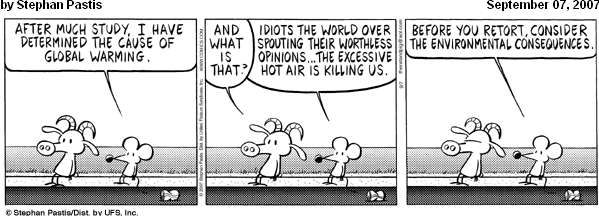
Cause of Global WarmingThe abortion issue has always seemed, to me, to have something to do with a minimalist definition of what people are. I reach this conclusion by observing it from a high level, from which I can simultaneously observe the euthanasia issue, the death penalty issue, the evolution-versus-intelligent-design flap, and the “don’t emit carbon ManBearPig” thing. Across all five of these issues, it seems the one axiom that earns opposition and condemnation from our liberals, is the one that says we matter. That we are here to accomplish something wonderful and great. Five times out of five, this dictum wanders into arguments that our liberals cannot allow to stand.

And you could power large cities off the energy they arouse in opposing them.

One can’t help but wonder if “global warming” isn’t caused, over the last ten years, primarily by liberal outrage. I guess when you work really hard over a lifetime at being ordinary, you get extra-extra-ticked-off if you see someone else trying to be extraordinary. Maybe that’s what liberalism is.

Memo For File LIV

Saturday, February 9th, 2008

John McCainThe flap-that-isn’t-a-flap over the Republican party’s nominee-apparent, continues.

Tom the Impaler wants to know where’d the quote come from? The quote in question is a rather arbitrary length of subselection in the dialog between Henry Rearden and the three-judge panel at his trial in Ayn Rand’s 1957 magnum opus Atlas Shrugged. The story takes place in an alternate-universe near-future at an unspecified date, and describes a downward spiral of America, the last non-collectivist nation on the face of the earth, into the individuality-murdering muck of socialism. Rearden, a brilliant metallurgist and entrepreneur, has invented a wonderful and fictitious metal alloy called “Rearden Metal” that lasts much longer than steel.

There are no planes in this alternate reality; freight is delivered by trains. Rearden Metal has the potential to save vast regions of the country from famine. But the politicians and labor bosses are afraid of the market being disrupted, so Rearden has been forbidden from selling his new metal. He’s on trial for violating the regulation. By showing the trial for what it is, he comes out of it with a $5,000 fine.

I’m doing this from memory. I may have to revise some little tidbits of that up there, but what you have is the essence of it. Which demonstrates two things, in my mind, which I’d been noticing years and years before I ever picked up the novel. They never, or very seldom, are pointed out. But they’re all-important.

Point One is what Rand called “the sanction of the victim.” If you study the history of western civilization since the industrial revolution, you’ll find one pattern that consistently emerges is that the most dreadful tyrants are stealthy. They have some kind of propaganda machination in place to pretend their government has power by consent of The People. Sometimes, they do not pretend this, but nevertheless persist in sending out word that their government is doing The Work Of The People. Nobody ever wants to self-annoint and then have the balls to say “I want this done because it’s me and I’m the guy who wants it done.”

And so when they oppress the classes under them, they demand sanction from the victim. There’s always some process for this, because it makes them and their lieutenants feel so much better about it when the victim participates in the process. It’s kind of like trying to get confessions out of John Proctor and Giles Corey in The Crucible.

Point Two is closely related. It is that when you are confronted by a silly idea, the most devastating thing you can do to it is to take it seriously. I can pinpoint exactly when it was I figured this out — I had it pointed out to me in this Time Magazine article, about a skirmish between Carlin Romano and feminist Katharine MacKinnon, after Romano’s negative review of MacKinnon’s book, Only Words.

At the heart of her thinking is the notion that pornography is literally a form of assault by expression, something like saying “Kill!” to a trained attack dog. “Protecting pornography means protecting sexual abuse as speech,” MacKinnon writes in her latest book, Only Words (Harvard University Press; $14.95). “Sooner or later, in one way or another, the consumers want to live out the pornography further in three dimensions.”

For more proof that words have consequences, there is Carlin Romano, book critic of the Philadelphia Inquirer. His Nov. 15 review of MacKinnon’s work in the left-leaning weekly the Nation set off a war of words that is reaching new heights of animosity. Romano, a former philosophy instructor, opened his review with a hypothetical proposition. “Suppose I decide to rape Catharine MacKinnon before reviewing her book. Because I’m uncertain whether she understands the difference between being raped and being exposed to pornography, I consider it required research for my critique of her manifesto…”

MacKinnon felt more than insulted. She felt…well, raped. “He had me where he wanted me,” she told TIME last week. “He wants me as a violated woman with her legs spread. He needed me there before he could address my work.” And the reviewer? “She’s claiming a book review equals rape,” says Romano. “That’s quite a stretch.”

MacKinnon’s assertion was just as patently absurd, in my view, as the McCain nomination that dangles over our heads like the Sword of Damocles today. And I further hold that the McCain nomination suffers from the same weaknesses as MacKinnon’s babblings did back then…that hobbled Henry Rearden’s “trial.” In all three of these situations, the protagonist has an expectation — a desperate one — that the selected audience will take the proposal somewhat seriously…just seriously enough to do what is expected…and then move on. Don’t take it so seriously as to inspect it.

Romano did exactly the opposite. Like Henry Rearden at his trial, Romano dealt a devastating broadside to the silly idea, simply by taking it seriously.

“People claim I dehumanized her,” Romano complains. “In fact, I did worse — I took her seriously. The worst thing that can happen to a flamboyant claim is to be tested.” To put it another way, MacKinnon’s contention that depictions of sex can be equivalent to sexual assaults may come as news to women who have suffered the atrocity of an actual rape.

How many messages surround us nowadays, carrying the expectation that we are to take said messages only seriously enough to do what is requested of us, but not so seriously as to test them?

I would offer that there are so many they threaten to drown us. And the impending McCain nomination is one of these.

So I intend to take the McCain nomination seriously. After the Republicans nominate him, I will accept him as a serious candidate, and support him to the extent that I think I can trust him. To the extent that his deeds — not his words — are compatible with my own interpretations of the country’s interest. Which means, not at all.

Now that I’ve dealt with how this boondoggle is connected to the Rearden trial, there is something else I think should be pointed out, and I think it’s been injurious to everybody who could be affected by a new administration that it’s gone this long without anyone talking about it. I hope what follows finds its way in front of the eyeballs of one or several prospective McCain supporters, before they pull that lever.

The labels. The directional labels. “Right…Left…Center.”

John McCain, I’m afraid, is the agent by which those labels are about to inflict upon us a very severe injury. No one can deny at this point what a wonderful medicinal balm those three words have been to his campaign. The narrative doesn’t change much at all, so let me see if I can recite it from memory here…

Senator McCain is a “maverick,” now “working hard” to heal the rift with the “Republican base,” over a number of issues on which that base “demands” a “drift” to the “hard right” but by “working with the democrats” Senator McCain has been offering a more “centrist” approach.

Something like that.

And this way of looking at things has been embedded in our political arena, in which massively important and impactful decisions are made, for generations now. There is right, there is left, there is center. Just like driving a car.

The problem is with this unstated moral to the story. I say unstated…it’s Not Articulated Outright…it’s an idea people take only seriously enough to do what is requested/demanded of them. And the idea is this: That if you want to get anywhere, most of the time you should stick to the center.

How conveeeeeeeenient. Now you’re on the hook to do whatever is compatible with the interests of whoever is defining what “center” is.

I’d like to propose something different. The left-right-center thing doesn’t survive the test of being taken seriously. You wouldn’t live by bad ideas half the time, would you? If one third-grader says people breathe air and another third-grader says people can breathe water, you wouldn’t stick your face in a pond half the time would you?

True, we can survive bad ideas. That doesn’t mean we’re obliged to do so 50% of the time.

So my proposal for replacing the left-right-center dictum, is this: Inside-outside. Convention-irony.

Deep down, I think all of us, regardless of ideological persuasion, understand what convention is in running a government, making our laws, and enforcing our rules. Convention is called out in the Declaration of Independence and in the Constitution. We are endowed by our Creator with inalienable rights, that among these are life, liberty and the pursuit of happiness. Congress shall make no law abridging freedom of expression, establishing a religion or prohibiting the free exercise thereof…we are, and of right ought to be, free…we’re entitled to equal protection under the law…etc.

If most of us want something to be illegal, and a law prohibiting it is compatible with the Constitution, we can make it illegal. And if it is illegal, you only get to break that law until you get caught, and then you get punished. If you aren’t breaking any laws, then you’re a free man, and you get to stay free, enjoy all your rights, and keep all your stuff.

That’s convention.

Irony is all the stupid crap we do when we find convention boring. Or when times get tough and we form the narcissistic worldview that someone has screwed us over…through convention.

Irony is a 70% income tax on the wealthiest during the administration of FDR. Irony is slaughtering pigs to rot in the fields, and pouring cream in the ditches, in some parts of the country — while, in other parts, people are starving to death.

Irony is eventful freedom. Deep down, everybody already knows Thing I Know #196: When classes of people take turns, over time, enjoying special privileges, not one man among them enjoys genuine freedom. Irony is the Year Of The Woman. Irony is the Black Civil Rights Movement. Irony is The Year Of The Queer, and hate crime legislation. Convention is what most of us understand is in the Fourteenth Amendment, and all of us know makes us a better people with a better government — equal protection. Not just in the boring durations between the fashionable debuts of oppositional things, when some special class has its turn in the limelight…but all the time. White guys aren’t special, persons of color aren’t special, women and gays aren’t special. We are all just “We The People,” like it says in those letters, larger than all the rest, in that Konstyitooshyun that so many say should be getting more attention.

Irony is the idea that violence stops when the tools used to inflict it become unavailable. That gun control can stop violent crime. That something called “disarmament” can stop war.

Irony is the Endangered Species Act. Deep down, everybody understands when our government is restricted from taking things away from us, and instead starts enforcing rules on how we are & aren’t supposed to use our stuff, including our land — this is nothing more than a mocking and denigrating end-run around the rules that were intended to make us more free than that.

Irony is saying illegal aliens “work hard and follow the law.” We all understand that some of them may do the first of those, but none of them do the second.

Irony is letting a murderer live, when he can look you right in the eye and promise you that if he does live, he will kill again. Irony is giving pregnant women the right to murder their babies. What can be more ironic than killing the innocent, while sparing the guilty, while accusing those who oppose you on both counts of contradicting themselves?

Irony is a bunch of soccer moms in New Jersey voting to decide what the speed limit will be in Montana, and what the legal drinking age will be in Kansas.

Irony is insisting that homosexuals can serve in the military until they tell someone they’re homosexual, and then out they go.

Irony is saying when our nation defends itsef, it should do so in a way that makes other nations happy, even if that means not defending itself…and without stopping to notice, nothing we ever do seems to make those other nations happy.

Irony is positioning yourself as a defender of womens’ choice, by bullying and intimidating women who are complete strangers to you, into making the career choices you think they should be making.

Irony is having absurd and silly arguments over the provision of good food, access to legal counsel, and prayer facilities to our own detainees, while when our folks get captured, the other side saws their heads off while they’re still alive.

Irony is the idea that when your employer gives you a stupid rule to follow you’re being oppressed and need organized representation, but when your union gives you a stupid rule to follow, then that’s all good.

Irony is the Earl Warren Supreme Court, 1954-1969. Irony is a fifteen year stretch of cooking up ingenious, creative, spellbinding and surreal new ways to let criminals out of jail that you know damn good and well are guilty, to the point where prosecutors don’t want to prosecute anything anymore, and women and children are afraid to walk the streets at night.

Irony is affirmative action, with quotas. For what can be more ironic than counting beans by the bean color, while insisting that you’re “color-blind” in everything you do?

Irony is running for President as a strong, independent woman, after creating a political career for yourself by riding your husband’s coattails while he cheats on you constantly and, on the record, you were too much of a dimwit to ever suspect anything was going on.

Irony is the fantasy that when someone is willing to hire you for four dollars an hour, if some law is passed that makes that arrangement illegal until the wage is doubled, the guy offering the four dollars will just…find the extra money…somewhere…and the job will still be yours.

Hooters WaitressIrony is complaining about carbon emissions and high gas prices, while driving something big that sits way up high…to work…every day…using 50 gallons of fuel a week to do something that requires 10…or less.

Irony is saying beautiful young women are being oppressed by Hooter’s waitress uniforms, while beautiful young women who don’t work at Hooter’s dress exactly the same way.

Irony is the notion that peace is possible if one side of a conflict, rather than both, thinks it’s a good idea. Or, when both sides hunger for peace, it can be achieved with the details of the peace relegated to minor-footnote status. Deep down, we all understand if both sides want peace and it doesn’t matter who runs anything, there wouldn’t be any fighting in the first place.

Irony is the absurd doctrine that you can’t do anything to defend yourself, unless the threat has already done something to actually hurt you. Who among us would impose such a requirement on their daughters, living away from home for the first time, confronted by a menacing neighbor or co-worker?

Irony is an automated voice asking you to press 1 for English. Irony is wondering wistfully what we can do to help our immigrants assimilate, while wandering the streets all day every day, hearing immigrants speak spanish to their children — their CHILDREN, who will one day have to get jobs here — and thinking nothing’s wrong with it. Or “celebrating the diversity.”

Irony is getting your news out of the Daily Show, your outlook from Rosie O’Donnell, your science out of Al Gore, and your medical advice out of Michael Moore.

Irony is nonsense we practice when we get tired of…sense.

It isn’t right and left. It’s things that we all know make sense…and other things that we all know don’t.

McCain looks like a reasonable candidate when you see him as someone alternating between right & left. When you see him the way I see him, through the lense of convention vs. irony, he looks very different. He looks unprincipled…more repugnant and loathsome on the occasions when he agrees with me, than another would be, in disagreeing with me. He looks like a career politican. More dangerous than all the rest. He looks like all the liabilities of George W. Bush, with none of the benefits.

Because that’s exactly what he is.

The Greatest Betrayal of All

Thursday, January 31st, 2008

Via Kathryn Jean Lopez, via Neo-Neocon, an item that begs to be parodied, but cannot be…since parody demands an assessment of the level of absurdity in the real thing, followed by a nudging-up by a couple notches. Said notches being simply unavailable.

This comes from NOW’s N.Y. chapter and just has to be quoted in full:

“Women have just experienced the ultimate betrayal. Senator Kennedy’s endorsement of Hillary Clinton’s opponent in the Democratic presidential primary campaign has really hit women hard. Women have forgiven Kennedy, stuck up for him, stood by him, hushed the fact that he was late in his support of Title IX, the ERA, the Family Leave and Medical Act to name a few. Women have buried their anger that his support for the compromises in No Child Left Behind and the Medicare bogus drug benefit brought us the passage of these flawed bills. We have thanked him for his ardent support of many civil rights bills, BUT women are always waiting in the wings.

“And now the greatest betrayal! We are repaid with his abandonment! He’s picked the new guy over us. He’s joined the list of progressive white men who can’t or won’t handle the prospect of a woman president who is Hillary Clinton (they will of course say they support a woman president, just not “this” one). ‘They’ are Howard Dean and Jim Dean (Yup! That’s Howard’s brother) who run DFA (that’s the group and list from the Dean campaign that we women helped start and grow). They are Alternet, Progressive Democrats of America, democrats.com, Kucinich lovers and all the other groups that take women’s money, say they’ll do feminist and women’s rights issues one of these days, and conveniently forget to mention women and children when they talk about poverty or human needs or America’s future or whatever.

“This latest move by Kennedy, is so telling about the status of and respect for women’s rights, women’s voices, women’s equality, women’s authority and our ability – indeed, our obligation – to promote and earn and deserve and elect, unabashedly, a President that is the first woman after centuries of men who ‘know what’s best for us.’”

Whining and complaining their way to global domination. Discriminating and hating their way to a discrimination-and-hate-free utopia. Championing choice, and refusing to let anyone anywhere decide anything any differently.

You do know what the etymology is behind the word “utopia,” don’t you? This is why we need NOW. They show us the reason why.

Memo For File LII

Monday, January 28th, 2008

Item!

Caroline Kennedy has been looking for a candidate like her father…and by doing so, one would presume, speaking for millions.

OVER the years, I’ve been deeply moved by the people who’ve told me they wished they could feel inspired and hopeful about America the way people did when my father was president. This sense is even more profound today. That is why I am supporting a presidential candidate in the Democratic primaries, Barack Obama.

My reasons are patriotic, political and personal, and the three are intertwined. All my life, people have told me that my father changed their lives, that they got involved in public service or politics because he asked them to. And the generation he inspired has passed that spirit on to its children. I meet young people who were born long after John F. Kennedy was president, yet who ask me how to live out his ideals.

Her reasons are patriotic, political and personal, and all three are intertwined. Hmmmm…

I’m fascinated with this passion for selecting one candidate over another, coupled with a seemingly blissful ignorance and apathy about positions. This editorial is ten paragraphs long, and every single syllable is about mood. Nothing, the all important make-me-happy issue aside, about what this candidate will do that that candidate will not…or what this candidate can do that that candidate cannot.

And that isn’t just my interpretation. Second paragraph from the end, Caroline comes right out and tells us what she wants in a President:

I want a president who understands that his responsibility is to articulate a vision and encourage others to achieve it; who holds himself, and those around him, to the highest ethical standards; who appeals to the hopes of those who still believe in the American Dream, and those around the world who still believe in the American ideal; and who can lift our spirits, and make us believe again that our country needs every one of us to get involved.

A President with the capability of telling us what we want to do.

Fox guarding the henhouse if ever there was one.

Item!

Gerard Van der Leun cites a parallel between Brave New World and the…uh…malaise:

Electile Dysfunction: “The inability to become aroused over any of the choices for president put forth by either party in the 2008 election year.”

Quick, break out the Soma!

“Awful? They don’t find it so. On the contrary, they like it. It’s light, it’s childishly simple. No strain on the mind or the muscles. Seven and a half hours of mild, unexhausting labour, and then the soma ration and games and unrestricted copulation and the feelies. What more can they ask for?” — Brave New World by Aldous Huxley

HT: The Homchick Report

Ah, Huxley. I have another passage to list as my personal favorite:

“And there you are,” Dr. Gaffney concluded.

“Do they read Shakespeare?” asked the Savage as they walked, on their way to the Bio-chemical Laboratories, past the School Library.

“Certainly not,” said the Head Mistress, blushing.

“Our library,” said Dr. Gaffney, “contains only books of reference. If our young people need distraction, they can get it at the feelies. We don’t encourage them to indulge in any solitary amusements.” [emphasis mine]

Item!

Millswood Middle School in Lodi, enforces a strict one-way hallway policy, with detention for violators:

Since the school opened in 2004, Millswood Middle staff has enforced the school’s one-way-only policy inside the main building on campus.

Once inside, students must follow the school’s circular hallways on both floors and on the school’s three staircases. Teachers and staff say the campus’ one-way-only policy cuts down on fights, hallway traffic and general chaos that comes with having 800 middle schoolers in one place.

“If everybody’s going the same direction, you can’t bump shoulders and you can’t give dirt looks, because you’re looking at the back of somebody’s head,” says Principal Sheree Perez.

But…but…but…if kids go through a K-12 curriculum that places such an inordinate weight upon their ability to co-exist and all head in the same direction, just to be herded around more easily…what is to prepare them for an adulthood, in which every now and then they’ll be required to go against the grain? To do the right thing?

Ah, but there’s the rub.

When it comes to preparing children for adulthood, a great deal of talk is made about teaching them how to “do the right thing” — but when’s the last time you ever heard of a child being encouraged to judiciously swim against the crowd? How many years has it been?

How old were most of us, when we finally figured out the frequent fallibility of the majority view? Some unfortunates make it all the way to the crypt never quite figuring it out. And we can’t rely on our schools, it seems — they are now at the point of dishing out punishment, for walking against the crowd. Inconceivable to imagine the school would permit thinking against the crowd…certainly, to imagine it would provide any encouragement for same.

And what of the adults? What is required of us, along the lines of that selective thinking-for-onesself?

It seems we are increasingly being called upon by our leaders…not to do…but to be. Indeed, I’m left struggling to figure out what distresses Caroline Kennedy so much. Umptyfratz presidential candidates have toured our state primaries, debating, advertising, giving speeches — trotting out their respective versions of this dream — adapting to a New America, in which the electorate no longer tells the leaders what to do, but rather, the other way around.

And as these candidates for President have told us what they want us to do, so few active verbs have come out of any of it. Just a couple, really: believe — and — sacrifice.

We’re there. Nobody expects anyone to do…everyone expects everyone to be. To be happy. To be enthused. To be clockwise. It’s gotten so bad, that our political leaders, like ourselves, are expected to be everything, but to do very little, if anything at all. All they are expected to do, is — expect. Expect things out of us. Expect us to be, and not to do.

Brave new world, indeed.

Soma all ’round.

Salvage’s Frosting Diet

Tuesday, January 15th, 2008

Salvage is Canadian, but I’d like to make it clear at this time that there are other Canadians who are not like him. He’s been hanging around Rick’s blog ever since Zossima dropped out of it…which is interesting…giving us an almost-daily education about sarcasm. How it is open to abuse. How pure sarcasm, can be used to prop up just about any silly statement. Convincingly. Somewhat convincingly when coming from salvage…perhaps more convincingly when manipulated by someone more capable.

It’s worth keeping in mind, I think. Some folks are known to use sarcasm to decide anything and everything. They are strangers to genuine exchanges of ideas. They are the “Daily Show” generation — those who were brought up under the belief that when they were watching certain entertainment programs, they were watching “news.” Who is to blame them for thinking any idea worth pondering, should fit onto a bumper sticker or within a single lungful of air?

Sarcasm has its place. But in my view, that place is as a garnish. Or cake frosting. We got a lot of young people walking around, I see, who substitute that frosting in place of the cake, the sherbet, the Hors D’Oeuvres, the vegetables, and the entree.

Their “diet” is as far away from healthy as you can get. And at Brutally Honest, we get a reminder of this every time we watch salvage do his “dining.”

Well, yesterday salvage took a break from the bucket o’ frosting and compromised with his mommy to chow down on a hunk of muffin…or sugar cookie…or something…with lots of sarcastic frosting spread all over it, of course. Can’t take a break from it, you know — in no other context, can his absurd ideas enjoy even the appearance of legitimacy. At issue was the case of Ezra Levant’s case before the Human Rights Commission.

A complaint has been filed with Canada’s HRC, which has lately become notorious. The point of the complaint is a selection of those horribly offensive cartoons about the prophet Muhammed, of which Levant is the publisher.

Van der Leun put up the YouTube clips from Levant, and then Rick linked to Van der Leun. Rick wondered aloud how it could be justified that this story is ignored, by the very same folks who “want to trumpet the loss of civil rights at the hands of Bushitler and his co-chimp Cheney and other ‘neocons’.”

…and salvage jumped in to provide an answer to that.

Yes, the elimination of habeas corpus and the indefinite detention certainly compares to the undemocratic hell that is a Human Rights Commission hearing and there is no doubt that Ezra Levant will be sentenced to life in the Maple Syrup mines.

Actually the Human Rights Commission is just following their mandate, someone made a complaint and now they’re investigating it. Sometimes people make stupid complaints but they still have to be followed up.

And yes, this is a stupid one you can tell because it’s gotten you wingnuts all worked up which is always fun to watch.

So keep it up, and when the Commission finds there isn’t any grounds and it ends? I’m sure you and your wingnut buddies will talk about that with equal enthusiasm.

Nah, just kidding, you’ll just find another molehill to shriek your fear and loathing at.

It’s clear to me that salvage didn’t watch the clips — that, or if he did, the point went whistling at Mach 1 right over what passes for his noggin.

See, when the argument is made about President Bush’s “elimination of habeas corpus and the indefinite detention,” this actually resonates with fair-minded moderate folks such as myself, even if it doesn’t completely convince us, because that says what we have is a decision we are accustomed to having made in the public spotlight, with transparency, publicity, and oversight, suddenly made in what might be thought of as a “black box.” We find the argument compelling, even if we don’t find it altogether convincing for a number of reasons. Some of the problems have to do with the nature of military operations. We have “detainees” captured on the field of battle…should the detainees be released to our court system? Can it not be said that the rights of the detainees have been violated, if this does not come to pass?

The argument isn’t dismissed lightly. Folks like salvage, gorging themselves on the frosting of sarcasm, think it is — because it does not triumph. The grownups, who understand things like roughage and protein and vitamins, and therefore do not dine on frosting alone, have other things to consider…

…like, for example, what laws have these “detainees” broken? The most-liberal guy where I work came up with an interesting point: He’s opposed to releasing detainees into the legal system, because regardless of his feelings about pre-emptive military strikes, he certainly doesn’t want America to be empowered to go around the world arresting people. On that, he and I agree. And then there’s the matter of what a legal system does with prisoners, who are found to have not violated any laws (or, more to the point, cannot be proven to have violated any laws).

Those prisoners have to be released, right?

It just doesn’t seem to fit the situation. It would appear we have found the reason why some things are treated as legal issues, and other things aren’t. The legal process is all about “rights,” whereas in thousands of years of war, nobody with a respected viewpoint on the matter ever declared the day-to-day business of war to have much to do with rights.

Saying so, doesn’t make you a right-winger or a Bush-bot. It makes you a grownup. But as salvage helps to remind us, lot of the folks talking about this stuff now aren’t really grownups.

But getting back to the back-room nature of how the Bush administration has been dealing with the detainees. I think we can all agree, at the grownup dining table at least, that the detainees do have some rights — and that whatever these rights are, they ought to fall short of the rights needed to run wild & free and make trouble. And so even though we don’t bow to the wisdom of the frosting-kids, as reasonable adults we are bothered by the idea that people in authority are deciding things and their decisions are not open ones.

Salvage and the rest of the frosting-kids, fresh off of making that argument, and festering in their disappointment that this one argument didn’t determine the outcome…then indulge in the unbelievable, which I’m pretty sure is the point Rick was making. They look upon the closed-door proceedings of the HRC — not the hearings we are able to browse on YouTube, thanks to the uploading by the defendant himself, but the process by which these decisions are handed down — they understand the rubber is going to meet the road in whatever way it’s gonna. And this raises no red flags with them.

To state it a little more succinctly. It is in the nature of a military tribunal that oversight is limited — that’s supposed to be an awful thing. Oversight seems to be missing altogether from what the HRC does…it’s not immediately obvious how the HRC finds it necessary to function without it, but it’s missing anyway…and that’s perfectly alright?

It should be noted the care involved in choosing the word “limited.” It does not mean “non-existent.” Far from it. At least, that is the case where the military tribunals are concerned.

President George W. Bush has ordered that certain detainees imprisoned at the Naval base at Guantanamo Bay were to be tried by military commissions. This decision sparked controversy and litigation. On June 29, 2006, the U.S. Supreme Court limited the power of the Bush administration to conduct military tribunals to suspected terrorists at Guantánamo Bay.

In December of 2006, the Military Commissions Act of 2006 was passed and authorized the establishment of military commissions subject to certain requirements and with a designated system of appealing those decisions. A military commission system addressing objections identified by the U.S. Supreme Court was then established by the Department of Defense. Litigation concerning the establishment of this system is ongoing. As of June 13, 2007, the appellate body in this military commission system had not yet been constituted.

Three cases had been commenced in the new system, as of June 13, 2007. One detainee, David Matthew Hicks plea bargained and was sent to Australia to serve a nine month sentence. Two case were dismissed without prejudice because the tribunal believed that the men charged had not been properly determined to be persons within the commission’s jurisdiction on June 4, 2007, and the military prosecutors asked the commission to reconsider that decision on June 8, 2007. One of the dismissed cases involved Omar Ahmed Khadr, who was captured at age 15 in Afghanistan after having killed a U.S. soldier with a grenade. The other dismissed case involved Salim Ahmed Hamdan who is alleged to have been Osama bin Laden’s driver and is the lead plaintiff in a key series of cases challenging the military commission system. The system is in limbo until the jurisdictional issues addressed in the early cases are resolved.

This has always bothered me about the “eliminating habeas corpus” argument. I remember all the crowing and champagne-glass-clinking when the Supreme Court decision was handed down. Oooh, we’re so wonderful and Bush sucks so much, because the Supreme Court showed him what-for. And then the process is reformed to accommodate the decision…and then is challenged anew…and heard in court some more.

That’s oversight. It’s there, or it isn’t. If you’re victorious in getting it installed, or using it, or exploiting it, and you want to shout from the highest hilltops that you had your victory against the Imperial Galactic Bush Administration and bask in your wonderful-ness — seems to me, the option to grumble about lack of that openness and oversight at some later time, has been jettisoned. You can’t have it both ways.

Okay now if the issue is comparing the military tribunal situation to the Human Rights Commission hearings…and it seems to be, because if I’m reading it right, Rick laid down a challenge and then cupcake-frosting-boy went and picked it up…it’s fair to ask: Does the HRC have as much transparency and oversight as this military tribunal process — which I’m told has none, but clearly does have plenty?

We’re not off to a good start here. I would cite as Exhibit A, Levant’s seventh clip, “What Was Your Intent?”

LEVANT: Why is that a relevant question?

MCGOVERN: Under section 31a, it talks about the intention…purpose…we like to get some background, as well.

LEVANT: Is it, you’d like to get some background? Or does this determine anything? We publish what we publish. The words speak for themselves. Are you saying that one answer is wrong and one answer is right? Is a certain answer contrary to law?

MCGOVERN: No.

LEVANT: So if I were to say — hypothetically — that the purpose was to instill hatred, incite hatred, and to cause offense, are you saying that’s an acceptable answer?

MCGOVERN: I have to look at it in the context of all the information, and determine if it was indeed.

You have to admire the way Levant is handling this. It’s not much of an exaggeration to say he is Henry Rearden sprung to life, leaping straight out of the pages of Atlas Shrugged:

“I do not recognise this court’s right to try me.”

“What?”

“I do not recognise this court’s right to try me.”

“But, Mr. Rearden, this is the legally appointed court to try this particular category of crime.”

“I do not recognise my action as a crime.”

“But you have admitted that you have broken our regulations controlling the sale of your Metal.”

“I do not recognise your right to control the sale of my Metal.”

“Is it necessary for me to point out that your recognition was not required?”

“No. I am fully aware of it and I am acting accordingly.”

He noted the stillness of the room. By the rules of the complicated pretence which all those people played for one another’s benefit, they should have considered his stand as incomprehensible folly; there should have been rustles of astonishment and derision; there were none; they sat still; they understood.

“Do you mean that you are refusing to obey the law?” asked the judge.

“No. I am complying with the law – to the letter. Your law holds that my life, my work and my property may be disposed of without my consent. Very well, you may now dispose of me without my participation in the matter. I will not play the part of defending myself, where no defence is possible, and I will not simulate the illusion of dealing with a tribunal of justice.”

“But, Mr. Rearden, the law provides specifically that you are to be given an opportunity to present your side of the case and to defend yourself.”

“A prisoner brought to trial can defend himself only if there is an objective principle of justice recognised by his judges, a principle upholding his rights, which they may not violate and which he can invoke. The law, by which you are trying me, holds that there are no principles, that I have no rights and that you may do with me whatever you please. Very well. Do it.”

“Mr. Rearden, the law which you are denouncing is based on the highest principle – the principle of the public good.”

“Who is the public? What does it hold as its good? There was a time when men believed that ‘the good’ was a concept to be defined by a code of moral values and that no man had the right to seek his good through the violation of the rights of another. If it is now believed that my fellow men may sacrifice me in any manner they please for the sake of whatever they deem to e their own good, if they believe that they may seize my property simply because they need it – well, so does any burglar. There is only this difference: the burglar does not ask me to sanction his act.”

A group of seats at the side of the courtroom was reserved for the prominent visitors who had come from New York to witness the trial. Dagny sat motionless and her face showed nothing but a solemn attention, the attention of listening with the knowledge that the flow of his words would determine the course of her life. Eddie Willers sat beside her. James Taggart had not come. Paul Larkin sat hunched forward, his face thrust out, pointed like an animal’s muzzle, sharpened by a look of fear now turning into malicious hatred. Mr. Mowen, who sat beside him, was a man of greater innocence and smaller understanding; his fear was of a simpler nature; he listened in bewildered indignation and he whispered to Larkin, “Good God, now he’s done it! Now he’ll convince the whole country that all businessmen are enemies of the public good!”

“Are we to understand,” asked the judge, “that you hold your own interests above the interests of the public?”

“I hold that such a question can never arise except in a society of cannibals.”

“What … do you mean?”

“I hold that there is no clash of interests among men who do not demand the unearned and do not practice human sacrifices.”

“Are we to understand that if the public deems it necessary to curtail your profits, you do not recognise its right to do so?”

“Why, yes, I do. The public may curtail my profits any time it wishes – by refusing to buy my product.”

“We are speaking of … other methods.”

“Any other method of curtailing profits is the method of looters – and I recognise it as such.”

“Mr. Rearden, this is hardly the way to defend yourself.”

“I said that I would not defend myself.”

“But this is unheard of! Do you realise the gravity of the charge against you?”

“I do not care to consider it.”

“Do you realise the possible consequences of your stand?”

“Fully.”

“It is the opinion of this court that the facts presented by the prosecution seem to warrant no leniency. The penalty which this court has the power to impose on you is extremely severe.”

“Go ahead.”

“I beg your pardon?”

“Impose it.”

The three judges looked at one another. Then their spokesman turned back to Rearden. “This is unprecedented,” he said.

“It is completely irregular,” said the second judge. “The law requires you submit to a plea in your own defence. Your only alternative is to state for the record that you throw yourself upon the mercy of the court.”

“I do not.”

“But you have to.”

“Do you mean that what you expect from me is some sort of voluntary action?”

“Yes.”

“I volunteer nothing.”

“But the law demands that the defendant’s side be represented on the record.”

“Do you mean that you need my help to make this procedure legal?”

“Well, no … yes … that is, to complete the form.”

“I will not help you.”

The third and youngest judge, who had acted as prosecutor snapped impatiently, “This is ridiculous and unfair! Do you want to let it look as if a man of your prominence had been railroaded without a –” He cut himself off short. Somebody at the back of the courtroom emitted a long whistle.

“I want,” said Rearden gravely, “to let the nature of this procedure appear exactly for what it is. If you need my help to disguise it – I will not help you.”

“But we are giving you a chance to defend yourself – and it is you who are rejecting it.”

“I will not help you to pretend that I have a chance. I will not help you to preserve an appearance of righteousness where rights are not recognised. I will not help you to preserve an appearance of rationality by entering a debate in which a gun is the final argument. I will not help you to pretend that you are administering justice.”

“But the law compels you to volunteer a defence!”

There was laughter at the back of the courtroom.

“That is the flaw in your theory, gentlemen,” said Rearden gravely, “and I will not help you out of it. If you choose to deal with men by means of compulsion, do so. But you will discover that you need the voluntary co-operation of your victims, in many more ways than you can see at present. And your victims should discover that it is their own volition – which you cannot force – that makes you possible. I choose to be consistent and I will obey you in the manner you demand. Whatever you wish me to do, I will do it at the point of a gun. If you sentence me to jail, you will have to send armed men to carry me there – I will not volunteer to move. If you fine me, you will have to seize my property to collect the fine – I will not volunteer to pay it. If you believe that you have the right to force me – use your guns openly. I will not help you to disguise the nature of your action.”

I did a quick check at the Fallaci award nominee page to see if Levine was nominated, as I was. Negatori. He should’ve been, at least next year if not this one. I’ll make a point to see what I can do about that next cycle.

It seems to me, at the very least, what we have here is a “black box” process for producing an outcome. I think even McGovern would agree with that — and with that, what we have is a breakdown in the ability to ensure consistency across the cases that come up before the Human Rights Commission.

McGovern is being deliberately evasive on the matter of how intent factors into the decision. She’s being asked about this directly. She has no answer. This is as valid a delineation as any other, in my mind at least, between free and un-free societies. The authorities are going to meet in a back room someplace and decide what’s what. Will they do that with any kind of consistency? With “equal protection,” as we call it down here?

Who knows? Who cares?

With nothing to hold the authorities to consistency and the provision of equal protection, they can show whatever favoritism they want to. What is to stop them? What oversight? Nevermind oversight…what opportunity to inspect, to criticize?

But of course this is not Guantanamo. These are full-fledged citizens of the country within whose government the HRC functions — not unlawful combatants.

Rick has issued the challenge, and frosting-boy salvage has failed in trying to accept it. He has no answer. His competence in following the facts and forming reasoned opinions about them, has been called into question. That has failed, or else his impartiality has failed. Maybe both.

Let’s pause for a minute or two to ponder how many people just like this are walking around — as free as you & me — spouting their nonsense, with “undecideds” listening to them, taking them seriously. It’s not a pretty picture. We have a multi-national conglomerate of folks who worry, ostentatiously, about things that are supposed to be described by words like “liberty” and “freedom.” But they have no understanding, or very little, about what those words really mean. And so when freedom is subject to genuine abuse, it can take place right in front of their eyes. And they can’t see it.

The frosting that is sarcasm is simply a poor diet. It makes for an imbalanced diet. To consume it, and nothing else, remains a bad idea, even if a lot of other folks are doing it. And if your diet of thinking is imbalanced, you can’t think straight…which is a problem for real lovers of freedom, because freedom is maintained only by means of rigorous, healthy, balanced, critical thinking. Here endeth the lesson.

On Snooping

Thursday, January 10th, 2008

I got this weird thing going on with my attitude toward the Constitution. I see it as a document built for the purpose of being cited; it’s got all them articles and sections and clauses and what-not, y’know? And so people say something shouldn’t be done because it creates problems with the Constitution — more often than not, I end up either watching this argument pass neatly over my little empty head, or else some kind of conflict ensues. Because I want to see the citation.

I see the document as dealing with a boundary…much like the boundary you draw around a baseball diamond or a tennis court. Those lines are just barely wide enough to be seen. Two or three inches wide, or so. That is how I see the Constitution. Its purpose is for knuckle-rapping. This is in-bounds…that is not in-bounds. If something is done that cannot be reconciled with the rules, then it ought to at least be possible to define where, in the rules, the transgression has occurred.

Is this asking too much?

In the last few years since you-know-what (hint: two odd numbers, the first number just below ten, the second number just above), it does seem to be asking way too much. And that is a great pity, because I’ll bet I’ve heard the word “Constitution” used ten or twenty times as numerously in the six years since that event, as I did in all the years before. If I were entirely unfamiliar with the document, judging it only by the jibber-jabber I’ve heard about it, I would imagine it to be a simple one-liner that could easily be printed on a small chewing-gum wrapper. Something to the effect that if you have to gather some facts in order to prosecute a crime, the crime shouldn’t count.

And even worse, listening to the mumbling in this handful of years, has left me with the impression that we have a lot of folks going through exactly that thought process. This guy on the radio…that friend at work…Keith Olbermann…they all seem so concerned about the “Constitution,” so surely they must have our interests at heart right? So you want to agree with them — and it takes so much effort to, y’know, actually open up the document and see what it says. So let’s just assume it says exactly that. Therefore, if this thing over here is against the Constitution, that thing over there must also be against it.

And so our prevailing sensibility ends up being that if you do something against the law, you have to do it right in front of a cop or else everyone is honor-bound to pretend you didn’t do it.

That seems awfully silly, so much so that nobody’s said it out loud just yet, and nobody is likely to say it out loud. But I think my specification is as good a predictor that someone is bound to jump up and say “that’s against the Constitution” as anything else. It certainly is more accurate than…say…the stuff that is actually written into the Constitution.

I was given cause to think about this when Jodi at Webloggin handed out the Mother of the Year award.

Jane Hambleton was snooping in her 19 year old son’s car when she found a bottle of booze under the front seat, promptly took the keys away, and put his car up for sale. Sounds great, right? That isn’t the best part. When she put the car up for sale she made a conscience decision to tell the potential buyers why they were selling the car; here is what the ad said:

OLDS 1999 Intrigue. Totally uncool parents who obviously don’t love teenage son, selling his car. Only driven for three weeks before snoopy mom who needs to get a life found booze under front seat. $3,700/offer. Call meanest mom on the planet.”

She not only received phone calls from people who were interested in the car but also from people who wanted to congratulate her. According to Hambleton, she has received over 70 phone calls from people saying what a super mom she is.

Unfortunately, in today’s world snooping parents are hard to come by. I have found that many parents have the “we can’t snoop” philosophy; citing that snooping “is an invasion of their children’s privacy”. I find it very refreshing to read about a mother who does have that attitude and has the attitude that she will do whatever it takes to keep her son safe.

Hats off to Jane Hambleton!

The article linked goes on to say the son is unhappy with the ad, partly because he’s got an alibi…the booze was left behind by a passenger. This doesn’t hold any sway with Mom, since two of the rules laid down when the car was first purchased were that there was to be no booze, and the car should always be locked.

I’m taking notes because these little episodes are ahead of me, beginning in about five years. I’ve been putting some serious thought into “no passengers.” Right now, I don’t see the social fabric as contributory to my son’s future car accidents…although, it should be noted, I imagine that is how those episodes start (oooh, now that li’l bubbins has a car, he can finally make some friends). Instead, I am most worried about his lack of comprehension of moving objects in the space around him.

Kids-n-kars is the one problem in our society that we have not been able to solve, or to even make any incremental effort at solving. The time comes for that first learner’s permit and then, God forbid, an actual driver’s license, and the parents and society must endure about two or three years of real danger. Curious that so little mitigation takes place over the generations, in an overly-pasteurized culture incandescently intolerant of the slightest residual danger from anything else.

We chalk it up to the need for the kids to learn responsibility. Simply upping the driving age would atrophy our youngest in their abilities to take on responsibility. That’s a pretty good argument, and I agree; my beef is that we seldom follow-up on it.

One car is used by a little tyke to learn responsibility, nine more cars are used by little tykes to turbocharge their social engines.

Which means — a bunch of things, none of ’em good. A passenger plus two or three in the back seat, nobody over age seventeen. Booze. Cell phones. Parties.

But getting back to the subject at hand…this complaint among “normal” parents, that snooping is an “invasion of privacy.” Let’s just leave alone the discussion over whether that’s a sensible opinion to have, or not, and simply accept the fact that it’s there. You know, there are a lot more parents practicing this, than not…which means there are a lot of crumb-crunchers growing up accustomed to the idea that they have this “privacy” and that it is — of course — unconditional. Our grown-ups, most of them by a large margin, think crimes must take place within eyesight of an actual cop, or else, said crimes must never have happened. Otherwise, it would be an invasion of this “privacy.”

So in childhood we think we can do anything we want, as long as nobody sees. We grow up with this expectation, we hang out with LOUD grown-ups who have the same expectation.

Does this sound to you like a society getting ready to come undone? Let’s postpone the argument about what privacy is, because I concede we should have some and I do think that’s a worthy discussion to have. But just concentrate on the matter at hand: What is the law, exactly? We’ve got this definition going where it doesn’t count for anything except in razor-thin circumstances. Crimes can’t be reconstructed from available evidence, they can’t be recorded, they can’t be intercepted electronically, they can’t be witnessed by anybody but a cop.

And even then, if the cop goes looking for X and he sees Y, both X and Y are illegal…if it isn’t X, again, it doesn’t count.

I’m actually glad we’re somewhat concerned about snooping. It just seems to me that our thinking about it is so sloppy and disorganized, what we’re actually engaged in here is a campaign to jettison laws of any kind — while pretending to be doing something else. Let’s face it, our definition of “privacy” has become so incredibly cockeyed that only complete anarchy will fulfill the expectations that truly prevail over the angriest and loudest of “privacy defenders.”

Is that not at least a worthy concern? I think so.

And if one accepts that it is, and wonders aloud what remedy we have for it, it’s a very simple one. Stop using “The Constitution” as a figure of speech. If something is supposed to have intruded into it, then let’s have a rational discussion about it — after someone has taken the time to cite book, chapter and verse. Otherwise, it’s just so much anarchist twaddle. And sorry, simply saying so doesn’t make me an advocate for Orwellian totalitarianism. Knowing your Constitution is a good thing.

We Don’t Communicate

Wednesday, January 9th, 2008

My mood’s been dark the last week or so, and about an hour ago I was grousing away about this phony resolve the nation has been showing about being unified. The substance of my complaint is that the words used, do not describe the intent. Tradition is a poor lodestar here — it says when we unite on something, we agree on a plan. In the 2007-2008 election cycle, though, being united has something to do with all of us feeling the same stuff. Being jovial, morose, amused, suicidal — it is a state of one emotion being decided-upon with pinpoint accuracy, and everybody feels whatever it is all at the same time.

Which inspires a very low quality of leadership in our leaders, or so says my recent concern. We unite in some meaningless emotion, our “leaders” articulate that for us, and then they go off and do whatever they want. Not a recipe for success or freedom in my book.

But that’s the kind of trouble we bring down upon ourselves, when we go through the motions of communicating without actually doing it.

I was given cause to think about this on Sunday. It all started when my lady went to work that morning and forgot to take her lunch with her. Being her Knight in Shining Armor, I volunteered to bring her some. So I grabbed the kid, loaded up the car and scrambled off to the restaurant to pick up some chow.

Tight timeline. But my gal’s food order was precise, and the reputation for service is above average. So in we go, and…uh oh. Language barrier. Not a trivial one. A big, thick, intimidating one.

I can handle language barriers, usually, but this one really got in the way for two reasons.

One: Whenever I was forced to ask the gentleman to repeat himself, he would do so. LOUDER. As if I had a hearing problem; that is all he would do. He would not enunciate. He would not s-l-o-w – d-o-w-n. This is not good. It sends the message that your motives are to make sure if there’s a screw-up, you the service-person cannot be blamed because you’re not the one who did it. You aren’t really trying to connect.

Two: It seemed to me as if there were a great many questions for a relatively simple dish that I’d ordered before. I wondered if I wasn’t on the wrong track. But after the third question that had to be repeated three times, I had begun to just say “yeah, that sounds like a great idea” without having the foggiest notion of what I was doing. Hey, it’s food. Yeah, it’s for my special lady and everything, but her expectations have been lowered in this department. Anyway, I figured my chances for getting everything p-e-r-f-e-c-t were already scuttled.

While this more-complicated-than-need-be order was being filled, the boss saw things weren’t going well and took over. Good business decision. But why was it necessary? And did I get that guy in trouble? I hope not. I was really trying to have a smooth conversation with him, but throughout most if it I had no idea what he was trying to ask me…and he acted like he just didn’t care.

There were another seventeen miles to go between the restaurant and the place where my girlfriend works. En route, the boy’s mother called. The day before she was emphatic that, due to the weather problems we had and the things she had to do, sorry but she had no idea what time she’d be able to pick him up. So she was calling to firm up on a time.

She had a bad cell. A bad one…or I did…or she wasn’t paying enough to have real cell phone service…or I wasn’t. Here it is ten minutes later — and again, I’m finding myself neck-deep in this swamp of “Huh”s and “What”s and “You’re Cutting Out”s.

Say What One More TimeFinally I screamed into the earpiece. Perhaps that wasn’t a good thing to do. But God damn, it felt good…and hey, we were able to figure out where she needed to pull off the road to really talk on her phone. I know — it was just plain rude. Shouldn’t do it. Well, it was that or run the car off the road. I’d reached my saturation point. I simply couldn’t handle hearing that dreadful word “What?” one more m—f—ing time. I am SO sick of that word “What?”

From that, and from this phony Obama phenoma, I have come to realize something.

I think it is vitally important to the future of our society, that we come to an abrupt stop in this thing we do. You know what I’m talking about, by now: Pretending to communicate. I think we should stop doing it.

I think when we fail to communicate, usually by communicating all half-assed, we should simply admit we aren’t getting it done.

Stop trying.

To pretend to communicate, and not do it, injures us in all kinds of ways…ways in which we are left relatively intact, if we just abstain from the whole pointless exercise.

This kind of fits in to my complaint about technology lately. What is technology in the 21st century? Apart from this music-listening fad that’s going on, it’s pretty much all cell phones. Now, really: A generation ago you left work, maybe hit the store on the way home, and until you showed up on the doorstep ready to kiss your sweetie hello and ask each other how the day was, you had no way to get ahold of each other.

Did you survive?

Yes, you did.

Today, we cannot. Oh horror of horrors, you might forget to go to the store. Or she might have needed six things, and told you to pick up only five. Or maybe you don’t know where to find it. It seems so vital and important now, even though deep down we all know it is not.

Is this constant faux-communication then, some sort of comfort to us, if not a necessity? Again, it does not appear so. The weekend comes, and you leave the house to do A. Your cell phone rings. It’s the boss. Now you have to do B. Maybe your sweetie calls and you need to do C, D and E. Here it is 2008…and you stand an excellent chance, better-than-even odds, of failing to get A done — and by the time it’s dark, you’re probably still going to be out there trying to get all this other stuff done. Thirty years ago you would have simply left the house, gotten A done, and come home again.

And the “Can You Here Me Now” stuff? It has become the stuff of comedy. But it’s not funny, in a way, because in this information age communicating with each other has become synonymous with getting things done. It’s pretty much a given, now, that if we cannot pass ideas off to each other, we will accomplish little…and we’re laughing at ourselves because we can’t do that. Not with any reliability. And it seems, from my point of view, as if the comedy has become less the “good natured chuckle” thing, and more the “don’t know whether to laugh or cry” thing.

Phil gave me props for recommending this movie. That very same day, my brother copied me on an e-mail, a frustrated reply he was sending to the customer service department of his wireless provider. He mentioned the movie too — his way of sending me the same thanks for the same recommendation. One of the things that happens in the movie in question: In the five hundred years that begin more-or-less now, the English language is destroyed, replaced by a muttering dialect that is a hodge-podge of valley-girl slang and rap-music outbursts.

I think we’re there, or nearly there. You go to do some business at some place that has a “service counter” — do you expect to get service? No, not really. We seem to be universally frustrated with the fact that very few people, anymore, care to express themselves in such a way that they’re truly understood, or understand what is told to them in a way that they truly get it. The problem long ago passed the point where it had begun to interfere with everyday business, and nowadays, we’re practically paralyzed from it. Ordering a plate of hot food has become a more challenging ordeal, with more questionable prospects for consistent success, than building a new fence around a pasture, digging a new well, or putting a new roof on a barn. It’s a simple task made artificially complicated, along with a bunch of other tasks that should be equally simple.

Our cultural ability to get things done is now in a steep nosedive. And until we start communicating — or at least, stop going through the motions of doing it without actually doing it — I don’t think we’re ever going to get out of this nosedive.

Let’s Stay Divided

Wednesday, January 9th, 2008

Well, it would appear Iowa and New Hampshire don’t agree on very much.

But I think this shaking-up of candidates on both the Republican side and on the donk side has been good for the country because it’s got us talking about things. And from all that talking about things, even at this late date, I’ve been learning a lot. This dosey-doh between Hillary and Obama, for example, has taught me a lot about what it means when someone says “only (blank) can unite the country“…(blank) being the candidate of choice.

Mood iconsRecent events have educated me about that verb. “Unite.” It doesn’t mean what a lot of people think it means. I’ve talked to too many people who are giddy about Obama, for example…vociferously opposed to my objections that Obama’s positions on the issues, while perhaps defined to some cursory extent, remain so pliable as to be meaningless.

They start out “educating” me about where Obama stands on this-or-that…

…and before they get too far, end up babbling some jibber-jabber about “charisma.”

It is not my intent to single out Obama here, for I think this is where the country has gone in general. And it’s a recent thing. Four years ago I would have similar objections to a John Kerry, and a Kerry fan would “educate” me with those four wonderful magic words: “Go to his website.” Missing the point entirely that it’s one thing to articulate a position, and a different thing entirely to commit onesself to that position.

It’s kind of like the story about the pig, the chicken, and the ham-and-egg breakfast. The chicken was involved with the breakfast, the pig was committed.

But four years ago, if I lowered myself to hitting a candidate’s website to learn about his position, at least I’d probably find one there. It might change the very next day — that was the point of using websites, although nobody said so out loud.

Nowadays, it’s even worse. “Positions” are things that are stated as vaguely as possible. Not in such a way as to involve any kind of a plan…not a plan you’d implement for your own private matters, anyhow. If you wanted to win at them.

In this way, Obama left himself open for a good skewering lately by John Gibson:

Obama was talking about the Iraq war — which he opposed — and the surge — which he opposed — and he said Democrats deserve credit for the reduction of violence in Iraq and he said:

“…Much of the violence has been reduced because there was an agreement with tribes in Anbar Province… Sunni tribes… who started to see after the Democrats were elected in ’06… you know that, the Americans may be leaving soon, and we’re going to be left very vulnerable to the Shias. We should start negotiating now.”

Obama is going to argue in a debate that the Dems who wanted to quit immediately, surrender now, were the ones who won the war?

I would be anxious to hear John McCain or Rudy Giuliani reply to that assertion. Obama’s line appears to be: We win wars by refusing to fight them.

I keep hearing about how we need a candidate that will “unite the country.” My point is, I think we’re not really communicating with each other when we say this. Unite the country, according to tradition, has something to do with coming up with a plan that will draw widespread support. Obama comes out and says: “We should start negotiating now.” Is that the plan?

It isn’t one that will draw widespread support. It will draw DailyKOS support, sure, but I don’t think that is what most people mean when they talk about uniting the country.

Blogger friend Phil made some good points about Obama’s evasiveness lately, and I think his words echo some doubts a lot of people might have about things, even though the message itself has yet to find resonance. But he really nailed it, I think.

In the paper the other day I saw a picture of Bara[c]k Obama with his campaign slogan on the podium in front of him. It was also plastered all over supporter’s signs behind him. It said:

Change We Can Believe In

I hate to state the obvious, but that doesn’t mean anything. Worse, it means nothing on purpose.

The candidates and pudits alike are all talking about “change” as if it means something. Something even semi-specific.

It means whatever the listener wants it to mean. That’s why they use it. It’s calculated ambiguity. Triangulation. Whatever you want to call it. [emphasis mine]

It bears repeating: Calculated ambiguity. Uniting the country…through calculated ambiguity.

As I said, it is not my intent to single-out the Senator from Illinois. Across the board, mostly with donks but lately I notice with Republicans as well…in 2008, I see the candidates who attract the greatest hope for “uniting the country,” are the ones who have left themselves the greatest latitude for changing positions later without shattering covenants, be they explicitly stated or implied. They are the candidates who address roomfuls of people, and in so doing, exert control over the mood in those roomfuls of people. The “charisma” candidates. The candidates who achieve unity by means other than by stating a position.

I’m left to arrive at one conclusion, and only one.

I think “unite” has something to do with dictating a mood, now. It has less to do with actually forming a plan, than it ever did before. You do what we call “uniting” in 2008, and what you do is set a current mood. You make the current mood “happy,” for example, and anybody who would just as soon feel sad or sober, simply doesn’t count. Or vice-versa.

That is what unity means today, I’m afraid. And it has its place. People who are given to communicating by articulating what “everybody feels,” by dishing out one baritone proclamation after another of the bullying, coercive, “Am I The Only One Who” variety…don’t like to wrestle with the thorny issue of the individual…that irritating guy off in the corner who might not be so easy to bundle up into some overly-simplistic statement about what “the room” is thinking.

They like all persons in the immediate vicinity to be united. To feel all energized at the same time, or all disappointed at the same time. So that our leaders — and our not-leaders as well, the ineffectual middle-management suck-ups, the bootlickers, the show-offs, the guys who simply laugh louder than everybody else — can easily figure out where the parade is going, and run to the front of it.

In short, I’ve come to the conclusion that most of the time when the word “unite” is used, that is what it means. Don’t unite the priorities. Or the plan. Or the concerns. Just unite the mood, and the rest will follow.

The problem I see with it, is that the rest won’t follow. Uniting a mood is not solving a problem.

So looking for reasons to be encouraged by the primaries, that is the one that I find. A bunch of sycophants want Iowa and New Hampshire to agree on things, and the two states have agreed on precisely nothing. This frustrates many, I think, and I’m glad for that if for nothing else.

Best Sentence XXI

Sunday, January 6th, 2008

Contrary to conventional medical wisdom, the cause of autism is not primarily genetic, but is a complex combination of genetics and environment. Genetics, so to speak, load the gun, and environment pulls the trigger.

Healing the New Childhood Epidemics: Autism, ADHD, Asthma, and Allergies. The Groundbreaking Program for the 4-A Disorders, Kenneth Bock, M.D., and Cameron Stauth, ISBN: 978-0-345-49450-4, p. 17.

I think that right there is one of two big ways we are screwing up with our children, particularly our male children. We think it has to be all-environmental or all-natural. All-nature or all-nurture. One or t’other. How these little idiosyncrasies can be any kind of blend, is something we adults tend to forget. Easily. Even the intellectual giants among us.

The other mistake we’re making, is in assessing what is “busted” in the first place. Things that used to be synonymous with plain ol’ masculinity are — nowadays — thought to be indicative of some kind of disease. Not good…not good at all.

Especially when, all the stuff that we use nowadays that supposedly makes life worth living, we have thanks to the contributions of people like Nikolai Tesla and Thomas Edison and Isaac Newton. People who would surely have been diagnosed with this-thing or that-thing, if they were children nowadays in our ultra-pure and ultra-pasteurized world…

Houseflies

Friday, January 4th, 2008

We started the New Year on a decidedly low note. By “we,” I mean in the office. A wonderful friend is now gone, his departure an unexpected one, and we’ve been struggling with a problem as old as death itself: How do we keep our thoughts properly trained on a future without him, when the past burns so brightly?

Good times. Working together, playing together, mutual appreciation for valuable talents that made money, and equally valuable talents that did not. Things he said that might’ve had hidden meaning — or might not have. Things we could’ve done to lighten a heavy load — or maybe we couldn’t have, or maybe if we could have, would not have so lightened.

His flame was extinguished quietly, while we clinked glasses and renewed our annual pledge to live together in brotherly love.Candle

We’re left in shock, to ponder the meaning of this little holiday pledge we made, and to look at old pictures. “Team” pictures. And wonder how much time is left behind each one of those other faces.

So…Iowa has “happened” now, and I’m supposed to have an opinion, is that it? Sorry, I don’t much have it in me. I do seem to notice an overall trend where candidates from this party or that party, lag behind for no explainable reason if they value life too much. If they think it’s too worthy of a solid defense. Their counterparts, the candidates who find new and creative ways to cheapen life, to say it is a casually exchanged thing, a fungible thing — they surge ahead and nobody can explain why.

I think I can explain why.

Houseflies are not burdened with philosophy. By that I mean, they don’t wrestle with the meaning of life. They aren’t equipped for it and there would be little point to it. This spares the housefly from pain and discomfort which visits itself upon we, the humans. When life is, by design, a quick and casual thing then thinking is unnecessary. You do what is expected of you until it’s time to clock out.

And so it seems to me Iowa has been won by “phenomenon” candidates, those candidates who spent energy that convention earmarks for defining issues, to instead buttress their positions as “rock stars.” The surnames of those candidates have become names of fads and fashions.

We’re running a twenty-one-month election. It doesn’t seem to have been anybody’s idea. Nobody thinks it’s a step in the right direction, but we’re doing it. And ironically, by running an election longer than any election that has ever come before it, we’re doing a greater job than we have ever done before, of living for the moment. Just for today. Like houseflies.

The nation is swept by this “craze” that says we are no longer entitled to any kind of break from election campaigns. Maybe houseflies aren’t deserving of such breaks. And I suppose it just makes sense that when one man lives like a housefly, he wants all other men to live that way. Meanwhile, I’m reminded of how precious life is, and that if it somehow isn’t, it is personally important to each one of us to make it that way.

Vicious crazy men around the planet want to kill innocent people to make political statements. It seems that if there is one popularly-supported remedy to this problem, it is to make health care universal and affordable, and maybe to increase the minimum wage. Those things would make life more comfortable. But they wouldn’t make it precious. To the contrary: Even a housefly values life more than a “kept” man, whose every necessity in life is provided on a guarantee. There are flyswatters and cobwebs to be avoided.

And so by worshipping rock stars instead of electing presidents, by living our every moment in this election cycle or that one, and by responding to deliberate murderous threats by ignoring the problem and providing more guarantees to ourselves, we’re on the brink of discovering a brand new species. And becoming it.

Any other time I’d courteously disagree with this course, but sympathize nevertheless. Now, I’m having a tough time even sympathizing. How does this seem like a good idea to anybody?

Worship of the Zero

Saturday, December 22nd, 2007

Mike over at Mike’s Eyes came across that silly book about what the world would be like without humans. Mike is a decent Ayn Rand fan, so he was appropriately horrified.

It’s all about the fear of responsibility. I reach that conclusion by the method of durable thinking that is a method of last resort, the process of elimination. Something makes this appealing to a large selection of people. Not just acceptable. Appealing. How can you have some genuine passion for this, when the point isn’t that your existence is genuinely toxic, it’s simply that you aren’t getting anything worthwhile done and lack even the distant potential to make the world a better place. How do you nurture passion for pointlessness? Fear of responsibility is the only thing that makes sense.

Well, it’s more than process of elimination that points to that. Some diligent thinking about what kind of folks we’re dealing with here, will also point in the same direction. These can’t exactly be shakers-and-movers can they? The go-get-em type? If that were the case, they wouldn’t be here. We don’t need to ponder suicide directly in order to think on that awhile. You sit around on your ass and say “the world would be much nicer if…” and no matter what comes after the word “if,” when all you do about it is just talk about it a lot more and buy or sell books that talk about it some more, it can be safely concluded that you’re something of a slug. A carping whining little nancy-bitch. So with that kind of character defined, fear-of-responsibility, you see, just kind of naturally falls into place.

In 2007, it’s safe to say, it is much tougher to die off from lack of ambition than it ever has been in the history of the human race. And with Christmas right around the corner, your bookstores are brimming over with treatises about atheism, which is essentially the randomness of life on earth, especially mankind; global warming, which is the next step, a study about how earth’s ecosystem is glorious, sacred and pristine — except for us. And, thinly disguised dysgenics movements, such as Les U. Knight’s crackpot group and this strange “world without us” item.

Yes, we’re up to our eyeballs in it lately. But it’s not a conspiracy, it’s a sequence of natural consequences.

Western civilization lacks predators. Visible ones, anyway. There are no day-to-day threats. You just avoid traffic accidents until you get to your little cube farm, stay there for eight hours, and avoid traffic accidents until you get home — that’s about it. Just as houseflies are a lot easier to swat in climates that are lacking in frogs and spiders, through our lack of everyday survival challenge we have become fat and lazy and dumb. So it just stands to reason we have fat, lazy dumb books to read. The dumb books tell us everything is pointless, there is no good and there are no evil acts, save one, and that one evil act is standing up for yourself and defending your property, and those who are depending on you.

After thousands of years of natural culling of the apathetic from the herd, suddenly nihilism is affordable. The gene pool suffers.

I Made a New Word X

Friday, December 14th, 2007

Inspired by this news story about steroids in baseball, I came up with a brand new word. Actually, I came up with two new words. I came up with these words because the steroids-in-baseball thing — you know, we have been hearing about this for a long, long, LONG time.

Making Progress?My son was asking what the deal was with steroids in baseball. And I told him the truth.

I said baseball was essentially a contest to see who could play the game the best, and steroids were like medicine that helped you play better, except there were rules against taking them. So the authorities in charge said, that’s a no-no. That means when someone takes steroids, they have an advantage over everybody else, but they have to make sure they don’t get caught. And so this makes baseball into a contest to see who can hide things the best and who can lie the most convincingly. We don’t like to admit that’s what baseball has become, and so we go through the motions of “getting rid of steroids” without really doing it.

Un∙solve (v.)
1. To toil away at a problem, without making any progress toward solving it.
2. To give the appearance of trying to solve a problem without really trying to solve it.
3. To present onesself as engaged in an effort to solve a problem, while engaged in activity irreconcilable with the supposed intent to solve the problem, or any serious supposition that the problem really is a problem.
4. To form alliances with people under phony pretenses by feigning readiness, willingness and/or ability to solve a problem that concerns them, or is expected to be of concern to them.
5. To present a phony problem as a problem more serious than it really might be, for political purposes.
6. To present a former problem as that has already been solved in relative terms, so that it can be regarded as not-yet-solved, for political purposes.

Un∙prob∙lem (n.)
1. A boogeyman.
2. A real or imagined problem that is presented in exaggerated proportion for political purposes.
3. Anything that highly visible officers or candidates discuss, in great exuberance and with great frequency, as a problem they are engaged in fighting, but with the passage of time and with minimal change in rhetoric, is revealed as a problem that is not actually being fought.

When one makes a study of all our various unproblems, one is exposed rather harshly to the realization that more & faster communication is not necessarily a good thing. Since mass communication has become rapid, efficient and cheap, we’ve been buried in unproblems. Problems we are told to think are very serious, and that this-guyy and that-guy are working very hard to solve — but the status of such worthy endeavors, never seems to change. Ever.

Prior to the information revolution, history presents us with very few examples of unproblems. Politicians that presented us with problems, and themselves as noble warrios engaged in battle against those problems, in the days of old had to actually solve them. Or, at least, achieve some incremental and demonstrable results in fighting the stated problem.

One notable exception to this is FDR and his phony efforts to battle the Great Depression. Roosevelt was the founder of America as a capitalist/socialist hybrid enclave, and the onset of dilatory and lackluster cognitive thinking is quick in a socialist enclave. So in that way, it could be said that Roosevelt doesn’t really count. Is there another example prior to, say, 1960? I really can’t think of one.

Nowadays, we’re so buried in unproblems that we’ve become accustomed to them. Politician says “I’m going to fight such-and-such a problem…” and two years later, deep down we all expect to hear the same rhetoric, about the same boogeyman, with the boogeyman exactly in the same position he’s in now. We don’t think it will be different — ever. Not anymore. Not in our heart-of-hearts.

A few of the unproblems we have in 2007…and these are just off the top of my head…

1. Shoring up Social Security
2. Global Warming
3. Drunk Driving
4. Steroids in Baseball
5. Money in Politics
6. California’s Budget
7. The Energy Crisis
8. Women and Minorities Being Oppressed — C.A.L.W.W.N.T.Y.
9. A.I.D.S. and Cancer
10. World Hunger

You can’t get elected to anything anymore without promising to do battle against all these dragons. Or most of them, anyway. And yet, we simply accept that year after year, not a single one of these battles will be lost, won, or even changed so much as one iota from exactly where they are now.

Solving any one of these unproblems, and more as-yet-unlisted here, has become just an empty ritual. No wonder it isn’t being done. It’s our fault, not the fault of the people we elect. We just don’t know what achievement looks like anymore.

Never Enough Diversity

Tuesday, December 4th, 2007

John Leo says “Diversity is a restless quasi-religion whose missionaries are ever on the move.” Now why, I have to ask, must a movement designed to get rid of something rather than to create more of something, be restless and ever on the move?

Yale already has an impressively vast diversity bureaucracy headed by Nydia Gonzalez, the new chief diversity officer. She is working on a long-term plan, “Diversity Yale 2010 and Beyond.” Each school has its own system of diversity apparatchiks. There’s even a Yale library diversity council with 10 to 16 members and a three-year diversity program. Now Yale’s Coalition for Campus Unity (CCU) is encouraging the residential colleges to create “some kind of diversity-awareness position or board.” A board of, say, ten members in each college would add 120 new officials – another diversity gusher. Last February, Yale continued its long-term program to segment the student body into ever smaller ethnic and sexual groups. It hired a new assistant dean for Native American affairs. Can anyone say that a provost for the transgendered is somehow out of the question?

Why does Yale, or any university, need to keep creating more diversicrats? Undergraduate Robert Sanchez says his group, CCU, “thought most Yale students lacked sufficient cultural awareness,” i.e. a high enough degree of enthusiasm for the diversity movement. Sanchez, according to the Yale Daily News, seems distressed that “when we have these forums and panels we are preaching to the choir because only a certain demographic of students attend the event.”

“Diversity” has an ugly truth to it. It is the one pursuit that, on an intellectual level, is devastated completely — not just intellectually embarrassed, but intellectually devastated — by a simple rhetorical exercise. You supervise a team of ten minorities. Two of them quit. You replace them with two six-foot-tall, right handed, straight white guys. What did you do to the diversity of your team?

The mathematician, or anybody else who works in a formal discipline that has a utilitarian requirement for the d-word…not a political requirement, but a utilitarian one…would have no choice but to answer “you just increased it.” But of course that isn’t the correct answer.

Now, perhaps it’s overstating things to say “diversity” is what we call it when we deal career and economic injury and destruction to straight white guys. Or perhaps that could be called an over-simplification. But the awkward truth of things is that diversity is not race- or gender-neutral. It is a code word to promote the population of, and success of, certain groups of people. Toward other groups of people, it is hostile at worst…apathetic at the very best.

Perhaps the most pernicious canard about the d-word, is that it is costless — a canard left unspoken, although people in positions of great authority are implicitly required to behave as if they think it’s true. The truth is, the d-word cannot be costless. When you are young, you don’t have the opportunity to develop basic aptitudes that involve independence, creativity and resourcefulness, when there are officers occupying high positions for no greater purpose but to ensure that the success of your group against other groups is guaranteed. And enforced. And measured. And…that next year and the year after, there will be more officers working toward exactly that.

Needless to say, your opportunities are similarly denied when you’re a member of the group targeted. It hurts everyone. The thing we’re supposed to be calling “diversity,” on the other hand, really is harmless or ought to be harmless. It’s just this other thing, this quite different thing, to which we’ve started to affix this word. The simple fact that this thing is on a never-ending mission to expand itself, is a red flag the size of a city block all by itself.

On the Castle Doctrine, and Race

Tuesday, November 27th, 2007

The radio guys were just talking about Joe Horn’s case, our latest “Castle Doctrine” event.

Link, link, link, link.

Turns out there’s a racial angle to this. The burglars gunned down by Horn, had skin darker than his. Which gives us a lot of stuff about which to think…

Critics of the way the case has been handled say the 911 tape is proof that Horn was predetermined to shoot the men before stepping outside with his gun.

Noting that Horn is white and the suspects were dark-skinned, Quanell X, a Houston activist, has accused the authorities of bias. “Mr. Horn did not have to kill those people,” Quanell X said at a protest on the street where the men were shot. “Mr. Horn became judge, jury and executioner.”

This is just so unbelievably phony. What’s going on here is there are two kinds of people who want to see Horn strung up by his balls. There are the “veal calf state” people who want to get a cultural contract going in which nobody is authorized, or able, to provide for their own defense. With a little bit of diligent reading-of-news day to day, you’ll see this spans a number of issues: We’re supposed to wait helplessly for some state agency to provide our…childrens’ education, our medicine, our next pay raise, our home defense, a retirement plan for our parents — everything. The one thing that doesn’t get nearly as much inspection as it deserves: If the “veal calf state” folks get their way, and we get some gargantual plan going to make sure “everybody gets” whatever goody is being discussed, and you don’t think it’s enough for you and you want to use your own billfold to supplement it…that’s not allowed. This element always seems to be present in all these plans; either already here, or coming soon. I think most rational, middle-of-the-road people, open to the plan but not yet having made up their minds, would deem that worthy of prolonged discussion. But most of the folks who are in business to dish out the stuff we call “news,” tend to gloss right over it.

I can see a good argument for the “thou shalt not supplement with thine own” doctrine in home defense. I don’t sympathize with it, but I can at least see it. I can’t see it with medicine. Or education. But that doctrine is always there. This, it seems to me, ought to make people generally more suspicious than they usually are.

The other group of people who want to see Joe Horn flushed down the tubes, of course, would be the reverse-racists. You know the type. The ones who say it’s not possible to even be a racist, unless you are a caucasian. Nobody will ever admit that burglary is a way of evening up some kind of racial score, of course…but these types will never fail to act that way, when it comes time to discuss what should happen to Mr. Horn.

But here’s what I think is really interesting. In the case of Mr. Horn, these two camps of people are united. Easily and effortlessly. Seamlessly. Obviously, if they were to be divided instead of united, the thing that would bring that about would be — some white guy broke into a black guy’s house, and the black guy pulled out a shotgun and ventilated him. Or…pulled out a crowbar. Or a knife. Used some implement to enforce the Castle Doctrine.

Does this never happen in a country with three hundred million people in it? I find that to be unfathomable. For one thing, a public agency capable of responding to personal emergencies, effectively, reliably, much as a staple as that ought to be, is something more easily acquired by the affluent. And I continue to be told our minorities are generally subjugated to the lower economic strata. This is, I’ve been informed, what led to the Katrina disaster in New Orleans…”George Bush doesn’t care about black people” and all that.

Now, I know exactly where I stand on Joe Horn. I think it’s very important to everybody else, that this guy walk — and if he was black, I’d be saying exactly the same thing. Quanell X, and the people who like to carry Quanell X’s ravings to the airwaves and newspaper pages, may see this as a racial issue; I do not. Nor am I the only one disagreeing with that. Nearly everybody who agrees with me on his situation as it exists now, I daresay, would follow me in staying consistent on the issue if the skin colors were reversed. My viewpoint is simply a desire to return to the old social contract: If you kick in someone’s door to take his stuff, nobody can say what’s about to happen to you and nobody should be able to say what will happen to you, because it’s something you aren’t supposed to do. In other words, in our desire to make things safe, and working with the limited resources to make everything safe, we prioritize appropriately by making life safer for the law-abiding. Black, white, green, purple, paisly I don’t care.

But that other side…the side that favors either reverse-discrimination, to even up “historic wrongs,” or continued propagation of the “veal calf state”…would be deeply split if a story came to light about a white redneck going to the Jailhouse in the Sky when breaking into the house of someone with darker skin. That side would be split. My side would stay unified.

So where’s the story? How come every one of these vigilante episodes that make the news, is a remake of the Bernhard Goetz incident?

To dismiss this casually, you’d have to insist dark-skinned people are committing all the burglaries, and that white people have all the guns. I think we can dismiss those outright. Therefore, this means something.

See, this is strong evidence that our news is being filtered. But it’s also strong evidence of something else: The unity of that other side…this sloppy conglomeration of “payback against white people” activists, and “get rid of every smallest tincture of independence and self-sufficiency” activists…is not being challenged because someone has calculated it would not be able to survive such a challenge. The fissure would be split clean through, and the split would be fatal or near-fatal.

I guess if I’m less cynical, I’m to suppose everyone in journalism wants to win a Pulitzer over the next story that busts the racial divide wide open. And that would explain why, if Joe Horn had darker skin than the two burglars he neutralized, we would not have heard about this. Our reporters are keeping their eyes and ears open for the next Bernhard Goetz or Rodney King incident and they think this might be it.

But if I’m to allow for that, I’m to allow for something else as well. Perhaps there’s something in journalism that makes professionals in that business, sympathize with the veal-calf-state people. It’s always made sense to me that citizens of a veal-calf-state, need the stuff we call “news” a lot more than citizens who take care of themselves. People who are invested in their careers, common sense says, will sacrifice anything to keep those careers going. This theory isn’t so paranoid — it simply says journalists are no different than any other professional. They’ll become activists for whatever political movement will make their commodity more economically viable, and in greater demand from the rest of us.

The racial angle, it seems to me, is simply a powerful engine affixed to this primary agenda, to give it propulsion. It’s really about demolishing the Castle Doctrine. I struggle to remember the last time I heard of a news reporter or editor passing up a chance to show hostility to this doctrine, or any other doctrine that makes people self-sufficient, self-responsible and independent. They just don’t want it. They want a society in which people depend on something external to themselves…because that makes people hungry for this stuff we call “news.”

And so this incident that really has nothing to do with race at all — positions a microphone in front of the mouth of this Quanell character so that we can read a bunch of reverse-racist drivel. Once again, in a world wherein information travels quickly, racial disharmony is to ensue where, if information did not travel so quickly, it would not. A simple situation is about to be made glaringly complicated.

But it isn’t complicated. At all. You don’t want to get shot, don’t take people’s stuff.

Update: I find it to be patently absurd, but sadly somewhat unsurprising, that the Los Angeles Times, or whoever fed this to them, would run a story so casually inserting a quote form Quanell X without delving at least a little bit into his history. How in the world could the quote have been newsworthy and the background not?

Olbermann Apologizes

Saturday, November 3rd, 2007

I get to link straight to the FARK thread on this one since it was green-lit, meaning you don’t need to be a member of TOTALFARK in order to see it. Just click on the YouTube logo at the top and away you go.

I think some of the comments from the Olby apologists are pretty important here.

The apology is for having pointed out what a crazy whack-a-doodle Rudy Giuliani seems to be, when you pretend that Giuliani said something that Giuliani did not, in fact, actually say. Actually, it’s somewhat less sincere than that. Giuliani said something, the Associated Press somehow began circulating a mythology that Giuliani said something else, the mythology reached Olby, Olby helped promote the mythology, AP issued a retraction, Olby followed suit.

To Olbermann’s credit, his apology clip contains an excerpt of Giuliani’s comments. From that, you are eqiupped with all the tools necessary to make up your own mind…an unusual move for Olby, but one can see how circumstances might persuade him to turn over a new leaf and step out of that cloistered citadel of “everybody tells everybody else what to think all the time.” What is not so clear, however, is how Giuliani’s remarks were mangled in the first place.

Nor am I clear on the thinking of the Keith-Oh fan base. To be sure, Olbermann’s doing a few things here that he doesn’t necessarily have to do, but each and every one of those things is reactive in nature. But more important than that, he got into this trouble by passing the second milestone on the way to insanity; in other words, he navigated the First Traid of the Nine Pillars of Persuasion out of sequence. And in that sense, his apology is just as out-of-step as the blunder that originally made the apology necessary.

To bottom-line it, he heard something, he believed it uncritically, he re-broadcast it, he learned about a retraction from the original source and then he re-broadcast that. And for the second re-broadcasting, his fan base is telling everyone within earshot that we’re all supposed to hold Olby in high esteem for his vaunted personal integrity.

This strikes me as trying to have things both ways. The apology is a reflection of your personal integrity, while the original screw-up is not? I dunno. When I look at the facts and decide what they mean for myself, it seems Olbermann is just some guy who reads or watches products from the Associated Press, believes every word of it without checking it out, does his bit to re-broadcast it to whatever extent he can, and takes bows for the AP’s retractions while disclaiming any involvement or responsibility when the AP fumbles.

I mean, an eight dollar pair of amplified speakers can do that.

Except stereo speakers don’t make careers out of being angry. At least now when I see Keith Olbermann being angry about something, I’ll know there’s a good chance he hasn’t the slightest idea whether or not his anger is based on anything real.

I get angry about things too. Pig-bitin’ mad, sometimes. I can make Olby look like Mahatma Ghandi, depending on what’s under discussion. But I can get only so mad, up to a certain level, beyond which I have to check things out and find out what’s going on. If I get angrier than that, then I’ve got to do this…or make a priority out of it. It’s tough on the ol’ ticker you know, I’ve only got so many occasions to get angry before it’s time to cash things in. I’d like my anger, therefore, to be based on something real. So anger compels me to check things out. That’s what normal people do.

So what use would I have for a guy like Olby, who shouts first and checks things out second?

Reasons to Not Trust Scientists

Saturday, October 27th, 2007

This article is cynical and inflexible and uses deliberations of fact in a childlike way…for example, “There is no such thing as objectivity and logic is a tenuous, frail, possibly mythical animal…”

But I see a lot of merit in each of the points that it makes. In fact, I’ll bet there are a lot of folks who have a big problem applying these considerations to scientists, but would have no problem applying them to others.

Like bloggers.

In fact, the article is really all about being human. So you could fairly apply these, or at least consider them, in regard to carbon-based life forms in any profession. Like…it occurs to me…journalists. But like Winnie The Pooh says, that is a story for another day.

I tell ya, every time I see people pontificate about the glowbubble wormening ManBearPig, and someone all-but-‘fesses up to just believing what “scientists say” on the strength that hey, they’re scientists, at least I’m not blindly going along with what someone else says…as if to say, y’know, we’re all following pied-pipers I’m just following the right one…it gives me a real “don’t know whether to laugh or cry” moment. And kind of a sharp migraine.

Best Sentence XIX

Sunday, October 21st, 2007

Time once again for a Best Sentence I’ve Heard Or Read Lately (BSIHORL) award. “I wish I’d been smart enough to say that,” says fellow Webloggin contributor Bookworm…and no, that’s not the glorious Best Sentence. She is simply commenting on the article which I, too, think worthy of high honors.

But as I often point out to my kid, we live in a universe that has a great many other things on it’s mind beyond the supposedly sacred obligation of keeping us constantly entertained, so often there’s an education before the payoff. Let’s take a few paragraphs, being the grown-ups that we are, to get that done.

It starts with Blogger Friend Phil’s expose on Friday about Senate Minority Leader Harry Reid and his forty compatriots who signed the “Hush Rush” letter. Actually, it starts a good deal before that…but I predict this is the point in the story where history will look back and find the eyes of “most” folks have glazed over.

Rush said something about “phony soldiers” on his radio show.

Reid & Co. put a fanciful spin on his remarks, re-invented them as saying something Rush did not, in fact, say; and then they wrote up a letter to try to get him silenced.

May I explore a bunny trail here? Since we’re adults and we have attention spans…let’s use ’em…we have got to find a word for this someday. This thing liberals do. Where you come up with this accusation out of thin air, and you know the facts aren’t on your side so of course there will be a discussion about whether the accusasion is true or not — which it isn’t. Then, you see to it that instead of being pursued…the discussion is instead prolonged…since, if the discussion were pursued, it would be a very short discussion indeed.

The casual observer will assume the accusation has some merit to it, but that’s a secondary payoff. The primary reward is that there is something you don’t want discussed, and now you’ve generated a distraction from it.

The classic Vaudeville version of this is “When Did You Stop Beating Your Wife?” For the uninitiated, the trick is that if you aren’t a wife-beater, there’s no correct way to answer the question. This is a close cousin to that. You come up with an argument which, plainly, has an inimicable relationship to truth and common sense — like — “we need twice as much money so let’s raise the tax rate twice as high.” I offer the counter-argument that plainly puts the kibosh on yours: “If you raise the tax rate significantly, people will change what they do to pursue their individual interests, and you won’t raise the revenue you expect to; this is basic economics and has proven to be an accurate prediction of human behavior, time and time again.” And you say, “you want the government to run out of money and you want poor people to suffer!”

It is an unfounded inference, one that enjoys no genuine confidence. You would not bet your life, your liberty, your treasured possessions on the axiom that I want the government to run out of money, or that I want poor people to suffer. But it’s an effective counterattack in the political realm, because now we’re going to have a long drawn-out discussion about whether I want the government to run out of money and the poor people to suffer. The genesis of the discourse has to do with whether supply-side economics works. It’s about the Laffer Curve. But with enough energized emotions at work…we’re not talking about that, are we? We’re talking about a sadistic streak I’m supposed to have, that nobody’s really going to bet anything worth keeping that I actually have.

That’s what we need to name, some day.

That’s exactly what Harry Reid and his pals did. They knew Rush was not trying to say all soldiers serving now, who do not agree with The Great Rushbo, are “phony.” That was not the spirit of anything he said or did. I know. I’m a member of Rush 24/7, I’m entitled to have that entire show, I do, I’ve listened to it. He didn’t say that. He didn’t say anything like it.

But Rush is not a stranger to politics, at all. And so…he did zip, zero, nada, butkus of the stuff neophytes do when confronted by this. He did not stutter or stammer or “homina homina homina” or “I’m sorry if my words were interpreted” or any of that nonsense Don Imus did. Read Phil’s post to find out what Rush did, if you need to.

And then, as Phil pointed out, Harry Reid backpedaled. But you have to look close to see what happened. Harry Reid’s new spin on it, is an expression of enthusiasm for the help being extended to the Marines and their families, an effort started by Rush, which Reid did not aid in any way except unwittingly. Being a stranger to the whole situation — knowing how to read and to think, but having no background information at all — you’d think Reid cooked up the whole idea and Rush grudgingly lent his support.

What a crock.

Bookworm has, for now, the very best chronicling of the whole sorry affair. If you’ve read his far, you’ve got the attention span you need to handle it, so I recommend you go there now.

There. Now you know what’s going on. And I think I can promise you if you’ve only heard about it from CNN or MSNBC or Larry King or any of those big figureheads…it was a paradigm shift, wasn’t it.

On with the BSIHORL award, to Captain’s Quarters commenter PackerBronco. It’s not one sentence, it’s two…and they say all that needs to be said…

The conservative thinks of a free-market way of raising private funds to aid a worthwhile causes and backs his commitment with his own money.

The liberal asks other people to donate funds, doesn’t donate any of his own money, and tries to take credit for the generosity of others.

Zing!

Update: Just received this via e-mail, under the heading “office gossip.” It seemed very fitting to the subject at hand:

Best Sentence XVIII

Friday, October 12th, 2007

Last month I shamelessly plugged this blog’s pages in a thread over on Pajamas Media, under a point/counterpoint article saying that an abortion was no more destructive to the rights of any other being, than ordering a cheeseburger with fries. My point was that this mindset was applicable in some way to just about every issue we’re arguing about now. There’s always a perspective someone wants to take on things, that starts with a premise that we are not glorious beings put in a glorious environment to fulfill a glorious purpose.

And the mindset slithers around and knots itself up into a messy ball of faux-logic, arriving at a conclusion having to do with “rights.” Well before ‘fessing up to this jaundiced view of our higher existential purpose, or lack thereof. And by the way, “every issue” means pretty much that. Abortion: We aren’t here to do much of anything, and so the mother has a right to terminate her pregnancy. All who dare to assert something else, or even to question this, must be shouted down. God in schools: We’ve got to get Him out of there. Intelligent Design must be pulled out of the science course, and put in the philosophy course, if it is to be put anywhere at all. Minimum wage: Nobody’s work is really that much more important than anybody else’s, so the services least in economic demand must be forced up to a certain level. Gun rights: You do not have a right or responsibility to protect your own family, that’s what 911 is for, and so you must surrender your guns, or at least register them so they can be taken away later. Torture: If the CIA is indeed protecting us from anyone, and this must be doubted everlastingly without any resolution one way or t’other, they must not resort to torture in what they do. No matter what. Death penalty: We must not do it, end of story. As for the guy who killed someone and the specific act that ended up putting him on that gurney, well, that’ll happen from time to time; but the important thing is the state must not kill to show that killing is wrong, even though it is.

All these people start from the axiom that no Higher Power put us here to accomplish anything more important than ourselves. Which must result in, in fact I would argue is a consequence of, the idea that life has but one purpose, and that is to be happy. They start out from that philosophical landmark, and trudge along a well-worn path to some magical valley filled to the brim with all these must‘s. You don’t know whether to laugh or cry. They strive for a life with fewer rules in it — they end up just like Gulliver tethered down to the sandy beach by all those Lilliputians. The conundrum of self-contradiction is obvious.

I’ve expressed this over and over again, to the point where I’m like a broken record. I’ve just not been able to find a way to do it in a single sentence.

But someone named “James” did. On September 26 at 8:52 PM. Using the rhetorical question, thereby pulling down the latest Best Sentence I’ve Heard Or Read Lately (BSIHORL) award.

As an atheist who lives an evidence- and reason-based life, would you be kind enough to give me the scientific proof for the existence of human rights?

Ding ding ding. Certificate, trophy, medallion…coupon for dinner-for-two at Black Angus…whatever. You covered everything, before you reached the first dot. WELL done.

Meanwhile, let us inspect the monotheists like me who believe in a “sky fairy” toiling away with our silly taboos. Somehow, we seem to be the only ones left with the ability to truly intellectually open a “must” to question and scrutiny. And this is a very surprising thing. To doubt the existence of God or any other deity, is supposed to be a precursor of reasoned thinking. In fact, it is supposed to be a result of that. It’s supposed to lead to a “free” life, with fewer rules in it. How can it not? Here’s this entity constructed for the purpose of telling people what to do, with omnipotent authority, and you just got rid of it. And you’d think that’s exactly the way it works.

Here’s the rub, though. In real life, it’s completely opposite from that. Atheists cannot question the must, anymore than you can bend your elbow backward, touching your middle finger to the tip of your shoulder blade. The parts just don’t bend that way. Us sky-fairy-believers have our set of “musts”…all the atheists can do, is dismiss those outright, and maybe go to some length to be seen dismissing, so they can chalk up some kind of atheist-brownie-points. As for the atheists’ own “musts” — and they do seem to have a whole wheelbarrow full of them, compared to us — those pretty much just stand, self-evident. There’s no ensuing debate about them. The atheist will not, and cannot, participate in an exploration of where they lead…or from where they came. They simply are. It is an astoundingly anti-intellectual mental state to assume, for one that is supposed to be derived purely of reason and fact. Think, again, about Gulliver staked down on the beach.

If I choose not to believe in the atheist’s “must,” it’s just further evidence that I’m intellectually underpowered. These are really genuinely oppressive “musts” because they test the intellect, rather than the other way around. Gulliver can’t squirm, Gulliver can’t wriggle.

This is the paradox. We have the instinct to live free lives. But we can only do this by being religious. Which means, ultimately, that we have been tasked to achieve something glorious, of such a great magnitude that we can’t comprehend what it is, by a consciousness with greater authority and importance than what we possess ourselves.

To repudiate that, is to repudiate freedom.

Best Sentence XVII

Thursday, September 20th, 2007

The winner of the “Best Sentence I’ve Heard Lately” award is, once again, Ann Coulter. Hey, what can I say, she tries harder than most other folks. It’s her schtick; she makes it her business to win these things.

And like the girl with the curl, when she is good she is very very good. It’s actually two sentences this time:

The editors of The New York Times have been engaging in a spirited debate with their readers over whether doctors are wildly overpaid or just hugely overpaid. The results of this debate are available on TimeSelect, for just $49.95.

Forcing Them Into Tolerance

Tuesday, September 18th, 2007

Two priceless quotes.

Thing I Know #8: It is hard to get people to argue about private matters, but easy if you can somehow turn them into public matters.

A concerned parent in Evesham Township, New Jersey: I’m losing my tolerance for the amount of tolerance I’m supposed to tolerate.

At issue is the district’s program designed to comply with New Jersey requirements for a “diversity curriculum.”

The film, “That’s a Family!”, looks at diversity through the eyes of children who talk about their own families. One child talks about having mixed-race parents. Another talks about living with a divorced parent. Others talk about single parents, traditional parents, adoptive parents.

And then there’s the child who says, “This is my mom. Her name is Betty. And this is my other mom. Her name is Kim.”

What really gets under my skin about this is this presumption of what goes on if the matter is simply left unexplored. As if we’re all predestined to turn into a bunch of Archie Bunkers if some sweater-wearing blue-stater doesn’t get to us first, and teach us how to be tolerant.

I know better. First-hand.

What gets people intolerant, is watching a bunch of blue-state liberals take over the curriculum and start deciding, on in place of the parents, that the kids should be exposed to the same-sex live-in issue when the parents might not be cool with it. You know, that just might cheese some people off.

Isn’t it funny? When people discuss the benefits of “tolerance” — not pencil-neck bureaucrats, but real, flesh-and-blood Main Street people — invariably, when they have something good to say about it it’s because they want less anger in the world, and they hope a greater amount of tolerance will displace the anger.

And then when the bureaucrats start teaching little kids how to be tolerant, it seems to have a symbiotic relationship with anger. As in, “We’re going to teach you how not to grow up to be a filthy so-and-so like that no-good redneck Archie Bunker.”

What other motive can be behind exposing kids to same-sex households in a controlled environment? What if, within that child’s experience, the matter is simply left untouched. And one day he goes home for some after-school milk-and-cookies with his friend Jimmy…who tells him…this is my Mommy and this is my other Mommy. Does anybody, anywhere, seriously think the kid’s going to freak out on the spot?

No, I don’t think anybody thinks that. Not unless the kid has been learning hatred at home.

In which case, the purpose of the program is to displace the parents’ values. Oh yes, for a righteous and noble purpose…make sure those bigoted parents can’t contaminate the next generation with their bigoted filth.

Well, I see some value in that. But when the purpose is confined to that, it’s a little disquieting. If the kids have been learning tolerance at home…and if they’ve been learning nothing about the issue at home…they’re outside the designated scope of the program. It’s for kids that have learned things at home that the teachers don’t like. So line up kids, we’re going to make sure you’re sterilized of any slime and bug larvae you might have picked up in that gutter from whence you came.

It’s certainly a camel’s nose issue if nothing else. Today the kids will be cleansed of any home-schooled values about same-sex couples they might have picked up, that the academics don’t like; tomorrow, it’ll be voting ideology, religion, gun rights, NASCAR races vs. Soccer.

I dunno. It’s tough to live out on the west coast and see it as a mecca of individualist values. But there is something invading our Atlantic seaboard, it seems to me. My girl grew up in upstate New York, she came out here to California because I was able to fool her into thinking I’m some kind of desirable and sexy dude…we like to tease each other now and then about which state is doing a better job becoming a Peoples’ Republic. Out there in this swath that stretches down from New England, to the beltway of DC, something’s going on. This whole “screw those brits, let’s dump the tea in the harbor” spirit has been driven out. Forcefully, from my point-of-view. I feel it every time I have to rummage around for quarters so I can go through those damnable turnpikes.

And hatred-versus-love toward same-sex households — there’s no two ways about it, that’s a private matter. It’s being turned into a public matter, so we can waste a lot of energy arguing about it. Not so we can be more “tolerant.” That isn’t part of the plan. If it was, the heat would dissipate over time with these diversity curricula, and that isn’t what I see happening by a damn sight.