Archive for the ‘Uncategorized’ Category

Fiscal Cliff

Tuesday, December 11th, 2012

Okay, so this is pretty interesting. The low-information voter is susceptible to the democrat talking points, almost by way of definition, to the point where they start to sound like they’re just reading the talking points word-for-word while they prattle away about how they “feel” and so forth.

Right up until where you start to talk about raising the debt ceiling, at which time the lights sort of start flickering on.

There’s something going on here that, not only am I not getting it, but as I make an effort to catch on to it I’m going to be among the last ones to do so. The government is deep into the red, so raising taxes on the rich people somehow resonates, but cutting the spending doesn’t resonate and this same crowd is recoiling in a healthy sense of disgust over the idea of raising the debt ceiling. What I get out of that is, people aren’t catching on to what’s happening when the government spends more money…not much more than just that, and that isn’t terribly helpful, in that it’s not something that comes as news.

So what do we make of this. We have three things: Government spending money, government taxing people, government authorizing itself to go into debt a certain amount. Your Low Information Voter, or LIV, doesn’t give a damn about the spending of the money, he’s not too sensitive about government taxing people because the politicians (even Republicans, these days) are doing his bidding and only going after the “rich” taxpayers. But the LIV doesn’t like to see the debt ceiling being raised and raised some more. I think we have a good explanation here of how the fiscal cliff came to be. If the people being interviewed here are representative of the voting public, and this does seem to be the case, the “mandate” seems clear: Spend whatever the hell you like because we don’t care, don’t raise the debt ceiling because that’s horrific & stuff, but don’t tax us, just tax people who make more than we do.

But Bill Whittle has already checked out the math on that…

…and it isn’t pretty.

The problem is well-defined. What to do about it, that’s what isn’t clear.

Although it all does seem to come back to, we can’t continue to accommodate people who want to have an impact on things but don’t really know anything, and can’t come up with any ideas other than channeling their own feelings of inadequacy and jealousy.

Old People Aren’t Wary

Tuesday, December 11th, 2012

Heard it on the radio, found it here.

Gerontologists and crime experts agree the elderly are more vulnerable to fraud and many have assumed it’s because of diminished brain capacity, as well as because retired people often have more assets and more time on their hands. But new research suggests that older people’s vulnerability might have more to do with the way older brains process visual cues.
:
“You know the ‘uh oh’ sense you get sometimes, the little sense that something is not quite right?” [UCLA Psych. Prof. Shelley] Taylor asks. “It’s not something you can necessarily verbalize. That’s what the older adults aren’t getting.”

Taylor’s team did two studies. In one, they asked 119 people aged 55 to 84 to look at photographs of people’s faces and rate them for trustworthiness, using standard cues that have been well-studied. They asked 24 young adults in their 20s to do the same.
:
The two age groups tended to react the same to the “trustworthy” and neutral faces. But those in the older group were far less likely to agree with the young people on who looked “untrustworthy.”

“They missed facial cues that are pretty easily distinguished,” Taylor said. “Is something going on the brain that would explain this pattern?”

To see, Taylor’s team set up a second study using functional magnetic resonance imaging or fMRI – a way to look at brain activity in real time. They studied 23 older adults aged 55 to 80 and 21 younger adults, with an average age of 33.

“We wanted to find out whether there are differences in how the brain reacts to these faces, and the answer is yes, there are,” Taylor said.

In the younger adults, an area of the brain called the anterior insula was active when they were examining all the faces, but especially when looking at those with expressions or characteristics that people associate with being untrustworthy. This brain region did not activate nearly so much in the older people.

“Their brains are not saying ‘be wary,’ as the brains of the younger adults are,” Taylor said.
:
This sounds familiar to Laura Carstensen, a professor of psychology at Stanford University who specializes in how older people respond to the world. “Older people tend to prefer good over bad,” she agreed.

The differences might not necessarily mean dysfunction, says Carstensen, who was not involved in Taylor’s research. “It’s not about chronological age so much as closeness to death,” she said. All people tend to monitor how much time they have left on this planet, consciously or unconsciously. Younger people with terminal illness often respond the same way older people do, by looking at the bright side of things.

So, to recap: They can see the difference in the way the brain lights up, in younger people, while the subjects are looking at photographs of these shysters and scalawags. The brains of the older people aren’t even lighting up. And if I’m reading this right, the research is suggesting this isn’t necessarily a diminished-brain-capacity thing or a stripped-gears kind of a thing, but more of a perspective thing.

I just can’t see this happening to me. Maybe my mindset is one shared by people who check out earlier than that, and I just won’t make it. Or, maybe I’m a functional outlier, reading studies on the averages that are essentially useless in my case. Either way, there’s a question that naturally sort of pops up, and it’s a bit frustrating that the article doesn’t go into it: What of the factors that one would necessarily expect to be applied in the opposite direction? Limited resources, limited prospects for revenue, fixed income, the fear of outliving one’s solvency. We know, in other situations, those concerns are present and they do have an effect on how the senior set behaves. How come they seem to be taking a holiday, at the brain/synapse level, when the time comes to get swindled?

Barack Obama and Taxes

Sunday, December 9th, 2012

Peter Wehner explores the obsession in Commentary Magazine:

For Obama, the top two percent are the Great White Whale–and he is Captain Ahab.

The question is why. Captain Ahab’s neurotic obsession was understandable (Moby Dick, after all, had destroyed his boat and bit off his leg). So what explains Mr. Obama’s obsession?

ObsessionIt can’t be what he claims, which is improving the economy or reducing the deficit. As Charles Krauthammer pointed out, “the alleged curative effect on debt of Obama’s tax-rate demand — the full rate hike on the ‘rich’ would have reduced the 2012 deficit from $1.10 trillion to $1.02 trillion. That’s a joke, a rounding error.”

So if what is driving Obama isn’t an economic argument, what else might it be? Part of it is, as Krauthammer argues, political. Mr. Obama believes forcing Republicans to agree to raise tax rates on the top bracket will fracture the party. But there may be something else at play as well. Barack Obama is a man of the left, a proud progressive, and what animates the left today isn’t a positive vision to achieve the common good; it’s a seething resentment toward those who are successful and a commitment to make them pay more in the name of “fairness.”

Wehner goes on to make a reference to Obama’s 2008 debate with Hillary Clinton, moderated by Charles Gibson:

GIBSON: All right. You have, however, said you would favor an increase in the capital gains tax. As a matter of fact, you said on CNBC, and I quote, “I certainly would not go above what existed under Bill Clinton,” which was 28 percent. It’s now 15 percent. That’s almost a doubling, if you went to 28 percent.

But actually, Bill Clinton, in 1997, signed legislation that dropped the capital gains tax to 20 percent.

OBAMA: Right.

GIBSON: And George Bush has taken it down to 15 percent.

OBAMA: Right.

GIBSON: And in each instance, when the rate dropped, revenues from the tax increased; the government took in more money. And in the 1980s, when the tax was increased to 28 percent, the revenues went down.

So why raise it at all, especially given the fact that 100 million people in this country own stock and would be affected?

OBAMA: Well, Charlie, what I’ve said is that I would look at raising the capital gains tax for purposes of fairness.

We saw an article today which showed that the top 50 hedge fund managers made $29 billion last year — $29 billion for 50 individuals. And part of what has happened is that those who are able to work the stock market and amass huge fortunes on capital gains are paying a lower tax rate than their secretaries. That’s not fair.

Capital gains, and income for the top two percent…or one percent…the “millionaires and billionaires.” Thar she blows!

Krauthammer, linked above, elaborates:

Obama has never shown interest in genuine debt reduction. He does nothing for two years, then spends the next two ignoring his own debt-reduction commission. In less than four years, he has increased U.S. public debt by a staggering 83 percent. As a percentage of gross domestic product, the real marker of national solvency, it has spiked from 45 percent to 70 percent.

Obama has never once publicly suggested a structural cut in entitlements. On the contrary, he created an entirely new entitlement — Obamacare — that, according to the Congressional Budget Office, will increase spending by $1.7 trillion over 11 years.

Now here’s where the problem gets into public relations. We have a negotiation going on between the Republicans in Congress, and President Obama, the latter of whom is suffering from this weird Ahab obsession and is demonstrably not interested, even a tiny bit, in solving the deficit problem. But what do you get back when you Google “obama obsessed tax rich“? Just as many links back about the Republicans’ obsession with not taxing the rich, and for good measure a righteous mocking by Jon Stewart.

Consider the message from democrats, to which the Republicans seem to be finding themselves unable to prepare a compelling response:

People are suffering, therefore it’s a problem when anybody prospers, so our plan is to make it much more difficult to prosper, and if anyone succeeds in spite of us then we’ll take their money away so they can see what suffering is like. We’ll pretend it’s got something to do with solving the deficit but nobody seriously thinks so, hardly any of us ever say so, we’re just using it as an excuse to grab money. It all works out in the end, trust us because we’re politicians!!

Something like that. Republicans cannot offer a rebuttal that resonates with the public? Uh, really?

So President Obama has this weird Ahab-like obsession, because the political reality is that He is allowed to have it. It isn’t costing Him anything to have it, or not very much anyway. Given that, there’s not much use to exploring how & why He has it; it is what it is. In fact, it could be argued that He was elected and re-elected to be so obsessed, and the white whale is, in fact, His “mandate” of sorts.

But I do think, for the good of the country, everyone should stop pretending President Obama is trying to solve the fiscal cliff problem. He’s not.

Update: There is the other matter (hat tip to Sonic Charmer) to be considered: President Obama doesn’t even seem to be that good at getting the wealth spread around. So there are two issues now: Obama is trying to do the wrong thing, at the expense involved in His neglect toward doing the right thing, and when you get past the fact that He is efforts are badly directed, there are further issues with effectiveness and competence.

Other than those minor problems, He’s doing a bang-up job.

“A Fatal Imaginary Paradox”

Friday, December 7th, 2012

Steven Goddard asks the rhetorical question: How do you get an organism to destroy itself?

Simple – convince it that something essential for its survival is making it sick. A great example of this is bulimia. If an individual believes that food is unhealthy, it eventually will self-destruct and die.

As far as I can tell, that is the fundamental purpose of the global warming movement. Civilization can not exist without an adequate energy supply, and greens are determined to make that impossible. They are determined to introduce a fatal imaginary paradox – which will lead western civilization to self-destruct.

Yes, we’ve been seeing a lot of this lately. Christians need to get-with-the-times, knock it off with those ancient hymns written by dead white guys, let the hippies lead the Sunday services with their tambourines and guitars. Men who are single and trying to find ways to attract women, should stop acting like men; shave the facial hair, speak in a higher voice, get into American Castrati mode. The Republican party, just lately spanked in this year’s elections, should stop acting like Republicans…turn a blind eye to that low-hanging fruit represented by the evangelicals and Tea Party people who couldn’t be bothered to pop a chad for Mitt Romney, and imagine these swelling throngs of butt-hurt hipsters who will surely vote GOP, in droves, with a bit of platform support for gay marriage, amnesty for illegal immigrants, exploding government largess, AND don’t forget the silly but creative new social programs.

And then there is technology. What does America have to do to recapture her competitive edge? More college grads, of course! Acres and acres of college grads, each one clutching a spiffy new roll of sheepskin, with a documented specialty in something absolutely useless that ends with the word “studies.” Pity the poor college student graduating just in time to compete for a limited number of jobs, with swelling throngs of classmates equally indoctrinated with equally smug heads packed full with equally silly things. How I pity them. Maybe if we grind enough of them down we can produce a few joules of energy after the coal & nuclear plants are shut down.

I suppose this is all just a byproduct of mass communication. Think back a century before now, which is just the blink of an eye in human evolution. What was communication? I’ll tell you what it was in 1912: You could have distance, you could have instant access to your audience, you could broadcast to multitudes — pick any two out of those three but you could not have all three. The one exception was a radio signal sent out randomly, like the Titanic’s shout-out for help, but that was nothing more than a scream converted to electronic form. Today, communication is one-way or two-way, we can choose one or the other of these at our leisure; you can broadcast, instantly, to whoever is interested, and you can pick up feedback whether the recipient wants you to or not. You can find out their time zone, their nearest major city, their GPS coordinates. You can get their IP address. You can find the time and date of their “page hit.” You can find out what Google query they used to find your page…and oh, is that not embarrassing and titillating at times. You can sell things across thousands of miles, with confidence, enjoying the benefits of highly advanced peer-reviewed digital signature algorithms. You can do practically anything. You can Facebook. You can open an entry on CraigsList. You can blog. You can tweet. And let’s not forget, of course you can “text.” You can send audio, video-still and video-motion. You can put out a live feed. You can make it look like Hitler is taking his own picture with an iPhone, or your pet “LolCat” is very sorry he made you a cookie and then eated it.

You can change the outcome of elections. Oh, yes, absolutely you can do that.

So I suppose we should not be surprised to see so many people seizing these instant-broadcast-communication technologies, and giving instructions to their enemies about how to, um, er, ah, survive. TO: N. BONAPARTE FROM: LORD WELLINGTON RE: WATERLOO. You really can’t blame them, can you? You can blame the enemies for accepting the advice, and then being surprised to learn it never was in their interests…that does seem pretty stupid. And it is. But the fact is, it works a good portion of the time. “Stick your head in this noose and then jump off the chair, you’ll be amazed at the results.” Derr, duh, um okay.

This is an ironclad rule: If it works, it doesn’t matter if it’s silly or tragic. You will be seeing a whole lot more of it, because hey, it worked. No exceptions. So yes, we have a lot of people talking their enemies into committing suicide, and we shouldn’t be surprised to see it.

Cross-posted at Rotten Chestnuts and Right Wing News.

Michigan Passes Right-to-Work Bills

Friday, December 7th, 2012

We’re seeing some stinky chestnuts popping out of a scuffle over labor laws in Michigan, which is about to become the 24th right-to-work state. Some of the words, phrasing, and even the body-language of those who are involved in the fracas on the organized-labor side, are very telling and very educational.

I was drawn in particular to this one:

“Young people don’t know the history of labor relations,” said Diane Petryk, a union member from Lansing. “They have an eight-hour day, a weekend, vacation and more because of labor unions.

“Their grandparents died on the picket lines in Flint, Detroit and other places so that we could have a middle class.”

Uh, YEAH. About that. Let’s get our hooks into this piece before the savage quicksand of forgotten Google queries and Internet time, swallows it up again. Lacking any good way to excerpt from it, I’ll just grab the whole thing:

Economic Myths: The 5 Day Work Week And The 8 Hour Day

How many times have you been in an economic discussion with someone, discussing the benefits of competition, the power of markets, and the overall benefits of capitalism when someone blurts out that in any competitive system, unions and regulations are necessary, for without them, without their interference, we wouldn’t have a middle class, we wouldn’t have a five day work week or eight hour work days? I hear this all the time, I see it on bumper stickers, and it is so often repeated that I thought I’d blog on it and give the readers of my blog an edge on what really happened, and how to respond if they encounter the same topic.

So, who gave us the 5 day, 8 hours per day, work week? Was it really the unions, was it really higher regulations? No, the historical answer is that it was Heny Ford who gave us the 5 day, 8 hours per day, work week. Ford was tired of continuously losing good employees, he was trying to increase employee retention and at the same time increase profits, so he basically doubled wages and implemented a 5-day work week, and in the process effectively invented the modern weekend. It is Henry Ford who is widely credited with contributing to the creation of a middle class in the United States.

In addition, if you look at why Henry Ford did this, you will see that his reasons had nothing to do with charity, and everything to do with increasing profits and dealing with the forces of competition.

What makes those who believe it was unions look even more ridiculous is the fact that Henry Ford despised unions. The tensions were so strong, that Ford hired a former Navy boxer to help him stop the unions from unionizing Ford Motor Company.

Many of those who hold the view that it was unions – or regulations – who gave us the middle class, often hold outdated fears against ‘unfettered markets’, still repeating the now fully debunked Karl Marx view that capitalism, through competition, will bring exploitation of workers, will be a ‘race to the bottom’, and will eventually, [at least] according to Marx, result in class warfare blah blah blah blah. However, if you come back to the real world, you will see that competition does the exact opposite, it increases the standard of living, it increases working standards, it increases pay, and it is overall the working person’s best weapon, not its enemy. This is why unions and the minimum wage have the opposite result, since by reducing competition they don’t make the working person’s standard of living better; on net balance, they make it worse.

So in conclusion, it wasn’t because of unions or regulations that we have a middle class, it was in spite of them that we do, and the next time you hear otherwise, correct them immediately, the working class will thank you.

This event in Michigan is a worthy thing for us to inspect, when we think about chestnuts that are past their prime. To illustrate why, I would ask the reader to think hard about what a chestnut is: In the final analysis, it is simply a message to be conveyed from those who are personally motivated, toward the low-information voter (or participant in the movement). It is a message from those who understand the deleterious consequences involved in bad left-wing public policy, but don’t give a rat’s ass about it, to those who would be more interested in these consequences but are unaware of them; a message from the apathetic to the ignorant. We see this all the time with organized labor. “Give us what we want, or else you will lose, or fail to gain, X.” It is their default strategy.

In this case, the issue is right to work, which puts them in an awkward fighting stance since the rotten chestnut becomes one of: “You are going to suffer some kind of injury if you have the right to work,” meaning, if you have the option of not paying dues to a union. Which means: You aren’t going to come out of this in one piece unless you are forced to give us money. Okay, so that’s the stanza of every crooked salesman there’s ever been, but still. How do you polish that turd? It’s quite a challenge, and it is only met by way of — spin, spin, and spin away. Lots and lots of idle babbling about nothing, and when that fails, resort to the “it just works out like that because I know something you don’t know” posturing. You young people with your 40 hour work weeks, you don’t understand the history of unions!

Well I agree with them in this much: Yes, we should understand the history of unions better than we do. And as is the case with many other progressive arguments, at core it is quite legitimate: When people share a common interest, it is to their benefit to organize and conduct their negotiations as one, for they gain a lot of power in that configuration that they’re missing otherwise. But when the final history is written on the labor union movement…assuming it is recorded at all in any useful way, which with all these chestnuts flying around today I have to question…this is going to be the jump-the-shark moment where the labor unions lost their usefulness, and it actually took place generations ago. Now that we have all this power to use against the boss, how do we make the most of it, and how do we get more? But the wealth that makes all this labor possible is created only by way of the projects and missions and tasks you manage to complete with the boss. He’s on your side, or to put it more accurately, you’re supposed to be on his. If “work” comes to be nothing more than a daily routine in which the two of you conspire to get more and more things at the expense of one another, it’s an unavoidable consequence that less work is going to get done. To put it another way, the business exists because “collective bargaining” is already taking place, and it’s the bargaining the management does partnered up with the labor, with the customer, who is also not an enemy. Sure, everyone’s got their separate financial interests. That doesn’t automatically make someone an inimical force. If it does, then ultimately no trade is possible, anywhere.

And regrettably, there are some nuggets of observed fact in that labor union history, that suggest rather strongly that at times, that might have been the goal.

Cross-posted at Rotten Chestnuts.

Richard C. Kirkland Interview

Friday, December 7th, 2012

I find these kinds of things interesting, especially after the September 11 attacks and the political division that took place after that. Seventy-one years ago the turn-about was in the opposite direction; I wasn’t there, but Kirkland was, and he’s not the first to note that America had isolationist misgivings about the war that was already going on in Europe. After the attack, like he says “we all just went down and signed up.”

To me, this illustrates the change America has seen since World War II. It’s not a good change; it is an erosion against the healthfully compartmentalized thinking that enables a college kid to say to himself, without anyone lecturing him into it: Well, that’s my country that’s just been attacked, class is over. Nowadays, we seem to be living in opposite-land. Some terrorist attacking our country must be some kind of freedom-fighter, let’s find out what he has to say; those rich people who start businesses that hire people, have to pay enough in taxes that they know how awful the rest of us think they are; that boss guy who tells me what to do all the time is so mean, we need a union to stand up to him and then I’ll just do whatever the union tells me to do; racial discrimination is so awful so we need an institutionalized system of discrimination in the opposite direction, and it should last forever and ever. Legalize pot because government has no business telling people what to put in their bodies, but size restrictions on sodas, “ya know I think that’s actually a good thing.”

What impresses me the most hearing these survivors talk about what went down back then, is I never get the impression they were in too big of a hurry to show off for each other by signing up. Like I said, healthfully compartmentalized thinking. There’s creation and then there’s destruction, there is helping and then there’s hurting. To the last man, they all seem to be going through a thought process of: Attack, response. Simple as that. Like seeing a fire break out in your living room and grabbing the extinguisher, just something that has to be done.

This is where our thinking has gotten muddled. The whole “waitaminnit waitaminnit, before we get to the stuff I’m going to do, what’s that other guy doing, what about equality.” It’s infected our very language. Can’t find occurrences of the word “disproportionate” before sometime in the 1970’s, and since then it’s gotten to the point where I see this concern, if not the actual word, several times monthly: Taxes, work, military service, sacrifice, contracting, promotions, weddings, health benefits — before we worry about the job getting done, we’ve got to start up all these tempests-in-teapots about making things equal-equal-equal.

It’s not an entirely illegitimate concern. But on December 7th, if not some of the other days out of the year, we might do well to spare some thoughts about how people used to be much more concerned about just meeting the goal and getting the work done. They had a sense of focus that we seem to be missing today. America would be much better off if we brought it back, and we’re very fortunate that if such a devastating attack had to happen, that it took place before we’d lost this sense of priority, drive and purpose.

Tax the Rich to Live Happily Ever After

Tuesday, December 4th, 2012

But Mr. Grant, Mr. Grant, I’m not clear on something: How do we go about living happily ever after, by taxing the rich? I mean if I’m out of a job, but the potholes are all filled in and the firefighters can get to my house lickety-split when I set it on fire, I’m still out of a job aren’t I?

And how did those rich people get to be rich in the first place? Your cartoon shows one in the “Cayman Islands,” fishing, hauling in bags full of money in lieu of fish. Is it really that simple? Or are they just not paying taxes and that’s how they got rich? You know, we’ve got a lot of poor people not paying any taxes at all; if that’s all it takes, they should be rich, right?

I’m looking forward to seeing this thing torn to shreds over at the new collaborative project we three amigos put together, Phil, Severian and myself. Why, this is just bursting with chestnuts, and every single one of them has turned smelly and bad. Where to begin!

“How Happy?”

Monday, December 3rd, 2012

From our friend in New Mexico.

I Made a New Word LX

Monday, December 3rd, 2012

Macrospeak (n.)

First, some background: I’m shamelessly borrowing from Orwell. From the SparkNotes…

Newspeak is engineered to remove even the possibility of rebellious thoughts—the words by which such thoughts might be articulated have been eliminated from the language. Newspeak contains no negative terms. For example, the only way to express the meaning of “bad” is through the word “ungood.” Something extremely bad is called “doubleplus ungood.”

Commenter severian came up with a good recommendation to follow, over at our new collaborative project Rotten Chestnuts:

Hit ‘em where they live.

Liberals are desperate to think of themselves as independent-minded deep thinking nonconformists. That’s why their first reaction to any unexpected stimulus is to run to their blogs and JournoLists, to see what all the other independent-minded deep thinking nonconformists have to say about it (see, for instance, this fascinating article from Mother Jones straight up instructing liberals how to think).

Use that. Mock them mercilessly. “Oh, it’s because I’m a racist, is it? Was it The Nation or Daily Kos who said that?” “Ah, so that’s the newest directive from Democratic Underground, eh?” “Yes, yes, I know — I get email updates from Organizing for America, too.” “Wow, I wonder how many F4 keys the New York Times has worn out with that macro.” &c.

For those who might protest — no, those who are leftward-of-leaning think much more independently than that, and you do not do them justice — right on cue, along comes Sen. Claire McCaskill:

“I feel almost sorry for John Boehner,” McCaskill said. “There is incredible pressure on him from a base of his party that is unreasonable about this. And he’s gotta decide, is his speakership more important, or is the country more important. And in some ways, he has got to deal with this base of the Republican Party, who Grover Norquist represents.”

Yes. It is quite “unreasonable” to question whether our government can spend our money better than we can…at a time when the Secretary of the Treasury is a tax cheat. No way in the world, is it reasonable to question the process in which we all have to skimp and scrimp and save to live within our means, so we can pay taxes to a government that is trying to repeal its own debt limit. That’s just so extreme and stuff.

Macrospeak is, therefore, speech disseminated from a lefty politician or power-broker, for consumption by lefty myrmidons, relying so much on hackneyed focus-group-tested codebook phrases that it veers away from the objective of forming or following any original content.

Cross-posted at Right Wing News and Rotten Chestnuts.

College

Monday, December 3rd, 2012

Hat tip to Captain at Small Dead Animals.

Not Giving Up

Sunday, December 2nd, 2012

Now that we have done a more-or-less decent job listing all the reasons why we might be feeling down-in-the-dumps lately, outside of that election debacle, let’s talk about optimism.

Item!

Facebook friend held in somewhat high regard, former work colleague, and opinionated amateur-pundit curmudgeon who does not identify with any established party (but does seem to fall for just about every line of b.s. the liberals put out) plies me with the Occupy wisdom one more time…character by character copy-paste follows…

i know its a neat dream to think that you might some day be one of those romneys up there making money with vulture capitalism, but the reality is that you wont be.

Yeah, I last heard that many years ago from Tom Leykis back in the mid nineties sometime. He demanded the caller tell him how much money he made per year, as I recall, to which the guy said something like thirty-two? And Leykis followed it up with this bit of “reality”: You will never make more than forty to forty-five, in your LIFE. Ever. Guaranteed.

It struck me as odd, since by the mid-nineties I had already succeeded in doubling my income simply by being promoted to more and more senior and responsible positions. Since then I’ve doubled it again.

I think these people are projecting, really. It’s “a neat dream to think” you can make more money…well…I think “it’s a neat dream” that you’re snagging your hooks into something called “reality” when what you’re really doing is letting go of hope. People who resign themselves from hope, feel this great feverish push to “inspire” others to let go of hope too, and it isn’t hard to see why. They’re like antimatter-cheerleaders or something.

Item!

I have got to get this properly blogged, sometime, somehow, somewhere…right here is as good a place as any.

If the culture of entitlement is illustrated by 47% of the population believing they have a right to live off the country’s teat, then what could be termed a “culture of pseudo-idealism” is the mindset that gets its self-worth from assisting them to do that.

Pseudo-idealism is a term coined by the Australian biologist Jeremy Griffith to describe apparently charitable behavior that on scrutiny is revealed as selfish, because the giver is engaging in it only so that he or she can feel good about him- or herself. It is a characteristic commonly found among the left, and it constitutes what the author Geoffrey Wheatcroft recognized as the left’s inherent dishonesty.

Mmmm, hmmmmm…we’ve noticed this ourselves, and we have called it GoodPerson Fever. But that isn’t all there is to the malady, there is much, much more:

Those suffering from this particular psychosis, then, naturally enough, become preoccupied with seeking relief, in particular through pseudo-idealism or “celebrating” victimhood. Rossiter says, “What the liberal mind is passionate about is a world filled with pity, sorrow, neediness, misfortune, poverty, suspicion, mistrust, anger, exploitation, discrimination, victimization, alienation and injustice.”

Griffith, while presenting an explanation for the human condition which he claims reconciles the differences between left- and right-wing politics at a fundamental biological level, is even more explicit in drawing the connection between dysfunction (what he terms “upset”) and this culture of pseudo-idealism. He says, “With the levels of upset in the world becoming extreme, relief-hunting became a huge industry, to the extent that we became, as sociologist Frank Furedi recognized, ‘a society that celebrates victimhood rather than heroism.'”

Answering the idea that pseudo-idealists are just trying to make a better world, Griffith says bluntly, “What rubbish — it’s a selfish attempt to gain relief from the agony of the human condition!”
:
The challenge is to understand this impulse well enough to resist it; otherwise, its carriers will lead us down a path from which we won’t recover — all the while, in sickly sweet tones, claiming the moral high ground.

Since childhood I’ve lived in fear of having to claim for my biographical outline, something like the following: Born, against the odds, on a planet capable of sustaining life; in the United States; around books; at a time when computers were just starting to be miniaturized and made viable for casual home use; essentially, given a handsome livelihood on a silver platter by a whole menagerie of happy coincidences, and then arbitrarily limited myself to some number of thousands of dollars per year, no more than that, dying in relative squalor. What a pathetic little wasted life that would be. A living, real-life fable of artificially self-imposed, entirely unnecessary limits.

And so, for my own part, I don’t accept it. I refuse. I reject it utterly, absolutely, and all the time, that’s what I think you should do. I’m still, to this day, dreaming of the massive seven-building mansion with the split-level swimming pool and the clear windows that turn opaque on a hot summer day when you clap your hands twice, and the Bugatti Veyron parked underneath in a concealed garage. It’s still on my list of projects.

But maybe I won’t ever get there? Well, I’ll admit that’s a possibility. But I don’t dwell on that much because, after all, who freakin’ cares. I’m going to work toward it nevertheless, and while I do, my energy is focused on: Let’s just see, for shits & grins, how close I get. I like this approach, it has served me pretty well. When approaches serve me well, I stick with ’em.

Some people might find that silly. Those same people, if I were to take the Tom Leykis approach and say, “my highest income plus twenty percent, I’ll never make that in my life and I better get used to it” — they wouldn’t find that silly. Okay, so if that is the exchange then I have to ask: What sort of pussy goes for that? Give up my seven-building dream house on eighty acres, to earn the adoration of a bunch of…let’s call them what they are…losers?? Why would I do that? Other people with less talent, have lived in bigger houses. And it’s a cool house. The Veyron has a turntable under it.

Item!

Mark Steyn is still right: Reality doesn’t need to win the Electoral College.

Now, that last part is not quite so optimistic. But…it’s real. And it shows the folly of trying to embrace that other kind of reality, that Leykis reality that says you’ll never make more than X. The question that emerges is: What is the point? You’re going to be “real” by admitting you can’t manage things for yourself, in spite of all the advantages you have been given by way of these happy cosmic accidents. And once you achieve this “reality” it’s going to amount to…you require and deserve all sorts of entitlements that are supposed to grow and grow and grow, while the real reality says, eh not so fast bub. The gravy train is coming to an end. What happens then? Who’s embracing reality then?

All this comes to a common focal point: Chasing pessimism for sake of clinging to reality, there’s something to be said for that. I’m a big fan of that, actually. But only if you’re going after a “real” reality. And there is the real sticking point. If you’re just letting go of your aspirations and making a point of living with your drudgery, to look sophisticated and cool and fashionably sullen and trench-coaty, I’m afraid you have to go down that road all by yourself, or at least without me to keep you company. I’m a fan of pessimism-for-sake-of-reality when it involves bringing things. Packing some jumper cables or a flashlight. Testing the ropes and carabiner clips. Extra batteries. More spare inner tubes. Such precautions are grounded in a vision for things going wrong; they are grounded in pessimism. But I am good with that. It all fits into that “don’t die” thing.

When people invest their emotions in such a thing simply to limit their options, it loses its luster with me. Prepare for the worst, but keep hoping for the best. That’s what successful people do, and really, what’s the price to be paid for that? That’s the real question, and from all I’ve seen, I don’t believe there’s an adequate answer. Just potential friendships with people who don’t make very good friends, that’s about it, am I right?

Our Despair

Sunday, December 2nd, 2012

The nation’s finances are being managed by crooks who want to get rid of the debt ceiling. Because debt ceilings are for little-people or something…you know…people out here in the “real” world, who pay taxes & stuff.

Atheists are gearing up for their annual Yuletide War against Christmas…you’ll be ridiculed if you stoop to so much as noticing it or pointing it out.

Israel is supposed to be some kind of a bully, for simply defending itself. That means the same goes for you and me; a successful bully achieves the ultimate bully objective, which is to look like the victim, and make his victim look like the bully. It’s getting easier to do.

The democrats have strong opinions about which other democrats are perfect for some powerful, respected, important and influential positions…it’s always a complete mystery what the candidate’s qualifications are supposed to be, nobody ever seems to provide any answers about this, nor are they pressed to.

We have a new legal principle that says if your efforts might be considered to have something to do with the “public interest” then you can break the law (hat tip to Sonic Charmer).

“The men’s voices are an octave higher than in 1950, and the women sound like kazoos.” (Hat tip to Gerard.) Yes, that pretty much nails it doesn’t it. That eardrum-burning Hillary-Clinton-duckbill nasal resonance, you can’t get away from it. Sweet dulcet tones from a female voice box, that’s as much a thing of the past as the headlight dimmer switch by your left toe. Evidently that’s considered too submissive now, and being submissive and soothing-of-tone is now a man’s job.

Dirty Jobs is canceled.

Although the new James Bond movie was a heap of fun and much better than the previous, the plot holes are rather massive and the new Q is roughly half my age, which is bumming me out.

The on-again off-again campaign to put Wonder Woman in long pants, always a reliable indicator of the waxing & waning influence of negative nasty people, may have subsided for the time being but I’m sure it’s going to come up again, any week now.

Taxmageddon is coming. More taxes, more taxes! Some people can’t get enough of it; their motives remain a complete mystery, but they might get their way nevertheless. And President Obama is the worst of the lot. Did we just have a divorce, or an election?

Steven Goddard has managed to detect a pattern, and I’m afraid he’s on to something. Worse yet, I’m afraid that as a sales job, it’s working just great and that means we should expect to see the pattern continue, and continue & continue some more.

Just figured out the reason I can’t find out how many seasons there “were” to Jersey Shore is: It’s not past-tense, they’re still making it. Let that sink in for a minute. Dirty Jobs canceled, dirty Jersey sluts still going strong.

But…you saw Passion of the Christ, right? How hopeless was that? And you remember who won? It’s got to do with spirituality, and it also has something to do with vision. So check that vision, and keep your chin up.

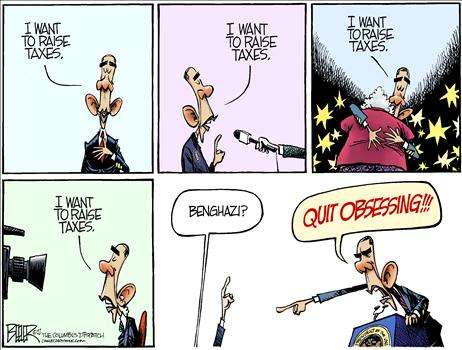
“Quit Obsessing!”

Saturday, December 1st, 2012

From the Columbus Dispatch.

Cross-posted at Rotten Chestnuts.

“And That’s Why I’m Not Ashamed to Talk About My Bank Account”

Friday, November 30th, 2012

Hat tip to Chicks on the Right.

How Terror Works

Friday, November 30th, 2012

“Extremely Scary Ghost Elevator Prank in Brazil”

Wednesday, November 28th, 2012

Hat tip to Bird Dog.

Found more meanness:

Time to Update Palin?

Tuesday, November 27th, 2012

Yeah, must have put this one together shortly after the accident that occurred four years ago…maybe need to drop that last “2” and stick in a “6” but it won’t do much good if she isn’t willing to step up. And who could blame her.

Over the past several years I see many trends. I’ve already discussed how there is evidently a hemisphere-wide attitude of hostility against simply dealing with details in the information, particularly the most important details, the details required to meet the stated objective. People talk about what needs to happen and at the end of every cherished make-it-all-good strategy, there is a trailing-off, it seems, a sort of vaporous and implied “…and then, I’m reasonably sure it will all work out okay.” But if you think on how such-and-such a cause is supposed to lead to such-and-such a desired effect, you realize you’re just dealing with more nonsense.

Compassion for those who are less well-off, it seems, is more and more of a forced sort of thing, not something to be left up to the whims of individual desire, or sympathy. It’s more and more taxed, which means coerced, involuntary. Simultaneous with this, there is a palpable dropping-off of the good old-fashioned feelings of true charity on the part of the givers, which is to be expected since, hey, they are no longer choosing their donations, the loot is being forcibly taken from them. And as for those receiving, it seems there used to be a sentiment of pure gratitude that is no longer there. Gimme gimme gimme, Obamaphone is free.

“Work,” at least the kind of work that earns respect and widespread appreciation, has changed. It isn’t productive work that people appreciate anymore, by which I mean the kind of work that creates wealth where it did not previously exist — or, the supporting work that makes that kind of work possible. No, we seem to be reserving our appreciation for “hard work” for the work that is purely non-productive. Or even anti-productive…the kind of work that interacts with that other work, the kind that creates wealth, and interferes with it. Don’t build that, there’s tree sloths & snail darters & caribou or whatever…

Side note: Dirty Jobs with Mike Rowe has been canceled. Welcome to twenty-twelve.

Forward!

I have faith. Things can get only so absurd, and then they’ll have to snap back again. It always works out that way; thing is, it’s always damned uncomfortable. Our fate lies in that direction, somewhere.

Free the Weed!

Tuesday, November 27th, 2012

According to Mr. Crowder’s IMDB page, he was born in the summer of ’87. So somewhere around 4:30 when he embarks on this “what the hell is the matter with kids these days” lament, well, that kinda smarts. What in the hell is “pogs” anyway??

See, here is why I can’t get with the legalize-it crowd. Just like with the liberals, it isn’t what they don’t know, it’s that they know so much that isn’t so. The early part of this clip makes the point pretty nicely: You have a perfect right to ingest the herb, but passing nanny laws against your next Big Gulp, why, that’s “probably a good thing, actually” and all the rest of what they were saying there…eh? Come again?

It’s no different from what we’re seeing in a lot of other places — people “knowing” things because, and only because, they’re trying to become members of some in-crowd. And they end up spewing nonsense. Somewhere around the brink of adulthood, I notice people are particularly susceptible to this. It’s particularly popular around that age to pick up on some prevailing and traditional notion of two things that are similar, and display one’s cleverness and rebellious streak by rationalizing some difference. Or vice-versa, to attack a more orthodox notion of difference and start monologuing about similarities. And the problem, of course, is that sometimes when our cultural traditions say two things are different, or similar, it isn’t a very rare happenstance that it turns out this is quite correct. And, once again, the overly-clever rebellious-but-law-abiding youths are caught, with their own identifiable voice-boxes positioned behind absurd, silly things.

It’s embarrassing just to watch.

When Technology is Used in Marketing…

Tuesday, November 27th, 2012

One of my social networking friends uploaded a re-transcribed “fail in Google Voice transcription” and oh, boy. Our technological journey seems to have taken a turn down the wrong cul de sac.

This really gets under my skin. Machines should be used to augment and enhance the return on investment when humans put time into things; it should never, ever be used to soak that time up or burn it away. If ever that is to happen, then we have to get into nets & grosses & all that stuff…and it seems we are now well past that point…but, even more worryingly, it seems lately the net is a negative. Meaning, we’re getting less done everyday than we’d get done if we just lived like the Amish.

Every time I pick up a ringing phone and hear some machine getting ready to connect me to some human who couldn’t quite spare the time to try to contact me personally, I’m more and more convinced of this. I don’t just hang up, I throw the damn handset across the room. Well, if the woman is home at the time, I only think about doing that. But it really, really pisses me off, the very thought of it: Machines being used to stop people from going about doing what they were doing. Machines being used to harass people. To do the harassing that the human harassers couldn’t quite find the time to do, without automated harassing-assistance. What, are we nuts?

You realize what else we have to consider? Perhaps the professional harassing humans can’t find the time to do the harassing they need to do, because they, in turn, are being harassed…by machines…which, in turn, well you can fill in that stupid little cycle all by yourself. Yes, it is endless.

Quoting myself:

I swear, if we could leverage technology to actually do productive things, as efficiently as we can leverage technology to go bothering each other, by this time we would have journeyed off to the brightest star in the Sirius constellation, dragged it back here in a great big net, and ground it up in a giant food processor to make a delightful sweetening powder for our corn flakes.

I’m seeing a lot of job postings for programmers in C#, .NET, Java. So…web development. And when I consume the web, what new technology do I see being developed, you know, on the web? Advertisements. Popup windows. Videos that auto-play, with sound and music. Little applets and widgets that wait until you’ve managed to call up the article you wanted to read…and then explode in your face with useless bits of nonsense. Refinance your house, pull in those chicks with some testosterone, make your dick bigger. Obama wants to send you back to school, find out if you qualify.

Reminds me of that favorite quote of mine about airport security, from an Israeli security expert:

The United States does not have a security system; it has a system for bothering people.

We have gotten awfully talented at bothering each other, interfering with what other people want to get done, haven’t we? Technology has made us unusually “productive” here, as of late.

Anti-Bullying

Tuesday, November 27th, 2012

Just have to get something off my chest here. Although, to be clear about it, my biggest “peeve” with this issue is not any of the many peeves themselves, it’s the nagging doubt I have that any of this comes as news to anybody, certainly not to those who are promoting the anti-bullying policy.

I was bullied, back in the day. We didn’t have anti-bullying policies. The response from the school officials who might have been in a position to do something, was pretty uniform: If we do something to interfere it will just make the problem worse. Continuing with this explanation of the dazzlingly obvious — although we today are supposed to deplore that attitude, and I certainly didn’t think highly of it at the time, it was & is completely correct. And it taught me the lesson that “nobody is looking out for your welfare, that is completely up to you.” Which is also correct. The drawback was, of course, it was up to me to toughen up to such a level that the bullies left me alone & went on to something else. Which, it turns out, really doesn’t involve that much toughening.

I remember stopping a bit too quick when I was being chased, on a downgrade, sending the bully sailing overhead out of control. Another one in the following year got a swift jab in the solar plexus, and I think that was about it. There’s a difference between taunting someone, and blocking him into a corner, you know. Bullies are cowards, they don’t like victims that fight back, they only prey on those weaker; it’s in the definition. So what concerns me nowadays is that this is the very first tier of learning to deal with a confrontation when there’s no authority figure around to bail your skinny ass out of trouble. We’re going to get rid of that? At the very least, it seems there are some potential liabilities involved in that, that should be inspected in foresight rather than in hindsight.

That is just the first concern I have, that comes immediately to mind. It is the most pressing. I’m not alone in thinking about it. But there are other things that should be bugging people about this more than they do.

I dislike seeing a website called www.stopbullying.gov. The TLD gives me the creeps more than any bully ever did.

Here’s something else that raises my concerns. I recall from the years gone by, that bullying had very little to do with physical torment or intimidation. The bullying I remember, would be much more accurately described, as: A perpetual celebration of the ability to bamboozle and hoodwink the authority figures. And I daresay every single teacher who has ever breathed air, knows exactly what I’m saying. “What, MEEEEE?” Don’t know what he’s talking about. I was just minding my own business. And the all-time favorite: He is actually the one who was hitting me.

I’m seeing all sorts of focus-group-tested and committee-crafted phrases, sentences, paragraphs about zero tolerance. I’m seeing not a single syllable about making the authority figures any smarter, or less distracted.

This suggests to me, rather persuasively, that it’s the bullies-grown-up who are behind the anti-bullying policies. Aren’t all the characteristics there? Smooth talkin’; getting the last word; no appeal, zero-tolerance.

And then there is, if we had some demonstrable talents in any other area of life, we’d be doing that & not this. That reminds me of the bullies, too.

Memo For File CLXXV

Tuesday, November 27th, 2012

On Sunday, on the Hello Kitty of Blogging I made an observation…and a funny…

Over the last twenty to thirty years or so, we have been seeing the ascension of a modern cultural crisis which takes the form of: People who loathe any kind of reckoning with details, insisting on unilateral control over efforts that can only be successfully realized by dealing with details. Examples abound and an exhaustive listing of them would not be useful here.

As is the case with most things, if we’re merely pondering what’s going on and figuring out what to do about it, any “exhaustive listing” wouldn’t be of much use anywhere. On the other hand, if you’re seeing some task through to the end and the task has any layers of complexity to it at all, you have to make a list and it has to be complete. I’ve had this out with my son throughout the years during our battles about homework; now that he’s in high school it seems the lesson is starting to sink in. (That puts him three years ahead of me, at the same stage.) I’ve lately taken to referring to this with a metaphor involving a “heap of gravel.” What thoughts and feelings are churning away inside you, as you pick up a shovel and tackle a pile of gravel that is so large and so heavy, that all you can do is slog away at it endlessly; hoping against hope that there isn’t some guy, or bunch of guys, maybe a machine, depositing more gravel in the pile on the other end? Answer: Not much. Just “let’s go,” and that’s when you are at your best. The mind shuts down. You feel a sense of hopelessness and despair. Whether you’re willing to admit it or not, you are overwhelmed with a sense of boredom and, ultimately, futility. You may actually see it through, and the results may be impressive when you’re finally finished. But you’re not at your best, you aren’t operating efficiently.

And worst of all, if someone comes along asking for a progress report or estimated date & time of completion, you can’t give them one.

So what I’ve been teaching him is: Before you start any task that is sufficiently complex that it requires a list to define what exactly it is — and most tasks are like this — make the list. Let’s look at it logically. There are three things you’re trying to do: 1) Keep yourself out of that depressing, soul-sucking “pile of gravel” mindset; 2) Track your progress, or at the very least maintain yourself in a position to do that; 3) At any given stage, after you have completed certain subtasks, make some qualified, informed decisions about what you should be working on next. The last of those may be the most important of all. You have to prioritize.

An exhaustive listing is needed for prioritizing. Prioritizing is nothing more than a decision based on a sequencing of some kind, and since it is sequencing, if the list is not complete then the decision is nothing better than guesswork. And then there are those other two objectives, staying out of the pile-of-gravel, and tracking progress. Both of those depend on the production of a fraction at any given time, a quotient between 0 and 1, showing how much of the task has been done and how much of it remains. Without that quotient you cannot do these other two things. Without the quantity of subtasks defined, you cannot produce the quotient because you won’t have the gross count which becomes the divisor. Without a record of each subtask, and some status maintained for each one, you won’t be able to produce the dividend. The quotient is the dividend divided by the divisor, right? So you need both of those two to make the one.

So quit fidgeting & pretending your pencil is a spaceship, and make the [expletive] list.

Do it, first and foremost, to get that number in Column A, row <n>; and, that “Completed” column whichever one it may be, so you can produce your fraction. Then, use your noggin to figure out what your prioritizing strategy is. The strategy determines what other columns go in. If the strategy is more complex than you might have thought at first, you’re going to need more columns than you thought you would. And this will usually happen. Build it once, make it proper, make it good, make it useful. Build it so it only has to be built one time. Go ahead and “waste” that time because it’s better to lose it up front rather than later.

I’m confident that this is putting him on a path that generally meanders toward success. This certainly would have been true some half-century ago. But I must confess, looking at where the world is going, this rising antagonism toward grappling with details, I have my doubts.

EducationAll my professional success, looking back on it, has derived from the exercise described above. The way I see it, this is what work is. But I also notice most of my little conflicts in the work environment have come from this as well. It entails some measure of independent thought…not very much, by any fair standard, but some. I have learned, periodically, that there are some people who can’t stand this. It isn’t just because they’re threatened by it, although there might be some of that. I’ve encountered some conflict with professionals who simply seek to gel with me, to team up with me, with each of us lending our individual efforts toward a common goal, and they’ve found they can’t do it. It’s not exclusively their problem but then again, it seems to me it’s not exclusively mine either. There are those three objectives, aren’t there? How else are they to be done?

Throughout the years I have gradually learned that in many cases the answer is, simply: They aren’t being done. The first objective is to keep your thoughts and your emotional state out of that depressing mire of gravel-digging. The lesson has gradually sunk in, for me, that this whole thing that people call “education” without very much discussing what the education is supposed to be, has a lot to do with building up a tolerance for monotony. Compared to this frame of reference, I’m spoiled and I might have a raging case of what they now call ADD, because I haven’t built up this tolerance. What I’ve built up, instead, brings us to the second objective which is to produce periodic progress reports; I have come to the realization that while some professionals do have such a requirement built in to the descriptions of their jobs, the vast majority of them, even the ones in skilled, technical occupations, do not. Now in my case I have actually been one of the ones who do have such a job description, so if I wasn’t already building these kinds of checklists before my formal training in project management, I would have been forced to have started it then.

But the fact is, here is how it really works: The engineer keeps his job skills current by going to training, and the training is some mash-up between “here is how all the pieces of our product fit together,” and “here are the steps you follow to do this thing, if anything goes wrong then call our support line.” And by “mash-up” what I mean is, any given cert program may be all of one & none of the other, or some combination of the two — the training may make a point out of keeping the content heavy on the assembly-of-parts stuff and light on the scripted-process stuff, but it doesn’t matter because management, and I’m describing at a high, generalized level here, doesn’t give a rip. Management is either paying for the training or making hiring decisions based on the training. So the point is, this vital distinction between outcome and process, doesn’t matter much in the final analysis because it doesn’t have any currency. The market doesn’t value the distinction. We can quibble all day long about whether or not it should, but it doesn’t.

So the engineers are given some kind of knowledge, which they then supplement day-by-day by attending to the job. Regarding the work itself, they are typically tasked with going at it pile-of-gravel style. The “priority” sequencing I described amounts to: Keep working until the thing is done, and make some kind of informed decision about going home when it isn’t done yet, based on whether the thing is a mega-super-high priority. That’s how engineers deal with priority.

Then, they report to the project manager who centralizes all this concern about status, completed, producing the quotient, tracking the progress, et al. Along with, next-subtask-to-be-worked. Usually, it is the project manager who owns that; he figures out what it is, or else it is chosen in some meeting environment, with project stakeholders providing their input…which is very likely to be “chaired” by this project manager.

Now, this is such a simplified explanation that it demands a whole lot of caveats, and the caveats are not trivial. One certainly does hope that if a job requires something called “engineering,” it should entail some complexity even within the most minor tasks, at least greater complexity than what is involved when one uses a shovel to move a scoop of gravel. But at the highest level of what it seeks to point out, the explanation works, for what it seeks to point out is this: Corporate America, and perhaps Corporate Western Civilization, has been making a point of isolating this task-tracking job requirement into managerial roles that are specifically delegated to provide a proper stewardship over all of it. So that no one else has to.

I’m very reserved about discussing job stuff on the blog. But I’ve spent a lot of years on each of the two sides of this “line,” so to speak…and although I’m unsure of what is to be done about it, I’m thinking I’m sufficiently qualified to say I’ve described something that actually does exist. And, to the extent it exists, it seems to be exacerbating a cultural split amongst us, that runs rather deep.

Now, this ties in to the election wreckage from earlier this month, and the identity crisis conservatives are having as they try to figure out what it all means. There are those who suggest that America, when all’s said & done, is a liberal nation and we’d all do well to just get with the program. There certainly is some evidence to support this point of view; if a dominant theme did emerge on Election night, it was that many among our fellow citizens don’t seem to give a rat’s rear end about what the rest of us call “freedom,” and when those fellow citizens actually use the word, they aren’t using it to describe what we describe. I’ve noticed many of them insist that some defined and isolated class of oppressed-types is missing its “freedom” until the individuals within it are 1) held blameless for civil and criminal infractions, 2) never spoken of in any unflattering way, lest the speakers suffer some kind of swift punitive consequences for their “hate speech” and 3) offered a bunch of material goods and services free of charge. And maybe that’s just it; “freedom” means you get things for free. I’ve asked around as to whether things really are that simple, with one half of America defining “freedom” as freedom and the other half using the actual word to describe a post-capitalism phase in which people simply run around taking things without paying for them. I haven’t gotten a straight answer back on that yet. I’m not altogether sure what I should presume about that in the absence of any determinant answer, so I remain undecided. But it does make sense.

There are those others who suggest that America is not a liberal nation, that it is moderate to conservative; and it is voting the wrong way because it is uninformed, combined with the effect achieved when liberals have enjoyed the benefits of a choke-hold maintained on our educational institutions throughout much of the last century. I think I’m pretty much in this crowd. It seems to me the conservatives are still arguing about what went wrong because many among them are looking for the problem that has to be fixed, and with that accomplished the thinking is, although they won’t actually say so out loud because it sounds so silly, that everything will magically fall into place. Obviously, when there is more than one thing broken, that isn’t going to work out well over the long term. And there is. Mentally handicapped people being shuttled to the polling places, and coached to vote for Obama. If we’re looking for just one thing, we could start with that…Mitt Romney woulda-coulda-shoulda taken Michigan, Colorado, Florida, maybe even Pennsylvania and Ohio. There is the Electoral College we can be thinking about, and each of those states could have swung the other way with the vote count being altered not-by-much. But granting that — why should it even have been this close? Look at what kind of a leader Barack Obama really is. Inspiring, fills people with hope…uh, really? He just sucks. He plays golf, flies around, delivers speeches all of which are pretty much useless, ethereal, even interchangeable. Then He flies around some more and plays some more golf. Look out our foreign relations, look how the economy is doing. It’s all the very picture of a “leader” who is not a leader, isn’t even engaged. This shouldn’t even have been close.

The inescapable conclusion is that there are many broken things. (VDH, true to form, does a better job analyzing the factors than most, hat tip to Instapundit.) Liberals, having a vested interest in these things being broken, have been…well…breaking them. While conservatives did nothing.

So these people say that what we saw three weeks ago was the culmination of a lot of carefully-coordinated, driven, determined hard work by our friends the liberals since twenty years ago…or forty…or even eighty. I concur in part and dissent in part. Careful coordination, drive and determination are rather difficult to achieve. I think I know what they look like, and I think I know what the effort looks like when people try to get ’em going. I don’t see any of this stuff from our friends the libs. None of it. Even when they do exactly what I was describing, up above; finish up with one subtask, and put some thought into figuring out what the next one is. They do not look, to me, like Morgan working from one of his notorious thousands-of-rows-long 8-point-font Excel 97 spreadsheets. Not even close. What I see is raw, emotion-based, unbridled impulse.

What I see reminds me of a dog chasing a car.

Forward!

And when conservatives make their attempts to try to comprehend it, I’m seeing a mistake being made. I do not know if it is a meaningful one, and if it is a meaningful mistake, I can’t completely define how. Perhaps it does not matter. But there is a major disconnect here, and I think it’s got to do with conservatives seeing things in absolute terms, whereas liberals, like the dog chasing the car, see things only in the relative.

This is to be easily demonstrated by asking a lib one of my favorite questions: Once government has achieved perfection and provides everything it should be providing, how much spending to make it happen, on a dollars-per-nose-per-annum basis? What’s that magic number? It works particularly well after the liberal has just gotten done bellyaching about the lack of efficiency involved in privatized this-or-that, the failure to centralize some effort to provide resources, in which case they’re effectively blocked from the escape hatch of “can’t put a price on human [whatever].” They react like they’ve been tazed, or hit over the head with a board: completely stunned. To paraphrase one of our most frequent and respected comment-posters on this blog, if they thought in those terms they wouldn’t be liberals.

The fact is, liberalism isn’t really an objective. Conservatism might be an objective, but liberalism is merely a direction. Dog chasing the car. It doesn’t really know where it’s going, nor does it care.

So how about that list of ways in which we, as an evolving society, have become increasingly hostile toward the grappling with details. You know what? It turns out an exhaustive listing doesn’t do much good here, either. I’ll just add that to my list of things to do.

“The Lust for Generators”

Sunday, November 25th, 2012

Egads, what a silly title, I wince just typing that one in. But as the quotation marks suggest, I lifted it from someplace else, specifically this Nicholas Kristof piece.

In upper-middle-class suburbs on the East Coast, the newest must-have isn’t a $7,500 Sub-Zero refrigerator. It’s a standby generator that automatically flips on backup power to an entire house when the electrical grid goes out.

In part, that’s a legacy of Hurricane Sandy. Such a system can cost well over $10,000, but many families are fed up with losing power again and again.

(A month ago, I would have written more snarkily about residential generators. But then we lost power for 12 days after Sandy – and that was our third extended power outage in four years. Now I’m feeling less snarky than jealous!)

More broadly, the lust for generators is a reflection of our antiquated electrical grid and failure to address climate change. The American Society of Civil Engineers gave our grid, prone to bottlenecks and blackouts, a grade of D+ in 2009.

It would seem this “less snarky than jealous” business in the parentheses might have been inserted after initial publication. In any case, the honesty is refreshing. Not that you have long to wait before Kristof gets to the heart of the matter of what he wants to discuss…

That’s how things often work in America. Half-a-century of tax cuts focused on the wealthiest Americans leave us with third-rate public services, leading the wealthy to develop inefficient private workarounds.

It’s manifestly silly (and highly polluting) for every fine home to have a generator. It would make more sense to invest those resources in the electrical grid so that it wouldn’t fail in the first place.

But our political system is dysfunctional: in addressing income inequality, in confronting climate change and in maintaining national infrastructure.

The article isn’t very long and you should go read it from top to bottom.

It is a fascinating study in how otherwise-intelligent, and no doubt well-intentioned, people get from “I wish to be seen participating in a political process to provide safety nets for those who need them” to the mind-boggling “there is something wrong when the lowly individual is able to take extra steps to protect himself.” Turns out that chasm is not so wide & yawning. Or, if it is, the mental gymnastics of Kristof find a way to shrink it down and make the leap.

But Dr. Jacobson (hat tip to Dyspepsia Generation) has a few words to offer by way of rebuttal…

[W]here is the link between marginal tax rates and (a) the percentage of total taxes actually paid by top income earners, which has risen in the last 50 years, and (b) the electric grid. Assuming the false arguendo that higher marginal rates would have resulted in more tax revenue, where is the evidence it would have been spent on the national electric grid, rather than pork projects and giveaways for political constituencies?

There are those who believe, in the wake of this last election, that we are now heading for a “fiscal cliff” that entails such a damning fall, with such a great head of momentum built up, and we’re so close to the brink, that we as a nation are now doomed. If that is the case then it is to our national shame that things have progressed to this point, and we still don’t have a name for this mental feebleness which apparently has determined our lack-of-future. Words like “envy” and “jealousy” do not adequately describe it.

The calamity arrives; your neighbor prepared against it and you didn’t; somehow, your neighbor with the spare tire & the jack, or the jumper cables, or the swiss army knife, or the polyurethane or the canned goods or the bottled water in his basement must have screwed it up for everybody else. Or maybe the connection goes the other way? Looking out for each other depends, in some way that’s never quite stated or defined, on being unprepared for extraordinary discomforts, and thereby burdening your fellow citizens with your entirely avoidable lack of preparedness.

We don’t do right by each other unless we’re constantly diving from the stage into a mosh pit. Or something.

Month by month and year by year, I continue to be amazed that things that should not be called mental deficiencies, somehow are, and things that should be categorized that way, somehow are not. I do not know if oblivion is avoidable or not at this point. But one way or another, we’d better get cracking and start fixing this. We need to start categorizing these mental illnesses before we can address the spending issues, that’s the take-away from this. Or, could it be that the New York Times has branched out into the satire business and I shouldn’t worry? I hope that is the case. But I have to doubt it, and my concerns are there.

The War on Men

Sunday, November 25th, 2012

Suzanne Venker:

Believe it or not, modern women want to get married. Trouble is, men don’t.
:
As the author of three books on the American family and its intersection with pop culture, I’ve spent thirteen years examining social agendas as they pertain to sex, parenting, and gender roles. During this time, I’ve spoken with hundreds, if not thousands, of men and women. And in doing so, I’ve accidentally stumbled upon a subculture of men who’ve told me, in no uncertain terms, that they’re never getting married. When I ask them why, the answer is always the same.

Women aren’t women anymore.
:
…[T]he so-called rise of women has not threatened men. It has pissed them off. It has also undermined their ability to become self-sufficient in the hopes of someday supporting a family. Men want to love women, not compete with them. They want to provide for and protect their families – it’s in their DNA. But modern women won’t let them.
:
It’s the women who lose. Not only are they saddled with the consequences of sex, by dismissing male nature they’re forever seeking a balanced life. The fact is, women need men’s linear career goals – they need men to pick up the slack at the office – in order to live the balanced life they seek.

Not exactly as ground-breaking as it has been presented here, at this point. And it comes as no surprise to me. Although I suppose I’m upsetting the trend by getting married at the end of next month.

But I do remember that brief stretch on the singles market, some eight-plus years ago, like it was yesterday. I was getting re-acquainted with it, since before that I’d been out of it again for, oh, another eight or nine years…so whatever changes took place there had a more pronounced effect on me, I suppose. And I recall having one thought more than the others: “Huh, well this seems like a match made in heaven if I want to be someone’s accessory.”

Venker “accidentally stumbled upon a subculture of men” in the course of writing her books, who were jaded against marriage. Well in the course of dating, I’d accidentally stumbled upon a subculture of single ladies who might as well have been responsible for making those men that way. They were all much more intelligent than I was, or am, at detecting the cultural trends of the moment and drifting around with them. And two demands here, are key: One, have a man; and two, don’t depend on him for anything. Ahem. No matter how you approach those, when you’re finished with them what you have is not much more than a teddy bear.

Some women buck the trend, and insist they are ready for a man to take his responsibilities in life, well, like a man. It turns out they’re much worse than the rest, and this is just a glorified way of saying “he should find out what I want and bring it to me.” These women make the mistake of assuming they’ve developed some keen insight on life’s challenges, leaving their sisters in the dust, by coming to grips & making peace with their own limitations. But in fact, all they’ve done is some cursory assessment of the difficulties involved in learning to drive a stick shift, arriving at the conclusion that it’s too much trouble and they don’t see the point.

You know, there’s an awful lot of that kind of thing going around lately: People seeking to define some keen insight they have, but once they’ve defined it you see there’s not a lot to it other than “I’m tired of trying to figure this thing out, so I’m just going to declare it dumb-and-stupid so I don’t have to figure it out anymore.” I think this would be just fine if it was something more like “I’m tired of figuring it out so I’m going to shut down this whole exercise, and file it as an object lesson in how I should appreciate the people who can do it, because I can’t.” There’s a subtle difference there, but an important one. The latter is a renewed appreciation for the socio-economic concept of specialization; the former is simply an exercise in limiting one’s life-goals and narrowing one’s world-view.

“Like You Liberals Give a Cluck About Thanksgiving”

Saturday, November 24th, 2012

If H.L. Mencken was right, that puritanism is the haunting fear that someone, somewhere, may be happy or having a good time; then surely, modern liberalism must be the haunting fear that someone, somewhere is raking in the dough from consumers willingly parting with it, and therefore getting their bills paid…without pledging themselves in any way to the agenda of liberalism.

“A corporation bites the dust. And what person in poverty, is better off for it?”

Where’s Her Helmet??

Thursday, November 22nd, 2012

From TheChive.

“-“

Thursday, November 22nd, 2012

We went to apply for our marriage license at the county office. What a fascinating custom, you fork over eighty bucks of your hard-earned loot, for that the clerk starts brow-beating your soon-to-be-wife about the possibilities of diminishing your manhood for the rest of your life by hyphenating her last name.

Fuck that. I did not relay her sentiments to the office in those words, I think I said something like “Yeah, I don’t think she’s too interested in that” — in a calm, soothing, but commanding and most patriarchal baritone. And there were giggles all around.

Had a casual conversation over on the Hello Kitty of Blogging about this, and discovered that I am by no means alone in this; I don’t care who it is, I’m not marrying anybody who’s keeping her last name or going in on that hyphenated crap. A lot of guys are of the same mind, it turns out. And that list of misgivings is not in sequence, I can certainly see the practical benefits of “just keep using the maiden name” if the woman in question has a career or some other tangibles built up around the identity she’s been using. If there are special expenses involved in a change, who am I to criticize? But that’s certainly not for me, she can marry some gelding somewhere, and I’ll stick with what I have. Wasn’t meant to be.

Think of it as a guy-competition thing. Other guys, within world history, have gotten married; some of them have been real stinkers, and I figure if they were good enough to foist their last names onto their brides, then so am I. Besides of which, for a surname that’s only 98 years old “Freeberg” is very hip and modern and with the times: You can type it in with your left hand while holding a beer in your right.

I absolutely detest hyphenated names. They represent, to me, a determination to ignore time. I mean, think this through: You’re a maiden losing her maiden-ness, getting married. But you’re such a hard-ass that you refuse to be subjugated by the patriarchy or whatever, and what to keep your name, so you’re first name, space, maiden-name hyphen married-name. That should show ’em! Alright, and your kids’ names are going to be what? And your grandkids’ names? And your great-grandkids’ names?

So the way I see it, since that’s impractical and it takes only about four or five decades to be exposed as such, this is all about living in the moment. It’s all about secularism, defining the ultimate goal of life as “being happy,” feeling-over-thought, who gives a rip about about tomorrow…

There is another thing going on here which I think I could call “agreement fatigue.” Right or wrong, I perceive that there is a new culture rising up within this thing we have taken to calling “feminism,” and its dictate is that males who lack aggrieved-minority cred — read that as, males who are of full height, hetero, Catholic/Protestant and Caucasian — are essentially binary; they can stick to a pure-passive role and simply agree with everything that comes along, or else they’re some kind of “ist.” It’s an all-or-nothing proposition, there is no in-between on this. Our sometimes-blogger-friend Margot Magowan made that abundantly clear, when it comes to looking at how a female is dressed & styled & presented and drawing inferences about what it all means, chicks get to do that and dudes don’t…unless the dudes are simply expressing agreement with the chicks. My observation with this sub-culture has been, this seems to be the way it works, across the board. Chicks get to have opinions, dudes get to have opinions that are aligned with the opinions the chicks have already expressed. Other than that, the dudes aren’t allowed to have any. So of course the expected reaction is going to be “Okay honey, hyphenated is just fine with me, whatever you say.” And, of course, once again I am going to fail this cultural expectation. As 2012 reaches a close, I’m all “whatever-you-say”-ed out, I’ve done used it all up.

So hyphens are not for us. But I do have to say what impressed me the most, was making all these options available to the li’l lady as if she hadn’t already given this some thought. My gal’s brain is considerably bigger than that. Uh, who’s isn’t? How does that conversation go…”Oh, I hadn’t thought of that, I could hyphenate my name!” No need to discuss it with the schmuck standing next to you who’s promising to raise any whelp that pops out of you, and pay all the bank fees on your bounced checks along with your overtime parking tickets.

This is one of many reasons why I don’t like to see government involved in family stuff. Government has a tendency to promote the dysfunctional, the living-for-today stuff. The self-destructive, lefty-hippie stuff. That’s where it goes. Conquest Rule.

Radical, Extreme Ideas

Tuesday, November 20th, 2012

Turkey Day minus two. No extended family showing up at our place this year, let alone any bug-eyed crazy McGovern-voting granduncles, so we’ll be spared that. Our hearts go out to those of you with your own blood-relative Joe Bidens who’ll be smirking at you over the stuffing and yams, reminding you of how much your side sucks and you need to come to terms with how much sucking you do, or whatever.

But our Thanksgiving will be politics-free.

One task remains to be done: I am hearing from a variety of different directions, from those hip and cool leftists as well as from some of those on the right, that the GOP — the one that nominated Mitt Romney, John McCain and Bob Dole — needs to retreat from the cliff. It needs to identify these kooky, weird extreme ideas that turned people off, and jettison them. What is kooky and weird though to me, though, is that these people seem to have a lot of adrenaline built up toward this objective and yet the very next step…which is to name some specifics…remains undone. They just stick to the general, high-level, useless message “get rid of those extremist ideas.”

Odd that the specifics should fall to me. And yet, they do. So I came up with twenty candidates. Can’t get rid of what you haven’t identified.

I’m thinking of leaving the final filtering & sequencing up to someone else though. So which ones, among these, cost the Republicans the election? Which among these odd, radical, kooky, weird, extremist, unreasonable ideas?

1. If you value that thing you have less than a certain amount of money, and I value that thing you have more than the money, we should be allowed to meet and facilitate a private sale that is agreeable to both sides.
2. If we’re concerned about the economy getting better & stronger, we should want to have more people getting rich and fewer people getting poor, rather than the other way around.
3. We should do something to make sure people who are casting votes in our elections, really are citizens who are eligible to cast votes.
4. “Freedom” has something to do with being able to do things FREE of interference, particularly by the government; it doesn’t refer to people getting material things FOR FREE.
5. We have to question the “Biden Doctrine” that says we have to spend lots of money to keep from going broke.
6. We have strong doubts that when you spread the wealth around, it’s good for everybody.
7. Sloppy wet camping in the middle of urban parks, pooping in buckets and calling the whole silly circus “Occupy-something,” is unlikely to solve any problems.
8. It probably is not among the legitimate occupations of the First Lady, to run around telling kids what they shouldn’t eat.
9. Especially if it has the effect of bankrupting companies and sending thousands of people to the unemployment line.
10. When a public-sector agency unionizes, and the “negotiating” ends up being government-to-government with no REAL compromises taking place…something might be a bit cocked up about that.
11. There might be a bit more to the United States Constitution than “NO CROSSES ANYWHERE, ROE V. WADE, END OF CONSTITUTION.”
12. “Dear liberals: A binder is something you keep resumes in. A resume is something you give someone to get a job. A job is something we do so we can make money.”
13. There’s more to “education” than the word; we’d like our kids to calculate that change for a sixty-two cent sale, out of $1.12, is two quarters. In their heads. Just for starters.
14. There’s more to “sitting down to talk to our enemies” than just that. We’d like to have some serious discussions, stateside, about what’s being negotiated before that happens.
15. Looking at a truly beautiful woman is a pleasant experience, nothing is made better when there are fewer pretty women and more ugly women.
16. People are capable of doing more things when they have more money, nothing is made better when there are fewer rich people and more poor people.
17. Babies are innocent and good. Convicted murderers are guilty and bad. Nothing is made better when babies are executed for nothing, and murderers are spared after doing something.
18. If it costs too much money to do business in the United States, and as a result of this a company “offshores jobs,” the people who run the company might not be the problem.
19. If terrorists launch an organized attack on our embassy in Libya, it might not be a good idea for our leaders to jump to a conclusion that “it was the video.”
20. Supreme Court justices should probably decide their cases according to the applicable legitimately ratified laws, not out of any kind of sense of “empathy.”

So someone tell me: Did I leave something off? If so, what is it? If not, then which one is the screwiest, the nuttiest?

I’m willing to keep an open mind about “getting with the program.” But first, someone needs to explain to me what the program is. I have doubts that anyone, anywhere, really has a clear picture of what it is.

Steve’s Place

Monday, November 19th, 2012

Sent in on an offline from WTBBIL (Wife-To-Be’s Brother-In-Law). Found it here. I LOL’d…

Last week, we took some friends to a new restaurant, ‘Steve’s Place,’ and noticed that the waiter who took our order carried a spoon in his shirt pocket.

It seemed a little strange.

When the busboy brought our water and utensils, I observed that he also had a spoon in his shirt pocket.

Then I looked around and saw that the entire staff had spoons in their pockets.

When the waiter came back to serve our soup I inquired, ‘Why the spoon?’

‘Well, ‘he explained, ‘the restaurant’s owner hired Andersen Consulting to revamp all of our processes. After several months of analysis, they concluded that the spoon was the most frequently dropped utensil. It represents a drop frequency of approximately 3 spoons per table per hour. If our personnel are better prepared, we can reduce the number of trips back to the kitchen and save 15 man-hours per shift.’

As luck would have it, I dropped my spoon and he replaced it with his spare. ‘I’ll get another spoon next time I go to the kitchen instead of making an extra trip to get it right now.’ I was impressed.

I also noticed that there was a string hanging out of the waiter’s fly.

Looking around, I saw that all of the waiters had the same string hanging from their flies.

So, before he walked off, I asked the waiter, ‘excuse me, but can you tell me why you have that string right there?’

“Oh, certainly!’ Then he lowered his voice. ‘Not everyone is so observant. That consulting firm I mentioned also learned that we can save time in the restroom.

By tying this string to the tip of our you-know-what, we can pull it out without touching it and eliminate the need to wash our hands, shortening the time spent in the restroom by 76.39%.

I asked quietly, ‘After you get it out, how do you put it back?’

‘Well,’ he whispered, ‘I don’t know about the others, but I use the spoon.’

“Be Safe Around Trains”

Monday, November 19th, 2012

From TheChive.

Memo For File CLXXIV

Sunday, November 18th, 2012

Even with the Petraeus/Allen sex scandals and Hostess going out of business, and Thanksgiving looming on the horizon, an improbable leitmotif has retained its dominance over all others: “I’m so sick of all the mud-slinging and campaigning and so glad the elections are over, most of all I’m tired of hearing about what those Republicans need to do to bring themselves back to life again. But, while I’m on the subject, here are MY words of advice for them…” There typically follows some helpful hints for the GOP that seem to have been culled straight from the democrat party, which boil down to: Become democrats.

Well, about that: The constructive advice is going to come after the constructive criticism, and the constructive criticism is two-fold. First, the know-it-alls within the Republican party — and, from elsewhere — identifying Sarah Palin as the cause of all electoral troubles and counseling that she should shut-up-and-go-away, was all wet. Everybody can agree on that, right? It’s been tested and it’s a flop. She was never the problem. C’mon…just admit it…I know you ultra-sophisticateds think so highly of your big brains and such, and difficulty in ‘fessing up to your mistakes is part & parcel of that. But there’s no getting around it, you were wrong on this one. You got want you wanted and disaster followed. You. Were. Wrong.

Private Sector is Doing FineThat, and: I think Ramesh Ponnuru (hat tip to The News Junkie) is on the right track…

The Republican story about how societies prosper — not just the Romney story — dwelt on the heroic entrepreneur stifled by taxes and regulations: an important story with which most people do not identify. The ordinary person does not see himself as a great innovator. He, or she, is trying to make a living and support or maybe start a family. A conservative reform of our health-care system and tax code, among other institutions, might help with these goals. About this person, however, Republicans have had little to say.

This is a bit outside my perspective, because I’ve actually worked for entrepreneurs. Quite a few of them, in fact. I tend to forget that this is an experience a lot of people haven’t shared; they hear “stifling regulation” and their eyes just sort of glaze over. They don’t see the connection. Maybe the boss will call them in and give them the “company is like a big clock” speech and give them their walking papers…and maybe he won’t. They aren’t put in a position where they’ll see the cause and effect. The erosion, also, is something that has to be communicated better. Too many of them see ten percent getting laid off and think “Oh well, I dodged that bullet, sucks that I have to do all this extra work though…” They don’t understand the increased likelihood that the next ten percent will also be laid off. That’s what a bad economy is, though. Everyone has to worry, and worry especially hard when they see the next guy being let go. One wave of discharge makes the next wave more likely, not less. The bullet is never really dodged.

And, increased regulation is what starts that whole chain-reaction.

But that is not the sad part. The sad part is, we are re-living what we saw four years ago when Barack Obama was first elected to the White House. It seems so strange, to me; I have, on occasion, been “elected” (hired or contracted or tasked) to do big things, at least, things much bigger than what I had been doing up to that point. Exuberant optimism and sensible pessimism collide, in my mind, to create a cyclone of inspiration which then churns into: What am I going to do on my first day? And, do I know nearly enough about the job, to start answering that question? If I don’t, then what exactly is it that I need to find out?

Obama’s people show absolutely none of this. Perhaps the urges are there, and they desire to conceal them in order to conceal the doubts that are necessarily associated with them. The “projecting confidence” thing, I guess. Well if that’s it, then now, as was the case four years ago, this does not seem too effective. I’m seeing all of the energy going into these tedious monologues about what bad people the Republicans are. It’s weird. It’s as if they haven’t won the election yet.

Where they do have some actual plans, those plans seem to have all the structure of an Underpants Gnome Profit Plan, with a big fat question mark in the middle, that remains a big fat question mark, never clarified…even when the plan fails. When that happens, all that happens is finger-pointing, followed by another underpants-gnome plan with a big fat question mark in the middle of it again.

I’m altogether confused about what to make of it. I’m repeatedly seeing all this lecturing from all sides that Obama is “owed respect because of the office that He holds.” There is legal authority that goes along with that, whether we like it or not, because it is entirely valid legal authority. And hey, He must know something about what He’s doing because of this victory, right? And yet — the very first thing a victorious candidate should be expected to know about campaigning, is when the campaign is over. Obama doesn’t seem to know this and, worse yet, doesn’t seem to care.

Another day, another reason we shouldn’t vote for Republicans. But, not much real leadership.

I was sorry, at first, that the very earliest sign that the election would not do anything helpful for the economy, was the demise of a huge company that makes snacky-cakes and so forth. We have the eighteen thousand people looking for work now, and for all that slippage, there’s not much clear communication of how this all works because, well, it’s just starchy crap you put in a kid’s lunchbox when he’s spoiled. So who cares? So it’s just more economic damage, with the electorate remaining under-informed and confused about the cause and effect…more of the things we have seen plenty enough already. Who needs it. Not much opportunity for education to be going on.

But thinking on it further, I see this is a good illustration of the problem, after all. Hostess wasn’t sunk because of Obama’s disastrous leadership, its demise came about because of union negotiations. And what are those: Artificial constraints. Options systematically eliminated. A bunch of musts and oughts and shoulds, written up into a contract. Lines drawn in the sand, which must be respected by the producers, drawn by non-producers. We have become quite adept at that lately, haven’t we? It is fun to imagine that, in so doing, we are building something. The Hostess thing demonstrates clearly that this is a destructive process, and not a creative one.

Generally, this is where the big mistakes are made: Destructive processes mistaken for creative processes. And so this shows where the mistake was made, in re-electing Barack Obama. A lot of people are having quite a thrill imagining that Obama is building something, but can any among them provide some specific answers about what He is building? There doesn’t seem to be any such answer, anywhere. But the people who believe He’s a destroyer, can certainly provide some specificity on what He’s destroying. That says something.

But, again, the election. Obama won, so He is the better incarnation of the feelings dominating the American landscape now. And I agree with that; this is the dominating sickness. People want to destroy things, and fool themselves into thinking they’re building something.

There is another epiphany to be observed here. The musts, the oughts, the shoulds. We all like to have an impact on each other; I think most people who desire this, would identify within the goals they cherish the most, things that have to do with thinking big. They would say we should try to work with each other, in unity, in part so that we can share the learning experience. Something about how we would benefit from our diverse range of backgrounds, our different points-of-view would provide perspective that would be missing if we were all to work in our silos. Added to that, they would say, we could help each other out, encourage each other, lend a hand. Is that close?

SelfishMy observation is, whether we like to admit it or not, this is not what we have been doing. We don’t encourage each other by coming together, not under the destructive stewardship of an Obama anyway. The encouragement, experience has shown us, is consistently toward the desultory actions. The ass-sitting. The living at home, on Mom & Dad’s health plans, until age twenty-six. The voting for the candidate who will give you a free cell phone. The ridiculous “Occupying” which means, if it means anything at all, acquiring one’s needs and wants through bitching and complaining and obstructing the efforts of others, as opposed to exchanging goods and services with those others for mutual benefit.

Allow me to offer an unflattering suggestion: We aren’t doing a good job of encouraging each other, because that is not where our efforts have been going. Encouragement is tough, and unappealing; encouragement toward productive actions is even tougher and even less appealing. Meanwhile, there are the musts, the oughts, the shoulds. That is much more fun, because it feels like power. And so our “coming together” energy has been focused on coming up with new restrictions, on telling each other “you can’t do that.” We very often speak to each other of rules that don’t even exist. “You’ll have to take down that American flag, because someone might be offended.” Don’t wear that shirt. Don’t tweet that message. Don’t put that in the “regular” garbage. You can’t say that, it might be construed as [insert something]-ist. Can’t buy any more than sixteen ounces at a time.

And don’t say anything bad about Obama, whatever you do!

It has the feel about it of pointing out the obvious — and maybe it is. But these are the words of people who wish to become guides and teachers, but lack the wisdom for it; they want it just because they have become bored with their ordinary lives. They wish to anesthetize against the boredom by telling others what to do, and it turns out it’s much easier to tell other people what not to do. They counsel us toward together-ness, but it isn’t the together-ness that appeals to them. They do not wish to encourage, they wish to impose constraints. They do not wish to provide lift under the wings of their fellow “birds,” their efforts are entirely invested in clipping those wings. Must not. Don’t. Stop. Can’t.

I have every confidence in the world that, to the last man, they’ll say I shouldn’t be blogging any of this.

But, it’s a problem we’re encountering more and more lately. Everybody wants to be the inspiring teacher, the one who provides the “big” encouragement, who fuels the “big” thoughts. But in practice, this big-encouragement seems to be pretty rare. It’s much more common we see the little stuff, the petty stuff, the can’t/don’t-do-that stuff. The little-rules, conjured up on the spot, even where the rules don’t exist people just make them up, either lying outright or seeking refuge in this craven and cowardly “might be a good idea not to do that” stuff. The ankle biting.

Leadership is reflected in landscape. I still have optimism we can succeed, by way of genuinely encouraging each other, daring each other to dare, dreamin’ big. But four years in, it is only becoming increasingly clear month by month that where that happens under the leadership of Obama, it happens in spite of Him, not because of Him.