Archive for the ‘Uncategorized’ Category

“They’ll Never Stop Doing it”

Sunday, May 4th, 2014

Derek Hunter writes at Townhall.com:

To progressives, you aren’t an individual, you’re your skin. Clarence Thomas isn’t a man, he’s a black man. He isn’t an American, he’s an African American. It’s the prefix, not the person, that matters. That, at its core, is racism.

Donald Sterling never will be accepted in polite society again, and rightfully so. He may even be forced to sell his NBA team for his private racist comments. Meanwhile, Democrats will continue to exude racism publicly, and proudly, in the hope that it scares the hell out of voters, particularly minority voters, and keeps them from realizing their lives depend more on who they are and what they do than on any politician or party. Democrats will continue to convince people that even though their lives haven’t improved after decades of loyally voting for Democrats and their ever-increasing government programs, the alternative is worse, so don’t try it.

It’s divisive, cynical, cruel, un-American and racist. It’s also the path to, the reason for, and the basis of Democrats’ power. As long as it works, they’ll never stop doing it.

Explaining Income Inequality at the St. Regis

Sunday, May 4th, 2014

Cave Pussies live it up, and make their plans:

Personally, I think the $200 two-ounce pour of Pappy Van Winkle is the perfect bourbon to sip on whilst discussing the evils of inequality.

Another shot, bartender, for the irony-challenged.

I Made a New Word LXIX

Sunday, May 4th, 2014

Cave Pussy (n.)

1. Humankind’s very first liberals, the cavemen who never bothered to learn to hunt or to brew ale; when the cave-conservatives dragged a big carcass back to the fire to carve up and feed everybody, the cave-pussies felt the need to justify their share of the meat, and so contributed some rules about how to divide it all up. Later on, they invented claiming credit for the meat, blaming the conservatives for whatever food poisoning might have happened, and vegetarianism.

2. Any modern day successor of the original cave pussies. Any liberal who implies, directly or indirectly, successfully or otherwise, that he and his friends are the ones who acquired this meat, just because he and his friends are the ones who are making rules about how it’s to be divided.

3. More broadly, anyone who confuses the provisioning of a valued commodity, with its regulation, and erroneously credits the rule-makers with the actual production of the assets.

Memo For File CLXXXVI

Sunday, May 4th, 2014

I finally found it. Kinda-sorta. See, this comedy bit has been kicking around for many years now, about how the human species began to be split between conservatives and liberals while we were still living in caves. It’s funny because there’s no way it could all literally be true, and yet — well, it isn’t entirely false either, is it.

The version I finally found, and I knew I had read this before I just couldn’t find the link…the part that draws my attention goes like this (emphasis added):

Some men tried to conserve remnants of the old way of life (hence the term “conservative”) by spending their days in the open field in the dangerous pursuit of big game animals. At night they would roast their prey at a big barbecue, and afterwards sat around the fire drinking beer, passing wind and telling off-color jokes.

Other, more timid, souls stayed closer to home. They are responsible for the domestication of cats and the invention of group therapy. Mostly, they sat around worrying about how life wasn’t fair and concocting elaborate schemes to “liberate” themselves from inequity (thus their designation as “liberals”). From this came the concept of Democratic voting, to decide how to divide the meat and beer that conservatives provided.

The thing that still puzzles me is, it bears a copyright date of 2012. But I know I saw it worded this way, before that other version I took the time to blog (before the link to that version was lost, evidently forever), which says

Some men spent their days tracking and killing animals to barbeque at night while they were drinking beer. This was the beginning of what is known as “the Conservative movement.”

Other men who were weaker and less skilled at hunting learned to live off the Conservatives by showing up for the nightly barbeques and doing the sewing, fetching and hair dressing. This was the beginning of the Liberal movement. Some of these liberal men eventually evolved into women. The rest became known as girlymen.

As far as making-a-funny, this is a distinction without a difference. The difference is in the other mission, the more serious social commentary: Liberals love to make rules, rules about how goods should be divided up, goods that they did not capture, or harvest, or invent, or find. Others do the real work, they do the “work” of figuring out who should get what. You might say these rules are what they bring to the table — that’s their contribution. The version I found eight years ago doesn’t mention this at that key part, where the split occurs, although it does go on to say:

Liberals produce little or nothing. They like to “govern” the producers and decide what to do with the production. Liberals believe Europeans are more enlightened than Americans. That is why most of the Liberals remained in Europe when Conservatives were coming to America. They crept in after the Wild West was tame and created a business of trying to get MORE for nothing.

And that nails it very, very plainly. Just not elegantly. I think it’s important to mention that, after that first kill, there must have been an abundance of meat and an abundance of people to consume it, along with an assortment of cave pussies who

The first time man ate cooked meat, the kill was dragged to the campfire by — who else? — the first conservatives. It would have to be that way, wouldn’t it; throughout antiquity, liberals have been opposed by principle to learning any of the skills needed in a hunt. So the liberals, having contributed nothing to the feast at all, in fact having ridiculed the conservatives as they gathered their ropes and knives and spears to go out on the hunt that morning, quickly came up with some rules about how the food should be divided. And one or two of them maybe brought some hummus; but mostly, they contributed rules.

Why am I so fixated on this? Because it’s important. It was almost certainly true, in some way or another, back then; we look all around and see it’s true today. It’s been true throughout all of our lives, in all of the history we can read, and so it has to have been true every day in between. Conservatives come up with something that can help people, that they can sell and thus selfishly hoard the profits; liberals scold them and ridicule them for engaging these enterprises, and learning and teaching the skills needed; conservatives haul in the bounty, and the liberals make a bunch of rules about how that’s to be divided up. Liberals claim credit for all the results that happen to be favorable, and blame conservatives for anything that could be regretted. It’s never played out any differently.

That’s why liberals insist on absolute and final victory with anything that has to do with rhetoric. Defining things, re-telling history, getting the last word, guiding narratives. That’s their game, that’s what they do: They dictate how goods are to be divided, and tell others what to think. ALL the time. This is all necessary, because their ideas are bad and can’t survive a more reasonable but uncontrolled forum of discussion.

That’s true in general, by the way. If you have to hover over any & all discussion of an idea, guiding narratives to make the idea look like a good one, like a helicopter-mom hovering over her under-achieving whelp when he’s getting detention or a lousy report card, that’s a tip-off that the idea sucks ass. If you want to understand as much as you can about the modern liberal movement in America in just one single sentence, that’s the one. That is a key point to the lasting difference between what we call conservatives and what we call liberals: When something is failing, do we sneak a finger onto a scale and change the measurements so failure can become success; or, do we let the thing go ahead and fail (hat tip to The Barrister at Maggie’s Farm) so that the learning can take place.

A fixed mindset tends to make one not only less resilient, but also more risk-averse; the two qualities go hand-in-hand. Society, of course, benefits from both resilient and risk-taking individuals. Learning from failure is essential for developing toughness, prudence, and humility, yet Americans have developed a societal sorting mechanism that encourages precisely the opposite.

Take the putatively meritocratic system of college admissions, which (despite that college application writing prompt) has evolved to punish all evidence of failure…Those with the time and wherewithal have rationally responded to this tournament with a parental investment arms race…parents strenuously protect their children from failure, resulting in adults who are under-equipped to deal with the inevitable challenges of life. Although these kids could probably use more failure in preparation for the independence of adulthood the failure they do experience is not catastrophic, and very often it serves an instructive function.

Biggest lie about American politics over the last hundred years — or a contender for that spot, anyhow — is the claim that liberals are for “progress.” Second-biggest would be that they are somehow more accepting of, or are accepting at all of, what we are supposed to be calling “science.” Progress and real science would have to have something to do with learning, and we assess learning according to non-instinctive change in behavior. Liberals, as liberals, do not change their behavior. Not even a little tiny bit. A truly dedicated liberal who might have told you of the wonderful things President Carter was about to do back in 1976, if you were to look him up today and he hadn’t renounced the movement, would swear up & down that these were & are the correct policies. That’s all you need to measure, right there; they don’t learn. Even when the circumstances make it most necessary and urgent, they don’t modify their behavior because modifying their behavior would be intolerable apostasy.

Failure has a lot to do with learning. Barrister makes a great point about this:

As we say here, you learn little from success but much from failures. I’ve had my share. In general, I won’t blame anyone but myself for them. When a lad, when I was prone to blame failures on external circumstances, jerky teachers, annoying coaches, rejecting girls, unappreciative people in general, etc., my Yankee Mom would always say in her Yankee way “Cut out that talk, sonny boy, and look to what you mishandled.”

I blew something pretty huge about three years ago. The consequences were devastating, and humbling, since this was central not only to my successes, but to my whole reason for existing, for over twenty years previous to that. It gives me no pleasure to admit it, but I learned a great deal more over the next year or two, than I learned out of what came before or since. Today, I am succeeding. And, not learning quite as much as I learned in the wake of my failure. And although I’m ashamed of that failure, that shame is insignificant to the shame I have about learning so very, very little over that prior, vast, stretch of time — during which, I was successful. That’s just how it goes. You succeed, you get to go on to bigger and better things, but without learning too much. You get a smack-down, you admit that you don’t know something, because you have to; the alternative is to just give up altogether. That’s your clue that something you thought would work, doesn’t work. You’re not going to get it any other way. Failure is the purifying fire. It is nature’s “don’t do that” signal. Or, in my case, “You’re too cocky.” There really isn’t any other one available, not in this universe.

Liberals do have one, and only one, understanding of failure, and they’re extremely energetic and enthused about it. A meaningful failure, in their world, is the failure to show proper fidelity to their liberalism. And, being prerational by nature or by choice, they’re constantly ready to banish whoever doesn’t succeed this way. You’re not sufficiently liberal, so begone and take your fail with you. No one is safe.

That’s why Cliven Bundy is a racist now. It’s not because that one clip makes him look like one — although that’s the evidence we’re given. But see, that’s just the lightning-rod effect. What people miss is that had it not been for the “better off in slavery,” but all the other remarks in the longer commentary remained, liberals would still be condemning him as a racist. Because he pointed to a liberal plan, assessed the results, and took note that they fell short of success; how they hurt the people they were supposed to have helped. That is how you get called a racist by liberals.
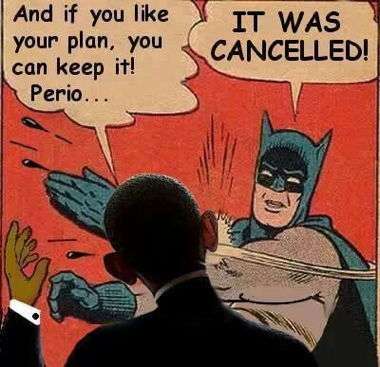
It Was Canceled!
Image shamelessly swiped from American Digest

Again, the prerational thinking. When everything you know about something is based on feelings and not on thought, it’s hard to learn because the edifying stuff mentioned above has something to do with failure, and therefore with pain. They evaluate everything — with feelings. They recruit other liberals — by way of feeling. They assess the “progress” of their agenda items — by way of feeling. We just saw it with ObamaCare. It was supposed to make insurance markets more competitive and affordable, but now our friends the liberals proclaim it a huge success because of some number of signups. The law requires coverage, it invalidates existing policies; people who think their way through problems, rather than feel their way around them, immediately understand what’s wrong with evaluating the law’s success according to signup numbers. It’s like bragging about selling and installing windshields by day, while you’re going out and smashing them at night. Would the owner of such a business be able to brag about “helping” the motorists who need their windshields? Certainly yes, but not to anyone who is informed about the situation and willing to invest some quality thought about it.

But to the prerational, that’s too harsh, too critical. It doesn’t feel good to entertain such thoughts. The person embarking on such a train of thought, must therefore be a…racist. There ya go, that’s how it works. That’s our modern village-banishment. If we were living back in the olden days, our liberals would escort Cliven Bundy to the big heavy village gates, compel him to walk outside of them, and slam them shut behind him. Along with everyone else criticizing ObamaCare. But it’s not then, it’s now, we have no gates — so we’re plied with stories about yet one more person being a racist.

It’s just one more “rule about dividing up the vittles” job for them. These people are in, those people are out. More rules. Their one contribution to the feast. Across the millennia, nothing has changed.

Doing Everything Wrong

Saturday, May 3rd, 2014

Stephen Moore at Heritage:

What happens to an economy when you do just about everything wrong? Say you spend $830 billion on a stimulus stuffed with make-work government-jobs programs and programs to pay people to buy new cars, you borrow $6 trillion, you launch a government-run health-care system that incentivizes businesses not to hire more workers, you raise tax rates on the businesses that hire workers and on the investors that invest in the businesses that hire workers, you print $3 trillion of paper money, you shut down an entire industry (coal), and try to regulate and restrain the one industry that actually is booming (oil and gas).

We made all of these imbecilic moves, and the wonder of it all is that the U.S. economy is growing at all. It’s a tribute to the indestructible Energizer Bunny that is the entrepreneurial U.S. economy that it keeps going and going even with all the obstacles. The problem is it isn’t going very fast. That’s what the Bureau of Economic Analysis told us this week when it reported that the GDP for the first quarter of the year grew an anemic 0.1 percent on an annual basis from January to March. The more meaningful measure of growth, private-sector GDP, rose by a still-meager 0.2 percent.
:
Reagan cut tax rates, slashed regulations, trimmed excess money supply (with the help of Fed chairman Paul Volcker), and let the private businesses — the supply side — grow their operations less hindered by government interference.

Obama did, well, pretty much the opposite. At the time of the mighty economic recovery of 2003–09, liberals explained the ferocious burst of growth and employment by saying it was a “classic Keynesian recovery” financed by debt spending. Except if that was the case, why is it that after Obama borrowed twice as much money, this Keynesian recovery has proceeded at half that pace? I’ve never heard an answer to that one. Never.

It’s always awkward when Post Hoc Ergo Propter Hoc fallacy works out to the benefit of liberals; awkward for them, that is. Being adamantly opposed to definitions in pretty much anything, but always ready to “win” an argument, they put one up that takes the form of: Look, something that can be plausibly likened to our ideas, preceded something that can be plausibly likened to success. Who could possibly take issue with such an unanswerable manifesto? What more could be said?

And then along comes some wise-ass — or, perhaps, merely someone who is interested in things going well, outcome versus process and all that stuff — to ask: Okay, what did Bill Clinton do to bring about this wonderful Clinton Economy? And they have nothing to offer here. It’s like the dog catching the car. They don’t know what to do.

And that’s important. On the Internet, it really doesn’t matter who wins what argument, or how surely. That doesn’t help anyone, on the Internet or off. But a crappy economy, and disastrous results needlessly dragged out by bad policy, New-Deal-style, hurts a lot of people. Just about everyone, really.

Where Is…

Friday, May 2nd, 2014

A tip for women who share a dwelling with any sort of male: Yes, you do have an obligation to remember where you put something if you’re the one who moved it “out of the way” or whatever.

Asking “Why do you need it?” in response to “Where is” means one thing to the male mind: You don’t really live here. A home, after all, is a place you can put something down, and not have to worry about touching it every day or two (or fastening it to something) to remind the world that you’re somehow associated with it.

And in response to “Where is”: Protesting how unfair it is that you should be asked where the thing is, when heck, it’s been a whole six weeks or more since the guy even noticed it was gone…well…that’s even worse. That means “You should have rented a storage locker, or better yet got a place of your own, six weeks ago.”

It’s sad, in a humorous sort of way, that some women just don’t get this.

Kate Upton’s Butt Deserves More Attention

Friday, May 2nd, 2014

Um…okay.

Metric System

Thursday, May 1st, 2014

A thought adjoining to the final lines of the post previous: I hate the metric system.

Not that it doesn’t have its uses. If I’m calculating the accumulation of kinetic energy in an accelerating mass, and the capacity of that kinetic energy when it’s converted into something else, the metric system would be my first choice.

It is the advocacy for the metric system that cheeses me off. The idiotic arguments. “Ten is sensible”; that right there, that’s it. No, ding-dong, ten is not sensible. What is two-thirds of ten? You want to build a house that way?

See, for guys who have hammer-loops in their jeans that they use to actually hold hammers, and carry a tape measure clipped to their belts, twelve is better. It’s better for actually building things. Twelve is a composite that is the product of a low prime times the square of an even lower prime. Ten is just two primes, great for multiplying but lousy for dividing.

And why do you want a number great-for-multiplying anyway? That’s just for doing math in your head, or on a sheet of paper. There’s computers everywhere, you goth vegan Canuck black-turtleneck-wearing atheist who probably thinks the European Union is the greatest thing since the printing press. We don’t need number systems that are great for multiplying. Great-for-multiplying is for lazy students who are still in class and want an easy A without bothering to switch their iPhones out of Angry Birds. Great-for-dividing is what people need when they’re designing or building something that is actually supposed to work. And the problem you run into with that, when you’re trying to divide ten by three, is not something that will trip you up until you have invested some actual time. Real time, out in the real world, building real things.

The ten-is-easier argument is just stupid. Worse than stupid, it is a successful inversion; it is the winning of an argument based on the aesthetics of the argument, without respect to the actual substance, or its ramifications for the rest of us out here where objects actually move around and have an effect on one another. The impression left is that the English system is based on yesteryear, specifically the distance between Henry I of England’s nose and his thumb, and the tens-system is the world of tomorrow. The truth is the opposite of this. Most people don’t have much call to do math with newtons and km/sec^2. And they haven’t got a frequent need to do math in their heads merely by moving a decimal point around. We’re spending our lives in front of computers. Imposing a whole new system on oldsters who just want to buy medicine and margarine, just so kids can get their math homework done a little quicker when they’re too lazy to enter numbers into a calculator, has turned out to be a relic of the 1970’s.

“Imagine Joining an Engineering Team…”

Thursday, May 1st, 2014

Some of us don’t need to imagine, we just need to remember. But we don’t like to, because we’ve worked so hard to forget…Programming sucks.

Imagine joining an engineering team. You’re excited and full of ideas, probably just out of school and a world of clean, beautiful designs, awe-inspiring in their aesthetic unity of purpose, economy, and strength. You start by meeting Mary, project leader for a bridge in a major metropolitan area. Mary introduces you to Fred, after you get through the fifteen security checks installed by Dave because Dave had his sweater stolen off his desk once and Never Again. Fred only works with wood, so you ask why he’s involved because this bridge is supposed to allow rush-hour traffic full of cars full of mortal humans to cross a 200-foot drop over rapids. Don’t worry, says Mary, Fred’s going to handle the walkways. What walkways? Well Fred made a good case for walkways and they’re going to add to the bridge’s appeal. Of course, they’ll have to be built without railings, because there’s a strict no railings rule enforced by Phil, who’s not an engineer. Nobody’s sure what Phil does, but it’s definitely full of synergy and has to do with upper management, whom none of the engineers want to deal with so they just let Phil do what he wants. Sara, meanwhile, has found several hemorrhaging-edge paving techniques, and worked them all into the bridge design, so you’ll have to build around each one as the bridge progresses, since each one means different underlying support and safety concerns. Tom and Harry have been working together for years, but have an ongoing feud over whether to use metric or imperial measurements, and it’s become a case of “whoever got to that part of the design first.” This has been such a headache for the people actually screwing things together, they’ve given up and just forced, hammered, or welded their way through the day with whatever parts were handy. Also, the bridge was designed as a suspension bridge, but nobody actually knew how to build a suspension bridge, so they got halfway through it and then just added extra support columns to keep the thing standing, but they left the suspension cables because they’re still sort of holding up parts of the bridge. Nobody knows which parts, but everybody’s pretty sure they’re important parts. After the introductions are made, you are invited to come up with some new ideas, but you don’t have any because you’re a propulsion engineer and don’t know anything about bridges.

Would you drive across this bridge?

The premise is the conclusion and the conclusion is the premise. I’m not too sure about it, because the problems mentioned are all introduced by the people. And it isn’t even rooted in the people, it’s in their associations; more beauty and order and functionality made into ugly detritus by group-think. “Tom and Harry have been working together for years, but have an ongoing feud over whether to use metric or imperial measurements, and it’s become a case of ‘whoever got to that part of the design first.'” That resonates with me, and my sad dark war-stories, more than anything else in that paragraph, but heck — Tom, working by himself, might end up doing just a dandy job, and the same is true of Harry.

People just aren’t good at looking at the designs and handiwork of other people, and saying to themselves “Right, so that’s it then; we’ll do it that way, going forward.” Teamwork, for all its blessings, is based on an axiom that people will be doing that every hour of the day, for months or years at a time. And that just isn’t how we’re wired. The problem is with the people, and the flawed assumptions about how they’ll work together, not with the programming.

This one hurt, like a shiv in the ribs:

Every programmer occasionally, when nobody’s home, turns off the lights, pours a glass of scotch, puts on some light German electronica, and opens up a file on their computer. It’s a different file for every programmer. Sometimes they wrote it, sometimes they found it and knew they had to save it. They read over the lines, and weep at their beauty, then the tears turn bitter as they remember the rest of the files and the inevitable collapse of all that is good and true in the world.

This file is Good Code. It has sensible and consistent names for functions and variables. It’s concise. It doesn’t do anything obviously stupid. It has never had to live in the wild, or answer to a sales team. It does exactly one, mundane, specific thing, and it does it well. It was written by a single person, and never touched by another. It reads like poetry written by someone over thirty.

MY GOD, IT’S TRUE. Red label, I keep it in a gravy jar in the chest freezer. But not German electronica, I watch Fargo or Club Dread. And yeah, you bet your ass it’s Good Code. The very best.

Okay, maybe not, but a damn sight better than anything that’s been tainted by the ravages of office politics. And if it was a bridge, yeah, you could drive across it.

Do you want to live in a world like this? No. This is a world of where you can smoke a pack a day and nobody even questions it. “Of course he smokes a pack a day, who wouldn’t?” Eventually every programmer wakes up and before they’re fully conscious they see their whole world and every relationship in it as chunks of code, and they trade stories about it as if sleepiness triggering acid trips is a normal thing that happens to people. This is a world where people eschew sex to write a programming language for orangutans. All programmers are forcing their brains to do things brains were never meant to do in a situation they can never make better, ten to fifteen hours a day, five to seven days a week, and every one of them is slowly going mad.

Yeah…I’m reminded of my late Uncle, who once said “Morgan, there are two kinds of people in the world…the ones like you who go around dividing everyone into two groups of people, and everyone else.” But there are two groups of people, and because of that, there are two groups of programmers: Some have passion about all the things you can do by translating an idea into a language, and some have passion about all the different languages into which one thing can be translated. Isn’t that the trouble with Common Core? It’s that second group that’s making the problem. The same is true of programming. No greater capability; no reduced maintenance; no easier comprehension of what is encoded, for the humans reviewing it; but, it is yet-another-way-to-do-the-same-thing, and that second group goes apeshit. The rest of us get more work to do, and we’d better act excited about it or we’ll be showing what slope-forehead troglodytes we are.

If a new language comes along to motivate the first group, it is one that makes something possible that had previously been written off as not-possible. There is a conflict, I think, that needs to be had-out sooner or later. Is that such a radical idea? We’re still in the first century of this new craft. It has to happen, because we’re the ones doing the brain surgery or trying to defuse the time bomb, and they’re the ones jumping on the bed.

The Development Triangle

Wednesday, April 30th, 2014

Another tortured metaphor I invented yesterday…It’s just like the fire triangle they taught you when the fireman came to visit your fourth-grade class. And if you were in Boy Scouts, you got to hear it all over again. Heat, oxygen, fuel. If you have all three, you have a fire, but if you have two and are missing the one, then you don’t. In both cases, like-it-or-not.

Fire TriangleTo get anything built, you have to have the skills to build it, or at the very least the aptitude to learn and efficiently acquire them.
You need to have the hours to sink into completing the project milestones.

You have to know what the fuck you’re doing.

There is a lot of confusion about this, unfortunately most of it concentrated into the layers of management, and others who can make authoritative and influential decisions about where the resources go, about this third leg of the stool. In fact, a lot of this confusion is shared by their organizational opposites, the geeks with the candy wrappers on their desks and the McDonald’s-remnant stains on their shirts. It is not the skills. It is a separate, distinct and vital thing. This is why we have project managers. Although they, by themselves, don’t bring all of it. All they can deliver by themselves is the methodology, and some detail-work that hopefully meshes with reality. That stuff is just garbage if it doesn’t mesh with reality. In fact, if it meshes with reality most of the way, but mixes the good stuff with a little bit of fiction, then it’s worse than useless.

The third leg is the hardest one because it requires cooperation, across the board. That means recognition all the way up & down the organizational chart, that it’s needed. I’ve noticed that organizations proven to show talent and strength achieving their more mundane but challenging deliverables, quickly melt down into chaos trying to address this simple task, because they need to quickly and effectively “un-specialize.” People who have found their niche building, and found their niche managing, have to figure out how to talk to each other. Like a football athlete or ballerina presented with some new exercise, they discover muscles they didn’t know they had, but have never used.

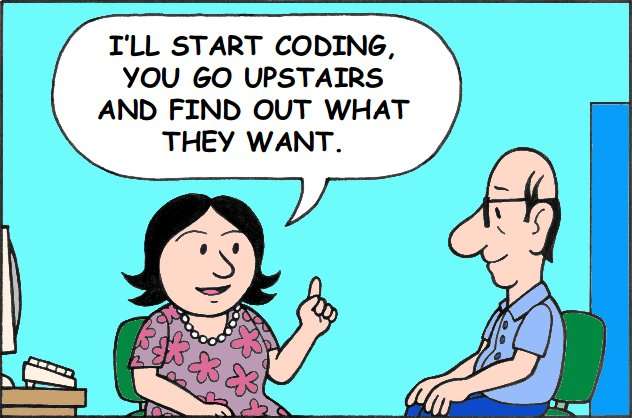
Can’t find that classic old cartoon, all that’s available to me now is this cheesy new one:

Yeah, that about captures it.

Skills…time…know what the fuck you’re doing, and the last is the hardest. Project charter document, work breakdown structure, explicit requirements, implicit requirements, validation checklist. But, it’s more than those. A shared, or properly disseminated, understanding of the organizational deficiencies being addressed if the intended use is internal, and of the market demand if it’s external. Many methodologies have been developed on defining how to achieve this, perhaps literally tons of books published, hours invested into teaching & learning in classes, which perhaps can never be entirely counted. Without the buy-in, it’s all for nothing, and without the third point of the triangle, the “fireplace” stays cold.

Doing Away With the Electoral College

Wednesday, April 30th, 2014

From Chicks on the Right.

Seems pretty reasonable at first, but most of the cunning plan has to do with abbreviating discourse. It is an overwhelming and complete lack of respect for the dissenting opinion, made ascendant by recent generations of college kids educated beyond their hat size, using the word “most” when & where it doesn’t apply, and when they don’t have the facts to back it up; using hackneyed phrases like “the vast majority” the way an alcoholic uses liquor.

Only the bit about doing away with “battleground states” has anything to do with shedding more light and honesty on the electoral process. And even there, I think if the idea is implemented, we’d end up disappointed with the results. Let’s see, Hollywood doesn’t use an Electoral College to figure out where action movies should take place, does it, and what sort of distribution do we get there? New York, LA, New York, LA, New York, New York, New York, LA, LA, New York, Chicago, LA, LA, LA, New York, LA, New York, New York, LA. The campaign events, I think, would look something like that.

People with good arguments to make, don’t look for ways to truncate the argument process. That’s what tyrants and dictators do.

Bloggiversary #4 for Professor Mondo

Wednesday, April 30th, 2014

Hope it’s a happy one. Cheers!

“Liberals Understand The Constitution Like Justin Bieber Understands Particle Physics”

Wednesday, April 30th, 2014

Great content, not too sure about the title though. What exactly are the limits on Mr. Bieber’s knowledge of particle physics? If he knows anything — or even if he knows nothing, but is at least willing to learn — it’s not a fair comparison.

Try educating a liberal about this sometime. You’ll quickly discover ignorance is not the root of the problem; you’ll discover there was something else putting the ignorance there, and keeping it there. They just don’t give a damn.

The whole point of listing a right within our Constitution’s Bill of Rights is that it’s beyond discussion, meaning some bureaucrat cannot infringe upon it because his pea-brain has decided that it makes sense to do so. What’s a “reasonable” exercise of religion or “reasonable” speech? Constitutionally, the question makes no sense. Liberals hate that they can’t “reason” our rights down to a tiny nub that’s too small to interfere with their dreams of power and control.

Rights aren’t a favor the government extends to us in its wise benevolence. Our rights existed in us from the moment of our creation, and they are inalienable. The Bill of Rights is not there to list for us what rights we have been granted. It’s to provide the government with a partial list of our fundamental rights and to warn it to keep its grubby mitts off them.

The only thing worse than seeing things within the Constitution which aren’t there is refusing to see things that manifestly are. Only liberals can look at an amendment reading “the right of the people to keep and bear arms shall not be infringed” and see blank parchment.

From Linkiest.

Brutally Honest Things Men Think About “Feminism”

Wednesday, April 30th, 2014

From Misfit Politics.

We think it’s stupid when feminists think it’s cool to not know how to cook. We don’t give more respect to a woman who thinks keeping her home organized and tidy is weakness. We find a woman who hates babies and children kind of off-putting, even if we don’t currently want a child. We don’t think it’s edgy. We think it’s silly that they think this somehow makes women strong and independent. Our mothers did all the above and more, and we recognize her as super strong.

Lefty movements do tend to have that in common, they confuse strength, robustness, wherewithal with weaknesses, deficiencies and handicaps. A good time for people to abandon them would be when they’re asked to aspire toward not being able to do something.

I think #10, the last one, is a decent summary for the previous items, and it’s pretty decent constructive-criticism for all the other social-equality movements we’ve been seeing through the years too:

Ladies, let me crush a silly idea that feminists have made popular: You don’t need to “elevate” yourself to where men are. You don’t need to be “just as good.” Men are not on a platform above you where the sun shines richer and we reap a bountiful supply of deserved ego. We’re not better or worse than you, we’re just not the same. Our needs diverge and intersect with yours because we’re tied to each other, but this doesn’t mean we need to be equal on every ground.

I’m particularly fond of the “platform above you where the sun shines richer and we reap a pountiful supply.” Stories of Eloi and Morlocks capture the natural human vice of jealousy, and all the passions that go with it. As many a liberated woman has discovered from trying to live the life of a man, men don’t really live an Eloi existence after all, and we certainly don’t hold a monopoly on sunshine.

Good ideas and good intentions. But, for the last half century, out of all the strides made by what we call “feminism,” few of them have been forward.

Animal Farm is About Capitalist Greed?

Wednesday, April 30th, 2014

Huh. Well, that’s a new one on me (video behind the link).

And she seems so sure of herself, too. Threatening to banish me to the crazy-uncle-table and such. The irony.

The Left’s Version of History

Tuesday, April 29th, 2014

Steve Deace makes some astute observations, in his book excerpted at Townhall.com:

If the Leftists want to make the case what they believe is in line with the founding vision of these United States, then by all means go back into the historical record and make that case. Except they won’t and they can’t. There’s a simple reason why the Left doesn’t pay as much homage to the founding of this country as we do, and it’s because most of what they believe is contrary to it, which is why they’ve had to take over the schools and scrub that history from the textbooks. Even one of the Left’s favorite Founding Fathers, Thomas Jefferson, was so opposed to what most Leftists believe they’d peg him with their favorite word for conservatives—“extreme.”

Proving those who do not learn from history are doomed to repeat it, not once but twice during the 2012 presidential debates Mitt Romney failed to confront President Obama on his version of the events that led to four dead Americans at the Benghazi terror attacks. Romney allowed Obama’s false premise to be asserted on the biggest stage of the campaign, thus allowing what should’ve been an issue that toppled the Obama presidency to become a strength prior to voters heading to the polls. It wasn’t until after the election in Congressional hearings featuring several Benghazi whistle-blowers — all of whom who worked for Obama — that the president’s account proved to be false. By then it was too late, and those four dead Americans and their families still haven’t received justice.

One of the reasons we see so many Republicans accepting the premise of the Left’s argument is because they don’t possess a solid worldview. Thus, most Republicans end up being defined by what they’re against and not what they’re for. Without a premise they’re just playing defense.

Rules for Patriots: How Conservatives Can Win Again.

“Man Up” is Offensive

Tuesday, April 29th, 2014

Well of course it is (hat tip to Bird Dog at Maggie’s Farm).

A new word-discouragement campaign at Duke University has labeled phrases such as “Man Up,” “That’s So Gay,” and “Don’t Be a Pussy” offensive language that “delegitimizes” homosexuality and oppresses and insults people.

But as the campaign has gained national popularity, its detractors have bristled at the effort, calling it a politically correct war on words that will stifle free speech and suggesting its true aim is to redefine terms to control public opinion and – ultimately – public policy.

In fact, the “You Don’t Say” campaign creators have admitted as much.

“Language is a reflection of how we think about others and view the world,” Jay Sullivan, a student leader of the campaign, tells Duke Today. “My goal is to…help facilitate discussion about how language affects many social issues, from race to gender and sexuality.”

I don’t understand why the PC-police keep saying things like “the goal is to facilitate discussion” or “foster dialogue.” I doubly-don’t-understand how they get away with it. Their goal is the opposite of that. Their goal is to intimidate and muzzle and silence people.

The democrats are sending me e-mails, asking for $3 donations, bragging about 26-year-olds putting themselves on their parents’ insurance. At Christmastime, their recommendation for these 26-year-olds is to put on footsie-pajamas, drink hot chocolate and talk about insurance. Now, if you tell someone to man up and stop being a pussy, you’re committing word-crimes — supposedly, it’s about the offensive words, not about the pattern of what’s being encouraged vs. discouraged.

Does anyone really think so?

Why do we continue to pretend such campaigns are all about one thing, when we know they’re really all about something else?

A little honesty would be refreshing. If you wanna say something, don’t get lost in the weeds tut-tutting and gagging other people who are saying something different. Say what you mean: “Man down. Be a pussy.” Too much to ask, I suppose.

“All You Need to Know About Barack Obama”

Tuesday, April 29th, 2014

Matt Walsh.

All you need to know about Barack Obama the man, and Barack Obama the President, can be summed up by the fact that he immediately and forcefully commented when a black Harvard professor was arrested by a white cop; he immediately and forcefully commented when a black teenager was killed by a Hispanic neighborhood watchman; and he immediately and forcefully commented when a white NBA owner allegedly made some insulting comments about black people — but when an abortionist was allowed to murder black infants for thirty years in the middle of an American city, he said nothing.

In all three of the cases where he did comment, the facts weren’t yet fully known, and the incident had no relevance outside of the area where it occurred. In Gosnell’s case, the facts were established, and the incident encompassed a wide range of local, state, and federal authorities. Yet on the first three he pounced, while on the last case he ran for the hills.

That’s all you need to know about Barack Obama.

Finally, criticism aimed where it will do the most good. Some things are above Obama’s pay grade, others are not; it’s rather telling, what things are and what things aren’t.

I’m loving the opening:

It’s really a fascinating thing, when you think about it.

Even a culture like ours — a culture dedicated to hedonism and relativism — has to put on a show every once in a while and pretend it has some semblance of a moral standard. It shows you that those philosophers and theologians were actually onto something when they wrote about Natural Law.

Deep down, in the pit of our being, there exists a need to be good and virtuous; but if being good and virtuous is too hard, then at least we need to find a halfway convincing substitute. Only demons and psychotics would stand and openly proclaim their own evil — the rest of us can act the part, but we still feel the urge to get up and play Morality Charades on occasion.

That’s what comes to mind when I see the reaction to the story about Donald Sterling. If you don’t watch the news, I’ll fill you in…

Sterling is an old, crazy, rich, (alleged) racist who happens to own the LA Clippers. Being old, crazy, and rich, and living in California, he also has a pretty progressive love life. He left his wife a while back and started shacking up with his young west coast mistress. Now, his wife has quite unfairly accused the mistress of gold-digging, all because she just so happened to fall madly in love with a rich married man who showered her with Bentleys, diamonds, and cash.

(It happens to the best of us. Stop judging.)

The wife filed a lawsuit against the mistress, and the mistress allegedly swore to ‘get even.’ Getting even, in this case, evidently involved coaxing her lover into making some very inane and very racist comments, while secretly recording the exchange. To give you an idea of just how inane and racist: Sterling allegedly tells his *minority* mistress that he doesn’t mind if she has sex with minorities, but he doesn’t want her to be seen in public with them.

Well, this audio tape SOMEHOW made its way to that bastion of journalistic integrity known as TMZ — although the girlfriend totally had nothing to do with that, she says.

In a normal and sane society, this sordid soap opera would never be discussed outside of gossip magazines and entertainment shows, because there’s nothing very newsworthy about it. A wealthy, morally bankrupt adulterer in Los Angeles professed some unsavory views, behind closed doors, to his manipulative morally bankrupt girlfriend.

I don’t see anyone worth defending, from anything, here at all. It reminds me of an essay I saw put together from someone who invested some amount of time researching the dark and unseemly personal life of Ian Flemming, whose marriage left a few things desired and might in some ways have necessitated the escapist invention of James Bond. After grinding through the ugly details, he signed off with something like “Well, I’m done, don’t want to read or write any more about these people, fuck these people.” Yeah, that. There are some movies made in which very few of the characters are even close to being likable, and none of them are even close to normal; the best of those tend to be really, really short. The “fuck these people” instinct sets in.

The scandal makes Mr. Sterling look really bad; should make some other people look bad; and that is all it is. But unfortunately, we have political figures and we have mediocre people down in the streets with the rest of us, all of whom are powerfully motivated to dress this thing up as some dark movement or relic of racism cloaking our whole society, so that some of us can strap on some polished shining armor, brandish our flaming swords, and do battle. It’s a popular thing now. But really fighting evil things, somehow, is not popular. That is frowned-upon. The image of fighting evil is in style, the reality of fighting evil is out-of-style. Interesting times.

Dear Zachary: A Letter to a Son About His Father

Monday, April 28th, 2014

We’ve got some liberal dipshits commenting on this blog, protesting that George Washington could not have said something commonly attributed to George Washington, based almost entirely on the opinions of some unnamed “experts.”

The liberal dipshits, also, are unnamed.

While I’m reading all about that, Mrs. Freeberg and I are watching this. Holy cats. Yes, do see it…once, and once only. It’s on Netflix instant. You’ll get the point straight-a-way:

This unlimited weight of faith in “experts” is not only wrong-headed, but dangerous. And, it could be reasonably conjectured — evil.

But, it certainly is popular. People are just afraid to think for themselves nowadays, I suppose.

Update: More expert opinion, from yesteryear.

These days, a lot of what passes for “debate” and “argument” is really just a bunch of excuses for not considering new ideas. Science-is-settled, debate-is-over, and all that.

“Opposite of America”

Sunday, April 27th, 2014

…is “full of lies”.

Gee, really?

Taxing corporations is much more appealing to people than taxing individuals, but this doesn’t mean that individuals aren’t paying for corporate taxes.

Economist Walter Williams did a great job of illustrating this point when he asks “Virginia has a car tax. Does the car pay the tax? In most political jurisdictions, there’s a property tax. Does property pay the tax?” Point being: all taxes are ultimately paid for by people.

If a corporation’s tax rate goes up, they can simply pass the cost onto their consumers by raising their prices to counteract losses from the tax. Norway is a prime example of this. Despite being oil rich, the price of gas in Norway tops $10 a gallon.

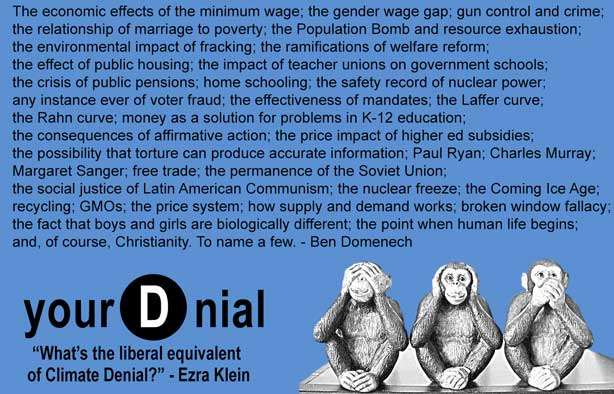
The Liberal Equivalent of Climate Change Denial

Sunday, April 27th, 2014

From here.

In response to Ezra Klein’s question.

Mansplainers

Sunday, April 27th, 2014

Heh. Yeah, that’s me…at times (via Instapundit).

The mansplainers don’t take into account what the person they’re speaking to might already know, especially since they’re often talking to students who may not in fact know all that much. Mansplainers often start with first principles. They take the conversational podium with ease and entitlement and stay there for as long as they please. They don’t notice when their listeners are nodding off, or trying to say something, or picking their cuticles until they bleed. On and on they go, merrily enchanted with the sound of their own voices, and the thoughts issuing from their overstuffed heads.

We’re all like that. Aren’t we? I know in the midst of my own misadventures in mansplaining, if someone accused me of failing to assess the knowledge level of my audience accurately, or of not bothering to assess it at all, I wouldn’t offer a defense because I usually wouldn’t disagree. Like many among us, I find it thoroughly baffling. Like letting an arrow loose from a bow, trying to hit another arrow someone else let loose from a bow, in mid-flight. Heck I can try, but that’s all I can do.

I have noticed, watching others interact with me, and others, that hitting the arrow seems to be a matter of perception: “I feel like he knows me.” And on the few occasions when we get to go back and compare that perception with reality, in love, war, diplomacy, salesmanship, it is seldom correct. It’s just a feeling. This leaves me to doubt anyone, anywhere, truly has the ability.

I think we’re all mansplainers. To some degree, to some extent, every now and then. It’s provable with mass-communication, isn’t it? The speaker can’t lift and then respond to some emotional vibe coming from the listeners; it’s strictly a one-way forum. All he can do is utter throaty magical incantations that arouse the mendacious feeling that he’s in sync. But the reality is that he’s just guessing about what questions the audience wants answered, and what they want to hear next. Guessing, and subtly guiding.

We’re wanting and lusting after something in our dialogues, something that never has been and never can be. Perhaps the trend we need to be noticing should be called “femlistening” or some such?

Flibbertigibbet

Saturday, April 26th, 2014

One of these days, I do have to improve my skills at spelling that word. It is an important word, and one that is becoming more and more important with each passing year.

Its meaning is not limited to “someone who does a lot of talking.” It means a great deal more than that. There has to be a certain meaninglessness to the chatter. And, a certain bossiness too. Flibbertigibbets are radios without off buttons; they care not that the commodity they’re supplying, is in negligible and dwindling demand, or in no demand at all.

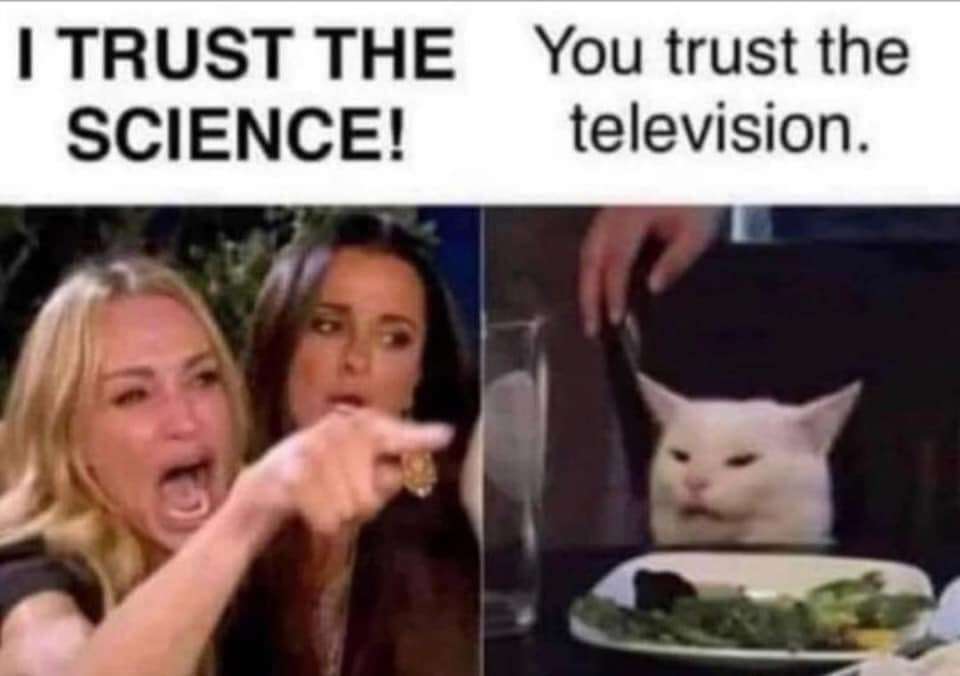
If you know a flibbertigibbet or two, it may not have escaped your notice — or maybe it did — that they prattle on with their excess verbiage in an attempt to convince themselves. That is the common content, and that is the common purpose. They repeat most bumptiously and most frequently the things that, according to their own systems of belief, are so emphatically true that they ought to be able to stand on their own. In so doing, they confess to that which is never to be considered: There actually are some doubts. About “The science is settled on global warming!” or “There is no god, now relax and enjoy your life” or “ObamaCare is a spectacular success.”

Or, they would be confessing to these doubts, if anyone with some ability to follow a coherent thought, was actually listening. This tends not to be the case. People who can do this, usually have some occupation, or obligation, to get something done that relies on this. And they don’t have the time.

We live in an age in which the flibbertigibbets insist on making all of the heavy decisions. And, a great deal of the time, end up doing so. Woe is us. There may not be any way to fix this, but we should keep a sharp eye out, each and every day, for ways we might initiate the needed repairs. Flibbertigibbets, from all I’ve been able to observe about them, get their thrills out of talking, babbling, whining, and winning arguments. They really aren’t at all into what motivates the rest of us, “this thing happened because I did such-and-such a thing.” They don’t want that. They haven’t got the capacity for details to handle it, and they’re not at all enthused about assuming the responsibility.

Somewhere, down that road, an answer lies waiting for us. If there is an answer at all, anyway — it’s that-a-way. We’re suffering because the flibbertigibbets possess a unique weight of authority, which they never actually sought. They just wanted to do a lot of talking, that’s all.

Cliven Bundy

Friday, April 25th, 2014

If his “racist” comments, once played out in full and heard in context (below), are still awful and execrable but he’s in the right in his dispute with the Bureau of Land Management, then he’s still in the right.

On the other hand, if this full context reveals the racism accusations to be nothing more than a complete sham, but he’s in the wrong in his dispute, then he’s still in the wrong.

Conclusion: Those who side against him in the dispute, and invest their energy in masticating over these controversial remarks, must not have much faith in the actual argument. And I have to wonder why not. Bundy doesn’t own the land, and it seems he’s had his day in court over this matter. A stupid law is still a law. So why are racist comments even part of the discussion?

The answer is pretty scary when you think about it: We’re having a Constitutional Convention, an informal and improper one, without the state legislatures or Congress voting it into session. We’re using electronic messaging, selectively edited, to decide what rights are to be enjoyed by the citizens, based on the perceived character flaws of those who value the rights in question.

No, nobody calls it a “constitutional convention.” But that is the effect. Everything’s on the table, everything’s up for grabs. Feds, states, people, all their rights depend on who’s a racist and who isn’t.

In fact, it’s really quite a bit worse than that. The critics of Cliven Bundy do not care about Cliven Bundy. They seek to embarrass everyone who’s come to his defense, or merely hesitated to take sides against him. It’s message-politics; message, as in “that’ll show you.”

Which can mean only one thing: Whether the statists are right or wrong in this particular dispute — and my understanding of the details compels me to believe they are, initially, in the right and Bundy is wrong — they have no intention of stopping here. They want absolute and uncontested control. Even when a rational discussion of the facts of the dispute might conclude in their favor, they don’t want it. The forum isn’t right for them, for what they want to do. For that, they require scandal and character assassination. They’ve got something in mind they can’t achieve without those things.

“An Active Participant in Massive Consumer Fraud”

Thursday, April 24th, 2014

Best of the Web, via Instapundit:

…the absence of [health care] alternatives in New Hampshire means that some policyholders in some parts of the state have to drive long distances to get to a hospital that is on the Anthem Blue Cross and Blue Shield coverage network.

Not surprisingly, [Sen. Jeanne Shaheen] is facing hard questions from constituents suffering under the new health-care regime. Her approach to answering them seems an unpromising one. It is to suggest that they don’t know what they’re talking about.

Blogger Jason Pye seems to have been the first to pick up on a Shaheen appearance last Friday “Good Morning With Dan Mitchell,” a radio talk show that airs on WKBR in Keene. His post includes audio of Shaheen’s exchange with an unidentified caller, which Pye says he obtained from America Rising, a conservative opposition-research group:

The caller told Shaheen that “President Obama’s health care is not affordable.”

“It’s cost me more, my deductible has more than tripled and my monthly premium has doubled, so it’s not affordable,” he said. “And so, I’d rather have my old healthcare, my old system back.”

Shaheen dismissed his concerns out of hand, telling him to leave his name with the host so her office could call him back “because that doesn’t sound right to me.” She chalked the caller’s complaints up to “misinformation.”

“It sounds, and there’s a lot of misinformation about what’s happening with the health care law,” Shaheen told the caller, “so we’ll get back in touch with you, we’ll find out what’s going on with your plan, and we’ll help you sort that out because you shouldn’t be paying that much more.”

Now perhaps this was a Republican prank call, or maybe the guy actually is misinformed. Offering to help sort the matter out is obviously the wise political response, noncommittal in substance while demonstrating (or at least asserting) a commitment to constituent service.

But it was awfully impolitic for the senator to preface her promise with the prejudicial statement “there’s a lot of misinformation.” The customer may not always be right, but a smart salesman doesn’t begin a transaction by saying he’s probably wrong.

The complaint is about more than bad salesmanship. “There’s a lot of misinformation out there” turns out to be a recycled hackneyed catchphrase, burbled up by programmed democrats who’ve been coached on what to say & do when cornered about this bad legislation. I’ve often theorized that democrats are just kids with complacent, weak or just plain dim mothers who, when the confrontation came about because of cookies missing from the jar, failed to call out the lie. The kids grew up, the lies got bigger…and, the liar’s expectation of getting away with it, interestingly, began to act as a powerful force to ensure that they would, at the end of each episode, get away with it after all. Natural confidence-men. And confidence-persons.

Well hold on a second Ma…there are a lot of cookies missing from this jar. Well YEAH. Who took them? Who put all this misinformation out there?

It is true that there’s been a lot of deliberate misinformation about ObamaCare. Example: “If you have insurance that you like, then you will be able to keep that insurance. If you’ve got a doctor that you like, you will be able to keep your doctor.” That was Barack Obama in July 2009.

Here’s another example:

My understanding…is that — and I know this is true of the bill that has come out of the committee in the Senate–if you have health coverage that you like you can keep it. As I said, you may have missed my remarks at the beginning of the call, but one of the things I that I [sic] said as a requirement that I have for supporting a bill is that if you have health coverage that you like you should be able to keep that. . . . Under ever [sic] scenario that I’ve seen, if you have health coverage that you like, you get to keep it.

A lot of misinformation indeed. That was Jeanne Shaheen in August 2009, responding to a constituent named Emil in another telephone town hall. The Washington Examiner’s Byron York noted it (along with similar comments from 26 other then or future Senate Democrats) in November, and via a Google search we found it on Shaheen’s official Senate website.

So Shaheen was an active participant, if perhaps an unwitting one, in a massive consumer fraud at the expense of many of her own constituents. No wonder she’s so defensive.

“You Didn’t Build That, and We Want More”

Thursday, April 24th, 2014

Most excellent essay by Bulldog over at Maggie’s Farm.

Even if you make the assumption that I got there with the help of others and/or the government, there is an implicit understanding that I did things, or provided payment and services, in return for that help. I must have paid some fees, taxes, or bartered something for these benefits I received. Very few things in life are truly free. Perhaps these benefits were subsidized, let’s call that a ‘gift’ from the government. Even so, what then allows the government to make further claims on me once I’ve become successful? As Professor Boudreaux points out, Amazon’s success is almost entirely reliant on the infrastructure of FedEx. Even if FedEx provided discounts and subsidies to Amazon early on to help them become successful, out of the goodness of their heart, unless a contract exists that stipulates further remuneration would occur upon this ‘success’ of Amazon, the relationship is based on a pecuniary exchange for goods and services, not a promise to pay more later.

Warren and Obama’s issue with this is, most likely, that the ‘social contract’ demands this future payment. Warren more or less demands it, saying that successful people should ‘pay it forward’. But who is she to say this? Who is anyone?
:
It remains a truth, as Hayek pointed out, that you can treat all people equally. But it is something else entirely to try and make them equal. Warren and Obama are on the wrong side of history but are so convinced of their moral superiority they are incapable of seeing the truth, because the only truth they see is their own power and how they can use it to force people to do what they believe is ‘just’.

From working in technology for…oh, about as long as anyone else I know — I’ve been often befuddled by the presence of those who obsess to excess over making sure everyone does everything the way it’s always been done. It starts out innocently enough, often with a respectable understanding of the problems and pitfalls involved in doing things in strange, unorthodox ways, and how the recommended and accepted process provides a countermeasure or remedy. It looks like good, vigilant, responsible technology stewardship. It often is.

But, the Morgan Rule of Technology eventually emerges: A definition more than a rule, really, since the rule is nothing more than a statement of what technology really is. It’s the opposite of doing everything the same way the other guy’s doing it. You can use other words, you can dress it up so it’s more appealing, like “learn to do more with less.” But that’s just semantics. At the end of it all, if you’re acting out a dedication to keep doing things the same way — or, if the process ever does change down the road, making sure it’s someone else’s idea so you don’t have to take responsibility — you’re not doing technology. Tack on another year or two to that timeline, and you end up being just another frazzled bureaucrat scrambling for ways to dodge the next layoff. Who deserves, on some level, not to be able to.

The common theme permeating throughout all of this, like a bad stink? Fear of the extraordinary. Fear of perceiving it, fear of association with it, fear of becoming it, fear of aspiring toward it. That is what Obama and Warren are acting-out with the “You Didn’t Build That” mania. That is them, and that is their constituency: Villagers who never want to leave the village, determined to lock the mighty gates behind whoever dares to venture outside of them, to ostracize whoever wanders afield. They think they’re building something great and grand, but can’t say what it is they’re trying to build, not nearly as easily or as clearly as they can say what they’re trying to destroy. There’s a reason for that. They’re destroyers, and they’re not builders.

Update: This, too, is most excellent. Take heart, nerds!

Extermination?

Wednesday, April 23rd, 2014

Kate at Small Dead Animals captured it as

Regular readers of my blog know that I have never seen CONservatives as anything other as subhumans who will willingly slave away to enrich their real exploiters. Rarely does a day go by when I do not come across one more example of why people of the CONservative mindset are subhuman tools. The remainder of this post is based upon one recent, and very clear instance, of why CONservatives are extermination-worthy subhumans.

But it’s evidently been edited

The remainder of this post is based upon one recent, and very clear instance, of why CONservatives are subhumans.

Perhaps it was the greater attention that made the blogger think again, or it could’ve been comments like this one:

I’m curious, as a conservative myself, what you propose as the method of extermination for me. I’m sure along with your fellow travellers, the possibilities you’ve imagined must be endless. Since you feel my progeny should be exterminated as well, how will you carry out this sentence on my young sons and daughter? Do we all get to enjoy a final train ride in a boxcar before our deaths? Please indicate your intentions as we’d like to make some final arrangements first.

This “Waterworld mentality” keeps coming up in liberal commentary, whenever they think no one’s listening, or that only “good” people are listening.

Liberalism being a bad sales job, from true-believers, to decent but ignorant people who don’t understand what they’re buying, it trades on deceit and therefore it’s difficult to extract a coherent overarching theme from it all. Except we know it isn’t about equality; that one we can safely rule out straight-away. Just walk up to a liberal, any liberal, and offer a serious proposal that gays should be treated like straights, black should be treated the same as whites, men and women should be on equal footing before justice and the law. See how that flies.

Across their true-believers and their recruits, it seems to be an inevitability that some statement surfaces about a coming storm, or at least, a belief in present or future scarcity. In advance of this scarcity, some individuals and/or classes are to be “voted off the island,” if you will; there will be some townhall assembly, during which the pariahs are to be singled out and banished.

It’s as if they’re advocating for a democratic method of selection of these inevitable casualties, as an alternative to a natural one. Meanwhile, they forget to question whether the coming famine is really a certainty. Reminds me of the South Park episode where a bunch of characters flying in a plane crash in the mountains, and someone announces they need to cannibalize Eric Roberts because otherwise they’ll starve to death — even though nobody’s really that hungry just yet.

Scalia on Schuette vs. Coalition

Wednesday, April 23rd, 2014

He got it exactly right:

It has come to this. Called upon to explore the jurisprudential twilight zone between two errant lines of precedent, we confront a frighteningly bizarre question: Does the Equal Protection Clause of the Fourteenth Amendment forbid what its text plainly requires? Needless to say (except that this case obliges us to say it), the question answers itself. “The Constitution proscribes government discrimination on the basis of race, and state-provided education is no exception.” Grutter v. Bollinger, 539 U. S. 306, 349 (2003) (SCALIA, J., concurring in part and dissenting in part). It is precisely this understanding — the correct understanding — of the federal Equal Protection Clause that the people of the State of Michigan have adopted for their own fundamental law. By adopting it, they did not simultaneously offend it.

Even taking this Court’s sorry line of race-based admissions cases as a given, I find the question presented only slightly less strange: Does the Equal Protection Clause forbid a State from banning a practice that the Clause barely — and only provisionally — permits?

As is so often the case with such hotly contested arguments, there are really two issues here; a specific one and a broader one. The specific issue is: Could a state be constitutionally prohibited from passing statutes, or amendments to their own constitutions, against race-based preferences? Or do they have the authority to do such a thing?

And the broader issue is: What has happened to our national wherewithal for logically noodling out such things, if this is even open to question? This is the curse of the information age; we seem to have a “neural net,” of sorts, spanning the entire nation, which has been lately invaded and torn-up by a busy flock of “Yeah But” people. Like moths attacking fine and cherished garments in a neglected closet, they’ve been chewing cavernous holes in our logical fabric, insisting that important and fundamental building-block definitions don’t mean what they mean, and in fact, mean the exact opposite of what they really were intended to mean.

They think they’re getting there, to Planet Opposite, by arguing cleverly, but they’re not even making the trip by arguing honestly. Their arguments and rebuttals, in many instances, don’t even make sense. Much of it seems to be based on nothing more than “Well this has been working for us for quite awhile, and we shall feel peeved if it does not continue to.” It is the shrill whine of people who have never been saddled with the burden of making anything actually work; in fact, much of the time when they prevail, they prevail because someone else simply ran out of patience, and opted to go get something productive done rather than continue to be annoyed.

Those who have other things they need to go do, then, are treble preoccupied — with standing up for reason and common sense; with trying to get something useful done; and, with wrestling the seemingly never-ending question of whether ignoring the one of those, and concentrating all of one’s energies on the other, might or might not be the right way to go.

Who loses? The country. The one thing that cannot be reasonably denied about where our energies and attention should be going, is that we ought not be wasting such resources arguing about whether two and two make five, or whether X equals not-X. We live in an age in which we have machines that can sort those out, millions of times in a fraction of a second. It’s a tragedy that the humans whose lives are supposed to be made easier by such machines, are compelled by warped internal desire, and external circumstances, to burn off such vast, great portions of their lives trying to settle the same silly things.

Why Do These People Even Exist?

Tuesday, April 22nd, 2014

I don’t know.

“‘The Debate is Over’ Syndrome”

Tuesday, April 22nd, 2014

Joel Kotkin:

Let’s call it “the debate is over” syndrome, referring to a term used most often in relationship with climate change but also by President Barack Obama last week in reference to what remains his contentious, and theoretically reformable, health care plan. Ironically, this shift to certainty now comes increasingly from what passes for the Left in America.

These are the same people who historically have identified themselves with open-mindedness and the defense of free speech, while conservatives, with some justification, were associated more often with such traits as criminalizing unpopular views – as seen in the 1950s McCarthy era – and embracing canonical bans on all sorts of personal behavior, a tendency still more evident than necessary among some socially minded conservatives.

But when it comes to authoritarian expression of “true” beliefs, it’s the progressive Left that increasingly seeks to impose orthodoxy. In this rising intellectual order, those who dissent on everything from climate change, the causes of poverty and the definition of marriage, to opposition to abortion are increasingly marginalized and, in some cases, as in the Steyn trial, legally attacked.

A few days ago, Brendan Eich, CEO of the web browser company Mozilla, resigned under pressure from gay rights groups. Why? Because it was revealed he donated $1,000 to the campaign to pass Proposition 8, California’s since-overturned ballot measure defining marriage as between one man and one woman.

In many cases, I might agree with some leftist views, say, on gay marriage or the critical nature of income inequality, but liberals should find these intolerant tendencies terrifying and dangerous in a democracy dependent on the free interchange of ideas.

This shift has been building for decades and follows the increasingly uniform capture of key institutions – universities, the mass media and the bureaucracy – by people holding a set of “acceptable” viewpoints.

Gets back to the Arguments About Definitions thing. “Acceptable” viewpoints and “reasonable” viewpoints are not measured to be that way. They are pronounced as such, by those who want to “win” arguments, but are dead-set against assessing or discussing details, something that is necessary to the process of winning an argument honestly.

So, they simply pronounce. They say silly, empty things like “everybody knows” or “most people say.”