Archive for the ‘Uncategorized’ Category

High Cost of Liberalism

Tuesday, April 22nd, 2014

Thomas Sowell discusses many cases of inflated pricing for houses in the Palo Alto area, then comes to the point…

Even a vacant lot in Palo Alto costs more than a spacious middle-class home costs in most of the rest of the country.

How does this tie in with liberalism?

In this part of California, liberalism reigns supreme and “open space” is virtually a religion. What that lovely phrase means is that there are vast amounts of empty land where the law forbids anybody from building anything.

Just Because They're IgnoredAnyone who has taken Economics 1 knows that preventing the supply from rising to meet the demand means that prices are going to rise. Housing is no exception.

Yet when my wife wrote in a local Palo Alto newspaper, many years ago, that preventing the building of housing would cause existing housing to become far too expensive for most people to afford it, she was deluged with more outraged letters than I get from readers of a nationally syndicated column.

What she said was treated as blasphemy against the religion of “open space” — and open space is just one of the wonderful things about the world envisioned by liberals that is ruinously expensive in the mundane world where the rest of us live.

Much as many liberals like to put guilt trips on other people, they seldom seek out, much less acknowledge and take responsibility for, the bad consequences of their own actions.

One minor quibble with this though: To true-believing liberals, these aren’t “bad consequences.” As hard as it is to nail down workable generalizations of their beliefs — being a bad sales job, it follows that deception is involved, and the interests of the buyers & sellers of liberalism must be different — there is one attribute more consistent than most others: Certain segments of the population should wake up one day to find out the world has no room for them. Margaret Sanger certainly wanted that. Today’s liberals want that. The only disagreement in their ranks is the sequence in which these demographic groups are to be shoved over the brink into the abyss.

But whether the lib realizes it or not, it’s a distinction without a difference. The central-umbrella-message that covers it all is that people are a toxin upon the planet. People are bad. In the wake of the implementation of their policies, things are bad for the people. Well, duh.

Update 4/23/14: The High Cost, Part II:

Liberals almost never talk about disarmament in terms of evidence of its consequences, whether they are discussing gun control at home or international disarmament agreements.

International disarmament agreements flourished between the two World Wars. Just a few years after the end of the First World War there were the Washington Naval Agreements of 1921-1922 that led to the United States actually sinking some of its own warships. Then there was the celebrated Kellogg-Briand Pact of 1928, in which nations renounced war, with France’s Foreign Minister Aristide Briand declaring, “Away with rifles, machine guns, and cannon!” The “international community” loved it.

In Britain, the Labour Party repeatedly voted against military armaments during most of the decade of the 1930s. A popular argument of the time was that Britain should disarm “as an example to others.”

Unfortunately, Hitler did not follow that example. He was busy building the most powerful military machine on the continent of Europe.

Update 4/24/14: Part III:

Income inequality has long been one of the liberals’ favorite issues. So there is nothing surprising about its being pushed hard this election year.

If nothing else, it is a much-needed distraction from the disasters of ObamaCare and the various IRS, Benghazi and other Obama administration scandals.

Like so many other favorite liberal issues, income inequality is seldom discussed in terms of the actual consequences of liberal policies. When you turn from eloquent rhetoric to hard facts, the hardest of those facts is that income inequality has actually increased during five years of Barack Obama’s leftist policies.

This is not as surprising as some might think. When you make it unnecessary for many people to work, fewer people work. Unprecedented numbers of Americans are on the food stamp program. Unprecedented numbers are also living off government “disability” payments.
:
Most Americans living in “poverty” have air conditioning, a motor vehicle and other amenities, including more living space than the average person in Europe — not the average poor person in Europe, the average person.

“Poverty” is in the eye of the statisticians — more specifically, the government statisticians who define what constitutes “poverty,” and who are unlikely to define it in ways that might jeopardize the massive welfare state that they are part of.

In terms of income statistics that produce liberal outcries about “disparities” and “inequities,” millions of people who don’t have to earn incomes typically don’t.

“Just Deal With That!”

Tuesday, April 22nd, 2014

NewsBusters, via Twitchy:

On the Sunday, April 20, Melissa Harris-Perry show on MSNBC, as host Harris-Perry chastised Democrats for not bragging about ObamaCare for the year’s midterm elections, she at one point mocked Americans angry about having their health insurance plans cancelled, which she referred to as “crappy plans,” as she lamented that Democrats are not boasting about ObamaCare or declaring, “Yeah, you can’t keep your crappy plans. Just deal with that!”

Her mockery of the ObamaCare-induced insurance cancellations came as she compared Republicans to people who flip houses and brag about doing only a little work, as she characterized Democrats, by contrast, as people who do substantial work on houses but fail to boast about it adequately to potential buyers. Harris-Perry:

You can have some people — let’s call them Republicans — who will go into a fallen down blighted house, slap on some granite counter tops, while ignoring real problems, and declare their work is the best thing ever.

After boasting about Democrats passing ObamaCare, she lamented:

And they’re not even owning it. No confidence, no swagger. No, “Yeah, you can’t keep your crappy plans. Just deal with that!”

Video at the link. Twitchy adds: “From ‘it’s going to be the best thing ever’ to ‘just deal with it’? Perfect…”

At Home With the Old Folks

Tuesday, April 22nd, 2014

Los Angeles Times, via Instapundit:

At a time when the still sluggish economy has sent a flood of jobless young adults back home, older people are quietly moving in with their parents at twice the rate of their younger counterparts.

For seven years through 2012, the number of Californians aged 50 to 64 who live in their parents’ homes swelled 67.6% to about 194,000, according to the UCLA Center for Health Policy Research and the Insight Center for Community Economic Development.

The jump is almost exclusively the result of financial hardship caused by the recession rather than for other reasons, such as the need to care for aging parents, said Steven P. Wallace, a UCLA professor of public health who crunched the data.

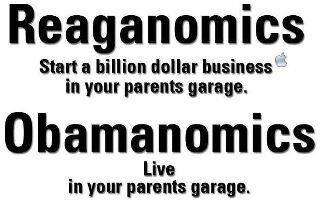
Parents' Garage“The numbers are pretty amazing,” Wallace said. “It’s an age group that you normally think of as pretty financially stable. They’re mid-career. They may be thinking ahead toward retirement. They’ve got a nest egg going. And then all of a sudden you see this huge push back into their parents’ homes.”

Many more young adults live with their parents than those in their 50s and early 60s live with theirs. Among 18- to 29-year-olds, 1.6 million Californians have taken up residence in their childhood bedrooms, according to the data.

Though that’s a 33% jump from 2006, the pace is half that of the 50 to 64 age group.

The surge in middle-aged people moving in with parents reflects the grim economic reality that has taken hold in the aftermath of the Great Recession.

Obama fans say this is what success looks like…wonder if they’d insist, what we need here is to make labor even more expensive, and business expansion even more difficult.

Watching loud, self-righteous people indulge in consistent policy changes, with the expectation of inconsistent results, is depressing. Greatly depressing. Not recessing.

Props to LA Times for making it to the end, without mentioning “Obama” or “ObamaCare” even one time. That must have taken something.

Stoffel Escapes…Again

Monday, April 21st, 2014

From here.

Mentally Deficient…You Might as Well be Arguing With a Tree

Sunday, April 20th, 2014

Captain Capitalism takes on the “Government is not a family” canard.

As long as the electricity stays on, they think the deficits are sustainable.

And, Republicans are continuing the legacy of the KKK, ObamaCare rocks, and rot like that.

I don’t generally approve of pronouncing the other side to be unworthy-of-debating. That’s their tactic. That’s what losers do. You debate if you can, and if you can’t, you come up with these rationalizations about why the debate is not possible — what they do. All the time. I just don’t think it’s productive for both sides to stoop to that level.

But, I can’t say it’s any more productive to do what I’ve been doing, either. I like the idea of imposing a litmus test. “I live in the other world, where people actually build things that have to work, that other people can use…as such, my time is valuable. So before we go further, a litmus-test question: What is better, a Mom and Dad married to each other, neither of whom has ever had sex with anybody else, with two virgin teenage children, living in the 1950’s…or a single-mom, now, with four kids by four different guys, depending on a dizzying kaleidoscope of government programs? In which household do the kids have a better shot spending their formative years?”

That does effectively separate out the slightly-lefty-leaning types, the fresh recruits, who still might be saved — from the crazies.

Movies So Bad They’re Funny

Sunday, April 20th, 2014

There are many lists like this out there, but this one appeals to me.

Lots of wire work appearing in the list…excessive CGI…a large number of superhero movies which, although not constituting proof of the list’s verity all by themselves, nevertheless strongly suggest the list is on the mark because, hey, there have been some real stinkers out there.

But the single factor I’m seeing emerge throughout all of it is: Actors just kinda phoning-it-in. That, and lack of sensibility and coherence in the plot. Those little things, that make you care about whether a movie character is going to live or die. Or succeed or fail.

Oh yeah, and the other way the list resonates with me? Through experience. Yes, Mrs. Freeberg and I have seen all of them, each and every single one…except maybe Catwoman which we haven’t watched together. I’m pretty sure we’ve both seen it. The subject just hasn’t come up, ya know?

Also, thought it was a bit harsh to go including Green Lantern on this kind of a list. That one wasn’t exactly great, or anything, but I wouldn’t call it bad either. Certainly not on par with Batman and Robin, good heavens no. A little perspective, folks.

“Liberalism Works on People Who Don’t Think”

Sunday, April 20th, 2014

Zo saw something…and said something.

The New Style Achieves Mainstream Acceptance

Saturday, April 19th, 2014

The Atlantic:

On March 24, 2014 at the Cross Examination Debate Association (CEDA) Championships at Indiana University, two Towson University students, Ameena Ruffin and Korey Johnson, became the first African-American women to win a national college debate tournament, for which the resolution asked whether the U.S. president’s war powers should be restricted. Rather than address the resolution straight on, Ruffin and Johnson, along with other teams of African-Americans, attacked its premise. The more pressing issue, they argued, is how the U.S. government is at war with poor black communities.

In the final round, Ruffin and Johnson squared off against Rashid Campbell and George Lee from the University of Oklahoma, two highly accomplished African-American debaters with distinctive dreadlocks and dashikis. Over four hours, the two teams engaged in a heated discussion of concepts like “nigga authenticity” and performed hip-hop and spoken-word poetry in the traditional timed format. At one point during Lee’s rebuttal, the clock ran out but he refused to yield the floor. “Fuck the time!” he yelled. His partner Campbell, who won the top speaker award at the National Debate Tournament two weeks later, had been unfairly targeted by the police at the debate venue just days before, and cited this personal trauma as evidence for his case against the government’s treatment of poor African-Americans.

This year wasn’t the first time this had happened. In the 2013 championship, two men from Emporia State University, Ryan Walsh and Elijah Smith, employed a similar style and became the first African-Americans to win two national debate tournaments. Many of their arguments, based on personal memoir and rap music, completely ignored the stated resolution, and instead asserted that the framework of collegiate debate has historically privileged straight, white, middle-class students.

Tournament participants from all backgrounds say they have found some of these debate strategies offensive. Even so, the new style has received mainstream acceptance, sympathy, and awards.

The beginning of the end of western civilization? Dunno. Depends on what sort of impact is had on civilization, by these debate teams. Not sure that that’s there. If it is, then this can’t be good.

I’ve now & then imposed a hypothetical of an alien from another planet renting space in our laundry room, experienced and competent in the realm of logic, reason, common sense, and maybe the English language, but entirely new to our culture, recent history and social customs. Like Mork From Ork or something — what sort of questions would such a visitor ask about this-or-that. In this situation, the curious alien would be transformed into a racist, and of the worst sort. But, this would be a reflection on us and not on him: He’d want to know, how come it is that debating a pressing issue coherently and rationally, has become a white thing?

I have also criticized the modern liberal movement for, among many other things, maintaining an ignorance of the concept of time. “They’re very often caught neglecting the refinement of the message that would be handed off to history, opting to focus their attentions on the emotional rapture of the moment. The Occupy Wall Street movement…is a perfect example of this.” The fuck-the-clock outburst is an even better example of it. The real tragedy is that entire lives are burned away, a year at a time, inside the hairpin turn of some glorious revolution. The time never seems to come to evaluate how it all went down, whether things have been made better. It requires less discipline, mentally at least, to endure the centripetal force of the turn. Everything is an outburst. Everything’s hyperbole. No cause-and-effect; no this, therefore that. “Fuck the time!” Outrage is always easier.

So the higher-ed institutions are cranking out more liberals. Well, that’s nothing new, is it. But this certainly can’t be good. And it isn’t fair to the students, not by a damn sight.

“I’m My Own Boss…Sick and Tired of My Party Treating Me Like a Victim”

Monday, April 14th, 2014

Salina Zito at TribLive (via Instapundit):

She gave a dramatic eye-roll in reaction to all of the fuss that Democrats and the president attempted to create over equal pay for women last week.

A Democrat herself, she said she has carved out a decent, comfortable life for her family over the years as a waitress at a local restaurant.

“I am in many ways my own boss,” she explained. “It is up to me to get the order right, treat people well, and use my personal skills to increase my wages.”

And she is “sick and tired of my party treating me like a victim. This is not 1970, and it’s insulting.”
:
The president, she said, “is trying to create a wedge issue when there isn’t one. Why can’t he focus on things people are really concerned about, like bringing back lost jobs, a tangible thing that has affected housing, communities, tax bases and schools?”

Last Tuesday, President Obama signed an executive order encouraging federal contractors to pay men and women the same amount of money for the same amount of work.

He claimed that women earn 77 cents to every dollar earned by men — a very broad statement and, in many ways, false, according to a Labor Department analysis showing that when you factor in job experience, education and hours worked, the difference in median wages between men and women shrinks to 5 to 7 cents on the dollar.

Christina Hoff Sommers has more to say about that (from Chicks On The Right):

Even the Washington Post Fact-Checker is boosting the rating on this chestnut, from one to two Pinocchios.

Really Looking Forward to Working with These Guys

Sunday, April 13th, 2014

It’s got a whole year of dust on it, but I just found it over at the Hello Kitty of Blogging…

…where, a friend-of-a-friend had this to add to it:

He forgot the part where they believe that guns are for breaking laws, so if guns are illegal, nobody will be able to use them to break laws.

Which touches on what’s always fascinated me about this — the commonality through it all. You can find it if you look for it, although at first it doesn’t seem possible. After all, how do you find coherence in “America is corrupt, politicians are crooks, let’s raise taxes so the politicians have more of our money and give them lots of power to solve all our problems”?

It is the power of the proclamation. You make a proclamation, and immediately at that point the difference between conservatives and liberals becomes apparent. They become opposites of each other right there & then.

Conservatives immediately think: And what of the people who will not follow this go-do? What of those who will not take it seriously? Or who simply won’t learn about it? With liberals, it’s ++whoosh++, right over their heads. Outlaw guns, the guns are all gone, there are no deaths or injuries from guns. How could there be, we just got rid of all the guns, silly! Illiteracy and unemployment are next.

One of the saddest things you’ll ever see is a liberal pundit crediting all the liberals of old for the huge strides made in fighting these scourges of mankind, along with war, pestilence, disease, famine, et al. And what did those old-time progressives do? Why, they passed some “landmark legislation.”

From all I’ve seen and heard about them, it’s always been that way. There’s a “joke” going around about conservatism and liberalism getting invented, way back in the days of the caveman. The first time man ate cooked meat, the kill was dragged to the campfire by — who else? — the first conservatives. It would have to be that way, wouldn’t it; throughout antiquity, liberals have been opposed by principle to learning any of the skills needed in a hunt. So the liberals, having contributed nothing to the feast at all, in fact having ridiculed the conservatives as they gathered their ropes and knives and spears to go out on the hunt that morning, quickly came up with some rules about how the food should be divided. And one or two of them maybe brought some hummus; but mostly, they contributed rules.

Then after everyone was fed and full, liberals took the credit. If anyone died from food poisoning, though, they quickly blamed the conservatives.

Nothing’s really changed from that configuration, in all this time. The conservatives contribute what everyone is there to consume, liberals contribute rules. If things go well liberals take the credit, and anytime there’s a problem with it they blame the conservatives.

Are the Clintons Still Married?

Friday, April 11th, 2014

I really don’t know the answer to that question. Is she a Mrs. Doormat, or former Mrs. Doormat?

If she runs, we should know. As First Dude, Bill Clinton would not be as dangerous as his wife. But he’d be more nauseating, if only just barely.

Apart from that, I suppose I don’t really care. I’m more concerned about the why. Why is it that I don’t know. The democrats have gotten into this weird habit of answering every single question that comes up with an answer of “How dare you ask the question” that their most notable luminaries have become cloaked with the shroud of enigma that in generations past, would have been thought dangerous to any aspiring politician. Not that anybody has asked questions about the Clintons’ marital status. But they haven’t been acting like a married couple since, oh, sometime around ’94 when Hillary was selling us her own health care plan. Twenty years. I haven’t heard anything of a divorce, but I wouldn’t.

Also: Why do democrats get married? I remember how they used to compare the Clintons, favorably, to Republicans like Bob Dole and Ronald Reagan who had been married more than once. Alright, assuming the Clintons are still married, that’s the first for both of them, good for them. But what’s the point?

For votes? Like Catholic democrats who are Catholic even though they aren’t practicing Catholics, so they can get Catholic votes? What is there apart from that? The democrat groom marries the democrat bride because he’s just so lost without her? And she marries him because “he makes me laugh” or some such rot?

The votes-thing distresses me somewhat, because there is something going on here that is new. It’s a change. That enigmatic cloaking, its beneficial effects. Voters feel like they “know” the candidate, now, when they don’t. Time was when the candidate would convince the voters, that the voters knew the candidate, by revealing something. Maybe it was all bull, but still that was the move: Inspire this feeling of camaraderie, membership in a common clique or interest group, by letting information out. Introducing the wife and kids. Appearing in front of cameras and talking about personal things. Now, it’s the opposite: They define themselves as dark and shapeless blobs. Defining through lack of definition. Stem to stern, it’s all “how dare you ask” to this and that and the other.

It’s not what they’re hiding that is bothersome. It isn’t even the dark-shapeless-blob maybe-married-maybe-not politicians. I’m concerned about the changing behavior of the public. They used to be fooled into thinking the candidate was their friend, when they learned things. Now they get fooled into thinking that when information is deliberately kept from them. The old way was better, because although problems can result from making friends with people who lie to you, it is certainly hazardous to make friends with people who consistently and deliberately hide things from you.

Wrong Party, Hank

Thursday, April 10th, 2014

Huffington Post tells of an interview with the legendary Hank Aaron:

“We are not that far removed from when I was chasing the record,” he said. “If you think that, you are fooling yourself. A lot of things have happened in this country, but we have so far to go. There’s not a whole lot that has changed.”

Aaron pointed to Republicans’ obstruction of Obama as one area where not much progress has been made.

“Sure, this country has a black president, but when you look at a black president, President Obama is left with his foot stuck in the mud from all of the Republicans with the way he’s treated,” he said. “The bigger difference is that back then they had hoods. Now they have neckties and starched shirts.”

Actually Mr. Aaron, those were democrats back then. The new Republican party was formed to oppose them, and end slavery. Thought you should know.

Update 4/10/14: Larry Elder poses the challenge to you, to name the names. Hope you can provide a response.

The Depth of the Problem

Thursday, April 10th, 2014

Washington Post.

All commercial transport aircraft are fitted with underwater locator beacons to assist in the relocation of black box flight data recorders and cockpit voice recorders. These beacons are free-running pingers that transmit signals at an acoustic frequency of 37.5 kilohertz and have an expected battery life of 30 days. The scale of the challenge in locating the black boxes is immense.

There follows, after that, an impressive visual graphic…

“Feel Free to Ridicule”

Wednesday, April 9th, 2014

To be added to the ever-thickening file marked “‘The Debate Is Over’ means ‘I am telling a much bigger lie than usual'”…

“The debate over repealing this law is over,” President Obama declared last Tuesday in reference to ObamaCare….
:
[Paul Krugman] asserted that “7.1 million and counting signups is a huge victory for reform.” And not just a huge victory but a definitive one: “The nightmare is over. It has long been clear, to anyone willing to study the issue, that the overall structure of Obamacare made sense given the political constraints. Now we know that the technical details can be managed, too. This thing is going to work. And, yes, it’s also a big political victory for Democrats.”

“My advice to reform supporters,” Krugman continued, “is, go ahead and celebrate. Oh, and feel free to ridicule right-wingers who confidently predicted doom.”

That last one explains a lot. “Reform supporters” don’t need any prompting to ridicule their opposition, but you can still tell when they’ve been prompted to do so. There is a perceptible up-tick, and an odd mixture of things they know how to do & other things they don’t know how to do. My stock answer to the “ridicule” has been to inquire whether or not they were trying to say ObamaCare was a good law, whether they’d go so far as to say this is a model of how legislation should be passed, and of what new laws should be doing. I never did get a straight answer to that.

As such, I’m not “confidently predict”-ing doom, I’m casually and sadly observing it.

The column continues, circling back to directly address this “debate is over” chicanery…

A demand for silence is not a sign of intellectual self-confidence. And this is not the only subject on which the left is demanding that its opponents just shut up. For years we’ve been hearing that the debate about global warming–or “climate change” or whatever they’re calling it this week–is settled. Early in the 2000s some news organizations declared they would banish dissenting points of view from their pages. The debate goes on.

It’s almost as if — let us say, exactly as if — the whole point to leftist policies enshrined into public law, is not to spare the public from disaster or to improve their lives, but to engage in this “ridicule” and act smug and superior to the opposition, results be damned.

Well, that explains Detroit.

Social Justice

Tuesday, April 8th, 2014

A few posts back there is something about Definitions, in which I posit that most serious human disagreements take place between one side that avoids definitions and an opposing side that insists on having them. I further observe that what we today call “the left” seems to be all about avoiding definitions.

And, blaming the ensuing inevitable conflict on the other side, persuading any bystanders into believing that all conflict comes from the attempt to define things. Successfully, for the most part. Well, we have multiple leftists trying to challenge this…it’s almost cute. Not a one among them seems to understand how they’re trying to so challenge. There’s no rhyme or reason or coherence to their criticisms. It’s like the Internet argument equivalent of a nerd-slap-fight. It’s also like they’re trying to put together an argument while…avoiding defining anything. Which would prove the point.

Jonah Goldberg has a fascinating addition to this: Ask some leftists you know, to define “social justice”:

Expert

Monday, April 7th, 2014

From my mean old big brother.

April Fool’s…is the Name of the Baby

Monday, April 7th, 2014

The professor has a policy that if your phone rings in class, you have to answer it on speaker…

…there’s no way that can backfire, right?

From here.

Noah

Sunday, April 6th, 2014

Looks like Superman’s dad. Bad at conflict resolution. Terrible babysitter. Sucks at parking.

They added a lot of new layers of detail to a historical figure about whom not much has been defined, even when you go back and comb over the Hebrew texts like the Midrash. Much of the negative commentary about the film has to do with that filling-in. And there’s a “Big Kahuna” thing that’s ticking off a lot of people, Christians in particular, but to reveal it would be a spoiler and there isn’t much point to doing that. There are other much more minor things that are upsetting to people, my son and I weren’t too fond of these “rocky transformer robots” that are supposed to be fallen angels.

And I don’t like my antediluvian patriarchs swashbuckling. Swinging a hammer and building a big boat is about as much physical action as I care to see there, and that’s just because it’s from Genesis. Swinging a javelin around being an Old Testament Darth Maul is over the top, but, artistic license and all…it didn’t quite ruin the movie.

On with the template…

Noah[ ] Tits
[?] Sex
[ ] Exploding cars
[ ] Guns Realism: [ ]%
[ ] Creatures eating people
[ ] Murder/mystery
[ ] Intrigue/espionage/complicated plot
[ ] Cool music
[x] Swashbuckling
[x] Good & evil wo/pain-in-the-ass hipster moral ambiguity
[x] BigBad
[ ] Client (rich powerful sucker the BigBad is trying to rip off)
[ ] Dragon (glorious bastard)
[x] Slimeball
[x] Pirate/ferryman/eccentric with highly recognizable cool ship
[x] Mooks
[x] I’m going to kill you the same way I killed your father
[ ] Girl-on-girl catfight
[x] The family patriarch spends way too much time around his work
[ ] Mom and kid live happily ever after, following the death of dumb ol’ dad
[ ] Philip K. Dick type of alternative-reality headache
[x] Maguffin
[x] Chase [x] foot [ ] flying [ ] water craft
[x] Indigenous peoples
[ ] Good guys held captive
[ ] Following a trail of clues
[x] Sinister plot [?] take over world [ ] kill lots of innocents
[ ] Love triangle [ ] girl-boy-girl [ ] boy-girl-boy
[ ] Revenge [ ] protagonist [ ] antagonist
[x] False lead/decoy
[x] Traitor
[x] Supernatural/sorcery
[ ] Ghost getting all pissed off because the good guys aren’t finding its body
[ ] Creepy young boy or girl
[x] Grisly deaths for the bad guys
[x] Race against time at the end
[ ] Cliffhanger
[ ] NO CONFERENCE TABLES

No conference tables, but it did have two conference-room scenes. They had the good sense to eliminate the middle kid, Ham, from the final one.

All in all, a very decent offering. I see at at this time it has a rating of 77% at Rotten Tomatoes, I think that’s about right.

When I took the wife to go see it this afternoon, we were a bit taken aback by the big ol’ pile of crap ONE YOUNG MAN left in his seat in the back row, just behind us. Napkins, popcorn residue on the floor, in the chairs, the bucket that was supposed to be holding it all, the wrappers going to whatever his lunch was, just scattered around on the seats. My wife whispered something to me about it, and just then the man came back up and excused himself past me, back to his seat. I thought maybe he overheard her and went to clean up after himself. But, he just picked up his cell phone and excuse-me’d past me again, leaving the mess.

The VERY LAST SCENES of the movie are the same as the last scenes in any other Noah-retelling. Animals being nice and mutually-caring and adorable, with a voice-over from the humans expressing hope that our species can learn to be just as kind and thus justify this second-chance we were given. They’d just gotten done saying that. And here’s this guy leaving several cubic feet of crap in his chair.

So, I guess I’m not entirely convinced that the big-screen forum is the right one for this message.

Arguments About Definitions

Sunday, April 6th, 2014

Wisdom from my Hello Kitty of Blogging account:

Like the jaws of an alligator or other predator, a pair of pliers works because one side is stationary while the other side moves. You don’t see it until you look closely. But that’s how it works.

Disagreements among people are similar to this; you don’t see it until you look closely, but you’ll find there’s one side in the argument, not quite so much arguing, as protesting against a definition being made (or requested). The other side is trying to establish definitions. Exceptions to this are few and far between. The argument erupts, and persists, because the two sides disagree on whether or not things should be defined.

Also generally true: The side that refuses to define things, which is responsible for the conflict, enjoys a lot of success making the conflict look like the other side’s fault. But you know something is rotten when you can start a big ol’ fight merely by asking that things be defined.

Ten examples, up with which I came:

1. When, during a pregnancy, does life begin?
2. What, exactly, has Barack Obama done to improve the economy?
3. For that matter, what did Bill Clinton ever do to improve the economy?
4. Since the minimum wage makes labor more expensive, how in the world could it possibly NOT eliminate jobs?
5. When we “sit down and talk out our differences with our enemies,” what exactly is going to be discussed?
6. If we’re obliged to allow and recognize gay marriage today, why would we not be doing the same with polygamy and bestiality tomorrow?
7. Are you really supposed to vote today? Do you have I.D.?
8. What makes a government regulator any wiser or more scrupulous than the people he’s supposed to regulate?
9. What EXACTLY are the problems “Common Core” is supposed to fix, and how EXACTLY is it supposed to fix them?
10. If politicians are “just a bunch of crooks, doesn’t matter what party they belong to”…then why would we expect to see a tax increase make anything better for anyone who isn’t a politician?

I’m sure there are more though.

I’ve been noticing that with what we lately call “left” and “right” in politics, it is a rather consistent configuration that this “side that refuses to define things” is on what we call the “left.” Issue after issue. I have also noticed that where these halves overlay occupations, the “left” sympathizes with those who don’t have any. Or, are occupied with something disassociated with any sort of material demand. Community organizing. Wheelchair-ramp-reconstruction or health insurance including birth control; other things people buy not because they actually want them, but to meet some sort of regulatory requirement. Well, this stands to reason. If you’re going to sell something to people who actually want to buy it, you’re going to need to define things in order to do your market research. And, to build the widget to make sure it does what people want it to do. And then the people lining up to spend their hard-earned dollars buying it, oh boy howdy, they’re going to want things defined too. What’s the total cost of ownership? What’s it like to use it? What are the consequences of moving on to this new thing, and stopping using the old thing?

This thing we now call “the left” is awash in pretend-games that cloak various life experiences as their polar opposites. It very often pretends that acts of destruction, as I’ve pointed out before, are brilliant creative efforts that produce something wonderful and great and grand. Can even the most ardent Obama supporter tell me what President Obama is building? They can certainly tell me what He’s destroying; in fact, if you compare those answers to what Obama opponents say He’s destroying, you’ll find the answers are substantially the same even though the two sides might disagree about names for these targets of destruction. It insists on treating people unequally and it calls that “equality.” It insists on forcing people to do things they don’t want to do and it calls that “choice.” When it bellows away about “diversity” you can be sure it will soon be pressing everyone to have the same opinions.

When every argument you make relies on presenting things as the opposites of themselves, that’s deceit; and, deceitful people don’t want things defined, that makes it harder to do the deceiving.

Much easier to tell the hoi polloi “we have to pass the bill so you can see what’s in it.”

The Debate Rule

Sunday, April 6th, 2014

de•bate (n.)
1. a discussion, as of a public question in an assembly, involving opposing viewpoints.
2. a formal contest in which the affirmative and negative sides of a proposition are advocated by opposing speakers.
3. deliberation; consideration.

I see Ed Darrell doesn’t want the seventeenth amendment repealed. His effort to explain why that is, is a fail, because his point is — as usual — some hated group of rich people wields too much influence. In this particular situation, it’s past-tense, so not only have the loathed copper barons been dead for generations, along with anyone else they might have unfairly oppressed, but there’s a lot of difficulty in evaluating just how much influence they might have had. The progressives of the time thought it was too much, therefore that’s what history says, since they won that fight. But what’s that mean? In politics, everyone is thought to have too much power, by someone who opposes whoever that would be. And history about any conflict is generally written by the victor.

Once those questions are answered, they fail to support the conclusion that we need the seventeenth amendment, which strips the states of representation in Congress. As in, reduces their influence all the way to zero. It is that “final solution” which fascinates me. Haven’t you noticed? Within lefty politics, this is always the answer: Someone’s influence should be — not just checked or balanced — but obliterated. A reduction or realignment is never good enough. That group, that party, that class, that guy, never should have had a vote in the first place.

It isn’t just the lefties anymore. We see it everywhere now, don’t we? A&E “fired” Phil Robertson, patriarch of Duck Dynasty — now, what was the point of that? I never did hear of anyone taking the extra time or trouble to teach or counsel Mr. Robertson into having the correct opinions about gay people, so it wasn’t about Robertson’s opinions. As always seems to be the case with actions like this, it was about influence. The rule seems to be that you can think whatever you want, but you’re not allowed to have influence unless you think the right things. If you don’t think the right things then you are to be driven out of whatever position you have. Once that’s done, you can go on thinking it, but the important goal is that we have to get our society properly arranged, with these good thoughts entirely saturating the tallest spires, and the bad thoughts entirely relegated down there in the dark alleyways, among the plebes. That is, from all I have seen and all I can figure out about it, the ultimate objective. The shrieking I hear is all about these exceptions: Someone in a position has a bad thought, let’s get him defrocked of the position so he can keep his bad thought — but, down there, not up where he is. Those people up there are all supposed to think the same, good, things.

Which brings me to the Eich matter (hat tip to blogger friend Rick).

The very same people who have declared, “I yam what I yam”, and “we’re here, we’re queer; get used to it,” and who fought against discrimination on the basis of physical or emotional natures are proving themselves empty of magnanimity in victory. They are now saying “don’t be who you are,” and “you’re wrong, you’re gone; get used to it.” They’re applauding employment discrimination on the basis of an intellectual or spiritual philosophy.

What are they, anyway, philosophobes? Are they so terrified of any outlook which does not conform to theirs? I always thought a well-founded argument could withstand a little principled opposition.

That last observation of The Anchoress’ cuts right through and stabs straight at the heart of the problem. For generations now, our society has become overly obsessed with seeking alternative methods for conflict resolution. At first blush, that seems to be just an attribute of a civilized society, doesn’t it? Conflicts settled by some other means than “might makes right” — isn’t that practically the definition?

Ah, but in opening the possiblity for victory to be awarded to someone besides the strongest, we’ve made the mistake of doing the same with arguments. Just as we don’t want the strongest kid on the playground to win all the time just because he’s strong, since that’s bullying, we’ve transformed debate the same way. The weaker argument has to have a fair shot. But not just a fair shot. Nothing short of a monopoly on any & all influence, will do.

If one could plausibly argue that left-wing politics in America is, as I’ve posited before, a message of “get out of here so the cool people can make decisions, but leave your billfold behind” — then, one would have to concede that our culture is being jerked in that direction, a whole lot in a very short time, suddenly, even violently. So many busy and talkative factions that want to “discuss” or “debate” something, have a “national dialogue” of some sort. But step one always seems to be to make sure someone else can’t participate.

They want to win a debate without participating in one. Let’s contemplate for just a moment or two how odious that is; or, ought to be. What would a casino or gambling hall say to something like that? You want to win the bet but you don’t want to subject yourself to the risks and rigors of the actual betting. You enter a poker match claiming to be good for it, lose the hand, and oopsie…your pockets are empty. What happens next? It wouldn’t be tolerated in there. Why do we put up with it out here?

And it hasn’t been lost on me that the people to be exiled from the discussions, more often than not, are the ones who are to involuntarily pay for the outcome. The here-and-there examples don’t bother me much. They’ll happen; unproductive people like to boss productive people around. They’ve always liked that. They have nothing else to do. What bothers me, and I suspect is of paramount concern to the people participating in Call Mozilla Monday tomorrow, is that this seems to have become the default configuration. Nobody seems to notice it much anymore unless someone takes the time and trouble to make a huge stink.

That would put me in the minority, because when I hear someone say “Before I make my argument, make sure my opposition cannot respond,” or anything that is equivalent, I don’t need someone to make a stink to understand what’s wrong with that. It sounds to me like conceding defeat. At that point I don’t even wanna hear what comes next, to tell the truth. Why waste my time listening to an argument that is so bad, that the person making it doesn’t want to make it until he can be sure no one has the opportunity to respond? Except to express total agreement?

Therefore, I propose the following rule. Its time has come: If you want to win a debate, you have to first allow it to happen.

How about it, can we all agree on that? Or can we at least get a lot of people behind that one? Doesn’t seem to me like too much to ask; it’s just common sense. Or maybe I’m expecting too much? Are we too “civilized” for that now?

Back From the Road Trip

Sunday, April 6th, 2014

Rolled over the odometer to 100k, then put an additional three or four thousand miles on it. It’s a Honda, so 100k is at the point where it’s just getting broken-in.

That thin wiry figure in the top panoramic, which is the Lake Mead area, is my sixteen-year-old son who I’m trying to get to eat real food. I suppose that will all come later. He’s about as tall and thin as I was at his age.


Before exploring the Grand Canyon, we took a walk through the neighborhood I used to call home, in early-early childhood, over forty years ago. The photo on the right is where my folks escorted me to my first Kindergarten class. Yup, this is where all the trouble started.

After finishing up with that, we took Bugs Bunny’s famous “left turn at Albuquerque” and carved our way through Colorado and Wyoming, then circled back through Utah and Nevada. I have pictures of that stuff too, but as you might imagine if you’ve been through that part of the country, they’re not very exciting. At all.

Click the pics to embiggen.

Pushing the Envelope

Thursday, March 27th, 2014

On the brink and, for the moment, pulling back:

Vulnerable Senate Democrats plan to introduce a bill as early as today that would alter some of the mandates in Obamacare and delay others, according to the Wall Street Journal:

Among the proposals likely to be included is one backed by Messrs. Begich and Warner offering a new kind of insurance plan, a “copper” plan featuring lower premiums and higher out-of-pocket costs than the “bronze,” “silver” and “gold” options on the government-run health-care exchanges.

Lawmakers also would like to make health care more affordable for small businesses by expanding certain tax credits and making them available for longer…
:
Many Democrats in tight races this fall have made clear they are committed to keeping the health law but want to fix it, drawing a distinction with Republicans who want to scrap it entirely. “The law is very good; it has some very good parts to it,” said Sen. Mary Landrieu, a Democrat running for re-election in conservative-leaning Louisiana. “I do not believe it should be repealed—my opponents do.”

This is a trap for Republicans. If they go ahead and help the Democrats by applying a bandaid to this gaping wound, it won’t help consumers and would dispirit the base of the party. On the other hand, that’s just what these Dems are counting on. By refusing to help “fix” Obamacare, they can run on the notion that Republicans don’t want to make the law better because it benefits them politically if it remains a mess.

There’s no reason for the GOP to alter what they’ve been doing. The mid terms will be a turnout election and anything that might keep their voters from going to the polls should be avoided. On the other hand, only those predisposed to think that a few minor tweaks could actually “fix” Obamacare would be influenced by the Democratic argument of GOP obstructionism. It’s far better for Republicans to keep the pressure on vulnerable Democrats than help them make meaningless changes to a bad law.

Thing is, though, this isn’t about applying patches to a bad law to make it into a good law, or correcting the implementation of a good law so that it’s a bit less messy. It’s about incremental movement. The questions have to do with quantity and not quality: How much of the poison can we swallow on any given day, or any given election cycle. How much furniture polish can you put in the stepkid’s soup before she complains about the taste and doesn’t eat it.

The way forward is not open to any sort of question or deliberation; it’s not on the table. I know this is true because I subscribe to the democrat party’s e-mail updates. They’re writing in this morning to get me all excited about taking back the House of Representatives. They need me to get fourteen people from my city to chip in $3 or more, so they can bring 218 seats under democrat control; see, that’s the thinking. When-are-we-done. What’s the bare minimum — to achieve iron-fisted, dictatorial control on a whole host of issues. When can we start forcing people we don’t know to do everything our way.

The question that would naturally come up to a truly political party trying to achieve success in a constitutional republic, would be: What would it take for us to win 300 seats? Or all 435? It is astonishing that liberals, as we understand that word today, have so little interest in such things. They know that the answers would have to do with chipping away at the agenda, giving something up. They don’t want to give up anything at all. They’re extremists by nature. They have no reason to be anything else; they know the ratchet effect works in their favor.

They know exactly what policies they want. The question is the size of the incremental steps, how quickly the electorate can be persuaded to absorb the “change” in each election cycle. This is much bigger than President Obama, He’s merely a device to speed up the sale. A bit of salt and seasoning in the poisoned soup, if you will.

And they’re doing this so we have better medical care? Been awhile since you’ve heard a democrat talk about that, though, hasn’t it. “The law is very good” and “has good parts to it.” But what about results? All of their talking points are “gonna-dooz” and very few of them have anything to do with “hav-dunz.” Even the disgraceful debunking of that cancer patient was chock full of “would be” and “will hit.” They have very few anecdotes to offer about people receiving better medical care at lower cost, and even fewer statistics to offer about a population staying healthy, or getting healthy, or saving money, or enjoying any other perks of state-managed health care services.

Like everything else they do to “help” people, it’s really all about control. Charge this much, pay that much, don’t own this, must own that. And how many such new rules can they pass this year without losing elections. And how many elections can they afford to lose without losing control of this-or-that chamber.

They’re not really representing people at all. They’re in our capitol to represent an agenda, not constituents. Whatever they haven’t outlawed or forced, they merely haven’t outlawed or forced yet. Republicans, as usual, suck at communicating so that hasn’t emerged as the central issue. But it’s really all about that. It has always been all about that.

“The Wealth in America Doesn’t Come from Government”

Thursday, March 27th, 2014

Kevin O’Leary responds to President Obama’s concerns about the minimum wage:

Even if the President’s facts and figures were correct, His logic is poor. You can effectively highlight the glaring gaps simply by relieving Him of the power to unilaterally choose phrases. Make labor more expensive, that would be an honest and balanced summary of what it is He seeks to do right now. Right?

Would even His defenders agree with the statement, “What we need to do right now is increase the cost of labor 39%”? Because if they won’t go along with that, then how come we have to use their phraseology when we debate measures like this?

People seem to forget: “Will increase the cost by such-and-such-a-percent” is not some abstract computation put together using some worst-case-scenario and then bandied about by the law’s critics; it is what the law does. It’s supposed to do that. It’s a minimum.

Eleven Hate Crime Hoaxes

Wednesday, March 26th, 2014

National Review:

This incident at Grand Valley State is just the latest of many instances over the past few years in which people claim to be the victims of hate crimes they inflicted on themselves or completely fabricated.

Perhaps attempting some misguided publicity stunt or perhaps trying to make others see hate where there is none, these people have gone to great lengths to claim they’ve been targeted.

When politicians manage to ram bad laws through the mill that are ripe for abuse, it’s a double-win for them. By subjecting ordinary citizens who are just minding their own business to casual civil and regulatory assault, they make The People less powerful, and in so doing make the state more powerful. They essentially pilfer rights away from The People. And politically, they help themselves by shrugging off concerns about this potential abuse, they set themselves up as believers in mankind’s inherent goodness.

Of course, if you noodle away on that last point with something resembling a working brain, you immediately understand that the “faith” they’re putting in mankind is nothing more than an illusion; if/when they turn out to be wrong, it doesn’t cost them a single thing.

Laws such as these rank high on the list of ways to empower the powerful, comfort the already comfortable, and afflict the afflicted.

“The Government Will Not Try to Determine Whether the Person is Telling the Truth”

Wednesday, March 26th, 2014

Washington Post, hat tip to blogger friend Rick.

The Obama administration has decided to give extra time to Americans who say that they are unable to enroll in health plans through the federal insurance marketplace by the March 31 deadline.

Federal officials confirmed Tuesday evening that all consumers who have begun to apply for coverage on HealthCare.gov, but who do not finish by Monday, will have until about mid-April to ask for an extension.

Under the new rules, people will be able to qualify for an extension by checking a blue box on HealthCare.gov to indicate that they tried to enroll before the deadline. This method will rely on an honor system; the government will not try to determine whether the person is telling the truth.

Nifty. Yeah, I can certainly see that Obama’s government has no need to be told what’s going on, when they’re plenty capable of making up all the truth they need.

Our nation’s first President supposedly couldn’t tell a lie…

25 Pictures of NFL Cheeleaders Who Should Put on More Clothes

Saturday, March 22nd, 2014

Rant Sports.

Showing Maturity

Saturday, March 22nd, 2014

I think this is completely great. What a fitting epitaph.

“Signs That Left Them Speechless”

Wimp Factory Tooling Up

Saturday, March 22nd, 2014

The joke around these parts is that when I started blogging, one of my favorite bitch-fests was that the Sacramento area didn’t have a single Hooter’s restaurant. Now there are three of them; so, all tremble before the power and wrath of The Blog That Nobody Reads. The serious side of it, though, is that market forces ultimately prevailed. And yet, since it took awhile, they obviously had to prevail against something. Prevail against what?

The answer is obvious: Prevail against the culture of “don’t want my husband looking at pretty women.” And the irony is that, since Sacramento survived a good long time without a Hooter’s, it probably could have survived without one indefinitely. The supply came because of the demand, and the demand was there because of the taboo against going. Going to silly restaurants with waitresses wearing skimpy clothes, and — any one of a number of other things. Don’t do this, don’t do that. It’s not the restaurant taboo that affects behavior, but the larger, broader taboo. And the NorCal culture is busy & thick with soft, silly, ineffectual rules; rules nobody takes the time to read, let alone follow, rules that command no respect. But, rules everyone likes to repeat over and over. It’s the land of a million rules that nobody ever follows.

We have a culture that is friendly to the little laws; it comes easy to us to complain that such-and-such is happening, unregulated and we need yet-another-little-law. Maybe an actual regulation, maybe just a new soft, cultural hand-slapping. No, we don’t have Hooters because a blogger complained. We have Hooters because of the people who wanted to keep Hooters out, or rather, because of the tension that built up around their mindset. It’s a case of the pressure building up under the blockage.

Half of us relieve our daily tensions by finding some refuge where we can get away from the little-laws. The other half of us, unfortunately, seem to escape similar tensions by passing those little-laws. Mencken said puritanism was the nagging fear that someone, somewhere is having a good time? What we’ve got is the widespread nagging fear that someone is able to do something they want to do. Not so much a desire to control others, as a phobia against liberty. Subtly different.

Those who have this phobia against liberty, I notice, seem to have a connected and inseparable loathing against success. The shrikes who won’t let their husbands go to Hooters, for example. What exactly is their problem, that the husbands have the freedom to go, or that the younger ladies are successful in trying to look good? Both are understandable resentments, but they tend to melt & meld together, no?

Not wanting the love of your life to gaze lasciviously upon another, is natural. Not wanting him to succeed at anything, is not.

A younger relative-of-sorts, who once shared a household with me due to one of my past relationships, put up a post at the Hello-Kitty-of-Blogging about the new configuration of his own household: Wife works, he’s Mr. Mom for awhile. Smart kid, knows how his bread is buttered. Wow, what a reaction! Like dragging tenderloin through a den of hungry lionesses. He netted lots of snotty lecturing about the laundry he may-or-may-not have screwed up yet, some you-go-girlfriends for the working wife, and a big mess of likes. And, silence from me, since contrary to my reputation I can figure out when my insight isn’t wanted.

Yes, I do live in a different world. But no, sorry if this disappoints anyone, on my planet we don’t look down upon Mr. Mom. I’ve been one. So has my Dad. We have to do what we have to do. In my world though, the reaction is not huzzahs and atta-girls for the lady of the house who now has to pick up the pieces, but one of concern. Yes, it is yet another thing we are not allowed to discuss, but a household in which the woman is the primary breadwinner, generally, is a household that would be in a more comfortable situation if that were not the case. I said “generally.” Even that is charitable; exceptions to the pattern are are quite rare. So we share the concern about finances that we’re sure exists even if it’s unspoken.

Cheers because she makes more now? What’s that all about. It’s supposed to be a partnership, not a race. I wonder what my Mother would have done if she got a “girl power” shout of support while she was working and my Dad wasn’t. She got something close to that, a lot of times, during the years when she owned her own business. None of those compliments ever actually put down my Dad, or accentuated the difference in their roles. At least not that I recall. What I do remember are the congratulations to her, and her alone, for living the “American dream.” Even so, she seemed a bit uneasy about it all. What if someone took the extra step and actually belittled or insulted her husband? There’s just no way. She wouldn’t have tolerated it.

But my parents were in a partnership. I guess that’s out of fashion now, and someone needs to warn the next generation of growing boys: There’s this huge tidal wave of available females who want to couple up with men, without any aspirations of partnership. And again, we see a supply forming to suit a demand, because we have a growing glut of available males ready to become human fashion accessories, or human furniture. Unequals for our supposedly-equal society.

John Hawkins writes:

We conquered a continent, built the Hoover Dam, went to the moon, and not only did our Olympic athletes refuse to dip our flag to Hitler during the 1936 Olympics, we made the most evil man who ever lived kill himself in fear before we could get to him.

Friend ZoneThat’s the stock that Americans come from, which begs an obvious question: What the hell happened to us?

How did the toughest, most independent society since Sparta turn into a wuss factory full of people who’ve never had an adventure in their life outside of a video game? We now have an entire grievance industry full of losers who spend all their time complaining that they’re “offended” by everything from the name of the Redskins to the “Patriarchy” to politicians using “violent language” like “crosshairs” and “job killing.”

There follows a list of five ways our society is losing its manly and capable edge, through generational attrition. He had the good sense to make “ban bossy” the first item on the list. You really should sit down and read the entire thing; #3 was news to me, and I only learned of #2 a little while ago. But I was most interested in the theme permeating throughout all of it. The subject of my complaint up above. The idea that whatever the problem is, yet one more obtrusive yet ultimately ineffectual nagging rule will somehow fix everything.

Rules, rules, and more rules! Can’t! Don’t! Prohibited! Stop! Not allowed! More more more…keep ’em coming, we should achieve total bliss any day now. I’d pop the top off a bottle of beer and watch it all down by the swimming pool…oh, if I could.

Prof. Sowell says:

Much of the social history of the Western world over the past three decades has involved replacing what worked with what sounded good. In area after area – crime, education, housing, race relations – the situation has gotten worse after the bright new theories were put into operation. The amazing thing is that this history of failure and disaster has neither discouraged the social engineers nor discredited them.

That’s now five decades, not three. It’s a twenty-one-year-old quote. It hits the nail right on the head: We’re so busy-busy-busy in this Twitter age, that the twits don’t have the time to stick around and see how these ideas pan out, let alone form their mouths around those all-important words, “I guess that didn’t work out quite like I thought it would.” It’s easy to find an Obama fan who will concede that some of the magic from 11/5/08 has worn off, but you can search weeks or months without finding one who will admit anyone in that movement made a mistake or had anything to learn at the beginning. Isn’t that ironic? After all their manic babbling about “change,” they don’t see any that’s necessary at this point. Just more of the same.

They’ve got lots of something called “humility,” but none of the good kind, the stuff that makes learning possible, that makes things actually work.

Wimps don’t worry me. I’m not even worried about an increasing population of wimps. Because wimps are, when you get right down to it, people who lack the resilience to learn. They’re missing the good-humility, the humility that is the start of all practical learning, the humility that says “I did something wrong there, the results speak loudly to me, so let us see how I can do it better next time.” They don’t worry me because they will eventually get tougher, and if they don’t, then their sphere of influence won’t get bigger than it is right now so they’ll remain harmless.

What worries me is the building of the wimps. The wimp-factories are shifting into high gear, revving up, achieving greater and greater efficiency and perfecting new methods as they manufacture these contributions to the newer wimp-generation. Hawkins continues:

There is actually a basic formula for building self-esteem. You find something you have talent at, you work at it, your ability is recognized and you feel better about yourself. However, we’ve moved past that formula and may have become the first society in history to almost entirely disconnect self-esteem from accomplishment. It’s debatable whether our schools should be focusing on building the self-esteem of kids at all, but we certainly shouldn’t be teaching every kid that he’s a special little sunflower, regardless of whether he’s done anything to earn it. Yes, God thinks all of His kids are special, but the rest of us generally aren’t impressed with someone who has nothing going for him other than the fact that he exists and his teacher says nice things about him. The world doesn’t owe you a living, you’re not special just because your teacher didn’t mark your papers with red ink, and the harsh truth is that the world values you for what you bring to the table, not because your life has been one long series of participation trophies.

It’s not just a kid-issue. It affects all aspects of our western society, right up to the tippy top. You see it when we have heads of state bragging, not about what they’ve actually managed to accomplish, but about the conversations they’ve been having over the phone. They’re acting like they’re doing, when all they’re doing is talking. Those are our leaders, tweeting away and hoping for their “participation trophies.” How can we expect better from the rank-and-file?

So our kids are not pushing themselves to deliver good results, or at any rate they have no reason to do so; the grown-ups are not likely to insist on such a threshold if they don’t insist on this from themselves. And after the kids earn their participation trophies, they are overprotected (hat tip to Bird Dog at Maggie’s Farm).

It’s hard to absorb how much childhood norms have shifted in just one generation. Actions that would have been considered paranoid in the ’70s—walking third-graders to school, forbidding your kid to play ball in the street, going down the slide with your child in your lap—are now routine. In fact, they are the markers of good, responsible parenting. One very thorough study of “children’s independent mobility,” conducted in urban, suburban, and rural neighborhoods in the U.K., shows that in 1971, 80 percent of third-graders walked to school alone. By 1990, that measure had dropped to 9 percent, and now it’s even lower. When you ask parents why they are more protective than their parents were, they might answer that the world is more dangerous than it was when they were growing up. But this isn’t true, or at least not in the way that we think. For example, parents now routinely tell their children never to talk to strangers, even though all available evidence suggests that children have about the same (very slim) chance of being abducted by a stranger as they did a generation ago. Maybe the real question is, how did these fears come to have such a hold over us? And what have our children lost—and gained—as we’ve succumbed to them?

What they gain is loyalty to a phony kind of “reality,” and what they lose is their attachment to the real-reality. The one that is genuine and testable.

We live in an age of wimp-reality leaders and wimp-reality constituents. It’s a vicious cycle, because constituents in this faux reality elect “leaders” who will tell them what to think. They have to. That’s how they form opinions; they repeat what they have heard, from others. Affordable, affordable, affordable.

And why do these leaders tell the constituents what the constituents are supposed to be thinking? Because they have no other choice. Their policies are awful and the results they produce are terrible.

A weak President emboldens our enemies and endangers the safety and very sovereignty of our country. And our Marxist/Alinsky-ite Follower of a President does not have the intestinal fortitude of a field mouse….and Putin knows it.

They lack that “good humility” I mentioned up above. The humility needed to recognize a revision to the plan must be necessary, because the results have not been good.

Harvard Journal of Law and Public Policy has just released a study of the relative effects of stringent gun laws. They found that a country like Luxenbourg, which bans all guns has a murder rate that is 9 times higher than Germany, where there are 30,000 guns per 100,000 people. They also cited a study by the U.S.National Academy of Sciences, which studied 253 journal articles, 99 books, 43 government publications, and it failed to find one gun control initiative that worked.

They talk about “science” endlessly but don’t know, or even seem to care, what that word is supposed to mean:

Real science (again, to them) isn’t real at all. The only real science is that which has been blessed by Al Gore, Barack Obama or his (allegedly non-political) Environmental Protection Agency.

Freedom, liberty, right and wrong are recognized by these types only — recently — in contexts that have something to do with gay sex. Huh, you know, some of us aren’t into that. Can we have freedom and liberty too?

It’s time to ask questions like this, I think, because force and freedom are measurable and rudimentary concepts. It’s true that “right and wrong” are not quite so simple. We can hash that one out across days, weeks, even years, with good points being made on both sides of a given disagreement. But I would expect any thinking individual to recognize the difference between, let’s say, taking in new information vs. deliberately blocking information out. I would expect them to distinguish properly between forming an opinion about nature in order to test it and validate it against measurements, vs. forming an opinion just to get along with everybody else. I would expect them to differentiate between discovering new things, and achieving unanimity within a collective by getting rid of any & all disagreement.

This is all part of our newer wimp-culture. Which, when you get right down to it, is a product of coddling. It is the product of too many people going too long without seeing prosperity connected to their wiser decisions, or seeing any suffering connected to their more foolish ones. They don’t catch on to these primitive and vital distinctions, because they don’t see the need and they don’t see the point.

They make these “jokes” about women being smarter than men; in so doing, they don’t look to me the way they think they’re presenting themselves. I know exactly what they want — I’m not supposed to take such comments seriously because they’re jokes. Well you see, the problem is that jokes are supposed to be funny, and in order to be funny they’re supposed to stay fresh. The “smart woman stupid man” joke is not fresh, it’s stale. The theme about President Obama being ordered around by the unforgiving First Lady Michelle, in particular, is now going on seven or eight years non-stop. As far as I can tell, there hasn’t even been any variance to it. So it doesn’t look like a joke. The guy telling it over and over again doesn’t look henpecked or humble in any way; not even respectful. The people who laugh at it don’t look sleek or sophisticated.

Who among us thinks for one moment, when the cameras click off, that President Obama says to Himself over and over “women are smarter than men, women are smarter than men,” and not — “Well, I pulled another one over on ’em.”

And what am I to think about these brittle biddies who know they’re being patronized like this, and laugh with their exuberant and theatrical approval anyway?

Where I come from, which I guess nowadays is another planet or something…this looks like what it is. Mass foolishness. Diseased thinking. The kind of faulty contemplation and deliberation that resulted in the healthcare.gov launch going the way it did.

Affordable, affordable, affordable…

It’s all cyclical. Life has a way of teaching you the same lesson over and over until you learn it, then you can go on to the next lesson. But there’s always some pain in these lessons, and the lesson that someone needs to learn here is: You can only count on strong and good results when you engage in strong and good thinking. I’m not sure what kind of pain has to be brought about to correct this wimp-thinking. I can only hope it’s spread out over a good long time, for the course correction we’re talking about here, and the mass, are way off on the high end. As in: Think of a long-drive of a golf ball resting on a tee, as a “course correction.” Now think of that golf ball possessing all the mass of a battleship. That’s how far off we are, I’m afraid. That’s the kind of correction that’s overdue now.

Obviously we’re dealing, once again, with a mass disagreement about a fundamental thing, a fissure that runs down between us separating us into two halves, unseen, imperceptible most of the time, but nevertheless running long and deep. The fundamental disagreement has to do with opportunity versus security, and outcome versus appearances. This connects back to that Sowell quote about replacing what works with what sounds good.

On the headboard of our bed I have a huge stack of Modesty Blaise books. I’m constantly wondering what today’s goth-wearing, complaining college-age feminists would think about it all. The constant theme is that Modesty, a woman, is the boss of Willie Garvin, a man. But Willie Garvin is not Ray Barone from Everybody Loves Raymond. Not even. By the time the story’s done, you wonder if Garvin or James Bond would come out on top mano-a-mano. He’s tough, resourceful, resilient and sharp. But throughout it all, he takes the extra step to find out what Modesty Blaise wants done, and how she wants it done, because — get this — he wants them both to come out of it alive and he figures they have a better shot that way.

Outcome over appearances. When that’s the priority, you get mutual respect regardless of who’s calling the shots. When the priority is the other way around, you get wimpiness, lots of complaining and butt-hurt, a bunch of bossy females bitching about being called “bossy” (!), friend-zoning, and perhaps most damaging of all: Zero actual learning, consistent courses of action repeated endlessly, at unlimited expense, with the culturally forced anticipation of inconsistent results.

Baracketology

Thursday, March 20th, 2014

It’s that time again.

With Joe Biden and John Kerry holding down the international fort, President Obama fulfilled an annual obligation:

President Barack Obama, the nation’s first basketball fan, took marker to bracket with ESPN again at the White House and selected Michigan State to defeat defending champion Louisville in the NCAA men’s tournament title game.

The path Obama took to arrive at his national champion, an event that has come to be known as “Barack-etology,” was revealed on SportsCenter at 9:30 a.m. ET Wednesday. It is the sixth consecutive year he’s made them with ESPN’s Andy Katz.

“Tom Izzo is a great tournament coach,” Obama said. “I’ve got Michigan State going all the way. … He know how to motivate folks and he knows how to coach. My pick: Michigan State. Bring it home for me. It’s been a while since I’ve won my pool.”

Based on past “Baracketology” national champion predictions, Michigan State might want to request a waiver.

I remember how impressed I was, two weeks ago, when President Obama was asked during lunch about that inconvenient other thing and completely ignored the Ukraine question. “Asked what he ordered, Obama said ‘A Korean beef sandwich, along with some chili. So I’m going with beef. I’m going with meat.'”

Bread-and-circuses to distract the populace. Fundamentally Transformed America’s First Pharoah is going with Michigan State, and meat.

Psychologists really should check out the phenomenon taking place here. Oprah Winfrey has been doing this for years. From what I can tell, you don’t get famous doing this, you have to already be famous, and you have to be famous in a certain way. You need to have a large fan base, and most of that fan base has to strangely work your identity into the maintenance of their own. They must see themselves, as real objects in the universe who bear some legitimacy of claim for taking up that space, as fans of you.

Betting...Once you have that, it doesn’t matter which book Oprah chooses to put in her club. It only matters that she chooses something. That having been done, word gets around. But, again, there’s much more going on.

The word getting around is a very quick process. I have to wonder what it takes to get other news traveling that fast, more helpful assets in the arena of human knowledge, like “affect is a verb, effect is a noun, they’re not interchangeable.” When the picking-by-deity has to do with future events, accuracy is absolutely and positively not part of the equation. Not even close.

I see the hoi polloi plays the game, too, and again accuracy doesn’t even come close to being part of it. “I’m picking [blank] to make it to the final four,” for the future, or “I could certainly imagine Michelle Bachmann saying that” for what should have taken place in the past. Did it pan out? Is that what she said? It’s rather alarming how little they care.

It’s almost like…in fact, I might be persuaded to amend that, saying it is exactly like…their existence is affirmed, or legitimized, through the expression of these opinions. The expression, and the display of confidence behind the opinion. The confidence is always total, I see. They have no idea how many chips they’d want to put in the pile, nor do they care. The content of the idea is the point of the outburst, but at the same time, the outburst is calculated to produce the same effect it would produce if it was about any ol’ other thing. President Obama is producing the same social effect by “going with meat” that He would be producing if He went with kale, onions, arugula, avocados and sprouts. It’s the “I’m going with” effect.

And it’s for idiots, frankly. There is an inverse bell curve going on, because when President Obama says “I’m going with,” half the country drops whatever they’re doing, racing to the idea like piggies running to the trough, and the other half says to itself something like “if I were ever on the bandwagon, this is where I’d be jumping off.”

So clearly, either those who follow this stuff have something in their lives that the haters are missing, or else it’s the other way around.

I think what we’re talking about is the maturity you’re supposed to acquire when you become an adult, and it’s the other way around. Yes Virginia, there is a Ukraine crisis out there, along with a big long list of other things involving people, places and situations that are affected by the wisdom of good ideas, as well as by the idiocy of wretched ones. Actions have consequences. Expressing a preference doesn’t actually make anything better. It can be a first step, sometimes, but nothing more than that.

So What’s a Hero?

Wednesday, March 19th, 2014

I’m in Margot Magowan‘s corner on this one, although I suspect for reasons that are different from what she has in mind. She found out about a nine-year-old boy who brought a My Little Pony lunch container to school, and was sent home with a message from the principal advising on a different choice of equipment, to prevent the bullying.

Well, we all like to avoid bullying incidents, the question is how. Margot’s point, as I understand it, is one I can appreciate: Teaching individuals to conform with the whims and the tastes of the (bullying) group is hacking away at the leafy part of the weed and doesn’t fix anything. It elevates the evil above the good, or at least, the dysfunctional above the not-dysfunctional. Or above the Brony-functional.

But, I had to point out to her that this was taking things a bit far:

Gender stereotyping CAUSES bullying. Bedazzling shoes? Not a solution here. What is that teaching your kid? To do whatever the bullies say to do. And what is it teaching the other kids? Keep bullying. Is that the lesson we want to be teaching? I honestly don’t even think these 4 year olds know they are bullying, because not enough parents and teachers are telling them that. I think these kids believe that they are stating a fact. It’s up to grown-ups to teach them differently. Don’t know how? Teach your children colors are for everybody, as are games, as are books, and TV shows, and movies. Seek out narratives with strong female protagonists for your sons and daughters.

I’ve been subscribing to her blog for a few years now, because she’s attacking the mindless-movie-culture with a formulation that I think makes a lot of sense: That fiction, especially fiction up on the big screen, has a way of shaping reality by way of shaping the expectations and the behaviors of the people who watch the movies. In that way, movie content has a way of determining cultural content.

Margot and I often agree about the problems and disagree about the solutions, as is the case here. Boys are to see females are strong and heroic? Wouldn’t surprise me one bit if it turned out that’s why the nine-year-old became a Brony in the first place. In fact, to me this whole thing looks like a crisis borne from weak and inadequate definitions: The kid doesn’t understand the benefits of developing manly personal attributes, and as for the principal, well, he doesn’t seem to get the whole “good should win out over evil” thing. Principal and student could both have stood to see a few more John Wayne movies.

Margot’s solution, and this is the continuation of a pattern I’ve seen, is not to resurrect the strong gender roles, but rather to tone them down even further. So I can take it as a given she’s not going to like my John-Wayne-movie remedy too much.

But I know I’m right, because of what it means to be a hero. And it does — must — mean something. Heroes are more than just examples. I believe Margot’s questions are good, and her complaints are sound, that our children are being short-changed. Much has already been made of the damage being done to the Millennial kids; they’re being made to think that trying-hard is good enough, and if it ever isn’t, then that must mean a protest is in order and that, surely, will solve everything. They’re being pushed and bullied and coerced into taking on more debt to learn soft skills that won’t make them more employable so they could pay this debt back. But there’s another side to this. Their vision is being clouded. They’re not being pushed, the way kids were pushed in my generation, to see themselves as forces of good.

Oh quite a few see themselves as deserving, sure. But that’s different from my complaint. The “deserving” angle carries with it an expectation that the tough work is in the rear view mirror somewhere. Once again, a crucial point relies on a distinction to be made, and here it is the distinction between the near future and the recent past. This is important, because if the work is just-ahead, you haven’t earned your reward yet and failure is still possible. From what I’ve seen of the Millennial attitude, I’m worried, because they don’t seem to catch on to this.

This dovetails back to an observation I’ve made before about DC superheroes versus Marvel superheroes. I don’t like Marvel as much because it’s a “hipster” comic book publication. Both universes seek audiences of geeky kids who read comic books because — let’s be honest, now — they have not successfully cultivated an everyday social life that fulfills them. Most kids who have that going on, don’t do comic books. There are exceptions to everything, but when you look at the audience of this sort of product overall, you’re going to see a lot of kids who are still struggling with figuring out how to integrate, how to function socially. There’s nothing wrong with that, it’s part of being a kid. Heck, I’ll be fifty in a couple years and I’m still figuring it out.

Comic books can help out with this. It’s not a perversion of the literary pursuits. It’s a noble calling. Well, DC’s message to kids who are in this situation is a good one: Sure it sucks not being able to fully fit in, but you don’t have to let that define you. Things will change, you will grow tall, strong and capable, who cares about being exactly like everyone else anyway. The world doesn’t need that from you, what it needs are your gifts. Marvel’s message is not so rosy: Yeah, you don’t fit in and you know why that is? Because society won’t let you. And it will never let you. Let’s just keep obsessing over that.

That theme is always there. Even with Spider Man, and Captain America, it’s still there. I suppose the Fantastic Four may be an exception. The X-Men certainly are not. I just can’t work up too much excitement over that gang. The sense of despair and angst and resentment, it’s just so thick you can cut it with a knife.

In moderate amounts, that can be okay though. Spider Man 2 was most enjoyable, I thought, possibly an entrant into the short list of “sequels better than their originals.” Heroes who are wallowing to excess in the angst from failing to fit in, have the potential of reaching a rise-above-it moment in which they decide “Well, life’s bigger than that little problem, let’s see what else I can do.” Like Peter Parker did when he ran out of money and his girl was about to marry someone else. That’s heroic. It’s the sort of heroism James Bond shows in just about every story, out of the books as well as the movies: Can’t fit in, the world won’t let me be part of it, I’m so angsty, but oh well. Hey, here’s a situation I can make better, and hopefully prevent large numbers of total strangers from being hurt or killed, therefore I shall act.

Sometimes, the hero makes the ultimate sacrifice to bring that about. Or tries to, or thinks he’s going to.

Within DC, Superman and Batman rise above all the rest, joined by Wonder Woman, although that last is debatable. Why are Superman and Batman on top? Some of that has to do with sequence; they were out first. But that doesn’t explain all of it. And obviously it isn’t superpowers, since Batman doesn’t have any. I believe there are other qualities that haven’t been explored above. In their case, they represent archetypal end-points on a spectrum of premeditation of the heroic act(s): Batman plans everything, Superman is constantly in reactive mode. Wonder Woman could certainly be as big as they are. But she would have to find her place on this spectrum.

You’ll notice that other heroes, who you might say have “figured out” what story they want to tell with regard to this, manage to achieve a level of profile that has been denied to all the others. James Bond, for example, has a better story to tell when Q is involved. It’s fun to watch because what the equipment is has been defined, the resources allocated, and things have been tested, tested and tested again before Bond ever found out he was being issued this pen, watch, cigarette case, lighter, whatever. How it is going to come in handy during the mission…well, nobody anywhere has the faintest clue. It’s a mix, but it works because it is strongly defined.

And then there’s Indiana Jones. What’s he going to do? “I dunno…I’m makin’ this up as I go.”

The hero doesn’t have to be completely altruistic. Many a story has been made more compelling by way of a “revenge theme,” such as Pale Rider, Robocop, The Count of Monte Cristo, Death Wish, Kill Bill, Lethal Weapon, Hang ‘Em High, Gladiator, The Road Warrior, Hannie Caulder, and several others. Sometimes in these stories, the hero is stopped by someone wiser and cooler, or perhaps from within, right before delivering the killing blow. I personally prefer to see the bastard smoked because the “don’t do it he’s not worth it” trope has been, in my opinion, so worn-out over the years, and offered so little for deep thinking at the very beginning, that it never delivered anything to justify the build-up. This late in the game, after all I’ve seen, it just annoys me.

The incremental acquisition of skill, like the pursuit of vengeance, offers another opportunity for the audience to relate to the hero. This is why the older Star Wars trilogy worked so well. The first time we ever saw a lightsaber was the first time Luke Skywalker was ever handed one, and it was obvious from the beginning that he was barely more knowledgeable of the device than we were.

A big part of the magic of the franchise, back then, was that we were becoming more familiar with the ways of the Jedi and this strange galaxy along with Luke. We had six years and some 400 minutes to watch this play out. At my age, that’s a saga that begins when you’re about to turn 11 and finishes up as you’re closing in on 17. That can have a huge effect on how a growing boy sees the world and the challenges in it.

I worry for this generation in that they’re not being given the same message, at least as far as I can see, and so it’s difficult to see from where they might be picking up that sort of vision, of “I don’t know much about what I’m doing yet but I’m going to get this skill developed, then I’m going to go out and do some cool stuff.” What’s missing — seems to be missing — is this incremental learning. The idea that if a skill is developed to the point that it’s worth some bragging, or some challenging of total strangers to physical contests with some degree of confidence in the outcome, then dues have to be paid. Someone is going to have to show a great deal of patience as they develop the skill. Feeling like you deserve to win because you’ve worked really hard and stuff, is not going to get it done.

This slow-cooking acquisition of skill, is merely an extension of something much more meaningful and much more important: The symbiotic relationship the hero has to the adventure. Just has he defines his heroism by changing the outcome — think of James Bond shutting down that death beam in space, sparing the lives of millions of people he’ll never meet who’d surely cook to death if he hadn’t happened along — the hero himself is changed by the adventure. That’s the second part of the story, like the submerged part of an iceberg it is much heftier, deeper, more massive, even though it is far less often seen.

In fact, that applies to just about everything I wrote down above: Stories. Augmentative, annexed stories. Other things that were happening, states of objects that were changed, people becoming acquainted with other people and learning new things, just before James Bond put the death ray out of commission. If those aren’t in there, it’s just boring. You can’t have everyone churning along, with their outlook on life and their priorities and their battle plans all set, everyone possessing all the fighting skills they’re ever gonna have, nobody needing to learn anything, heroes and villains alike all kicking-ass…well you can. It’s done quite often. Right before I fall asleep.

Some of that’s my problem, I admit. I have a bad habit during the long lazy summer days of rising before the birds, packing my errands into a busy Saturday, then heading off to the drive-in with wife & kid(s) where the show doesn’t start until it’s dark again…ZZzzz. But, heroes-in-movies should make it more likely I’ll stay awake until the end. Not less likely. And I think that’s what everyone wants, isn’t it?

All of that is prologue to what follows: No, that is not the solution. You can’t just put a woman on a movie screen, have her do some cool hero stuff, and wait for the girls and the boys in the audience to ooh and aah and express their admiration that hey, a girl did some cool stuff. That’s why Hunger Games, in spite of all the hype, fell short. Yes it made a lot of money and won a lot of awards along with critical acclaim — that’s because Margot is right, there is a market niche that has been under-served here, and for a good long time. But is Katniss an intriguing heroine? Not to anyone who is outside of the agenda, who just wants to watch something entertaining. You wouldn’t want to pop that puppy into the DVD player on a boring Saturday afternoon, as you might with Raiders of the Lost Ark or any one of a number of film adaptations of Zorro.

To make that happen, you have to tell the story — in some form or another — of Joseph Campbell’s transformation:

One thing that comes out in myths is that at the bottom of the abyss comes the voice of salvation. The black moment is the moment when the real message of transformation is going to come. At the darkest moment comes the light.

The kind of hero we’re talking about, the fictionalized hero who fires up the imagination and gets people thinking and talking, does not & cannot live on past the end of the story. The hero is the story; neither one can exist without the other because each one is merely a part and not a whole. That makes things tough for the producer of a franchise — like, for example, the above-mentioned James Bond. The natural desire is that all significant situations should achieve orbit around something constant, so that by the end of each installment everything is returned to normal. The installments therefore become interchangeable; You Only Live Twice comes after On Her Majesty’s Secret Service, or maybe before, who cares? In the end, though, that ultimately hurts the hero’s ability to captivate and inspire, because he stops acting like some living and growing thing.

To do it right, the hero must become the story, and the story must become the hero. The two are interwoven and inseparable, in the same way you and I are interwoven and inseparable from our stories. They make us what we are. That is what makes us alive, and we want our heroes to be similarly alive, even if they don’t really exist.

Now if you can capture all that in a female action-movie-hero, then you’ll have something. Today’s militant feminists will never allow it, though. Because to get there, you have to tell a story that involves female fallibility; you’d have to explore her concession that she had learning to do in prospect, or her admission of some error in judgment in hindsight. They’re not even cool with Wonder Woman wearing shorts, so they’re certainly not going to sit still for any of that.

They’re making their own problem.