Between the candidates’ debates and my conversations with the Occupy Wall Street protesters, it seems to me that there is a persistent, dangerous disconnect between our political conversation and reality. On the right, we’re still too focused on taxes, rather than on the spending that drives taxes. On the left, they’re . . . the Left, still, unfortunately for them.
With an eye on 2012, here are ten important but sometimes counterintuitive facts to keep in mind:
:
: (The ten, with links)
:
The real debate isn’t whether to cut, only what and how much and when. (My preferred answers: almost everything, a lot, now.)
This has become, over time, my preferred medium for finding out what happened in debates. Am I one of the “one percent,” so to speak, that doesn’t watch these things live? Can’t bring myself to do that; it’s just one more thing that is gobsmackingly important, for no other reason than that lots of other people think it is gobsmackingly important. Frankly, if it were up to me, I’d say we don’t want a President who does well in debates. That seems to be where all the trouble starts. You know someone personally who does well in debates? Ever try to tell that dumb bastard anything?
Besides, I’m building another computer, looking for receipts for GPS devices that don’t work, and watching Mia Sara’s gorgeous writhing naked body on Timecop. Priorities, you know.
We wonder if there’s a way that foreign policy could be made off-limits to the president? If so, we’re all behind Ron.
Regretfully, no. RONPAUL!’s batshit crazy “Who gives a flying fig if Iraq gets a nuke?” statement remains relevant, and the crazy uncle in the attic remains crazy. Keep looking. The rest of RONPAUL!’s ideas do look appealing, though; that they would be a radical shift from the way things are now, says a lot lot more against the way things are done now, than it does against RONPAUL!
Have you ever heard anyone as incoherent as the people staging protests across the country? Taxpayers ought to be protesting against having their money spent to educate people who end up unable to say anything beyond repeating political catch phrases.
It’s as if he saw yesterday’s post and decided “oh, there are some people paying attention to this after all, let’s write about it.”
Anyway. The Professor opines in the Wall Street Journal. I’m liking the first two paragraphs because they are difficult, perhaps impossible, for the opposition to dispute. The very name “Laffer Curve” invokes a disputatious undertone; indictments of the status quo tend, by their nature, to be disputatious; this is not. It’s just highly inconvenient — for some.
It used to be that the sole purpose of the tax code was to raise the necessary funds to run government. But in today’s world the tax mandate has many more facets. These include income redistribution, encouraging favored industries, and discouraging unfavorable behavior.
To make matters worse there are millions and millions of taxpayers who are highly motivated to reduce their tax liabilities. And, as those taxpayers finagle and connive to find ways around the tax code, government responds by propagating new rules, new interpretations of the code, and new taxes in a never-ending chase. In the process, we create ever-more arcane tax codes that do a poor job of achieving any of their mandates.
I make the point that it’s hard to deny the truth of these paragraphs, never mind how much some may wish to, on my way to making a larger point: Our tax code sucks. It’s one of those things nobody is defending, anywhere. They gripe that it punishes such-and-such a group too harshly, or doesn’t punish it enough, or “We here at the IRS don’t make the rules, that’s up to Congress” or “We here in Congress didn’t write the tax code, it’s some previous Congress that did that” or that it doesn’t generate enough loot. But it is the culmination of this self-imposed mission to reward and punish behavior. It is the very best scenario that can be produced from that. That’s what you get — when some behavior is to be “softly” punished through the tax code, since there is disagreement on what behavior is to be punished, eventually all behavior will fall under this. And this is exactly where we’re going.
Whatever it doesn’t punish, it rewards. If you don’t like that, you demagogue against it and eventually, if you get enough people ticked off about it, you get your way. Then that behavior loses its cozy little exemption clause, and is dutifully punished like all the other behaviors. Whenever you hear the word “loophole,” that is exactly what is happening. If you like the exemption clause or if you’re taking advantage of the exemption clause, it’s an exemption; if you don’t like it and want it to go away, you call it a loophole. In the long run, it seems, the loophole people generally win.
On this issue of static versus dynamic scoring, regular reader cylarz sez…
I don’t get it. What’s so hard about recognizing that economic policies shape economic behavior? Cause, effect. Stimulus, response. We can debate about what the response is or whether it’s desirable or whether the chicken or the egg came first….but why are we sitting around pretending that there isn’t going to be any response, that it’s all going to work out in the three-dimensional real world just like it did on paper?
Any military veteran will tell you that no battle plan survives contact with the enemy. We’ve got cliches like, “The best laid plans…” and “The road to hell is paved with good intentions.” I just don’t understand what’s so hard to grasp about this, or how anyone sane can ignore at least a hundred years of economic history and think things are going to turn out differently this time….or worse, how people this dense manage to get elected to high public office.
I suppose it comes from advocating for a tax increase. The third-grade math says, you’re bringing in so-many dollars by hiking the rate so-much. That helps your argument for an increase; the more sophisticated examination of human behavior, would reverse this. Why belabor a more complicated review that hurts your argument, when the simpler one helps your argument? Maybe you’d do that if you were sitting in judgment and mulling it over logically. But liberals don’t do that — they like to look like they’re doing that, when they’re selling things, but all they’re really doing is selling things. No really, go see what they say, and go do the research on things when they tell you something is a certain way. You’ll see what I mean. They sell things, and they’re very fond of making it look like they’re weighing things fairly, bringing zero preconceptions to their little weighing session, when they know at the outset exactly what conclusion they want to reach and so does everybody else.
Like I’ve said before: It would almost be adorable if it didn’t cost us so much human potential and money.
Anyway. To the subject at hand: The 9-9-9 draws glowing praise from Prof. Laffer:
The whole purpose of a flat tax, à la 9-9-9, is to lower marginal tax rates and simplify the tax code. With lower marginal tax rates (and boy will marginal tax rates be lower with the 9-9-9 plan), both the demand for and the supply of labor and capital will increase. Output will soar, as will jobs. Tax revenues will also increase enormously—not because tax rates have increased, but because marginal tax rates have decreased.
By making the tax codes a lot simpler, we’d allow individuals and businesses to spend a lot less on maintaining tax records; filing taxes; hiring lawyers, accountants and tax-deferral experts; and lobbying Congress. As I wrote on this page earlier this year (“The 30-Cent Tax Premium,” April 18), for every dollar of business and personal income taxes paid, some 30 cents in out-of-pocket expenses also were paid to comply with the tax code. Under 9-9-9, these expenses would plummet without a penny being lost to the U.S. Treasury. It’s a win-win.
Me, I find Laffer’s remarks edifying, but I’m still on the fence about it. I’m one of the people he acknowledges in the final paragraph:
Still, a number of my fellow economists don’t like the retail sales component of the 9-9-9 plan. They argue that, once in place, the retail rate could be raised to the moon. They are correct, but what they miss is that any tax could be instituted in the future at a higher rate. If I could figure a way to stop future Congresses from ever raising taxes I’d do it every day of the week and twice on Sunday. Until then, let’s not make the perfect the enemy of the good.
Valid point, just an insufficient one. For the last century or so, this has been the history of taxation in the United States: Gotta do something, we’re not collecting “enough.” Well waitaminnit, the geniuses in Washington just got done spending 40% last year than they did the year before, and what they spent the year before was 20% higher than the year before that. These spending binges never seem to attract the scrutiny they deserve. It’s always the taxpayer’s fault for not paying enough. And that, as is usually the case, is my beef with the “perfect enemy of good” argument: Since it seeks to dismiss rather than explore, it leaves legitimate objections largely intact.
But Laffer is right. The 9-9-9 plan is static-score neutral, and as it shows the “failings” of this static scoring in a dynamic-scored world — refer back to cylarz‘ comment about “no battle plan survives contact with the enemy” — said “failings” would work to the benefit, rather than to the detriment, of the generation of the tax base. So I’m still undecided, but this is a powerful argument in favor of the plan.
Whether or not it could actually happen, is a question future events will settle, or at least help to discern.
[Saul] Alinsky rode into town on a one-trick pony that the Left has since turned into its warhorse: Agitate one side’s grievances, and appeal to another side’s decency and gullibility in order to provoke the establishment, whose reaction will unite the other two. Then the community organizer charges in on his nag-turned-steed and proceeds to set the rot in motion under the banner of “progress.”
It is the very devil’s work, and Alinsky certainly made a splendid devil: unctuous and whiny at the same time, and always casting himself as the real, heroic victim standing for progress, when in fact he was a particularly nasty, cowardly kind of cultural vandal. Here he is, talking to Playboy about his days in Rochester:
ALINSKY: In the aftermath of the riots, the Rochester Area Council of Churches, a predominantly white body of liberal clergymen, invited us in to organize the black community and agreed to pay all our expenses. We said they didn’t speak for the blacks and we wouldn’t come in unless we were invited in by the black community itself. At first, there seemed little interest in the ghetto, but once again the old reliable establishment came to the rescue and, by overreacting, cut its own throat. The minute the invitation was made public, the town’s power structure exploded in paroxysms of rage. The mayor joined the city’s two newspapers, both part of the conservative Gannett chain, in denouncing me as a subversive hatemonger; radio station WHAM delivered one-minute editorial tirades against me and told the ministers who’d invited me that from now on they’d have to pay for their previously free Sunday-morning air time. A settlement house that had pledged its support to us was promptly informed by the Community Chest that its funds would be cut off if it went ahead; the board retracted its support, with several members resigning. The establishment acted as if the Golden Horde of Genghis Khan was camped on its doorstep.
If you listened to the public comments, you’d have thought I spent my spare time feeding poisoned Milk-Bones to seeing-eye dogs. It was the nicest thing they could have done for me, of course. Overnight, the black community broke out of its apathy and started clamoring for us to come in; as one black told me later, “I just wanted to see somebody who could freak those mothers out like that.” Black civil rights leaders, local block organizations and ministers plus 13,000 individuals signed petitions asking me to come in, and with that kind of support I knew we were rolling. I assigned my associate, Ed Chambers, as chief organizer in Rochester, and prepared to visit the city myself once his efforts were under way.
PLAYBOY: Was your reception as hostile as your advance publicity?
ALINSKY: Oh, yeah, I wasn’t disappointed. I think they would have quarantined me at the airport if they could have. When I got off the plane, a bunch of local reporters were waiting for me, keeping the same distance as tourists in a leper colony. I remember one of them asking me what right I had to start “meddling” in the black community after everything Kodak had done for “them” and I replied: “Maybe I’m uninformed, but as far as I know the only thing Kodak has done on the race issue in America is to introduce color film.” My relationship with Kodak was to remain on that plane.
But the key to Alinskyism is the whipsaw, a constantly shifting “moral center” that can argue both sides of an issue at the same time. Thus Alinsky’s love child, Barack Obama, can boast of being rich and siding with the “99%” simultaneously; attack him as one and he’ll say he’s “really” the other. Just look what the Obama administration is doing now, claiming to suspend the “CLASS” act of Obamacare while the president swears to defend it. Intellectually absurd — but emotionally pitch-perfect: Barry as the eternal outsider, battling dark forces inimical. For Alinsky always needs a villain, even if the villain is Alinskyism itself. But what do you expect from a political philosophy that claims up is really down, in is really out, and black is really white?
Alinskyism forces the Right to always be on the defense, shadow-boxing in a hall of mirrors against a foe whose moral turpitude it refuses to credit. If Alinsky stood for anything, it was, like Lucifer, destruction; the Left’s rage is animated by its lust for demolition, and the sooner the Right stops accepting its pretensions, the quicker the real battle can finally be engaged.
But I sometimes wonder whether I make any progress with these arguments. Maybe I’m being too much of a wonk? Perhaps I need an example that strikes a chord with regular people.
I don’t know if that’s true, but let’s give it a try. I now have an example of the Laffer Curve for the MTV audience. Best of all, the story is from USA Today.
The IRS got red-faced trying to collect the new tanning tax, burning a hole in estimates on how much the levy would bring in to federal coffers, a new report said Thursday. …Tanning tax receipts for that nine-month period totaled $54.4 million, the report found. That was below projections by the Congressional Joint Committee on Taxation, which had estimated the tax would raise $50 million in the last three months of fiscal year 2010 and $200 million for the full 2011 fiscal year.
Let’s deconstruct the numbers from the article. The Joint Committee on Taxation estimated that this new “Snooki” tax (part of the awful Obamacare legislation) was going to raise about $50 million every three months.
Yet during the first nine months, the tax raised just $54.4 million, not $150 million.
To be fair, some of this huge revenue shortfall may be a result of short-run factors associated with levying a new tax, but does anyone think the actual revenues will match the JCT’s estimates at any point in the future? If you think that will happen, get in touch with me so we can make a friendly wager.
Since Laffer, it has strangely become a left-right point of disagreement when we consider the potential behavioral change shown by people in response to a changed economic incentive, with the “right” side of the spectrum predicting the change will occur and the “left” side of the spectrum insisting it won’t, that people will just stand still like stationary architectural structures, takin’ it.
Time was when it was the foundation of what we call “economics” to believe that altered prospects bring altered behavior. After all, if this is not the case, what is there to study?
It has all become a bit embarrassing to watch. The local newspapers, as I have observed repeatedly — since it happens repeatedly — plaster all over Page B1 all the sob stories about the welfare cases who don’t know what they’re going to do with the budget cuts that are coming. At the federal, state and county level there is weeping, wailing, gnashing of teeth about the red ink and the shortfalls and the “crisis” and the missed deadlines and the defaults and the expanding deficits…the talking heads go on the Sunday morning talk shows to spew their gibberish about “the discredited Laffer curve,” someone makes that tragic observation that “the money’s gotta come from somewhere” and so there is a tax increase. Wait for the seasons to change a couple times, and we have the stories like what you see in USA Today: It was expected to take in X, it actually took in less than X. Unexpectedly.
But pay no attention to the curve behind the curtain.
We very often fail to express skeptical thoughts about things richly deserving of skeptical thought, through our failure to give those things names. The reverse is true as well: A lot of the things that are frequently on the receiving end of mindless criticism, are derogatorily named, when there exists little rational cause for them to be named at all, let alone criticized. “Unfettered capitalism” would be tops on that list. “Climate change” would be a close second. If it’s climate, don’t we expect it to change? If it’s the free-trade brand of capitalism, isn’t it impossible for it to be unfettered? Whoever loses out, should be in a position to do some fettering. Patriarchy. Heteronormativity. Hyper-nationalism. Jingoism. Such terms exist, not because of any pre-existing need to describe something, but because of a need someone had to destroy something.
Most of the time I make up words, this is the reason why: Something, somewhere, is getting away with becoming mainstream just because nobody’s calling out its toxicities or deficiencies, and they’re not calling it out because there’s no name for whatever it is.
We need a name to describe pointlessly elaborate explanations for undesirable situations. We already have a rule that says people should make the effort to avoid them, it’s called Occam’s Razor. Example: Last night I saw a light in the sky that is unlike any I have ever seen. The most alluring explanation that can be found for this, would be that I saw an aircraft engineered and sent over here by an extraterrestrial intelligence. That would likely mean, though, that someone had achieved interstellar travel, which must mean waiting some extraordinary length of time for a journey to be completed or else achieving FTL (faster than light) velocity. The simpler explanation is the less exciting one, that I’ve witnessed a light show that is outside of my previous experience. Fireflies, swamp gas, or if you really want to get unhinged, some experimental craft being fiddled around with by the Air Force. But there exist among us many who will irrationally leap to the little-green-men theory.
And here, I must focus my misgivings upon parents of small children, and the mental/behavioral-health practitioners who enable them. We need a word to describe this phobia they have against the simpler explanation to be supplied with regard to undesirable behavior — which, I notice, would involve some work for the parents. Example: It is work for the parents to counsel the child “We are expected to abide by certain behavioral customs at the dinner table, such as not telling our invited guests to go fuck themselves in the ear.” Simple explanation: Johnny needed to be told this. Work: Make the lesson stick. This may involve a confrontation if Johnny thinks it’s acceptable behavior to tell people to go fuck themselves at the dinner table. It may involve an assertion of the protocol that the parents are right and Johnny needs to change his mindset.
A lot of parents aren’t up to the challenge, so we have Tourettes, ADHD, and all sorts of codswallop like that. We do have the controversies over whether these are real or imagined maladies, but I notice those discussions often get sidetracked into exchanges about the maladies themselves, to wit: “I knew someone who knew someone whose kid had hardcore Tourettes, and it was freaky, he did…[insert long windy paragraph about what the freaky kid did]…and if you haven’t been around someone like that you don’t know what you’re talking about.”
Which is the purest kind of abject nonsense, of course. You don’t need to have met that other kid to be able to say something about “Johnny.”
The point is, the issue is not the learning-disability or maturity-deficiency itself. The issue is, what are you concluding about the boy’s genetics/environment, and what evidence has been brought to your attention — or anybody else’s — to provide rational support for what you are concluding. We seem to be living in an age in which, for reasons not fully explored or defined, our current prevailing cultural sensibilities are stuck in a belief that parenting needs to be zero-effort. I’m really not sure where we got this. It seems to have snuck up behind us and caught us all in a big net when we weren’t looking. But these “diagnoses” of learning disabilities are based not so much on scientific thinking, or even on scientific knowledge, but more on a logical contortion of our reasoning skills, toward the end of finding support for a conclusion that would demand as little as possible effort out of the parents, particularly in the realm of having unpleasant confrontational conversations with their kids.
So everyone & his dog seems to have a learning disability that explains what the kid’s doing that he isn’t supposed to be doing.
Left unexplained, is: This is driving a statistical skyrocketing of the so-called “diagnoses”; a lot of people are supposed to be super-duper concerned about that, but not nearly enough to ask some questions or re-think anything.
Their signs say one thing, their actions say something a little bit different. People on the inside accuse people on the outside of missing the point, but can’t or won’t offer a cohesive, coherent statement of exactly what it is they’re trying to say. I’m given to understand there is a great deal of momentum in this movement, but what they have accumulated looks less to me like “momentum” than the much more superficial quality of visibility. Momentum may come after the definition of the message. And, were it left to me, I’d say that would be a necessary first step before the visibility.
Thought I’d help them out. And for the record, they can count on my support if they go with the first seven items.
1. Too Big To Fail, with the S&L bailout, was a fraud and a sham, let’s never do that again.
2. Sarah Palin is completely right about “crony capitalism” and it needs to stop, gosh darn it.
3. When you have one guy saying something…when you have one guy saying something…and the crowd around him repeats it…and the crowd around him repeats it…you may not have realized this…you may not have realized this…but it’s really, really, creepy…but it’s really, really creepy.
4. See all those old people joining us in our demonstrations? They are testament to the waste of human potential taking place here; they prove that entire lives are being wasted on this leftist gobbledygook. And it doesn’t make a face any prettier.
5. When people are born with silver spoons in their mouths, they don’t end up satisfied, they end up “demonstrating” for more goodies. Me and my friends are living proof!
6. If you spend some kid’s entire childhood telling him how wonderful and special he is, rather than teaching him a rugged work ethic and marketable skills, it doesn’t make society more orderly or better-functioning, it just brings rancor. And again, me and my friends are living proof!
7. All you kids just a few years younger than us, still going to school: See the way we’re dressed? When you dress like this, you can’t get a job. Think about your higher ed: Too many of our universities are soaking up copious quantities of money, and teaching students like us nothing but a bunch of drivel that will land them on Wall Street, with signs in their hands, crapping on police cars. Maybe it’s too late for us but you can still save yourselves.
8. Everybody should have the same amount of stuff.
9. Everybody should be making the same amount of money.
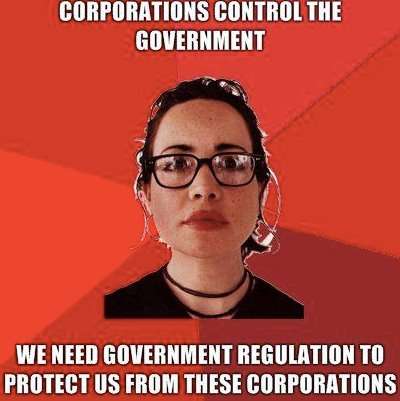
10. Like the spectacles lady says: Corporations control the government, and we need government regulation to protect us from these corporations.
11. Those OWS protesters telling you this isn’t about overthrowing capitalism, are a bunch of damn liars! It is! We’re a bunch of Bolsheviks and it’s high time we faced up to it!
12. George W. Bush has screwed up this economy so badly, that millions of people are lining up around the block to shell out hundreds of dollars to get a fancy new phone, with a new numeral and letter printed on it. It’s just brutal!
It’s all about helping mankind? Then an inexplicable viewpoint, one that has enjoyed a meteoric rise in popularity in recent years, must need a re-think:
A student at one of my talks on the nonprofit sector asked if I could name a for-profit company that was making a difference on the scale that nonprofits do. I said I’d be hard-pressed to name one that wasn’t.
Our youth are growing up with the strange notion that the only way to make a big difference in this world, or to be of service, is to work for a nonprofit organization, or become the next Bill Gates and establish a private foundation, or to start some kind of “social enterprise,” often without any understanding of what that means.
:
What a loss to humanity it would have been if [Steve] Jobs had dedicated the last 25 years of his life to figuring out how to give his billions away, instead of doing what he does best.
Following that last sentence, it gets interesting. RTWT. Thanks to Instapundit.
OWS protester(s) in a complete meltdown, on camera…complete…as in, Wicked Witch of the West with water poured on her.
From here. Elsewhere, I’ve seen a lot of legitimate question put to this video, in terms of is this real or is it an act. My experience growing up in a college town blinds me to the evidence, or edifies me, depending on your point of view. No, it’s not an act. They prattle about how strong they are, they get mad, they cry, they cringe, they hug, they prattle some more. That’s the cycle.
Another OWS protester, or sympathizer of same, blames “religious fundamentalism” for the 1% being so much wealthier than the 99%. Hey rocket scientist: Whenever people come up with complaints against fundamentalists and the complaints actually manage to resonate, they have to do with the fundamentalists working too hard to make others more like them, which when you noodle it out for a second or two, is the polar opposite of creating a stratified society with a 1% and a 99%. Begone and take your fail with you.
I see the New York Times is putting a good amount of elbow grease into dredging up a new scandal, inferring that “bankers” express different opinions about the OWS protesters in public than they do in private. If this is true, it seems only reasonable, to me. Whenever one speaks in any proximity to a corporate emblem, and the association that could be made is in fact a substantial one — the speaker is on the corporation’s payroll — it is wise to remain extremely guarded, lest the comments be construed as an official position. This, for example, is actually a muted tone version of the thoughts going through my head about it:
“Most people view it as a ragtag group looking for sex, drugs and rock ’n’ roll,” said one top hedge fund manager.
If I worked on Wall Street, there’s no good that could come from me saying what I really thought about OWS, out in public. I’m sure some people from the New York Times would love it, but it wouldn’t be helpful to anyone else.
But I don’t want to talk about these three items, per se. I want to talk about our response to them and our response to the situation that has caused them.
What it all has in common, I think, is this mistaken perception that something is broken and the cure for it is more unity. One cannot help but sympathize; it’s in the name of our country, is it not? And so if we have a fractious phenomenon taking place, the unthinking primal instinct is to move forward, see what we can do to glue the fine China dinnerware together. Get everybody united again.
It is to our credit. It is something hard-wired deep within us, not as a species but as a nation: Someone’s got a beef? Let’s see what they have to say. Give it a fair hearing. They can’t live here the way things are? Maybe we can improve. What does it take, to absorb them into our expanding and evolving culture, so they can learn from us and we can learn from them. We seek to be a growing, sentient entity, as a nation. And why shouldn’t we? We’ve made it work.
But this is also, I think, the point where a more vigorous method of thinking would improve the situation.
Everything cannot be united with everything else. The harmful deception that permeates the Occupy Wall Street movement, which never is challenged since it is never put to voice or to ink, is that all this protesting is a necessary step toward building something big, functional, and beneficial to all. Those who announce their support for the movement, whether they say so or not, predicate that support on this premise. But the protest itself has been an endless procession of behaviors not to be carried out in job interviews, which says something when you think about it, since much of the angst that launched the protest is supposed to have something to do with the difficulties involved in getting a job.
So the energy we’re seeing on parade here is not creative or preservative energy; it is destructive. It seeks to bring moving, functional machinery to an indefinite halt. That’s the point, isn’t it? Occupy Wall Street…so that Wall Street can’t get anything done while it’s being occupied?
This is nothing new. Ever since the protests in the sixties, America has been blitzed by one “protest” after another after another, enshrouded in this unspoken, glittery, translucent narrative that this is a disruption necessary to a larger process of building something big that will help everybody; such disruptions have received a lot of support throughout the decades, presuming the truth of such a narrative, and it has never once actually been carried through. The closest we’ve ever seen it come is the election of a lot of fringe-radical leftists to political offices, and the damage came in the wake of that. Now, we see it come full-circle — the last White House Chief of Staff and current Mayor of Chicago actually came out and said a crisis is something you shouldn’t let go to waste. So the leftist/anarchist damage, manufactures the crisis, the crisis leads to the protests, the protests now & then manage to affect an election and the election leads to more damage.
Everything cannot be united with everything else. Oil and water cannot occupy the same space. Insert them in a common vessel together, and they will separate; put ’em in a blender and turn it on puree, you’ll get a frothy mixture that isn’t good for anything, and then the contents will settle never having truly emulsified. And that’s the way it is with creative and destructive energies. They don’t mix. It may make us feel good to fantasize about some big sit-down where all the differences get talked out and somehow reconciled and we end up square-dancing at some big picnic, but it isn’t gonna happen. These are people who have problems with it if they see someone making money. No, I’m not about to make less money to make them happy.
Does this mean I want them marooned on an island somewhere? No, there are too many of them. That might be a good idea for some of the organizers though, some of the die-hards, the ones who will never rest until there’s a national salary cap in place. They don’t want to live with anybody else anyway. I mean, think about it: They go apoplectic when they find out someone made more money than they did, how could they live in any populated, advanced society? But, of the “99%” we see, 99% of the 99% fits the description of the unnamed hedge fund manager. They want to meet girls and smoke weed. They’re followers.
The solution is not to unite, nor to ostracize, but to dissipate. If they really think they want to overthrow capitalism, they should be granted the right to speak their minds, freely — so that others can see what they’re about, and the movement can be discredited as it deserves to be. And then incentives can be applied for them to show up, participate in a process that already has been built and might benefit incrementally from their contribution…so they can contribute to it in this incremental way, without completely dismantling it and starting from scratch. See, that takes a lot of maturity, and that’s the problem. Riding in like a hurricane and saying “This is all messed up, we need to tear it apart and start over, the way it needs to work is like this” — that doesn’t take anything. Somehow, these children have been given a massive incentive to live out their entire lives this way. Maybe their professors are all socialists, maybe it’s the hormones talking, maybe they weren’t raised right. I vote for a combination of all three. Whatever it is, that’s how they’re looking at life: Nothing exists before I come along, and if something does, then it needs to be wrecked so I can make things the way I want them to be.
Rather than uniting with their cause, the solution is for the rest of us to give them an incentive to do things the mature way. Clock in, shut up, see how things work, find out where you can make your contribution and get busy.
The point is, we’re going into our second half of a century now, uniting with every crackpot cause that’s come along — none of which has sought to reciprocate, to be part of any unifying effort. Unification does nobody any good if it isn’t paired up with intelligence, and in order to make intelligence useful you have to see what’s going on and respond to it. Where we’ve really been falling down is in our determination to treat adults like children and children like adults. We’ve treated constructive people like they’re destroying something without defining exactly what it is they’re supposed to be destroying, and we’ve treated destructive people like creators without inspecting too closely what it is they’re trying to create. Maybe this is the point where we finally learn the lesson we’ve been needing to learn.
It’s Friday. Time to take a break from beating up on the liberals and man-god-king-president and the silly twits in Congress and the douchebags lining up to protest the…well…we’ll take another crack at figuring out their so-called “message” next week…
Some of my wisdom on Facebook (subscription probably required), trying to figure out why liberals are liberals:
Seems to me they go through these stages. They start off like I was when I was ten, and Carter was about to be elected…”Well if we have these poor people out there, why wouldn’t we try & do right by them?” From there, it seems they shift forward…very much like a car entering a freeway entrance ramp from a traffic meter, from a dead stop, going through the gears…at some point they make up their minds that everyone with a different viewpoint must be a Bad Persontm.
After I jotted that down, I thought back on all my years arguing with libs and I realized there is some irony here: They are backed into a corner of thinking, those with different viewpoints are Bad Peopletm. They don’t set out wanting to come to this conclusion…well, the ones who start out being nice people, they don’t. They are choosing this option after other avenues have been blocked.
I think they are pushed into this corner by…or perhaps, they were once themselves…Cheesecake Nazis, the people who leap to take over any social event where people get into discussions about politics, to stop them from discussing politics. Presumably because of practical matters, like people need to stop discussing politics anyway, to be served cheesecake. Which, when you think about it, you realize isn’t true.
Cheesecake Nazis are always serving cheesecake, though. After the cheesecake has been devoured, if you want to go back to discussing politics, the Cheesecake Nazi will stop you. And, you’ll notice, they’re usually still serving their cheesecake when the political discussion hasn’t even turned nasty.
So there is the irony: Cheesecake Nazi acts out of fear that a discussion about ideological viewpoints is going to turn rancid and acrimonious — and then she makes it that way.
I suppose it varies on a case-by-case basis whether the Cheesecake Nazi is the liberal running through these “gears,” these different stages of becoming a frenzied, agenda-driven conservative-bashing liberal…or…whether she is acting upon the person going through that transformation. It doesn’t really matter. This is a pressure that has been placed on us all by our modern society as a whole, rather than by any individual within it: We are to put on a good show of thinking things through and coming to our own opinions about things, but we aren’t supposed to actually be doing it.
And so, given those incentives and pressures, the only place we can end up when we set out to fulfill all of the most clear expectations, is — another irony — like the “politically incorrect” guy Bill Maher. Most progressive position possible on each & every issue that comes along, suspecting the absolute worst about anybody who has a different opinion, denigrating both character and intellect, and rude as all holy fuck about it. That would be your “overdrive” gear, with all the others just transitional phases on the way toward getting there.
We posted a badge in our sidebar to honor Steve Jobs when he passed away a few days ago; don’t everybody line up to give me a whallopin’ over this, but I think this obituary, today, is more worthy of our notice. At least, as a technologically advanced society seeking out its own roots and looking to offer credit where it is due. Dennis M. Ritchie, creator of Unix and the C programming language:
After a long illness, Dennis Ritchie, father of Unix and an esteemed computer scientist, died last weekend at the age of 70.
Ritchie, also known as “dmr”, is best know for creating the C programming language as well as being instrumental in the development of UNIX along with Ken Thompson. Ritchie spent most of his career at Bell Labs, which at the time of his joining in 1967, was one of the largest phone providers in the U.S. and had one of the most well-known research labs in operation.
Working alongside Thompson (who had written B) at Bell in the late sixties, the two men set out to develop a more efficient operating system for the up-and-coming minicomputer, resulting in the release of Unix (running on a DEC PDP-1) in 1971.
The thing I think people are missing is this: Under the tutelage of Jobs, Apple released generations of high quality products that “just plain worked” and so forth. But you generally can’t build something else with those. So Apple products get credit as the gunpowder in the bullet cartridge, not as the “primer cap” that sets off the chain reaction.
Now to be clear about it: That is something. User interface is tricky; Steve Jobs made it his life’s work to wrestle with something that people like me would just as soon avoid. But there is another talent involved in building the building block itself. That is the skill upon which we truly rely. And so I have a hope that Ritchie’s passing will attract as much notice and attention as Steve Jobs’. I know that’s a futile hope, but I’ll entertain it nevertheless.
You could also a good case that this is all a red herring, it ain’t no competition. Well, of course it isn’t a competition. But it’s a decent counterpoint: What does it good to take notice and show proper reverence to the passing of a designer of user interfaces, and all-but-entirely ignore the passing of the designer of the tools that are used to build stuff? It’s like lining up for the funeral of the guy who trimmed the tree, and taking a pass on the funeral of the guy who planted the seed. And so I offer that this passing is just as worthy of our notice; dare I say even moreso.
John Hawkins catalogs ’em for your displeasure. Bear in mind, I didn’t bolt on the last two words “so far,” I took them from his original headline.
Pretty sure #8 is my favorite:
This kooky list of demands on the Occupy Wall street forum was picked up everywhere as their list of demands. It includes items like, raising “the minimum wage to twenty dollars an hour,” “Open borders migration. anyone can travel anywhere to work and live,” and “immediate across the board debt forgiveness” for everyone “on the entire planet.” Because this sounds all too plausible given the gang of braindead rabble attending the Occupy protests across the country, people bought it. But actually, the Occupy Wall Street people want you to know, “There is NO official list of demands.” In other words, they have no idea why they’re camping in the park like hobos. No idea at all. [bold emphasis mine]
This clip Rick posted seems to capture this sense of “Why Are We Here” confusion. Interesting question raised by the comment at the end: Are things better organized in New York? I’ve been watching New York; I’m not so sure.
Lefty blogger Steve Benen had an exciting day day yesterday, enjoying two of the big-font links on the front page of Memeorandum. After reading his work, though, I have to wonder if Memeorandum is being managed by his mother or something. What a bizarre way liberals have of “proving” things they want proven. In this case, Benen puts forward the notion, not that the 53 percent quotient which is the selection of persons who pay federal income taxes should be bigger, but that maybe it should be smaller.
I should qualify that, since this is a writer who chooses his words not so much carefully or skillfully, but in an “oily” way…you’ll see what I mean, below. He doesn’t take the responsibility of “putting forward the notion,” what he puts forward is a crafty assemblage of words that powerfully persuade the casual reader to think this notion.
This would, of course, damage the progressive argument that our tax system is insufficiently punitive against the hated rich. But the friendly-fire is a small price to pay for Benen, who just wants to laugh at people. In this case, for thinking they pay federal income taxes when they really don’t.
There are all kinds of problems with the right’s [“We Are The 53%”] approach here, including the fact that they seem to want to increase working-class taxes and also seem entirely unaware of the fact that it was Republican tax cuts that pushed so many out of income-tax eligibility in the first place. There’s also the small matter of some of those claiming to be in “the 53 percent” aren’t actually shouldering a federal income tax burden at all, but are apparently unaware of that fact.
Ooh! He’s got a link! Let’s click it open. His entire argument rests on this “fact,” after all, which he explicitly calls a “fact.” Well, most of his argument does anyway…definitely more than 53% of it. And I don’t see anything on Benen’s page that provides support for the idea that the 53% needs to be tapered down, so let’s open a new browser tab and find out what support is available for this “fact.”
We are taken to a blog called, simply, “A plain blog about politics” and the post in question is called “That 53% Tumblr.” The part that apparently made an impression on Benen, is:
…the other story in the “53%” group is that I’m pretty confident that a substantial portion of them…don’t actually pay income taxes, and therefore are not, in fact, part of the 53% of households who do. For example, this citizen claims to be a college senior working “30+ hours a week making just barely over minimum wage.” Which is great and all, but if that’s all he’s got he’s not paying any income tax. Just as a guess, I’d be surprised if any fewer than 10% of the posters are actually income-tax free, and I wouldn’t be surprised if it’s about 50/50.
What I’d be curious about is what some of these folks would say if they realized that they’re not actually part of “the 53%.” Of course, to be fair they all do pay taxes; they just — perhaps — don’t pay income taxes. [emphasis mine]
Now from where I sit, “A plain blog” hasn’t done anything wrong here at all, in fact his hypothesis makes good sense to me. He doesn’t claim to have proven anything, he’s mostly just questioning things. His one definite statement, “if that’s all he’s got he’s not paying any income tax,” is true so far as I know…and if it’s not true in that particular individual’s case for some reason, I’d agree he probably needs to go see a tax professional.
Now Benen, too, could perhaps be regarded as mostly ship-shape if you read his letters and words with surgical precision, as if you’re reading a statement from Bill Clinton containing the word “is.” But the spirit of it is just plain phony. What’s it mean to you, in common-sense land, when you read a statement like “There’s also the small matter of some of those claiming to be in ‘the 53 percent’ aren’t actually shouldering a federal income tax burden at all.” Yes he uses the word “claiming.” “A plain blog”‘s link is not working for me, so I don’t know first-hand what this person is claiming or how he’s claiming it. Is this a reference to the person being part of the movement?
The title of Benen’s piece is “about those 53 percent,” which certainly offers a powerful nudge in the direction of concluding that a quotient is to be subjected to challenge. Seems to me, if Benen’s beef is that the group should be named differently because there are people in the membership sympathetic to the message, but who do not pay federal income taxes…it’s a case of the pot calling the kettle black. Is he challenging the percentage figure, or something else? Does he even know what he’s challenging?
But the bigger problem is with the proof of this “fact.” Benen is known to me, from past experience I recall only in the hazy outline of the lessons learned but not in the details, as a voice often indulging in patterns like these: He seems to be assembling these posts for the benefit of fellow liberals who want to dredge up some more talking points to use against conservatives at social functions, in discussions in which details & facts are not going to be examined too closely. And, perhaps as a result of this, a lot of his “facts” turn out to rely on some guy somewhere thinking something and saying “I wouldn’t be surprised if.”
A bigger problem? If I were ever part of the 99% and found myself skimming over the posts in the 53% tumblr for myself…I dunno, maybe this is just me being weird or something…but, just speaking for myself, I’d see a lot more than just some isolated opportunities to write deceptive lefty blog posts with oily wording to beat up on the tumblr people. There is a lesson ambling to the forefront as you read the pages from these fifty-three-percenters. Actually, it sort of reaches out of the monitor and smacks you. It’s not a new lesson by any means: You’re the captain of your own vessel in this big ocean called life, you have options, you have opportunities, there are things you can do. Some of them aren’t as sociable as marching on Wall Street, some of them are boring, some of them might involve taking off your headphones and maybe wearing some job-interview-acceptable clothes now & then. But the opportunities are there.
Takes a certain mindset to protest. A better, stronger, more advanced civilization does not always lie in that direction; maybe what we’re learning here is, more often than not, that’s where the slackers go. Nope, not saying I can prove that. Just a gut feel.
Democratic leaders in the Senate are scrambling to avoid defections on President Obama’s jobs package, which appears headed for defeat on Tuesday.
A lack of Democratic unity on the president’s bill would be embarrassing for the White House, which has been scolding House Republicans for refusing to vote on the measure.
Obama has been touring the country, aiming to put pressure on the GOP to act. But Senate Democrats have indicated they are feeling some heat. Last week, Democratic leaders revised Obama’s bill, scrapping his proposed offsets. Instead of raising taxes on families making more than $250,000 annually, Senate Democrats lifted that figure to $1 million.
Despite the changes, the legislation still does not enjoy the support of all 53 senators who caucus with the Democrats. A handful of Democrats are undecided or leaning no on the bill.
Democrats who will vote no or are leaning no include Sens. Joe Manchin (W.Va.), Jon Tester (Mont.) and Ben Nelson (Neb.), who all hail from red states and are up for reelection next year.
Republican and Democratic analysts say it will be politically difficult for Obama to blame the GOP for blocking the bill if more than a few conservative Democrats break ranks.
“It is important to have the vast majority of your people, because what we are doing here is a political exercise at the moment, since there doesn’t seem to be any chance that the Republican side really wants to do anything,” said Steve Elmendorf, a senior adviser to former House Democratic Leader Dick Gephardt (Mo.) for 12 years. “This needs to be a 90 percent vote.”
Well, I’m hoping like the dickens it’s defeated in one way or another, just because we’ve already seen the economic recovery power to be enjoyed by means of spending stimulus and it seems to be nine steps forward & ten steps back. But this could be a big nothing…maybe Biden ends up breaking the tie. Or, a bunch more democrats defect and the whole thing is a big flop.
Not too much to be learned from this particular story, except the opportunity to watch one of these super-duper charismatic speech-makers who construct these narratives…I mean the Obama-like people, who spin these tall tales and then start believing them…and then reality, inconveniently, fails to obey. After all that money I paid to pollute the environment, in the form of my President flying around on Air Force One creating this fiction about Republicans gumming up the works with the Jobs Bill. And, as is always the case, He did such an excellent job giving all those speeches! But now we see Republican obstructionism doesn’t have a whole lot to do with it.
At this point, the best case scenario is: Early recovery, in the form of Obama’s re-election becoming a more and more dismal and remote prospect, up to some point where the “smart money” starts to move away from Him. And then businesses will start to anticipate a change in policy well before the elections, and take a gamble. That’s our best hope right now. But I’m not going to believe my own wild, tall tale, I’m going to wait for it to happen. Still & all, it’s a good hope to have.
Learned something today. Neal Boortz went off on the Congressional Budget Office’s forecast that this latest proposed tax increase on the wealthy, this time, for once, is sure to make a dent in the deficit.
The Congressional Budget Office did say that the 5.6% surtax on millionaires would bring in $450 billion over 10 years. But here’s the rub: The Congressional Budget Office is compelled by law to make a static analysis of changes in the tax law. The CBO cannot issue a dynamic analysis. This works to the favor of those who propose ever-higher taxes.
Here’s an explanation from Wikipedia of static economic scoring vs. dynamic:
Static analysis, static projection, and static scoring are terms for simplified analysis wherein the effect of an immediate change to a system is calculated without respect to the longer term response of the system to that change. Such analysis typically produces poor correlation to empirical results.
Its opposite, dynamic analysis or dynamic scoring, is an attempt to take into account how the system is likely to respond to the change. One common use of these terms is budget policy in the United States, although it also occurs in many other statistical disputes.
Now .. a question for you. Do you think that there is any chance in the world that the high achievers subject to this punitive 5.6% surtax are going to find a way to change their economic behavior when this tax goes into effect? These people aren’t exactly picking up paychecks every two weeks from some employer. They earn their money in a variety of ways – imaginative ways – often from the operations of businesses and through investment techniques. These people are going to move to take advantage of information technologies, tax laws and the ease with which money is moved electronically around the world in order to find a way to moderate the impact of this class warfare tax.
None of this is news to anybody who’s been making a point of digging in a little bit deeper, going beyond Jon Stewart, Bill Maher and the six o’clock news, making some effort to figure out why governments at all levels seem to be perpetually in debt…maybe tuning into some right-wing hate radio now & then. We vote in these people who can wear suits well and talk well and have big hair, then they bring in these “brain trusts” and the brain trusts sit down and try to manage the economy with third-grade math: Okay, we’re short five million dollars, this industry over here is a hundred million dollars a year, so we’ll hike the tax rate five percent and the problem’s solved.
And, if you’ve been doing this digging, you’ll not be surprised to learn our federal government requires itself, through the CBO, to think in this primitive way.
But here’s where I learned something new. I went and found the Wikipedia page that Boortz (for some reason) didn’t link…it’s not hard to find at all, and I’d already read it over a couple of times in the last few years, since this is a subject that comes up now & then…and I read it again. Well, I must have missed this before:
The term was used in 1977 in an international academic journal, in a discussion of tax policy. In recent years, it has become very common in academic, business and political discussions of US government economic policy. [emphasis mine]
Uh, just WOW…pretty fuckin’ late. So I was mowing lawns in my holey-jeans earning money to go see Star Wars…and these economists who are supposed to know everything, were just starting to invent some phrases to describe the idea that maybe tax revenue shortfalls cannot be solved by means of simple multiplication.
I want to be fair here, it’s entirely reasonable to expect some of the professionals in the field might have noticed this, without explicitly coming up with a name to describe it. But if it’s all about “reasonable,” I would have to file that under “possible but not likely.” Even today, the notion that there might be a curvilinear relationship is conflated with the “Laffer Curve” and there’s a lot of progressive propaganda out there that this has been “debunked,” although the regurgitators of this propaganda cannot give you a decent explanation as to why it is debunked. That’s because it has not been, and cannot be.
In fact, it’s pretty easy to prove. In geometry, three points on two dimensions will define a curve, and three can be defined with respect to tax revenues: Zero revenue at zero percent, probably-zero-revenue at a hundred percent, and non-zero revenue at something between zero & a hundred percent. None of these three points require experimentation, none can be subjected to serious intellectual challenge. If you accept the three, then the laws of geometry say you have to accept that there is a curve.
The argument then becomes — presuming you can keep the progressive engaged in an honest and coherent discussion this long, and that’s a little like giving a pill to a cat — on what side is such-and-such a tax policy on, relative to the apex of that curve? Are we on the left side, meaning we can still ratchet up that tax rate a point or two & rustle up some more bucks…or are we on the far side?
Well if you read that last paragraph of what Boortz wrote, and ponder for awhile what it means, you realize the ramifications are that the curve’s apex migrates toward the left when you start to deal with higher incomes. Or, at least, when you start to deal with the entrepreneurial mind, which almost by definition is going to be inhospitable to the idea of keeping-on doing things just because that’s-the-way-we-always-done ’em. You go down toward the trenches, and you’ll start to deal with people who are more interested in just constructing a routine that works. They’re not quite there yet, or if they’re there, it takes some effort to “make ends meet.” So they’re at the make-ends-meet stage. Unlikely to change behavior based on a revised tax policy. The apex moves toward the right, and you have more latitude to raise taxes and still realize revenue…maybe…we don’t really know that, because we aren’t too aggressive about taxing people down there.
But what we do know is there’s a long trail of wreckage and failure behind this notion of “taxing the millionaires and billionaires.” These are individuals highly likely to change their behavior in response to a new tax policy. And that is not to say they are necessarily more intelligent people. All this overlooks the issue of bracket mobility. People start out trying to build that routine that works, that is sustainable, and then if they’re a mind to, they’ll start looking at new routines that do more than work. Less security, more opportunity. That’s after they’ve stopped associating with the old college roommate who comes by to practice guitar-playing on Friday nights, drinking all the beer in the house. Life throws you the same lessons over & over until you learn them, and then it moves on to some different lessons to throw at you over and over again until you learn those. Some of us graduate from one lesson to the next, a little quicker than others. Some of us settle for a humble station in life, others don’t. The point is this: If you’re the type to forsake the paycheck every 15 days and try to make a living on your wits, and you actually manage to succeed at that — you are highly, highly unlikely to just bend over and take it just because your local, state or federal government thinks it’s time to “make the millionaires and billionaires with their private jets pay their fair share.” Odds are, you will find a way to adapt and survive.
And the government will not take in what it was planning — according to straight-edge, third grade math — to take in. It has been ever thus.
But I’m rather flabbergasted to see we were only just starting to come up with terms to describe this, in ’77. What an awful lot of time, before that, for all the misery and the struggling, apparently without too much disciplined thought about what was happening. “Brain trusts,” you say? My goodness…what was it I was saying about life handing you the same lesson over & over until you learn it?
Damn it. I know I was thinking that, I believe I forgot to write it down anywhere. But, yeah that pretty much captures it doesn’t it? The Solyndra Economy. That’s what we’ve got. A capitalism crazy-quilt, with enough panels removed and replaced with command-economy knitting that the original only continues to exist in a halfassed hodge-podge unrecognizable mishmash of what it was.
The more we learn about the Solyndra solar-company debacle, the more the Obama Administration leaps to defend the $535 million loan guarantee. “There were going to be some companies that did not work out; Solyndra was one of them,” President Obama told reporters Thursday. Earlier in the week he told ABC News “if we want to compete with China, which is pouring hundreds of billions of dollars into this space…we’ve got to make sure that our guys here in the United States of America at least have a shot.”
And there you have America’s Solyndra economy, as the White House understands it: Washington allocates capital, and taxpayers pick up the tab if those choices go bust. Through this political lens, the August bankruptcy of the Fremont, Calif. company was a necessary casualty in the greater campaign to steer the U.S. economy toward Mr. Obama’s noble goals. Private competition that winnows out losers is so yesterday.
As it happens, we’re getting a look at what this world of political investment entails thanks to Administration emails released last week by House Democrats on the Subcommittee on Oversight and Investigations and the White House. Democrats say the emails reveal a “vigorous internal debate” about the Solyndra deal and dispel accusations of crony capitalism.
The opposite is closer to reality. Solyndra received federal help in 2009 and never turned a profit. In March 2010, PriceWaterhouseCoopers raised questions about the company’s solvency. The next month, a White House Office of Management and Budget staffer worried that the Department of Energy “has one loan to monitor and they seem completely oblivious.” Another said it was “terrifying” to consider that some of DOE’s next projects would make Solyndra look “better.”
To be fair about it, “pure” capitalism already saddles us with an endless procession of sad situations in which resources are allocated according to who’s-friends-with-who, rather than what would be best for consumers and other stakeholders. But a centrally planned economy does nothing to fix this, if anything it exacerbates the situation. When you have a free economy and the consumer is in charge, there’s always some corrective force applied to it. It doesn’t win out at the end of the day, true; it doesn’t even win most of the time. But at least the corrective force intensifies as the problem gets worse, and it’s easy to forget that what we see of the problem is really just the remnants of it after the unacceptably odious parts of it have been quietly cleaned up.
A command economy lacks this clean-up device, and so, over time, the problem has to get worse. It can’t do anything else.
The Occupy Wall Street kids claim to have been inspired by the Arab Spring revolutions earlier this year, which toppled many regimes in the Middle East. The Occupy Wall Street kids are nothing like those who participated in the Arab Spring revolutions. Unlike the revolutions in the Middle East, the Occupy Wall Street kids don’t have common stated goal .. the overthrow of the government for instance. Instead, their general purpose to gather together to whine. What are they whining about? They are whining because they want the government to seize the wealth from the people who are earning it and give it to them, among other things. They are whining because they want a Command economy, whereby the government controls prices, dictates wages and directs which industries will succeed and which ones will fail. They want this type of economy, because they themselves have failed to thrive in a capitalist economy, whereby their abilities dictate how much they earn, not the government. These kids do not want more freedom, like those who were protesting in Egypt, Tunisia, etc. These kids want LESS freedom and MORE government. Ironic .. isn’t it?
In the old days, the tribunes of the masses demanded an honest wage for honest work. Today, the tribunes of America’s leisured varsity class demand a world that puts “people before profits.” If the specifics of their “program” are somewhat contradictory, the general vibe is consistent: They wish to enjoy an advanced Western lifestyle without earning an advanced Western living. The pampered, elderly children of a fin de civilisation overdeveloped world, they appear to regard life as an unending vacation whose bill never comes due …
Ah, but the great advantage of mass moronization is that it leaves you too dumb to figure out who to be mad at.
I like that: Mass moronization. But Mark Steyn is exactly right. This is what happens when you raise a generation that knows nothing about hard work or sacrifice. This is a generation where kids played soccer because their mommies were afraid of them getting hurt in other sports where people throw balls and hit each other. Their mommies wanted to make sure that everyone got a trophy just for participating because everyone is “special.” This is a generation that was told to shoot for their dreams, without any sense of reality – “How will I pay the bills as an artist if no one wants to buy my stuff” or “how will I pay my $80,000 in student loans with a degree in Women’s Studies?” Their whole lives, mommy and daddy had protected them from the painful realities of a real world driven by competition. Until now … and now that their mommies and daddies are also out of work, they have no one to turn to.
Someone over on the Hello Kitty of Blogging made the observation that a part of the frustration that is driving the protests, by no means a small one, is the fresh-faced college grad emerging into the world of work to find out his or her degree is worthless. Paraphrasing what he observed next: A degree, classically, has been inferred to mean you are at the very least least trainable. And it seems in our present time that is no longer the case, that can no longer be inferred.
Well I have my own observations about this. “A degree means you’re trainable” is, in itself, a dwindling and a shriveling from the way it was explained to me last time I was counseled to go back to school, which was not that long ago. So there is evidence that the business/academic trust conduit is going through a decades-long softening, in stages, here: First off, a high school diploma meant you knew some generalized things, and a degree meant you knew some specialized things. At some point, the high school diploma showed that you were trainable, not that you knew anything, and the degree showed you used that training to learn some things. Then we entered a period where both of them showed you were trainable, not necessarily that you knew much of anything, but the high school diploma showed you were enrolled into the system and your parents didn’t keep your existence secret while you lived in a cave somewhere, you had all your immunizations, from a thirteen-year experience someone managed to come up with a GPA number that nobody would ever see…the degree meant that you, or your parents, were willing to part with some loot to entertain ambitions that you’d be the boss of something someday.
And then the high school diploma meant nothing and the degree meant you were trainable.
Now the degree means jack squat. And it costs a goddamn fortune.
How come it isn’t an “Occupy Dean’s Office” protest? Maybe it should be the “Occupy the Beltway” protest. As a Hotmail user, whenever I check my e-mail at certain times of the day I’ll see these cartoon women in the right sidebar with a lot of propaganda lettering exhorting me — Microsoft has been convinced for a long time I’m female, for some reason, I imagine my first name is loaded into some database table that way somewhere — to go back to school and Barack Obama will pay for it. See, that’s one thing that’s been left out of the discussions entirely. Whenever government subsidizes something, the producers of that thing lose any & all incentive to try to keep their prices competitive. Why bother? Obama will pay for it. And so the cost of the thing shoots out of sight. Anybody else out there who wants to pay for it out of their own wallet, now must compete with the government in a bidding war. Corn, borrowed money, apartment leases, oil products…and college tuition & textbooks.
Add to that the problem that President Obama thinks, for the good of the country, we need to increase the number of college graduates. Seems like a swell idea, at first, if you don’t understand the laws of supply and demand. The situation in which this places a college upperclassman, is something I would not wish on my worst enemy. More college graduates! Great, so after my parents take out that second- or third-mortgage, I’m going to enter the workforce with this impressive piece of paper to hang on the wall…that…everyone else…also has. Aw, that’s just spiffy. Thanks a bunch, Barack.
Mass Moronization. Good term. But the moronization has started to hurt us, long before it became mass…
Netflix CEO Reed Hastings delivered the news via a blog post this morning, reversing a decision he announced via a blog post three weeks ago. Though the Web site for Qwikster, the would-be DVD-only service, said Sunday night that it was “launching soon,” it will never launch at all. The URL now directs visitors to the main Netflix site.
While Netflix had to use some strained logic to explain its decision last month, this one is straightforward: It’s not going to force customers to use two different services to rent DVDs and streaming video, because customers hated that idea.
Wall Street didn’t like it, either. After Netflix unveiled its Qwikster plans, its stock, which had been tumbling since July, fell another 25 percent — from $155 on September 16 to $117 last Friday.
Just this last Friday, I was bitching to someone at work that this Reed Hastings guy seems to be apologizing for something every time I hear from him, and I’ve lately begun to entertain the thought he’s one of these people who screw up on purpose just so they can apologize. Ever know anyone like that?
Fiance is flying back home today. I was just about to sit down with her & figure out exactly how we wanted to downsize our 6-disc Netflix subscription. Wouldja freakin’ hold still so we can figure out what to do with ya?
Attention, all powerful people who run things: When you’re contradicting yourself and taking a hairpin-turn route bulldozing your own ideas, or nobody ever seems to say anything good about them unless they’re on your payroll, or it starts to seem appropriate to play some Three Stooges music when your ideas are being discussed…you might be having one of those “George Lucas invents Jar Jar Binks” moments. The failure to distinguish between the ideas of “I built something that seems to have taken off here” and “I am absolutely incapable of making mistakes.” Those are two different situations. Seems like it shouldn’t be hard to keep that in mind, but failing to keep it in mind, does seem to have become the plague of our times.
Sometime between the ages of 0 and what I am now…I can’t recall if it was before or after the age of our “married couple” here…I figured out there’s just no up-side to trying to come out ahead of the woman. It’s better just to let her have the last word, grab your coat, go out & get a beer.
You hear this soft, inflected tone everywhere that young people below, roughly, 35 congregate. As flat as the bottles of spring water they carry and affectless as algae, it tends to always trend towards a slight rising question at the end of even simple declarative sentences. It has no timbre to it and no edge of assertion in it.
The voice whisps across your ears as if the speaker is in a state of perpetual uncertainty with every utterance. It is as if, male or female, there is no foundation or soul within the speaker on which the voice can rest and rise. As a result, it has a misty quality to it that denies it any unique character at all.
I hope this is not a case of plagiarism against our blog-uncle, because if it is one, it works at a sluggish, pokey pace. Good choice in figuring out what to plagiarize though…and I deplore, in the strongest terms, that all these years later it remains an unchanged but equally timely subject. This says something about our society, and what it says is not good:
If you are forced to use public transport, you see them all the time. Soppy young blokes in skinny jeans, hair artfully arranged to mimic a guinea pig in a hurricane, being mollycoddled by a domineering, post-Spice Girls vixen who, if figures released last week are correct, also earns more than him.
:
It’s not just young bucks. Men who would once have been called middle-aged are behaving like teenagers, faces nourished by some male consumer-targeted unction (because he’s worth it), huddled over their Nintendo Wii or iPhone, desperate to ignore the spectre of maturity tapping on their shoulder.
:
Remember the boyband East 17? I think the rot might have set in there. They looked like they had borrowed their big brothers’ clothes and crooned: ‘If you’ve got to go away, don’t think I can stand the pain.’ Just like a child to his mother on his first day at school.
What a weird century. We fret endlessly about little girls growing up too quickly, while men regress back to the womb.
We can ask: What would happen if, today, a man on the silver screen dashed in to save a helpless female who’d been placed in some awful death trap by an unscrupulous villain while she just…waited to be saved? James Bond saves Honey Rider from being drowned at the end of Doctor No, or Dudley Doright severs the binds that tie Nell Fenwick to the railroad tracks, or Superman saves Lois Lane from some elaborate death trap cobbled together by Lex Luthor…and the females do nothing. No slapping the bad guy across the face, or spitting in it. Heck, more recently than that, Marion Ravenwood wasn’t doing a whole lot while waiting for Indiana Jones to save her. She clobbered some guy with a skillet, but mostly just hid in a basket getting moved around. Can you make a movie like that today? A decisive NO.
It’s boycott-based feminism. Revolutionary-minded females put the movie industry on notice that the male heroism was disposable, and the female heroism was not. Have the chick do something, or we’re not going to see it. In this demand, they brandished a feminine power that, although they pretended it was new, was anything but. In truth, Grandpa didn’t see movies Grandma didn’t want to see. Car salesmen were never as excited seeing your grandfather browse their lots, unless the little lady was with him. Women have driven consumerism as long as consumerism has been around. What happened, somewhere around the seventies and eighties, is they got bitchier.
Usually when I talk about movies as they relate to the broader picture of what’s happening to us, I treat them as a symptom. In this case, they are a cause. Movies have become more and more of a kid thing. Back in my day, when you were in the pre-teen years a movie was an occasional treat, and you saw them a bit more often when you started dating. Nowadays it seems things have become reversed; the pre-teen set is the target market, and I don’t even want to ask what comes later. But it seems once kids are about fifteen they’re done with movies. So there are no slasher movies about murdering madmen rampaging through a summer camp; only occasionally, and they’re mostly straight to video. The IMAX screen is saved for adorable feel-good things about dolphins with prosthetic tails, and comic book superheroes. Who do not, repeat do not, save the damsel in distress.
The movie industry is cause rather than effect, here, because young people are impressionable. They pick up on messages that it is their destiny to get in a laser sword fight with Darth Vader and bring peace and order to the galaxy…or…to make asses out of themselves so that the leading lady can lead, and feel good about herself, and laugh at the silly toddler-man, and most of all, find him completely adorable. Occasionally. When he isn’t annoying her.
The tenor of the message has changed, the message has changed, and now our young men have changed.
I’m afraid this ties into the Occupy Wall Street movement, because that demonstration has offered young men a rare opportunity to say absolute things, express absolute thoughts, with certainty and conviction, without being criticized for it. They appreciate this opportunity all the more because it is only occasional. But two questions arise from this: One, are things like certainty & conviction genuine, when they can & will be expressed only when there is assurance that criticism will not result?
And two: What does it say about a so-called “man,” when he possesses certainty & conviction only when he discusses the deconstruction of some unknown stranger’s right to earn and own property? And on all other subjects he reverts, with all the reliability of gravity, right back to the dreaded emasculated tone of the American Castrati? What do we know about someone who is certain about the world in which he lives, only when he seeks to destroy things, along with people who built those things and might build other things?
Someday, I should make a point of starting a recurring headline that runs something like “What they told me is going on all over the place, and I must not be paying attention because I can’t find any examples” but shorter. (For all that loquacity, I still haven’t defined who the “they” is, and I don’t know if I can.) It’s been a somewhat eventful week, but I’d have no problem picking out the single event from this week that would appear under such a headline — whatever comes in second-place isn’t even close.
The all-time champion phenomenon of the “What they told me is going on everywhere” category for the week ending October 7, 2011 is: The weepy, inconsolable, overly-emotional Sarah Palin fan.
Oh, there may be some somewhere. But it seems like an example or two should have been presented with the recurring meme, and none have been brought, nor can I find any. And I have little reason to expect to. People who place great value on their own emotional state, are not well represented within the Palin fan base; such people all too often hopped on the “She’s so stupid and I just hate her, Grrrr!” bandwagon three years ago. Today, if you want illogical and overly-dramatic reactions to things, you need to go talk to them. And you should; from what I’ve actually seen with my own eyes and heard with my own ears, Gov. Palin’s announcement has sent them into something worth studying, for purposes of research into behavioral health science. I’m picking up feelings of euphoria, as if something meaningful has been accomplished, by them, although the only thing that’s changed is a possibility has been eliminated that, according to them, never enjoyed probability significance. And I detect trace quantities of some feeling of betrayal, as if Sarah Palin owed it to them, to run for President.
To the last person, all of the Sarah Palin enthusiasts I know, have reacted coolly and rationally to this: Okay, that’s out, so to whom do we pledge our support? ABO stands for Anybody But Obama. And that’s that. Efficiently, coldly, rationally, if-this-then-that, just like a computer processor. Well…a computer processor with a drive to win, anyway.
Got any exceptions to this? Any Palin fans acting like Michael Jackson fans who just can’t believe the music’s gone, or Barbra Streisand fans who missed the flight to the latest Final Farewell Tour? Go on, educate me. Fix my mistake; I’ll man up.
Gonna award it to myself this time, for my awesome Facebook status:
Lefists talk a lot about “equality” but so much of what they do has to do with aggravating inequalities that already exist. Government’s record-breaking budget needs to be bigger; a day of protest for a bunch of complaining jackwagons who’ve never had jobs; more stoking & feeding of the ego of Michael Moore; and let’s have another speech from President Obama so we can be sure and hear His side of the story.
When’s the “Edit Post” button going to finally make an appearance over there, anyway? Now that I read it again I see this would have been a perfect opportunity to use the word “exacerbate.” Fits the context slightly better, I think.
Well, I’m sure as the hours & days roll by I’ll think of more items to add to that list.
There are a few amusing parts where he seems to forget about this format. He seems to be making an effort to keep it short so the crowd can keep on echoing, but you get the idea that it starts to frustrate him a little bit…like his mouth is a fine-tuned high-power sports car, and he can’t shift into second.
Update: I’ve not heard anyone comment on this directly, but isn’t Michael Moore just about the worst spokesman you could possibly have for Occupy Wall Street? To whatever extent this protest has managed to gin up some public sympathy, that sympathy is generally rooted in an instinctive recoil from overfed and over-privileged things being fed & privileged even more. And Michael Moore is just about the most spectacular living and visible example of a person who’s body and ego have been fed to excess…now, the body-feeding I don’t get to see, directly, but it’s obviously happening. The ego-feeding, on the other hand, I get to see pretty much every time I see him — his massive ego is getting stoked. I’ve come to see his overfed bulk as emblematic of his overfed ego, like he’s a fictional character written into a story just to carry that metaphor along, to keep it in the story, as a garnish to whatever moral will be presented at the end. Michael Moore == overfeeding the already overfed.
Given what little has dribbled out about the platform and message of the OWS movement, the gelatinous, un-crisp and undefined state that this message is in, and the difficulty myself & others are having in trying to figure out whether the movement wants the message left this way…he is a most unlikely symbol. What am I to make of this? “We demand a new country in which nobody is allowed to be over-indulged except Michael Moore”?



 I suppose it varies on a case-by-case basis whether the Cheesecake Nazi is the liberal running through these “gears,” these different stages of becoming a frenzied, agenda-driven conservative-bashing liberal…or…whether she is acting upon the person going through that transformation. It doesn’t really matter. This is a pressure that has been placed on us all by our modern society as a whole, rather than by any individual within it: We are to put on a good show of thinking things through and coming to our own opinions about things, but we aren’t supposed to actually be doing it.