Archive for the ‘Uncategorized’ Category

Hundred Percent Fallacy

Friday, June 2nd, 2006

Hundred Percent Fallacy

God bless Roger Ebert, who has been my favorite movie critic, and will be again. Although I disagree with his politics, he has done his job well, and throughout my entire adult life I have read his movie reviews before all others, in an erstwhile attempt to avoid throwing away nine-bones-per-scalp-plus-snacks on a crappy movie.

Nobody else can be counted on to give me a more reliable measurement of which movie was made with some real passion and fun, and which movie is just another “gotta make a boat payment” movie. Besides, the name “EBERT” can be typed while you hold a mug of beer in your right hand. As can the name “FREEBERG”.

But he’s really screwed the pooch here.

I can safely say that before I have even seen “An Inconvenient Truth” because — and it pains me to say this — whatever uncertainties I have as I begin reading Ebert’s review about whether the movie’s any good, I still have those uncertainties when I’m finished. Ebert’s assessment of what kind of experience is to be had from viewing the film, comes out in this:

This is not a boring film. The director, Davis Guggenheim, uses words, images and Gore’s concise litany of facts to build a film that is fascinating and relentless.

That’s all you get, twenty-eight words. Nothing more. Every other paragraph of the review, every sentence, each syllable, is consumed instead with the issue of whether Ebert believes in MMGW (this blog’s acronym for Man Made Global Warming) how much he does, and how important he thinks it is. That’s really all I know from reading this. Er, that’s not the question at hand, Roger. You didn’t do Job Number One. Bad Roger!

What Ebert has ripped off from the practice of reviewing movies, by forgetting to do his freakin’ job, he has gifted to the practice of philosophy, for he has illuminated a previously little-talked-about logical fallacy. Let us call it the “Hundred Percent” fallacy.

Gore says that although there is “100 percent agreement” among scientists, a database search of newspaper and magazine articles shows that 57 percent question the fact of global warming, while 43 percent support it. These figures are the result, he says, of a disinformation campaign started in the 1990s by the energy industries to “reposition global warming as a debate.” It is the same strategy used for years by the defenders of tobacco. My father was a Luckys smoker who died of lung cancer in 1960, and 20 years later it was still “debatable” that there was a link between smoking and lung cancer. Now we are talking about the death of the future, starting in the lives of those now living.

Did you catch that? A hundred percent of scientists agree with Al Gore. When you really look into it, Roger and Al will freely confess the real quotient is 43, not 100 — but when you discard the scientists who disagree, we really are talking about a hundred percent. Put another way, the viewpoint is unanimous when you ignore everyone who doesn’t go along.

And you should, because everyone who doesn’t go along is bought-off by the “energy industry,” or influenced by someone else who is similarly bought-off. This premise, upon which the entire argument depends, is not substantiated anywhere and cannot be substantiated anywhere. We pretty much pulled it out of our asses. But trust us, “everyone” agrees with Al.

A trivial point? That is up to the MMGW people to decide. It hasn’t escaped my notice that one of their most important arguments, probably the keystone without which the entire structure would crumble, is the “overwhelming” number of scientists who agree with global warming. Quantity over quality. It’s good to know about the shenanigans that are being pulled in measuring that quantity, so thanks for that if nothing else.

Now would someone kindly step up to the plate and write some movie reviews? It is summer, after all, and if I’m going to poison the environment with my charcoal barbeques and burpin’-&-fartin’ and driving to hell-n-gone, it would be nice to have a movie or two to watch.

Thing I Know #97. There is always someone who believes what I’ve been told “nobody believes,” and there is always someone who contests what I’ve been told “everybody agrees.” Quite a few of both, actually.

Irony

Friday, June 2nd, 2006

Irony

Next month I’ll be forty. If you are my age or if you have some years on me, you may be able to appreciate the irony of the following. If you’re younger, you probably can’t.

I don’t need to go reaching ’round for lots of stuff, the irony is all contained in one single, two-line headline:

Poll: Bush Worst President Since 1945
Ronald Reagan Picked As Best President In Nationwide Survey

(CBS) President Bush has been named as the worst president since the end of the World War II in a new national poll.

Mr. Bush was chosen by 34 percent of the voters who participated in the the Quinnipiac Unversity survey. Richard Nixon finished second with 17 percent — just ahead of Bill Clinton with 16 percent.

Ronald Reagan was the top choice as best president, with 28 percent. Finishing second was Mr. Clinton with 25 percent.

The poll reflected deep partisan divisions. Mr. Bush was ranked worst by 56 percent of Democrats and 35 percent of independent voters but only 7 percent of Republicans.

Reagan, on thew other hand, was named as the No. 1 president by 56 percent of Republicans and 25 percent of independent voters but only 7 percent of Democrats.

“Kennedy and Truman get big Democratic votes, especially among baby boomers (45 – 64 years old) and seniors (over 65), but recent memory counts,” said Maurice Carroll, director of Quinnipiac’s Polling Institute.

“Democrats say Clinton’s the best and Republicans say he’s the worst. Republicans don’t think much of Jimmy Carter either. There’s no contest for the GOP favorite: It’s the Gipper,” Carroll added.

The Quinnipiac University poll was carried out from From May 23-30 and surveyed 1,534 registered voters nationwide. The poll has a margin of error of +/- 2.5 percentage points.

I do not know how old the 1,534 registered voters were. The reason I think it is an important question, is that it wasn’t so long ago that Reagan was the “worst president” in recent memory.

Will Bush pull out of this slump the way Reagan did? In my opinion, it borders on the pre-ordained. When one looks for a broadly-encompassing, consensus-based justification for the current president’s unpopularity and what endangers his legacy, one emerges with a notion that President Bush is apathetic to the warm reception, or lack thereof, toward the decisions he is in the process of making. In other words, it isn’t that people abhore his decisions, it’s his lack of sensitivity to the prospect that people might abhore those decisions.

And yet…of all the figures from the past upon whom history has smiled, this is the trait they all have in common.

Including Reagan.

Now, this is a far cry from saying if you want to emblazon your name into the history books, the best way to go about it is to go ’round pissing everybody off. That is a different thing. It’s also quite different to take a “whatever” attitude; a “here’s a quarter, call someone who cares” attitude. History is a little more stingy in picking out characters like that, to admire (although it has done so on occasion).

President Bush, like the figures remembered favorably by history — including Reagan — simply responds to a higher ideal. He responds to primitive notions of good versus evil. And he is excoriated for doing so; interestingly, by people who have no passion at all in debating what’s good and what’s evil, and confine their angsty reservations to the simple recognition that there are such things.

Well, I know of no reason to denounce the current president for such notions, and spare Reagan from similar besmirchment. I know of no justification for doing this, and I strongly doubt any among the 1,534 have such a justification in mind. In short, there is no conceptual, sustainable difference between these two figures. The only real difference is the two decades that separates their dates of service.

Like I said, President Bush’s vindication is pre-ordained. Reagan once said so, about himself, in so many words: “History will vindicate me.” This was my tip-off that the old man had really lost it. He turned out to be right. I’ve learned my lesson.

Is there any one figure who must everlastingly wrestle with his condemnation, and must forevermore earn a hard, jaundiced staring-down from history, for the infraction of caring too much about good-and-evil and not enough about what people around him thought? I can’t think of a single example. Not one. Nobody’s offering such an example, but plenty are trying to assert that President Bush will be the first. I find that more than a little extravagant.

Thing I Know #64. You know you have courage when you see the flimsiest spoiler of fortune decides if history will focus on your breathtaking stupidity, or your enormous balls.

Bubble Of Unreality

Friday, June 2nd, 2006

Bubble Of Unreality

I was waiting for someone else to cover this. It’s being done, but the attention paid is far, far below what I believe is appropriate.

In the photo to the left is a picture of some guy who was almost elected President in 2000, someone whom many believe really ought to be the President, after six-year-old election results in Florida are invalidated due to vague shenanigans. His name is Al Gore and he’s produced a movie called “An Inconvenient Truth” about the world coming to an end because of man-made global warming (abbreviated, on this blog, as MMGW). You can tell this is an extremely serious, life-threatening global emergency, because of the way Mr. Gore is yucking it up on the set of Current.tv. Tee hee! We’re all gonna die!

Well, it turns out Mr. Gore is ushering in a climactic disaster of his own, this one creating a massive hole in the ozone layer of truth. This is deliberate. While breathlessly awaiting the release of Mr. Gore’s new movie, Grist Magazine sat down and had an interview with him about MMGW, what it is, how to stop it, how to get people motivated, and oh by the way does he plan to run for President again. Boy, that is one hard-hitting interview.

The subject came around to how, exactly, does one go about getting the message out to people that MMGW is a real thing and that something has to be done about it. You know, how to get people motivated. And Virtual President Gore had quite an interesting bombshell to drop. He conceded, readily, that in his position there comes a point where you have to choose between a sincere presentation of the facts, and motivating your intended audience to do what you want them to do. And surprise surprise, he opts for the second of those two.

Q. There’s a lot of debate right now over the best way to communicate about global warming and get people motivated. Do you scare people or give them hope? What’s the right mix?

A. I think the answer to that depends on where your audience’s head is. In the United States of America, unfortunately we still live in a bubble of unreality. And the Category 5 denial is an enormous obstacle to any discussion of solutions. Nobody is interested in solutions if they don’t think there’s a problem. Given that starting point, I believe it is appropriate to have an over-representation of factual presentations on how dangerous it is, as a predicate for opening up the audience to listen to what the solutions are, and how hopeful it is that we are going to solve this crisis.

Over time that mix will change. As the country comes to more accept the reality of the crisis, there’s going to be much more receptivity to a full-blown discussion of the solutions.

Let me see if I have this straight. Over time, we will become more receptive to the notion of MMGW and to strategies for doing something about it, and at that point it will be okay to level with us. But until then, we live in a “bubble of unreality” and the only way to pierce that bubble is to…I want to adhere very closely to what he’s saying here…”have an over-representation of factual presentations on how dangerous it is.”

We live in unreality, so the only way to get through to us is to lie to us.

Well clearly this is not an across-the-board thing, because Mr. Gore believes in an under-representation of what needs to be done, when it comes to relocating the people who live on our coastlines, inland, lest they wake up to a foot and a half of seawater in their living rooms. To the best I’m aware, he hasn’t called for anything like that, although he certainly should be expected to if one takes his claims seriously.

So Mr. Gore, I’m gathering, is selective about when to oversell the MMGW schtick, and when to undersell it. So a chunk of this thing, at least, has nothing to do with science and everything to do with showmanship. That much is proven. How big that chunk is, I’ll leave it up to readers to form their own opinions.

I’ve formed mine.

Hat tip on this item, to Maggie’s Farm, by way of FARK.

Seen

Thursday, June 1st, 2006

Bill O’Reilly made an interesting point about the Haditha incident:

…some Americans, including many in the press, honestly feel that the Bush administration is evil and its policies have led to Abu Ghraib and now to Haditha.

You’ll see this line of thinking all over the place in the coming weeks, but that’s like saying if one child turns out to be a criminal, the entire family’s bad. Most honest people acknowledge that the U.S. military has performed heroically and humanely under extremely difficult circumstances in Iraq and Afghanistan. Since President Bush is the commander in chief and Donald Rumsfeld’s in charge of military operations, don’t the heroics of our service people reflect well on them? If you blame Bush and Rumsfeld for the bad stuff, shouldn’t you praise them for the good stuff? Wouldn’t that be fair?

Now I suppose you could say no, Bill, it wouldn’t be fair; the heroics of the military forces are credited to those military forces alone. But then it’s awfully hard to intellectually support that the White House is to blame if/when those troops are caught torturing prisoners or murdering civilians. The point is, intellectual sturdiness demands either both or neither — hair-splitting finds a comfortable home only in the nurturing of a politicized agenda, not in the making of a reasoned argument.

It should be noted, however, that the anti-war left is two steps ahead of O’Reilly on this one. The evil that men do lives on long after them, so to speak, while the good is buried with the bones. The bad stuff leaves a far deeper imprint. Because of scandals like Abu Ghraib and Haditha, so goes the argument, America is seen as an agressor. As a tyrant. As a conquistador. This argument is easily understood.

Less easily understood is who is doing this seeing. We are seen…by whom? Who are those people seeing us this way?

I don’t mean to imply that such people do not exist. What I mean to do, is simply to ask the question that logically must be asked before the argument is admitted into what may be seriously considered. I mean to question, simply, who the “seers” are. It’s a reasonable question, since the argument is demanding I let those people decide everything, and resolve that anyone having a different viewpoint, is allowed to decide nothing.

To “google” the phrase “We Are Seen” is an interesting experience, somewhat akin to sipping from a fire hose. On May 13, this blogger said the following:

Now, in Somalia, al-Qaeda linked Islamicists are seen as the nations only hope against the civil wars of the warlords. The Islamicists are seen as they only chance for stability and we are seen as a destabilizing force.

Who sees us that way? To consider the point seriously, as I said above, we must know. Is it all of someone or a majority of someone? The blogger does not say.

A reader writes to the Times-Herald Record, New York, on May 7,

This administration has created an atmosphere in which we are seen as the imperialistic bully to many of our one-time allies – our soldiers are portrayed as torturers.

The author of the letter does not say who sees us that way.

Sen. Patrick Leahy, D-VT, helped on March 28 to solve the mystery for me. The entity that sees us this way, are “alarming numbers of people”:

After 9/11 there was an outpouring of sympathy from every corner of the globe. Today, we are seen by alarming numbers of people as an aggressive, occupying bully that locks up innocent people indefinitely, humiliates and physically abuses them, and denies them the right to even know what they are accused of.

This is problematic. Alarming numbers of people hold viewpoints that are illegitimate, faulty, lacking in potential, and just plain wrong — all the time. Ask anybody who’s ever been in the minority about any issue.

Alice Slater, the anti-nuke activist, commenting on the 60th anniversary of dropping the bomb on Hiroshima, said

Breaking our promises for good faith efforts for nuclear disarmament in the Non-Proliferation Treaty, refusing to submit the Comprehensive Test Ban to the Senate for ratification, trashing the Anti-Ballistic Treaty to clear the way for dominating and controlling the military use of space–and spurring a new arms race to the heavens, developing new more useable nuclear weapons and planning to replace all the thousands we already have, we are seen as the nuclear bully, lawlessly menacingthe world with our might like some mad cowboy nation from the Wild West, while actually going to war without legal authority and slaughtering tens of thousands of innocent civilians under the false premise that Iraq was a nuclear threat to America.

Again, we’re a “bully.” Ms. Slater didn’t say specifically who sees us that way.

“Zero Political Capital” commented on July 15, 2005,

Not surprisingly, the world opinion of the United States is still pretty negative. We are seen throughout the Muslim world as a bully and a threat to Islam, and while the numbers aren’t as horrific as they were two years ago when we first invaded Iraq, they are still cause for concern.

Ah, we have a specific now: the Muslim world. How much of the Muslim world? “Thoughout” could mean 80%…it could mean 20%. The number must be something measureable — the text says so — but I don’t know what it is. How do we know what the number is? Was a poll taken? None that was discussed here.

John Dear wrote, in a column that appeared July 10, 2005,

Half the world considers the United States the leading terrorist in the world, by our public spokespeople remain clueless about what�s really going on. We are seen as terrorists by many around the world because we bombed and killed 100,000 people in Iraq in 2003, and because we have over 20,000 weapons of mass destruction, (many of them in my neighborhood in New Mexico), which we are willing to use on any nation that does not support “U.S. interests.”

There’s that magic phrase again, about us being seen a certain way. This time the entity so envisioning us, seems to be “half the world.” Zowie! That’s some kind of a poll! Well, nobody asked me.

Just before the elections of 2004, Manuel Valenzuela, writing for the Dissident Voice, said

Rightly or not, the last four years under the House of Bush have imputed Americans of all creeds, colors and classes with the personality of the man who expropriated the White House away from democracy, freedom and liberty. Worldwide, we are now seen as a nation of attention-deficit robots devoid of world knowledge or concern for anything beyond our borders. We are seen as selfish, gluttonous warmongers and imperialists concocting wars for profit, empire building and market colonialism, all at the expense of the rest of the world. Americans have become, in the eyes of the people of the world, easily manipulated and controlled beings living lavish lifestyles, distracted by bread and circus, and having cheap products through developing country slave labor and resource exploitation and pilferage.

The people of the world. There’s that worldwide poll again.

Perhaps Valenzuela was drawing for inspiration from Jesse Jackson’s comments on the 50th anniversary of the Brown v. Board of Education ruling:

Our moral authority is born of the last 50 years of successful struggle by human rights and civil rights organizations. We were trapped on our own perverse use of power. In the Second World War we began to gain some. We were seen by the world as rescuers; now we are seen as invaders and occupiers and conquerors. We are choosing might over right. We are losing something dear. When I went to meet with the president of Sudan to challenge him about the humanitarian crisis � about 1.5 million people will die unless something happens quickly, and we need the U.S. to help � they said, “We don’t need your help. Based upon your presence in Iraq you don’t have the authority to tell us what to do. You invade and occupy and now you seek to conquer, you bomb thousands and you call it collateral damage, you cannot tell us what to do.”

Okay, now we have another entity to attach to this: the President of Sudan. Fine, the President of Sudan has an opinion, the President of the United States has a different opinion. Cool. Everybody has opinions. Why is it that the President of Sudan has an opinion, and suddenly, his viewpoint becomes the viewpoint of “the world”?

Stephen Bosworth, Dean of the Fletcher School at Tufts, included in his address on the second anniversary of the September 11 attacks, the following:

In addition to what our response to September 11 has meant for us internally, I am even more concerned by what is happening to the relationship between ourselves and the rest of the world. In the weeks after September 11, there was a tremendous outpouring of grief and sympathy for the United States from virtually the entire world. Now, just two years later, that has changed dramatically and everywhere there has been a surge of anti-Americanism. We should, it seems to me, ask ourselves why this has happened and what we might do about it. We are seen as almost unimaginably powerful. But we are also seen as being frightened and therefore unpredictable. That combination is in turn frightening to the rest of the world, and the United States is now feared to an extent never before experienced.

There’s that “rest of the world” again. It sounds so much like someone took the time to go knocking door-to-door, which obviously could not have been the case.

There’s still more. And now, you see something interesting start to take form as you move further backward in recent history.

According to this blogger, sometime before March of 2004 the mideast editor of Newsweek had another epiphany about how we are “seen”:

A certain number of “facts” are apparent, but they have to do with sandstorms, troop movements, unforseen attacks by paramilitary Iraqi loyalists and unexpected events. The war is clearly more difficult than it was made out to be beforehand, and we are seen by many Iraqis as imperialist invaders rather than as humanitarian liberators. The mideast editor of Newsweek pointed this out last night on the NBC news.

“Many Iraqis.” Okay, that’s a specific, but the conclusion drawn has some problems. By this time, the opinion of “Iraqis” was acknowledged, by pro-war and anti-war people, as being mixed; Iraqis thought we were aggressors, and others thought we were liberators. Is it possible one of these mindsets can be completely legitimate and the other one is so much poppycock? I suppose it is, but not if you’re establishing a viewpoint as legitimate, just on the strenght of “many Iraqis” upholding it. Either that’s a sound test, or it isn’t. Obviously, to say “Idea A is a good idea when ‘many Iraqis’ sign onto it, but Idea B still sucks no matter how ‘many Iraqis’ agree with it,” is to push a political ideology — not to seriously and fairly consider the merits of A and/or B.

Moving back in time further, closer to the September 11 attacks themselves, we see something interesting. It seems a lot of this “seen” stuff comes from a sentiment that prevailed soon after the September 11 attacks, from the school of thought of indigenous guilt, the “we had it coming” mindset. Don Belt, senior editor of National Geographic magazine, touched on this in an interview from early 2002:

I think that we are seen as arrogant and bullying in our approach to the Muslim world and especially the Arab world. A number of the stories in The World of Islam touch on that point. The story on Pakistan in 1991 that Bill Ellis wrote…is an excellent reminder that a lot of times this tendency to blame the United States for the evils of societies�whether it’s impoverishment or whether it’s hopelessness�is a pervasive factor in these countries and has to be dealt with.

Google reveals that this isn’t a pervasive factor just in those countries, but in Portland, OR as well. There is this sermon from the First Unitarian Church just a couple weeks after the attacks:

Just as we are called to find the goodness that has come in response to the attacks, we also have to at least try to know what has caused a group of people to do these horrible things. One of the awakenings for me has been how we as Americans are so terribly isolated from the rest of the world and these attacks have been a wake-up call to see how at least some people in the world view us. We are seen as the big rich bully with all of the power. Our actions in the past have played a part in what is happening now.

There is a point to all this, and it isn’t a pretty one. When you say something is “seen” a certain way, you may pack a powerful punch in intimidating people toward your point-of-view, but you prove very little. What you’re really saying is that someone, somewhere, whether you name them or not, has a certain opinion. And this says, precisely, nothing. That’s the long and the short of it — nothing. Back in the olden days before we invaded Iraq, it was an important ramification to be considered, or at least, might have been. In my view, it was a realistic, pragmatic approach to say “think twice about invading Iraq, because we are seen as xxx and the message sent will make this a lot worse.” I still agreed with invading Iraq. I still agree with it now. But I agreed then, and agree now, with taking into account what the perception would be from outside. There was wisdom in this. A lot of bad decisions, have it in common with each other that they became bad decisions when someone forgot to consider the messages sent in executing them.

With that decision a thing of the past, this principle has fallen away into irrelevance. The “seen” argument has lost all meaning as a tool of diplomacy, and retains use only as a tool of inference: We must be invaders, and we must be bullies, because that is how we are “seen.” Well, moose feces on that.

Whether you’re generalizing over a world, part of a world, a country, a faith — it’s wombat-rabies bollywonkers crazy to say people within the class you’ve defined “see” things a certain way. Five people will have five different perspectives — five thousand, will have that many more. To define a single perspective to which all in your defined class will cling, is a foolhardy ambition, one which reality is sure to confound. That’s the first problem. Second problem is, human history is just one big chronicle of people seeing things other than the way those things really are. Human affairs are recognized for what they are, even by those you would think to be close enough to assess them accurately, about as often as a football bounces rightside-up. As an indicator of what’s going on, human perception…pretty much sucks.

Give me an opinion, no matter how nonsensical you make it out to be, someone, somewhere, has that opinion. To point out simply that someone has it, therefore, is tantamount to saying nothing at all. Not that someone isn’t willing to waste time and breath pointing it out anyway. I have an impressive collection up there of “we are seen” quotes. It is just scratching the surface, believe me.

My point is simply this: It’s past high time someone was called to account for who is doing all this “seeing.” I mean, given how much weight the rest of us are being expected to put on these opinions, nurtured as those opinions are, by people we’ve never met.

Thing I Know #50. The decisions we make out of a sense of fair play, an appreciation for fun, a sense of responsibility, a sense of concern, and even a sense of entitlement, we sometimes remember fondly. The decisions we make out of guilt, we never do.

Deception Is The Common Theme

Thursday, June 1st, 2006

Deception Is The Common Theme

At a time when we are definitely split between “right” and “left” but there is so little agreement on what it means to be “right” or “left,” it’s always interesting to dissect what happens when one side declares victory. This post over on DailyKos says halfway down “just to clear some things up here…” and by the time the things are cleared up, things are more confused than they were to begin with.

It all started when Rush sniffed out a scammer on his show in the middle of a call.

Rush: To Oceanside, California. Jack, glad you called sir. Glad to have you on the EIB network.

Jack: Rush, John Kerry said about Vietnam, “No one wants to be the last one to die for a mistake”. Incidents like Haditha will make it impossible to achieve the goal of creating a democracy in Iraq that is friendly to the United States. Rush, are you now willing to admit that Iraq is a disaster, a mistake and it is time to bring the troops home? Unless you in your arrogance are willing to send more of young men and women to their death…

Rush: (talking over Jack) Hey Jack, Jack Hey Jack! Jack! (deadens Jack’s mic) Tell us all your real name, will ya? And tell us where you really live… Tell us who you really are Jack… give us your real name. And, also… you might want to tell us when you’re gonna be in Las Vegas – that’s coming up soon isn’t it?

Jack: (bewildered) What? What’s that? I don’t even know what you’re talking about.

Rush: Yes you do. Tell us you’re real name. You are an imposter. You make a habit of calling programs and reading prepared speeches like this gibberish that you’ve just shared with us making demands of me. So tell us who you really are Jack, I want to know you’re real name.

Jack: Well you know, you’re just displaying to your audience that you can’t answer my question.

Rush: No. What I’m displaying to my audience is that I don’t put up with liars and frauds on this program. You don’t have to lie to get on this program, and when you do, your time is cut short. Why should I give credence, why should I respond and descend to your level to answer your silly, non-sensical, biased, agenda-oriented questions? I’m not going to waste my time. Just tell us who you are Jack and tell us where you really live.

Jack: Well, uh, you know… I think you’ve lost your marbles.

Rush: uh, no Jack… I’m in full possession of all three of my marbles…

Jack: I have no idea what you are talking about. You need to address what I just said.

Rush: No, I don’t need to address a damned thing that you just said, Jack

[crosstalk]

Rush: You are a fraud and I don’t have to address anything. I will address things on my own time in my own way, but I am not going to allow some low-life to put me on the defensive and make me assume the position of defending a position tha I don’t even know is true based on just your simple assertion. I’ve given you three chances now to come clean, to be honest and tell us who you really are… uh… I happen to know who you are Jack and if you try this one more time I’m going to blow you’re cover so that everybody else knows who you are and ruin your little scam that you’ve got going out there.

My question is, who exactly has lost their marbles? Who is suffering from delusions of grandeur? The guy who wrote the post, Mike Stark, says “Rush thought Jack was me.” There is much in the post to indicate Mr. Stark has been making a habit of calling talk radio shows under false pretenses…nothing, nothing whatsoever, to indicate Rush thought Stark was the guy calling. Stark says “Jack was really Jack,” but there’s nothing to indicate that either — and furthermore, what Stark says is “some great comedy” depends on Jack being a scammer, and thus, presumably, not really being Jack.

I just find it interesting what goes on right before someone on the left-wing declares victory. Deception is a common theme — someone is always deceived. Michael Moore makes persuasive arguments that depend on the audience not taking the time to research what he’s talking about; Bill Clinton says he didn’t have sex with a woman he did, in fact, have sex with; liberal spammers call Rush’s show pretending to be someone else. Jon Stewart takes some incoherent babbling of the President out of context and plays it on his own show.

The pattern seems to hold that whenever liberals exchange high-fives and pats on the back, a presentation has just been made of something, with a crucial disparity between what was displayed and what really was.

What events culminate in “conservatives” idolizing one of their own? I notice it has to do with being a stalwart. Nobody held Reagan up to worship — or vindication — because our fortieth president found creative and ingenious ways to present things and make them look like something they weren’t. Reagan is remembered, by those who approve of him, as someone who confronted political resistance over his ideas, and faced down the resistance with a minimum of compromise. Ditto for Newt Gingrich. He said what he was going to do, he got in, and he got 90% of it done. Now, some think the remaining 10% is all-important, and others don’t like what was done. But deception had nothing to do with Gingrich’s claim-to-fame — it was about overcoming obstacles and staying true to an agenda previously defined.

This Mike Stark guy seems to have an interest, which is shared among most liberals, in eschewing reality. And you can see how it hurts him, because he himself doesn’t know what he’s writing. Is Jack from Oceanside really Jack from Oceanside, or is he a spammer? Mr. Stark, at some places in the post, says the former, and at other places he says the latter. Who achieved this victory over Rush, is it Jack from Oceanside, or Mike Stark? The first half of Mr. Stark’s post seems to indicate this is Jack’s victory and Jack’s alone; the second half is a rigorous exercise in self-glorification and gratification, that more spamming is on the way because Stark is “not hidin’ and not quittin’.” Oops? I thought when Jack called Rush, you were looking for a place in Charlottesville?

Mike Stark doesn’t seem to know what he’s saying anymore. There’s a lesson here: Sow the seeds of un-reality, and thus shall you reap.

You can also get sued. Michael Moore, who has become a hero of sorts to the left for putting stuff on film that appears to be different from what it really is, has been sued for $85 million by a double-amputee vet. The content of the film appears to indicate the vet is opposed to the War on Terror, when actually Sgt. Peter Damon agrees with and supports the war effort.

The National Guardsman lost both his arms when a tyre on a Black Hawk helicopter exploded while he and a colleague were servicing the aircraft on the ground in Iraq. Another soldier was killed in the explosion.

In Moore’s documentary, Sgt Damon is shown lying on a stretcher with his wounds bandaged. He says he feels like he is “being crushed in a vise”.

The clip is screened shortly after US Congressman Jim McDermott is seen speaking about the Bush administration: “You know, they say they’re not leaving any veterans behind, but they’re leaving all kinds of veterans behind”.

The sergeant, from Middleborough, Massachusetts, claims that by putting the news clip of him immediately after the Congressman’s comments, director Moore made Sgt Damon appear as if he felt “left behind” by the military and the Bush administration.

Sgt Damon maintains he was complaining about “the excruciating type of pain” that he was suffering as a result of his wounds.

The National Guardsman stated in case papers that he “agrees with and supports the President and the United States’ war effort, and he was not left behind”.

This is probably a publicity lawsuit; I have little reason to think Mr. Moore will actually have to part with $85 mil over this. But it helps to highlight what just about everyone, privately, already knows, easy as it may be to forget in public. Moore is a talented illusionist, not a maker of documentaries. What makes Michael Moore famous? What makes him popular? His stuff appears to be something different than what it really is. This is what showcases his talent. If he was good at putting films together, but the films comported perfectly with reality, we’d have no clue who the guy was.

Being a liberal, say the liberals, is supposed to be about “speaking truth to power.” But whenever it’s time for party balloons and champagne and kazoos in liberal-land, it seems the previous events that called for the celebration have very little to do with “truth.” The people who call themselves liberals, are placed in a state of euphoria when something has been presented in a way that finds favor with them. And the substance contradicts the presentation.

Always, there is the sense of urgency in the celebration. Drink up. Wait too long, and reality is sure to tug on that presentation the way gravity tugs on a house of cards.

Sidebar Update II

Wednesday, May 31st, 2006

Sidebar Update II

Today we are expanding our horizons with the Anti-Idiotarian Rottweiler blog. This is the place from which I shamelessly borrowed the touching Memorial Day tribute, or rather, pointed to it. This was deliberate. I didn’t want to write something original when so many other blogs were doing a better job of paying tribute to our vets, and this guy’s post filled the bill.

There is a healthy overlap of common interests here, in fact enough to pose a marginal danger of redundancy. Over there, as is the case with over here, what the opinion is, is a secondary consideration, with how the opinion is reached being the primary concern.

Foolishness ticks me off. But it has a worse effect over there. Makes the guy who runs the site act like a…well, an angry Rottweiler. Have a look around, you’ll be glad you did.

You Report It Or You Are It

Wednesday, May 31st, 2006

You Report It Or You Are It

This post is unusual since it draws on, as a source, television. I don’t have television. My better half has the TV on, and it’s all Katie Couric all the time. Katie has been saying “goodbye” for nearly two months now, and gets a three-hour send-off tonight. Matt Lauer just said “our top story is Katie.”

An issue? Yeah, I think so. A conflict. You report the news or you are the news. Can’t do both.

Next time some woman starts whining about “men hogging the remote,” if I don’t bite my tongue hard enough this might come up. If this is, indeed, a man’s world — and I highly doubt that — television is a shelter from that, not a manifestation of it.

Here’s a question. If Iran blew up Tel Aviv with a 20-megaton nuke, during the Long Goodbye of Ms. Couric, would we even hear about it?

My Leanings

Wednesday, May 31st, 2006

My Leanings

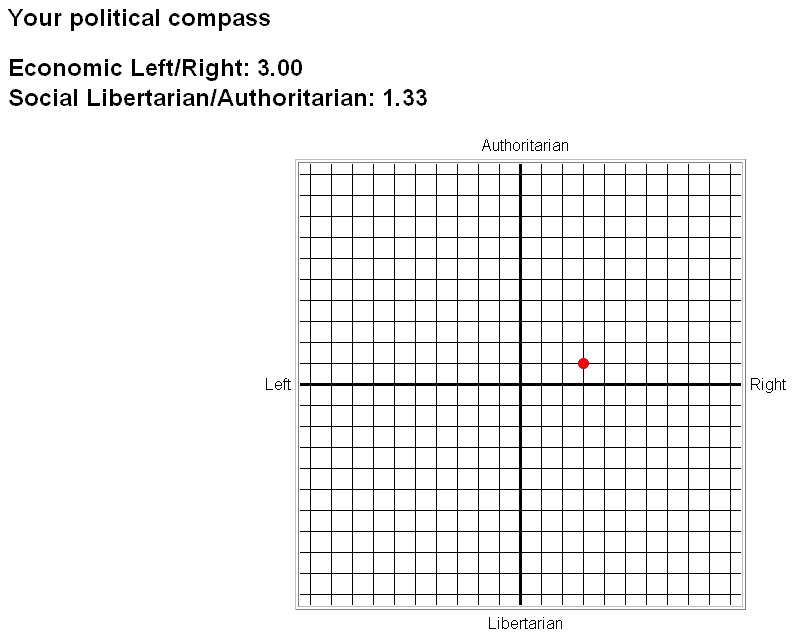
Someday soon I will have to write one of these myself (click on image to take the quiz and find your own leanings).

If memory serves, there are six-to-eight questions about regulating sex, pornography, abortions, smoking pot, and other things that people on the “left” don’t like to see regulated…and only a couple of questions about regulating the evil corporations, stealing money from productive people to give to lazy people, things people on the “right” bristle at seeing regulated.

This always emerges as a pet peeve of mine whenever I take such a quiz, especially with social issues, since my feelings about things are especially weak. If California were to consider an anti-sodomy law for example, or an anti-abortion law, or a new anti-pot-smoking law, I might be persuaded to vote “Yes” on those. I don’t really care that much about them. If you can make the case to me that they’re bad ideas, it would be pretty easy to persuade me to vote “No.”

If you were to try to convince me it was a bad idea to even have them on the ballot, it would be easy to do that, too. I’d even be open to some arguments that they’re unconstitutional, if you make ’em good arguments. The only thing I’m going to stick to, like super-glue, is that assuming you can’t define some sort of constitutional indigestion with regard to such laws, the citizens of a state have a God-given right to vote on these things. The authority to strike down laws, popularly enacted laws, comes from nowhere else. Either a law encroaches on the Constitution, or it doesn’t. And if there is doubt on such a question, the popularly-enacted law enjoys the benefit of the doubt, and the notion of unconstitutionality labors under the burden of proof.

Is that an “Authoritarian” mindset? Some would say that is the very definition of same. I don’t share that viewpoint. I think you can achieve tyranny, easily, by making it easier to declare things unconstitutional — since that wrests power from the people who would otherwise be voting on those laws. To me, that seems to be just common sense. But with most social issues, as far as how I would vote on them when the time comes to potentially outlaw them, I have very few opinions and most of those opinions are pretty weak. I’m much more concerned with who is making the choice, than how the choice is made.

And when an authority says it is unconstitutional to outlaw certain sexual positions, or abortions, or whatever…I don’t think power has been restored to The People, I think it’s been taken away.

But it’s pretty hard to find one of these tests that actually reflects that.

If you did find such a test, it would reveal something that has until now been shrouded in obscurity: We live in a time when being on the “left” is melding with being “authoritarian,” and being “libertarian” is quickly becoming synonymous with being on the “right.”

I know of many “conservative” people who think it’s wrong to penalize those who make money. I know of none among them, however, who would address that by lifting the issue away from the public vote. Can’t think of a single one. Friend, acquaintance, peer on the “innernets,” politician, or pundit. How many issues are there that liberals would like to decide their way, and then chisel into the marble slab of unconstitutionality, lifting the question away from the public vote? I think the answer to that is up into the double-digits by now, and going higher.

Vote To Impeach President Bush Passes Two-to-One

Wednesday, May 31st, 2006

Vote To Impeach President Bush Passes Two-to-One

Aw, isn’t this cute

Brookline Town Meeting last night voted to impeach the president of the United States in a 104 to 52 vote that was greeted with an eruption of applause and cheers.

Jonathan Margolis, who sponsored the article, repeated the embittered claims of the left that Bush lied to the nation and picked and chose which laws his administration would obey.

Margolis was forced to defend his proposal against detractors who suggested he was pushing beyond the bounds of Town Meeting authority.

“While I understand your sincerity and patriotism,” Margolis told one opponent, “I respectfully suggest you go back and read the Declaration of Independence and the Constitution of the United States.”

Margolis then went on to specify exactly what it was he was parodying. Well, no he didn’t, or if he did it was left out of the story.

My Wine Club II

Tuesday, May 30th, 2006

My Wine Club II

I do not usually like to spend lots of money on red wine. My palette is much more sensitive with white wines, and I’ve had some rewarding experiences from letting go of the purse strings and splurging for the sake of expanding horizons with dessert wines, table wines, Pinot Grigio, Muscat, etc. With red wine, I’ve noticed the cheap stuff works just as good. The entree has much more to do with making a good meal than the beverage.

Every rule has an exception, however, and this stuff is more than worthy of a sampling. Villa Mt. Eden Cabernet Savignon, last bottle I got I think was a 2000 vintage. You will notice the quality right away even if you’re not a red-wine-snob…looking at about $14 to $18 a bottle.

Ouch IV

Tuesday, May 30th, 2006

Ouch IV

Anything for the public safety, especially during the hazardous Memorial Day weekend…

Public Advocate USA set up a “Kennedy Sobriety Checkpoint” right in the ol’ beltway. Of course, we go about our daily lives under threat of life and limb from impaired drivers, no matter what the driver’s surname happens to be. But we have things like laws to protect us from the ones who aren’t named “Kennedy.”

Couldn’t Have Said It Better Myself… VIII

Monday, May 29th, 2006

Couldn’t Have Said It Better Myself… VIII

The Anti-Idiotarian Rottweiler says let us all take a break from politics and do what only makes sense…

Let�s turn to those truly worthy of our attention, the men and women at the sharp end of the spear to whom we owe the privilege of having a Memorial Day to celebrate in the first place.

While we�re all here safe at home enjoying the official start of summer with our families, we owe it to those fine men and women out there to recognize their sacrifice and to honor them for it, because without them, we�d be celebrating whatever our new masters would tell us to celebrate.

We are what we are and we enjoy the status that we, as a nation, enjoy because of those brave crusaders for freedom.

The author of this post, “Darth Misha,” has worded it in such a way that it lacks the tightrope-walking finesse necessary to comport with the “Support The Troops Not The Mission” template. You know the one I’m talking about, where you support the troops in this all-volunteer military, because they got duped by a lying recruiter, and then sent by a power-hungry lying President over to a “war for oil” and don’t know when they’re coming home again…blah blah blah.

No, Misha says we owe these servicemen and women our freedom, which implies that the mission is worthwhile after all. And that, perhaps, the members of this all-volunteer military aren’t a bunch of dolts, and maybe know what they’re doing. How politically incorrect.

That’s why I like it.

No effort to marginalize the left-wing anti-war peaceniks who hold the service-members in intellectual contempt, just a determination to do what’s right, and honor those who have made a choice out of love of country. Let the message marginalize whoever it must, no more and no less. Perfect.

Bush Signs Bill; Confusion Reigns

Monday, May 29th, 2006

Bush Signs Bill; Confusion Reigns

Thus sayeth Associate Press, by way of Yahoo News:

President Bush, marking Memorial Day with a speech paying tribute to fighting men and women lost in war, signed into law Monday a bill that keeps demonstrators from disrupting military funerals.

In advance of his speech and a wreath-laying at America’s most hallowed burial ground for military heroes, Bush signed the “Respect for America’s Fallen Heroes Act.” This was largely in response to the activities of a Kansas church group that has staged protests at military funerals around the country, claiming the deaths symbolized God’s anger at U.S. tolerance of homosexuals.

Obviously it is time, once again, to deliberate whether with our right to speak out, is entangled inextricably a right to be heard. Few are willing to assert the existence of such an inseperable package, yet many are willing to act as if there is such a thing.

Among those many, are the Bush-bashing liberals and the Westboro Baptist Church. The former bristles at being mentioned in the same breath as the latter — but mentioned side-by-side they shall be, everlastingly, as long as the issue comes up. Fred Phelps wants to protest anywhere he wants to, and so do the Bush-bashers. They are strange bedfellows, on this issue if on none other.

Should a lot of noise be made over this?

I hope there is. I hope people talk about it day and night…that among the reasons we have such a terrible president, is that he signed a law against protests at military funerals, by peacenik liberal loudmouths and, uh, and the “God Hates Fags” Westboro Baptist Church. Those two. Which, of course, have nothing in common with each other.

Except that each of those two, by asserting their freedom-of-speech is incomplete if the rest of us aren’t compelled to listen to them anywhere and everywhere, is essentially advocating the position of the other. Unless they want to take a position of “I have a first amendment right to make sure you hear me wherever you go…but that other guy doesn’t have the same right.” Everyone upset about this new bill, does have that option.

And I can’t wait to see what they do with it. Let the hair-splitting commence.

Otherwise Good Typing Paper

Saturday, May 27th, 2006

Otherwise Good Typing Paper

Quothe an unnamed professor, ostensibly from Ohio University, at what most certainly must have been a long time ago:

I am returning this otherwise good typing paper to you because someone has printed gibberish all over it and put your name at the top.

Scathing as it is, a comment like this wouldn’t be handed out by a college professor to just anyone. There is a not-so-subtle implication a great deal better work is expected from the intended recipient of the critique, compared with what passed under the teacher’s scrutiny. For that reason, I find it to be a more-than-a-fitting comment in response to House Speaker J. Dennis Hastert’s editorial in USA Today Thursday:

There’s a right way

If the information we have read about the behavior of Rep. William Jefferson, D-La., seems as obvious to a jury as it does to me, he deserves to be vigorously prosecuted. I do not want to do anything that will interfere with that prosecution.

The issue that has concerned me, as Speaker, since Saturday night is not if the FBI should be able to search a member of Congress’ office, but rather how to do it within the boundaries of the Constitution.

On Thursday, President Bush recognized that serious constitutional issues needed to be resolved. He wisely directed the Department of Justice to send the documents (taken from Jefferson’s office last weekend) to the Solicitor General’s office for safekeeping for 45 days. This was a meaningful step. The president also encouraged the Justice Department to meet with us.

Democratic Leader Nancy Pelosi and I directed the lawyers for the House to develop reasonable protocols and procedures that will make it possible for the FBI to go into congressional offices to constitutionally-execute a search warrant.

In more than 219 years, the Justice Department has never found it necessary to use a search warrant to obtain documents from a congressional office. These issues have always been resolved without the necessity of a search warrant, and prosecutions have gone forward.

Justice Department officials now insist that this specific case required them, for the first time, to conduct a search. I regret that when they reached this conclusion, they did not work with us to figure out a way to do it consistently with the Constitution. But that is behind us now. I am confident that in the next 45 days, the lawyers will figure out how to do it right.

Someone return this otherwise-good typing paper to the Hon. Speaker Hastert, for someone has covered it with gibberish and put his good name at the top. Where it most assuredly doesn’t belong.

Speaker Hastert is known to me, albeit with a good deal less certainty than to someone who might be personally acquainted with him, as a man of integrity. I come to that conclusion after observing the events that resulted in his elevation to House Speaker in the first place. The transition between the 105th and 106th Congresses, rocked as it was by the then-recent impeachment of President Clinton, was a crisis of leadership. It seemed to be an endless game of hot-potato, and endless progression of “Speaker, Speaker, Who Is The Speaker,” until the baton finally came to rest in the steady hand of Congressman Hastert. Since then, over seven years I’ve heard nary a peep. I don’t know too much more about how things work under that strange old space under the dome compared to the next fellow, but I know when credit is due. And our current House Speaker deserves credit. Institutional credibility, I’ve observed over time, is a far easier thing to sabotage than to restore.

But I’m sorry, I don’t intend any disrespect. The stuff that somehow found its way under his by-line, above, is sheer nonsense.

“Boundaries of the Constitution?” What constitutional conundrum is it that challenges us here? William F. Buckley has taken a wild stab at figuring out what the confounding passage might be, which is a question I would rather prefer be subjected to unambiguous resolution by the Speaker himself. Lacking that, Buckley postulates we are talking about Article I Section 6, and I’m inclined to agree with him:

If the Constitution’s rule separating church and state can be held to mean that a replica of the scene at Bethlehem cannot be constitutionally displayed on state property, then maybe Mr. Jefferson is indeed protected, giving credibility to the new Hastert-Pelosi exegesis of the Constitution.

But stare down hard at the language. The Constitution holds that lawmakers are “privileged from arrest during their attendance at the session of their respective Houses, and in going to and returning from the same.”

That provision was intended to protect legislators from arrest for statements made in the course of their legislative duties. This has nothing to do with Mr. Jefferson’s case. Which means that those who say that the FBI should not have had access to the congressman’s home or office are extending that constitutional provision to the point of immunity from search.

House Majority Leader John Boehner said something about the issue having to do with independence of the legislative branch and separation of powers. This seems to be a contradiction with Hastert’s editorial, since Hastert appears to be acknowledging that a search of congressional offices with a warrant may be necessary, and now that it’s being done for the first time, that it be done “right.” Is a warrant not sanction from the judicial branch, and by design, protection against the executive branch going off half-cocked, gathering dirt on hitherto-independent legislators for nefarious ends?

I once had a position in computer network security. It was my job to enforce rules, to figure out where rules were inadequate, recommend new ones, and bring infractions to the attention of those who could do something about them. I had a boss whom I respected a lot, whose mantra was “if ya know something, ya gotta do something.” Put another way, if skullduggery is going on under your nose and you get nailed on it later on, whatever hopes you have of successfully pleading ignorance vanish with your plausible deniability. You know something, and do nothing — trouble awaits. The issue is one of trust.

Our House Speaker, whatever impeccable moral credentials he had before and that he might still have, has created an issue of trust where one didn’t exist before. Well perhaps that’s unfair…he further cemeted a lingering issue of trust, that otherwise might have eventually dried out, shriveled up, and fallen away. No, I wouldn’t bet money on that but hope springs eternal.

To put it simply, I don’t trust a government that finds out about malfeasance and then draws on legal precedent, however enshrined that precedent may be by the legal experts, to find creative new ways to “not know” things they do in fact know. It seems a congressman has accepted kickbacks. Let us cease and desist in the pointless debate about whether we ought to know what we know about it, and instead deliberate what to do now that it is indeed known.

Yeah, separation of powers is important. But the case has not been made, to my satisfaction anyway, that it’s an issue here. Meanwhile, the issue of equal protection under the law cries out for more attention, as does the issue of trust in our public officials.

Rude Pundit

Saturday, May 27th, 2006

Rude Pundit

In the FAQ (questions 7, 8 and 10) if you read between the lines you’ll pick up on my assertion that the way one goes about doing one’s thinking is important, because it affects the conclusions one reaches by doing that thinking. This is just common sense, a point that is so innocuous as to be useless, but we seem to have a lot of people who just don’t get it.

Or don’t want to get it, because it would be injurious to what they’re trying to compel themselves and those around them to believe.

Here’s just a golden textbook example of what I’m talking about. All who disagree with the assertions made by Al Gore’s new movie about global warming, are wrong, and we know this because Al Gore says they are wrong. So says the Rude Pundit (warning, the bold-type headline of the review is probably NSFW, it has the “F” word that rhymes with “truck”). This is a persuasive argument because, and only because, the critical barrier between fact & opinion has been erased. That which is intoned, so long as it is intoned by the right people, and intoned with a demeanor of sufficient certainty, is equivalent to that which is.

Essentially, Gore’s mission on global warming is rhetorically similar to George Bush’s mission in Iraq: revolution now so that the future can be secure. The difference, of course, is that Gore isn’t a liar, and he doesn’t have to hype the evidence. Gore approaches his subject the way every politician ought to lead: he knows he’s right, and he’s so right that others are wrong. When Gore was asked about scientists who say that climatic change is just part of ongoing natural cycles, Gore didn’t pander, didn’t offer that idiotic “well, good people can have differences of opinion” bullshit the Bush administration uses to paper over their lies. No, Gore just said that the questioner was wrong. That the vast scientific consensus says global warming is real and happening. And to believe otherwise is to believe liars. He said scientists who say otherwise are industrial “prostitutes” and “camp followers.”

Convincing stuff. Trouble is, as I indicated above, once the fissure is re-established between stuff that’s known and stuff that’s conjectured based on other stuff that’s known — everything changes.

“Gore didn’t pander…Gore just said that the questioner is wrong.” Is that a fact or an opinion? Does the reviewer know? Does Al Gore know? If I round up a hundred people who sign on to the notion that “the questioner is wrong” and take a poll from amongst them, am I going to get a single answer back on whether that’s a fact vs. an opinion?

Here’s another problem, and this one is a doozy. “He knows he’s right, and he’s so right that others are wrong” comes off more like grave criticism, than flattery, and there is a reason for this. There is a prevailing school of thought, well-represented amongst the souls sympathetic to Gore’s global-warming ideas, I infer, which lends enthusiastic support to the Barbeque Problem especially when criticizing, with varying degrees of etiquette, the forementioned President George Bush. This “Barbeque Problem” essentially says that correctness is manifested through doubt and contrition: It’s better to burn your whole house down during a barbeque so long as regret is expressed over the mistake, than it is to cause a slight delay in cooking the food by providing the wrong brand of charcoal, if the charcoal-error is not admitted. Correcting a mistake means nothing, and articulating the mistake means everything.

How come doubt-makes-right with our current President, and the rule doesn’t hold for the guy who lost the election and is reduced to making movies? It’s a fair question to ask, since the reviewer isn’t simply saying Gore’s right — what he’s saying, is we know Gore’s right because Gore knows he’s right.

Come to think of it, I wouldn’t mind hearing some regrets and doubts from some of the officials responsible for leaving Saddam Hussein in charge of Iraq, and relatively carefree in his tenure, all the way through the 1990’s. But I guess that’s a different topic.

Good post, though. Coriolanus, I’ll have to look that guy up.

Thing I Know #67. Some among us seem to think an election is the only time public opinion is important; others seem to think that’s the only time it isn’t.

But Then Again, Too Few To Mention?

Friday, May 26th, 2006

But Then Again, Too Few To Mention?

On Monday, I defined what we could call the “barbeque problem” which was my way of capturing the essence of concern of an insightful former colleague of mine:

Two years ago when the election was in full swing, a co-worker made an interesting observation in the form of a rhetorical question. His inquiry was, what is up with all this concern, lately, over admitting mistakes? What is the point? If you make a mistake and it results in a lot of damage you can’t fix, and you admit it, is that any better than making a mistake, correcting whatever damage resulted, and then keeping quiet on any regrets you might have about the mistake? In other words, when did admitting the mistake become any more important than actually fixing the problem that resulted?

Two neighbors have a barbeque. One buys the wrong brand of charcoal and has to make a quick run down to the store to get a better brand — thus correcting his mistake — but won’t admit he made a mistake! The other neighbor burns down his whole house but says “oops I made a mistake.” It’s better to burn down the house? The charcoal-mistake was a worse mistake because it was never outwardly confessed?

A neighbor presides over a household where hamburgers are eaten 45 minutes late, and another neighbor presides over no household at all. Nevermind that; to millions and millions of loud and angry people, eventual results decide nothing and contrition decides everything.

Well, at long last our current President has given you folks what you’ve been wanting. He admitted some of his regrets.

Bush uncharacteristically did not hesitate when asked about mistakes he had made since the March 2003 invasion.

“Saying ‘bring it on,'” he said, in reference to an ill-advised taunt to Iraqi insurgents in the summer of 2003.

“The kind of tough talk, you know, that sent the wrong signal to people. You know, I learned some lessons about expressing myself in maybe a little more sophisticated manner…’wanted dead or alive,’ that kind of talk.”

He also said the U.S. has been paying for the 2004 Abu Ghraib prison scandal “for a long period of time.”

Now you can start liking him! Let the healing begin!

Yeah, right. Pfffft.

Scary Peace-People

Friday, May 26th, 2006

Scary Peace-People

If I’m afraid of any one class of people, it’s those scary peace-at-any-price, anti-war people.

Item!

Malcolm’s mom from “Malcolm in the Middle” gets in a little bit of a tiff with another female shopper during the holiday season. Video clip is safe for work, but your boss might decide to can your ass because you’re laughing so hard. Being a dude, I’m handicapped from understanding a social issue or two that I know is going on here, which has to do with that enigmatic wrinkle in the human condition, the female-on-female conflict. Boy howdee, when women don’t get along with other women, they really don’t get along. I am past the point where I’m even going to pretend I understand what’s happening here, or have a shot at someday understanding it. I don’t and I won’t.

A guy pisses me off, or else we get along great, or else we ignore each other. One of the three. In all three cases, I’ve forgotten all about him two minutes later, and he’s forgotten about me. In an extreme situation where I’ve had a verbal exchange with a complete stranger, or let’s say, flicked each other off on the freeway, the unpleasantness is purged from my memory with the audible announcement of: “What a dick!” The instant the plosive sound of “K” has clicked out of my mouth, I’ve forgotten about the asshole and I’m on to the next thing. And it’s mutual.

Ladies just aren’t wired this way. Smart women, dumb women, all women in-between. Two women having a conflict, within a heartbeat will become two Xena Warrior Princesses goin’ at it, in mind if not in body. I’ve never been able to understand it, and through the years I’ve joined the ranks of wiser men who see what’s about to unfold, stop in mid-sentence, take a step back, try to look inconspicuous, grab a beer if one is available, and watch quietly.

But getting back to the subject at hand: Check out the bumper sticker at 1:48. What makes this so funny? Because there’s a dark truth-of-life being subtly commented-upon, one which usually passes under the radar uncommented-upon. A policy of pacificism for those facing conflict, is very much like the principle of “giving back to the community” for those who are solvent. An appealing cause to champion, a principle ripe for activism, perhaps a lot of fun to promote, but always intended for somebody else.

Item!

Anti-war looney Brit sensationalist politician George Galloway wouldn’t object too terribly much if PM Tony Blair got blown up by a suicide bomber. You remember George Galloway don’t you? He’s the British anti-war MP who was shown by captured Iraqi documents, to have been paid-off by Saddam’s dirty Oil For Food money. A word on how that controversy turned out: He won a libel case against the Daily Telegraph for having reported on the documents, after huffing-and-puffing that the documents were fake. At this date, to the best of my knowledge and Wikipedia’s, nothing has emerged to even call the veracity of the documents into question, save for the Respect Member of Parliament’s theatrical outrage. The Telegraph had to fork over �150,000, essentially, for writing up something about Mr. Galloway that Mr. Galloway didn’t like, because Mr. Galloway has become exceptionally skilled at supressing genuine apprehension and guilt — to the extent he has any — and displaying instead a veneer of phony anger.

I do not understand Galloway’s sterling reputation for “debate.” He has a lot of performance skill, but when you’re in a debate, sooner or later you have to let the other guy talk. No matter how poorly his opponent would deliver the line, “excuse me Mr. Galloway, but with all due respect you didn’t answer my question,” that one riposte by itself would peel the Galloway I’ve been reading about, like a banana. I have not read one thing — not one — where this distinguished public servant allows someone else to establish the issue under consideration, and then turns in a satisfactory job of actually addressing it. Everything out of his mouth, that has been brought to my attention, has been smoke-and-mirrors.

But like most other anti-war people, he’s scary too. Mr. Galloway says that for a dynamite-belt-guy to blow PM Blair to smithereens, would be “entirely logical and explicable.” Such an event would be ” morally justified.” But don’t worry, he’s “not calling for it.”

For the past three years and eight months, anti-war people have displayed so much anger compared to the pro-war people. I’m frequently instructed I should have the opinion that pro-war people, like me, are lusting for war because we’re projecting some kind of unresolved emotional issue on world events. More and more as time goes on, it looks to me like it’s the other camp doing that. Perhaps the time has come to have a worldwide discussion about what, exactly, peace is. If it’s an absence of fighting, there is an unresolved conundrum because that doesn’t appear to be what the peace-people want. Not the ones who’ve taken the trouble to make their opinions known to me.

That’s About Right

Thursday, May 25th, 2006

That’s About Right

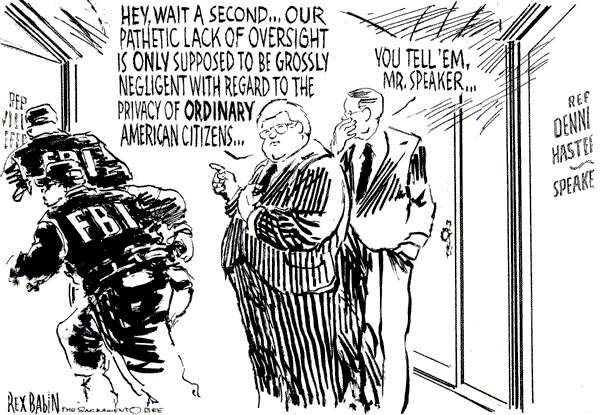
Let me start by saying Rex Babin has horrible taste. I don’t say that because I generally disagree with the tenor of the Sacramento Bee cartoonist’s work, although I do. I say that because I quite honestly fail to see what there is to recommend him. He draws far better than I do, but that says very little since I’m not a cartoonist. The illustrations are sub-par at best. Cartoonists can disagree with me, and still be counted on to produce illustrations that are pleasing to the eye. Babin’s drawings make me dizzy. As for content, his cartoons rarely adhere to reality, and where they depart from said reality, the disengagement seems to be a premeditated and deliberate attempt to deceive the people who will be consuming his product. Throughout the years, I’ve been forced to reject the possibility that Babin is simply ignorant of what he draws. I’ve come to the conclusion he’s a Democrat-party shill, knowing full well what he’s doing when he leads people astray. I decided that after looking at things like this and this and this and this.

He is to cartoonists what Howard Stern is to radio. Dancing on the edge, just asking to be fined or fired or both…except in Babin’s case it never quite seems to happen. This would be a compliment to him for his amazing finesse, his pinpoint precision in figuring out where the line is, but if Babin has style and grace here he manages to show it nowhere else. Everything about his work reminds one of the metaphorical bull in a china shop. When he goes over the line, he goes way over it. One gets the impression that his continued employment is not an indication of his discretion or his skill or his market value, but instead of some enormous favor someone owes him.

Having said all that, even a stopped clock is right every twelve hours. And in the cartoon at left he has managed to capture the situation perfectly. It’s still ugly to look at, but the reader is left to ponder on what exactly is wrong with this situation, and in so doing will unerringly echo my own thoughts if the reader has an ounce or more of working brain in his head. The comportation with the truth is perfect, or near-perfect.

I suspect Babin’s preference for what is to be done about this, is different from my own. But that’s okay. He’s built a picture around my thousand words: It is bull squat that two different standards of privacy should exist for two different classes of people, with some cock-and-bull excuse of “separation of powers” being used to legitimize such a stratification.

The Founding Fathers were pretty worried about the existence of an aristocracy before they got caught up in how our government was to be designed. Jefferson, alone, spent a lifetime crusading against aristocracy and in particular, primogeniture. We don’t have primogeniture in the Congress, but the folks under the dome seem to be working under a wholly different set of rules from us “real” folks, and the difference between those two sets of rules appears to have escaped everybody’s ability to measure.

President Bush, seeking to somewhat extinguish this escalating firestorm, has ordered a 45-day freeze on the documents in question. Any sixth-grader ought to be able to tell you that if you buy into the arguments about “independence of the legislative branch” — and that’s a huge “if” — a 45-day-freeze does nothing to address the issue raised. How stupid do they think we are? Like I said in the post linked above, to solve the problem Pelosi and Hastert are saying demands the attention, in fact to even begin to address it, you have to exempt members of Congress from the law. All laws. Any law. Anything that can be enforced, because they don’t like the enforcement. Nothing else will do.

Congrats, Babin. You got it right this day. I’ll mark the calendar; credit where credit is due, and all that. I’m sure you’ll tick me off pretty good tomorrow.

He’s Just Askin’

Thursday, May 25th, 2006

He’s Just Askin’

Neal Boortz, commenting on the William Jefferson thingamajig, has a great question. William Jefferson is a congressman who took bribes. The FBI raided his offices, and his house, and found the evidence they need which includes $90,000 in cash. Now a whole bunch of Congresspersons are protesting over how the evidence was collected, citing something about separation of powers. The theory is that this is injurious to the independence of the legislative branch.

I’m wholly unexcited about this argument. Story after story, as they are brought to my attention, inform me of the agitation felt by members of Congress about the loss of independence or their fear of loss of independence. As I understand it, when the executive branch gathers its dirt, we have nothing in place to force the executive branch to use that dirt for legal purposes — it could engage in blackmail. Very plausible, especially when you consider that probably 99% of the dirt would be unsuitable for prosecution anyway, but ripe for arm-twisting and dirty tricks.

The problem comes up when we consider remedies. Rules for gathering evidence, special warrants, 24-hour advance notice when the FBI is about to raid a congressman’s office — none of this would address the concern. The President knows something about Congressman Flibbertigibbit, and Congressman Flibbertigibbit’s vote is needed on a bill the President wants, evidence is gathered against Congressman Flibbertigibbit, and there ya go. Hasta la vista, Independence-Of-Legislative-Branch. I suppose the Congressman or his aid, would have to have lunch in a nice restaurant with a member of the FBI, and they’d reach an “understanding.” The bill would pass, and the incriminating nugget would pass through a paper shredder. No way could we ever allow such a thing to happen in America, could we.

I call shenanigans. Such a thing has always surrounded power, since Roman times. No of course I can’t prove that. That’s the nature of the thing under discussion, isn’t it? Vote my way, and nobody ever has to know? Can’t prove what I don’t know.

No, evidence-gathering rules will not fix this. There is only one thing that will fix this, and that is to put Congress above the law. Does anyone, anywhere, want to sign on to that one? That while you serve in Congress, nothing you do should be subject to prosecution by any lawmaking or law-enforcement entity, anywhere, because the threat of indictment would hurt the independence of the legislative branch? How about all the other things that a legal authority could do to a private citizen…how about subpoenas? Sexual harrassment suits? OSHA audits of congressional offices? Overdue library book fines? Parking citations?

The Constitution says you can be a congressman when you’re 25 and a senator when you’re 30. Now look how old some of those gasbags are. Do we really trust these guys enough to give them half a freakin’ century of exemption from the law?

No, nobody’s suggesting that. But my point is they need to suggest that. They have to. They’re concerned about independence and separation, and if they want it, they must have that exemption; nothing short of that will work. I know I’m not down with that, is anybody else? Like I said yesterday: It seems to be just a great way to lose a mid-term election.

Rambling a bit here. On to the wonderful question posed by Mr. Boortz.

Republican Speaker of the House Dennis Hastert and Democratic Minority Leader Nancy Pelosi issued a joint statement yesterday. It demanded that “the Justice Department must immediately return the papers it unconstitutionally seized.” I guess the FBI is supposed to give notice before they go poking around in a Congressional office. They need time to shred, you know…if the feds have to return the papers, will Jefferson have to return the $100,000? I’m just askin.’

Priceless.

Earth in the Balance? II

Wednesday, May 24th, 2006

Earth in the Balance? II

Earlier this month I commented about the whole Al Gore and Global Warming thingy.

It is lost to me, forever I fear, where I heard this. God forbid it was on Rush’s show, which I fear is the case, because digging into those archives and playing them back at double-speed is so time-consuming and tedious it’s out of the question. But it was a brilliant point.

It’s brilliant because all other attempts to address MMGW (our acronym here for the dubious concept of “man made global warming”) are met with what could best be described as existentialism: I can’t prove my stuff, you can’t prove yours, so let’s get in a shouting match about who should be awarded the benefit of the doubt. And, of course, it’s better to act as if the sky is falling when it isn’t, than the other way around, so game-set-match the watermelons win.

(Watermelon: Someone green on the outside and red on the inside.)

Enter the caller, who had a great question.

Since according to Mr. Gore the earth is definitely heating up and lives are hanging in the balance, and one of the things that’s supposed to happen is that the sea levels are going to rise — what is he doing to get everyone who lives within fifty miles of the coastlines, to relocate like yesterday? Since it’s definitely going to happen, someone should be on top of this right?

Yeeowch…that had to have hurt.

Update 5/25/06: In a world that is so crammed up to the rafters with moose feces, it really bugs me when someone says something sensible and doesn’t get credit for it. So I went ahead and sifted through the archives, which I can do as a Rush 24/7 subscriber. I found it at Hour #2 on Tuesday, 5/23. The caller is Cheryl and I’m going to make an assumption on how to spell her name. Her call begins at time index 20:58, without the commercials.

Mark Belling, substitute host: To Latrobe, Pennsylvania, it’s Cheryl; Cheryl, it’s your turn on E.I.B.

Cheryl from Latrobe, PA: Oh hi Mark, nice to speak with you. Hey Mark, I question the courage of Al “Google” Gore’s convictions. If he really believes what he’s claiming, you know, that the water’s going to come up on all coastlines, all over the earth — well, why isn’t he calling for all coastline states to vacate, immediately, all people and buildings, at least fifty miles inland? Why isn’t he calling for that? If this is really happening, and we can’t be sure it’s humans, but he’s sure it’s happening…

I’ve got an idea about how to make this even better. Since there is a whole lot of time, aggravation, money and trouble involved in relocating people away from coastlines, and even identifying them could cause a political backlash — what’s wrong with discussing this class in aggregate form? You know, like we do with the homeless; we don’t say “Bob’s homeless and Joe’s homeless and Frank is homeless,” what we do is estimate there are one point five million homeless people. Media outlets just love to do that. Three million people with AIDS, forty-seven thousand high school students who can’t pass their exit exams. Oh, the sensationalism-sans-responsibility, that goes with quoting numbers without citing specific cases. They just can’t get enough of it.

Why do I not know, and why can I not find out, how many thousands of people in my country live in daily fear of waking up to seawater in their living rooms, because of the looming danger of global warming? Why does this seem to be the one subject where the number-floating-game suddenly loses any appeal? The very least you could say about it, is that it’s a worthwhile question.

An Interesting Exchange

Wednesday, May 24th, 2006

An Interesting Exchange

Almond and Rice, Rice and Almond. The major players in this story both have something to do with food. You could make a real cute title out of that, and I chose not to. You’re welcome.

Hat tip to Neal Boortz for this one. Steve Almond is the name of that Boston College professor who resigned his post in protest when Condoleeza Rice came to speak at commencement. He appeared on Hannity & Colmes, and Hannity cracked him like a — well, sorry. Read the transcript for yourself.

PROF. STEVE ALMOND, RESIGNED TO PROTEST RICE: I think actually morality plays a role. I just feel public officials shouldn’t lie to us, especially about matters that are as important as war.

HANNITY: I got that. But did you � but you are politically a Democrat. You’re politically lefty. You voted for John Kerry, right?

ALMOND: I believe that politicians shouldn’t lie to the American people.

HANNITY: I didn’t ask you that. Did you vote for John Kerry, sir?

ALMOND: And I’m telling you that I don’t believe that our public officials should lie, Democrat, Republican, or…

HANNITY: I got that. You’re a broken record. Now this is a simply question: Did you vote for John Kerry?

ALMOND: I don’t see what it has to do with Condoleezza Rice…

(CROSSTALK)

HANNITY: I’ll tell you what it has to do with it.

ALMOND: … lies to the American public. What does it have to do with it?

HANNITY: I’ll explain it to you. If you would give me an honest answer, I can explain why. Did you vote for John Kerry?

ALMOND: What is it that you want to say to me? Are you going to try to establish that I’m a lefty or Democrat? I believe that public officials shouldn’t lie, and Condoleezza Rice has lied repeatedly.

HANNITY: I already know you voted for John Kerry, but you won’t admit it. But you don’t have to. I’ll tell you why: Because John Kerry, in the lead-up to this very war, in your letter, where you say, “In an effort to build the case for war, then-National Security Adviser Rice repeatedly asserted that Iraq was pursuing a nuclear program.”

Well, I’ll quote John Kerry, the guy that I suspect you voted for. He says, “If you don’t believe Saddam is a threat with nuclear weapons or WMDs, you shouldn’t vote for me.” Is the guy that you voted for a liar?

ALMOND: The secretary of state, who has also been a part of prosecuting this war…

HANNITY: All right, you can’t even answer a question.

ALMOND: … incredibly ineptly is…

HANNITY: Is John Kerry a liar?

Now, I part company with Boortz here. You’ve seen one Hannity exchange, and for the most part you’ve seen ’em all, and because Professor Almond refused to confess who he voted for the point wasn’t really made — nothing was proven — Hannity has done much better.

But he did take his pound of flesh. Almond ended up one step forward, and four steps back give-or-take. His only defense can be an assertion that Hannity’s thesis had some measure of meaninglessness to it, and instead the professor chose to stand on keeping the facts behind the thesis shrouded in doubt.

Ironically, because of this, Hannity’s premise seems to be correct — I have no logical reason to believe it isn’t. Even if the Professor did indeed vote for Kerry, he would have been in a much stronger position to say “yeah, I voted for him, what about it?” and pursue an argument about whether the Senator’s quote means much of anything. Of course, that would require some thinking-on-the-ol’-feet. An impressive amount. Honestly, I’m not sure I got it in me, so I can’t blame the Prof. for thinking he doesn’t have it in him, even though I assume he was doing that for a living.

So the situation ends up thusly: Hannity did not prove his point. But boy, he sure raised a lot of questions, and the Professor looks like an ivy-league snob who wants to tell everybody else what they’re supposed to be thinking. Condi is a liar, although I cannot say why, and you are not to wonder about who I voted for, and I won’t explain why not. Most damning of all, Condi’s lying is worth resigning my position so I can protest, and you won’t get a peep out of me about Kerry saying exactly the same thing.

Advantage: Hannity.

Race To Lose

Wednesday, May 24th, 2006

Race To Lose

Republicans don’t want to win in November, so now that the Congressman William Jefferson imbroglio has scuttled the “GOP Culture of Corruption” ship, which had been the only ship in the fleet that could carry Democrats to victory — they want to look as unappealing as possible. That’s the only explanation I can produce. Because, it seems, being a Republican means when the executive branch comes gunnin’ for you, it’s okay to let them search things, unless you’re a member of the legislative branch and then suddenly we have to worry about abuse of power, gathering dirt on potential enemies, etc.

House Speaker Dennis Hastert complained directly to President Bush about the FBI’s unprecedented raid on Rep. William Jefferson’s office on Tuesday, while officials said senior Democrats worked to ease the Louisiana lawmaker out of a powerful committee assignment, at least temporarily.

“Obviously we are taking note of Speaker Hastert’s statements,” said White House press secretary Tony Snow after the Illinois Republican spoke with Bush at the White House.
:
The search may have overstepped constitutional boundaries, House leaders said as the congressman under investigation pledged to stay in office.

House Majority Leader John Boehner of Ohio told reporters Tuesday that the Congress will somehow speak to “this issue of the Justice Department’s invasion of the legislative branch. In what form, I don’t know.”

“I’ve got to believe at the end of the day it’s going to end up across the street at the Supreme Court,” Boehner said.

Hastert said Monday the Justice Department had never before crossed a line that separates Congress from the executive branch by searching a congressional office while investigating a member of Congress.

The search warrant was issued by a federal district judge in suburban Virginia, based on an affidavit from FBI investigators outlining some of the evidence that have accumulated in the case, including video tape of Jefferson accepting $100,000 in $100 bills from an FBI informant, who agreed to have her conversations with the congressman taped.

Agents later found all but $10,000 of the cash � in marked bills � hidden in a freezer in one of the congressman’s homes, according to the affidavit.

His homes in New Orleans and the Washington area were searched by FBI agents last August.

“Nothing I have learned in the last 48 hours leads me to believe that there wasn doubt, the filter team will give the documents to a judge for a definitive ruling before giving them to case prosecutors, according to the affidavit.

Hastert said those protections may not be enough.

“It is not at all clear to me that it would even be possible to create special procedures that would overcome the Constitutional problems that the execution of this warrant has created,” he said.

Hey, that’s just who I want to elect. Someone who worries about the White House exceeding its authority when his own office is searched, and turns a blind eye to it when I’m searched. Great plan!

And here I thought Republicans want to win.

Well, it seems the Democrats aren’t wild about winning either. Hillary Clinton, whom I’m told is a moderate senator, wants to restore the 55-mph speed limit. And wait until you read about the rest of her plan.

In a surprise move yesterday, Sen. Hillary Rodham Clinton called for “most of the country” to return to a speed limit of 55 mph in an effort to slash fuel consumption.

“The 55-mile speed limit really does lower gas usage. And wherever it can be required, and the people will accept it, we ought to do it,” Clinton said at the National Press Club.

Before sounding off on the benefits of a lower speed limit, Clinton called for a combination of tax incentives, the use of more ethanol-based fuel and a $50 billion fund for new energy research to cut the consumption of foreign oil 50 percent by 2025.

She also pushed for half of all the nation’s gas stations to have ethanol pumps by 2015, and for every gas station to have them by 2025.

I’ve been noticing this about Democrats since I was a little kid. They’re constantly accused of “not offering a plan,” but there seems to be something mutually exclusive between being a Democrat, and even knowing what a plan is. Cutting consumption of foreign products in half by 2025 is a goal, not a plan. These are just numbers, no better or worse than any other number — until the $50 billion has actually been spent. She might as well have said to cut it by 75% by 2010, or by 99% by the end of next year. Who cares?

It’s as if Hillary is trying to sabotage her party. You could confound a conservative-libertarian guy like me, indulging in the superlative that “Bill Clinton never did anything good” by pointing out that the 55-mph national speed limit was eliminated on Clinton’s watch. It’s been done. You could do that…until Hillary opened her big mouth. And behold, today, the next great hope of the Clinton legacy, wanting the federal overlords to once again tell the states how to do their business. Behold the new agenda, for soccer moms in Trenton, NJ to once again tell cattle ranchers in Butte, MT how fast they should drive.

Nobody’s going to argue that people in New York City should tell people in North Dakota how fast to go — they won’t do that. They’ll just prattle on about “55 saves lives” and claim to know more, compared to the people who actually drive their own cars, about what speed is the best for that car’s use of gas.

So evidently, Republicans would like to remind us they don’t think “little people” have as much need to worry about their privacy, as legislative office-holders. Which may very well be true, but it doesn’t make them very appealing.

And Democrats would like to remind us that they know what’s best for us, and their “plans” will culminate in fuel conservation. And that may very well be true too, but it doesn’t make them very appealing.

Nobody really wants to win in November. They aren’t trying.

This Is Good V

Wednesday, May 24th, 2006

This Is Good V

Spoiler alert. Movie spoilers, as many as you can think of, just stuck end-to-end for as long as you can stand it. Warning, some written language not safe for work.

And warning, uh…spoilers herein.

Pretty amusing in places.

What People Think

Wednesday, May 24th, 2006

What People Think

The Dixie Chicks want & need a job wherein those who hold the job, can “speak truth to power,” and whatever everybody else thinks about it is irrelevant. There are jobs like this. There are even some jobs where what your boss thinks about it, is irrelevant, although those are a tad harder to find. But one thing is for sure, they’re in the wrong line of work.

What we have come to call “Show Biz” is all about what-people-think. Natalie Maines knew all about this, when she famously took back her previous apology to President Bush.

The Dixie Chicks’ Natalie Maines apologized for disrespecting President Bush during a London concert in 2003. But now, she’s taking it back.

“I don’t feel that way anymore,” she told Time magazine for its issue hitting newsstands Monday. “I don’t feel he is owed any respect whatsoever.”

As war in Iraq loomed, Maines told the London audience: “Just so you know, we’re ashamed that the President of the United States is from Texas.”

Yeah, you got it right. Nat bad-mouthed President Bush from the safety of another country, then apologized for it, and now she’s taking back the apology. It might arouse feelings of cynicism to note that the original bad-mouthing took place in a concert, and the apology was issued when someone pointed out this might have an effect on album sales, and now the apology is being taken back when — guess what? — a new album is coming out.

One of her band-mates helpfully put a “we meant to do that” spin on things.

For band member Martie Maguire, the controversy was a blessing in disguise.

“I’d rather have a small following of really cool people who get it, who will grow with us as we grow and are fans for life, than people that have us in their five-disc changer with Reba McEntire and Toby Keith,” Maguire said. “We don’t want those kinds of fans. They limit what you can do.”

Well, I’m not one to cast dispersions on this tactic, I use it all the time. That’s why I call myself “the blog that nobody reads.” Except I’m a blog, and they’re a band. I don’t release albums; they do. And I gotta think it’s going to cause some problems when they launch this project to winnow the fan-base down to something miniscule and snobby, and the project works out all too well.

The Dixie Chicks aren’t ready to make nice, and it seems the feeling is mutual.

With their new album, Taking the Long Way, in stores Tuesday, no Houston stations � country or pop � claim to be playing any of the trio’s new music.

“We got so many calls and e-mails asking us to stop playing their music that KILT hasn’t played it since the meltdown in London,” says Leslie T. Travis, host of the popular Texas Roadhouse on KILT (100.3 FM).

Travis was referring to the 2003 controversy that erupted after singer Natalie Maines told a London concert crowd that she was “ashamed that the president of the United States is from Texas.” At the time, the Chicks � Maines, Martie Maguire and Emily Robison � were one of country music’s top-selling acts, with album sales of more than 20 million.

“I did get a couple people call and ask what I thought about the new material and if we were going to play it. Most of those wanted to make sure KILT wouldn’t,” Travis said.

This is an irreconcilable contradiction. You can’t be in the country music business, any show-business for that matter — and go around saying this politician or that politician is unworthy of any respect whatsoever, and you’re ashamed that he came from Texas. When you are in show business, you make people happy. That is THE JOB.

Sure it’s not for everyone. That’s why I’m not in it.

But the Dixie Chicks are in great company here. For the last several years we’ve had a number of people who are in show business — paid good money to make people happy — to make me happy — who like to go around pissing people off and being seen doing it. I guess they like to be in show business, but they want everyone who doesn’t have the right opinions, to disappear.

We should make it happen. Let’s separate the blue states from the red. Blue-staters appear to want this to happen more than anyone else, Dixie Chicks right along with them. They can have all the show biz airheads and the colleges, and the red-staters will have all the food. See how that shakes out.

Unable To Solve A Problem

Wednesday, May 24th, 2006

Unable To Solve A Problem

On Sunday, the most powerful man in American print media went to New Paltz, NY, and apologized to SUNY graduates. In so doing, he gave them a good education about the world into which they have just entered, namely, that if you have the right pedigree you can sail through life without accumulating the mental skills necessary to solve a problem, large or small.

Ha ha! No, that isn’t what he said. That message would only be received only by those among the 900 who can read between the lines a little. To those who think what they’re told to think, and nothing more than that, the message delivered by Arthur Ochs “Pinch” Sulzberger, scion of the Sulzberger dynasty and publisher of the New York Times, was this: A simple lamentation about how little the world has changed since his own college graduation, and how this lack of change is all his fault.

“It wasn’t supposed to be this way,” Sulzberger said. “You weren’t supposed to be graduating in an America fighting a misbegotten war in a foreign land. You weren’t supposed to be graduating into a world where we are still fighting for fundamental human rights, be it the rights of immigrants to start a new life, the right of gays to marry or the rights of women to choose.”

Sulzberger added the graduates weren’t supposed to be let into a world “where oil still drives policy and environmentalists have to relentlessly fight for every gain.

“You weren’t. But you are and I am sorry for that,” Sulzberger said.

Referring to his newspaper, Sulzberger said that it has made big decisions lately.

“It’s important that those of us at the New York Times have the courage of our own convictions and defend the rights of our journalists to protect their sources or, after much debate and discussion, publish news that our government is bypassing its own legal systems to tap into phone calls made to and from the United States,” Sulzberger said.
:
“None of you wants to be standing where I am 30 years from now, apologizing to the next generation of bright and shiny college graduates,” Sulzberger said.

Simply amazing, isn’t it? Sulzberger sits at the helm of not only the New York Times, but arguably the entire newspaper industry in the United States. Terrorists attacked us, leaving an empty hole that remains to this day right in his own back yard. They’d piss rusty nickels for the chance to do it again. And in his mind, the problem that remains unaddressed, is that gays can’t marry, women can’t kill babies and illegal aliens can’t hop the fence.

Er wait it’s a little worse than that. What Sulzberger appears to have left unmentioned, is that illegal aliens can hop the fence just fine, and mothers can slaughter their babies as quick as they want thank you very much. Pinchy was bellyaching that there is some resistance involved in keeping those rights around. Not that the rights have been rolled back, just there are some among us who have reservations about them. That’s the most generous interpretation you could apply today to “graduating into a world where we are still fighting for fundamental human rights”: You’re fighting, Pinchy, because there is some debate going on about whether the human rights you mention, really are fundamental.

Women’s right to choose? Don’t apologize; take a bow. It has been unconstitutional to pass laws restricting this “right” since 1973, a year before you graduated from Tufts. The right of women to end their preganancies is intact, and unmolested throughout your sojourn in the real world — can’t say the same for the sovereign right of state residents to vote on their own abortion laws. Is that a “fundamental right”? No? Who says?

What any of this has to do with the problem at hand, though, is what I’d really like to know. There’s an enemy willing to crash a plane into a building, taking out themselves and thousands of innocent civilians, to make some boneheaded political statement. They’ve done it before; they’ll do it again. What, exactly, does homosexual marriage do to address that issue?

Oil drives our policy and environmentalists are fighting for yet more gains. Class of 2006, this is the biggest problem with the world into which you’ve just stepped. Envronmentalists artificially drive up the cost of commodities we must have in order to function in our daily lives, and whenever they impose a new hindrance on the rest of us, it’s never enough — they always want more. They make it hard to draw from domestic oil reserves, they make it hard to import the stuff, they make it super-hard to refine it, and they make it hard to ship gasoline between states. In my lifetime, it would be fair to say, no substantial victory, political or industrial, has been denied them. And the most powerful men in the communications business, piss and moan about how tough things are for the environmentalists.

Sulzberger’s great-grandfather bought the New York Times with borrowed money, and saved it from certain failure by identifying problems and coming up with solutions to those problems. His grandfather expanded the circulation yet more by adapting it to a changing world with newer technology — remote-control typesetting machines, facsimile transmission of photographs, again, identifying problems and then solving them. The quote “I believe in an open mind, but not so open that your brains fall out” is attributed to him.

Pinch’s brains are falling out. His idea of solving a problem, would appear to be this: Terrorists want to kill us, so we should make sure illegal aliens can come streaming in wherever and whenever they want, and when someone in our country wants to talk to Al Qaeda, nobody should ever find out about it.

He’s to be congratulated for inheriting such a high position that his cognitive skills can atrophy this badly — and still he survives. One must marvel at the figures of history who enjoyed no such luxury. Like, for example, Adolph Ochs when he bought the New York Times 110 years ago.

Owned

Tuesday, May 23rd, 2006

Owned

I heard them discussing this on the radio just this morning. Naked pedophile gets busted. Busted hard.

Video…technically safe for work, but maybe not really. I wouldn’t. Naked guy with his naughty bits blurred out, R-rated dialog with naughty words bleeped out, and the subject matter is…gyah. Sex with domesticated felines.

Happy viewing.

Websites

Tuesday, May 23rd, 2006

Websites

No links in this post, but that’s okay. This blog isn’t really about links. It’s about the process of thinking things out logically, prevailing notions of current happenings within our culture, and the stark contrast between those prevailing notions and any process of logical thinking. It’s about the elites instructing the commoners on what opinions everybody is supposed to have, when a little bit of personal observation and rational cogitation would cause such opinions to implode — and how rarely that happens.

I’ve made some references here to the confession from Nancy Pelosi, the leader of the minority party in the House of Representatives: The Democrats have no position on Iraq. Refer back to my notes about this in December and you’ll see what I mean. I’m not saying “they haven’t gotten around to making one yet,” instead, what I’m saying is this: They don’t have a plan. They don’t want a plan. There is a plan to make sure they never have a plan. They are proud of the fact they have no plan. They intend to remain planless, and that is their plan.

So I was having a good-natured debate in a thread somewhere last week, and I made reference to the problem democrats have, that after they’ve made their case that Bush and Cheney are crooked and there’s a GOP Culture of Corruption, blah blah blah, and the time comes for them to make the pitch to the electorate which is asking “well what would YOU do” — they got nuthin’. And I wasn’t proffering an argument of “Democrats SUCK!” — although I do think that — the point I was trying to make, is that I’m not sold on the idea they’re going to win. I don’t think they will. In my lifetime there has always been a connection between the guy who wins an election, and a pre-election message of “if/when I get in, I’m going to do X.” If you don’t have the latter, the former won’t be happening. So I think they’ll lose.

It worked out that way two years ago.

And reliable as rain, someone piped up and said they do too have a plan, you can find out all about any issue you want, if you go to their website.

And maybe twenty others said something to the effect of “yeah, and Bush’s plan has gotten thousands killed, so what’s worse?” thus proving my point.

Well, the website-guy promptly went away. I posted a link to support my thesis — the Democrat’s lack of a message isn’t my opinion, it’s Minority Leader Pelosi’s — and I never heard from him again. No, I don’t believe I defeated him with the brilliance of my logic, I think he had something to do. So I’m inclined to doubt that he read what he would have found…

Pelosi said Democrats will produce an issue agenda for the 2006 elections but it will not include a position on Iraq. There is consensus within the party that President Bush has mismanaged the war and that a new course is needed, but House Democrats should be free to take individual positions, she sad.

“There is no one Democratic voice . . . and there is no one Democratic position,” Pelosi said in an interview with Washington Post reporters and editors.

What my antagonist was saying, was inconsistent with the facts. You can’t go to the DNC website and find a position on “any issue.” Certainly not on Iraq, on which the DNC is pledged to be position-neutral. From where, I wonder, did he get the idea that you could?

This brought me a bit of deja vous because I heard the same thing during the elections twenty-four months previous. I was saying some liberal candidate was going to die on the vine, because it takes a lot for people to invest a leader with power, when they didn’t know what this guy was going to do. Some lefty woman protested that oh, he HAS said what he’s going to do, you can look it up on his website and everything will be explained.

I can’t remember who the candidate was. It might have been Dean, or Kerry, or that four-star general guy whose name nobody can remember.

What’s up with this bit we keep hearing about “look it up on his website”? If a candidate wants to win, doesn’t he want to get everyone talking about his bold new plan for such-and-such? Isn’t that where all the money is supposed to go?

When the field-marshals tell the buck-privates “just tell everyone to hit our website and all will be explained,” what is it that they have in mind? What’s this talking point look like? Is it “tell ’em to go to our website,” or is it “tell ’em to go to our website where they will find out we want to xxx yyy zzz“? If it’s the first of those two and not the second, then why would that be? Because the campaign strategists want the liberty of being able to change the position in mid-stream, simply by updating the website?

That would impress me as an ingenious way of providing information resources on a network, but a poor way to run a campaign. We live in a world where many things are dynamic, and a candidate’s plan for public office is NOT one of those things. Or shouldn’t be, anyway.

A strong candidate who is destined to be an effective leader doesn’t need a “website.” Not for definining what his positions are, anyway. Either someone is being paid huge money to decide campaign strategy for these races, and has yet to grasp that simple fact…or else the “website” ruse is formed purely for deceiptful purposes, to stifle the debate, and make the supporter look like he’s done a little more homework than the dissenter, even though that is not necessarily the case. I can’t think of a third possibility. And it’s been my experience, that people who are paid big money to know about things, in general really do know quite a bit about them.

We may disagree about whether President Bush’s plan is better or worse than no-plan-at-all. But I hope everyone would agree that an incumbent or challenging candidate taking extravagant steps to cloak his plans in secrecy about such important public issues, even magnifying his potential for defeat by doing so, knowingly, can’t be a good thing.

Return to Sanity

Monday, May 22nd, 2006

Return to Sanity

Red-blooded men will be pleased to know that Erica Lee is being featured prominently, in a way I suspect she had not been featured before, on the National Bikini Team website. “Erica Lee” is the pseudonym of Erica Chevillar, who looks just freak-o-nature fantastic in a bathing suit, and got in trouble for posing for pictures. Wasn’t that long ago she was in such deep trouble, she was about to be fired from her job, and the Bikini Team website thought the whole matter was a little too hot even for them. So her pictures were taken down, and for awhile a lot of the other womens’ pictures were removed too.

Erica got in trouble with the school district, in her current capactiy as a teacher. Got in trouble…for pictures taken years before. Back when she was in college. Some busybody parent, whom so far as I know is still anonymous, was able to stir up a big ol’ crock o’shit after tripping across the old pictures on the “innernets.” Before calling the principal to stir up the big ol’ crock, I imagine, the parent did exactly what I did: Look at all 24 pictures, over and over and over again, just to make sure they were still really offensive.

She looks good. Smoldering. Even among swimsuit models, she looks crem da la creme good.

As a public service, since I know I owe half of my May web traffic to Google searches for Ms. Chevillar, I’ll take this opportunity to announce that the National Bikini Team website is back to showcasing Ms. Chevillar’s…you know, poses. And they all still look pretty good (warning, some of these have to do with “butt floss” and may not be safe for work, if your work includes a bunch of easily-startled sissies). Her pictures are up…she looks good…school district is keeping her, at least as long as she wants to be kept which won’t be for long. Anonymous parent has to disappear back into the shadows of anonymity, to circle around like a shark looking for the next good thing in life to screw up. All in all, we’ve returned to sanity. Good.

I’ve said it before…Thing I Know #55. Aside from providing one of life’s simple pleasures, young ladies in skimpy outfits are wonderful whackjob detectors. Anyone objecting to their presence or their attire, is someone I don’t want to know. I can think of several reasons for this objection and none of them are the least bit healthy, helpful or benevolent. What is up with all this negativity anyway? I can think of a few times a woman should not wear a bathing suit. When she’s ugly, when she’s ridiculously young, when she’s trying to sell me on a major financial commitment involving stocks or a car or a house…other than that, put a cork in your cakehole, you bikini-haters. Sure, some bikinis reveal an awful lot nowadays. You might think women are nuts for wanting to wear them, but you’re a lot nuttier for trying to force them not to.

All of the People?

Monday, May 22nd, 2006

All of the People?

Oldie but a beauty: Abraham Lincoln was supposed to have noted, a few years before becoming our 16th U.S. President, that “you can fool all the people some of the time and some of the people all of the time, but you cannot fool all of the people all of the time.”

Alas, it appears he didn’t say it. Oh well. The quip has always been burdened by problems here & there, like the doubt I privately nurtured the first time I heard it: What business does “honest Abe” have making observations on how much you can lie to people, and still get away with it?

And does it really work? If Lincoln had said this, the best theory you could prove from it is that he didn’t have e-mail. Oh, how I’d love to watch him in the Oval Office in 1865, switching on the e-Machine and opening his Hotmail, only to be slammed with screenful after screenful of spam. All of it forwarded from friends and relatives, half of it about the guy waking up in a bathtub full of ice with his kidneys missing, the other half about free money from Bill Gates for testing out his mail-forwarding program. Can’t fool all of ’em all the time, huh?

I’ve got something I’ve been noticing about people that fits into this pretty well…although not without, what we call in the software development biz, “a major re-write.” It’s way too long to fit into a “Thing I Know,” but I can probably make it work by borrowing from Honest Abe’s template here.

All of the people mean some of what they say, and some of the people mean all of what they say; but all of the people do not mean all of what they say.

Vague? A tad perplexing to try to untangle? Maybe even, bad writing? Sure. But with my fortieth birthday sneaking up on me, I look back on events up to this point — and this is probably the one lesson about my planet-mates I’ve had the greatest need to learn.

You Made A Mistake

Monday, May 22nd, 2006

You Made A Mistake

A few days ago, I made an observation that there is a repeated pattern of bovine feces and codswallop being pumped out about the current White House having done something really bad. I don’t mean to say things are being said which I find disagreeable; what I mean to say is, things are being said that subsequent events confirm to be untrue. Someone says the President did something, and then we find out it’s not true, and the person who says it gets a little embarrassed, but his embarrassment is eclipsed by his anger — and he blames his own screw-up on the “spin machine” of Karl Rove and President Bush. Life goes on, and before too long, it happens again.

It’s gotten to the point where we really don’t know much about anything anymore. Ninety-nine percent of what we’ve been told is either crap, or has been placed under legitimate suspicion of being crap. This is not good. The tightrope we walk between safety and liberty is all too real, and we need good information, not rumors.

Well, I must conclude that the rumors will keep on a-comin’. For the Jason Leopold/Truthout dealy-bob, Truthout has issued a “partial apology” that even the Bush-bashing Democrats find to be unsatisfying at best. Once again, there is a prevailing wisdom blanketing us that runs directly afoul of common sense, a notion of forgive-and-forget, next time they’re sure to do much better, let’s move on. Some of my conservative friends are frustrated by this; they wonder when-and-if this will be hung around the neck of the crap-spewers like the dead albatross it is.

Couldn’t happen to a nicer bunch of guys, I must agree. It won’t happen. Why? Because there is a good possibility that someday, Karl Rove will be indicted. Do you really want to see a bunch of loud liberals, each imbued all the maturity of a five-year-old, still smarting from the spanking they received over falsely claiming Karl Rove was indicted and then being embarrassed — after Rove has really been indicted, albeit just a little bit late?

But I sympathize with the conservatives. For now, the prediction has turned out to be false, the latest of many. The falsity impresses me, but not nearly as much as the lack of responsibility taken for the falsity. Things are spewed, and I’m supposed to take them seriously, but how can I take what is spewed any more seriously than those who spew? They put their crap out there, get nailed on it, shrug and move on to the next load of crap.

The way I see it, this is a case of throwing stones while living in a glass house. Even today, if you google the phrase “Won’t admit he made a mistake” it seems all of the results you get back are references to President George W. Bush — each and every single one of them (I stopped checking after the first page). This is quite bizarre. The phrase is used nowhere else, in the whole universe of googledom? No transcripts from puppet shows about marriage therapy sessions? No blogs written by angst-filled teenaged girls about their fathers? Just an endless river of crap about the President? Surreal.

Two years ago when the election was in full swing, a co-worker made an interesting observation in the form of a rhetorical question. His inquiry was, what is up with all this concern, lately, over admitting mistakes? What is the point? If you make a mistake and it results in a lot of damage you can’t fix, and you admit it, is that any better than making a mistake, correcting whatever damage resulted, and then keeping quiet on any regrets you might have about the mistake? In other words, when did admitting the mistake become any more important than actually fixing the problem that resulted?

Two neighbors have a barbeque. One buys the wrong brand of charcoal and has to make a quick run down to the store to get a better brand — thus correcting his mistake — but won’t admit he made a mistake! The other neighbor burns down his whole house but says “oops I made a mistake.” It’s better to burn down the house? The charcoal-mistake was a worse mistake because it was never outwardly confessed?

Well if we’re going to allow that, then I have to have it on my mind when I think about these “Truthout” people and their mistake. If “won’t admit he made a mistake” is such a paramount and all-consuming concern with the President…to the point where the leading search engine is persuaded by its content to hold the phrase virtually synonymous with his name…should this concern not apply to his critics, when it fits them so well right now? Whatsamatta with you guys, that you won’t admit when you made a mistake?

To which they would respond — and I’m quite sure of this, almost on a word-for-word basis — “when we made our mistake, nobody died.”

Very true. But don’t go there. Don’t go there, because when we compare the “mistake” of going into Iraq, versus the mistake of saying Karl Rove’s indictment was imminent when it really wasn’t, a whole fistful of differences emerge and the military casualties are only one among those differences. For starters, the admission of a “mistake” carries different ramifications with the two situations. In Iraq, this would mean a change in foreign policy — a change toward Neville Chamberlain appeasement toward those most threatening. A policy of doing nothing. This would be a change appealing to some, but it finds avid support from neither the electorate, the executive voted into the White House by that electorate, nor history. So besides putting a disenfranchised minority in charge of our foreign policy, it would fix nothing. Show me a million people who despise President Bush because he “won’t admit he made a mistake,” and I’ll show you a million people who would hate him just as much if he admitted it. No one’s ready to dispute I could do this.

Contrasted with that, admission of a mistake in the Rove indictment thing, would signal a new policy of simply getting the story right. That was supposed to have been the goal all along — to conservatives, to liberals, to people who just like to read stuff and don’t care who wins. We’re all supposed to want diligence and accuracy. Such an admission would show that someone, somewhere, is at least trying to get some good information out. That is what we need now. Accuracy over timeliness — and if you can’t show us some achievement, then at least show us some effort.

Right now, in the Bush-bashing world, we see neither.